By: Kartika Aji Lukitasari
(135020201111085)
Basic Management Accounting
Concepts
Management Accounting as One
Type of Information
 Accounting is one type of information. The total
amount of information available to a manager
include both monetary, but includes related
nonmonetary data.
 Most accounting information, in terms of quantity of
data, is operating information. The mass of
operating data flowing through an organization
consist of streams of information about production,
purchasing and materials, payroll, plant and
equipment, sales and accounts receivable, and
finance. Data in these streams provide the raw
materials for financial statements. These
 Management accounting is the process within an
organization that provides information used by an
organization’s managers in planning, coordinating,
and controlling the organization’s activities.
 Management accounting information is summary
information. In order to understand it, one needs
to know something about the source of raw data
used for summaries, but only enough to be able to
understand the result summaries.
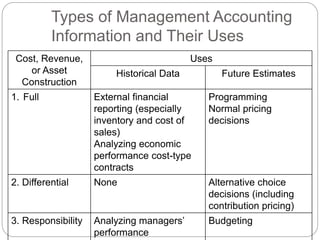
Types of Management Accounting
Information and Their Uses
Cost, Revenue,
or Asset
Construction
Uses
Historical Data Future Estimates
1. Full External financial
reporting (especially
inventory and cost of
sales)
Analyzing economic
performance cost-type
contracts
Programming
Normal pricing
decisions
2. Differential None Alternative choice
decisions (including
contribution pricing)
3. Responsibility Analyzing managers’
performance
Budgeting
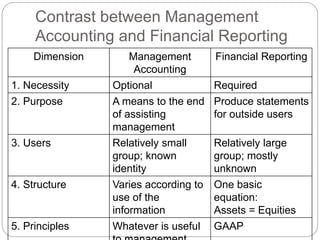
Contrast between Management
Accounting and Financial Reporting
Dimension Management
Accounting
Financial Reporting
1. Necessity Optional Required
2. Purpose A means to the end
of assisting
management
Produce statements
for outside users
3. Users Relatively small
group; known
identity
Relatively large
group; mostly
unknown
4. Structure Varies according to
use of the
information
One basic
equation:
Assets = Equities
5. Principles Whatever is useful GAAP
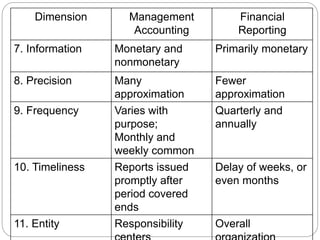
Dimension Management
Accounting
Financial
Reporting
7. Information Monetary and
nonmonetary
Primarily monetary
8. Precision Many
approximation
Fewer
approximation
9. Frequency Varies with
purpose;
Monthly and
weekly common
Quarterly and
annually
10. Timeliness Reports issued
promptly after
period covered
ends
Delay of weeks, or
even months
11. Entity Responsibility Overall
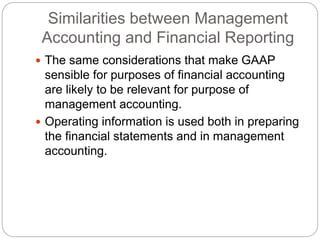
Similarities between Management
Accounting and Financial Reporting
 The same considerations that make GAAP
sensible for purposes of financial accounting
are likely to be relevant for purpose of
management accounting.
 Operating information is used both in preparing
the financial statements and in management
accounting.
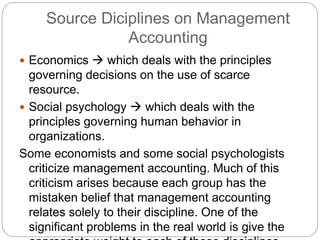
Source Diciplines on Management
Accounting
 Economics  which deals with the principles
governing decisions on the use of scarce
resource.
 Social psychology  which deals with the
principles governing human behavior in
organizations.
Some economists and some social psychologists
criticize management accounting. Much of this
criticism arises because each group has the
mistaken belief that management accounting
relates solely to their discipline. One of the
significant problems in the real world is give the
Uses of Management
Accounting
1. Measurement of revenues, costs, and
assets.
2. Control.
3. To aid in choosing among alternative
courses of action.
Measurement
 Full cost accounting measures the resources
used in performing some activity.
 Full cost of producing goods or providing
services = direct costs + indirect costs.
 Direct costs = costs directly traced to the
goods or services.
 Indirect costs = a fair share of costs incurred
jointly in producing goods or services.
Control
Costs (also, revenues and assets) are
identified to and measured by responsibility
center.
 A manager heads each responsibility center.
 Corrective action can only be taken by
individuals.
 To help identify problems (and opportunities)
actual costs are measured and compared to
a benchmark (budget, last year, industry
average).
Alternative Choice Decisions
 Differential costs of alternative possible actions
are developed.
Some General Observations
 Different numbers for different purposes:
Many different types of costs: historical,
standard, overhead, variable, fixed, differential,
marginal, opportunity, direct, estimated, full, etc.
 Clarify which type you are talking about.
 Accounting numbers are approximations
 Working with incomplete data
 Accounting evidence is only partial evidence
 People, not numbers, get things done. How you
use the numbers is as important as how the
numbers are produced.
Different numbers for different
purposes
 Each of the several purposes previously described requires a
different accounting approach. Since these different numbers may
superficially resemble one another, a person not familiar with them
may easily get confused. One of the most common sources of
confusion is the word cost. Cost could be defined as "... Everything
a manager does, as well as many of the things he does not do."
Cost is a synonym of sacrifice and as such, controlling it and
reducing it is a great concern for managers. In management
accounting, there are historical costs, standard costs, overhead
costs, variable costs, fixed costs, differential costs, marginal costs,
opportunity costs, direct costs, estimated costs, full costs, among
others. Some of these are synonyms; others are not quite
synonyms; still others, although not synonyms at all, are used by
some people as if they were. Accounting numbers should always
be interpreted within the context of the specific problem they are
Accounting numbers are
approximations
 Users of accounting information must acquire an
understanding of the degree of approximation
present in the data. Some accounting numbers
(such as the amount of cash in the bank account)
may be accurate within very narrow limits,
whereas others are only rough approximations.
The degree of approximation is especially high in
the case of numbers used for planning purposes,
because they are always estimates of what will
happen in the future.
Working with incomplete data
 In a management problem, we almost never have
exactly the information we would like to have. The
person struggling with the problem usually can
think of additional information that, if available,
would be helpful. There are many decision-making
situations in which pages of numbers are available
but only a small portion of them is truly relevant to
the problem at hand and perhaps none of them is
quite what one needs in order to solve it. The
problem must be solved, it is a fact of life.
 Management decisions must be made and often
cannot be delayed until all pertinent information is
available. We do the best we can with what we
have and then move on to the next problem. On
the other hand, a decision should not be made if a
vital, obtainable piece of evidence is missing.
Deciding whether or not to act on the available
evidence is one of the most difficult parts of
managerial decision processes. "The art of
business is the art of making irrevocable decisions
on the basis of inadequate information" Wallace B.
Donham.
Accounting evidence is only
partial evidence
 Few, if any, management problems can be solved solely by
collecting and analyzing numbers. Usually, there are important
factors that cannot be, or have not been, reduced to
quantitative terms. Some people act as if most problems could
be solved by means of a numerical analysis. At the other
extreme are those who believe that intuition is the sure guide
to a sound decision and therefore pay no attention to
numbers. Although the correct attitude is clearly somewhere
between those extremes, there is no way to describe precisely
where it is. "The real trouble with this world of ours is not that
it is an unreasonable world, nor even that is a reasonable one.
The commonest kind of trouble is that it is nearly reasonable,
but not quite. Life is nor an illogicality; yet it is a trap for
logicians. It looks just a little more mathematical and regular
People, not numbers, get
things done
 An obvious statement about organizations is that
they consist of human beings. Anything that an
organization accomplishes is the result of human
actions. Although numbers can assist the people in
an organization in various ways, the numbers by
themselves accomplish nothing. But numbers do not
talk back; they give the appearance of being
definitive and precise. It is a comforting illusion to
imagine that the construction of a set of numbers is
the same as acting on a real problem. A
management accounting system may be well
designed and carefully operated, but it will be of no
 For instance three companies may use exactly the
same system with entirely different results. - In the
first company, the system may be useless because
management never acts based on the information
collected and the organization has become aware if
this fact. - In the second company the system may
be helpful because management uses the
information as a general guide for planning,
implementation and, control and has educated the
organization to use it in the same spirit. - In the
third company, the system may be even worse than
useless. It may be damaging because management

Basic management accounting concepts

  • 1.
    By: Kartika AjiLukitasari (135020201111085) Basic Management Accounting Concepts
  • 2.
    Management Accounting asOne Type of Information  Accounting is one type of information. The total amount of information available to a manager include both monetary, but includes related nonmonetary data.  Most accounting information, in terms of quantity of data, is operating information. The mass of operating data flowing through an organization consist of streams of information about production, purchasing and materials, payroll, plant and equipment, sales and accounts receivable, and finance. Data in these streams provide the raw materials for financial statements. These
  • 3.
     Management accountingis the process within an organization that provides information used by an organization’s managers in planning, coordinating, and controlling the organization’s activities.  Management accounting information is summary information. In order to understand it, one needs to know something about the source of raw data used for summaries, but only enough to be able to understand the result summaries.
  • 4.
    Types of ManagementAccounting Information and Their Uses Cost, Revenue, or Asset Construction Uses Historical Data Future Estimates 1. Full External financial reporting (especially inventory and cost of sales) Analyzing economic performance cost-type contracts Programming Normal pricing decisions 2. Differential None Alternative choice decisions (including contribution pricing) 3. Responsibility Analyzing managers’ performance Budgeting
  • 5.
    Contrast between Management Accountingand Financial Reporting Dimension Management Accounting Financial Reporting 1. Necessity Optional Required 2. Purpose A means to the end of assisting management Produce statements for outside users 3. Users Relatively small group; known identity Relatively large group; mostly unknown 4. Structure Varies according to use of the information One basic equation: Assets = Equities 5. Principles Whatever is useful GAAP
  • 6.
    Dimension Management Accounting Financial Reporting 7. InformationMonetary and nonmonetary Primarily monetary 8. Precision Many approximation Fewer approximation 9. Frequency Varies with purpose; Monthly and weekly common Quarterly and annually 10. Timeliness Reports issued promptly after period covered ends Delay of weeks, or even months 11. Entity Responsibility Overall
  • 7.
    Similarities between Management Accountingand Financial Reporting  The same considerations that make GAAP sensible for purposes of financial accounting are likely to be relevant for purpose of management accounting.  Operating information is used both in preparing the financial statements and in management accounting.
  • 8.
    Source Diciplines onManagement Accounting  Economics  which deals with the principles governing decisions on the use of scarce resource.  Social psychology  which deals with the principles governing human behavior in organizations. Some economists and some social psychologists criticize management accounting. Much of this criticism arises because each group has the mistaken belief that management accounting relates solely to their discipline. One of the significant problems in the real world is give the
  • 9.
    Uses of Management Accounting 1.Measurement of revenues, costs, and assets. 2. Control. 3. To aid in choosing among alternative courses of action.
  • 10.
    Measurement  Full costaccounting measures the resources used in performing some activity.  Full cost of producing goods or providing services = direct costs + indirect costs.  Direct costs = costs directly traced to the goods or services.  Indirect costs = a fair share of costs incurred jointly in producing goods or services.
  • 11.
    Control Costs (also, revenuesand assets) are identified to and measured by responsibility center.  A manager heads each responsibility center.  Corrective action can only be taken by individuals.  To help identify problems (and opportunities) actual costs are measured and compared to a benchmark (budget, last year, industry average).
  • 12.
    Alternative Choice Decisions Differential costs of alternative possible actions are developed.
  • 13.
    Some General Observations Different numbers for different purposes: Many different types of costs: historical, standard, overhead, variable, fixed, differential, marginal, opportunity, direct, estimated, full, etc.  Clarify which type you are talking about.  Accounting numbers are approximations  Working with incomplete data  Accounting evidence is only partial evidence  People, not numbers, get things done. How you use the numbers is as important as how the numbers are produced.
  • 14.
    Different numbers fordifferent purposes  Each of the several purposes previously described requires a different accounting approach. Since these different numbers may superficially resemble one another, a person not familiar with them may easily get confused. One of the most common sources of confusion is the word cost. Cost could be defined as "... Everything a manager does, as well as many of the things he does not do." Cost is a synonym of sacrifice and as such, controlling it and reducing it is a great concern for managers. In management accounting, there are historical costs, standard costs, overhead costs, variable costs, fixed costs, differential costs, marginal costs, opportunity costs, direct costs, estimated costs, full costs, among others. Some of these are synonyms; others are not quite synonyms; still others, although not synonyms at all, are used by some people as if they were. Accounting numbers should always be interpreted within the context of the specific problem they are
  • 15.
    Accounting numbers are approximations Users of accounting information must acquire an understanding of the degree of approximation present in the data. Some accounting numbers (such as the amount of cash in the bank account) may be accurate within very narrow limits, whereas others are only rough approximations. The degree of approximation is especially high in the case of numbers used for planning purposes, because they are always estimates of what will happen in the future.
  • 16.
    Working with incompletedata  In a management problem, we almost never have exactly the information we would like to have. The person struggling with the problem usually can think of additional information that, if available, would be helpful. There are many decision-making situations in which pages of numbers are available but only a small portion of them is truly relevant to the problem at hand and perhaps none of them is quite what one needs in order to solve it. The problem must be solved, it is a fact of life.
  • 17.
     Management decisionsmust be made and often cannot be delayed until all pertinent information is available. We do the best we can with what we have and then move on to the next problem. On the other hand, a decision should not be made if a vital, obtainable piece of evidence is missing. Deciding whether or not to act on the available evidence is one of the most difficult parts of managerial decision processes. "The art of business is the art of making irrevocable decisions on the basis of inadequate information" Wallace B. Donham.
  • 18.
    Accounting evidence isonly partial evidence  Few, if any, management problems can be solved solely by collecting and analyzing numbers. Usually, there are important factors that cannot be, or have not been, reduced to quantitative terms. Some people act as if most problems could be solved by means of a numerical analysis. At the other extreme are those who believe that intuition is the sure guide to a sound decision and therefore pay no attention to numbers. Although the correct attitude is clearly somewhere between those extremes, there is no way to describe precisely where it is. "The real trouble with this world of ours is not that it is an unreasonable world, nor even that is a reasonable one. The commonest kind of trouble is that it is nearly reasonable, but not quite. Life is nor an illogicality; yet it is a trap for logicians. It looks just a little more mathematical and regular
  • 19.
    People, not numbers,get things done  An obvious statement about organizations is that they consist of human beings. Anything that an organization accomplishes is the result of human actions. Although numbers can assist the people in an organization in various ways, the numbers by themselves accomplish nothing. But numbers do not talk back; they give the appearance of being definitive and precise. It is a comforting illusion to imagine that the construction of a set of numbers is the same as acting on a real problem. A management accounting system may be well designed and carefully operated, but it will be of no
  • 20.
     For instancethree companies may use exactly the same system with entirely different results. - In the first company, the system may be useless because management never acts based on the information collected and the organization has become aware if this fact. - In the second company the system may be helpful because management uses the information as a general guide for planning, implementation and, control and has educated the organization to use it in the same spirit. - In the third company, the system may be even worse than useless. It may be damaging because management