Basic Infection Control & Prevention :
Hand Hygiene and PPE
30 March 2020
Ong Poh Ling
Nurse Clinician
All rights reserved by Khoo Teck Puat Hospital. No part
of this document may be modified, copied, transferred,
and reproduced in any form, without prior written
permission from Khoo Teck Puat Hospital.
Outline
 The importance of hand hygiene
 Transmission Precautions
 PPE donning and doffing
 NH residents and visitors’ Education on personal
hygiene
 Q&A
Hand Washing is the
MOST IMPORTANT
measure to reduce cross
infection
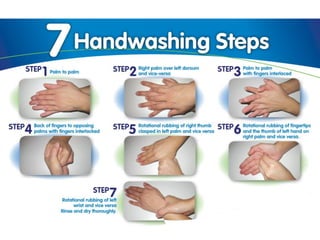
Hand Washing
(60sec)
Alcohol-based Hand Rub
(30sec)
Hand Hygiene
Hand Hygiene
1. Before touching a patient
2. Before clean/aseptic
procedures
3. After body fluid
exposure/risk
4. After touching a patient
5. After touching patient
surroundings
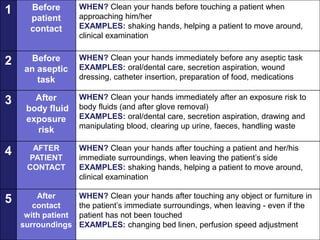
1 Before
patient
contact
WHEN? Clean your hands before touching a patient when
approaching him/her
EXAMPLES: shaking hands, helping a patient to move around,
clinical examination
2 Before
an aseptic
task
WHEN? Clean your hands immediately before any aseptic task
EXAMPLES: oral/dental care, secretion aspiration, wound
dressing, catheter insertion, preparation of food, medications
3 After
body fluid
exposure
risk
WHEN? Clean your hands immediately after an exposure risk to
body fluids (and after glove removal)
EXAMPLES: oral/dental care, secretion aspiration, drawing and
manipulating blood, clearing up urine, faeces, handling waste
4 AFTER
PATIENT
CONTACT
WHEN? Clean your hands after touching a patient and her/his
immediate surroundings, when leaving the patient’s side
EXAMPLES: shaking hands, helping a patient to move around,
clinical examination
5 After
contact
with patient
surroundings
WHEN? Clean your hands after touching any object or furniture in
the patient’s immediate surroundings, when leaving - even if the
patient has not been touched
EXAMPLES: changing bed linen, perfusion speed adjustment
Mask
 Wear appropriate mask
when caring
/approaching patients on
droplet or airborne
precaution
 Ensure your nose and
mouth are covered
Surgical
Mask for
Droplet
Precaution
N95 Particle
Mask for
Airborne
Precaution
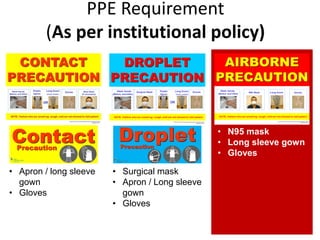
PPE Requirement
(As per institutional policy)
• Apron / long sleeve
gown
• Gloves
• N95 mask
• Long sleeve gown
• Gloves
• Surgical mask
• Apron / Long sleeve
gown
• Gloves
Gloves
 Wear gloves when coming in contact with
blood, body fluid and mucous membrane
 Change gloves between patients
 Discard gloves after procedure
 WASH HANDS after removal!
Clostridium difficile * ESBL
We are literally working side-by-side with them. Welcome to the reality of working
and staying in the hospital!
VRE * Multidrug resistant Organisms (MDRO).*
Infection Control:
It’s Everyone’s
Business
Education for residents
• Personal hygiene
• Wear surgical mask if unwell
Education for visitors
• Personal hygiene
• Hand hygiene before and after
visiting
• Do not visit if unwell
Case scenario 1
• Bed 6 patient had test MRSA
Urine (Catheterized) positive.
• What PPE to don?
??
Case scenario 2
• Bed 10 patient tested Clostridium
Difficile positive
• What PPE to don?
• Single room?
• Hand hygiene (Handwashing or
alcohol handrub??)
• As per institutional policy
??
Thank
You
Basic infection control prevention 30 march 2020

Basic infection control prevention 30 march 2020

  • 1.
    Basic Infection Control& Prevention : Hand Hygiene and PPE 30 March 2020 Ong Poh Ling Nurse Clinician
  • 2.
    All rights reservedby Khoo Teck Puat Hospital. No part of this document may be modified, copied, transferred, and reproduced in any form, without prior written permission from Khoo Teck Puat Hospital.
  • 3.
    Outline  The importanceof hand hygiene  Transmission Precautions  PPE donning and doffing  NH residents and visitors’ Education on personal hygiene  Q&A
  • 4.
    Hand Washing isthe MOST IMPORTANT measure to reduce cross infection
  • 6.
  • 7.
    Hand Hygiene 1. Beforetouching a patient 2. Before clean/aseptic procedures 3. After body fluid exposure/risk 4. After touching a patient 5. After touching patient surroundings
  • 8.
    1 Before patient contact WHEN? Cleanyour hands before touching a patient when approaching him/her EXAMPLES: shaking hands, helping a patient to move around, clinical examination 2 Before an aseptic task WHEN? Clean your hands immediately before any aseptic task EXAMPLES: oral/dental care, secretion aspiration, wound dressing, catheter insertion, preparation of food, medications 3 After body fluid exposure risk WHEN? Clean your hands immediately after an exposure risk to body fluids (and after glove removal) EXAMPLES: oral/dental care, secretion aspiration, drawing and manipulating blood, clearing up urine, faeces, handling waste 4 AFTER PATIENT CONTACT WHEN? Clean your hands after touching a patient and her/his immediate surroundings, when leaving the patient’s side EXAMPLES: shaking hands, helping a patient to move around, clinical examination 5 After contact with patient surroundings WHEN? Clean your hands after touching any object or furniture in the patient’s immediate surroundings, when leaving - even if the patient has not been touched EXAMPLES: changing bed linen, perfusion speed adjustment
  • 9.
    Mask  Wear appropriatemask when caring /approaching patients on droplet or airborne precaution  Ensure your nose and mouth are covered Surgical Mask for Droplet Precaution N95 Particle Mask for Airborne Precaution
  • 10.
    PPE Requirement (As perinstitutional policy) • Apron / long sleeve gown • Gloves • N95 mask • Long sleeve gown • Gloves • Surgical mask • Apron / Long sleeve gown • Gloves
  • 11.
    Gloves  Wear gloveswhen coming in contact with blood, body fluid and mucous membrane  Change gloves between patients  Discard gloves after procedure  WASH HANDS after removal!
  • 12.
    Clostridium difficile *ESBL We are literally working side-by-side with them. Welcome to the reality of working and staying in the hospital! VRE * Multidrug resistant Organisms (MDRO).*
  • 13.
  • 14.
    Education for residents •Personal hygiene • Wear surgical mask if unwell
  • 15.
    Education for visitors •Personal hygiene • Hand hygiene before and after visiting • Do not visit if unwell
  • 16.
    Case scenario 1 •Bed 6 patient had test MRSA Urine (Catheterized) positive. • What PPE to don? ??
  • 17.
    Case scenario 2 •Bed 10 patient tested Clostridium Difficile positive • What PPE to don? • Single room? • Hand hygiene (Handwashing or alcohol handrub??) • As per institutional policy ??
  • 18.