Don’t Let the SORES grow on them
Wound Management
Orange Valley Nursing Home
(Marsiling)
CONFIDENTIAL
• Pressure Ulcer or Pressure Injury is defined as an area of
localized damage to the skin, muscle, and/or unrelieved
pressure, usually over bony prominences and an external
surface for a prolonged period of time (MOH, 2001).
• It is common among elderly patients who have reduced
activity or become immobile.
• It can present a serious health problem if it becomes infected
or reach an advanced stage.
• Preventing pressure injury requires care and attention and
recognizing the signs is very important.
November 18
2
What is pressure ulcer?
© 2014 Orange Valley Nursing Homes Pte Ltd
CONFIDENTIALNovember 18
3
What is pressure ulcer?
© 2014 Orange Valley Nursing Homes Pte Ltd
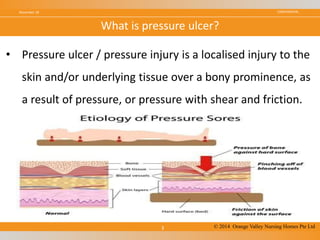
• Pressure ulcer / pressure injury is a localised injury to the
skin and/or underlying tissue over a bony prominence, as
a result of pressure, or pressure with shear and friction.
CONFIDENTIALNovember 18
4
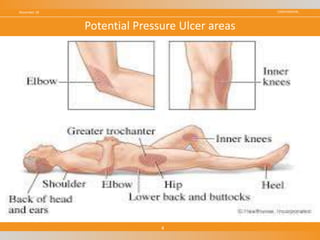
Potential Pressure Ulcer areas
CONFIDENTIALNovember 18
5
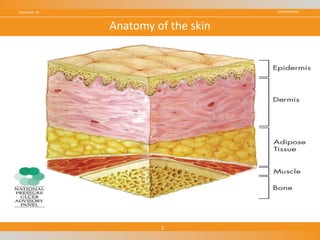
Anatomy of the skin
CONFIDENTIAL
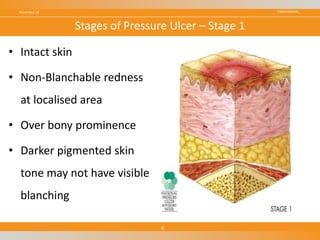
• Intact skin
• Non-Blanchable redness
at localised area
• Over bony prominence
• Darker pigmented skin
tone may not have visible
blanching
November 18
6
Stages of Pressure Ulcer – Stage 1
CONFIDENTIAL
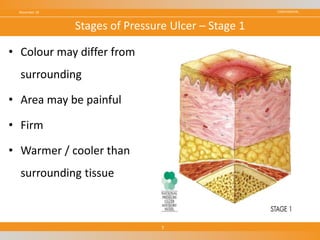
• Colour may differ from
surrounding
• Area may be painful
• Firm
• Warmer / cooler than
surrounding tissue
November 18
7
Stages of Pressure Ulcer – Stage 1
CONFIDENTIALNovember 18
8
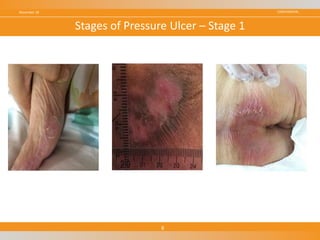
Stages of Pressure Ulcer – Stage 1
CONFIDENTIAL
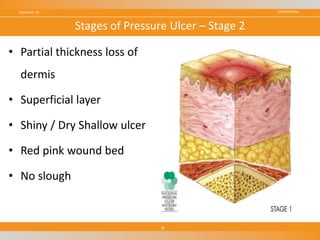
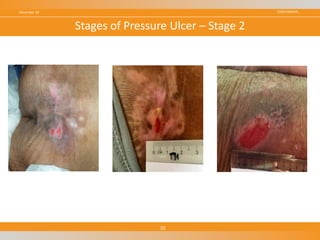
• Partial thickness loss of
dermis
• Superficial layer
• Shiny / Dry Shallow ulcer
• Red pink wound bed
• No slough
November 18
9
Stages of Pressure Ulcer – Stage 2
CONFIDENTIALNovember 18
10
Stages of Pressure Ulcer – Stage 2
CONFIDENTIAL
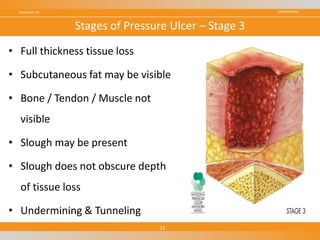
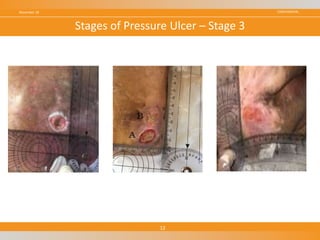
• Full thickness tissue loss
• Subcutaneous fat may be visible
• Bone / Tendon / Muscle not
visible
• Slough may be present
• Slough does not obscure depth
of tissue loss
• Undermining & Tunneling
November 18
11
Stages of Pressure Ulcer – Stage 3
CONFIDENTIALNovember 18
12
Stages of Pressure Ulcer – Stage 3
CONFIDENTIAL
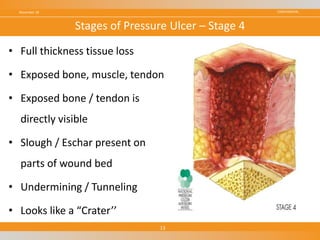
• Full thickness tissue loss
• Exposed bone, muscle, tendon
• Exposed bone / tendon is
directly visible
• Slough / Eschar present on
parts of wound bed
• Undermining / Tunneling
• Looks like a “Crater’’
November 18
13
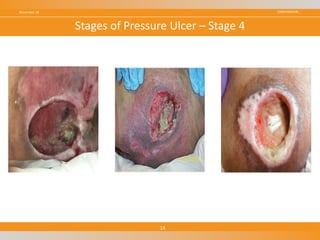
Stages of Pressure Ulcer – Stage 4
CONFIDENTIALNovember 18
14
Stages of Pressure Ulcer – Stage 4
CONFIDENTIAL
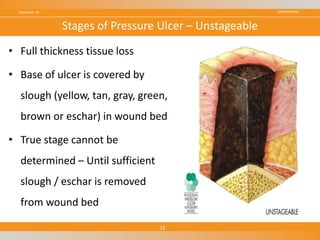
• Full thickness tissue loss
• Base of ulcer is covered by
slough (yellow, tan, gray, green,
brown or eschar) in wound bed
• True stage cannot be
determined – Until sufficient
slough / eschar is removed
from wound bed
November 18
15
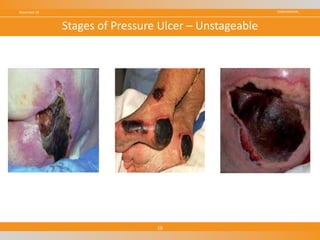
Stages of Pressure Ulcer – Unstageable
CONFIDENTIALNovember 18
16
Stages of Pressure Ulcer – Unstageable
CONFIDENTIALNovember 18
17
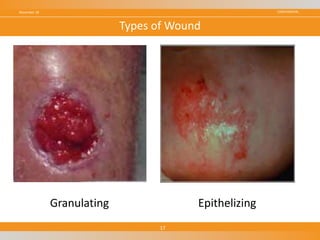
Types of Wound
Granulating Epithelizing
CONFIDENTIALNovember 18
18
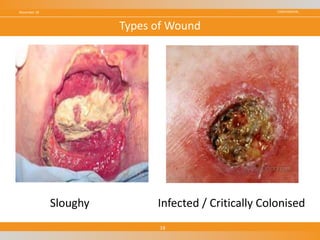
Types of Wound
Sloughy Infected / Critically Colonised
CONFIDENTIALNovember 18
19
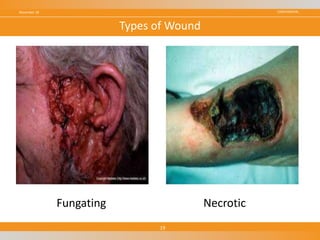
Types of Wound
Fungating Necrotic
CONFIDENTIAL
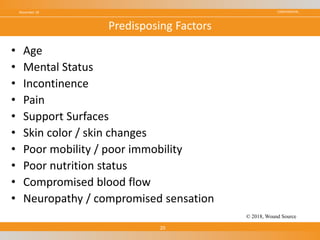
• Age
• Mental Status
• Incontinence
• Pain
• Support Surfaces
• Skin color / skin changes
• Poor mobility / poor immobility
• Poor nutrition status
• Compromised blood flow
• Neuropathy / compromised sensation
November 18
20
Predisposing Factors
© 2018, Wound Source
CONFIDENTIAL
• Mr. A, 94 years old, male, was admitted to Orange Valley
Nursing Home in Marsiling on June 2018
• Ex-smoker, bedbound, uncommunicative, NGT
• Past Medical History:
- Hypertension
- Old lacunar infarcts
- Abdominal aortic and bilateral artery aneurysm
- Metastatic prostate cancer
- Mild dementia
November 18
21
Case Study 1
CONFIDENTIAL
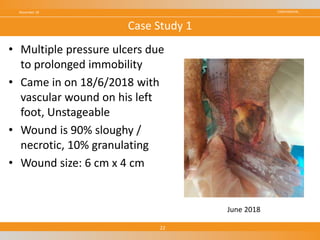
• Multiple pressure ulcers due
to prolonged immobility
• Came in on 18/6/2018 with
vascular wound on his left
foot, Unstageable
• Wound is 90% sloughy /
necrotic, 10% granulating
• Wound size: 6 cm x 4 cm
November 18
22
Case Study 1
June 2018
CONFIDENTIALNovember 18
23
Case Study 1
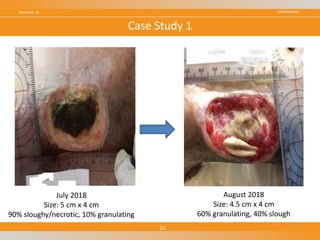
July 2018
Size: 5 cm x 4 cm
90% sloughy/necrotic, 10% granulating
August 2018
Size: 4.5 cm x 4 cm
60% granulating, 40% slough
CONFIDENTIALNovember 18
24
Case Study 1
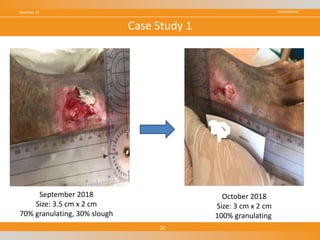
September 2018
Size: 3.5 cm x 2 cm
70% granulating, 30% slough
October 2018
Size: 3 cm x 2 cm
100% granulating
CONFIDENTIALNovember 18
25
Case Study 1
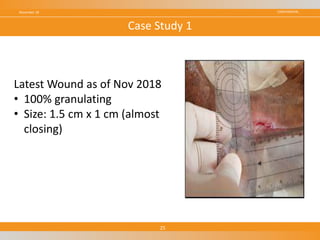
Latest Wound as of Nov 2018
• 100% granulating
• Size: 1.5 cm x 1 cm (almost
closing)
CONFIDENTIAL
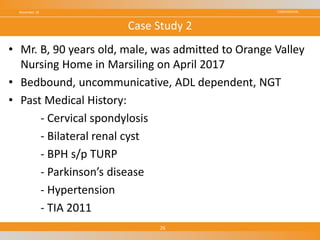
• Mr. B, 90 years old, male, was admitted to Orange Valley
Nursing Home in Marsiling on April 2017
• Bedbound, uncommunicative, ADL dependent, NGT
• Past Medical History:
- Cervical spondylosis
- Bilateral renal cyst
- BPH s/p TURP
- Parkinson’s disease
- Hypertension
- TIA 2011
November 18
26
Case Study 2
CONFIDENTIAL
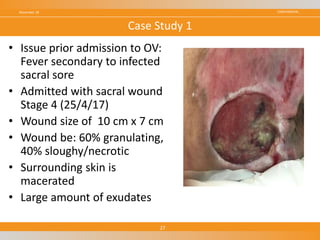
• Issue prior admission to OV:
Fever secondary to infected
sacral sore
• Admitted with sacral wound
Stage 4 (25/4/17)
• Wound size of 10 cm x 7 cm
• Wound be: 60% granulating,
40% sloughy/necrotic
• Surrounding skin is
macerated
• Large amount of exudates
November 18
27
Case Study 1
CONFIDENTIALNovember 18
28
Case Study 2
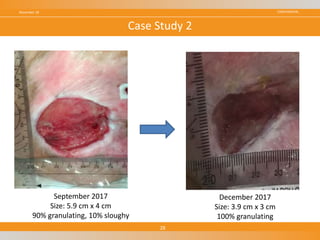
September 2017
Size: 5.9 cm x 4 cm
90% granulating, 10% sloughy
December 2017
Size: 3.9 cm x 3 cm
100% granulating
CONFIDENTIALNovember 18
29
Case Study 2
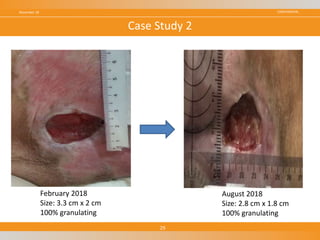
February 2018
Size: 3.3 cm x 2 cm
100% granulating
August 2018
Size: 2.8 cm x 1.8 cm
100% granulating
CONFIDENTIALNovember 18
30
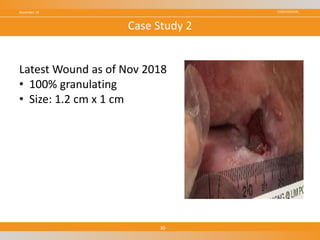
Case Study 2
Latest Wound as of Nov 2018
• 100% granulating
• Size: 1.2 cm x 1 cm
CONFIDENTIAL
• Braden scale assessment upon admission and at regular
intervals
• Daily skin assessment / inspection to all residents.
 Usage of topical moisturiser / barrier cream
 Improve activity or mobility status
 Cleanse skin at time of soiling
 Hourly – two hourly changing of position
 Basic range of motion exercise on bedbound
 Provide pressure relieving mattress for at risks
November 18
31
Pressure Ulcer Prevention and Management
CONFIDENTIAL
• Photo taking of all wounds
during admission and or when noted with early
signs of developing pressure injury.
• Wound rounds were conducted by wound team to
assess the wounds on each level – focusing from
complex and infected wounds to simple wounds.
• Daily wound measurement every after wound dressing.
• Diligent review and documentation on wound progress.
• Monthly discussion by branch wound team on all
wounds and residents at risk.
November 18
32
Pressure Ulcer Prevention and Management
CONFIDENTIAL
• Multi-disciplinary approach on wound management:
 Referral to dietician to improve nutritional status –
monthly or more frequent review by RD.
 Referral to doctor on any skin abnormalities and or
changes on wounds for further intervention – close
follow up on identified cases.
 Referral to PT for mobility interventions.
• Staff education and training – competency on proper
assessment and monitoring of wounds, wound dressing
• Education for residents and their family members.
November 18
33
Pressure Ulcer Prevention and Management
Thank You!

Wound Management

  • 1.
    Don’t Let theSORES grow on them Wound Management Orange Valley Nursing Home (Marsiling)
  • 2.
    CONFIDENTIAL • Pressure Ulceror Pressure Injury is defined as an area of localized damage to the skin, muscle, and/or unrelieved pressure, usually over bony prominences and an external surface for a prolonged period of time (MOH, 2001). • It is common among elderly patients who have reduced activity or become immobile. • It can present a serious health problem if it becomes infected or reach an advanced stage. • Preventing pressure injury requires care and attention and recognizing the signs is very important. November 18 2 What is pressure ulcer? © 2014 Orange Valley Nursing Homes Pte Ltd
  • 3.
    CONFIDENTIALNovember 18 3 What ispressure ulcer? © 2014 Orange Valley Nursing Homes Pte Ltd • Pressure ulcer / pressure injury is a localised injury to the skin and/or underlying tissue over a bony prominence, as a result of pressure, or pressure with shear and friction.
  • 4.
  • 5.
  • 6.
    CONFIDENTIAL • Intact skin •Non-Blanchable redness at localised area • Over bony prominence • Darker pigmented skin tone may not have visible blanching November 18 6 Stages of Pressure Ulcer – Stage 1
  • 7.
    CONFIDENTIAL • Colour maydiffer from surrounding • Area may be painful • Firm • Warmer / cooler than surrounding tissue November 18 7 Stages of Pressure Ulcer – Stage 1
  • 8.
    CONFIDENTIALNovember 18 8 Stages ofPressure Ulcer – Stage 1
  • 9.
    CONFIDENTIAL • Partial thicknessloss of dermis • Superficial layer • Shiny / Dry Shallow ulcer • Red pink wound bed • No slough November 18 9 Stages of Pressure Ulcer – Stage 2
  • 10.
    CONFIDENTIALNovember 18 10 Stages ofPressure Ulcer – Stage 2
  • 11.
    CONFIDENTIAL • Full thicknesstissue loss • Subcutaneous fat may be visible • Bone / Tendon / Muscle not visible • Slough may be present • Slough does not obscure depth of tissue loss • Undermining & Tunneling November 18 11 Stages of Pressure Ulcer – Stage 3
  • 12.
    CONFIDENTIALNovember 18 12 Stages ofPressure Ulcer – Stage 3
  • 13.
    CONFIDENTIAL • Full thicknesstissue loss • Exposed bone, muscle, tendon • Exposed bone / tendon is directly visible • Slough / Eschar present on parts of wound bed • Undermining / Tunneling • Looks like a “Crater’’ November 18 13 Stages of Pressure Ulcer – Stage 4
  • 14.
    CONFIDENTIALNovember 18 14 Stages ofPressure Ulcer – Stage 4
  • 15.
    CONFIDENTIAL • Full thicknesstissue loss • Base of ulcer is covered by slough (yellow, tan, gray, green, brown or eschar) in wound bed • True stage cannot be determined – Until sufficient slough / eschar is removed from wound bed November 18 15 Stages of Pressure Ulcer – Unstageable
  • 16.
    CONFIDENTIALNovember 18 16 Stages ofPressure Ulcer – Unstageable
  • 17.
    CONFIDENTIALNovember 18 17 Types ofWound Granulating Epithelizing
  • 18.
    CONFIDENTIALNovember 18 18 Types ofWound Sloughy Infected / Critically Colonised
  • 19.
    CONFIDENTIALNovember 18 19 Types ofWound Fungating Necrotic
  • 20.
    CONFIDENTIAL • Age • MentalStatus • Incontinence • Pain • Support Surfaces • Skin color / skin changes • Poor mobility / poor immobility • Poor nutrition status • Compromised blood flow • Neuropathy / compromised sensation November 18 20 Predisposing Factors © 2018, Wound Source
  • 21.
    CONFIDENTIAL • Mr. A,94 years old, male, was admitted to Orange Valley Nursing Home in Marsiling on June 2018 • Ex-smoker, bedbound, uncommunicative, NGT • Past Medical History: - Hypertension - Old lacunar infarcts - Abdominal aortic and bilateral artery aneurysm - Metastatic prostate cancer - Mild dementia November 18 21 Case Study 1
  • 22.
    CONFIDENTIAL • Multiple pressureulcers due to prolonged immobility • Came in on 18/6/2018 with vascular wound on his left foot, Unstageable • Wound is 90% sloughy / necrotic, 10% granulating • Wound size: 6 cm x 4 cm November 18 22 Case Study 1 June 2018
  • 23.
    CONFIDENTIALNovember 18 23 Case Study1 July 2018 Size: 5 cm x 4 cm 90% sloughy/necrotic, 10% granulating August 2018 Size: 4.5 cm x 4 cm 60% granulating, 40% slough
  • 24.
    CONFIDENTIALNovember 18 24 Case Study1 September 2018 Size: 3.5 cm x 2 cm 70% granulating, 30% slough October 2018 Size: 3 cm x 2 cm 100% granulating
  • 25.
    CONFIDENTIALNovember 18 25 Case Study1 Latest Wound as of Nov 2018 • 100% granulating • Size: 1.5 cm x 1 cm (almost closing)
  • 26.
    CONFIDENTIAL • Mr. B,90 years old, male, was admitted to Orange Valley Nursing Home in Marsiling on April 2017 • Bedbound, uncommunicative, ADL dependent, NGT • Past Medical History: - Cervical spondylosis - Bilateral renal cyst - BPH s/p TURP - Parkinson’s disease - Hypertension - TIA 2011 November 18 26 Case Study 2
  • 27.
    CONFIDENTIAL • Issue prioradmission to OV: Fever secondary to infected sacral sore • Admitted with sacral wound Stage 4 (25/4/17) • Wound size of 10 cm x 7 cm • Wound be: 60% granulating, 40% sloughy/necrotic • Surrounding skin is macerated • Large amount of exudates November 18 27 Case Study 1
  • 28.
    CONFIDENTIALNovember 18 28 Case Study2 September 2017 Size: 5.9 cm x 4 cm 90% granulating, 10% sloughy December 2017 Size: 3.9 cm x 3 cm 100% granulating
  • 29.
    CONFIDENTIALNovember 18 29 Case Study2 February 2018 Size: 3.3 cm x 2 cm 100% granulating August 2018 Size: 2.8 cm x 1.8 cm 100% granulating
  • 30.
    CONFIDENTIALNovember 18 30 Case Study2 Latest Wound as of Nov 2018 • 100% granulating • Size: 1.2 cm x 1 cm
  • 31.
    CONFIDENTIAL • Braden scaleassessment upon admission and at regular intervals • Daily skin assessment / inspection to all residents.  Usage of topical moisturiser / barrier cream  Improve activity or mobility status  Cleanse skin at time of soiling  Hourly – two hourly changing of position  Basic range of motion exercise on bedbound  Provide pressure relieving mattress for at risks November 18 31 Pressure Ulcer Prevention and Management
  • 32.
    CONFIDENTIAL • Photo takingof all wounds during admission and or when noted with early signs of developing pressure injury. • Wound rounds were conducted by wound team to assess the wounds on each level – focusing from complex and infected wounds to simple wounds. • Daily wound measurement every after wound dressing. • Diligent review and documentation on wound progress. • Monthly discussion by branch wound team on all wounds and residents at risk. November 18 32 Pressure Ulcer Prevention and Management
  • 33.
    CONFIDENTIAL • Multi-disciplinary approachon wound management:  Referral to dietician to improve nutritional status – monthly or more frequent review by RD.  Referral to doctor on any skin abnormalities and or changes on wounds for further intervention – close follow up on identified cases.  Referral to PT for mobility interventions. • Staff education and training – competency on proper assessment and monitoring of wounds, wound dressing • Education for residents and their family members. November 18 33 Pressure Ulcer Prevention and Management
  • 34.