1
Infection prevention and Patient
safety
By Mesfin D.
2
Introduction to Infection Prevention and Patient
safety
At the end of this chapter, you will be able to;
Define infection prevention
Describe the goal of infection prevention and patient
safety
Describe the magnitude of nosocomial infection
Explain how to stop the spread of disease at each part
of transmission cycle
Recognize the level of risk of infection at health care
facilities
Describe the role of IP and PS in reducing the level of
risk
3
• Describe the steps of processing instrument
• Define decontamination
• Explain the rationale for decontamination before cleaning
• Demonstrate how to prepare chlorine solution for
decontamination
• Demonstrate how to decontaminate soiled instruments
and other items
4
Why Infection Prevention/patient Safety ?
 To protect patients (nosocomial infections)
To protect the healthcare workers (occupational
hazard/employee health)
To protect visitors
To protect students
To protect communities and environment
The goal of Infection Prevention and Patient Safety
is to make healthcare facilities a safer place.
5
Definition of terms
Microorganisms are the causative agents of
infection: Bacteria, Fungi or Parasites
Colonization is the presence and
multiplication of a microorganisms without
tissue invasion or damage
Infection means that the colonizing organisms
are now causing Cellular response
Infection prevention -prevent the spread
of infection B/n the susceptible host & MO
by using d/t techniques.
6
• Depends on placing protective barriers
(physical, chemical, or mechanical) between a
susceptible host (person lacking immunity)
and the organisms.
7
Nosocomial Infections
Nosocomial (health facility-acquired
infections) are a major cause of preventable
morbidity and mortality worldwide
Nosocomial infections increase the cost of
healthcare:
Increase length of hospitalization
Require treatment with expensive, broad-
spectrum agents
Increase use of other interventions
(laboratory, surgery, etc)
8
Most nosocomial infections in healthcare facilities
can be prevented with readily available,
relatively inexpensive strategies,
For some of the most serious infections, namely,
HIV, HBV, HCV, and MDR-TB, prevention is all we
can do.
Nosocomial Infections:Transmission requires
THREE elements:
1. A source of infecting microorganisms
 Human source - patients/hospital,
personnel/visitors
 Other sources - contaminated objects or medical
instruments
9
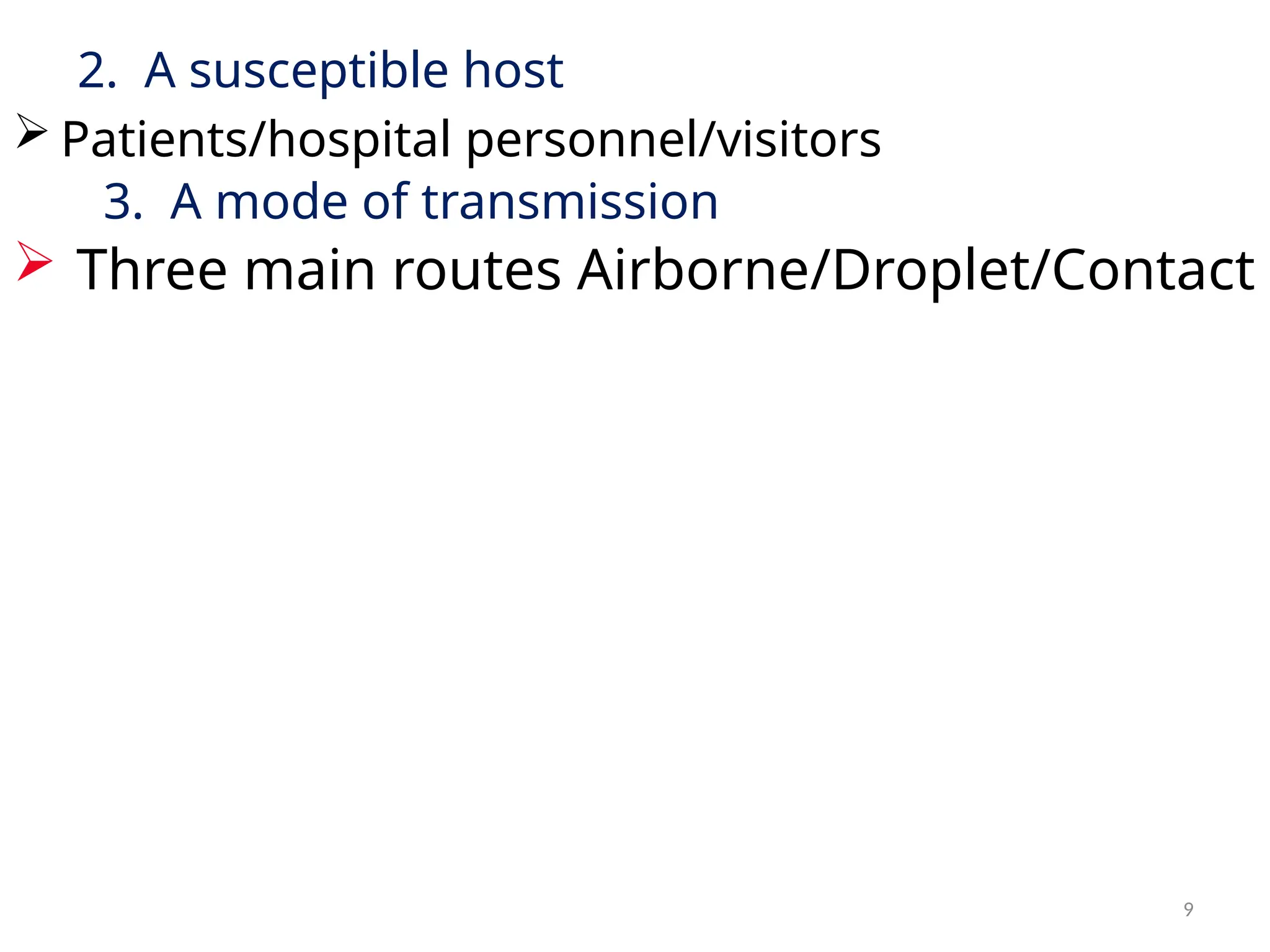
2. A susceptible host
 Patients/hospital personnel/visitors
3. A mode of transmission
 Three main routes Airborne/Droplet/Contact
10
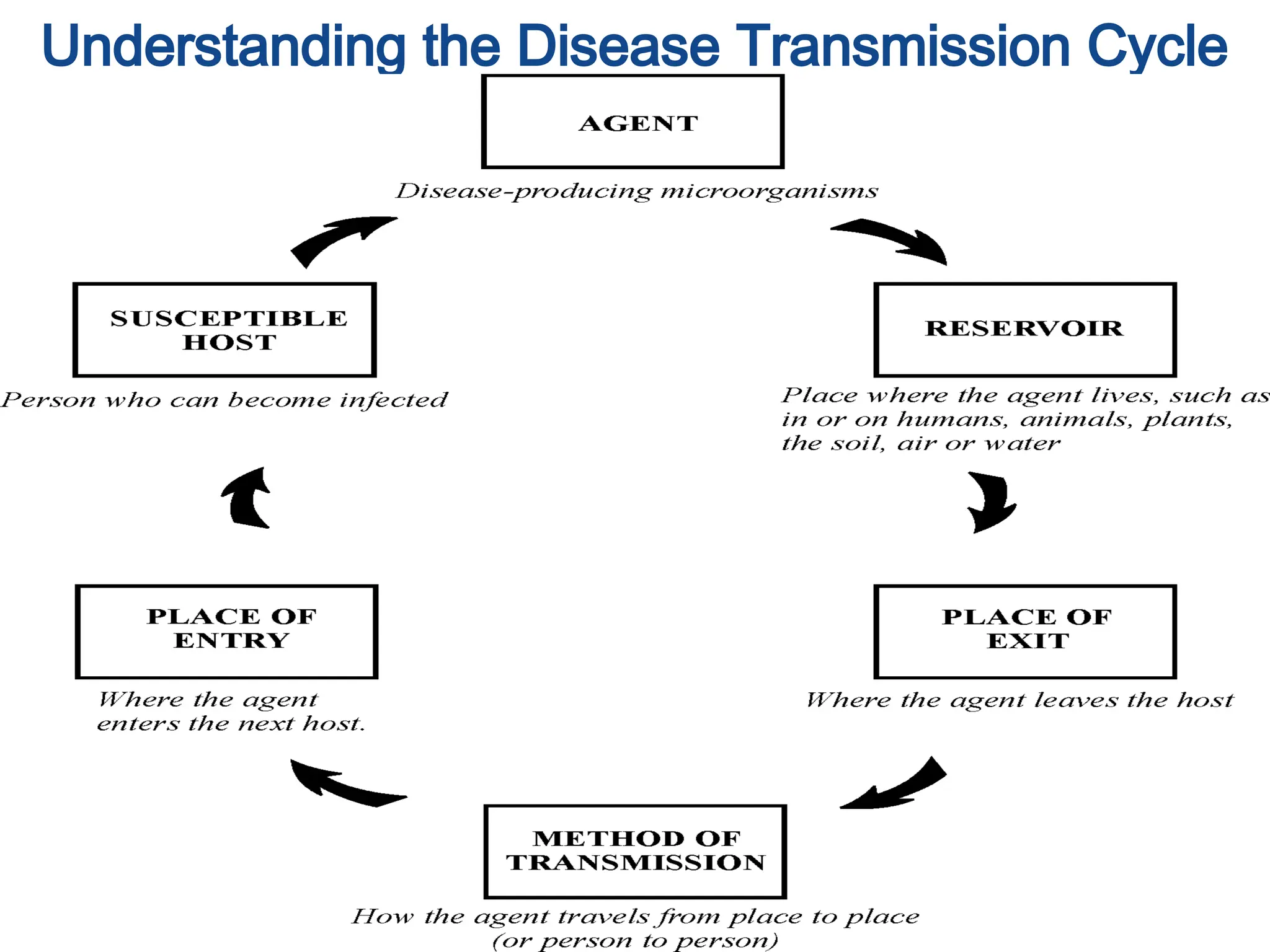
Understanding the Disease Transmission Cycle
11
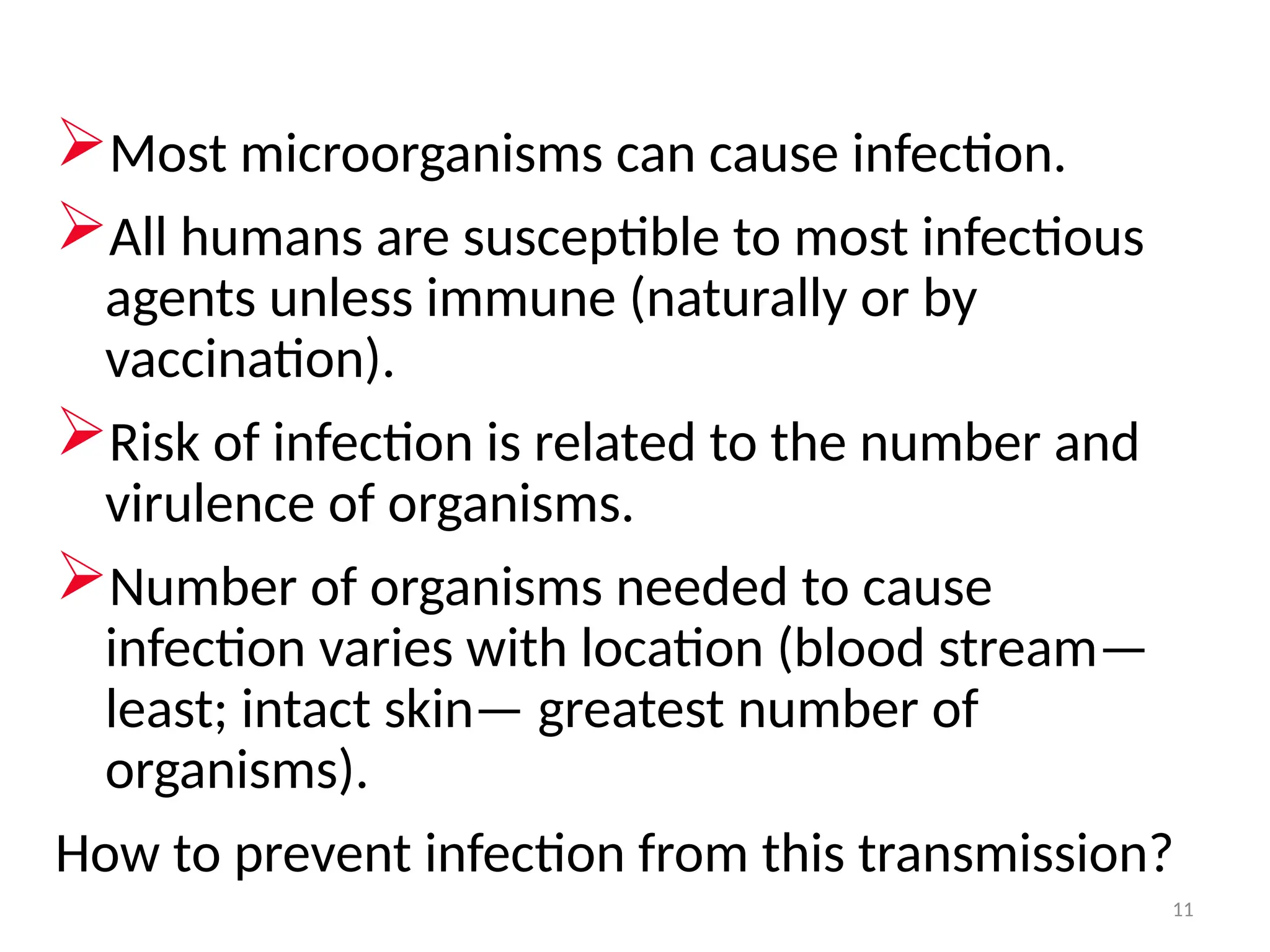
Most microorganisms can cause infection.
All humans are susceptible to most infectious
agents unless immune (naturally or by
vaccination).
Risk of infection is related to the number and
virulence of organisms.
Number of organisms needed to cause
infection varies with location (blood stream—
least; intact skin— greatest number of
organisms).
How to prevent infection from this transmission?
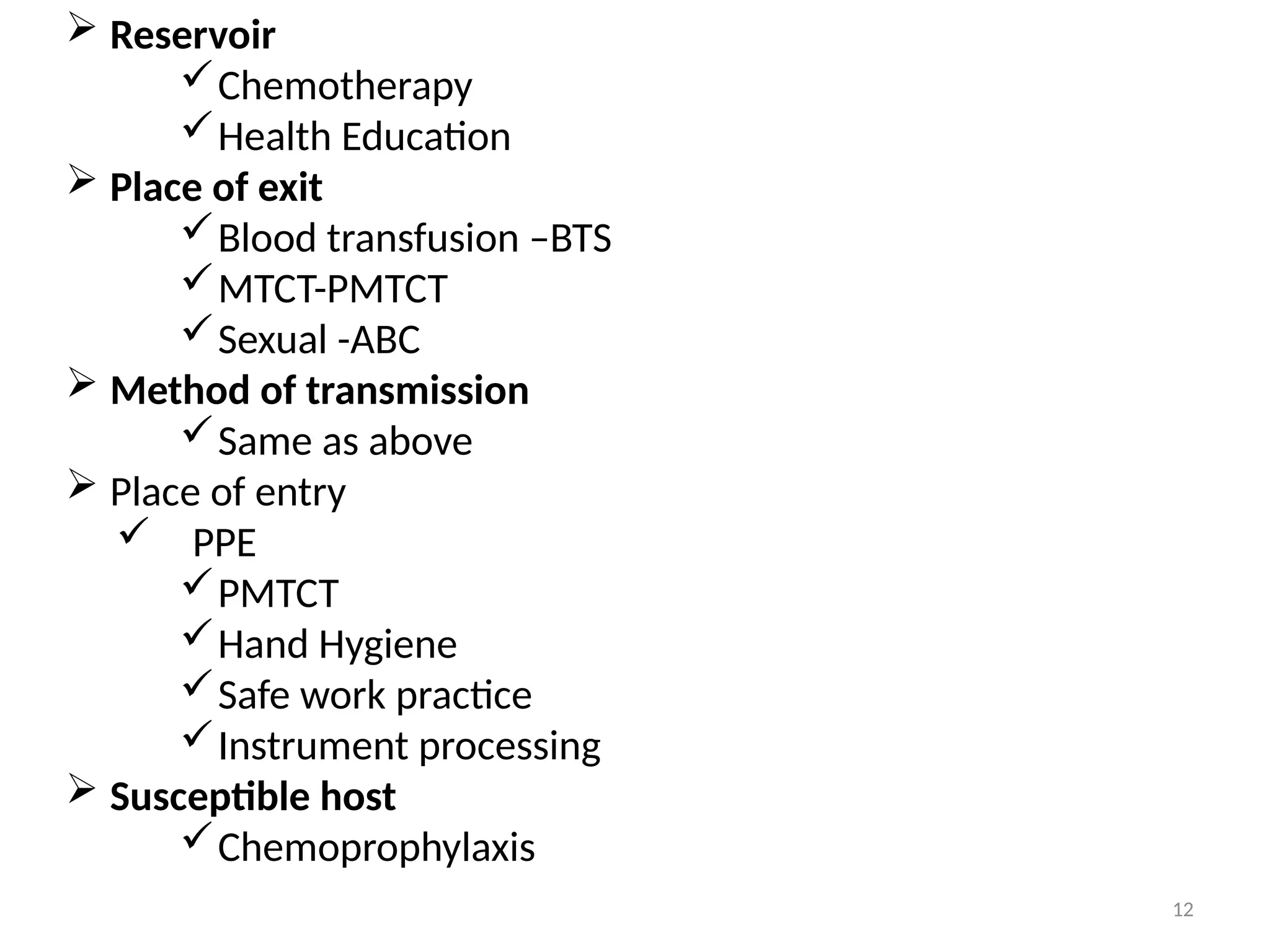
12
 Reservoir
Chemotherapy
Health Education
 Place of exit
Blood transfusion –BTS
MTCT-PMTCT
Sexual -ABC
 Method of transmission
Same as above
 Place of entry
 PPE
PMTCT
Hand Hygiene
Safe work practice
Instrument processing
 Susceptible host
Chemoprophylaxis
13
Preventing Infections in Patients
and Healthcare Clients
Primarily involves preventing the spread of
infectious diseases through the air, from blood or
body fluids, by contact (fecal-oral, contaminated
food or water), and from infected animals or insects
by:
Inhibiting or killing the infectious agent
Blocking the agent’s means of getting from one
infected person to a susceptible host
Making sure people, especially healthcare
workers, are immune or vaccinated
Providing healthcare workers with appropriate
personal protective equipment
14
What Standard Precautions Are?
Definition
Guidelines designed to create a physical,
mechanical, or chemical barrier between
microorganisms and a person to prevent the
spread of infection (i.e., the barrier serves to break
the disease transmission cycle)
Examples of Barriers
Mechanical : High-level disinfection (HLD) by boiling or
steaming and sterilization by autoclaving or dry heat ovens
Physical : Personal protective equipment
(gloves, face masks, goggles, gowns, plastic or rubber
aprons, and drapes)
Chemical: Antiseptics (iodophors and alcohol-based
antiseptic agents) and high-level disinfectants (chlorine,
15
Transmission-Based Precautions
Definition
Guidelines designed to reduce the risk of
transmitting infections that are spread
wholly or partly by airborne, droplet, or
contact routes between hospitalized patients
and health workers
Examples
Airborne: Chicken pox (varicella virus),
measles, and tuberculosis,
16
Droplet: Mumps, rubella, and
meningitis (N. meningitides)
Contact: Enteric pathogens like
hepatitis A and herpes simplex1
Also should be used with wet or
draining skin, eye, or wound infections
that may be contagious
17
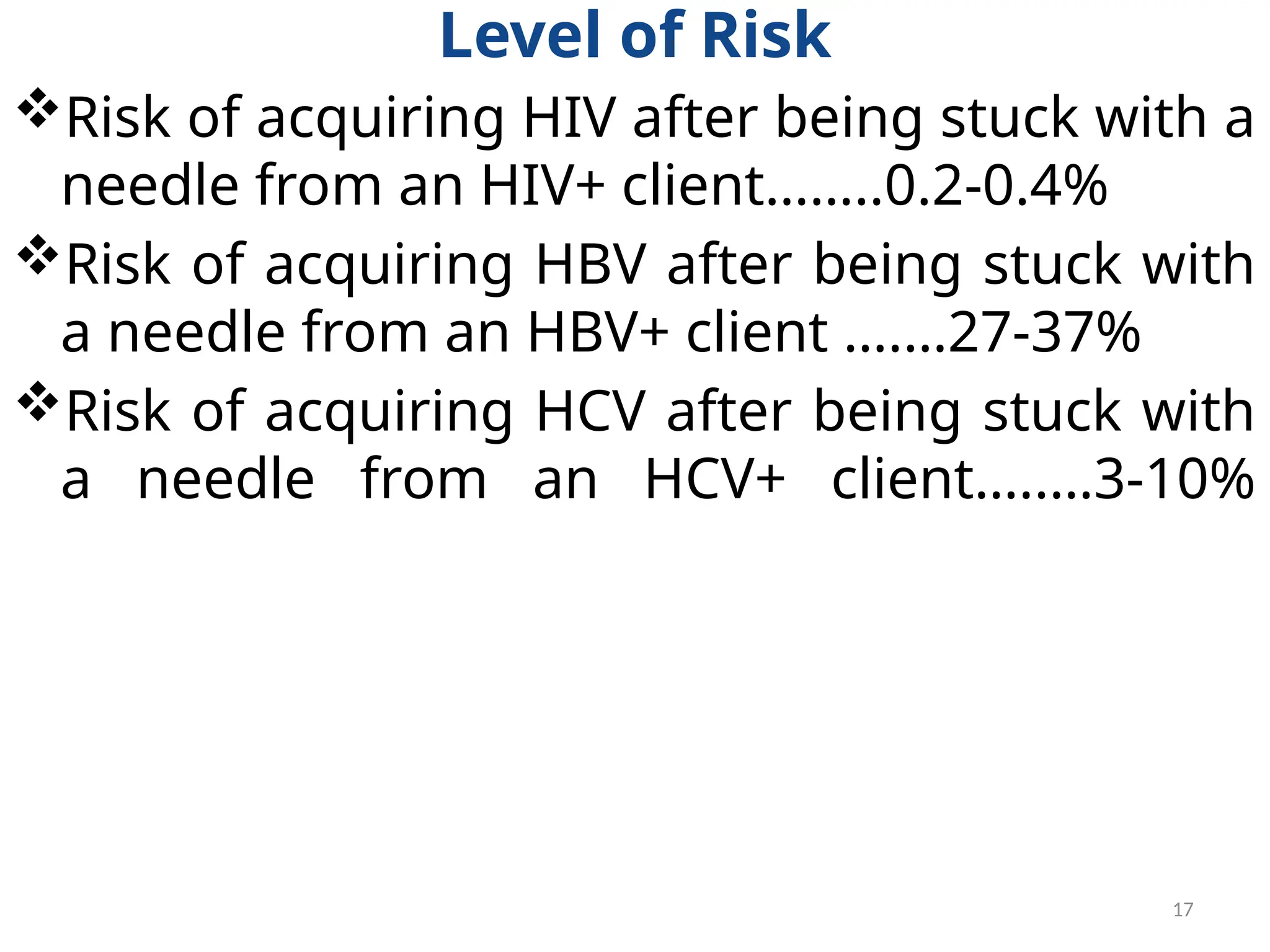
Level of Risk
Risk of acquiring HIV after being stuck with a
needle from an HIV+ client……..0.2-0.4%
Risk of acquiring HBV after being stuck with
a needle from an HBV+ client ….…27-37%
Risk of acquiring HCV after being stuck with
a needle from an HCV+ client…..…3-10%
18
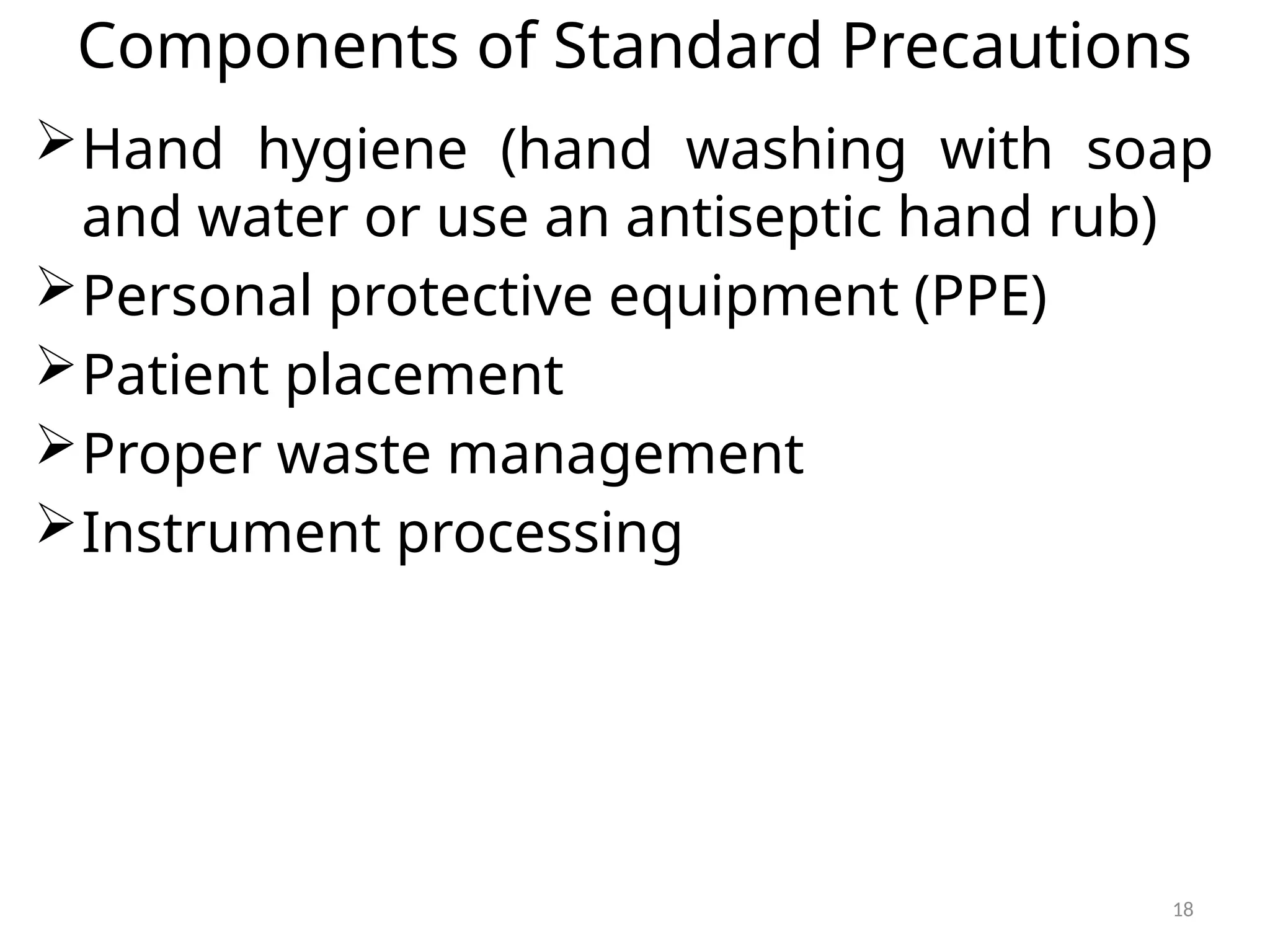
Components of Standard Precautions
Hand hygiene (hand washing with soap
and water or use an antiseptic hand rub)
Personal protective equipment (PPE)
Patient placement
Proper waste management
Instrument processing
19
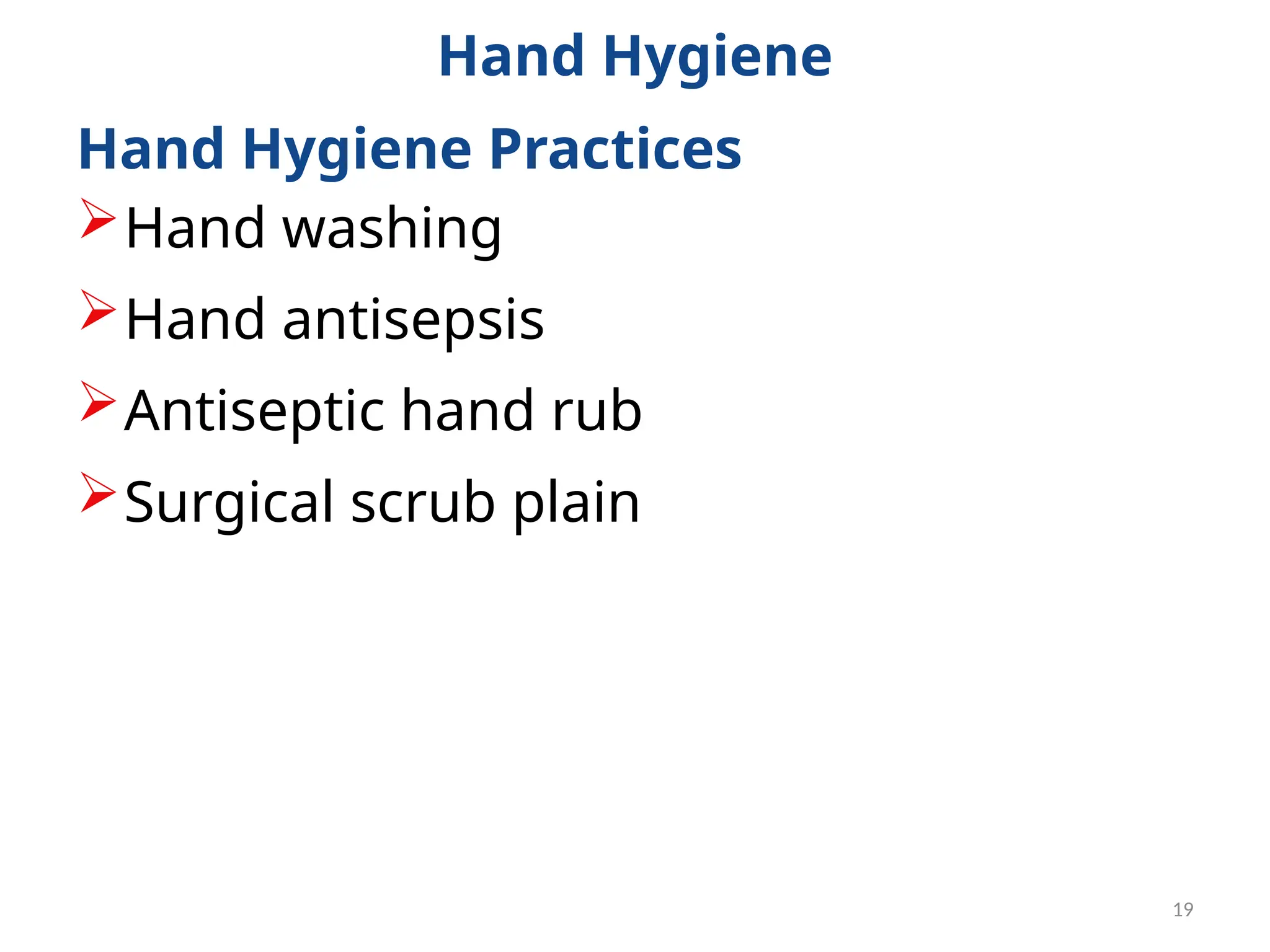
Hand Hygiene
Hand Hygiene Practices
Hand washing
Hand antisepsis
Antiseptic hand rub
Surgical scrub plain
20
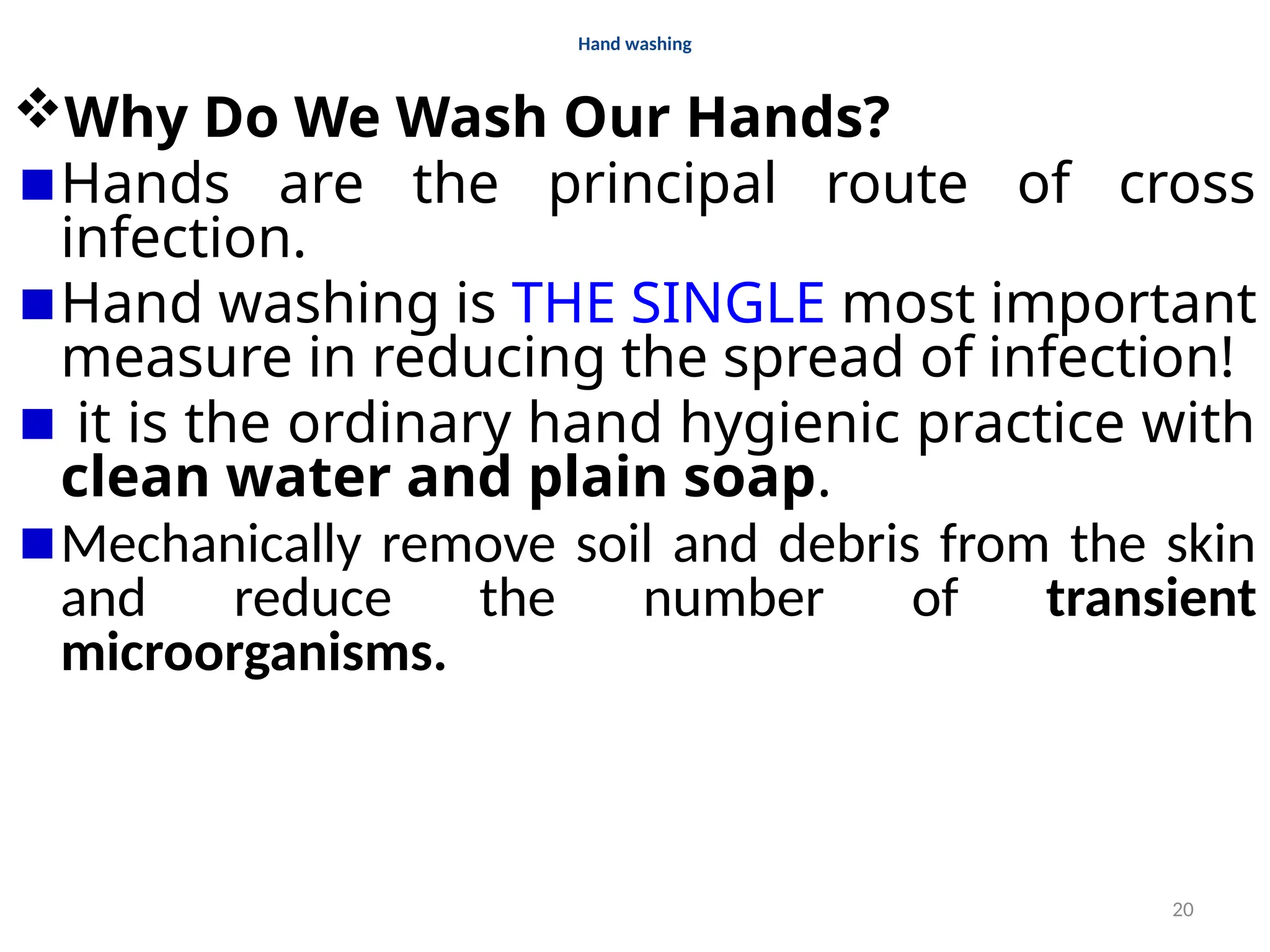
Hand washing
Why Do We Wash Our Hands?
Hands are the principal route of cross
infection.
Hand washing is THE SINGLE most important
measure in reducing the spread of infection!
it is the ordinary hand hygienic practice with
clean water and plain soap.
Mechanically remove soil and debris from the skin
and reduce the number of transient
microorganisms.
21
 When Do We Wash Our Hands?
Wash hands:
After arriving at work
Before and after examining any client
After touching contaminated instruments/items
After exposure to blood or any body fluids
Before putting on gloves and after removing
them
Whenever our hands become visibly soiled
After blowing your nose, covering a sneeze
After visiting the toilet
Before leaving work
22
Why Healthcare Workers Don’t Wash Their
Hands?
Beliefs:
Hand washing between every patient encounter is
unnecessary,
Hand washing doesn’t affect clinical outcome,
Hand washing is unnecessary when gloves are
worn,
Frequent hand washing damages skin and causes
cracking, dryness, irritation and dermatitis,
Hand washing damages nails and nail polish
Hand washing facilities are not conveniently
placed or well designed,
Hand washing takes too much time….etc.,
23
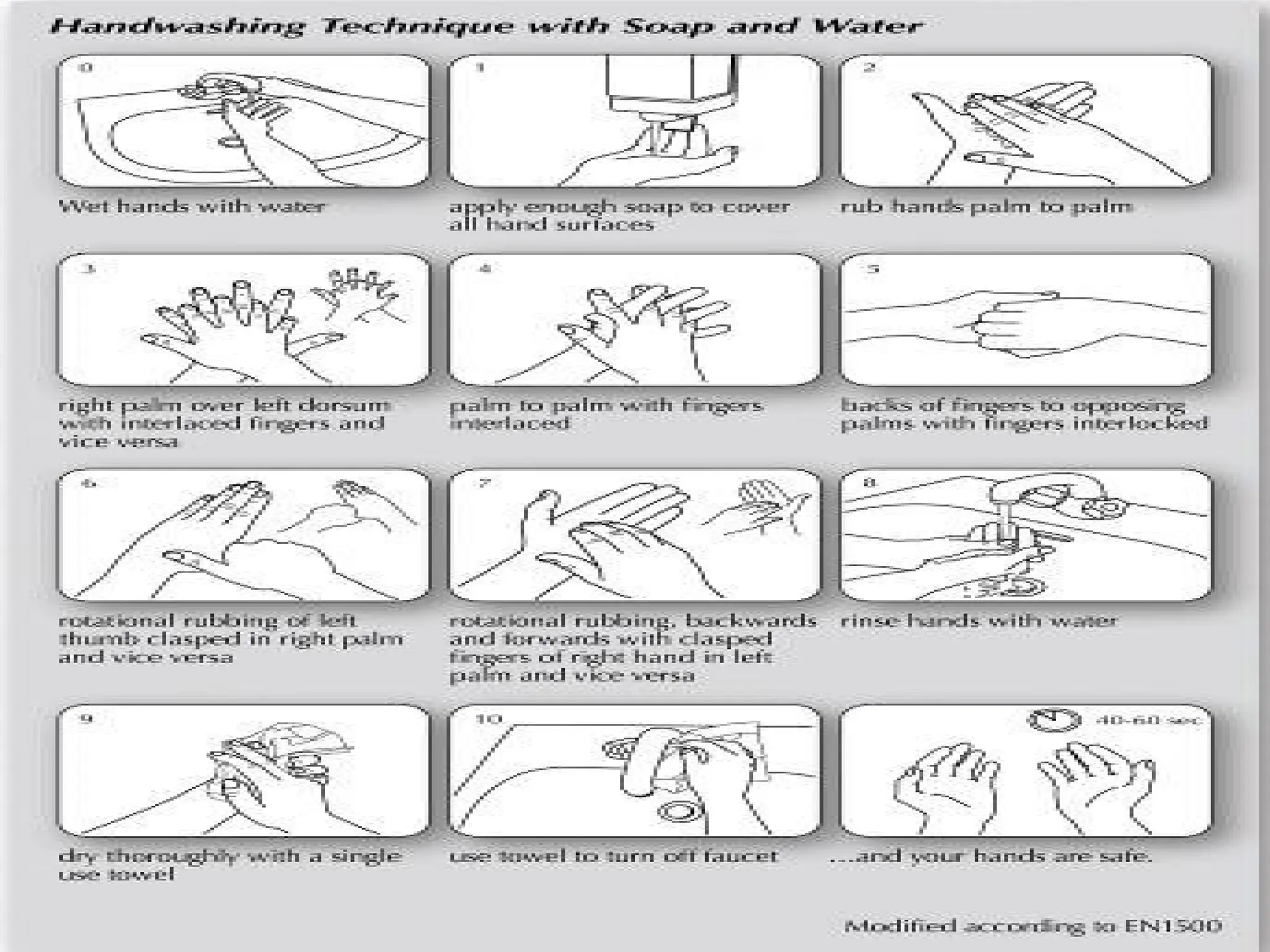
Hand washing
Steps:
1. Thoroughly wet hands.
2. Apply plain soap (antiseptic agent is not
necessary).
3. Vigorously rub all areas of hands and fingers
for 10–15 seconds, paying close attention to
fingernails and between fingers.
4. Rinse hands thoroughly with clean water.
5. Dry hands with a paper towel or a clean, dry
personal towel.
6. Use a paper towel when turning off water if
there is no foot control or automatic shut-off.
24
25
Hand Antisepsis
Purpose:
Similar to that for plain hand washing. The
soap or detergent contains an antiseptic
agent (often chlorhexidine, iodophors, or
triclosan) instead of plain soap or
detergent.
Objective: Remove soil and debris as well
as to reduce both transient and resident
flora
26
we use hand antisepsis:
Before:
 Examining or caring for highly susceptible
patients (e.g., premature infants, elderly
patients, or those with advanced AIDS)
 Performing an invasive procedure
 Leaving the room of patients on Contact
Precautions (e.g. hepatitis A or E,)
27
Antiseptic Hand rub
Purpose: Is to inhibit or kill transient and
resident flora.
Considered to be more effective than
antimicrobial hand washing agents or plain
soap and water,
It is quicker and easier to perform,
but it should not be used when the hands
are visibly soiled.
Do not rinse hands after applying hand rub
28
alcohol-based solution for hand rub:
• Add glycerin or sorbitol to alcohol (2 ml. in
100 ml. of 60–90% ethyl or isopropyl alcohol
solution)
Steps:
Apply enough alcohol-based hand rub to cover
the entire surface of hands and fingers (about
a teaspoonful -5ml)
continue rubbing the solution over hands until
they are dry (15-30 seconds)
Rub the solution vigorously into hands,
especially between fingers and under the nails
until dry.
29
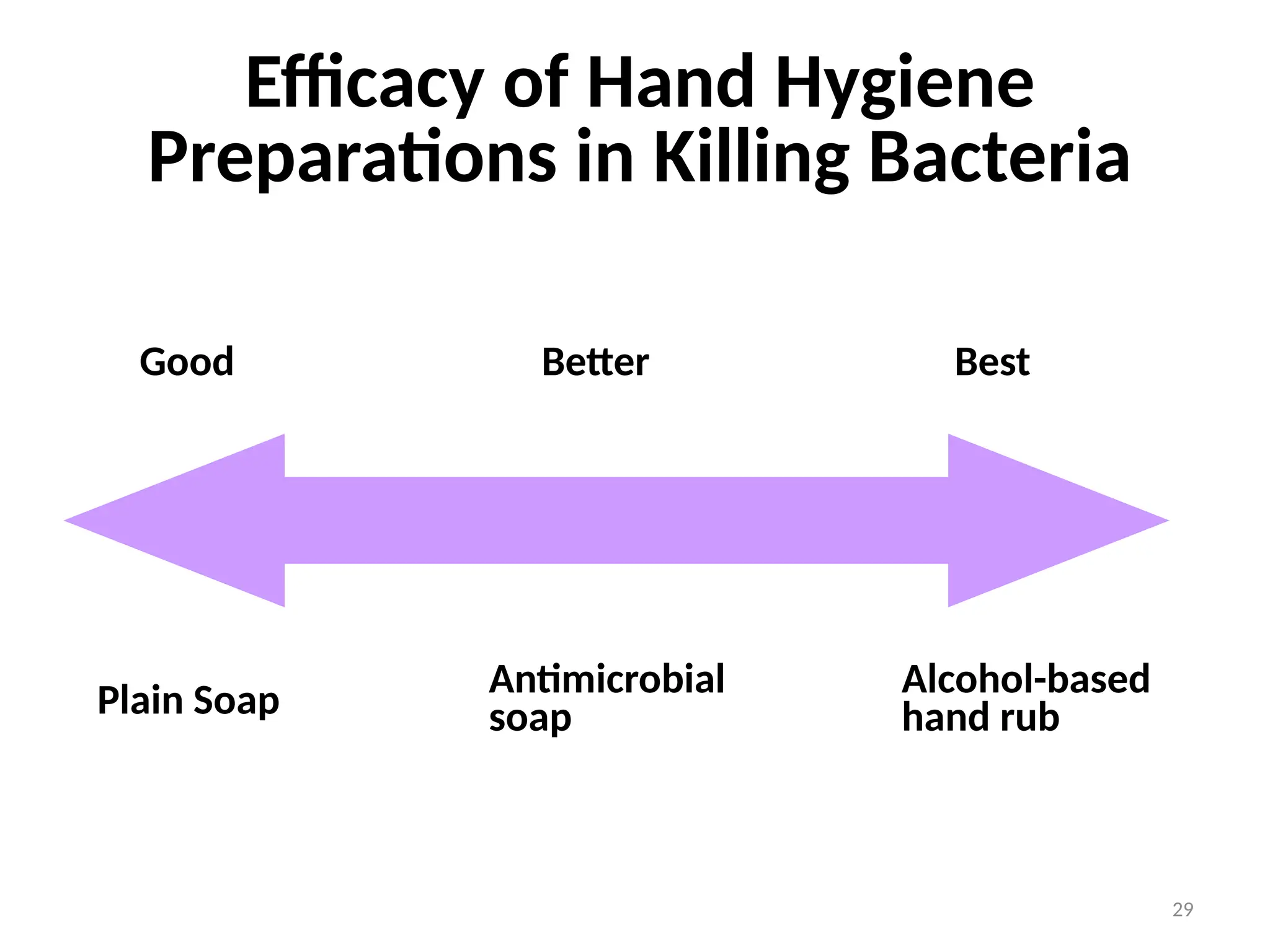
Efficacy of Hand Hygiene
Preparations in Killing Bacteria
Good Better Best
Plain Soap Antimicrobial
soap
Alcohol-based
hand rub
30
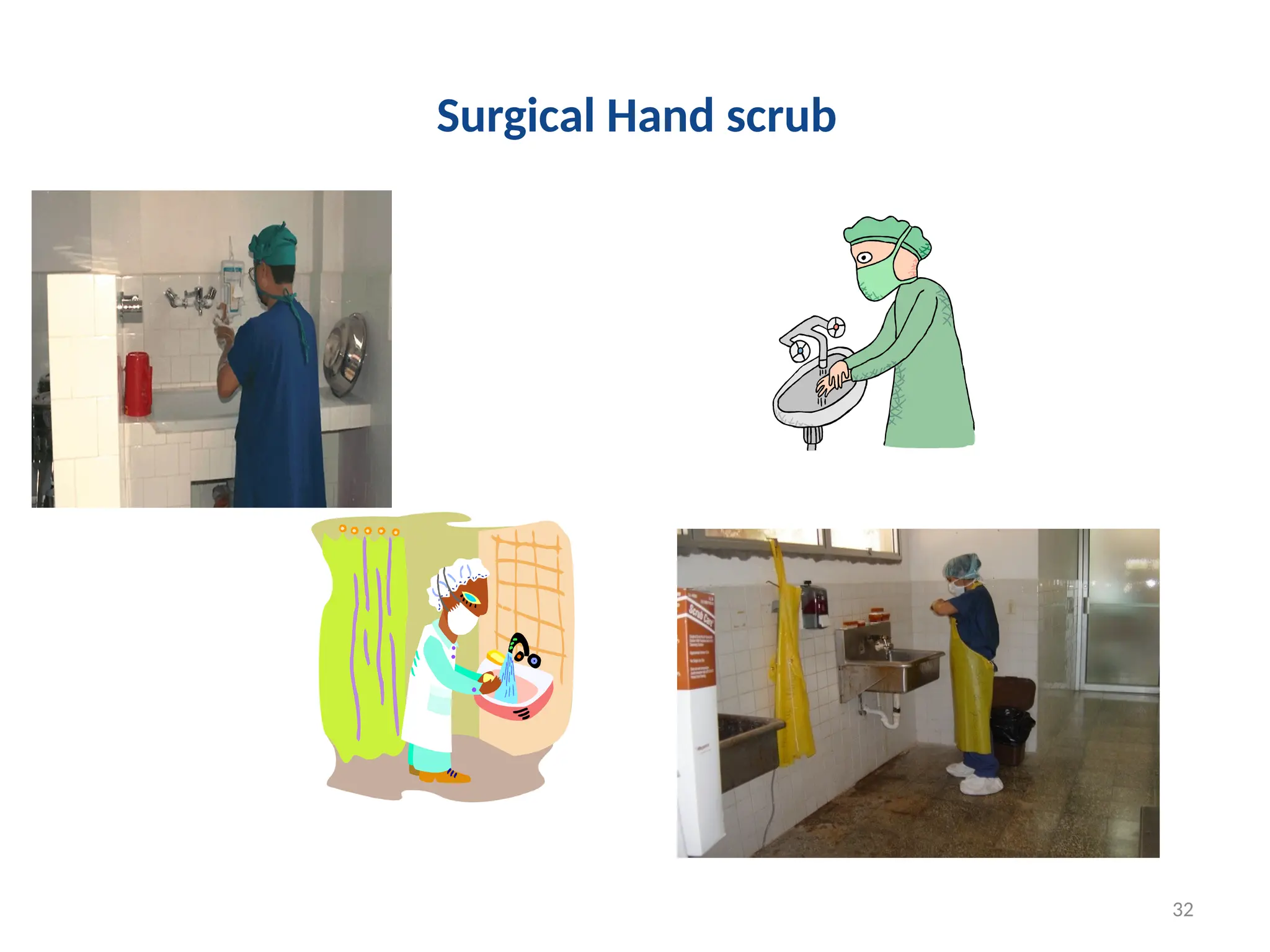
Surgical Hand scrub
Purpose: To mechanically remove soil, debris and
transient organisms and to reduce resident
flora for the duration of the surgery
Steps:
1. Remove rings, watches, and bracelets.
2. Thoroughly wash hands and forearms to the
elbow with soap and water.
3. Clean nails with a nail cleaner.
4. Rinse hands and forearms with water.
5. Apply an antiseptic agent (soap)
6. Vigorously wash all surfaces of hands, fingers,
and forearms for at least 2 minutes.
31
7. Rinse hands and arms thoroughly with
clean water, holding hands higher than
elbows.
8. Keep hands up and away from the body,
do not touch any surface or article. and
dry hands with a clean, dry towel.
9. Put on sterile or HLD gloves
32
Surgical Hand scrub
33
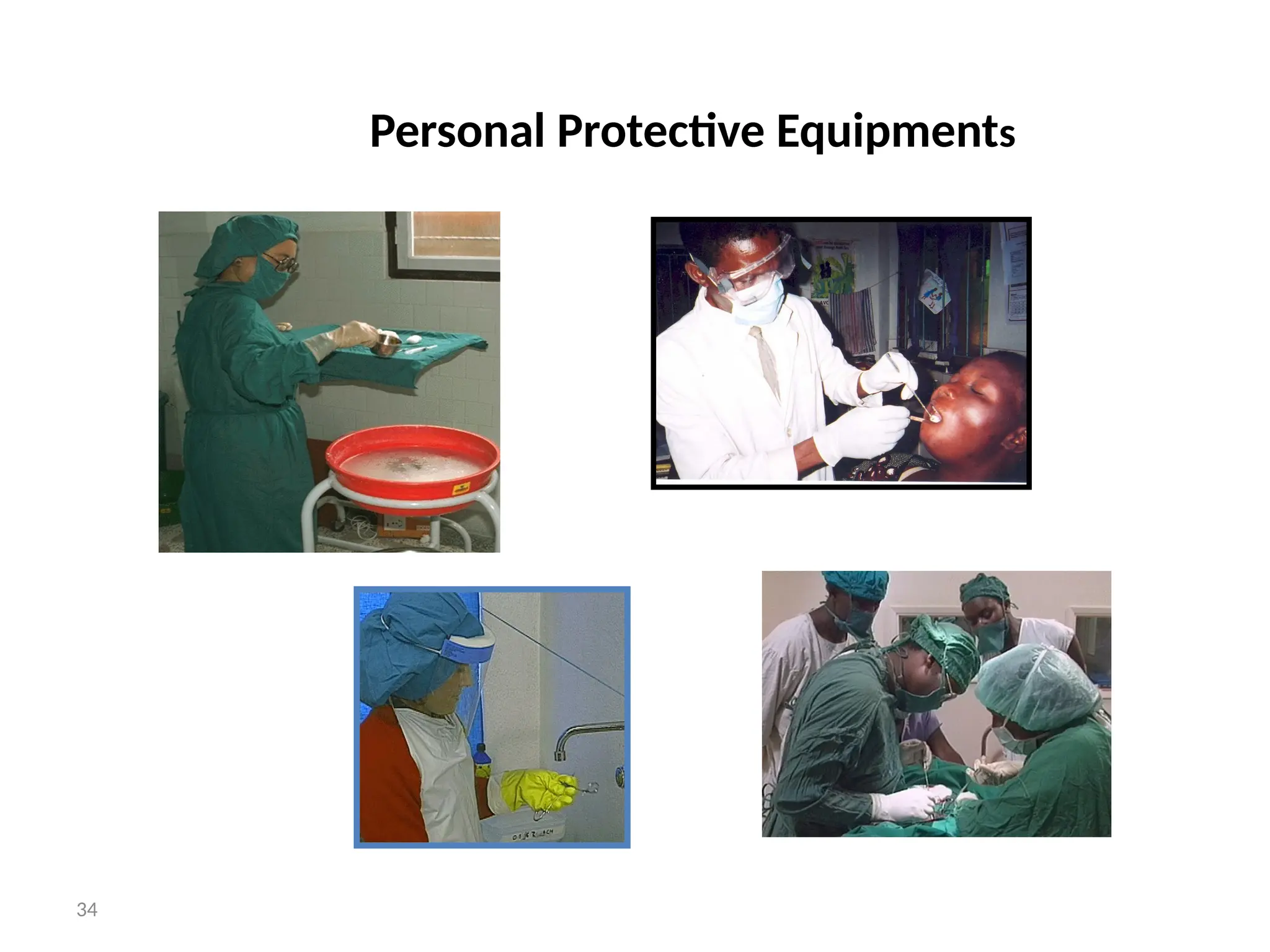
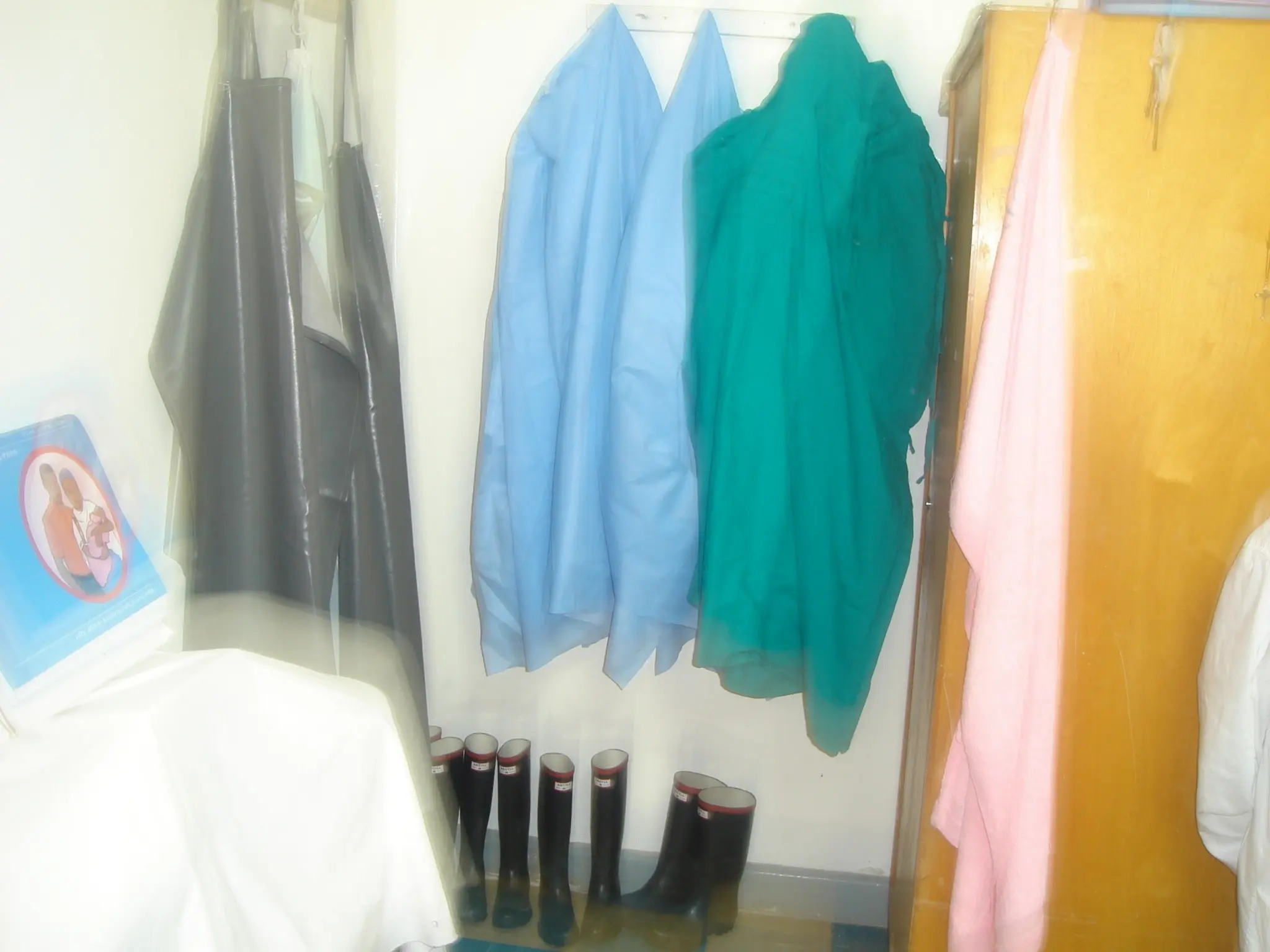
Personal Protective Equipment
(PPE)
• PPE includes: gloves, masks/respirators, eyewear
(face shields, goggles), caps, gowns, aprons, boots
and other items.
• The most effective barriers are made of synthetic
materials that do not allow water or other liquids to
penetrate them.
• These fluid resistance materials are not; however,
widely available because they are expensive.
34
Personal Protective Equipments
35
36
Donning and removing gloves
• At the end of this lesson, learner will
be able to:
· Identify the types of gloves
· Demonstrate wearing and removing
gloves
37
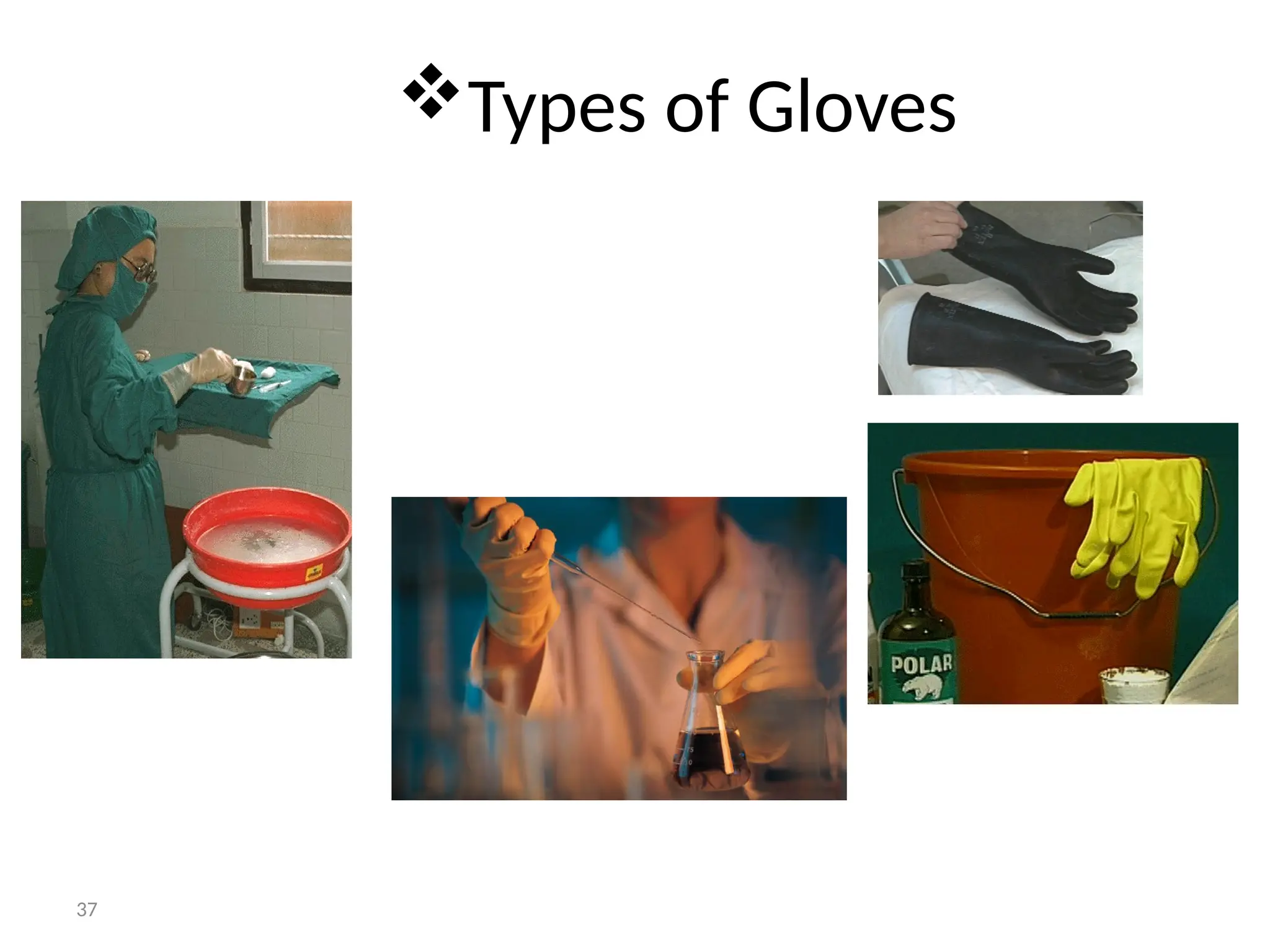
Types of Gloves
38
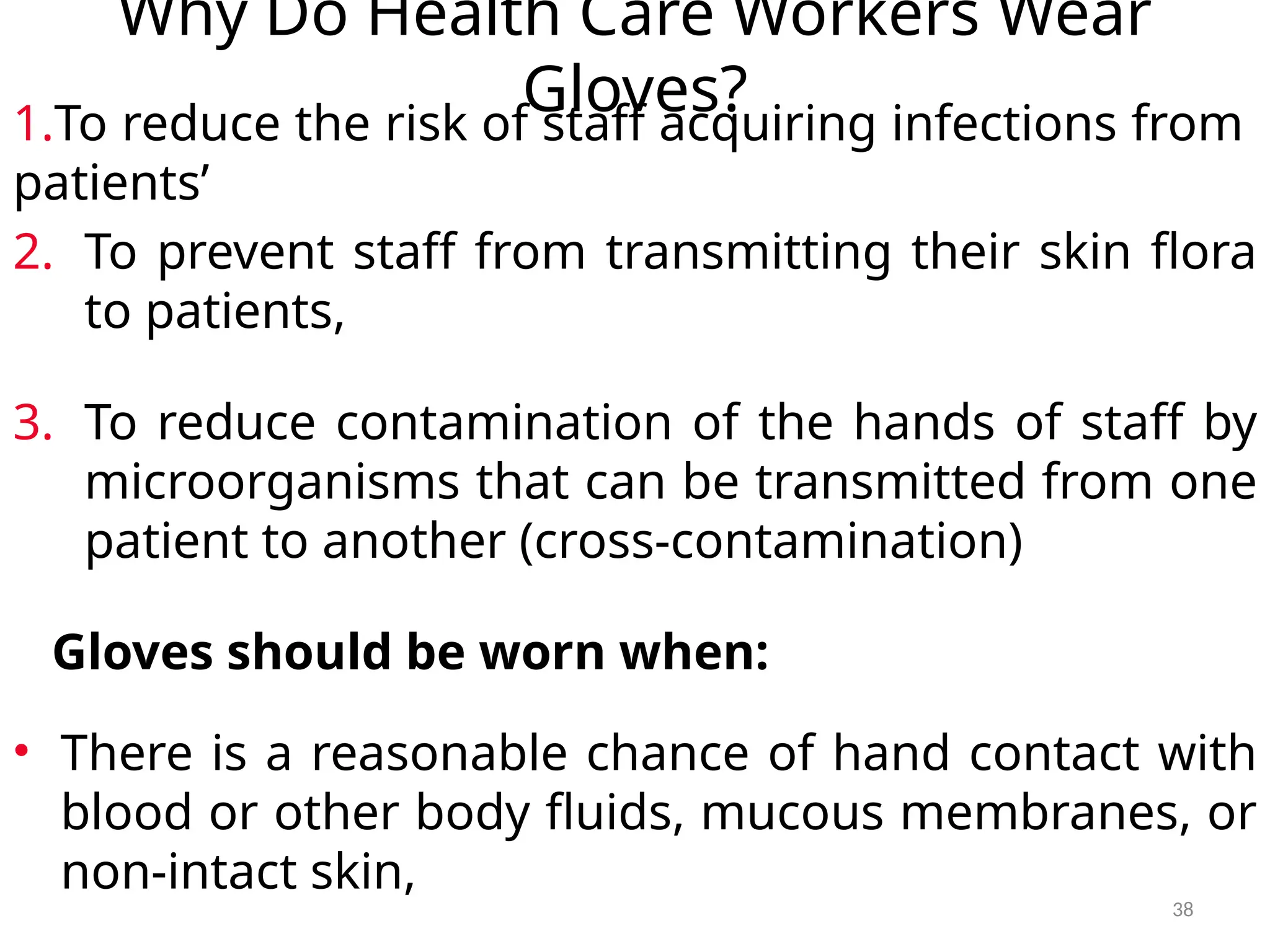
Why Do Health Care Workers Wear
Gloves?
1.To reduce the risk of staff acquiring infections from
patients’
2. To prevent staff from transmitting their skin flora
to patients,
3. To reduce contamination of the hands of staff by
microorganisms that can be transmitted from one
patient to another (cross-contamination)
Gloves should be worn when:
• There is a reasonable chance of hand contact with
blood or other body fluids, mucous membranes, or
non-intact skin,
39
Performing an invasive medical procedures,
Before handling soiled instruments, contaminated
waste items or touch contaminated surfaces.
When disposing contaminated waste items
Handling chemicals or disinfectants
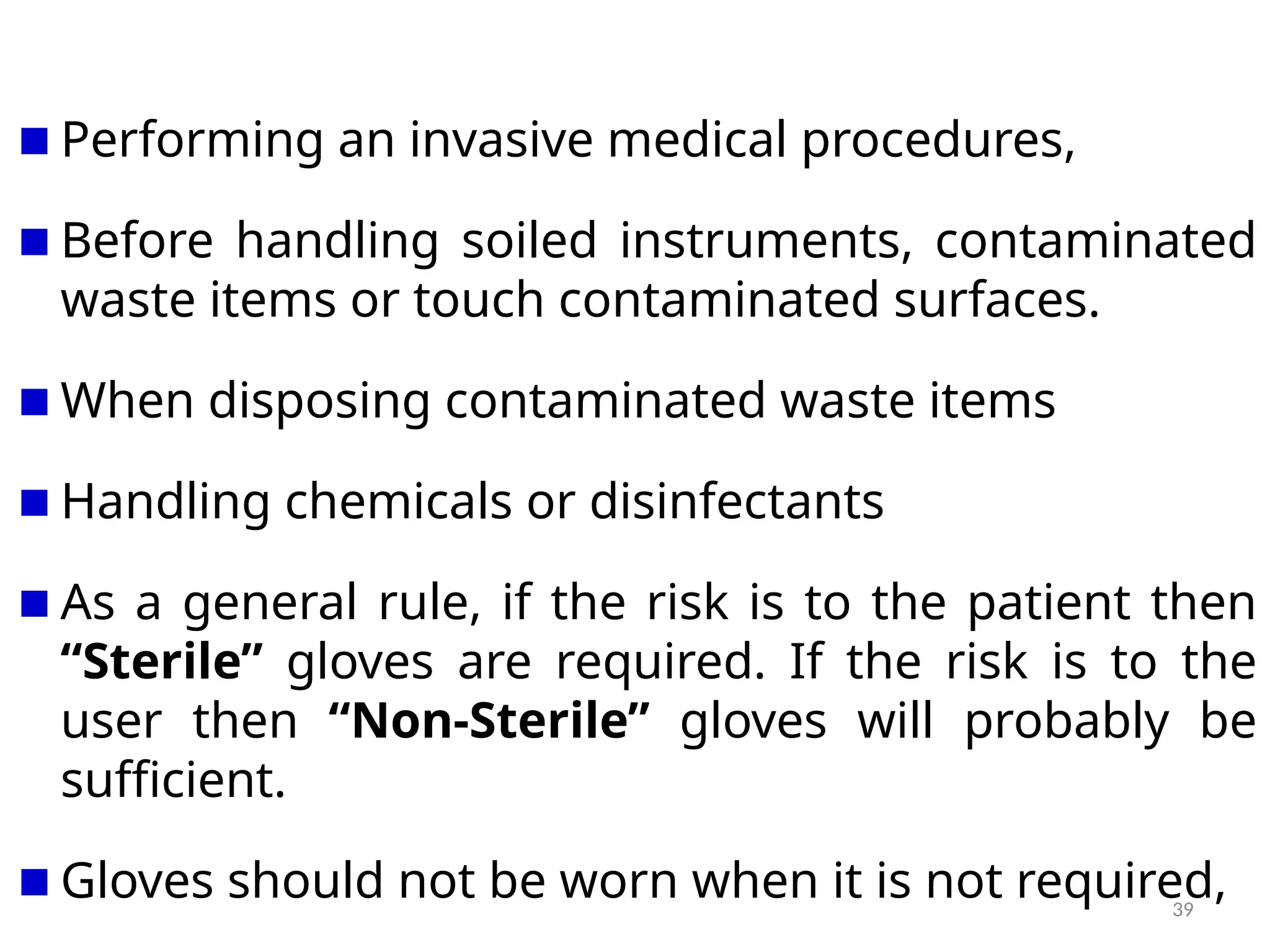
As a general rule, if the risk is to the patient then
“Sterile” gloves are required. If the risk is to the
user then “Non-Sterile” gloves will probably be
sufficient.
Gloves should not be worn when it is not required,
40
Double gloving
Although double gloving is of little benefit in
preventing blood exposure if needle sticks or
other injuries occur, it may decrease the risk
of blood hand contact.
The procedure involves coming in contact
with large amount of blood or other body
fluid,
Orthopedic procedures in which sharp bone
fragments, wire sutures and other sharps
are likely to be encountered,
41
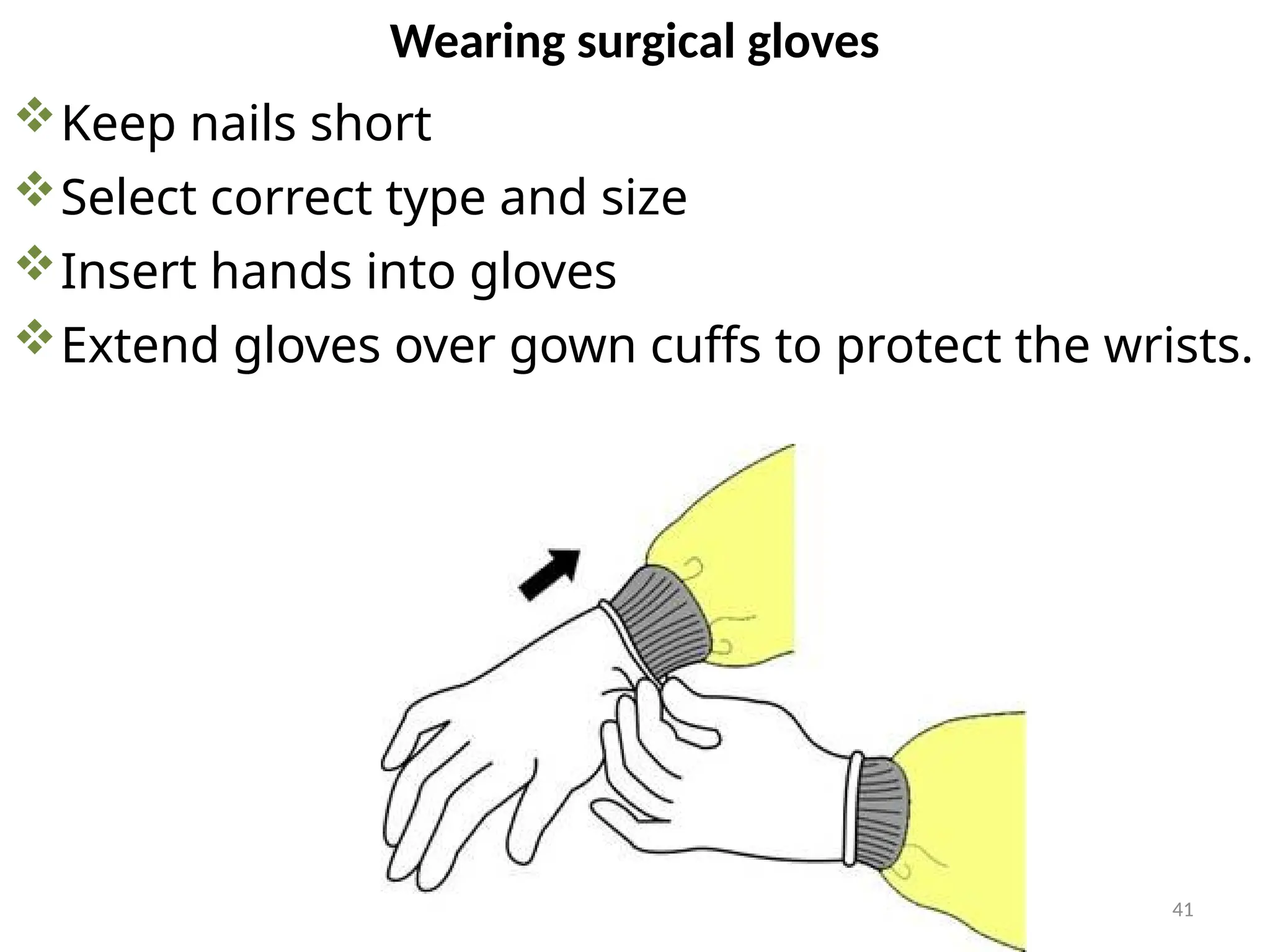
Wearing surgical gloves
Keep nails short
Select correct type and size
Insert hands into gloves
Extend gloves over gown cuffs to protect the wrists.
42
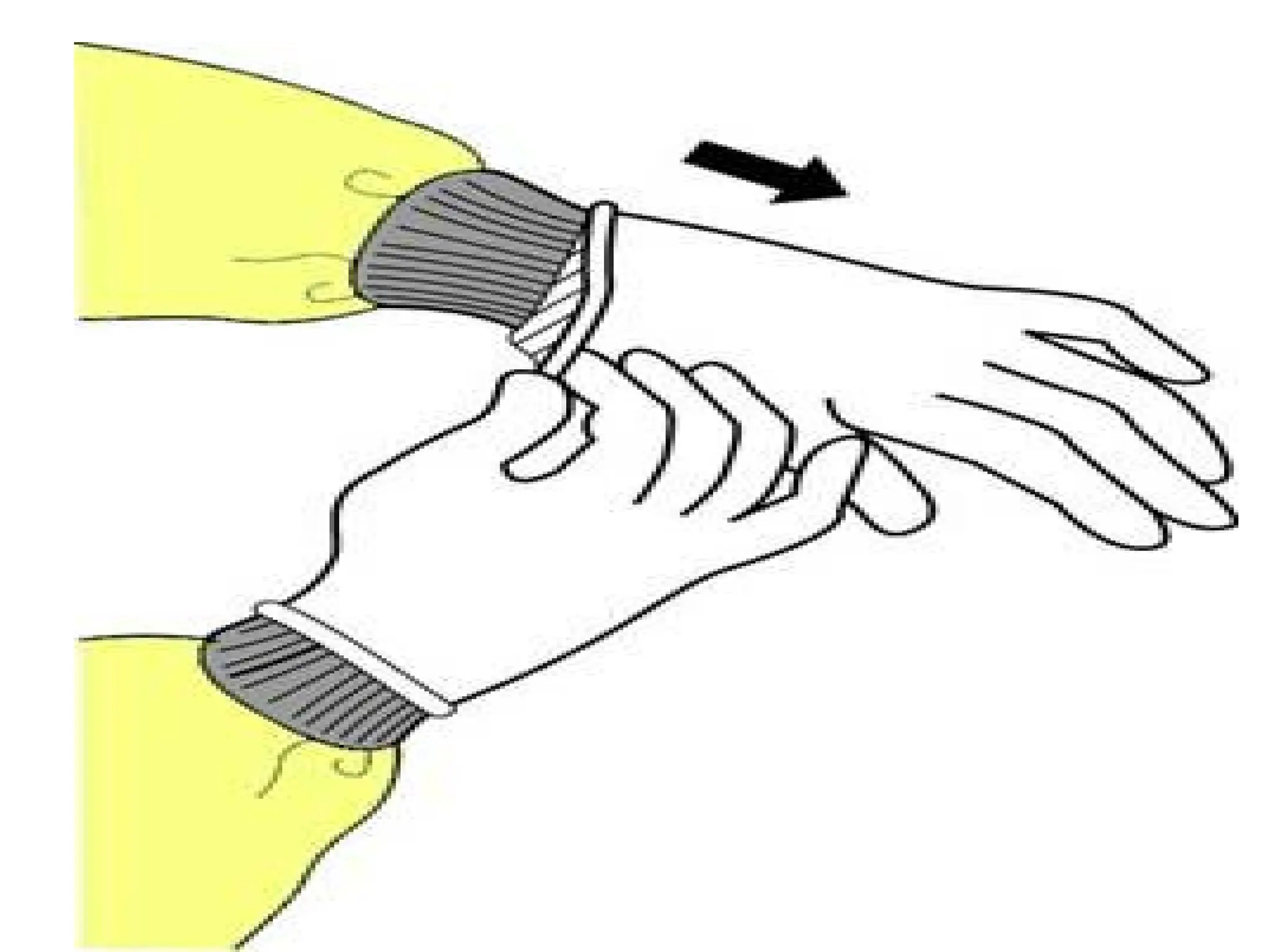
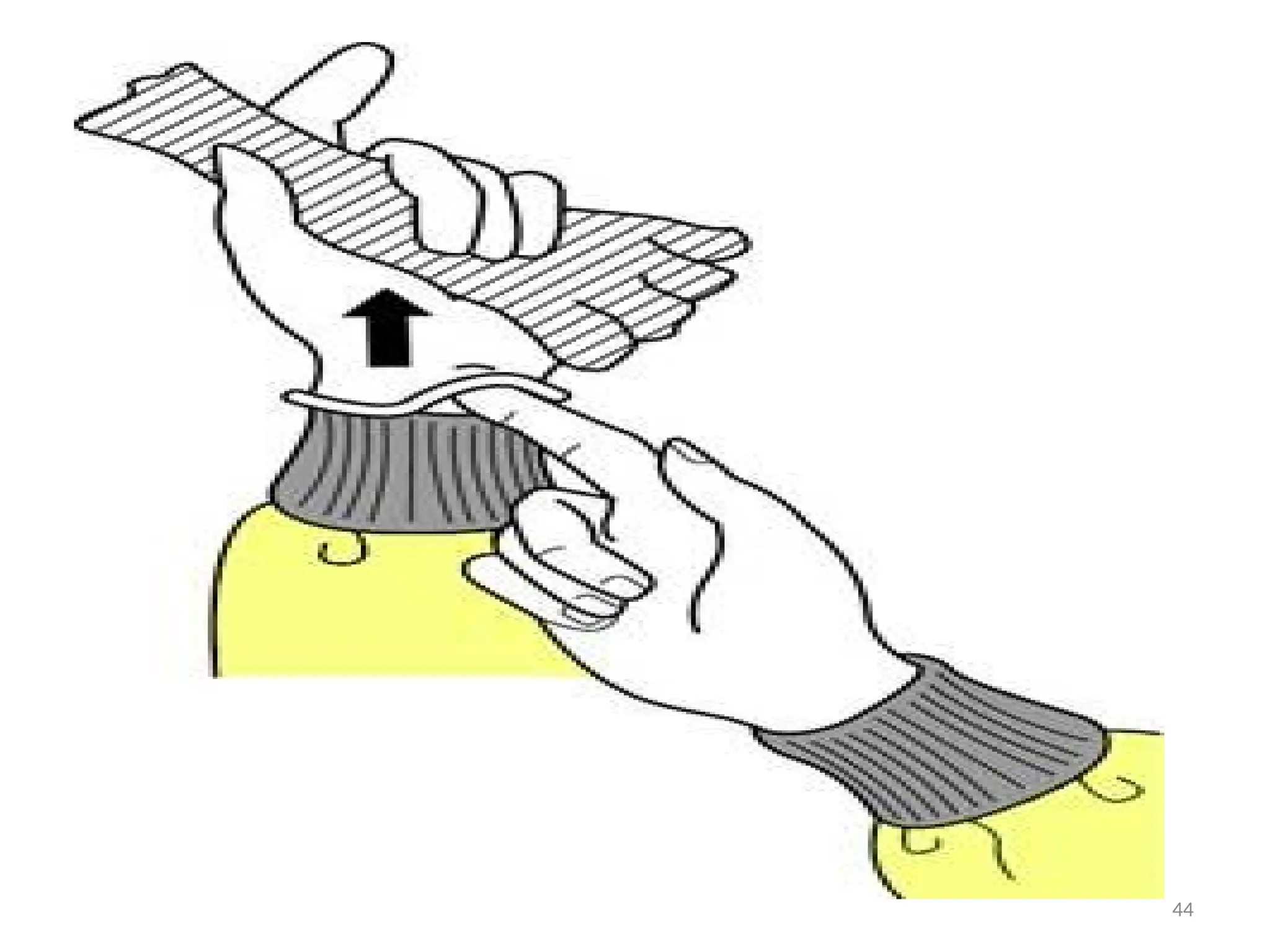
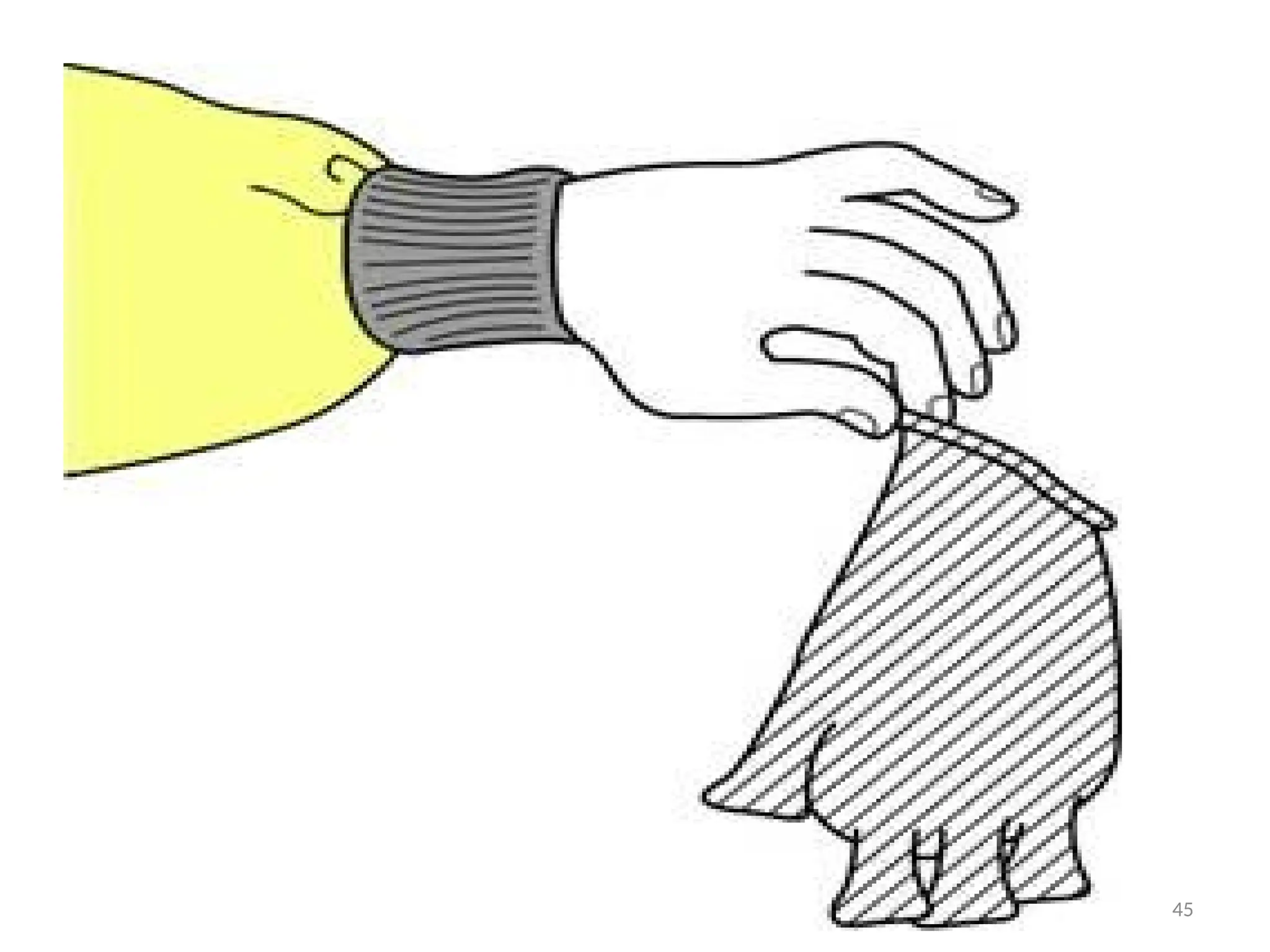
Removing Gloves
 Grasp outside edge near wrist
 Peel away from hand, turning glove inside-
out
Hold in opposite gloved hand
Slide ungloved finger under the wrist of the
remaining glove
Peel off from inside, creating a bag for both
gloves
43
44
45
46
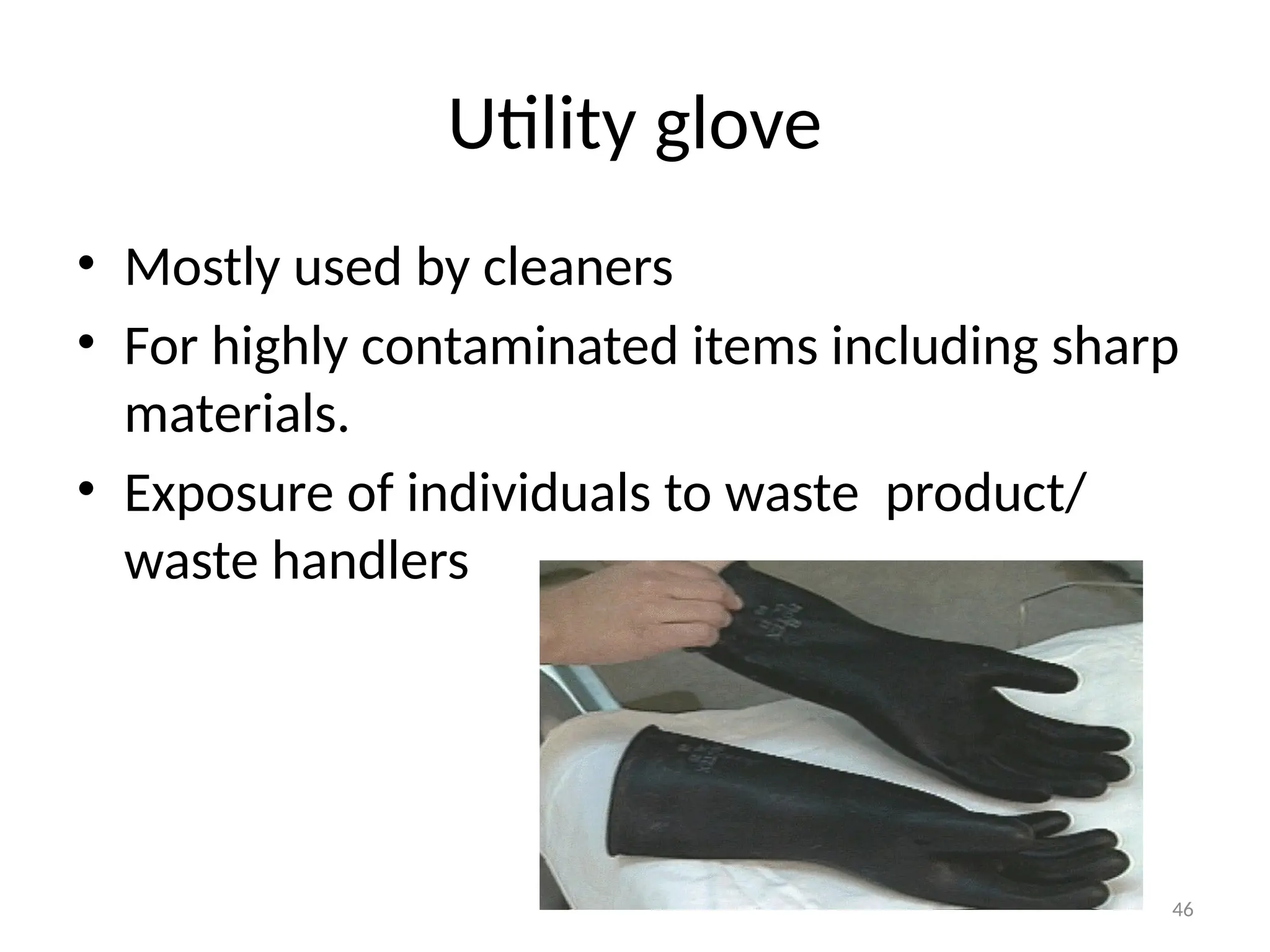
Utility glove
• Mostly used by cleaners
• For highly contaminated items including sharp
materials.
• Exposure of individuals to waste product/
waste handlers
47
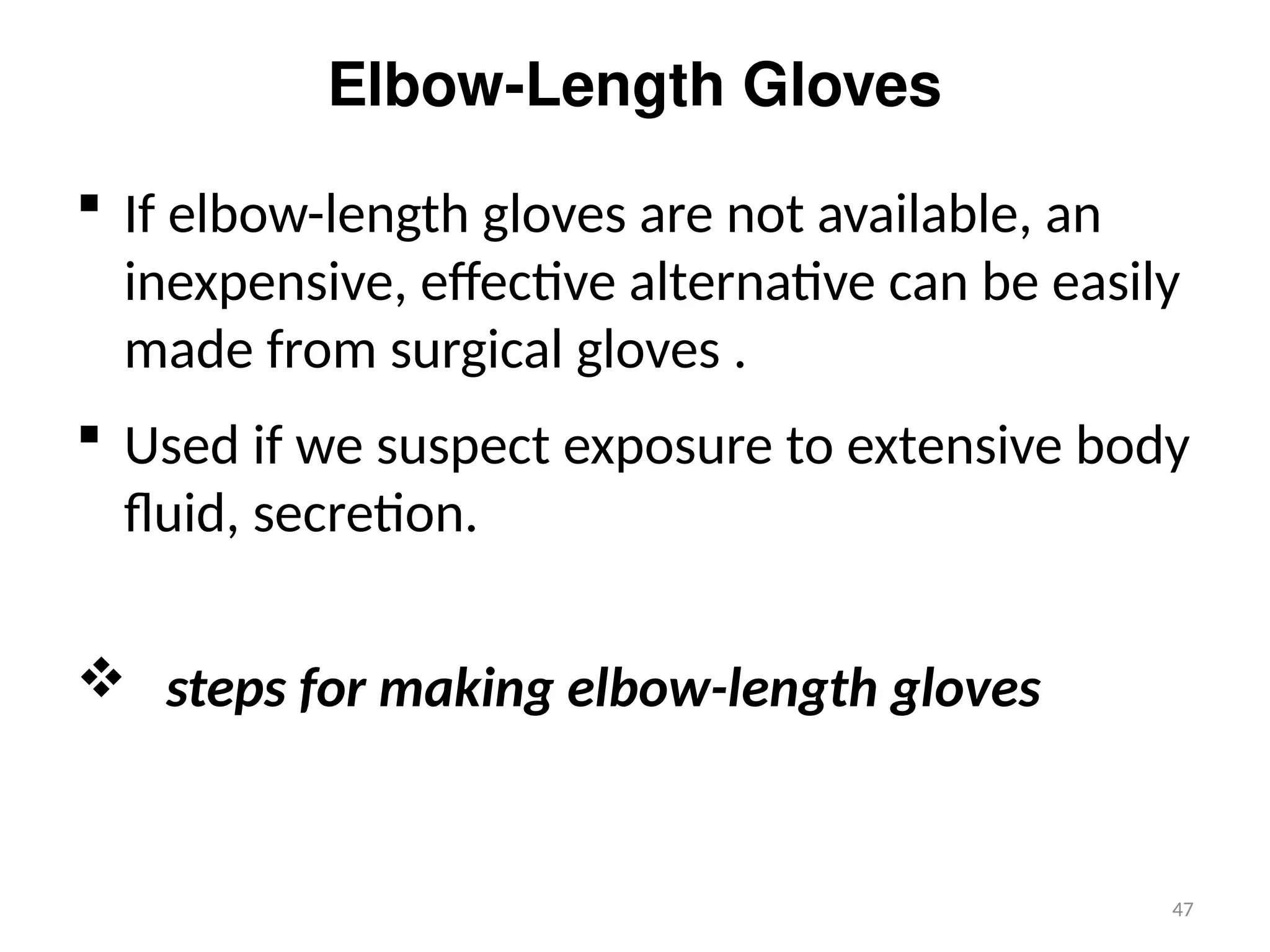
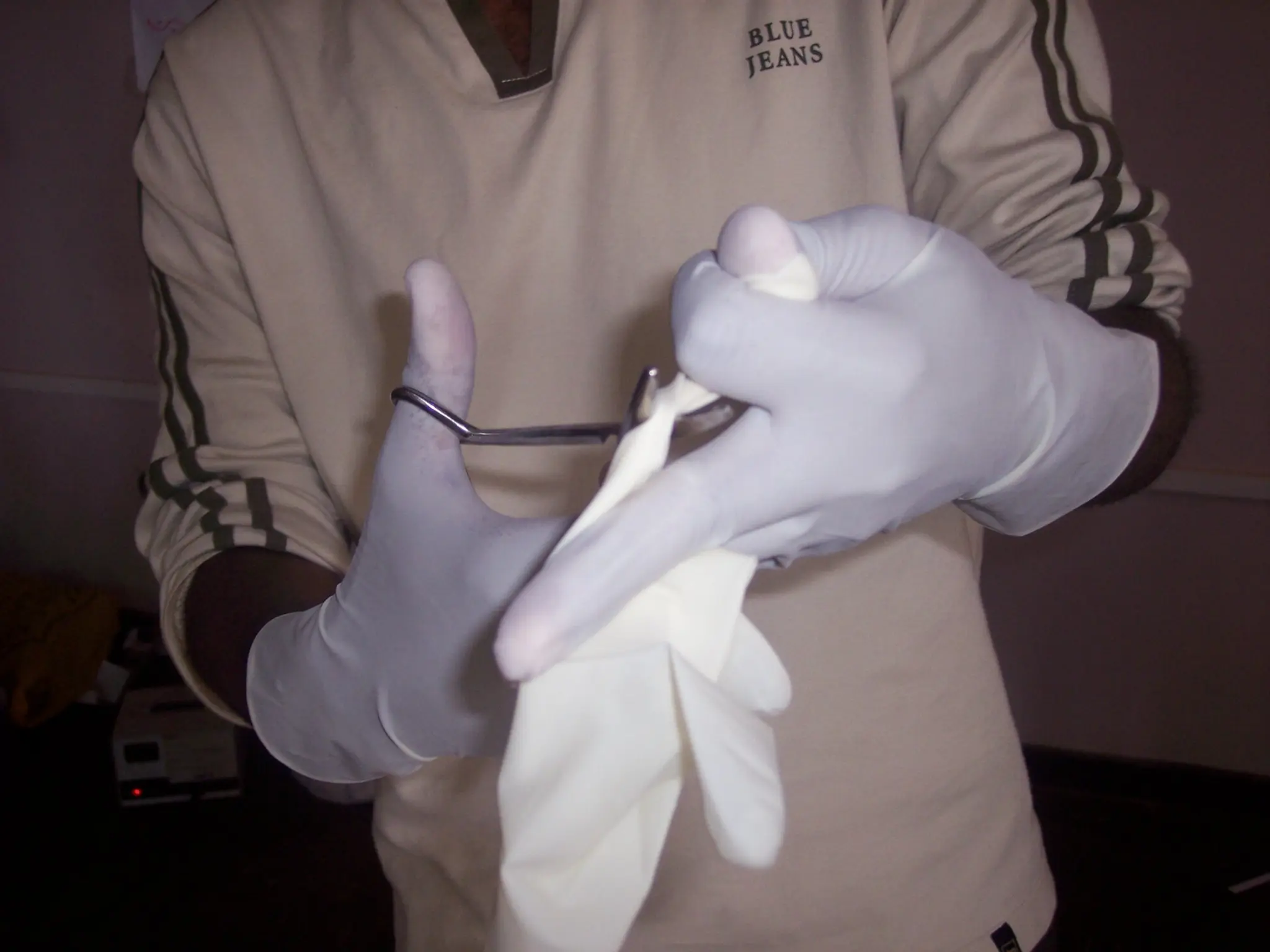
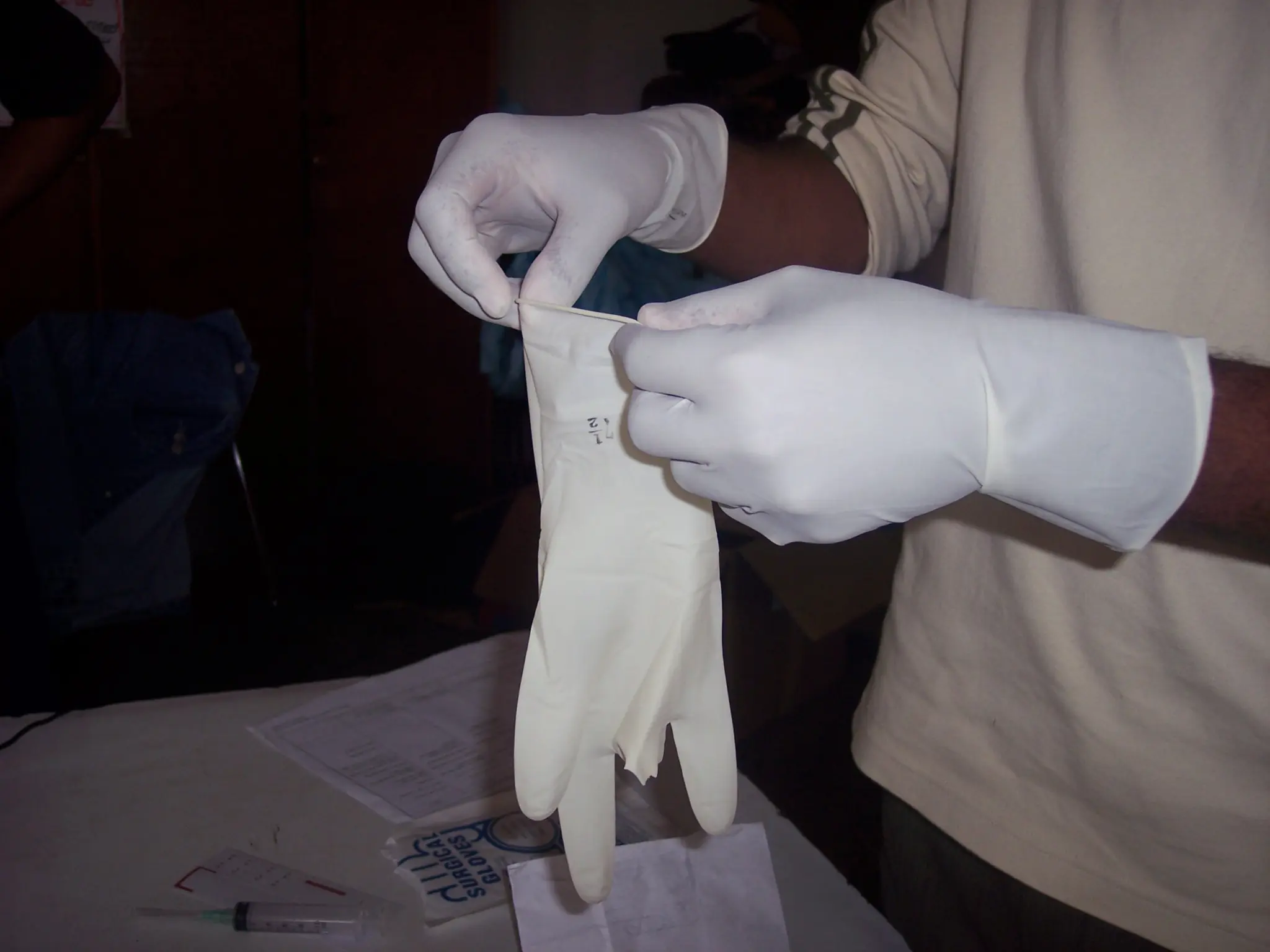
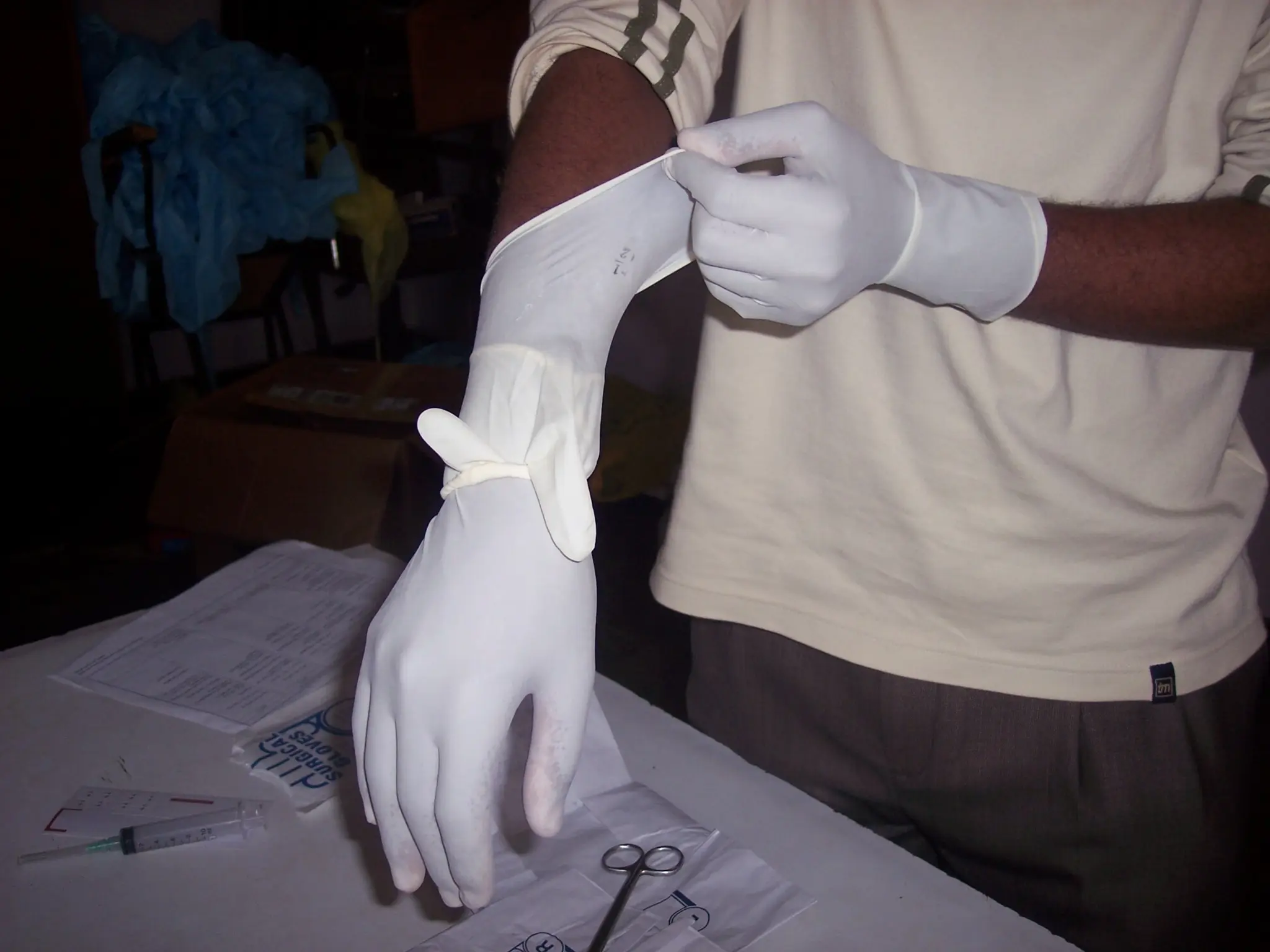
Elbow-Length Gloves
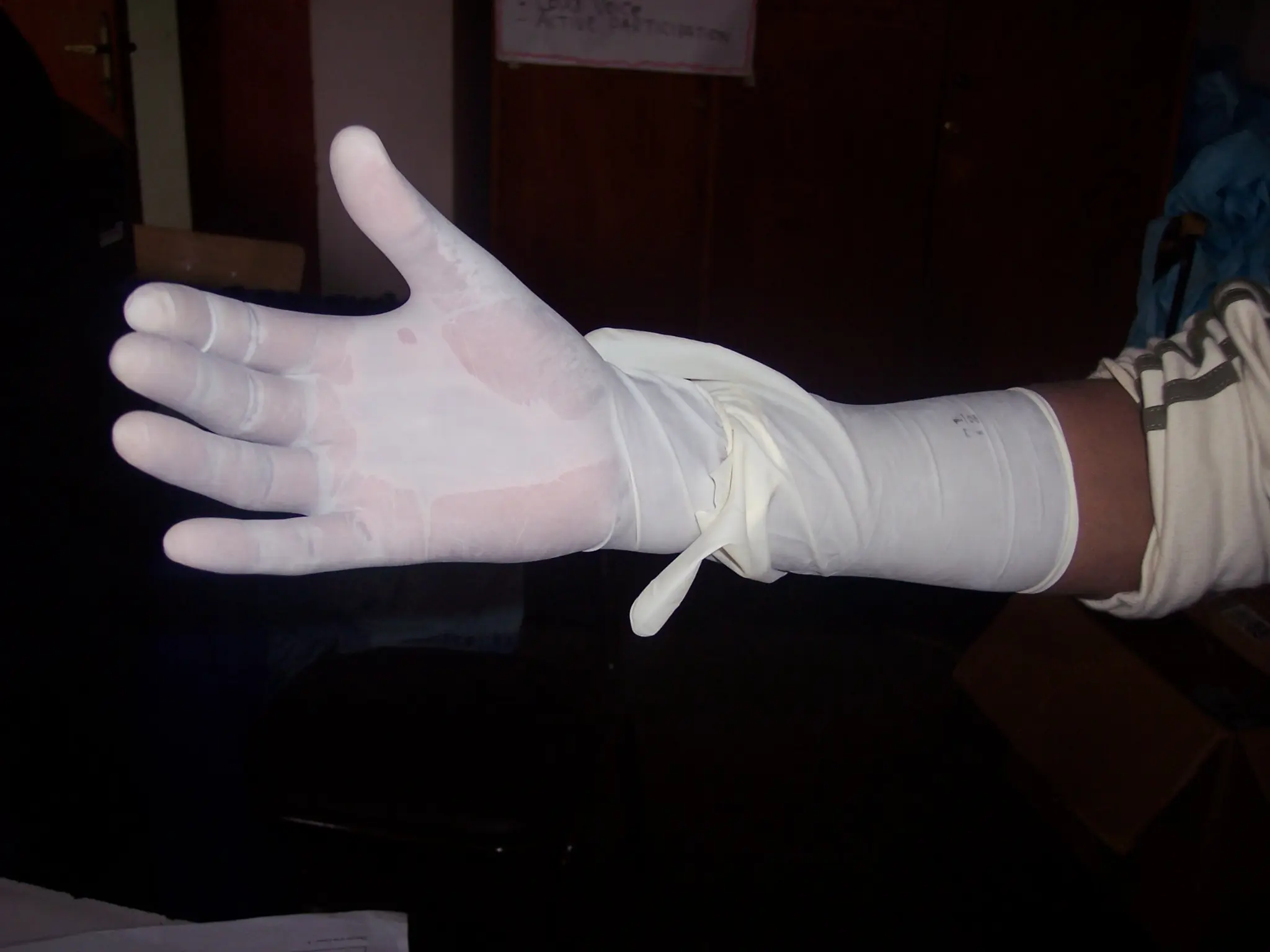
 If elbow-length gloves are not available, an
inexpensive, effective alternative can be easily
made from surgical gloves .
 Used if we suspect exposure to extensive body
fluid, secretion.
 steps for making elbow-length gloves
48
49
50
51
52
Issues with Gloves
be aware that gloves may elicite Allergic reactions
Use water-soluble hand lotions to prevent skin from
drying.
Use oil-based and perfumed hand lotions.
53
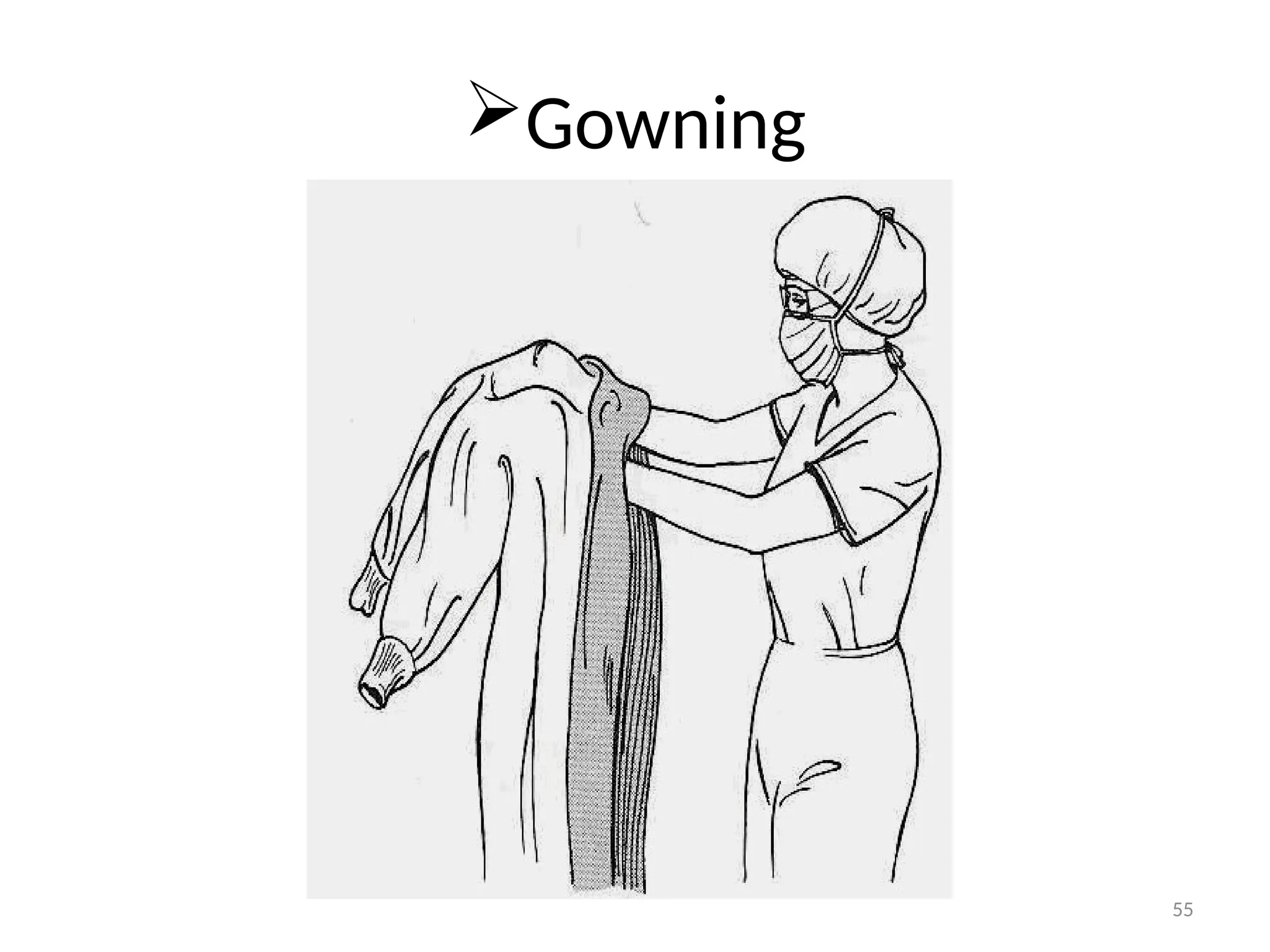
Donning and removing surgical Gowns
• The purpose of wearing sterile gown is in
order to provide sterile field
• There are two methods of sterile gowning:-
o Gowning self and
o Gowning another
54
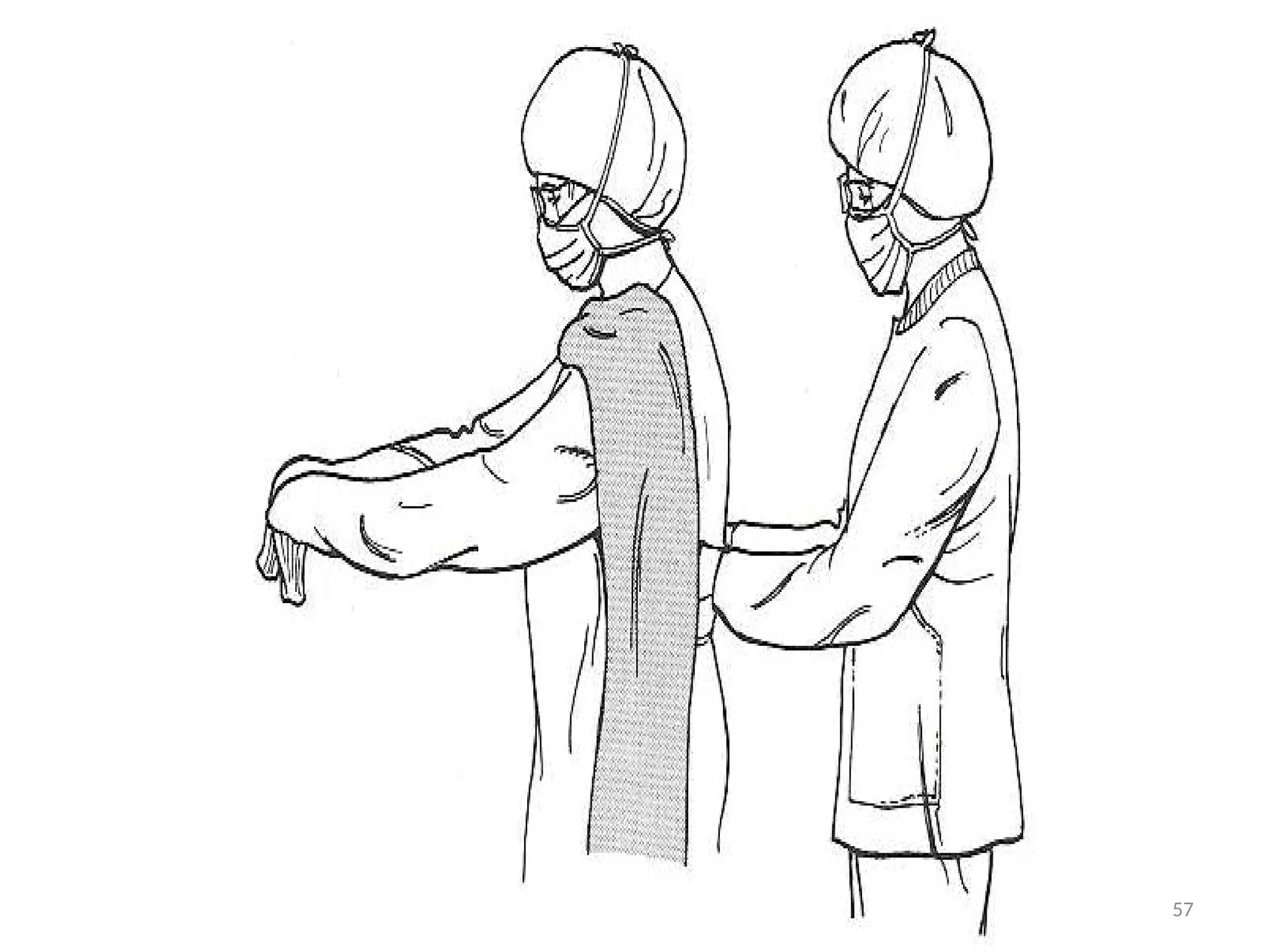
• The practitioners must ensure that they touch
the inside of the gown only and that both
arms are inserted into the sleeves of the gown
together.
• The circulating person should assist the
scrubbed person by securing the gown’s back
ties.
55
Gowning
56
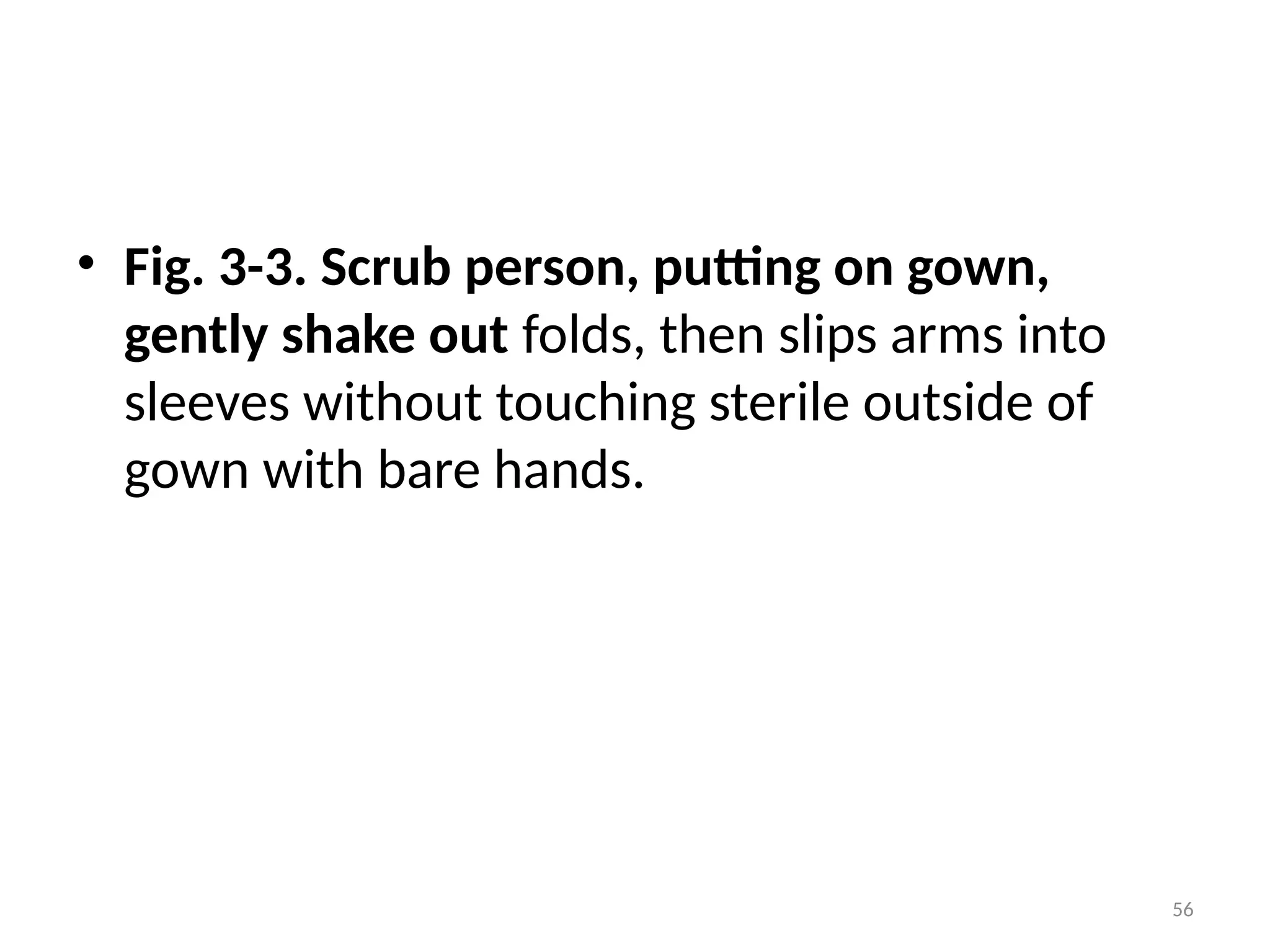
• Fig. 3-3. Scrub person, putting on gown,
gently shake out folds, then slips arms into
sleeves without touching sterile outside of
gown with bare hands.
57
58
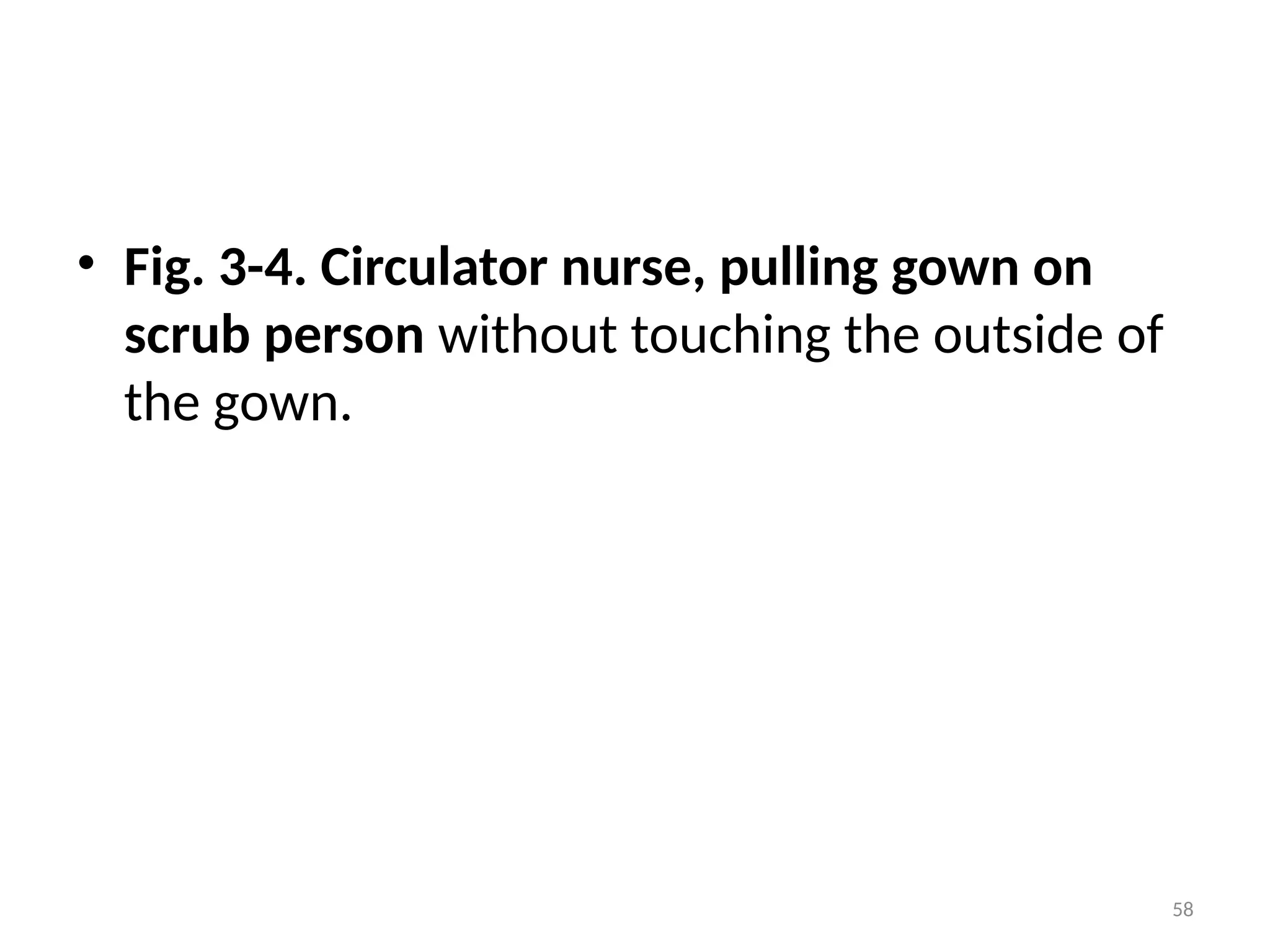
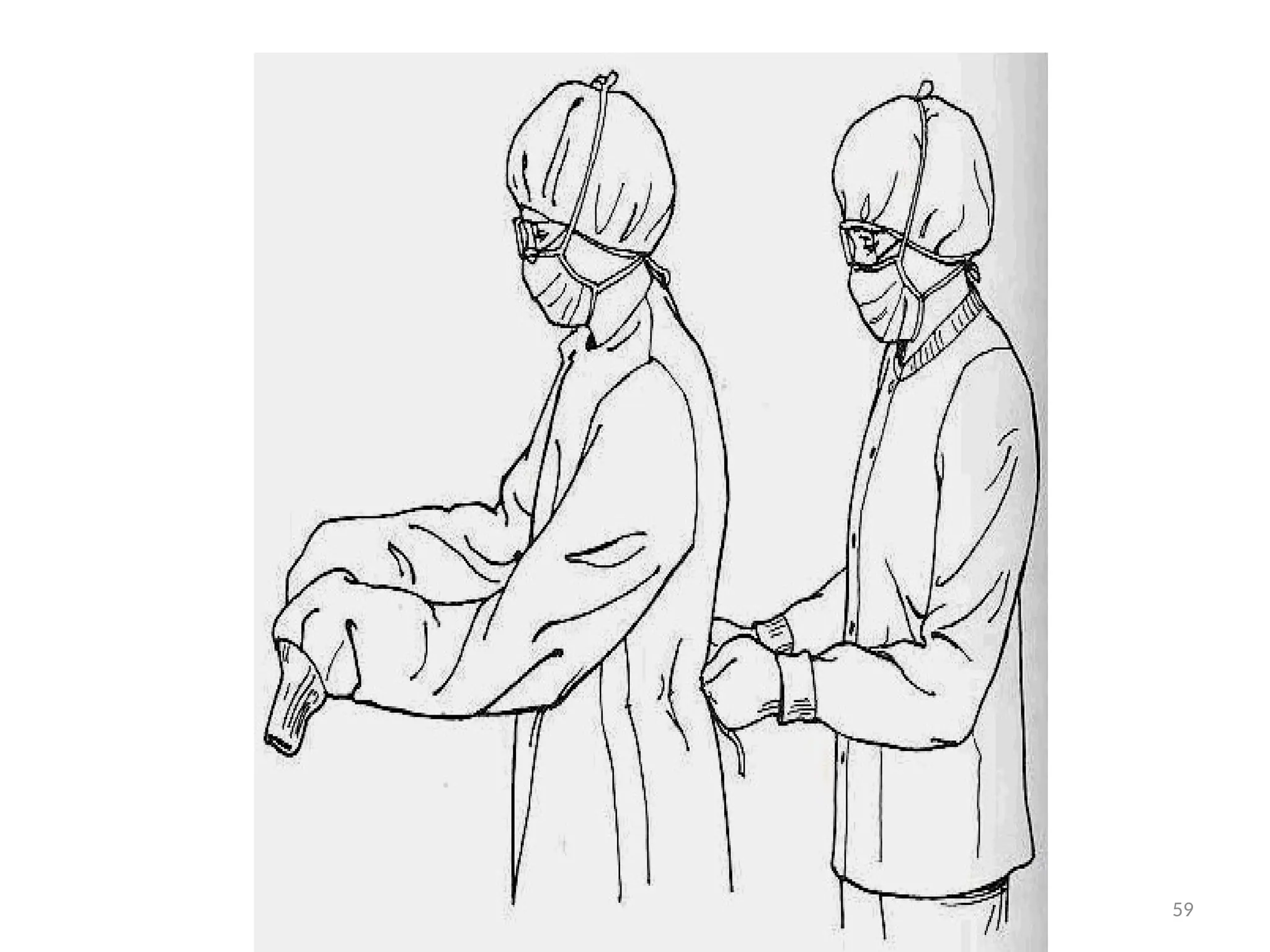
• Fig. 3-4. Circulator nurse, pulling gown on
scrub person without touching the outside of
the gown.
59
60
• Fig. 3-5. Circulator nurse completes pulling on
scrub person’s gown, secures ties on inside of
back, and closes fastener at neck.
61
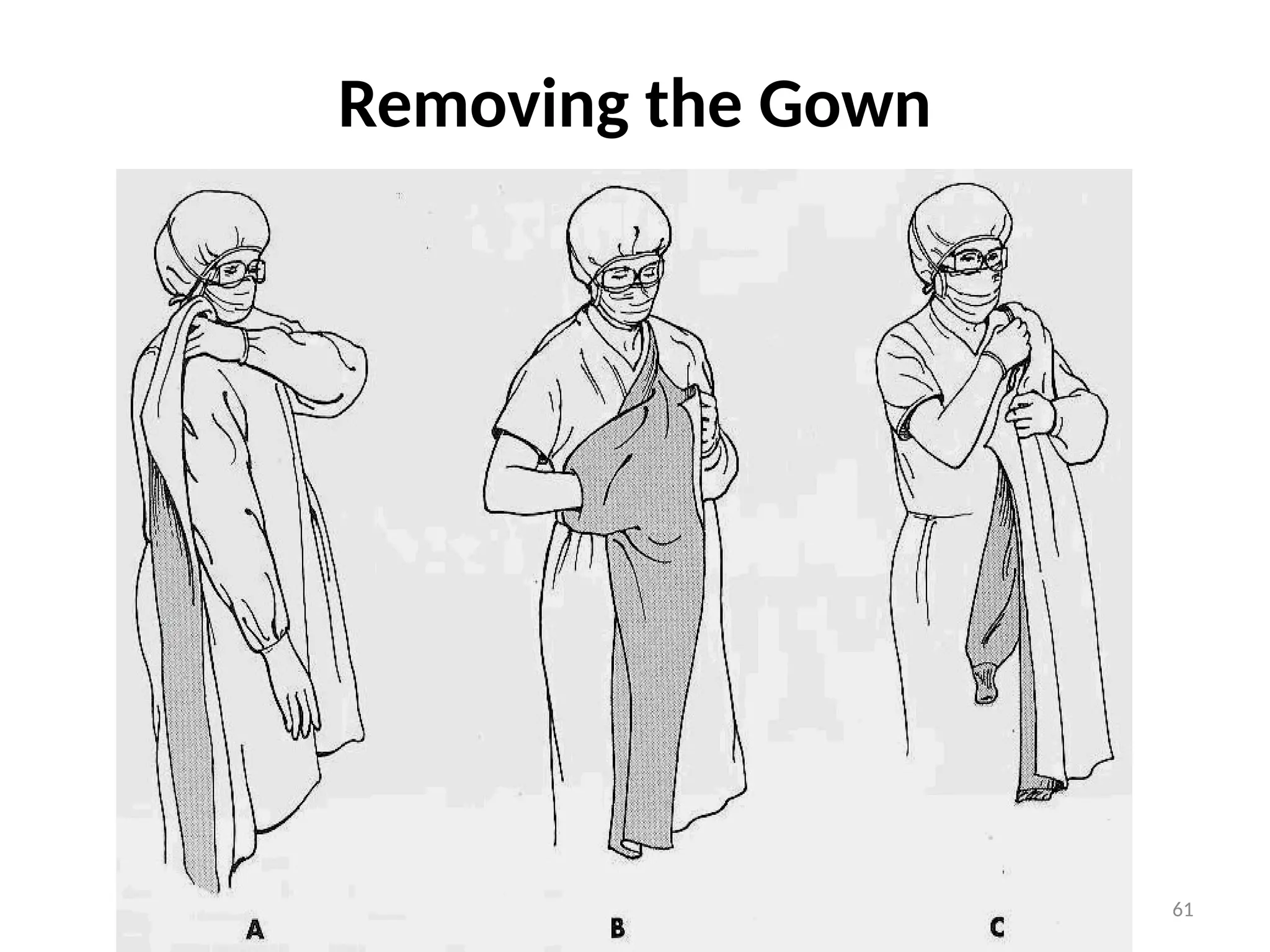
Removing the Gown
62
• Fig. 3-6. (A to C) sequence of scrub person
removing soiled gown at the end of a surgical
procedure. Clean arms and scrub suite are
protected from contaminated outside of
gown.
63
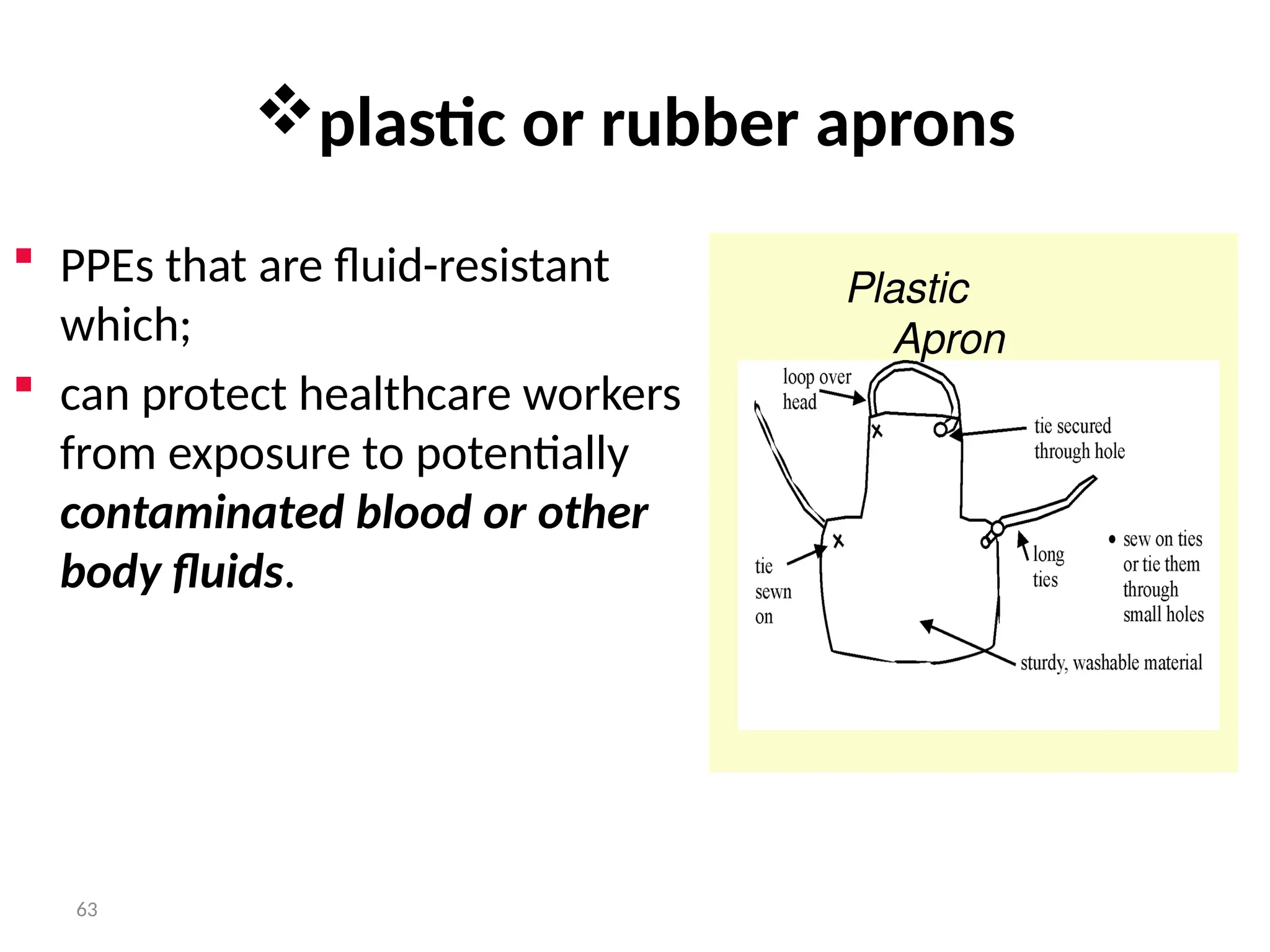
plastic or rubber aprons
 PPEs that are fluid-resistant
which;
 can protect healthcare workers
from exposure to potentially
contaminated blood or other
body fluids.
Plastic
Apron
64
Masks
• made from a variety of materials
• Should be large enough to cover the nose,
lower face, jaw and facial hair.
• Masks are worn in an attempt to contain
moisture droplets expelled as the HCW
speak, cough or sneeze.
• to prevent accidental splashing during
certain procedures .
65
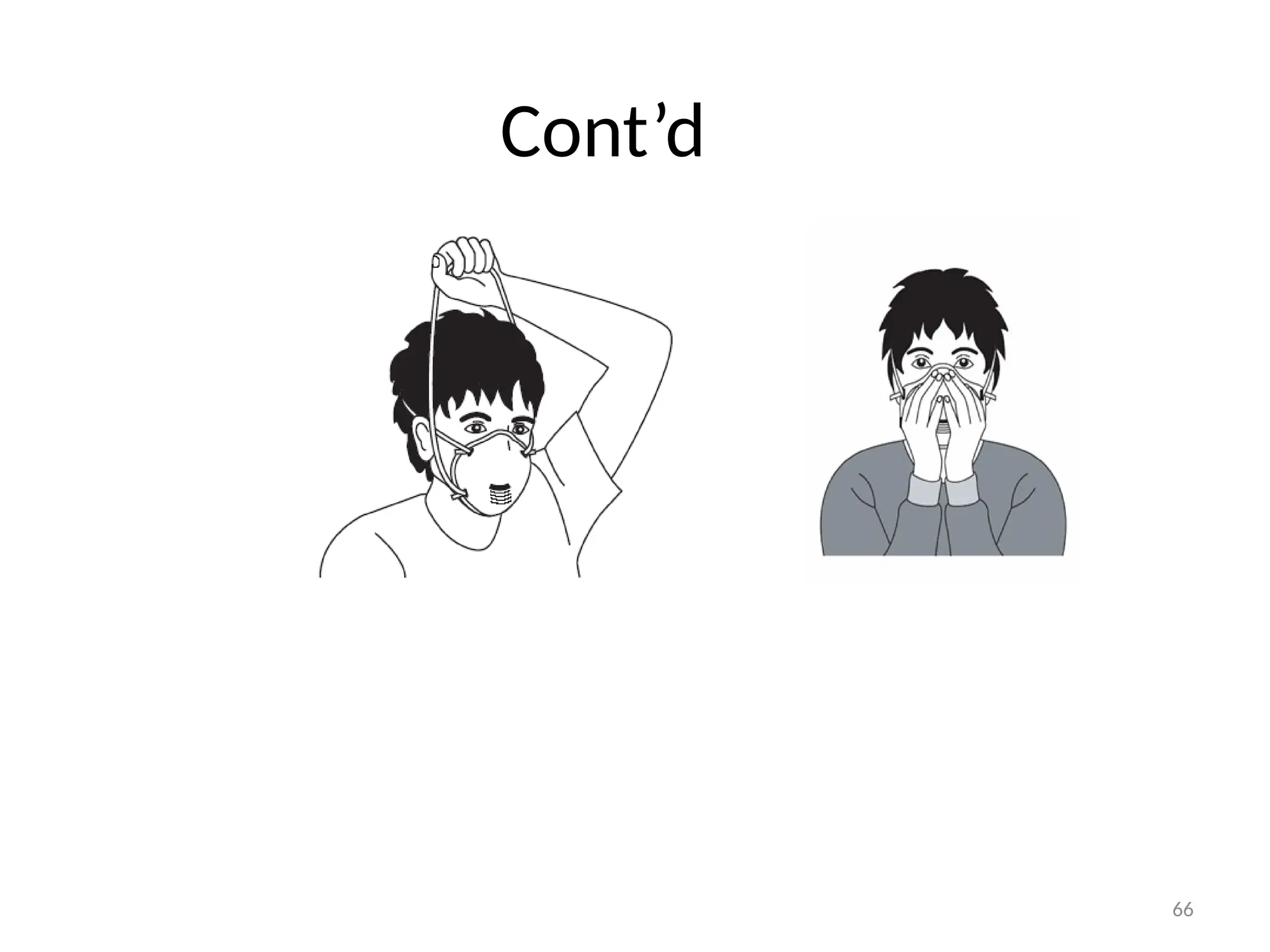
 Respirators
• Are specialized types of masks e.g. N95
particulate respirators
• More expensive than surgical masks
• Recommended for situations in which
filtering inhaled air is important.
• It contains multiple layers of filtering
material and fit the face tightly.
66
Cont’d
67
Goggle/face shield
• prevent accidental splashing of the mouth and
face during certain procedures.
Cap
• used to keep the hair and scalp covered so
that flakes of skin and hair are not shed into
the wound during surgery
68
 Footwear
• It is used to protect feet injury
from sharps or heavy items that
may occur accidentally.
• Sandals or shoes made of soft
materials (cloth) should not be
worn.
• Rubber shoes provide more
protection, but they must be kept
clean.
69
Healthcare waste management
• refers to all activities, involved in the collection,
handling, treatment, conditioning, transport, storage
and disposal of waste produced at healthcare facilities
High Risk Wastes
o Infectious waste
o Anatomical waste
o Sharps wastes (used or unused)
o Chemical waste
o Pharmaceutical waste
o Radioactive wastes
o Pressurized containers
70
Low Risk Wastes
• Non infectious waste/Communal wastes
Waste Segregation
• Waste segregation is separating waste by type at the
place where it is generated
• Purpose
–Protect people who handle waste items from
injuries
–Prevent the spread of infections to HCWs who
handle waste
–Prevent the spread of infection to the community,
-protect the environment
71
Separate wastes based on their level of infection
• Noninfectious (Black color code): Presents no risk.
Examples: paper, packaging materials, office
supplies, drink containers, hand towels, boxes,
glass, plastic bottles, and food.
• Infectious (Yellow color code): Contaminated with
human blood and has the ability to spread disease.
Examples: gauze, cotton, dressings, laboratory
cultures, IV fluid lines, blood bags, gloves, and
pharmaceutical waste.
72
• Highly infectious (Red color code): Highly infectious
Anatomical waste, pathological waste
• Sharps waste (Safety box, needle remover, or other
puncture-resistant and leak-resistant sharps
containers): Syringes and needles should be
discarded without recapping.
73
House keeping
Patient unit care
Patient's unit is a small separate room in
which the patient rest during his/her hospital
stay.
• Patient's unit usually consists of basic
furniture and standard equipment.
74
Cleaning of patient's unit is keeping of
the patients room neat & orderly.
• There are two types of cleaning that are
concurrent and terminal cleaning
75
1. Concurrent Cleaning
• is a daily cleaning of the patients room.
• It consists cleaning the room by damp
mopping the floor and dusting with
damp cloth.
76
Purpose:
• To prevent accumulation of dirty
• To promote the pt's health and comfort
physically & mentally
• To remove germs & dust particles
• To prevent spread of micro organisms
• To have neat appearance of the unit.
77
Terminal cleansing of the patient care unit
• The sanitation of the bed, bedside cabinet,
and general area of the patient care unit with
a detergent/germicidal agent after the patient
is discharged or transferred from the nursing
care unit.
• Performed at every patient care unit before
the area is prepared for the next patient.
78
Purpose
• Prevention of the spread of microorganisms.
• Removal of encrusted secretions from
framework or bedside rails.
• Removal of residue of body wastes from the
mattress.
• Deodorizing of the bed frame, mattress, and
pillow.
79
Guidelines for Terminal Cleaning
• Reviews ward for specific procedures.
• Use only authorized disinfectant/detergent or
germicidal solution for cleaning.
• Check to ensure the bedside cabinet is
cleared of any valuables belonging to the
patient.
• Check bed linens for personal items
(dentures, contact lenses, money, jewelry,
etc.) belonging to the patient.
80
• Prevent spread of microorganisms by carefully
removing linen from the bed.
• Use caution when cleaning the under frame
and bedsprings.
• Replace any torn mattress or pillow covers.
• Allow the mattress and pillow to air-dry
thoroughly before remaking the bed.
81
Linen processing
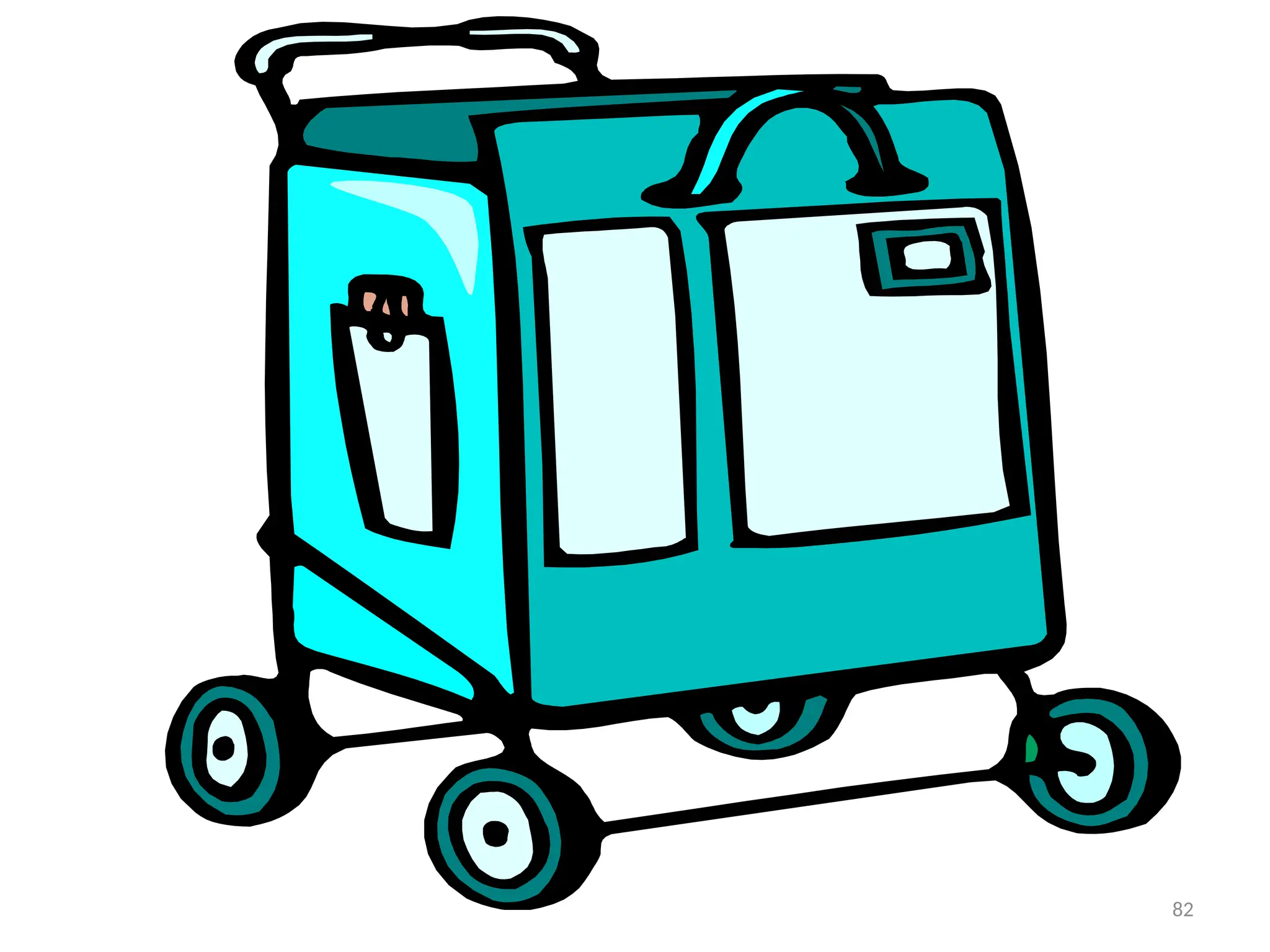
• Processing linen-: consists of all the steps
required to collect, transport and sort
soiled linen as well as to launder (wash,
dry and fold or pack), store and
distribute it.
82
83
Injection Safety
At the end of the topic, students will be able
to:-
Define injection safety, and describe the
situation of unsafe injection,
Describe the risks and impacts associated
with unsafe injection practices,
Identify best practices in injection Safety
Differentiate the advantage and
disadvantage of different injection devices,
84
Definition:
 A safe injection is an injection that:
Does not harm the recipient
Does not expose the provider to any
avoidable risk
Does not result in any waste that is
dangerous for other people
Is given by skillful health care worker
using sterile equipment,
85
Needles-stick injury: Puncture of the skin
caused by an injection needle.
Sharps injury: An injury caused by puncture
of the skin by a sharp object/instrument.
Safety (Sharps) box: A puncture/liquid-
proof container designed to hold used
sharps safely during collection, transport
and disposal .
86
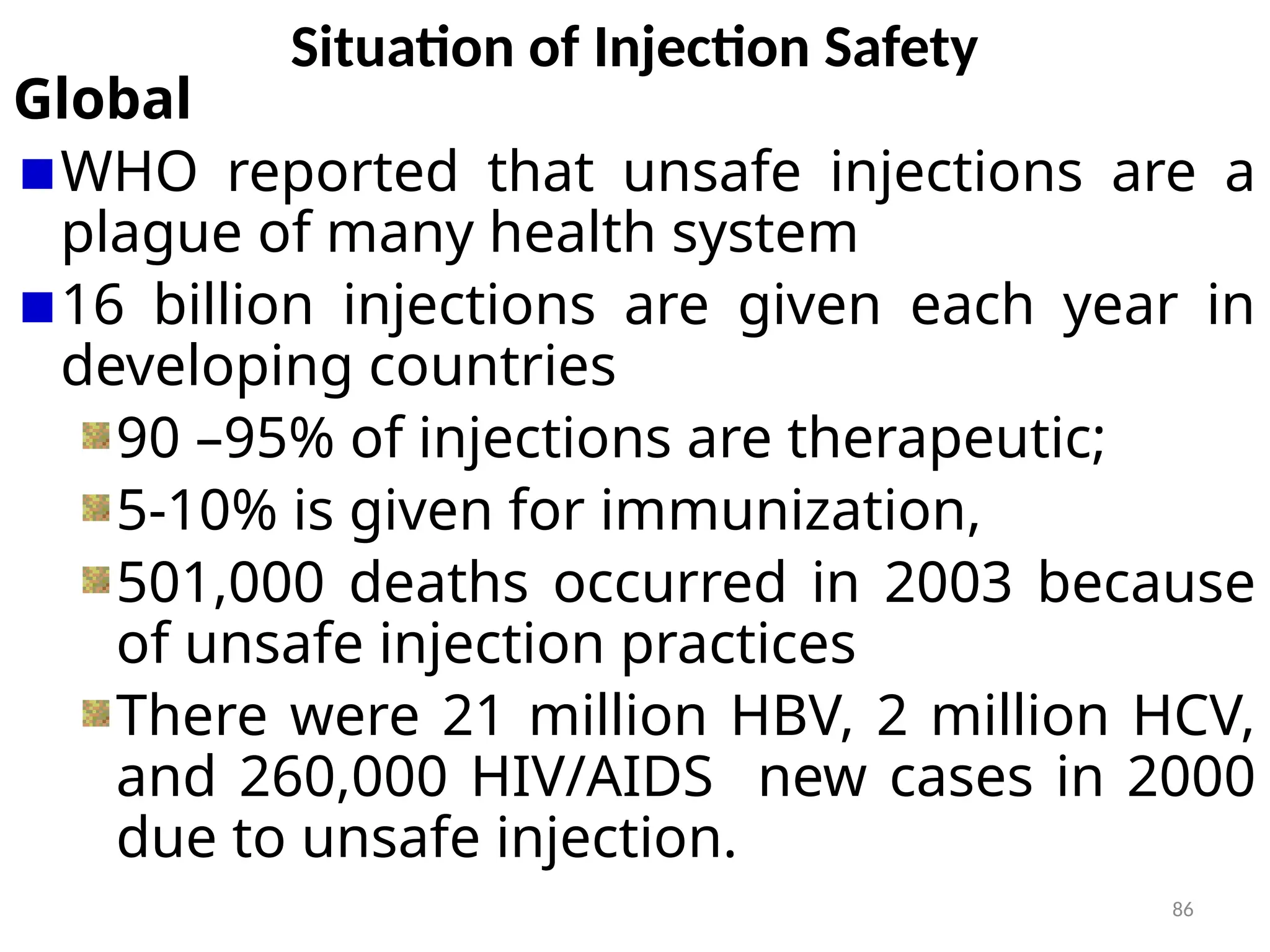
Situation of Injection Safety
Global
WHO reported that unsafe injections are a
plague of many health system
16 billion injections are given each year in
developing countries
90 –95% of injections are therapeutic;
5-10% is given for immunization,
501,000 deaths occurred in 2003 because
of unsafe injection practices
There were 21 million HBV, 2 million HCV,
and 260,000 HIV/AIDS new cases in 2000
due to unsafe injection.
87
Situation in Ethiopia
The survey covered 40 health facilities.
74% of the observed injections were unsafe.
32% of the health workers reported needle
stick injuries in the last 12-month.
45% of patients prefer injection. However, on
the contrary, most health workers reported
that clients prefer injection to oral drugs.
Evidence shows that death and disability
associated with unsafe injections are highly
preventable.
88
Reasons for providing unsafe injections:
 Inadequate dissemination and use of standard
treatment guidelines
 Prescriber preference for injections
Lack of knowledge on the dangers of injections,
Perception that injections are more effective than
oral medications,
Perception that injections give more rapid relief,
Perception that injections are more potent,
financial incentive for prescribing injections
Perceived belief that patients prefer injections
 The role of informal health care providers in giving
injections,
89
Risk and Impact of unsafe Injection
Transmission of blood born infections
 There are about 40 blood borne
pathogens that could be transmitted via
injection. Among these, HBV, HCV,
HIV/AIDS are the commonest and with
grave implications
Injection abscesses
Paralysis- following the damage of a nerve
as a result of injection of a drug into a nerve
and trauma.
Drug/allergic reactions:
90
Risk Groups:
1. Health care providers
2. Patients/clients
3. Communities
• Impacts of Unsafe Injection
1- Health Impact
 There are about 40 blood born pathogens that can
be transmitted via unsafe injections; of all
HBV,HCV and HIV are the common once.
91
Unsafe injection causes:
• 21.7 million new HBV infection
• 2.3-4.7 million contract HCV
Nearly 2-5% of all new HIV infections are
caused by unsafe injections
2. Economic impact
Each year unsafe injection causes a
dramatic global economic impact
Annual burden of indirect medical cost
estimated to be US 535 million,
Increases economic burden on the family.
92
3. Psycho-Social
Social stigma and discrimination
Stress associated with HIV
Decreased productivity of an individual
Burden up on the community
Loss of trained health workers
93
Best practice in Safe Injection
1. Elimination of Unnecessary Injection
– Promoting Rational Prescribing
– Educating the patients.
2. Administer Injections Safely; Make sure you are doing the
‘right’ things (Respect the nine right of safe injection)
1. Right Patient,
2. Right Drug,
3. Right formulation,
4. Right injection equipment,
5. Right dosage,
6. Right time,
7. Right route,
8. Right storage
9. Right method of disposal
94
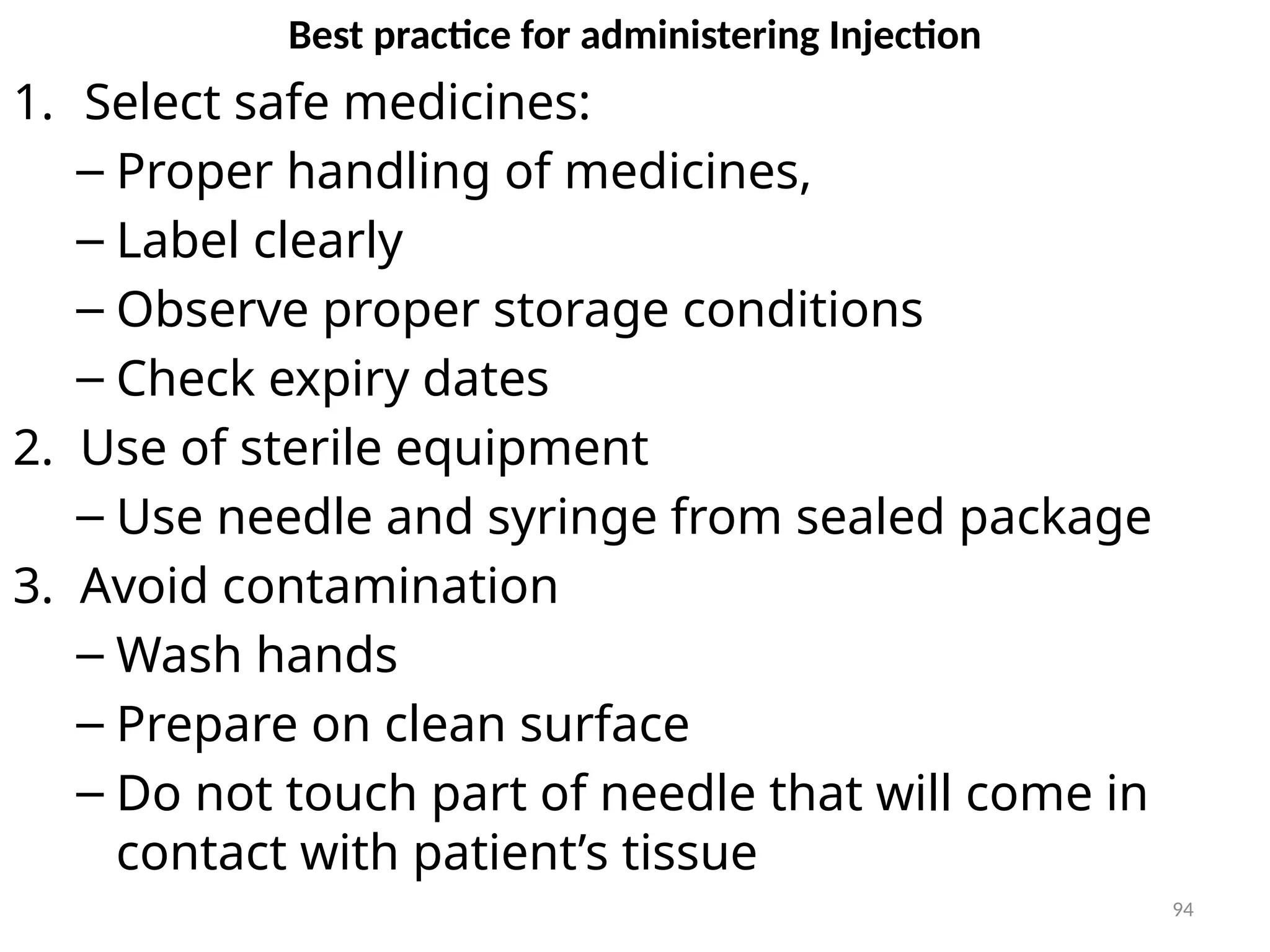
Best practice for administering Injection
1. Select safe medicines:
– Proper handling of medicines,
– Label clearly
– Observe proper storage conditions
– Check expiry dates
2. Use of sterile equipment
– Use needle and syringe from sealed package
3. Avoid contamination
– Wash hands
– Prepare on clean surface
– Do not touch part of needle that will come in
contact with patient’s tissue
95
4. Reconstitute drugs or vaccines safely
–Use new sterile syringe and needle for
each reconstitution
–Use the correct diluents/water for injection
–Reconstitute according to the
manufacturers’ specifications
5. Dispose of injection wastes and sharps
properly
–Immediate disposal of needle and syringe
in puncture- and leak-proof container
6. Public health education
96
Types of Injection Device
1. Auto-disable syringes
Advantage:
–Cannot be reused.
–They save time for sterilization.
• Disadvantage:
–More expensive than standard disposable
–Have no safety features
–Need collection and disposal system.
97
2. Automatically retractable:
• Advantage:
–Cannot be reused.
–Has safety feature: needle retracts inside
barrel.
–It saves time for healthcare workers from
the burden of sterilization.
–Eliminate the patient-to-patient disease
transmission,
• Disadvantage:
–Most expensive
98
3. Standard disposable ;
Advantage:
–Cheap.
–Available on local market.
–They save time for healthcare workers from the
burden of sterilization.
–Eliminate the patient-to-patient disease
transmission.
Disadvantage:
–Can be reused without sterilization.
–Have no safety features.
–Need sharps container or needle remover.
99
Safety Device
1. Safety Box- is a puncture and leak-resistant
container for disposal of sharps including
hypodermic needles, needles from IV bags,
lancets, scalpels and suture needles.
• When using safety box the following points should
be considered:-
– Put sharps containers as close to the point of
use, ideally within arm’s reach.
– Don’t shake a container to settle its contents
and make room for more sharps.
– place containers in high traffic areas where
people could bump into them or be stuck by
someone carrying sharps to be disposed of.
100
2. Yellow pin- used for to hold contaminated
materials after use like catheter, nasogastric
tube, gloves,
3. Black pin- used to hold patient/client materials
like banana, orange… cover after eating and
discarded food after eating.
101
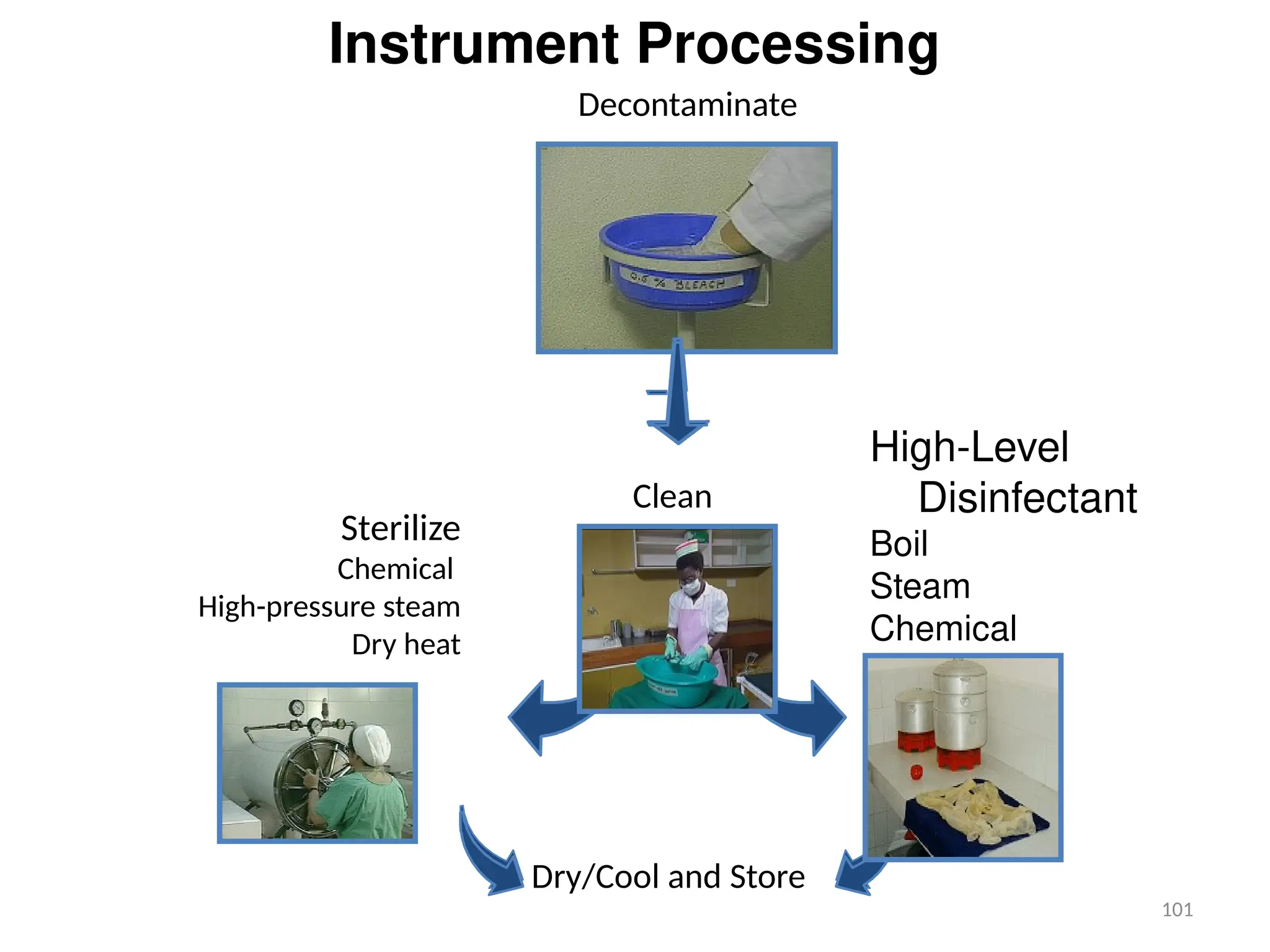
Instrument Processing
Decontaminate
Clean
Sterilize
Chemical
High-pressure steam
Dry heat
Dry/Cool and Store
High-Level
Disinfectant
Boil
Steam
Chemical
102
103
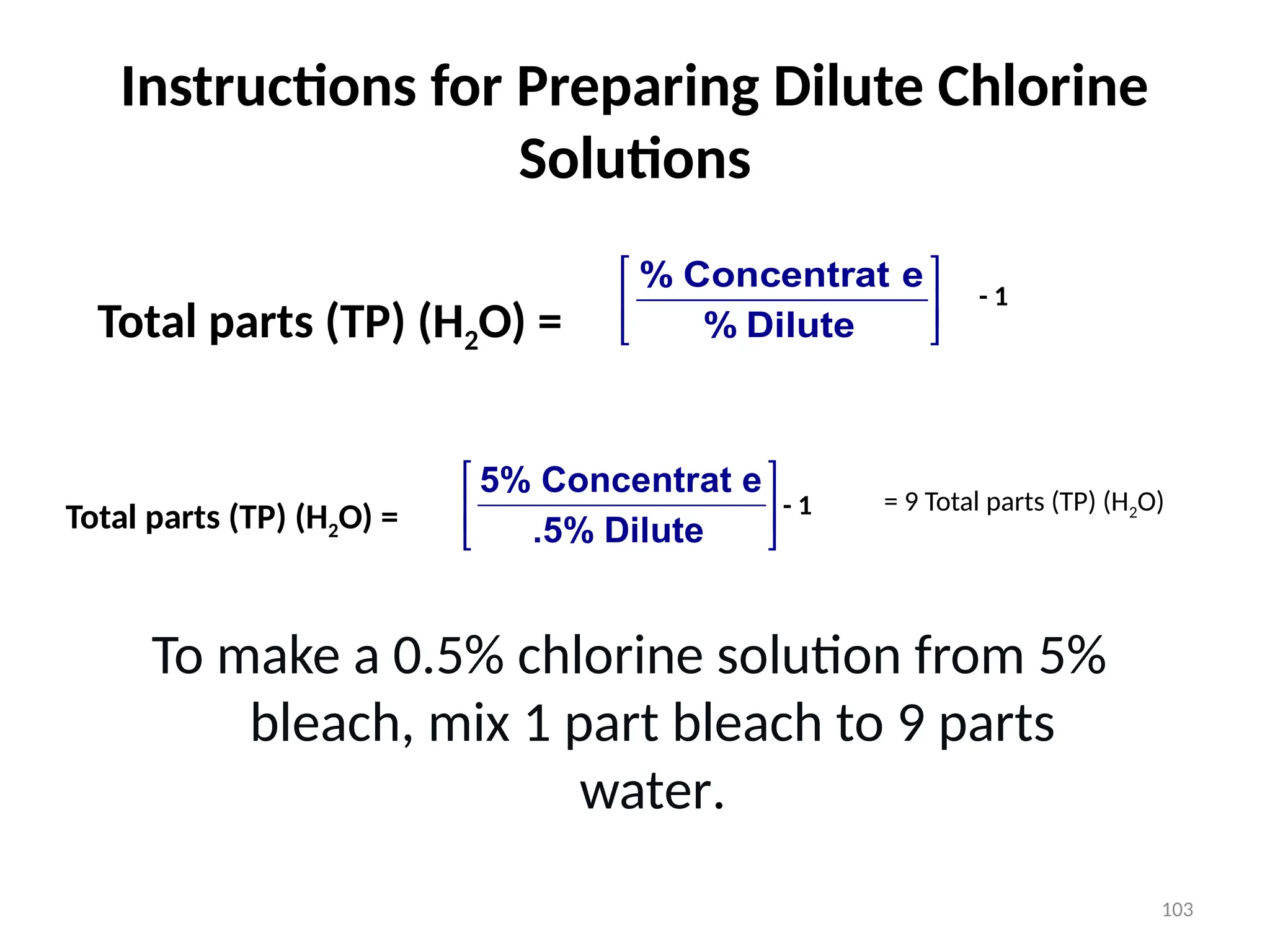
Instructions for Preparing Dilute Chlorine
Solutions






Dilute
%
e
Concentrat
%
Total parts (TP) (H2O) =
- 1
Total parts (TP) (H2O) = 





Dilute
.5%
e
Concentrat
5%
- 1 = 9 Total parts (TP) (H2O)
To make a 0.5% chlorine solution from 5%
bleach, mix 1 part bleach to 9 parts
water.
104
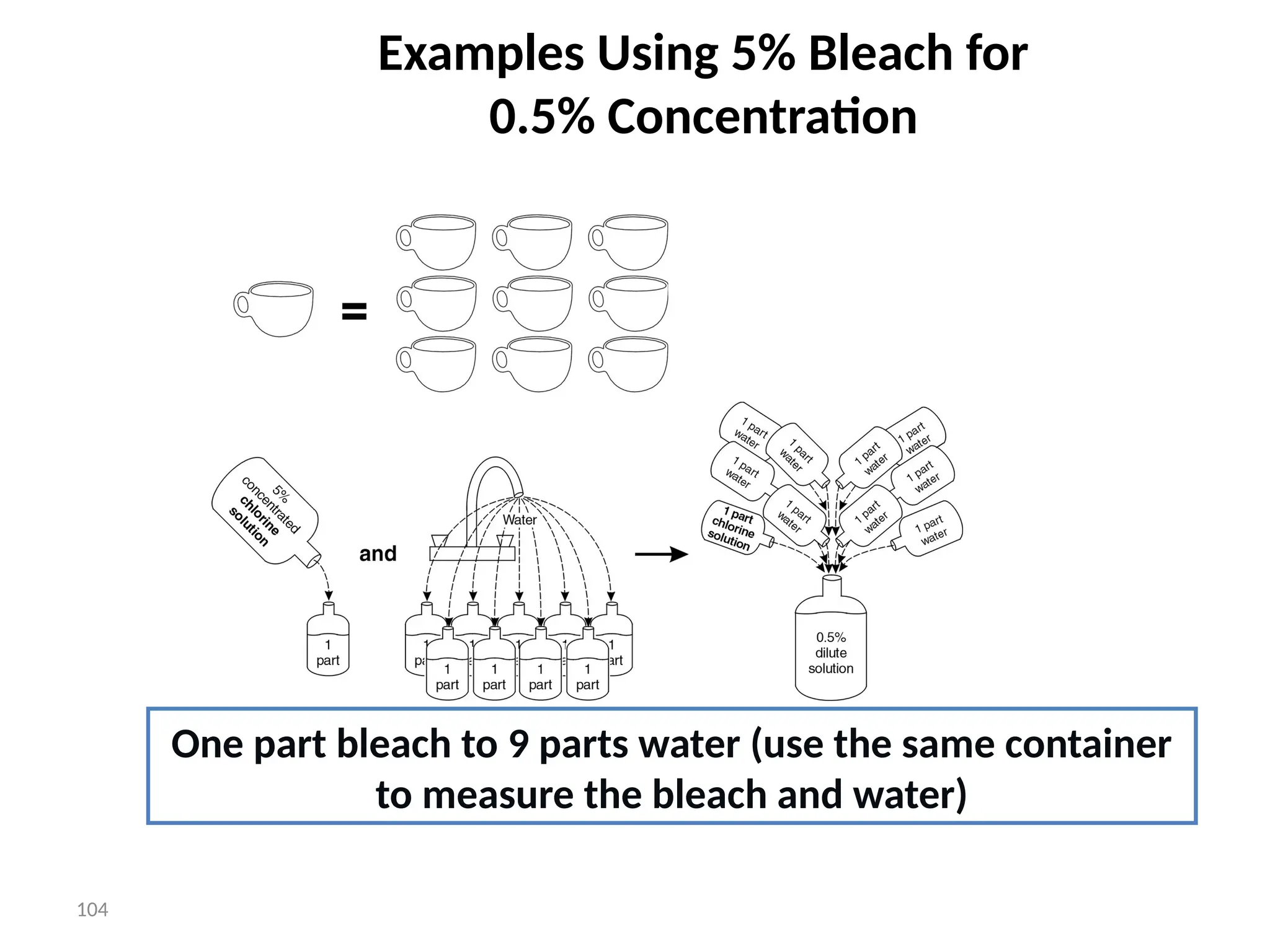
Examples Using 5% Bleach for
0.5% Concentration
One part bleach to 9 parts water (use the same container
to measure the bleach and water)
105
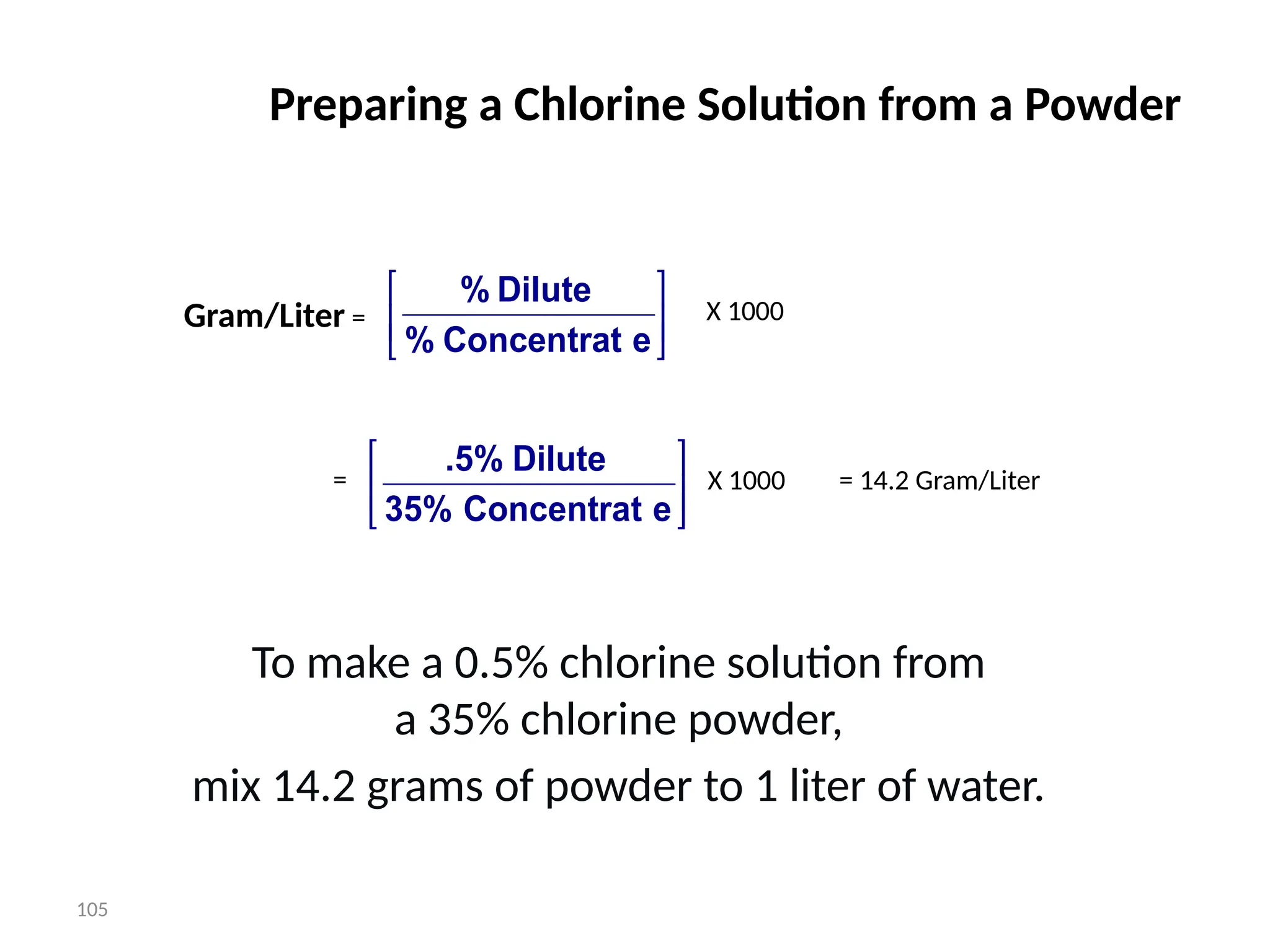
Preparing a Chlorine Solution from a Powder
To make a 0.5% chlorine solution from
a 35% chlorine powder,
mix 14.2 grams of powder to 1 liter of water.






e
Concentrat
%
Dilute
%
Gram/Liter = X 1000






e
Concentrat
35%
Dilute
.5%
= X 1000 = 14.2 Gram/Liter
106
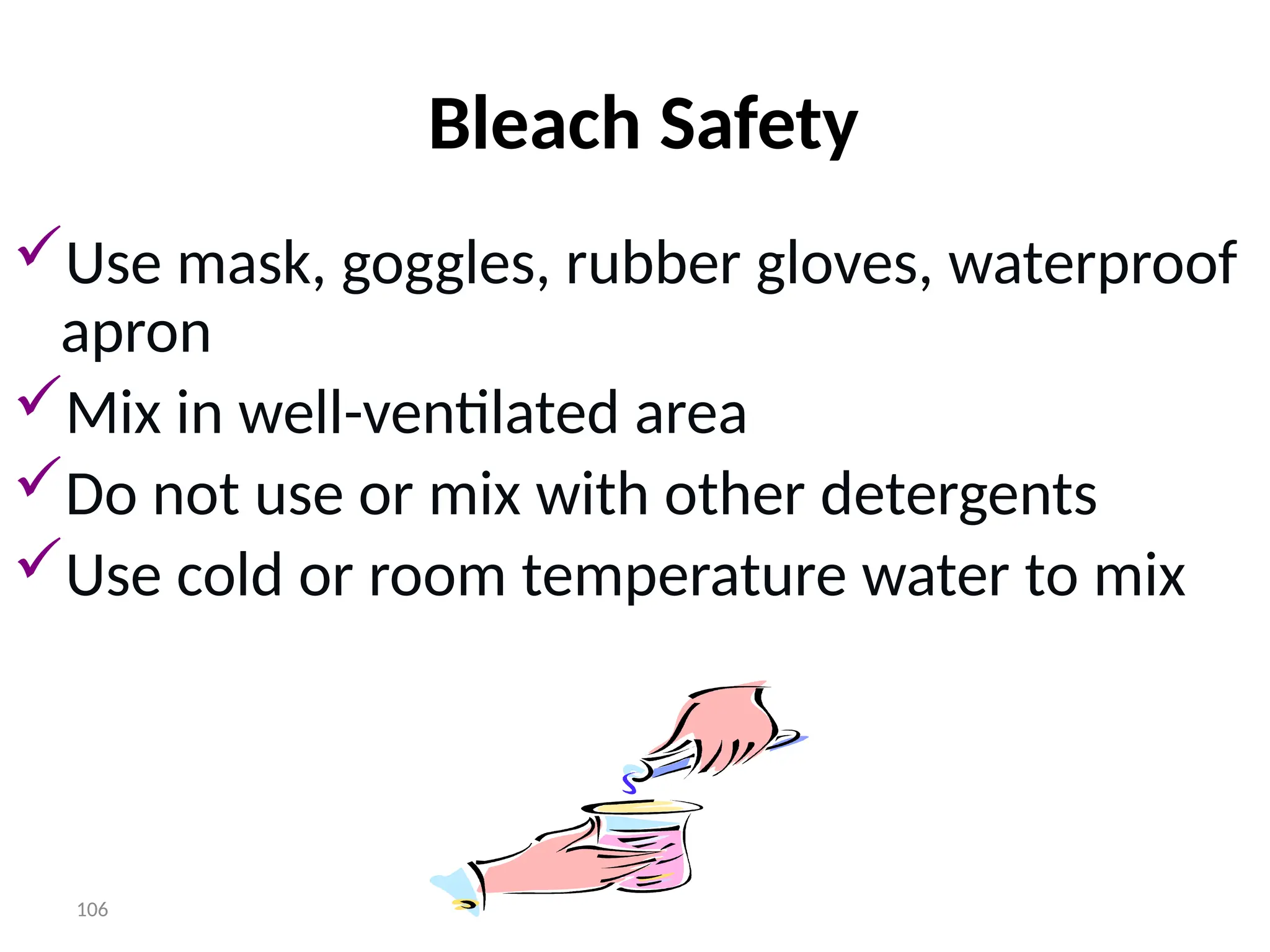
Bleach Safety
Use mask, goggles, rubber gloves, waterproof
apron
Mix in well-ventilated area
Do not use or mix with other detergents
Use cold or room temperature water to mix
107
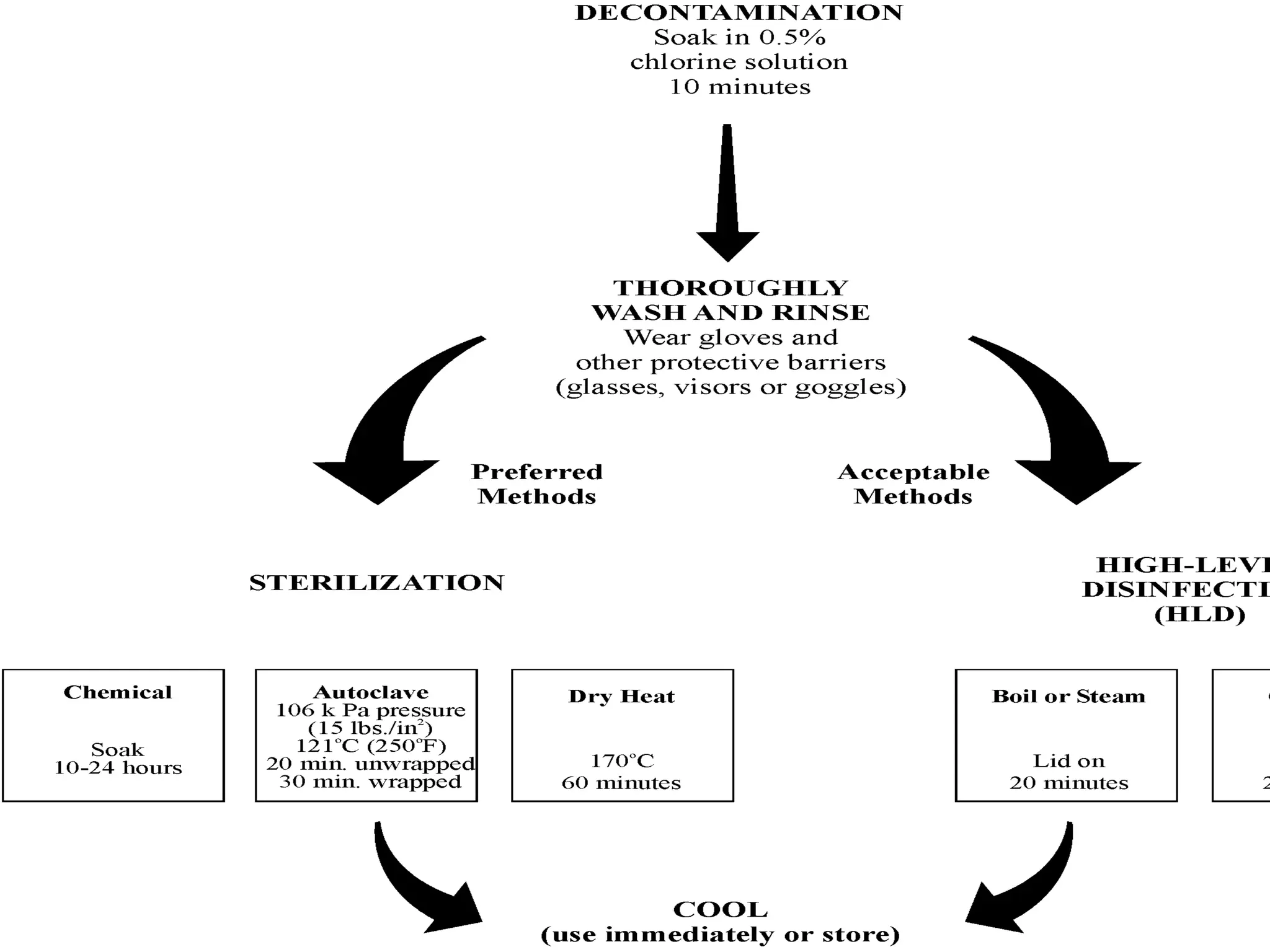
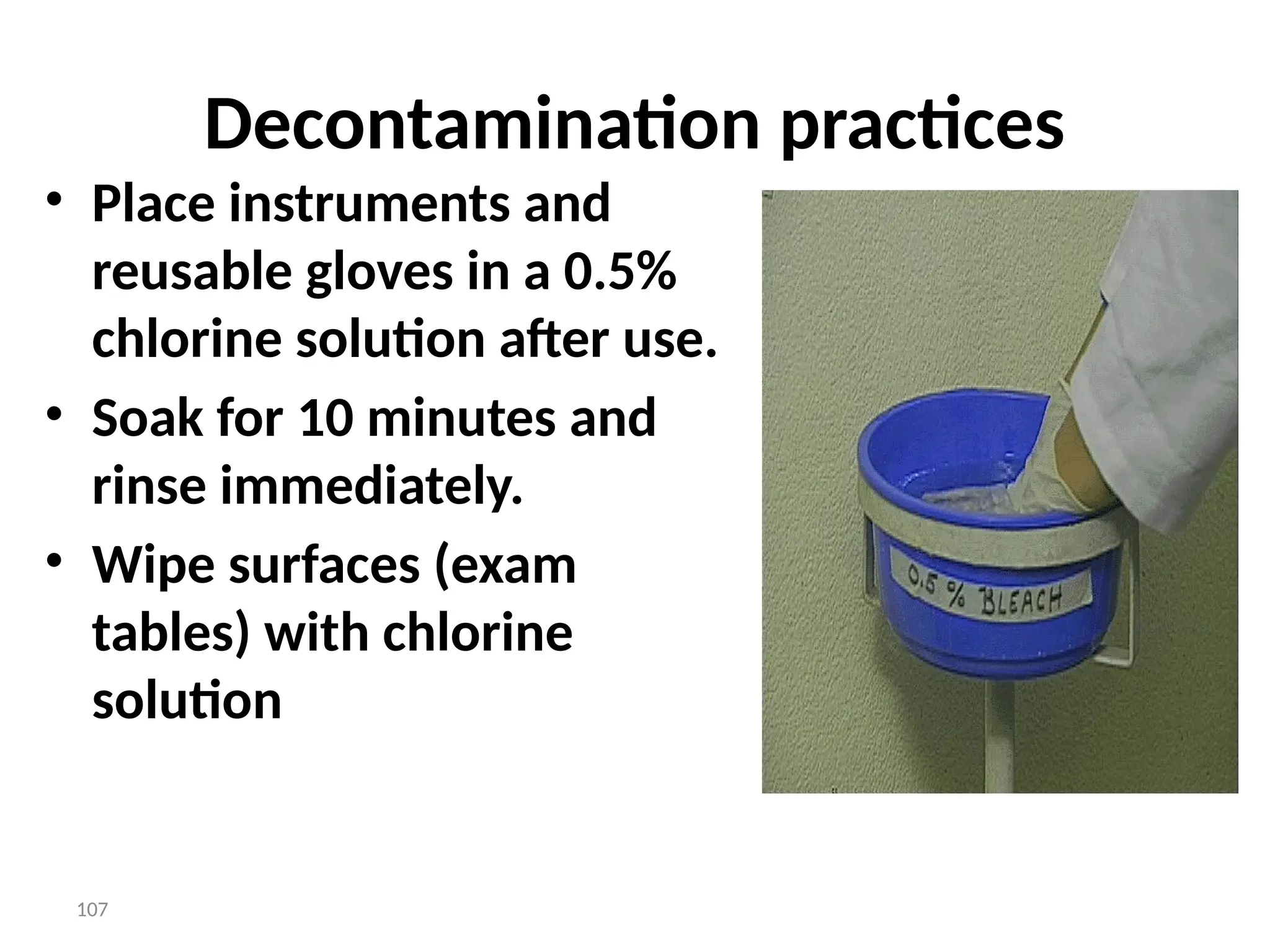
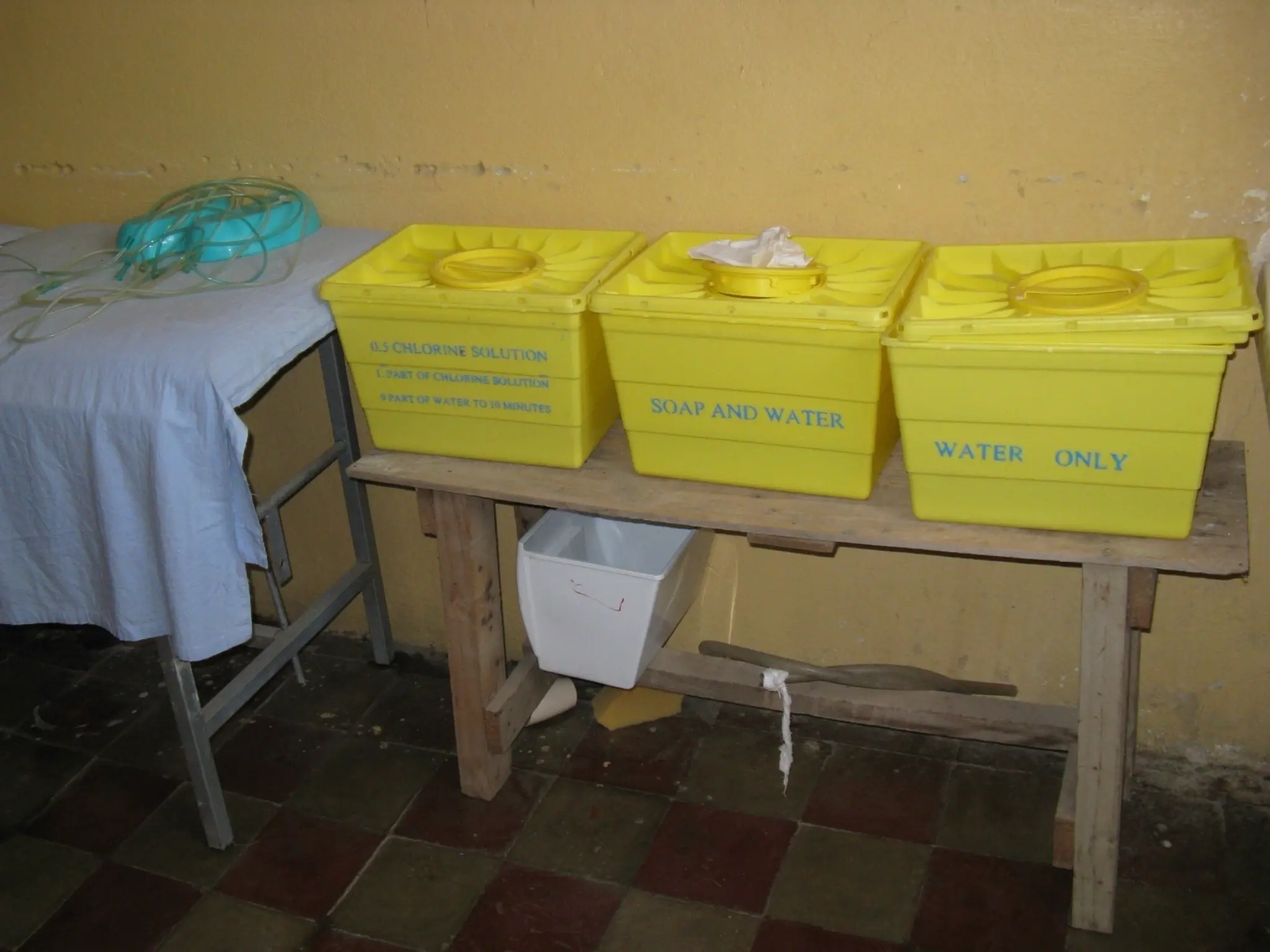
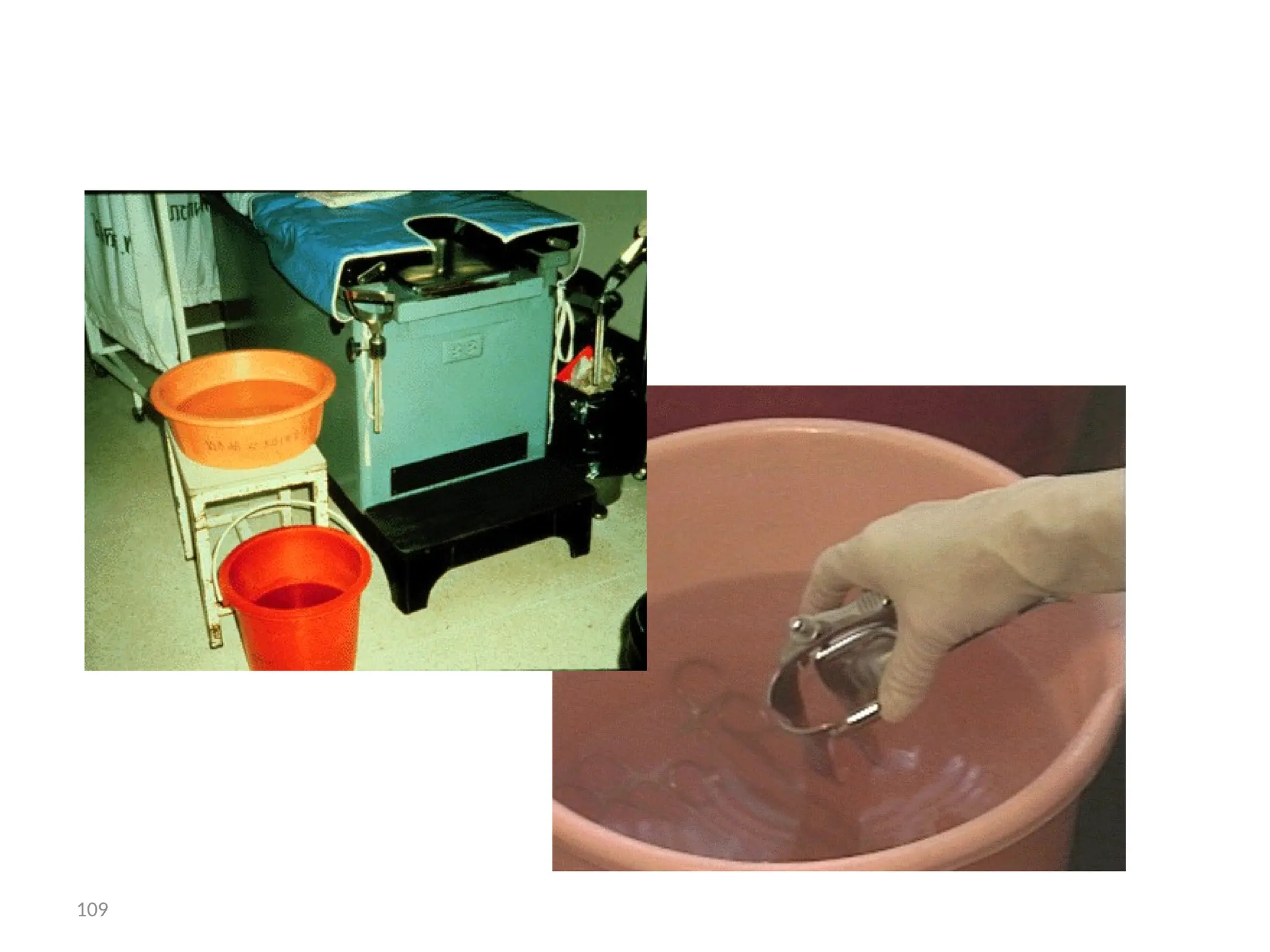
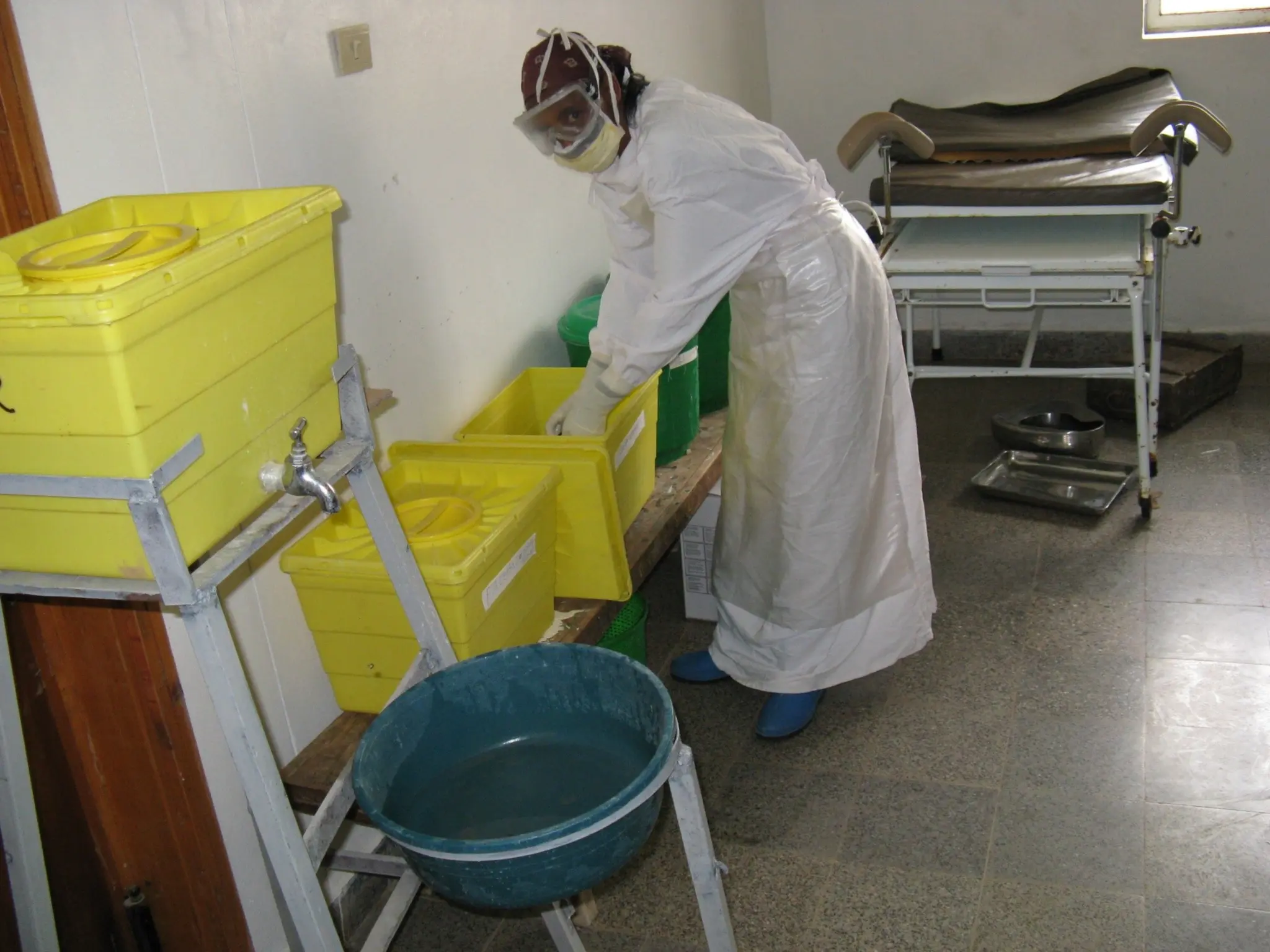
Decontamination practices
• Place instruments and
reusable gloves in a 0.5%
chlorine solution after use.
• Soak for 10 minutes and
rinse immediately.
• Wipe surfaces (exam
tables) with chlorine
solution
108
109
110
2. Cleaning
• Method of mechanically reducing the number of
microorganisms.
• Proper cleaning using detergents removes up to 80%
of microbial burden and also reduces the number of
spores which are difficult to eradicate using HLD as
final processing .
Principles:
Remove organic material that Protects
microorganisms against sterilization and HLD
Must be done for sterilization and HLD to be effective
111
Cleaning…
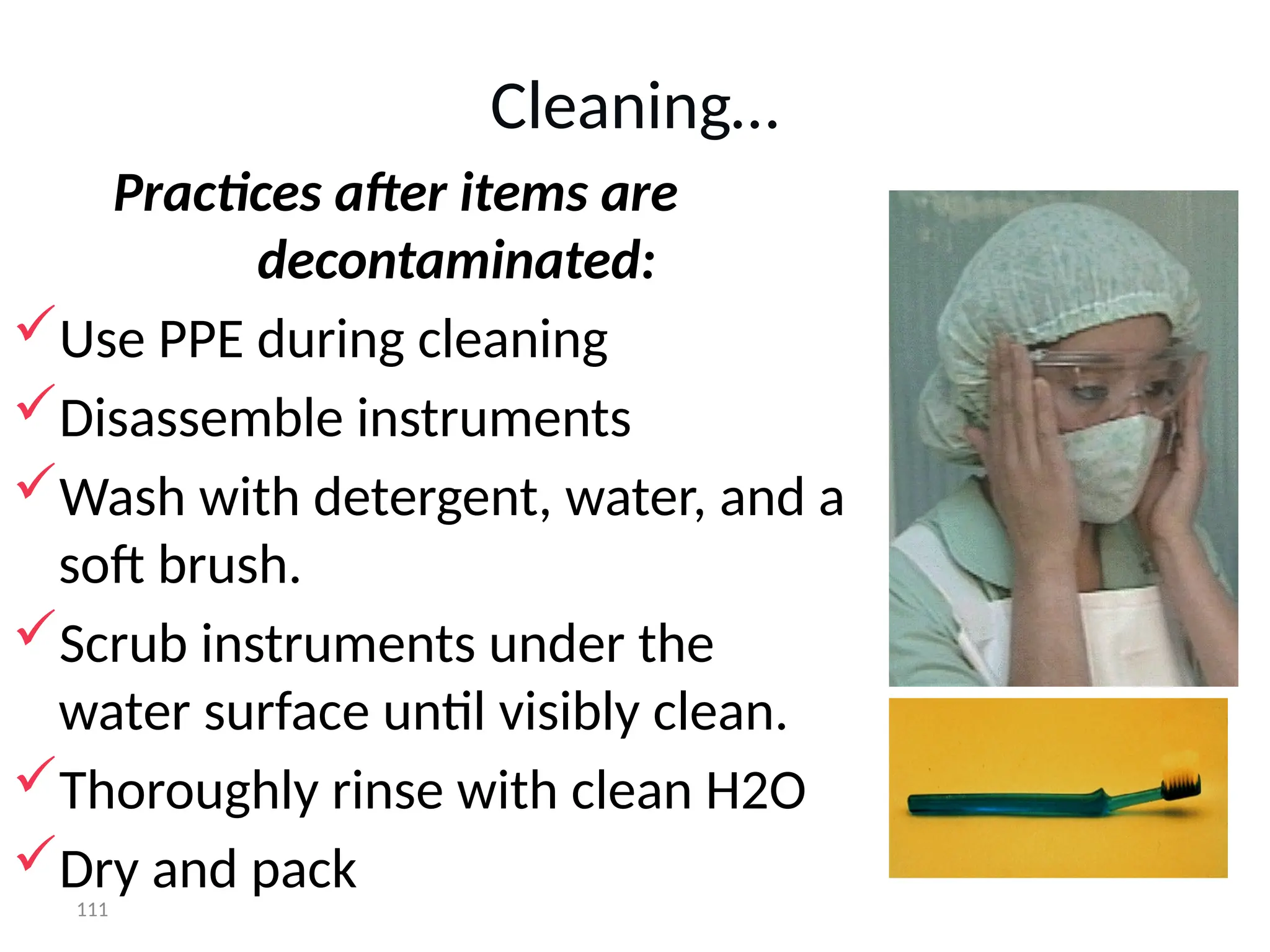
Practices after items are
decontaminated:
Use PPE during cleaning
Disassemble instruments
Wash with detergent, water, and a
soft brush.
Scrub instruments under the
water surface until visibly clean.
Thoroughly rinse with clean H2O
Dry and pack
112
113
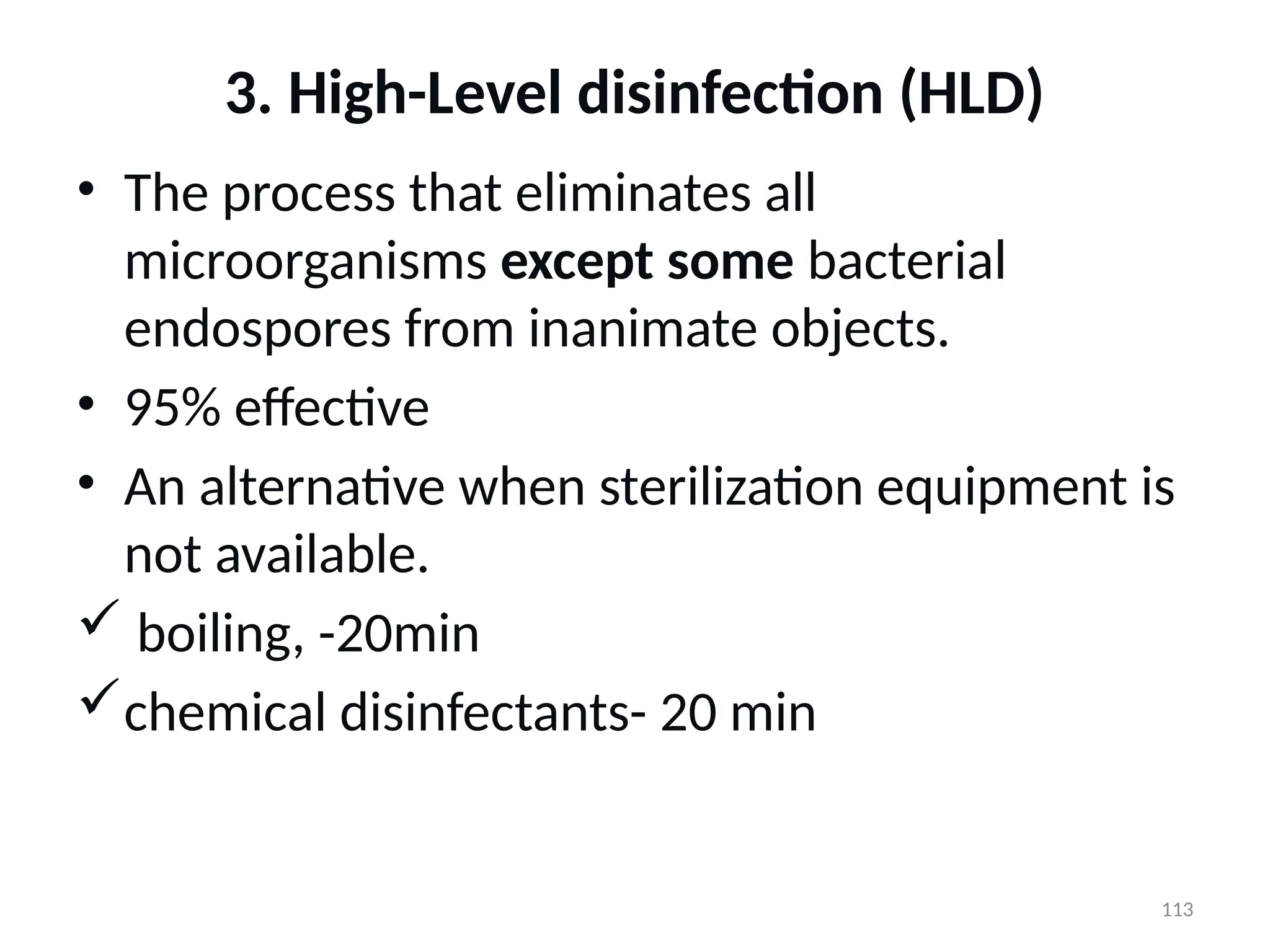
3. High-Level disinfection (HLD)
• The process that eliminates all
microorganisms except some bacterial
endospores from inanimate objects.
• 95% effective
• An alternative when sterilization equipment is
not available.
 boiling, -20min
chemical disinfectants- 20 min
114
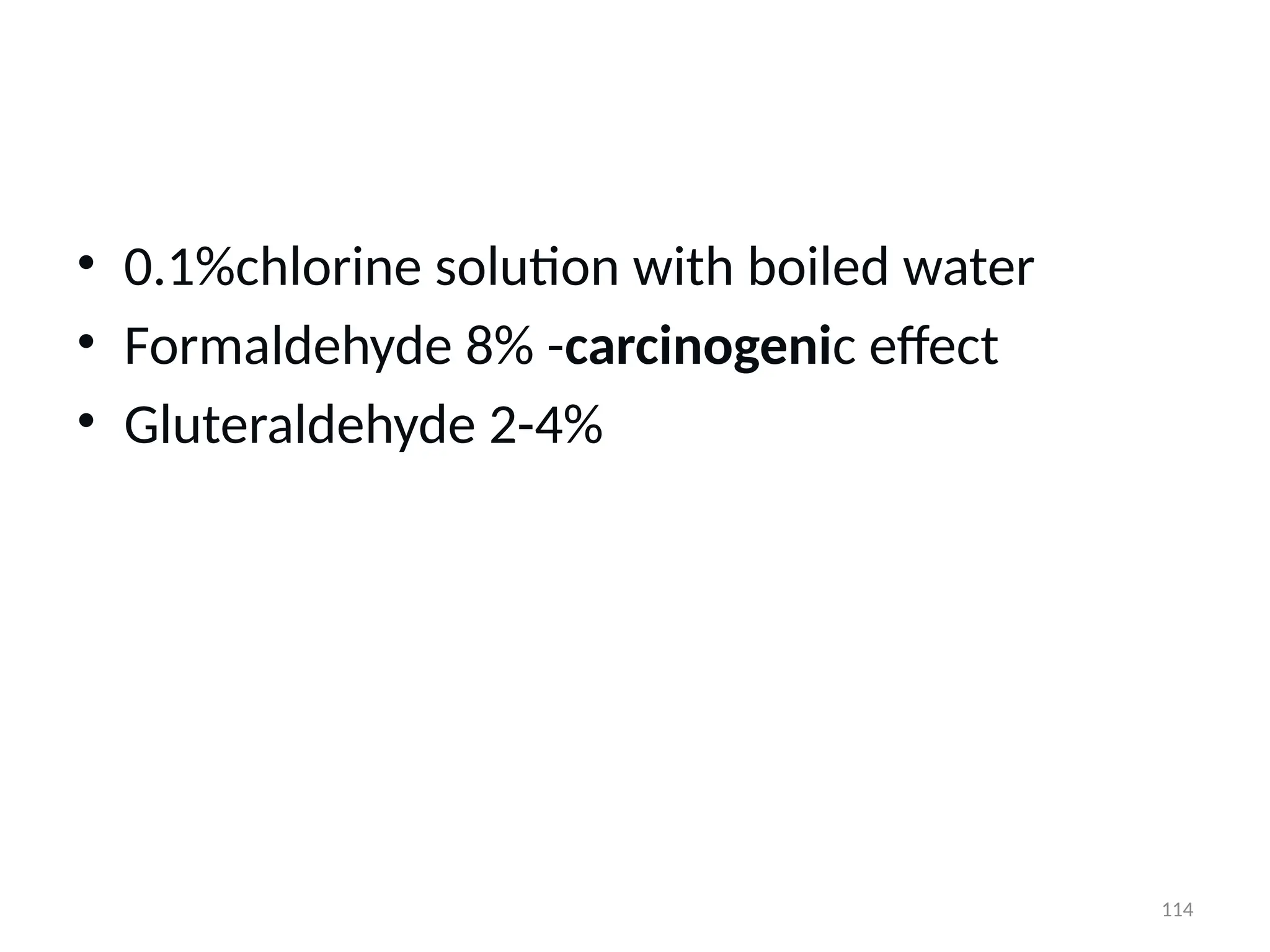
• 0.1%chlorine solution with boiled water
• Formaldehyde 8% -carcinogenic effect
• Gluteraldehyde 2-4%
115
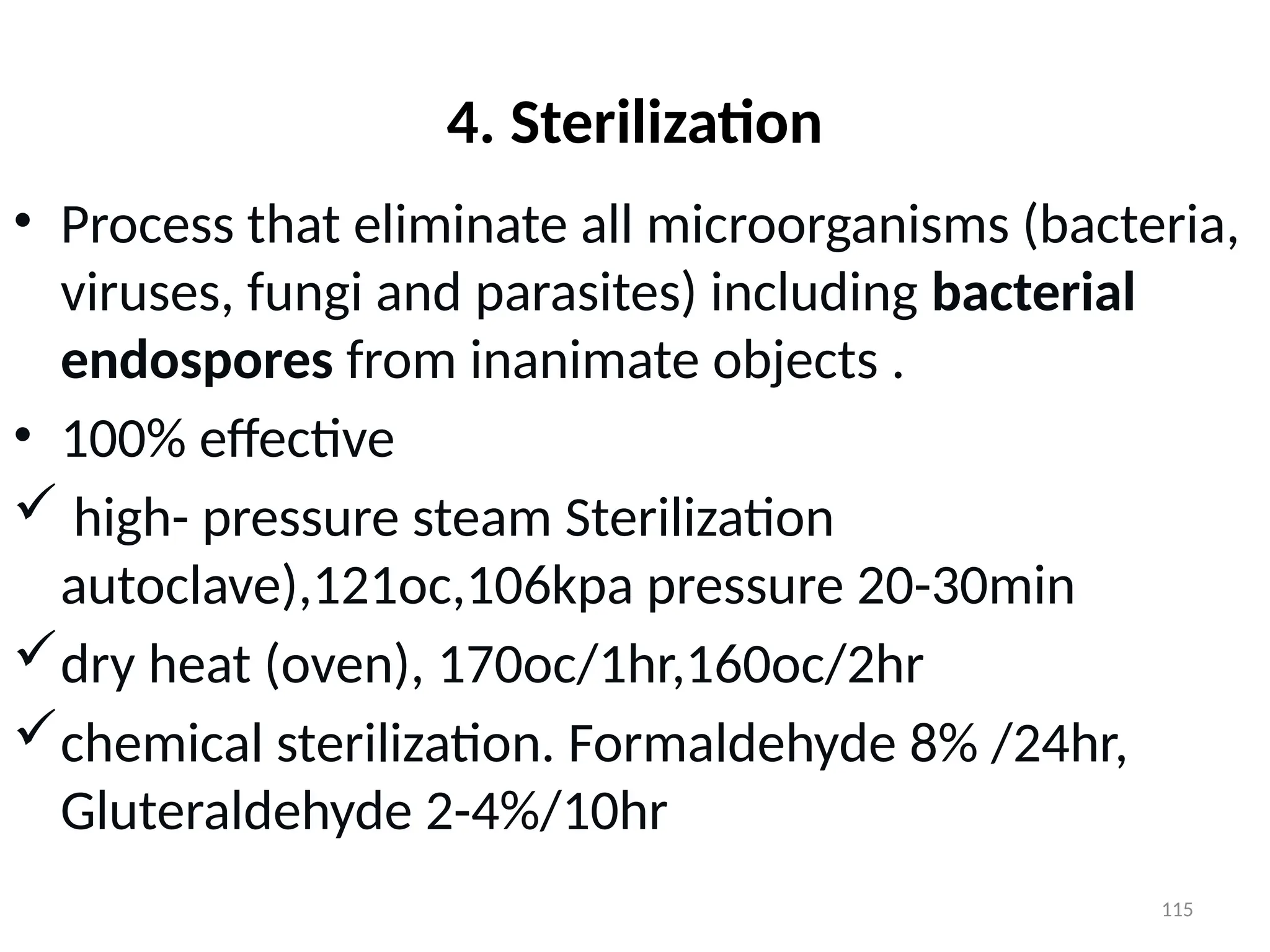
4. Sterilization
• Process that eliminate all microorganisms (bacteria,
viruses, fungi and parasites) including bacterial
endospores from inanimate objects .
• 100% effective
 high- pressure steam Sterilization
autoclave),121oc,106kpa pressure 20-30min
dry heat (oven), 170oc/1hr,160oc/2hr
chemical sterilization. Formaldehyde 8% /24hr,
Gluteraldehyde 2-4%/10hr
116
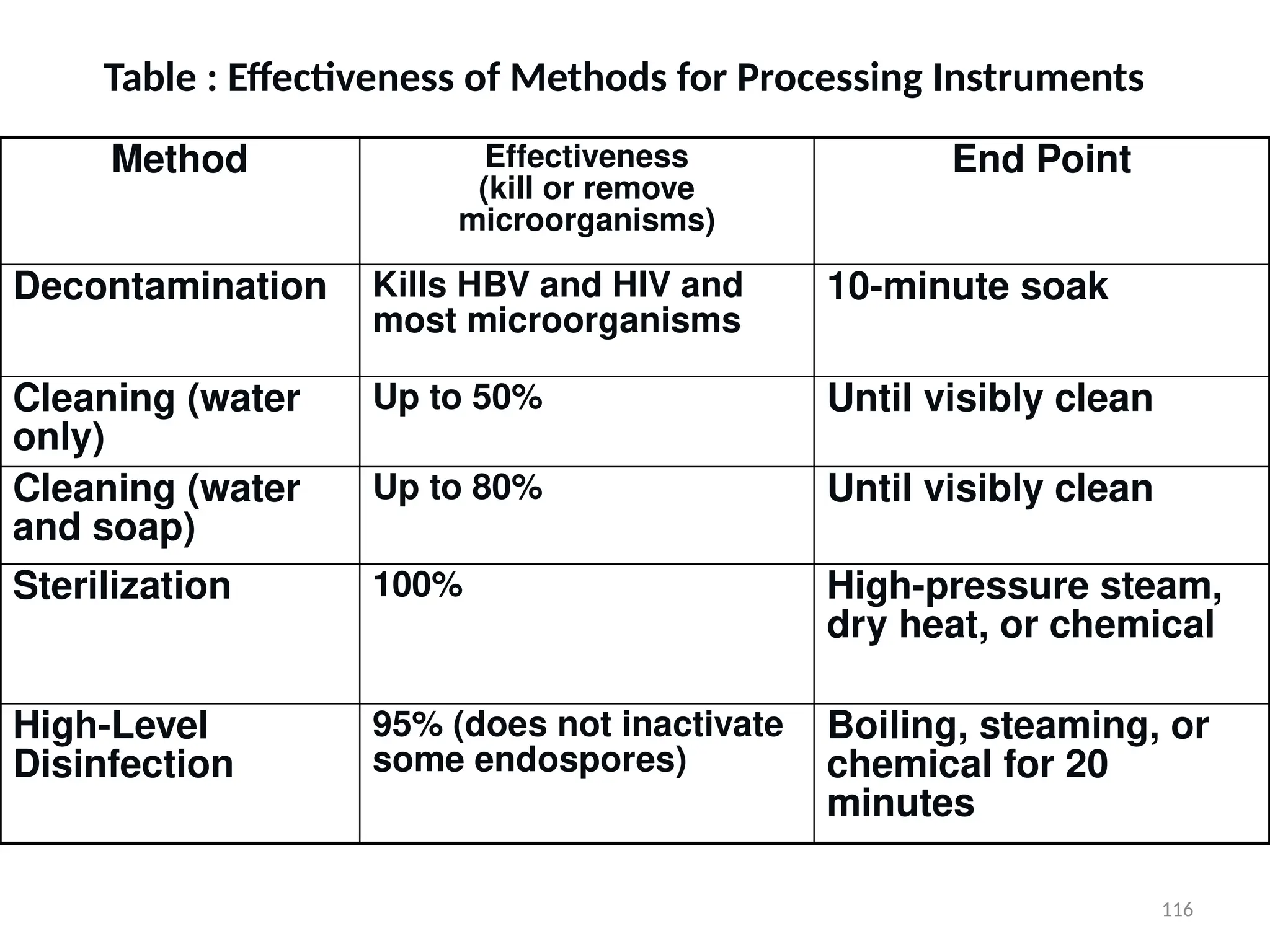
Table : Effectiveness of Methods for Processing Instruments
Method Effectiveness
(kill or remove
microorganisms)
End Point
Decontamination Kills HBV and HIV and
most microorganisms
10-minute soak
Cleaning (water
only)
Up to 50% Until visibly clean
Cleaning (water
and soap)
Up to 80% Until visibly clean
Sterilization 100% High-pressure steam,
dry heat, or chemical
High-Level
Disinfection
95% (does not inactivate
some endospores)
Boiling, steaming, or
chemical for 20
minutes
117
Post-Exposure Prophylaxis (PEP)
• PEP is Use of therapeutic agent to prevent
establishment of infection following exposure to
pathogen.
• HIV occupational exposure: An “occupational
exposure” to HIV when an individual is exposed to
blood or bodily fluids during the course of the
individual’s duty of work.
• Risk factors for Occupational HIV Transmission
1.Type of contact or exposure:
 Percutaneous
 Mucocutaneous
 Non intact skin
 Bites resulting in blood exposure
118
2.Type and amount of fluid/tissue:
 Blood
 Fluids containing blood
 Potentially infectious fluid or tissue
 Exposure to larger quantities of blood is
associated with increased risk of transmission
3. Disease status of source patient:
-Higher viral loads (terminally ill patients or individuals
with Acute HIV infection)
4. Host defenses:
-The host immune response may prevent
HIV infection after exposure
5.Community HIV status:
- Risk higher in areas with high HIV sero-prevalence.
6. Post exposure management
119
Significant exposure to any of the following
may pose a risk to blood born pathogen
infection
• Blood
• Semen
• Vaginal secretions
• CSF
• Synovial fluid
• Pleural fluid
• Peritoneal fluid
• Pericardial fluid
• Amniotic fluid
120
Body fluids that do NOT pose a risk of blood
born pathogen transmission UNLESS visibly
bloody include
• Urine
• Sputum
• Saliva
• Stool
• Emesis
• Nasal discharge
• tears
• Sweat
121
• Risk of HIV Transmission Following Percutaneous
Injury
Average risk of HIV transmission
• Needle stick injury ~ 0.3%
• Mucous membrane exposure ~0.1%
• Multiple cofactors may affect HIV transmission
What are these cofactors?
• Viral load
• Glove use
- 50% decrease in volume of blood transmitted
• Hollow bore vs. solid bore (needle type)
- Large diameter needles weakly associated with
increased risk
122
Post Exposure Management
1. Management of the exposure site
2. Risk assessment
 Use the decision making tool to determine the
risk of HIV infection (high or low) based on the
source status and exposure code, HIV test at base
line
3. Administer post exposure prophylaxis (PEP)
• PEP should be initiated as soon as possible, ideally
within two hours after the accidental exposure or
at the latest 72 hours,
• Prophylaxis has to be given for 28 days;
• Protection is not absolute, the efficacy of PEP varies
between 75-80%.( Evidence)
123
HIV Post-exposure Counseling
• Side effects of PEP drugs
• Signs and symptoms of acute HIV
infection
–fever
–rash
–flu-like illness
124
• Prevention of secondary transmission
–sexual abstinence or condom use
–no blood/tissue donation
4. Follow-up and monitoring of patients given PEP
at ART clinic; do HIV test 6 weeks, 3 month, and 6
months
5.Report and document the incident
125
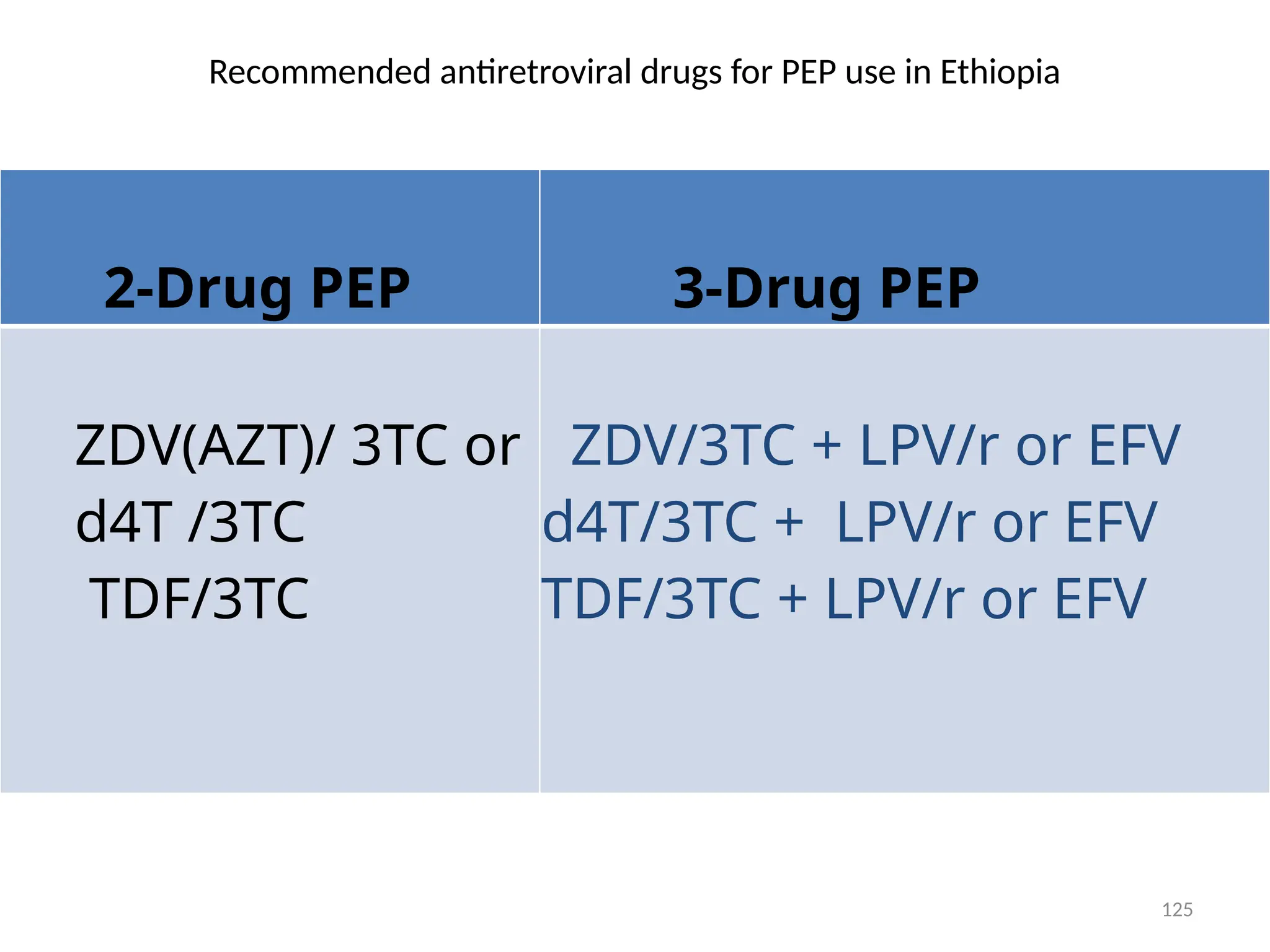
Recommended antiretroviral drugs for PEP use in Ethiopia
2-Drug PEP 3-Drug PEP
ZDV(AZT)/ 3TC or
d4T /3TC
TDF/3TC
ZDV/3TC + LPV/r or EFV
d4T/3TC + LPV/r or EFV
TDF/3TC + LPV/r or EFV
126
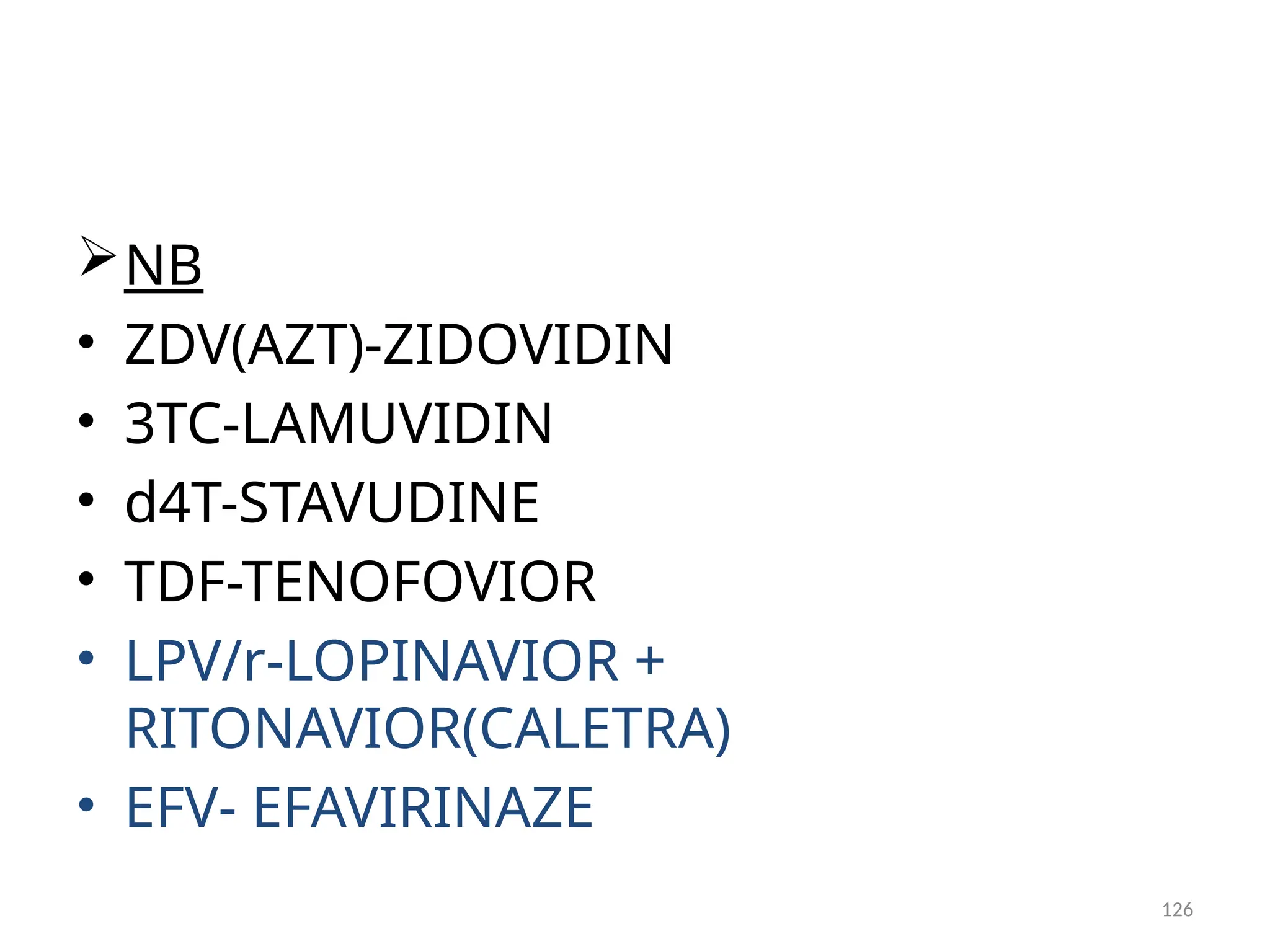
NB
• ZDV(AZT)-ZIDOVIDIN
• 3TC-LAMUVIDIN
• d4T-STAVUDINE
• TDF-TENOFOVIOR
• LPV/r-LOPINAVIOR +
RITONAVIOR(CALETRA)
• EFV- EFAVIRINAZE
127
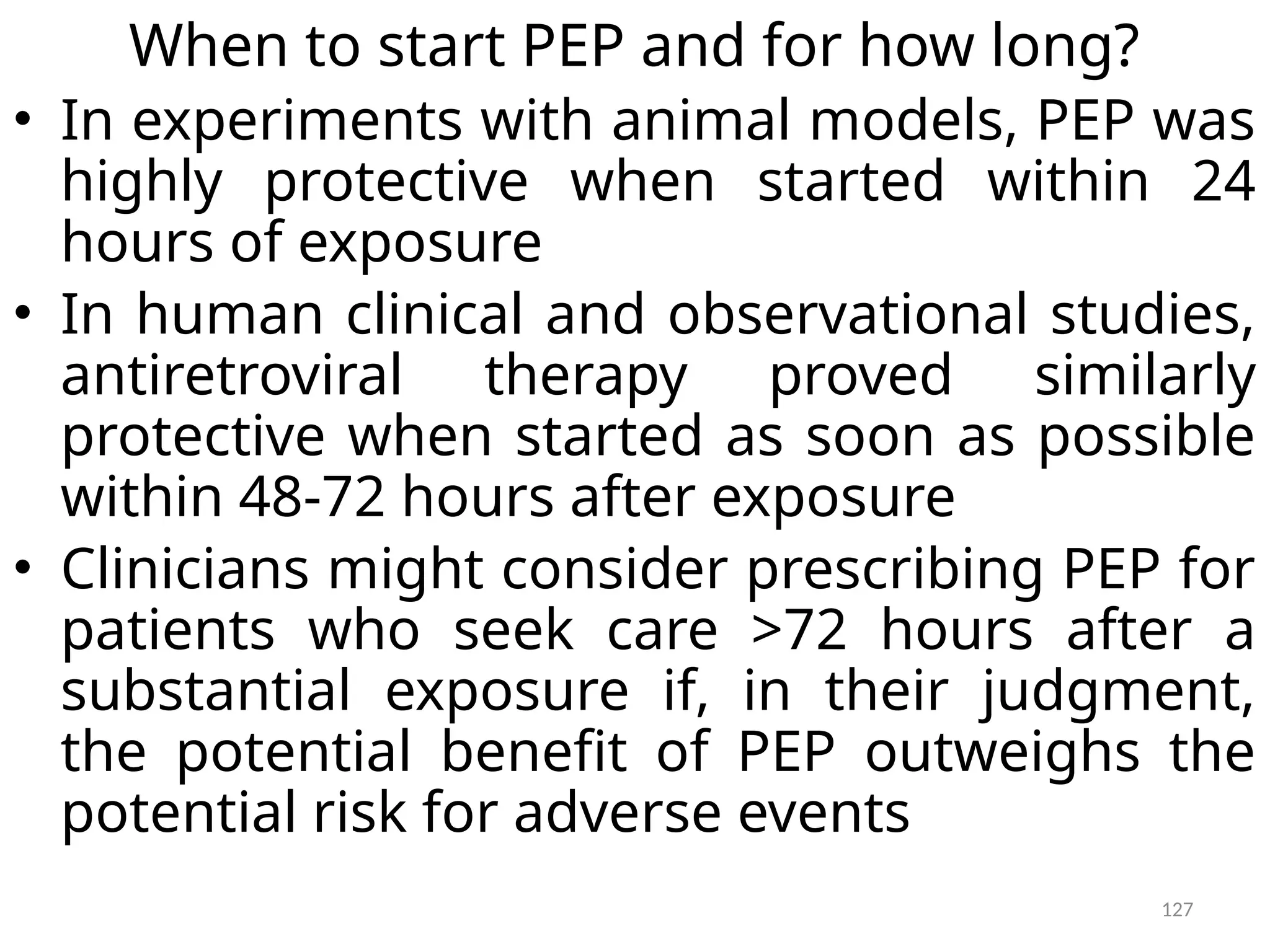
When to start PEP and for how long?
• In experiments with animal models, PEP was
highly protective when started within 24
hours of exposure
• In human clinical and observational studies,
antiretroviral therapy proved similarly
protective when started as soon as possible
within 48-72 hours after exposure
• Clinicians might consider prescribing PEP for
patients who seek care >72 hours after a
substantial exposure if, in their judgment,
the potential benefit of PEP outweighs the
potential risk for adverse events
128
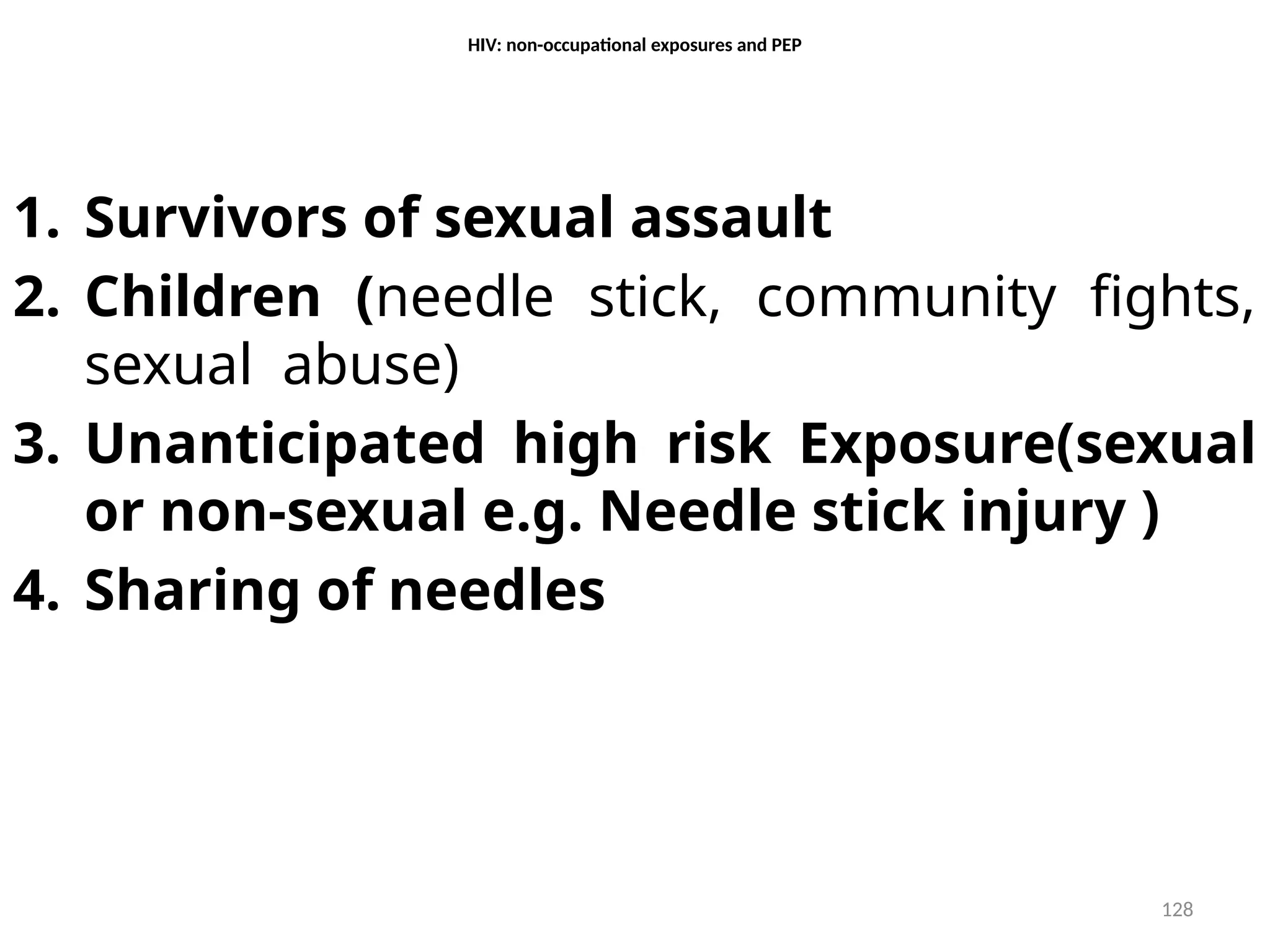
HIV: non-occupational exposures and PEP
1. Survivors of sexual assault
2. Children (needle stick, community fights,
sexual abuse)
3. Unanticipated high risk Exposure(sexual
or non-sexual e.g. Needle stick injury )
4. Sharing of needles
129
Post-exposure Management of HBV
• 1st
dose of HBIG (0.06 ml/kg IM)- within
seven days of exposure,
• 2nd
dose approximately one month later.
• Those previously infected with HBV are
immune to re-infection and do not require
PEP,
Post-Exposure Management of HCV
• At this point, there is no effective post-
exposure vaccine, or drug prophylaxis for
HCV,
• Prevention of exposure; therefore is the only
effective strategy.

IP.pptxShow Advanced SettingsShow Advanced SettingsShow Advanced SettingsShow Advanced SettingsShow Advanced Settings

  • 1.
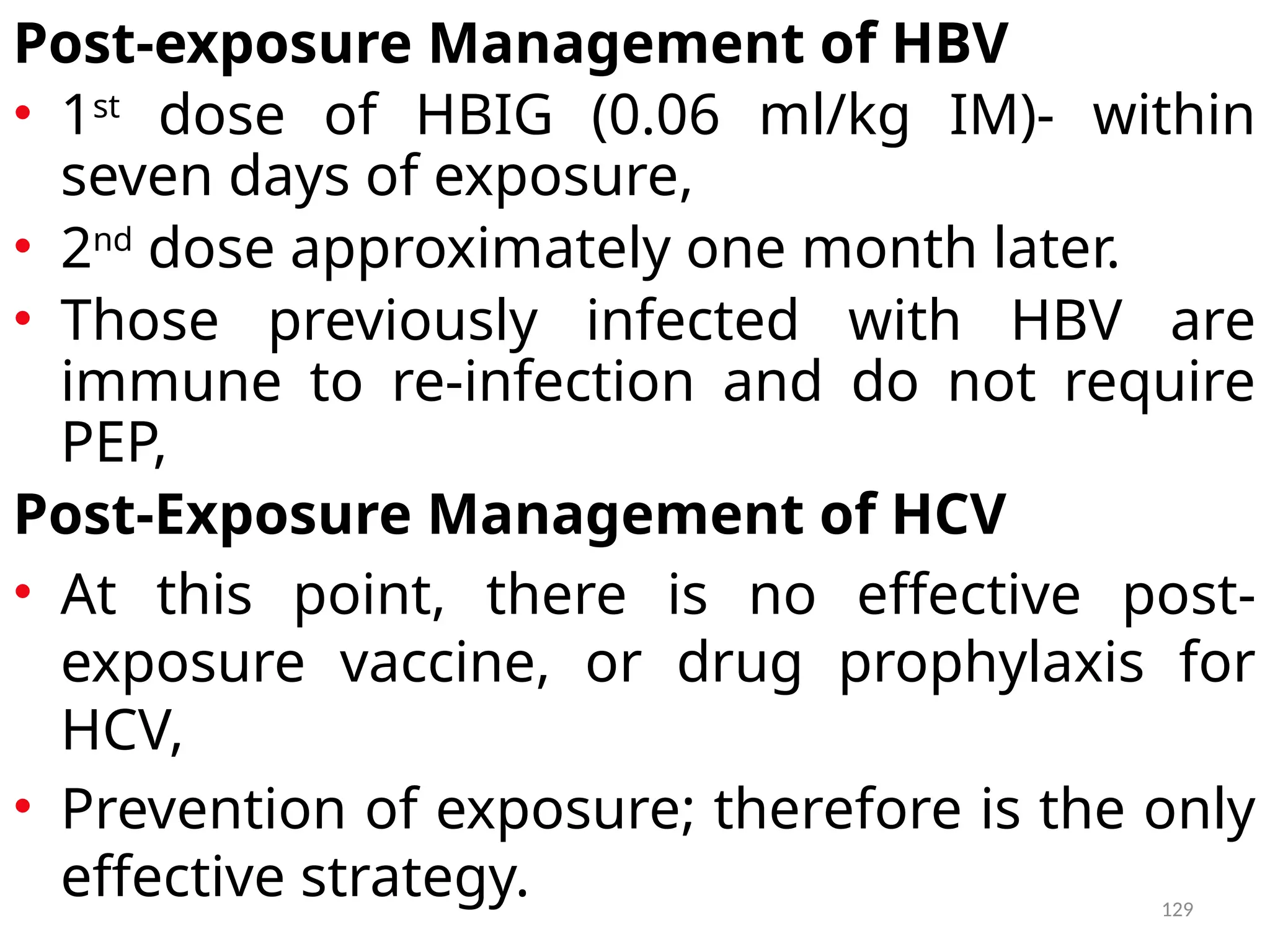
    1 Infection prevention andPatient safety By Mesfin D.
  • 2.
    2 Introduction to InfectionPrevention and Patient safety At the end of this chapter, you will be able to; Define infection prevention Describe the goal of infection prevention and patient safety Describe the magnitude of nosocomial infection Explain how to stop the spread of disease at each part of transmission cycle Recognize the level of risk of infection at health care facilities Describe the role of IP and PS in reducing the level of risk
  • 3.
    3 • Describe thesteps of processing instrument • Define decontamination • Explain the rationale for decontamination before cleaning • Demonstrate how to prepare chlorine solution for decontamination • Demonstrate how to decontaminate soiled instruments and other items
  • 4.
    4 Why Infection Prevention/patientSafety ?  To protect patients (nosocomial infections) To protect the healthcare workers (occupational hazard/employee health) To protect visitors To protect students To protect communities and environment The goal of Infection Prevention and Patient Safety is to make healthcare facilities a safer place.
  • 5.
    5 Definition of terms Microorganismsare the causative agents of infection: Bacteria, Fungi or Parasites Colonization is the presence and multiplication of a microorganisms without tissue invasion or damage Infection means that the colonizing organisms are now causing Cellular response Infection prevention -prevent the spread of infection B/n the susceptible host & MO by using d/t techniques.
  • 6.
    6 • Depends onplacing protective barriers (physical, chemical, or mechanical) between a susceptible host (person lacking immunity) and the organisms.
  • 7.
    7 Nosocomial Infections Nosocomial (healthfacility-acquired infections) are a major cause of preventable morbidity and mortality worldwide Nosocomial infections increase the cost of healthcare: Increase length of hospitalization Require treatment with expensive, broad- spectrum agents Increase use of other interventions (laboratory, surgery, etc)
  • 8.
    8 Most nosocomial infectionsin healthcare facilities can be prevented with readily available, relatively inexpensive strategies, For some of the most serious infections, namely, HIV, HBV, HCV, and MDR-TB, prevention is all we can do. Nosocomial Infections:Transmission requires THREE elements: 1. A source of infecting microorganisms  Human source - patients/hospital, personnel/visitors  Other sources - contaminated objects or medical instruments
  • 9.
    9 2. A susceptiblehost  Patients/hospital personnel/visitors 3. A mode of transmission  Three main routes Airborne/Droplet/Contact
  • 10.
    10 Understanding the DiseaseTransmission Cycle
  • 11.
    11 Most microorganisms cancause infection. All humans are susceptible to most infectious agents unless immune (naturally or by vaccination). Risk of infection is related to the number and virulence of organisms. Number of organisms needed to cause infection varies with location (blood stream— least; intact skin— greatest number of organisms). How to prevent infection from this transmission?
  • 12.
    12  Reservoir Chemotherapy Health Education Place of exit Blood transfusion –BTS MTCT-PMTCT Sexual -ABC  Method of transmission Same as above  Place of entry  PPE PMTCT Hand Hygiene Safe work practice Instrument processing  Susceptible host Chemoprophylaxis
  • 13.
    13 Preventing Infections inPatients and Healthcare Clients Primarily involves preventing the spread of infectious diseases through the air, from blood or body fluids, by contact (fecal-oral, contaminated food or water), and from infected animals or insects by: Inhibiting or killing the infectious agent Blocking the agent’s means of getting from one infected person to a susceptible host Making sure people, especially healthcare workers, are immune or vaccinated Providing healthcare workers with appropriate personal protective equipment
  • 14.
    14 What Standard PrecautionsAre? Definition Guidelines designed to create a physical, mechanical, or chemical barrier between microorganisms and a person to prevent the spread of infection (i.e., the barrier serves to break the disease transmission cycle) Examples of Barriers Mechanical : High-level disinfection (HLD) by boiling or steaming and sterilization by autoclaving or dry heat ovens Physical : Personal protective equipment (gloves, face masks, goggles, gowns, plastic or rubber aprons, and drapes) Chemical: Antiseptics (iodophors and alcohol-based antiseptic agents) and high-level disinfectants (chlorine,
  • 15.
    15 Transmission-Based Precautions Definition Guidelines designedto reduce the risk of transmitting infections that are spread wholly or partly by airborne, droplet, or contact routes between hospitalized patients and health workers Examples Airborne: Chicken pox (varicella virus), measles, and tuberculosis,
  • 16.
    16 Droplet: Mumps, rubella,and meningitis (N. meningitides) Contact: Enteric pathogens like hepatitis A and herpes simplex1 Also should be used with wet or draining skin, eye, or wound infections that may be contagious
  • 17.
    17 Level of Risk Riskof acquiring HIV after being stuck with a needle from an HIV+ client……..0.2-0.4% Risk of acquiring HBV after being stuck with a needle from an HBV+ client ….…27-37% Risk of acquiring HCV after being stuck with a needle from an HCV+ client…..…3-10%
  • 18.
    18 Components of StandardPrecautions Hand hygiene (hand washing with soap and water or use an antiseptic hand rub) Personal protective equipment (PPE) Patient placement Proper waste management Instrument processing
  • 19.
    19 Hand Hygiene Hand HygienePractices Hand washing Hand antisepsis Antiseptic hand rub Surgical scrub plain
  • 20.
    20 Hand washing Why DoWe Wash Our Hands? Hands are the principal route of cross infection. Hand washing is THE SINGLE most important measure in reducing the spread of infection! it is the ordinary hand hygienic practice with clean water and plain soap. Mechanically remove soil and debris from the skin and reduce the number of transient microorganisms.
  • 21.
    21  When DoWe Wash Our Hands? Wash hands: After arriving at work Before and after examining any client After touching contaminated instruments/items After exposure to blood or any body fluids Before putting on gloves and after removing them Whenever our hands become visibly soiled After blowing your nose, covering a sneeze After visiting the toilet Before leaving work
  • 22.
    22 Why Healthcare WorkersDon’t Wash Their Hands? Beliefs: Hand washing between every patient encounter is unnecessary, Hand washing doesn’t affect clinical outcome, Hand washing is unnecessary when gloves are worn, Frequent hand washing damages skin and causes cracking, dryness, irritation and dermatitis, Hand washing damages nails and nail polish Hand washing facilities are not conveniently placed or well designed, Hand washing takes too much time….etc.,
  • 23.
    23 Hand washing Steps: 1. Thoroughlywet hands. 2. Apply plain soap (antiseptic agent is not necessary). 3. Vigorously rub all areas of hands and fingers for 10–15 seconds, paying close attention to fingernails and between fingers. 4. Rinse hands thoroughly with clean water. 5. Dry hands with a paper towel or a clean, dry personal towel. 6. Use a paper towel when turning off water if there is no foot control or automatic shut-off.
  • 24.
  • 25.
    25 Hand Antisepsis Purpose: Similar tothat for plain hand washing. The soap or detergent contains an antiseptic agent (often chlorhexidine, iodophors, or triclosan) instead of plain soap or detergent. Objective: Remove soil and debris as well as to reduce both transient and resident flora
  • 26.
    26 we use handantisepsis: Before:  Examining or caring for highly susceptible patients (e.g., premature infants, elderly patients, or those with advanced AIDS)  Performing an invasive procedure  Leaving the room of patients on Contact Precautions (e.g. hepatitis A or E,)
  • 27.
    27 Antiseptic Hand rub Purpose:Is to inhibit or kill transient and resident flora. Considered to be more effective than antimicrobial hand washing agents or plain soap and water, It is quicker and easier to perform, but it should not be used when the hands are visibly soiled. Do not rinse hands after applying hand rub
  • 28.
    28 alcohol-based solution forhand rub: • Add glycerin or sorbitol to alcohol (2 ml. in 100 ml. of 60–90% ethyl or isopropyl alcohol solution) Steps: Apply enough alcohol-based hand rub to cover the entire surface of hands and fingers (about a teaspoonful -5ml) continue rubbing the solution over hands until they are dry (15-30 seconds) Rub the solution vigorously into hands, especially between fingers and under the nails until dry.
  • 29.
    29 Efficacy of HandHygiene Preparations in Killing Bacteria Good Better Best Plain Soap Antimicrobial soap Alcohol-based hand rub
  • 30.
    30 Surgical Hand scrub Purpose:To mechanically remove soil, debris and transient organisms and to reduce resident flora for the duration of the surgery Steps: 1. Remove rings, watches, and bracelets. 2. Thoroughly wash hands and forearms to the elbow with soap and water. 3. Clean nails with a nail cleaner. 4. Rinse hands and forearms with water. 5. Apply an antiseptic agent (soap) 6. Vigorously wash all surfaces of hands, fingers, and forearms for at least 2 minutes.
  • 31.
    31 7. Rinse handsand arms thoroughly with clean water, holding hands higher than elbows. 8. Keep hands up and away from the body, do not touch any surface or article. and dry hands with a clean, dry towel. 9. Put on sterile or HLD gloves
  • 32.
  • 33.
    33 Personal Protective Equipment (PPE) •PPE includes: gloves, masks/respirators, eyewear (face shields, goggles), caps, gowns, aprons, boots and other items. • The most effective barriers are made of synthetic materials that do not allow water or other liquids to penetrate them. • These fluid resistance materials are not; however, widely available because they are expensive.
  • 34.
  • 35.
  • 36.
    36 Donning and removinggloves • At the end of this lesson, learner will be able to: · Identify the types of gloves · Demonstrate wearing and removing gloves
  • 37.
  • 38.
    38 Why Do HealthCare Workers Wear Gloves? 1.To reduce the risk of staff acquiring infections from patients’ 2. To prevent staff from transmitting their skin flora to patients, 3. To reduce contamination of the hands of staff by microorganisms that can be transmitted from one patient to another (cross-contamination) Gloves should be worn when: • There is a reasonable chance of hand contact with blood or other body fluids, mucous membranes, or non-intact skin,
  • 39.
    39 Performing an invasivemedical procedures, Before handling soiled instruments, contaminated waste items or touch contaminated surfaces. When disposing contaminated waste items Handling chemicals or disinfectants As a general rule, if the risk is to the patient then “Sterile” gloves are required. If the risk is to the user then “Non-Sterile” gloves will probably be sufficient. Gloves should not be worn when it is not required,
  • 40.
    40 Double gloving Although doublegloving is of little benefit in preventing blood exposure if needle sticks or other injuries occur, it may decrease the risk of blood hand contact. The procedure involves coming in contact with large amount of blood or other body fluid, Orthopedic procedures in which sharp bone fragments, wire sutures and other sharps are likely to be encountered,
  • 41.
    41 Wearing surgical gloves Keepnails short Select correct type and size Insert hands into gloves Extend gloves over gown cuffs to protect the wrists.
  • 42.
    42 Removing Gloves  Graspoutside edge near wrist  Peel away from hand, turning glove inside- out Hold in opposite gloved hand Slide ungloved finger under the wrist of the remaining glove Peel off from inside, creating a bag for both gloves
  • 43.
  • 44.
  • 45.
  • 46.
    46 Utility glove • Mostlyused by cleaners • For highly contaminated items including sharp materials. • Exposure of individuals to waste product/ waste handlers
  • 47.
    47 Elbow-Length Gloves  Ifelbow-length gloves are not available, an inexpensive, effective alternative can be easily made from surgical gloves .  Used if we suspect exposure to extensive body fluid, secretion.  steps for making elbow-length gloves
  • 48.
  • 49.
  • 50.
  • 51.
  • 52.
    52 Issues with Gloves beaware that gloves may elicite Allergic reactions Use water-soluble hand lotions to prevent skin from drying. Use oil-based and perfumed hand lotions.
  • 53.
    53 Donning and removingsurgical Gowns • The purpose of wearing sterile gown is in order to provide sterile field • There are two methods of sterile gowning:- o Gowning self and o Gowning another
  • 54.
    54 • The practitionersmust ensure that they touch the inside of the gown only and that both arms are inserted into the sleeves of the gown together. • The circulating person should assist the scrubbed person by securing the gown’s back ties.
  • 55.
  • 56.
    56 • Fig. 3-3.Scrub person, putting on gown, gently shake out folds, then slips arms into sleeves without touching sterile outside of gown with bare hands.
  • 57.
  • 58.
    58 • Fig. 3-4.Circulator nurse, pulling gown on scrub person without touching the outside of the gown.
  • 59.
  • 60.
    60 • Fig. 3-5.Circulator nurse completes pulling on scrub person’s gown, secures ties on inside of back, and closes fastener at neck.
  • 61.
  • 62.
    62 • Fig. 3-6.(A to C) sequence of scrub person removing soiled gown at the end of a surgical procedure. Clean arms and scrub suite are protected from contaminated outside of gown.
  • 63.
    63 plastic or rubberaprons  PPEs that are fluid-resistant which;  can protect healthcare workers from exposure to potentially contaminated blood or other body fluids. Plastic Apron
  • 64.
    64 Masks • made froma variety of materials • Should be large enough to cover the nose, lower face, jaw and facial hair. • Masks are worn in an attempt to contain moisture droplets expelled as the HCW speak, cough or sneeze. • to prevent accidental splashing during certain procedures .
  • 65.
    65  Respirators • Arespecialized types of masks e.g. N95 particulate respirators • More expensive than surgical masks • Recommended for situations in which filtering inhaled air is important. • It contains multiple layers of filtering material and fit the face tightly.
  • 66.
  • 67.
    67 Goggle/face shield • preventaccidental splashing of the mouth and face during certain procedures. Cap • used to keep the hair and scalp covered so that flakes of skin and hair are not shed into the wound during surgery
  • 68.
    68  Footwear • Itis used to protect feet injury from sharps or heavy items that may occur accidentally. • Sandals or shoes made of soft materials (cloth) should not be worn. • Rubber shoes provide more protection, but they must be kept clean.
  • 69.
    69 Healthcare waste management •refers to all activities, involved in the collection, handling, treatment, conditioning, transport, storage and disposal of waste produced at healthcare facilities High Risk Wastes o Infectious waste o Anatomical waste o Sharps wastes (used or unused) o Chemical waste o Pharmaceutical waste o Radioactive wastes o Pressurized containers
  • 70.
    70 Low Risk Wastes •Non infectious waste/Communal wastes Waste Segregation • Waste segregation is separating waste by type at the place where it is generated • Purpose –Protect people who handle waste items from injuries –Prevent the spread of infections to HCWs who handle waste –Prevent the spread of infection to the community, -protect the environment
  • 71.
    71 Separate wastes basedon their level of infection • Noninfectious (Black color code): Presents no risk. Examples: paper, packaging materials, office supplies, drink containers, hand towels, boxes, glass, plastic bottles, and food. • Infectious (Yellow color code): Contaminated with human blood and has the ability to spread disease. Examples: gauze, cotton, dressings, laboratory cultures, IV fluid lines, blood bags, gloves, and pharmaceutical waste.
  • 72.
    72 • Highly infectious(Red color code): Highly infectious Anatomical waste, pathological waste • Sharps waste (Safety box, needle remover, or other puncture-resistant and leak-resistant sharps containers): Syringes and needles should be discarded without recapping.
  • 73.
    73 House keeping Patient unitcare Patient's unit is a small separate room in which the patient rest during his/her hospital stay. • Patient's unit usually consists of basic furniture and standard equipment.
  • 74.
    74 Cleaning of patient'sunit is keeping of the patients room neat & orderly. • There are two types of cleaning that are concurrent and terminal cleaning
  • 75.
    75 1. Concurrent Cleaning •is a daily cleaning of the patients room. • It consists cleaning the room by damp mopping the floor and dusting with damp cloth.
  • 76.
    76 Purpose: • To preventaccumulation of dirty • To promote the pt's health and comfort physically & mentally • To remove germs & dust particles • To prevent spread of micro organisms • To have neat appearance of the unit.
  • 77.
    77 Terminal cleansing ofthe patient care unit • The sanitation of the bed, bedside cabinet, and general area of the patient care unit with a detergent/germicidal agent after the patient is discharged or transferred from the nursing care unit. • Performed at every patient care unit before the area is prepared for the next patient.
  • 78.
    78 Purpose • Prevention ofthe spread of microorganisms. • Removal of encrusted secretions from framework or bedside rails. • Removal of residue of body wastes from the mattress. • Deodorizing of the bed frame, mattress, and pillow.
  • 79.
    79 Guidelines for TerminalCleaning • Reviews ward for specific procedures. • Use only authorized disinfectant/detergent or germicidal solution for cleaning. • Check to ensure the bedside cabinet is cleared of any valuables belonging to the patient. • Check bed linens for personal items (dentures, contact lenses, money, jewelry, etc.) belonging to the patient.
  • 80.
    80 • Prevent spreadof microorganisms by carefully removing linen from the bed. • Use caution when cleaning the under frame and bedsprings. • Replace any torn mattress or pillow covers. • Allow the mattress and pillow to air-dry thoroughly before remaking the bed.
  • 81.
    81 Linen processing • Processinglinen-: consists of all the steps required to collect, transport and sort soiled linen as well as to launder (wash, dry and fold or pack), store and distribute it.
  • 82.
  • 83.
    83 Injection Safety At theend of the topic, students will be able to:- Define injection safety, and describe the situation of unsafe injection, Describe the risks and impacts associated with unsafe injection practices, Identify best practices in injection Safety Differentiate the advantage and disadvantage of different injection devices,
  • 84.
    84 Definition:  A safeinjection is an injection that: Does not harm the recipient Does not expose the provider to any avoidable risk Does not result in any waste that is dangerous for other people Is given by skillful health care worker using sterile equipment,
  • 85.
    85 Needles-stick injury: Punctureof the skin caused by an injection needle. Sharps injury: An injury caused by puncture of the skin by a sharp object/instrument. Safety (Sharps) box: A puncture/liquid- proof container designed to hold used sharps safely during collection, transport and disposal .
  • 86.
    86 Situation of InjectionSafety Global WHO reported that unsafe injections are a plague of many health system 16 billion injections are given each year in developing countries 90 –95% of injections are therapeutic; 5-10% is given for immunization, 501,000 deaths occurred in 2003 because of unsafe injection practices There were 21 million HBV, 2 million HCV, and 260,000 HIV/AIDS new cases in 2000 due to unsafe injection.
  • 87.
    87 Situation in Ethiopia Thesurvey covered 40 health facilities. 74% of the observed injections were unsafe. 32% of the health workers reported needle stick injuries in the last 12-month. 45% of patients prefer injection. However, on the contrary, most health workers reported that clients prefer injection to oral drugs. Evidence shows that death and disability associated with unsafe injections are highly preventable.
  • 88.
    88 Reasons for providingunsafe injections:  Inadequate dissemination and use of standard treatment guidelines  Prescriber preference for injections Lack of knowledge on the dangers of injections, Perception that injections are more effective than oral medications, Perception that injections give more rapid relief, Perception that injections are more potent, financial incentive for prescribing injections Perceived belief that patients prefer injections  The role of informal health care providers in giving injections,
  • 89.
    89 Risk and Impactof unsafe Injection Transmission of blood born infections  There are about 40 blood borne pathogens that could be transmitted via injection. Among these, HBV, HCV, HIV/AIDS are the commonest and with grave implications Injection abscesses Paralysis- following the damage of a nerve as a result of injection of a drug into a nerve and trauma. Drug/allergic reactions:
  • 90.
    90 Risk Groups: 1. Healthcare providers 2. Patients/clients 3. Communities • Impacts of Unsafe Injection 1- Health Impact  There are about 40 blood born pathogens that can be transmitted via unsafe injections; of all HBV,HCV and HIV are the common once.
  • 91.
    91 Unsafe injection causes: •21.7 million new HBV infection • 2.3-4.7 million contract HCV Nearly 2-5% of all new HIV infections are caused by unsafe injections 2. Economic impact Each year unsafe injection causes a dramatic global economic impact Annual burden of indirect medical cost estimated to be US 535 million, Increases economic burden on the family.
  • 92.
    92 3. Psycho-Social Social stigmaand discrimination Stress associated with HIV Decreased productivity of an individual Burden up on the community Loss of trained health workers
  • 93.
    93 Best practice inSafe Injection 1. Elimination of Unnecessary Injection – Promoting Rational Prescribing – Educating the patients. 2. Administer Injections Safely; Make sure you are doing the ‘right’ things (Respect the nine right of safe injection) 1. Right Patient, 2. Right Drug, 3. Right formulation, 4. Right injection equipment, 5. Right dosage, 6. Right time, 7. Right route, 8. Right storage 9. Right method of disposal
  • 94.
    94 Best practice foradministering Injection 1. Select safe medicines: – Proper handling of medicines, – Label clearly – Observe proper storage conditions – Check expiry dates 2. Use of sterile equipment – Use needle and syringe from sealed package 3. Avoid contamination – Wash hands – Prepare on clean surface – Do not touch part of needle that will come in contact with patient’s tissue
  • 95.
    95 4. Reconstitute drugsor vaccines safely –Use new sterile syringe and needle for each reconstitution –Use the correct diluents/water for injection –Reconstitute according to the manufacturers’ specifications 5. Dispose of injection wastes and sharps properly –Immediate disposal of needle and syringe in puncture- and leak-proof container 6. Public health education
  • 96.
    96 Types of InjectionDevice 1. Auto-disable syringes Advantage: –Cannot be reused. –They save time for sterilization. • Disadvantage: –More expensive than standard disposable –Have no safety features –Need collection and disposal system.
  • 97.
    97 2. Automatically retractable: •Advantage: –Cannot be reused. –Has safety feature: needle retracts inside barrel. –It saves time for healthcare workers from the burden of sterilization. –Eliminate the patient-to-patient disease transmission, • Disadvantage: –Most expensive
  • 98.
    98 3. Standard disposable; Advantage: –Cheap. –Available on local market. –They save time for healthcare workers from the burden of sterilization. –Eliminate the patient-to-patient disease transmission. Disadvantage: –Can be reused without sterilization. –Have no safety features. –Need sharps container or needle remover.
  • 99.
    99 Safety Device 1. SafetyBox- is a puncture and leak-resistant container for disposal of sharps including hypodermic needles, needles from IV bags, lancets, scalpels and suture needles. • When using safety box the following points should be considered:- – Put sharps containers as close to the point of use, ideally within arm’s reach. – Don’t shake a container to settle its contents and make room for more sharps. – place containers in high traffic areas where people could bump into them or be stuck by someone carrying sharps to be disposed of.
  • 100.
    100 2. Yellow pin-used for to hold contaminated materials after use like catheter, nasogastric tube, gloves, 3. Black pin- used to hold patient/client materials like banana, orange… cover after eating and discarded food after eating.
  • 101.
    101 Instrument Processing Decontaminate Clean Sterilize Chemical High-pressure steam Dryheat Dry/Cool and Store High-Level Disinfectant Boil Steam Chemical
  • 102.
  • 103.
    103 Instructions for PreparingDilute Chlorine Solutions       Dilute % e Concentrat % Total parts (TP) (H2O) = - 1 Total parts (TP) (H2O) =       Dilute .5% e Concentrat 5% - 1 = 9 Total parts (TP) (H2O) To make a 0.5% chlorine solution from 5% bleach, mix 1 part bleach to 9 parts water.
  • 104.
    104 Examples Using 5%Bleach for 0.5% Concentration One part bleach to 9 parts water (use the same container to measure the bleach and water)
  • 105.
    105 Preparing a ChlorineSolution from a Powder To make a 0.5% chlorine solution from a 35% chlorine powder, mix 14.2 grams of powder to 1 liter of water.       e Concentrat % Dilute % Gram/Liter = X 1000       e Concentrat 35% Dilute .5% = X 1000 = 14.2 Gram/Liter
  • 106.
    106 Bleach Safety Use mask,goggles, rubber gloves, waterproof apron Mix in well-ventilated area Do not use or mix with other detergents Use cold or room temperature water to mix
  • 107.
    107 Decontamination practices • Placeinstruments and reusable gloves in a 0.5% chlorine solution after use. • Soak for 10 minutes and rinse immediately. • Wipe surfaces (exam tables) with chlorine solution
  • 108.
  • 109.
  • 110.
    110 2. Cleaning • Methodof mechanically reducing the number of microorganisms. • Proper cleaning using detergents removes up to 80% of microbial burden and also reduces the number of spores which are difficult to eradicate using HLD as final processing . Principles: Remove organic material that Protects microorganisms against sterilization and HLD Must be done for sterilization and HLD to be effective
  • 111.
    111 Cleaning… Practices after itemsare decontaminated: Use PPE during cleaning Disassemble instruments Wash with detergent, water, and a soft brush. Scrub instruments under the water surface until visibly clean. Thoroughly rinse with clean H2O Dry and pack
  • 112.
  • 113.
    113 3. High-Level disinfection(HLD) • The process that eliminates all microorganisms except some bacterial endospores from inanimate objects. • 95% effective • An alternative when sterilization equipment is not available.  boiling, -20min chemical disinfectants- 20 min
  • 114.
    114 • 0.1%chlorine solutionwith boiled water • Formaldehyde 8% -carcinogenic effect • Gluteraldehyde 2-4%
  • 115.
    115 4. Sterilization • Processthat eliminate all microorganisms (bacteria, viruses, fungi and parasites) including bacterial endospores from inanimate objects . • 100% effective  high- pressure steam Sterilization autoclave),121oc,106kpa pressure 20-30min dry heat (oven), 170oc/1hr,160oc/2hr chemical sterilization. Formaldehyde 8% /24hr, Gluteraldehyde 2-4%/10hr
  • 116.
    116 Table : Effectivenessof Methods for Processing Instruments Method Effectiveness (kill or remove microorganisms) End Point Decontamination Kills HBV and HIV and most microorganisms 10-minute soak Cleaning (water only) Up to 50% Until visibly clean Cleaning (water and soap) Up to 80% Until visibly clean Sterilization 100% High-pressure steam, dry heat, or chemical High-Level Disinfection 95% (does not inactivate some endospores) Boiling, steaming, or chemical for 20 minutes
  • 117.
    117 Post-Exposure Prophylaxis (PEP) •PEP is Use of therapeutic agent to prevent establishment of infection following exposure to pathogen. • HIV occupational exposure: An “occupational exposure” to HIV when an individual is exposed to blood or bodily fluids during the course of the individual’s duty of work. • Risk factors for Occupational HIV Transmission 1.Type of contact or exposure:  Percutaneous  Mucocutaneous  Non intact skin  Bites resulting in blood exposure
  • 118.
    118 2.Type and amountof fluid/tissue:  Blood  Fluids containing blood  Potentially infectious fluid or tissue  Exposure to larger quantities of blood is associated with increased risk of transmission 3. Disease status of source patient: -Higher viral loads (terminally ill patients or individuals with Acute HIV infection) 4. Host defenses: -The host immune response may prevent HIV infection after exposure 5.Community HIV status: - Risk higher in areas with high HIV sero-prevalence. 6. Post exposure management
  • 119.
    119 Significant exposure toany of the following may pose a risk to blood born pathogen infection • Blood • Semen • Vaginal secretions • CSF • Synovial fluid • Pleural fluid • Peritoneal fluid • Pericardial fluid • Amniotic fluid
  • 120.
    120 Body fluids thatdo NOT pose a risk of blood born pathogen transmission UNLESS visibly bloody include • Urine • Sputum • Saliva • Stool • Emesis • Nasal discharge • tears • Sweat
  • 121.
    121 • Risk ofHIV Transmission Following Percutaneous Injury Average risk of HIV transmission • Needle stick injury ~ 0.3% • Mucous membrane exposure ~0.1% • Multiple cofactors may affect HIV transmission What are these cofactors? • Viral load • Glove use - 50% decrease in volume of blood transmitted • Hollow bore vs. solid bore (needle type) - Large diameter needles weakly associated with increased risk
  • 122.
    122 Post Exposure Management 1.Management of the exposure site 2. Risk assessment  Use the decision making tool to determine the risk of HIV infection (high or low) based on the source status and exposure code, HIV test at base line 3. Administer post exposure prophylaxis (PEP) • PEP should be initiated as soon as possible, ideally within two hours after the accidental exposure or at the latest 72 hours, • Prophylaxis has to be given for 28 days; • Protection is not absolute, the efficacy of PEP varies between 75-80%.( Evidence)
  • 123.
    123 HIV Post-exposure Counseling •Side effects of PEP drugs • Signs and symptoms of acute HIV infection –fever –rash –flu-like illness
  • 124.
    124 • Prevention ofsecondary transmission –sexual abstinence or condom use –no blood/tissue donation 4. Follow-up and monitoring of patients given PEP at ART clinic; do HIV test 6 weeks, 3 month, and 6 months 5.Report and document the incident
  • 125.
    125 Recommended antiretroviral drugsfor PEP use in Ethiopia 2-Drug PEP 3-Drug PEP ZDV(AZT)/ 3TC or d4T /3TC TDF/3TC ZDV/3TC + LPV/r or EFV d4T/3TC + LPV/r or EFV TDF/3TC + LPV/r or EFV
  • 126.
    126 NB • ZDV(AZT)-ZIDOVIDIN • 3TC-LAMUVIDIN •d4T-STAVUDINE • TDF-TENOFOVIOR • LPV/r-LOPINAVIOR + RITONAVIOR(CALETRA) • EFV- EFAVIRINAZE
  • 127.
    127 When to startPEP and for how long? • In experiments with animal models, PEP was highly protective when started within 24 hours of exposure • In human clinical and observational studies, antiretroviral therapy proved similarly protective when started as soon as possible within 48-72 hours after exposure • Clinicians might consider prescribing PEP for patients who seek care >72 hours after a substantial exposure if, in their judgment, the potential benefit of PEP outweighs the potential risk for adverse events
  • 128.
    128 HIV: non-occupational exposuresand PEP 1. Survivors of sexual assault 2. Children (needle stick, community fights, sexual abuse) 3. Unanticipated high risk Exposure(sexual or non-sexual e.g. Needle stick injury ) 4. Sharing of needles
  • 129.
    129 Post-exposure Management ofHBV • 1st dose of HBIG (0.06 ml/kg IM)- within seven days of exposure, • 2nd dose approximately one month later. • Those previously infected with HBV are immune to re-infection and do not require PEP, Post-Exposure Management of HCV • At this point, there is no effective post- exposure vaccine, or drug prophylaxis for HCV, • Prevention of exposure; therefore is the only effective strategy.

Editor's Notes

  • #29  Plain soap is good at reducing bacterial counts but antimicrobial soap is better, and alcohol-based handrubs are the best. Plain soap and water do not kill germs. Almost half of the hand soaps in the market have antibacterial additives. The active ingredient in most of the soaps is triclosan.In the amounts used in the hand soap(0.2 or less) triclosan doesnot kill many bacteria but may keep bacterial count down due to its residual effect
  • #32 The purpose is to mechanically remove soil, debris, and transient organisms and to reduce resident flora for the duration of a surgical procedure. The goal is to prevent patient wound contamination by microorganisms present on the hands of the surgical staff. Use an antiseptic. If an antiseptic is not available, use plain soap and then apply an alcohol solution and rub until dry two times. Use running water from tap or bucket. Use a stick or brush for cleaning the fingernails. Use a soft brush or sponge for cleaning the skin. Remember, a hard-bristled brush can irritate and cut your skin. Use towels or air-dry. (Sterile towels should be provided in the operating room.) Handcreams: The APIC Guidelines states that lotion may be used; however, it should be supplied in small, individual-use or pump dispensers that can not be refilled. The guidelines also state that the compatibility between lotion and antiseptic products and the effect of petroleum or other emollients on the integrity of gloves should be considered at the time a product is chosen, because findings show that anionic moisturizers can interfere with CHG effectiveness.
  • #66 The process for removing a particulate respirator is similar to that for a mask. Lift the bottom elastic over the head first. Then remove the top elastic. This should be done slowly to prevent the respirator from “snapping” off of the face. As you discard the mask, avoid touching the front of it. N-means not resistant to oil .i.e. not filter particulates aerosols in oil.95 –means filters 95% or greater of the particles. It has a less than 10% leak of air during breathing
  • #68 No scientific evidence to support the use of shoe cover.
  • #102 Mask=visor
  • #104 When we say part it may be a jug or calibrated container but we should use the same container to measure both bleach and water as shown in the diagram above
  • #105 When the concentrated solution of chlorine is in powder form the formula varies. We use different formula to get the amount of powder in grams to be diluted in one liter To prepare 0.5%chlorine solution from concentrated powder containing 35% chlorine. We calculate the amount in gram that we need to dilute in one liter as percent of dilute over percent of concentrate times one thousand. In this case it is 14.2g/liter.This means to make a 0.5% chlorine solution from a 35% chlorine powder we mix 14.2 grams of powder to 1 liter of water. If we need 3 liters of water for decontamination we multiply the amount of chlorine we need by three and it becomes 42.6 grams of chlorine powder.
  • #106 When preparing or using bleach solutions, you should wear a mask, rubber gloves, and a waterproof apron. Goggles are also recommended. And you should mix the solution in a well-ventilated area. Don’t mix your bleach solution with other household detergents. This may reduce its effectiveness or cause chemical reactions that produces toxic gases. For example, mixing bleach with acidic agents can produce toxic gas.
  • #107 How do we decontaminate used medical equipment? We soak contaminated medical equipments in 0.5% chlorine solution for ten minutes. It is then followed by cleaning .Other ways of decontamination include wiping examination table with cloths soaked in 0.5% chlorine solution and flushing syringes after use by 0.5%chlorine solution.
  • #109 When we put the items in chlorine solution we should completely submerge it in the solution. To help you with this you should prepare chlorine solution adequate enough to submerge the items of interest.
  • #111 We should wear appropriate personal protective equipments when we clean the items. Jointed instruments should be disassembled not to miss organic matter lodged at the joints. Instruments should be washed using soft brush under the surface of water. This will facilitate removal of organic a matter as well as reduces splashes. Items should be washed until visibly clean and rinsed with clean water.
  • #116 As you can see in the above table decontamination inactivates the common blood borne pathogens. Cleaning if properly conducted as recommended will remove up to 80% of microorganisms. High level disinfection kills 95% of microorganism. It kills all vegetative organisms except spores while sterilization kills all microorganisms including spores.