Computer Network
A computer network is a group of interconnected computers. They share
resources such as electronic mail, bulletin boards and access to unique databases. They
can be thought of as information highways for data.
 Data Communication:
Data communications are the exchange of data between two devices via some
form of transmission medium such as wire cable. For enabling data communication, a
combination of hardware and software is essential. In data communication maximum
permissible transmission rate of a message is directly proportional to signal power and
inversely proportional to channel noise.
 Characteristics of Data Communication System:
i) Accuracy: The system must deliver the data accurately. Data that have been altered
in transmission and left uncorrected are unusable.
ii) Timeliness: The system must deliver data in a timely manner. In the case of video
and audio, timely delivery means delivering data as they are produced, in the same
order that they are produced and without significant delay. This kind of delivery is
called real-time transmission.
iii) Correctness: When a sender transmits data for an intended recipient, the data must
reach only the intended recipient and not someone else.
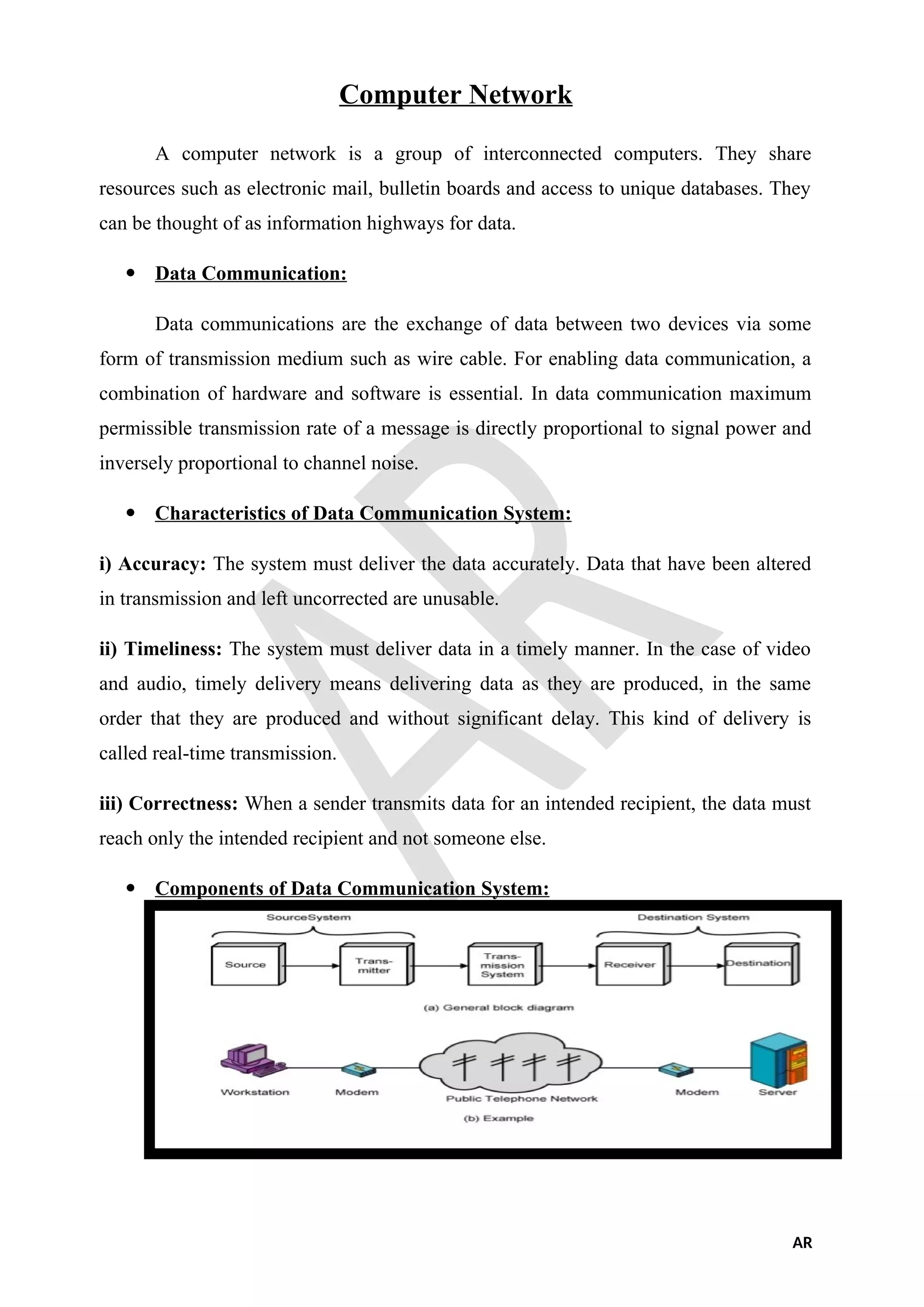
 Components of Data Communication System:
AR
i) Terminals: It includes video display terminals and other end user workstations. Any
input/output device that uses a network to connect to transmit or receive data is a
terminal. This includes micro computers, telephones, fax machines etc.
ii) Communication Processors: These are devices which support data transmission
and reception between terminals and computers. It performs a variety of control and
support functions in a network. It includes modems, message switchers, multiplexers
etc.
iii) Telecommunication channels and media: The media over which data is
transmitted and received is called Telecommunication Channels. These channels use
combinations of media, such as copper wires, coaxial cables, fiber optic cables etc to
interconnect the other components of a network.
iv) Host Computer: Networks interconnect computer at all sizes and types so that they
can carry out their information processing assignments. For example, a mainframe
computer may serve as a host computer for a large organizations network.
v) Telecommunication Software: It consists of programs that reside in host computer
systems, communication control computers and end user computers. This controls the
telecommunication activities of the computer systems and manages the functions of
networks.
 Communication Processors:
Communication Processors are devices, which support data transmission and reception
between terminals and computers.
It includes the following:
i) Modems: Modems are the most common type of communication processors. They
convert the digital signals from a computer or transmission terminal at one end of
communication link into analog signals and vice versa. This process is known as
modulation and demodulation.
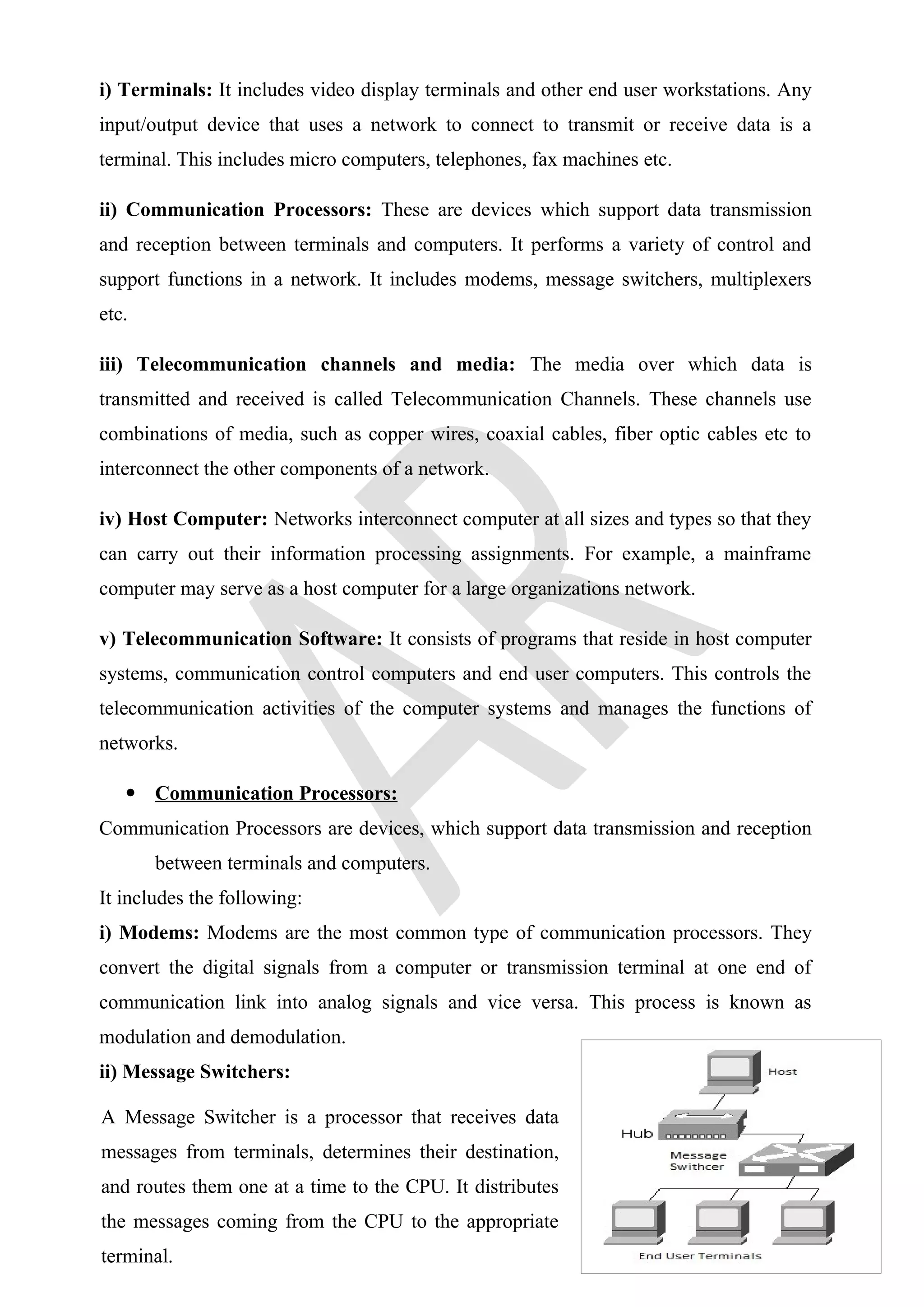
ii) Message Switchers:
AR
A Message Switcher is a processor that receives data
messages from terminals, determines their destination,
and routes them one at a time to the CPU. It distributes
the messages coming from the CPU to the appropriate
terminal.
iii) Multiplexers, Concentrators and Controllers:
A Multiplexer allows several terminals to use one line to communicate with a
CPU. However, it allows the terminals to send their messages simultaneously.
A Concentrator is essentially a smart multiplexer. It can be programmed, has
more processing capability, and is more flexible than a multiplexer.
Controllers link groups of terminals or other devices to a communication
channel.
iv) Front end processors:
With most computers the CPU must communicate with several computers at the
same time. Routine communication tasks can absorb a large proportion of CPU’s
processing time, leading to degraded performance on more important jobs. In order to
not to waste the valuable CPU time, many computer systems have a small secondary
computer dedicated solely to communication. These are known as front-end processors.
 Modes of Data Transmission:
There are 3 ways for transmitting data from one point to another.
1. Simplex Channel: A Channel whose direction of transmission is unchanging.
Eg. Radio Station
2. Half-Duplex:
3. Full Duplex:
AR
A Half-Duplex channel is a single physical
channel in which the direction may be
reversed. In half-duplex, Messages may flow
in two directions, but never at the same time.
Eg. Telephone Conversation
A Full-Duplex channel allows simultaneous message
exchange in both directions. It really consists of two
simplex channels, a forward channel and a reverse
channel, linking the same points.
Eg. Message chatting

Data Communication and Communication Processors and Modes of Data Transmission

  • 1.
    Computer Network A computernetwork is a group of interconnected computers. They share resources such as electronic mail, bulletin boards and access to unique databases. They can be thought of as information highways for data.  Data Communication: Data communications are the exchange of data between two devices via some form of transmission medium such as wire cable. For enabling data communication, a combination of hardware and software is essential. In data communication maximum permissible transmission rate of a message is directly proportional to signal power and inversely proportional to channel noise.  Characteristics of Data Communication System: i) Accuracy: The system must deliver the data accurately. Data that have been altered in transmission and left uncorrected are unusable. ii) Timeliness: The system must deliver data in a timely manner. In the case of video and audio, timely delivery means delivering data as they are produced, in the same order that they are produced and without significant delay. This kind of delivery is called real-time transmission. iii) Correctness: When a sender transmits data for an intended recipient, the data must reach only the intended recipient and not someone else.  Components of Data Communication System: AR
  • 2.
    i) Terminals: Itincludes video display terminals and other end user workstations. Any input/output device that uses a network to connect to transmit or receive data is a terminal. This includes micro computers, telephones, fax machines etc. ii) Communication Processors: These are devices which support data transmission and reception between terminals and computers. It performs a variety of control and support functions in a network. It includes modems, message switchers, multiplexers etc. iii) Telecommunication channels and media: The media over which data is transmitted and received is called Telecommunication Channels. These channels use combinations of media, such as copper wires, coaxial cables, fiber optic cables etc to interconnect the other components of a network. iv) Host Computer: Networks interconnect computer at all sizes and types so that they can carry out their information processing assignments. For example, a mainframe computer may serve as a host computer for a large organizations network. v) Telecommunication Software: It consists of programs that reside in host computer systems, communication control computers and end user computers. This controls the telecommunication activities of the computer systems and manages the functions of networks.  Communication Processors: Communication Processors are devices, which support data transmission and reception between terminals and computers. It includes the following: i) Modems: Modems are the most common type of communication processors. They convert the digital signals from a computer or transmission terminal at one end of communication link into analog signals and vice versa. This process is known as modulation and demodulation. ii) Message Switchers: AR A Message Switcher is a processor that receives data messages from terminals, determines their destination, and routes them one at a time to the CPU. It distributes the messages coming from the CPU to the appropriate terminal.
  • 3.
    iii) Multiplexers, Concentratorsand Controllers: A Multiplexer allows several terminals to use one line to communicate with a CPU. However, it allows the terminals to send their messages simultaneously. A Concentrator is essentially a smart multiplexer. It can be programmed, has more processing capability, and is more flexible than a multiplexer. Controllers link groups of terminals or other devices to a communication channel. iv) Front end processors: With most computers the CPU must communicate with several computers at the same time. Routine communication tasks can absorb a large proportion of CPU’s processing time, leading to degraded performance on more important jobs. In order to not to waste the valuable CPU time, many computer systems have a small secondary computer dedicated solely to communication. These are known as front-end processors.  Modes of Data Transmission: There are 3 ways for transmitting data from one point to another. 1. Simplex Channel: A Channel whose direction of transmission is unchanging. Eg. Radio Station 2. Half-Duplex: 3. Full Duplex: AR A Half-Duplex channel is a single physical channel in which the direction may be reversed. In half-duplex, Messages may flow in two directions, but never at the same time. Eg. Telephone Conversation A Full-Duplex channel allows simultaneous message exchange in both directions. It really consists of two simplex channels, a forward channel and a reverse channel, linking the same points. Eg. Message chatting