
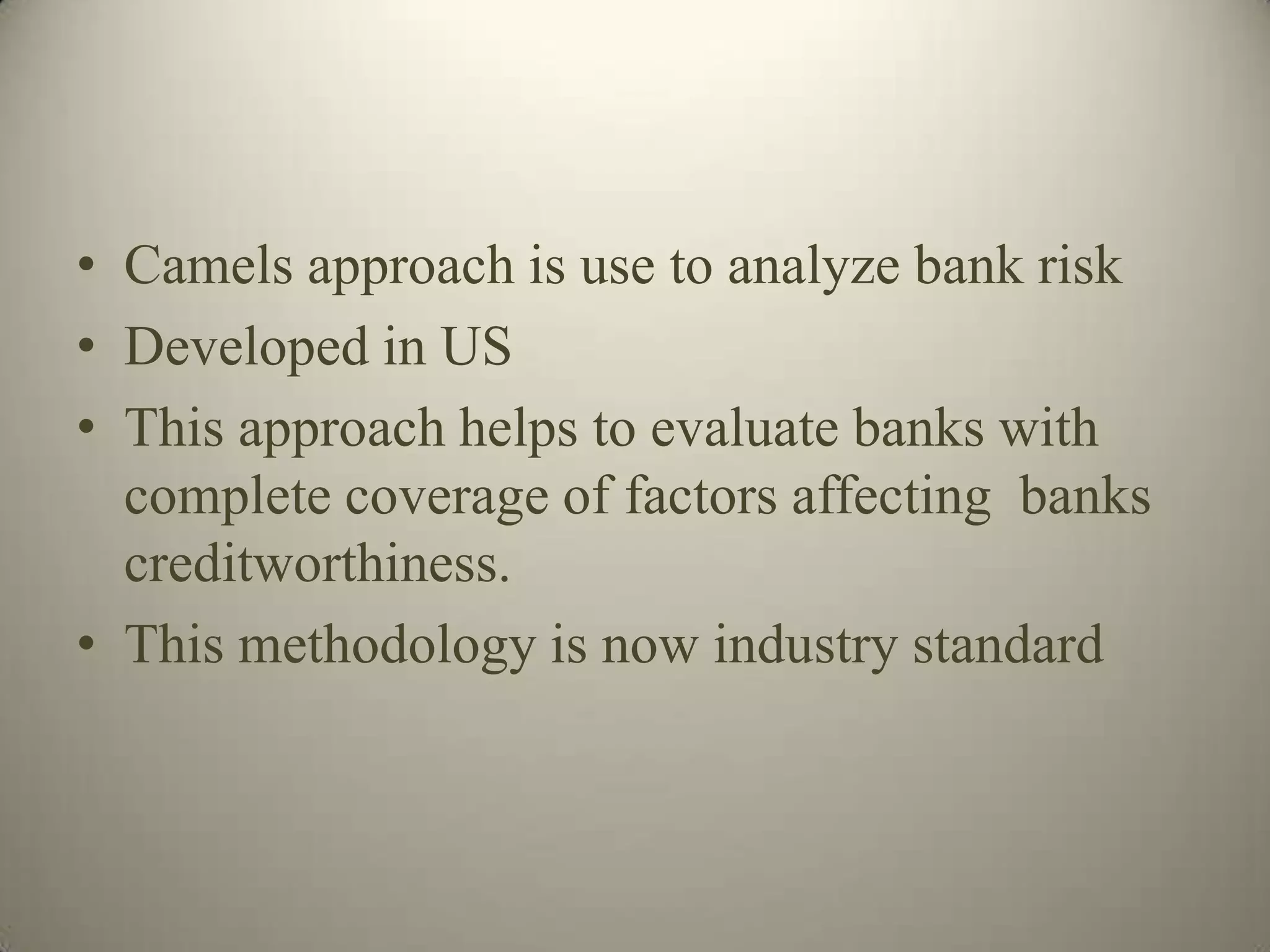


• Camels approach is use to analyze bank risk
• Developed in US
• This approach helps to evaluate banks with
  complete coverage of factors affecting banks
  creditworthiness.
• This methodology is now industry standard
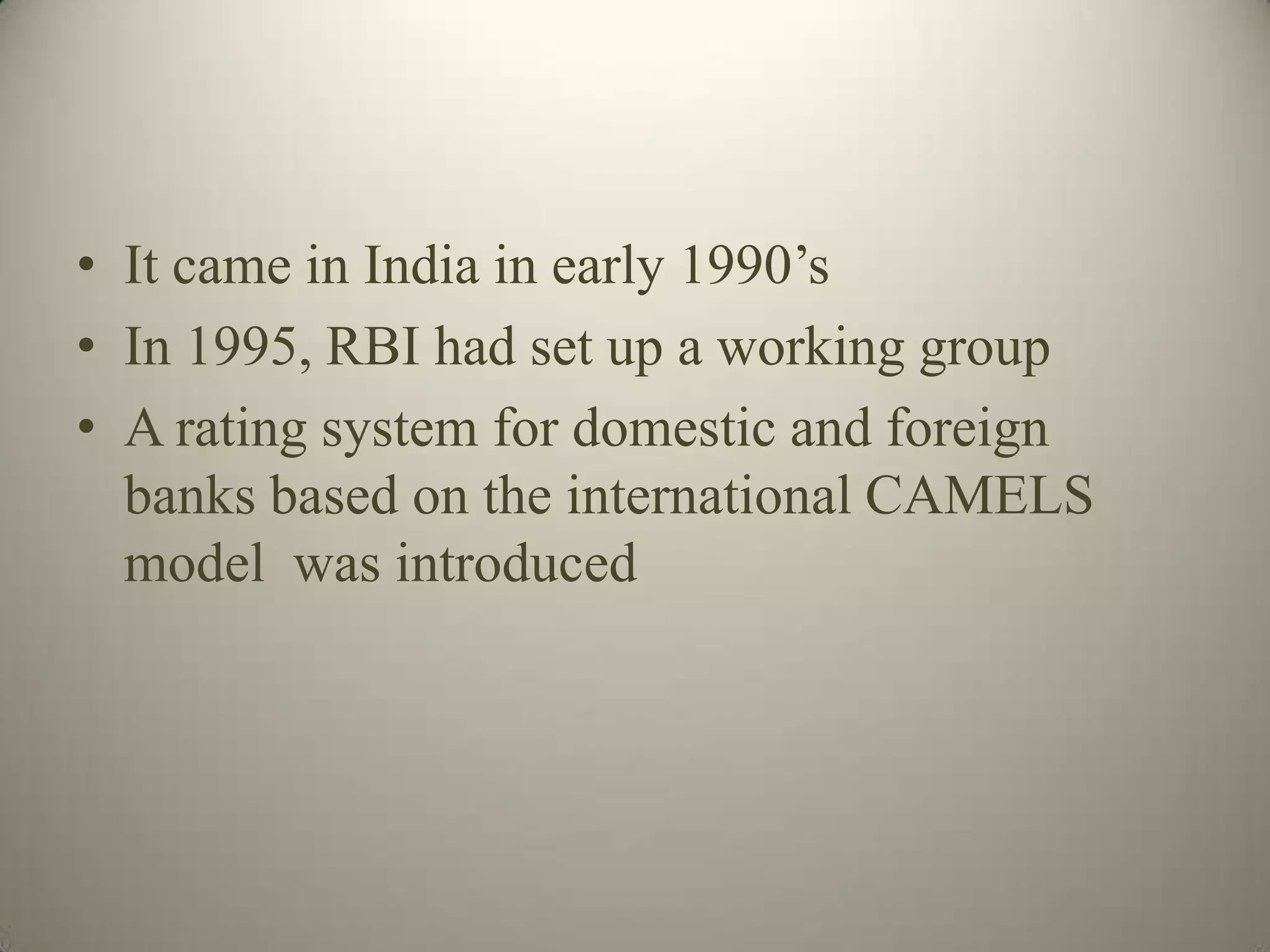
• It came in India in early 1990’s
• In 1995, RBI had set up a working group
• A rating system for domestic and foreign
  banks based on the international CAMELS
  model was introduced
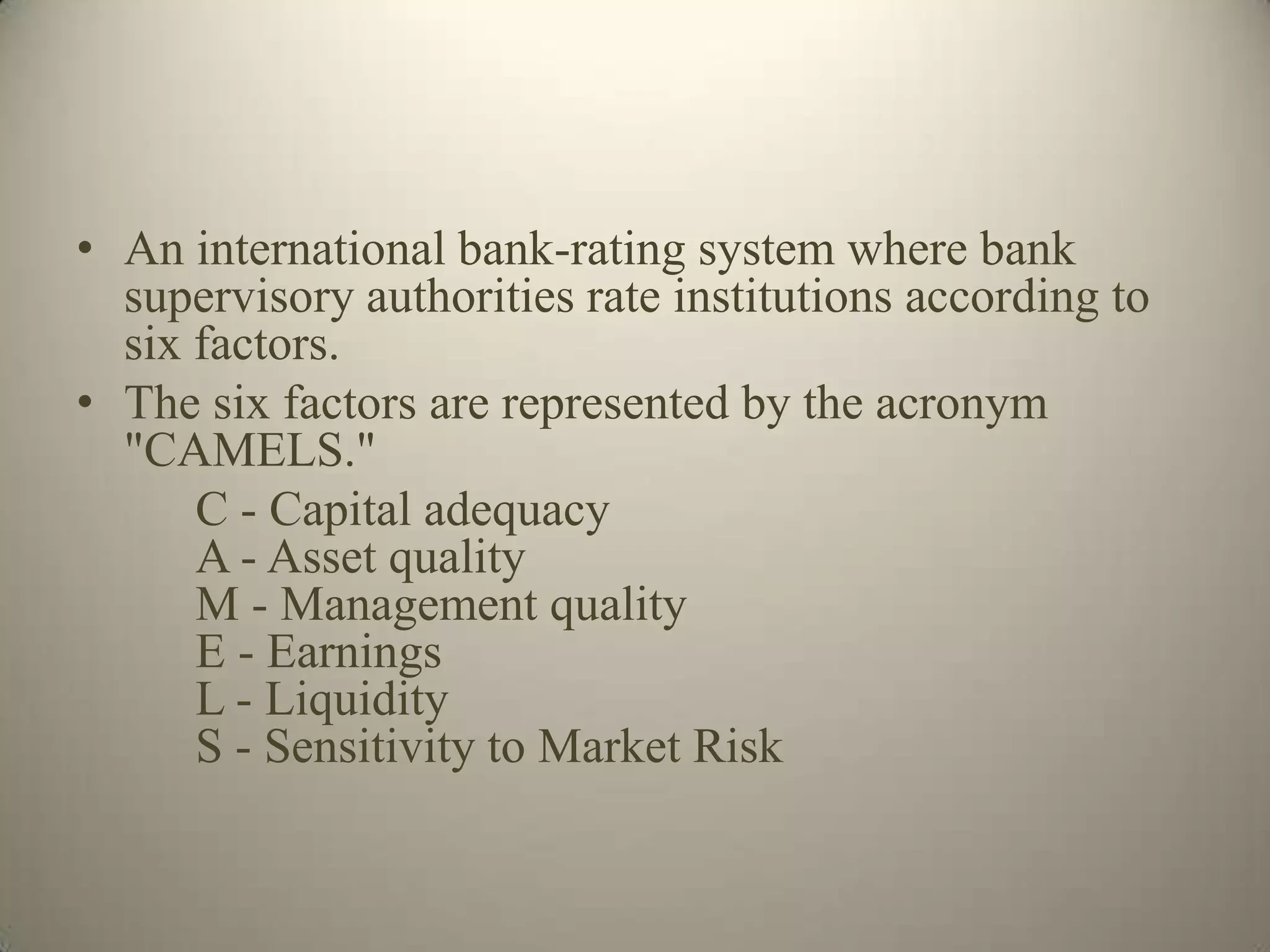
• An international bank-rating system where bank
  supervisory authorities rate institutions according to
  six factors.
• The six factors are represented by the acronym
  "CAMELS."
      C - Capital adequacy
      A - Asset quality
      M - Management quality
      E - Earnings
      L - Liquidity
      S - Sensitivity to Market Risk
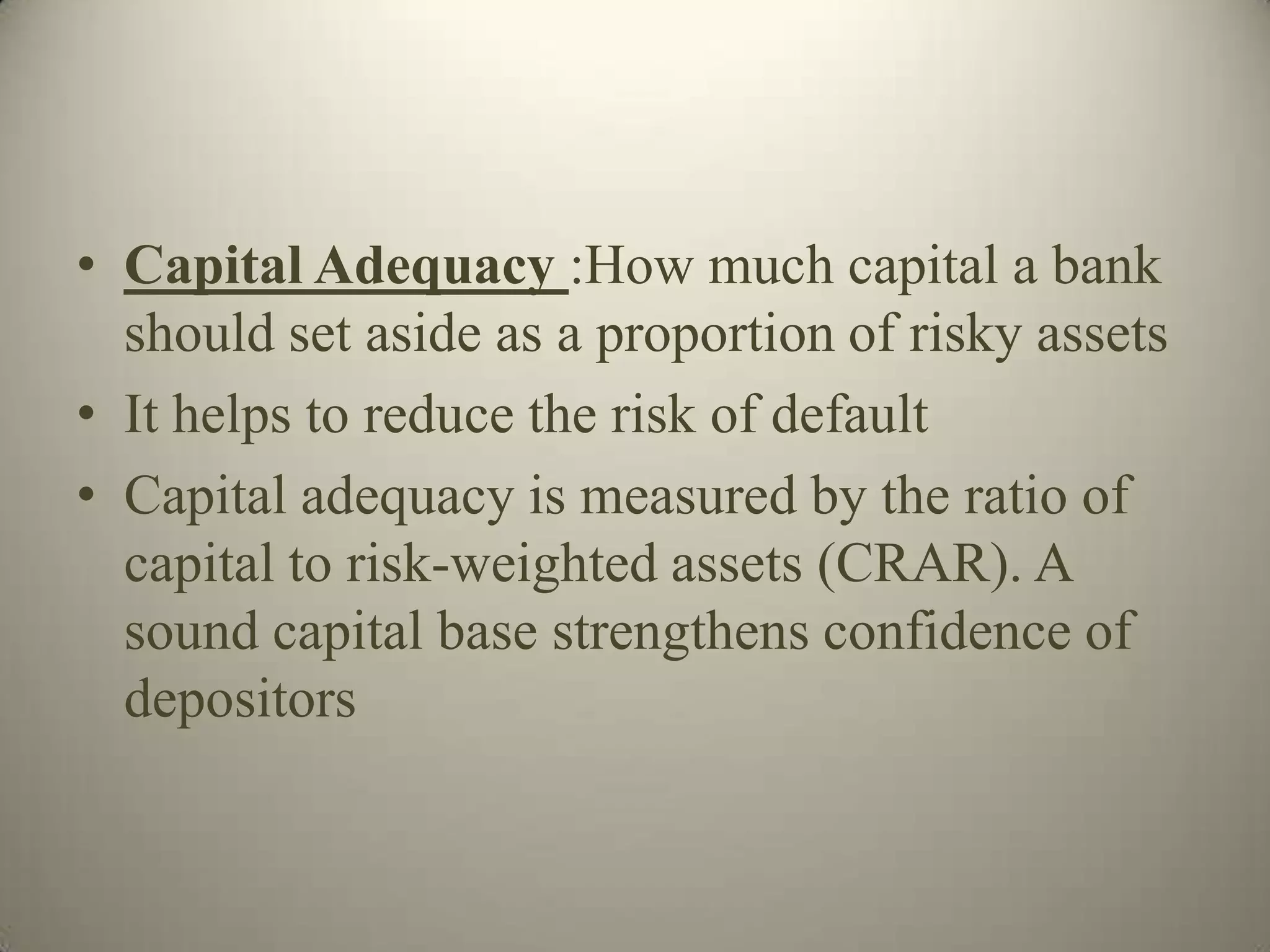
• Capital Adequacy :How much capital a bank
  should set aside as a proportion of risky assets
• It helps to reduce the risk of default
• Capital adequacy is measured by the ratio of
  capital to risk-weighted assets (CRAR). A
  sound capital base strengthens confidence of
  depositors
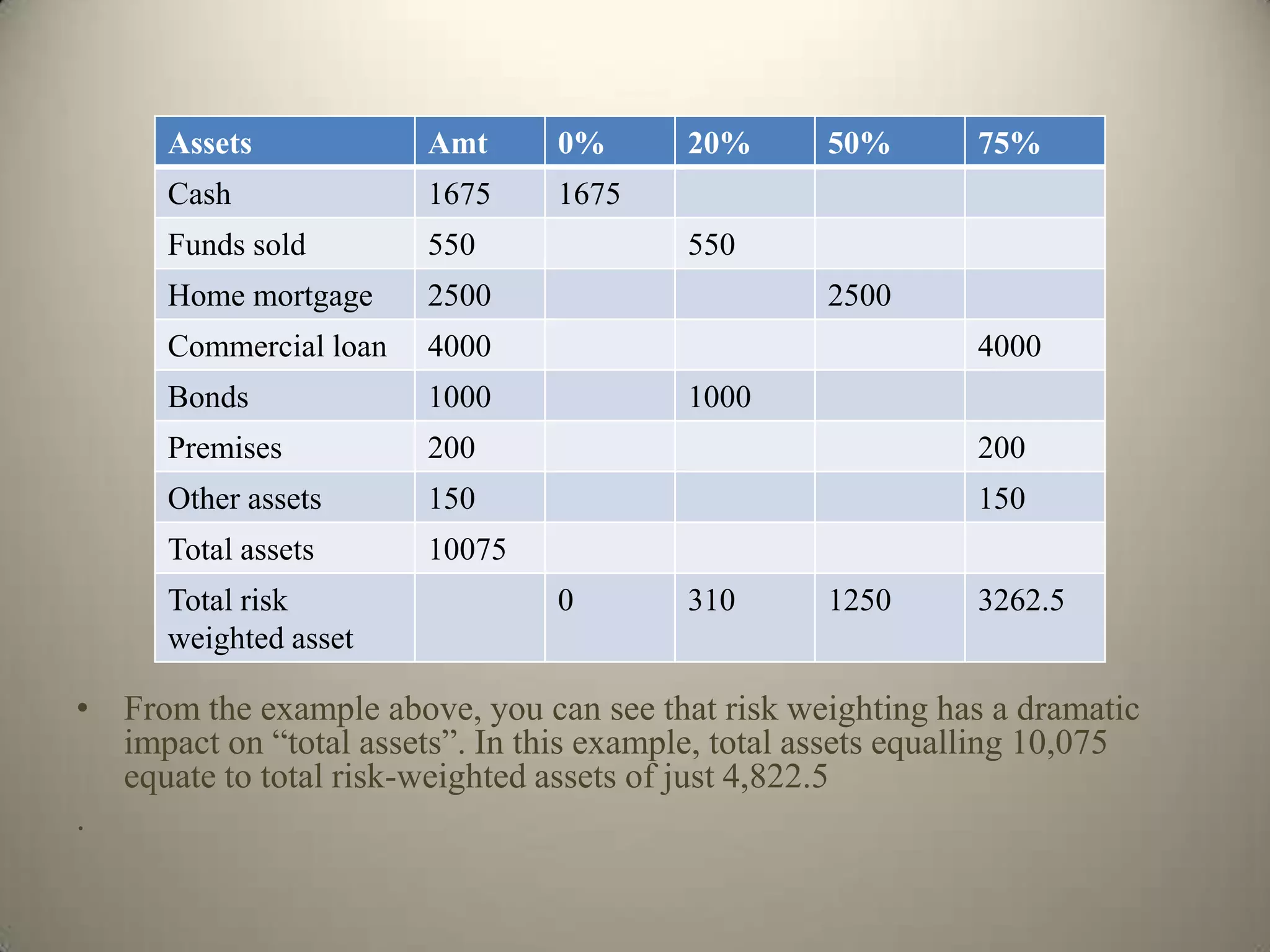
Assets            Amt      0%       20%       50%       75%
      Cash              1675     1675
      Funds sold        550               550
      Home mortgage     2500                        2500
      Commercial loan   4000                                  4000
      Bonds             1000              1000
      Premises          200                                   200
      Other assets      150                                   150
      Total assets      10075
      Total risk                 0        310       1250      3262.5
      weighted asset

• From the example above, you can see that risk weighting has a dramatic
  impact on “total assets”. In this example, total assets equalling 10,075
  equate to total risk-weighted assets of just 4,822.5
.
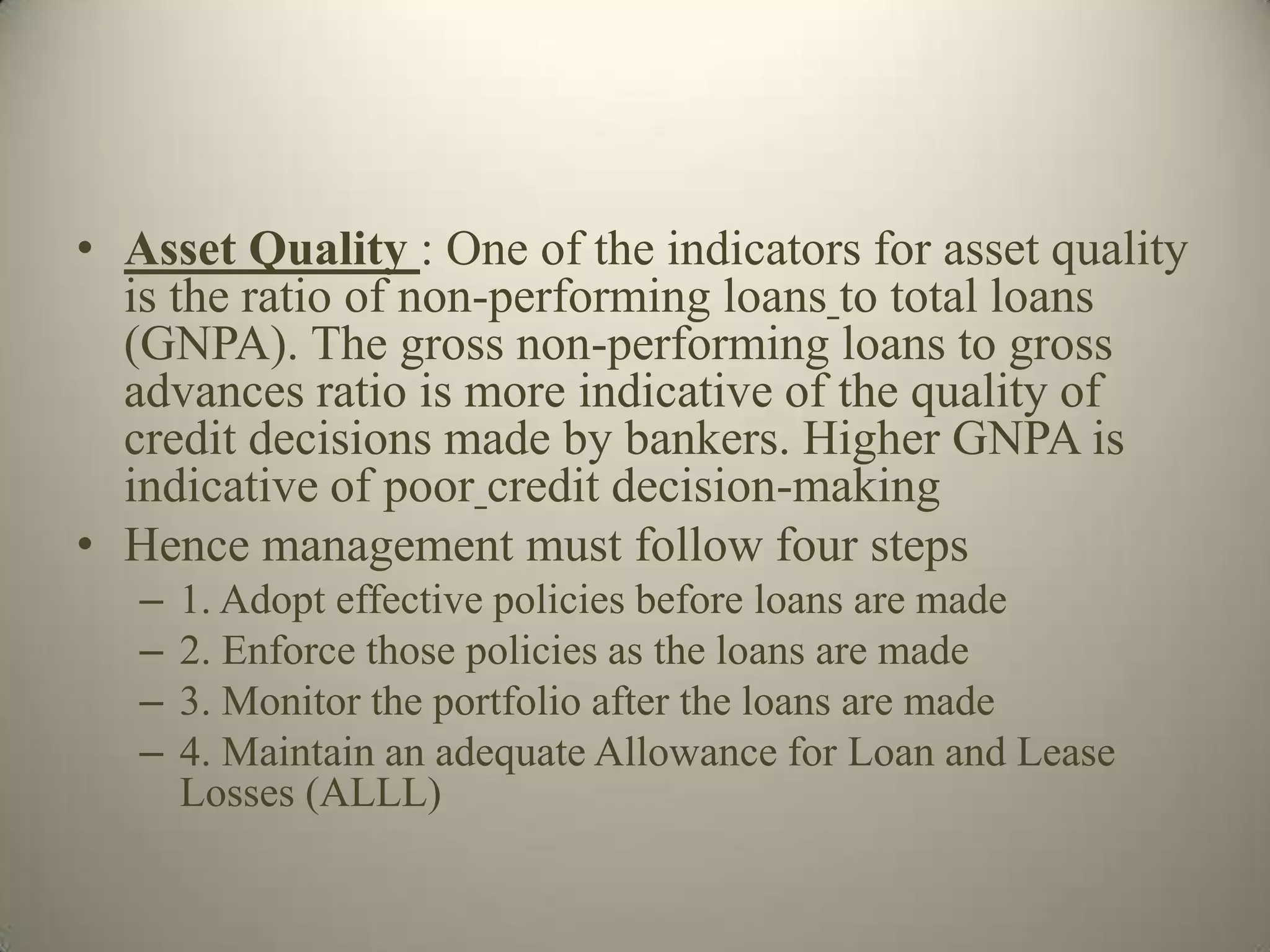
• Asset Quality : One of the indicators for asset quality
  is the ratio of non-performing loans to total loans
  (GNPA). The gross non-performing loans to gross
  advances ratio is more indicative of the quality of
  credit decisions made by bankers. Higher GNPA is
  indicative of poor credit decision-making
• Hence management must follow four steps
   –   1. Adopt effective policies before loans are made
   –   2. Enforce those policies as the loans are made
   –   3. Monitor the portfolio after the loans are made
   –   4. Maintain an adequate Allowance for Loan and Lease
       Losses (ALLL)
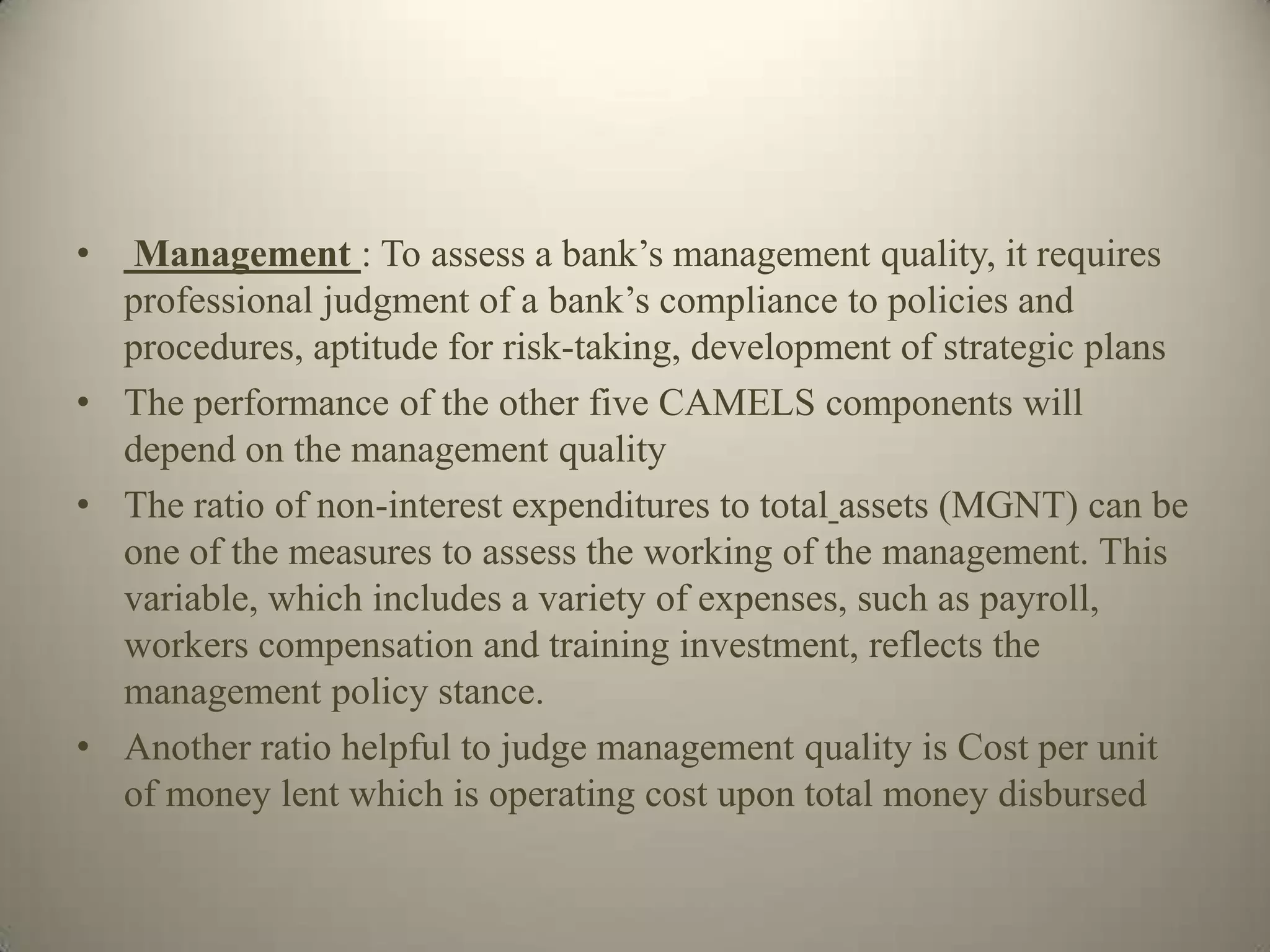
• Management : To assess a bank’s management quality, it requires
  professional judgment of a bank’s compliance to policies and
  procedures, aptitude for risk-taking, development of strategic plans
• The performance of the other five CAMELS components will
  depend on the management quality
• The ratio of non-interest expenditures to total assets (MGNT) can be
  one of the measures to assess the working of the management. This
  variable, which includes a variety of expenses, such as payroll,
  workers compensation and training investment, reflects the
  management policy stance.
• Another ratio helpful to judge management quality is Cost per unit
  of money lent which is operating cost upon total money disbursed
• Earnings : The quality and trend of earnings of an
  institution depend largely on how well the management
  manages the assets and liabilities of the institution. An FI
  must earn reasonable profit to support asset growth, build
  up adequate reserves and enhance shareholders’ value.
• It can be measured as the return on asset ratio
• Liquidity :An FI must always be liquid to meet depositors’
  and creditors’ demand to maintain public confidence.
• Cash maintained by the banks and balances with central
  bank, to total asset ratio (LQD) is an indicator of bank's
  liquidity. In general, banks with a larger volume of liquid
  assets are perceived safe, since these assets would allow
  banks to meet unexpected withdrawals.
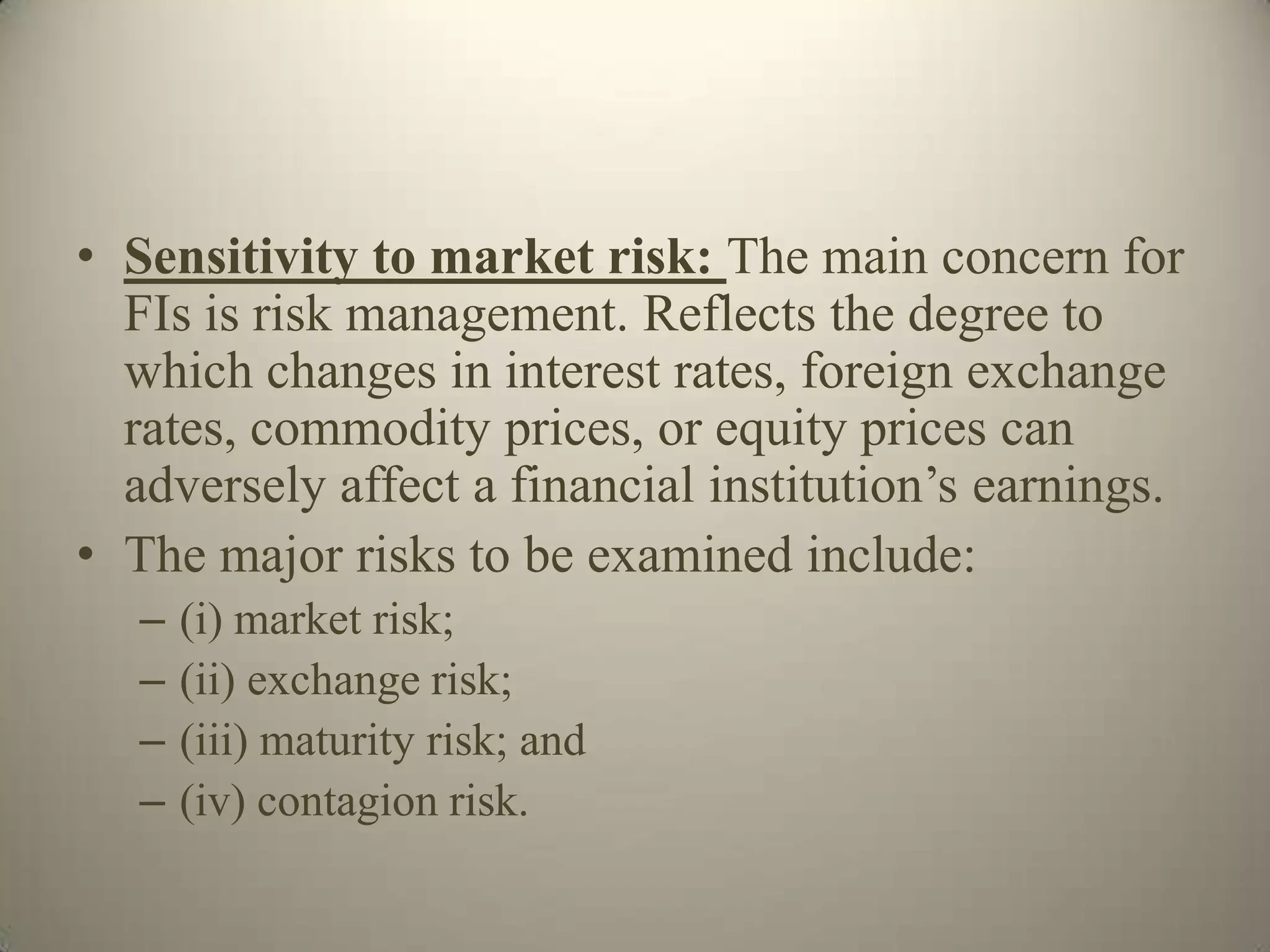
• Sensitivity to market risk: The main concern for
  FIs is risk management. Reflects the degree to
  which changes in interest rates, foreign exchange
  rates, commodity prices, or equity prices can
  adversely affect a financial institution’s earnings.
• The major risks to be examined include:
   –   (i) market risk;
   –   (ii) exchange risk;
   –   (iii) maturity risk; and
   –   (iv) contagion risk.
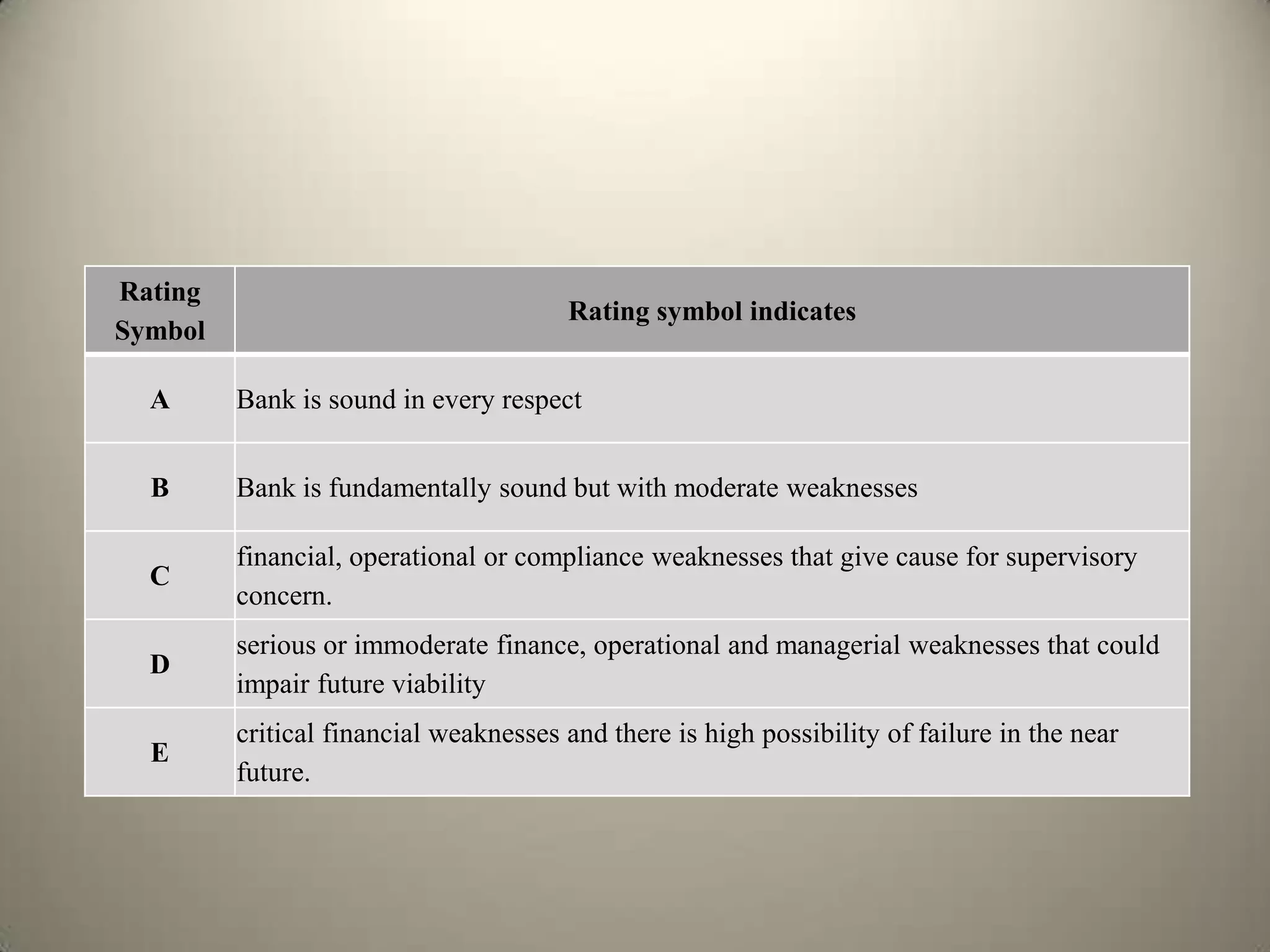
Rating
                                       Rating symbol indicates
Symbol

  A      Bank is sound in every respect


  B      Bank is fundamentally sound but with moderate weaknesses

         financial, operational or compliance weaknesses that give cause for supervisory
  C
         concern.
         serious or immoderate finance, operational and managerial weaknesses that could
  D
         impair future viability
         critical financial weaknesses and there is high possibility of failure in the near
  E
         future.
Camels approach

Camels approach

  • 2.
    • Camels approachis use to analyze bank risk • Developed in US • This approach helps to evaluate banks with complete coverage of factors affecting banks creditworthiness. • This methodology is now industry standard
  • 3.
    • It camein India in early 1990’s • In 1995, RBI had set up a working group • A rating system for domestic and foreign banks based on the international CAMELS model was introduced
  • 4.
    • An internationalbank-rating system where bank supervisory authorities rate institutions according to six factors. • The six factors are represented by the acronym "CAMELS." C - Capital adequacy A - Asset quality M - Management quality E - Earnings L - Liquidity S - Sensitivity to Market Risk
  • 5.
    • Capital Adequacy:How much capital a bank should set aside as a proportion of risky assets • It helps to reduce the risk of default • Capital adequacy is measured by the ratio of capital to risk-weighted assets (CRAR). A sound capital base strengthens confidence of depositors
  • 6.
    Assets Amt 0% 20% 50% 75% Cash 1675 1675 Funds sold 550 550 Home mortgage 2500 2500 Commercial loan 4000 4000 Bonds 1000 1000 Premises 200 200 Other assets 150 150 Total assets 10075 Total risk 0 310 1250 3262.5 weighted asset • From the example above, you can see that risk weighting has a dramatic impact on “total assets”. In this example, total assets equalling 10,075 equate to total risk-weighted assets of just 4,822.5 .
  • 7.
    • Asset Quality: One of the indicators for asset quality is the ratio of non-performing loans to total loans (GNPA). The gross non-performing loans to gross advances ratio is more indicative of the quality of credit decisions made by bankers. Higher GNPA is indicative of poor credit decision-making • Hence management must follow four steps – 1. Adopt effective policies before loans are made – 2. Enforce those policies as the loans are made – 3. Monitor the portfolio after the loans are made – 4. Maintain an adequate Allowance for Loan and Lease Losses (ALLL)
  • 8.
    • Management :To assess a bank’s management quality, it requires professional judgment of a bank’s compliance to policies and procedures, aptitude for risk-taking, development of strategic plans • The performance of the other five CAMELS components will depend on the management quality • The ratio of non-interest expenditures to total assets (MGNT) can be one of the measures to assess the working of the management. This variable, which includes a variety of expenses, such as payroll, workers compensation and training investment, reflects the management policy stance. • Another ratio helpful to judge management quality is Cost per unit of money lent which is operating cost upon total money disbursed
  • 9.
    • Earnings :The quality and trend of earnings of an institution depend largely on how well the management manages the assets and liabilities of the institution. An FI must earn reasonable profit to support asset growth, build up adequate reserves and enhance shareholders’ value. • It can be measured as the return on asset ratio • Liquidity :An FI must always be liquid to meet depositors’ and creditors’ demand to maintain public confidence. • Cash maintained by the banks and balances with central bank, to total asset ratio (LQD) is an indicator of bank's liquidity. In general, banks with a larger volume of liquid assets are perceived safe, since these assets would allow banks to meet unexpected withdrawals.
  • 10.
    • Sensitivity tomarket risk: The main concern for FIs is risk management. Reflects the degree to which changes in interest rates, foreign exchange rates, commodity prices, or equity prices can adversely affect a financial institution’s earnings. • The major risks to be examined include: – (i) market risk; – (ii) exchange risk; – (iii) maturity risk; and – (iv) contagion risk.
  • 11.
    Rating Rating symbol indicates Symbol A Bank is sound in every respect B Bank is fundamentally sound but with moderate weaknesses financial, operational or compliance weaknesses that give cause for supervisory C concern. serious or immoderate finance, operational and managerial weaknesses that could D impair future viability critical financial weaknesses and there is high possibility of failure in the near E future.