BFSM – UNIT 4
CAMELS MODEL
JEPPIAAR ENGG COLLEGE
CAMELS- Introduction
Bank regulators, for example, use financial
ratios to help evaluate a bank’s performance
as part of the CAMEL system”. The
evaluation factors are as follows.
C → Capital adequacy
A → Asset quality
M → Management quality
E → Earnings ability
L → Liquidity , S– Sensitivity to Market risk
Process
 Each of the five factors is scored from one
to five, with one being the strongest
rating.
 An overall composite CAMELs rating
also ranges from one to five. The
Federal Reserve System in U.S. describes
the five composite rating levels as follows
CAMELS Rating
 1 = An institution that is basically sound in every
respect.
 2 = An institution that is fundamentally sound but has
modest weaknesses.
 3 = An institution with financial, operational, or
compliance weaknesses that give cause for supervisory
concern.
 4 = An institution with serious financial weaknesses that
 could impair future viability.
 5 = An institution with critical financial weaknesses
that render the probability of failure extremely high in
the near term.
Capital Adequacy considerations
 Nature and volume of problem assets in
relation to
 total capital and adequacy of LLR and
other reserves
 • Balance sheet structure including off
balance sheet
 items, market, and concentration risk
 • Nature of business activities and risks to
the bank
Capital Adequacy
 Asset and capital growth experience and
prospects
 Earnings performance and distribution of
dividends
 Capital requirements and compliance with
regulatory requirements
 Access to capital markets and sources of
capital
Asset Quality Considerations
 Volume of problem of all assets
 Volume of overdue or rescheduled loans
 Ability of management to administer all
the assets of the bank and to collect
problem loans
 Large concentrations of loans and
insiders loans, diversification of
investments
Asset Quality
 Loan portfolio management, written
policies, procedures internal control,
Management Information System
 Loan Loss Reserves in relation to problem
credits and other assets
Management Quality
considerations
 Quality of the monitoring and support of
the activities by the board and
management and their ability to
understand and respond to the risks
associated with these activities in the
present environment and to plan for the
future
Management Quality
 Development and implementation of
written policies, procedures, MIS, risk
monitoring system, reporting,
safeguarding of documents, contingency
plan, and compliance with laws and
regulations controlled by a compliance
officer
Management Quality
 Availability of internal and external audit
function
 Concentration or delegation of authority
 Compensations policies
 Response to CBI concerns and
recommendations
 Overall performance of the bank and its
risk profile
Earnings Ability
 Sufficient earnings to cover potential
losses, provide adequate capital and pay
reasonable dividends
 Composition of net income; Volume and
stability of the components
 Level of expenses in relation to operations
 Reliance on extraordinary items, securities
transactions, high risk activities
Earnings Ability
 Adequacy of budgeting, forecasting
 Earnings exposure to market risks, such as
interest rate variations, foreign exchange
fluctuations and price risk
Liquidity Considerations
 Sources and volume of liquid funds
available to meet short term obligations
 Volatility of deposits and loan demand
 Interest rates and maturities of assets and
liabilities
 Access to money market and other
sources of funds
 Diversification of funding sources
Liquidity Considerations
 Reliance on inter-bank market for short
term funding
 Management ability to plan, control
and measure liquidity process.
 Contingency plan
Sensitivity
 Sensitivity (S) Sensitivity ratios those are
related to risk and covering power of
organization that are defined and
calculated to finalize bank's performance
model because risk indicators is very
important and highlighted in CAMELS
model.
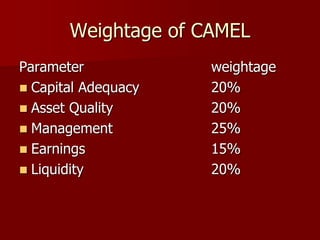
Weightage of CAMEL
Parameter weightage
 Capital Adequacy 20%
 Asset Quality 20%
 Management 25%
 Earnings 15%
 Liquidity 20%

Camels rating

  • 1.
    BFSM – UNIT4 CAMELS MODEL JEPPIAAR ENGG COLLEGE
  • 2.
    CAMELS- Introduction Bank regulators,for example, use financial ratios to help evaluate a bank’s performance as part of the CAMEL system”. The evaluation factors are as follows. C → Capital adequacy A → Asset quality M → Management quality E → Earnings ability L → Liquidity , S– Sensitivity to Market risk
  • 3.
    Process  Each ofthe five factors is scored from one to five, with one being the strongest rating.  An overall composite CAMELs rating also ranges from one to five. The Federal Reserve System in U.S. describes the five composite rating levels as follows
  • 4.
    CAMELS Rating  1= An institution that is basically sound in every respect.  2 = An institution that is fundamentally sound but has modest weaknesses.  3 = An institution with financial, operational, or compliance weaknesses that give cause for supervisory concern.  4 = An institution with serious financial weaknesses that  could impair future viability.  5 = An institution with critical financial weaknesses that render the probability of failure extremely high in the near term.
  • 5.
    Capital Adequacy considerations Nature and volume of problem assets in relation to  total capital and adequacy of LLR and other reserves  • Balance sheet structure including off balance sheet  items, market, and concentration risk  • Nature of business activities and risks to the bank
  • 6.
    Capital Adequacy  Assetand capital growth experience and prospects  Earnings performance and distribution of dividends  Capital requirements and compliance with regulatory requirements  Access to capital markets and sources of capital
  • 7.
    Asset Quality Considerations Volume of problem of all assets  Volume of overdue or rescheduled loans  Ability of management to administer all the assets of the bank and to collect problem loans  Large concentrations of loans and insiders loans, diversification of investments
  • 8.
    Asset Quality  Loanportfolio management, written policies, procedures internal control, Management Information System  Loan Loss Reserves in relation to problem credits and other assets
  • 9.
    Management Quality considerations  Qualityof the monitoring and support of the activities by the board and management and their ability to understand and respond to the risks associated with these activities in the present environment and to plan for the future
  • 10.
    Management Quality  Developmentand implementation of written policies, procedures, MIS, risk monitoring system, reporting, safeguarding of documents, contingency plan, and compliance with laws and regulations controlled by a compliance officer
  • 11.
    Management Quality  Availabilityof internal and external audit function  Concentration or delegation of authority  Compensations policies  Response to CBI concerns and recommendations  Overall performance of the bank and its risk profile
  • 12.
    Earnings Ability  Sufficientearnings to cover potential losses, provide adequate capital and pay reasonable dividends  Composition of net income; Volume and stability of the components  Level of expenses in relation to operations  Reliance on extraordinary items, securities transactions, high risk activities
  • 13.
    Earnings Ability  Adequacyof budgeting, forecasting  Earnings exposure to market risks, such as interest rate variations, foreign exchange fluctuations and price risk
  • 14.
    Liquidity Considerations  Sourcesand volume of liquid funds available to meet short term obligations  Volatility of deposits and loan demand  Interest rates and maturities of assets and liabilities  Access to money market and other sources of funds  Diversification of funding sources
  • 15.
    Liquidity Considerations  Relianceon inter-bank market for short term funding  Management ability to plan, control and measure liquidity process.  Contingency plan
  • 16.
    Sensitivity  Sensitivity (S)Sensitivity ratios those are related to risk and covering power of organization that are defined and calculated to finalize bank's performance model because risk indicators is very important and highlighted in CAMELS model.
  • 17.
    Weightage of CAMEL Parameterweightage  Capital Adequacy 20%  Asset Quality 20%  Management 25%  Earnings 15%  Liquidity 20%