CAMELS RATINGS?By:-Shraddha DharmadhikariMBA-II
INTRODUCTIONIn 1995, RBI had set up a working group under the chairmanship of Shri S. Padmanabhan to review the banking supervision system. The Committee certain recommendations and based on such suggetions a rating system for domestic and foreign banks based on the international CAMELS model combining financial management and systems and control elements was introduced for the inspection cycle commencing from July 1998. CAMELS evaluates banks on the following six parameters
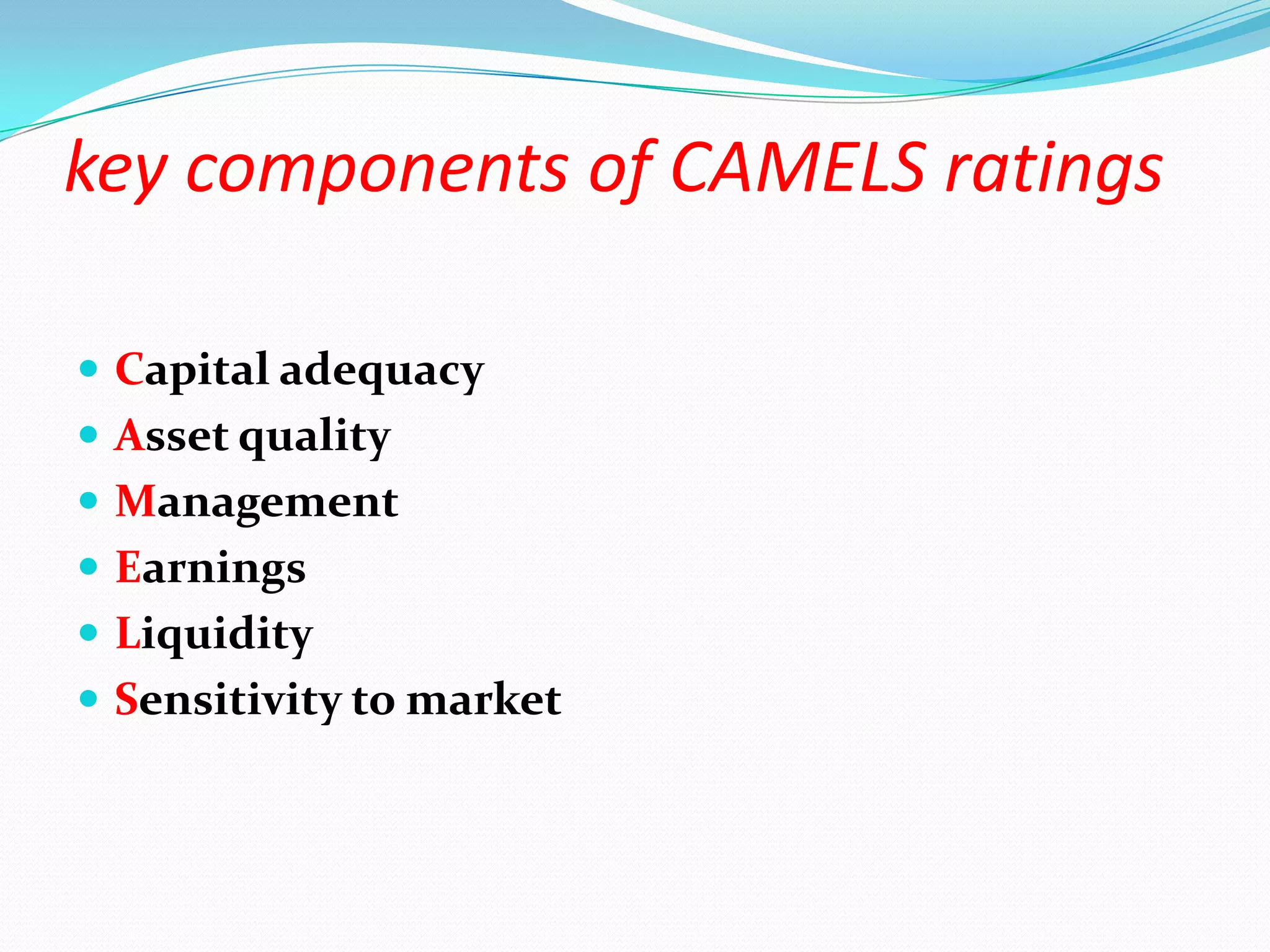
key components of CAMELS ratings Capital adequacyAsset qualityManagementEarningsLiquiditySensitivity to market
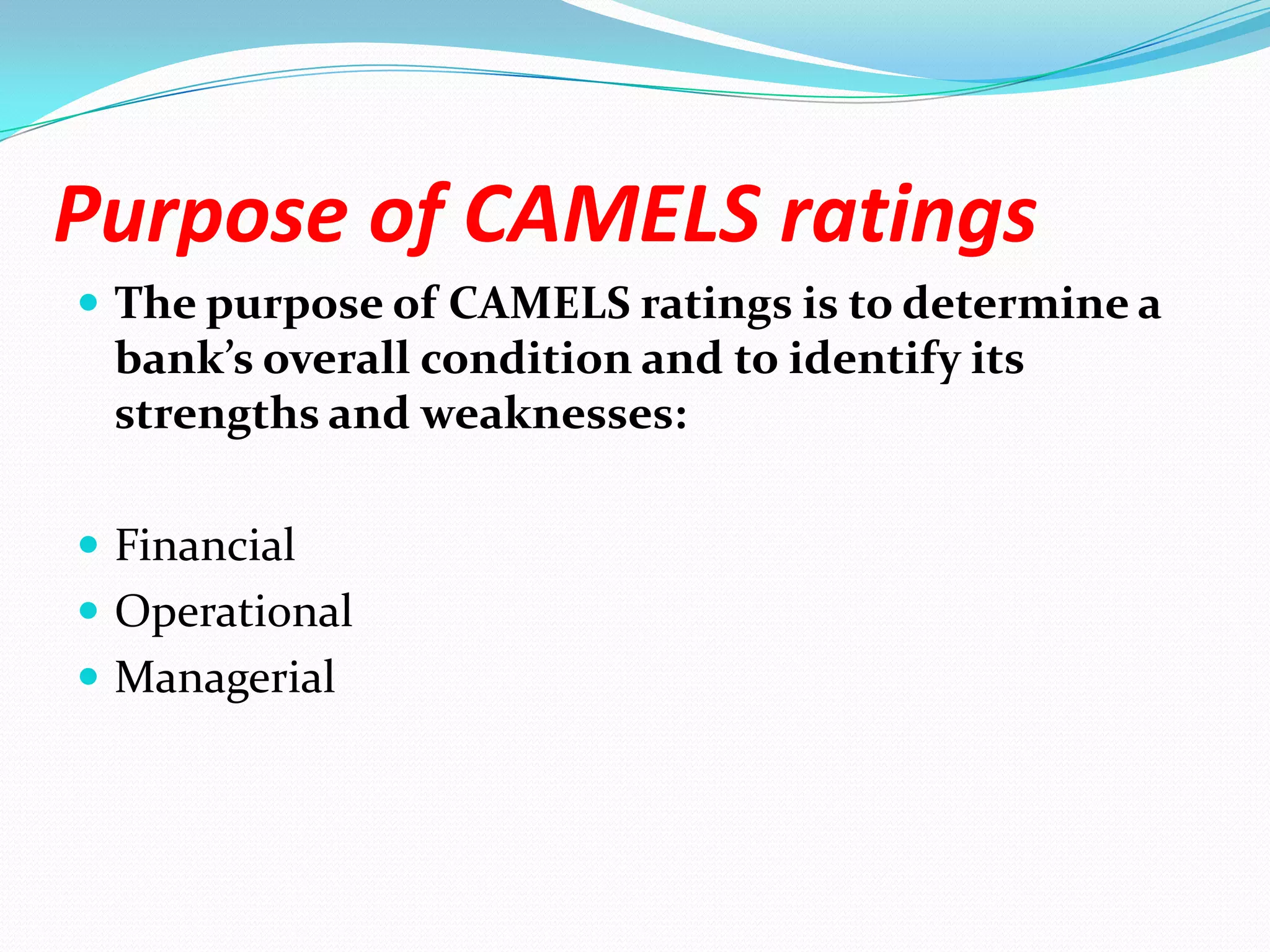
Purpose of CAMELS ratingsThe purpose of CAMELS ratings is to determine a bank’s overall condition and to identify its strengths and weaknesses:FinancialOperationalManagerial
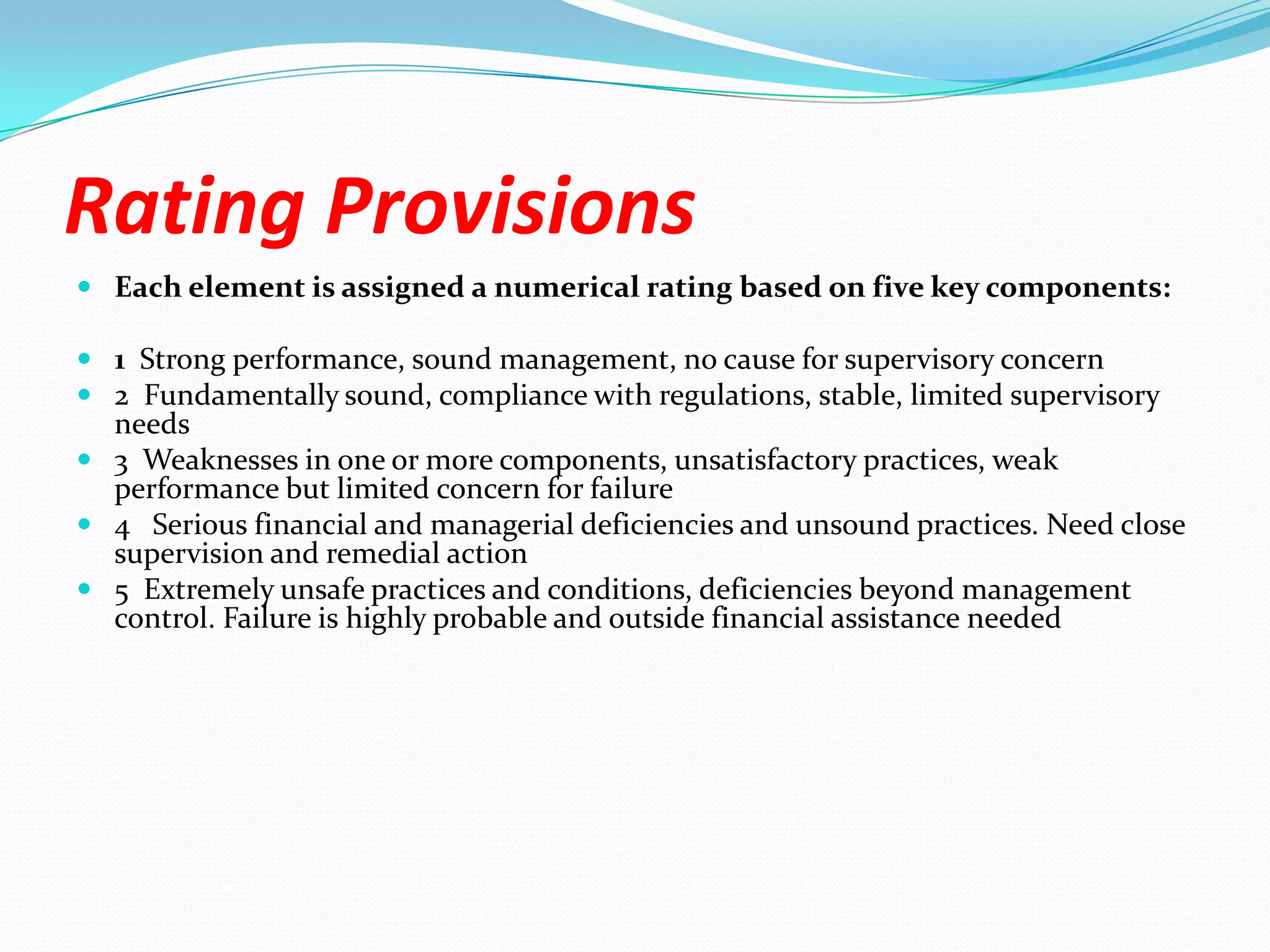
Rating ProvisionsEach element is assigned a numerical rating based on five key components:1  Strong performance, sound management, no cause for supervisory concern2  Fundamentally sound, compliance with regulations, stable, limited supervisory needs3  Weaknesses in one or more components, unsatisfactory practices, weak performance but limited concern for failure4   Serious financial and managerial deficiencies and unsound practices. Need close supervision and remedial action5  Extremely unsafe practices and conditions, deficiencies beyond management control. Failure is highly probable and outside financial assistance needed
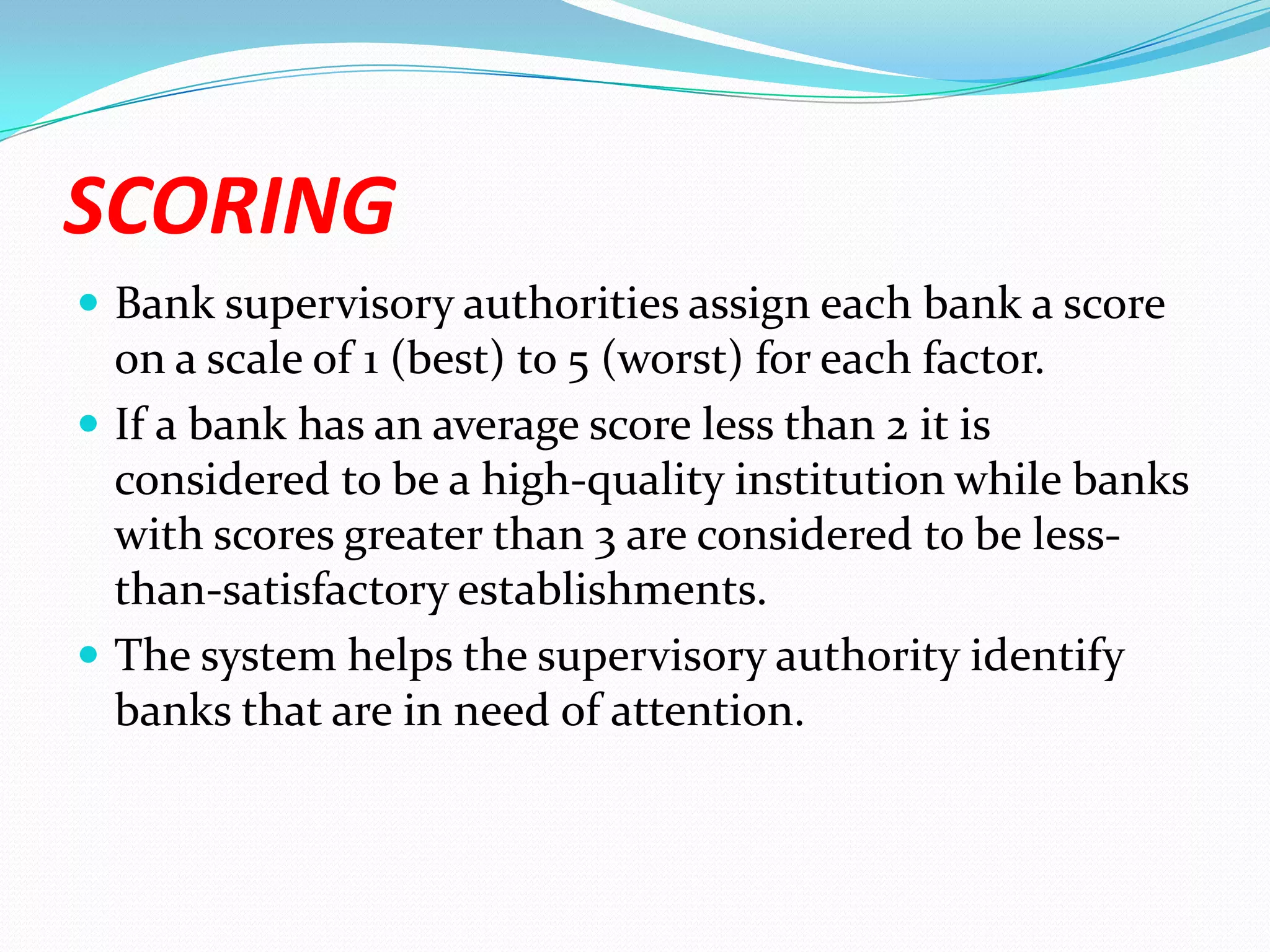
SCORINGBank supervisory authorities assign each bank a score on a scale of 1 (best) to 5 (worst) for each factor. If a bank has an average score less than 2 it is considered to be a high-quality institution while banks with scores greater than 3 are considered to be less-than-satisfactory establishments. The system helps the supervisory authority identify banks that are in need of attention.
Capital AdequacyCapital adequacy is measured by the ratio of capital to risk-weighted assets .   A sound capital base strengthens confidence of depositors
Capital is rated based on the following considerationsNature and volume of assets in relation to total capital and adequacy  other reservesBalance sheet structure including off balance sheet items, market and concentration riskNature of business activities and risks to the bankAsset and capital growth experience and prospectsEarnings performance and distribution of dividendsCapital requirements and compliance with regulatory requirementsAccess to capital markets and sources of capital
ASSET QUALITYOne of the indicators for asset quality is the ratio of non-performing loans to total loans (GNPA). The gross non-performing loans to gross advances ratio is more indicative of the quality of credit decisions made by bankers. Higher GNPA is indicative of poor credit decision-making.Asset represents all the assets of the bank, current and fixed, loan portfolio, investments and real estate owned as well as off balance sheet transactions
Rating factorsAsset quality is based on the following considerations:Volume of problem of all assets Volume of overdue or rescheduled loansAbility of management to administer all the assets of the bank and to collect problem loansLarge concentrations of loans and insiders loans, diversification of investmentsLoan portfolio management, written policies, procedures internal control, Management Information SystemLoan Loss Reserves in relation to problem credits and other assetsGrowth of loans volume in relation to the bank’s capacity
ManagementManagement includes all key managers and the Board of Directors
Rating factorsManagement is the most important element for a successful operation of a bank. Rating is based on the following factors:Quality of the monitoring and support of the activities by the board and management and their ability to understand and respond to the risks associated with these activities in the present environment and to plan for the futureDevelopment and implementation of written policies, procedures, MIS, risk monitoring system, reporting, safeguarding of documents, contingency plan and compliance with laws and regulations controlled by a compliance officer Availability of internal and external audit functionConcentration or delegation of authorityCompensations policies, job descriptionsOverall performance of the bank and its risk profile
EarningsAll income from operations, non-traditional sources, extraordinary itemsIt can be measured as the the return on asset ratio
Rating factorsEarnings are rated according to the following factors:Sufficient earnings to cover potential losses, provide adequate capital and pay reasonable dividendsComposition of net income. Level of expenses in relation to operationsReliance on extraordinary items, securities transactions, high risk activitiesNon traditional or operational sourcesAdequacy of budgeting, forecasting, control MIS of income and expensesAdequacy of provisionsEarnings exposure to market risks, such as interest rate variations, foreign exchange fluctuations and price risk
LiquidityCash maintained by the banks and balances with central bank, to total asset ratio is an indicator of bank's liquidity. In general, banks with a larger volume of liquid assets are perceived safe, since these assets would allow banks to meet unexpected withdrawals.
Rating factorsLiquidity is rated based on the following factors:Sources and volume of liquid funds available to meet short term obligationsVolatility of deposits and loan demandInterest rates and maturities of assets and liabilitiesAccess to money market and other sources of fundsDiversification of funding sourcesReliance on inter-bank market for short term fundingManagement  ability to plan, control and measure liquidity process. Contingency plan
Sensitivity to Market RisksSensitivity to market risks is not taken into consideration by CBI.
Rating factorsMarket risk is based primarily on the following evaluation factors:Sensitivity to adverse changes in interest rates, foreign exchange rates, commodity prices, fixed assetsNature of the operations of the bankTrends in the foreign currencies exposureChanges in the value of the fixed assets of the bankImportance of real estate assets resulting from loans write off
THANK YOU

Camel ratings ppt

  • 1.
  • 2.
    INTRODUCTIONIn 1995, RBIhad set up a working group under the chairmanship of Shri S. Padmanabhan to review the banking supervision system. The Committee certain recommendations and based on such suggetions a rating system for domestic and foreign banks based on the international CAMELS model combining financial management and systems and control elements was introduced for the inspection cycle commencing from July 1998. CAMELS evaluates banks on the following six parameters
  • 3.
    key components ofCAMELS ratings Capital adequacyAsset qualityManagementEarningsLiquiditySensitivity to market
  • 4.
    Purpose of CAMELSratingsThe purpose of CAMELS ratings is to determine a bank’s overall condition and to identify its strengths and weaknesses:FinancialOperationalManagerial
  • 5.
    Rating ProvisionsEach elementis assigned a numerical rating based on five key components:1 Strong performance, sound management, no cause for supervisory concern2 Fundamentally sound, compliance with regulations, stable, limited supervisory needs3 Weaknesses in one or more components, unsatisfactory practices, weak performance but limited concern for failure4 Serious financial and managerial deficiencies and unsound practices. Need close supervision and remedial action5 Extremely unsafe practices and conditions, deficiencies beyond management control. Failure is highly probable and outside financial assistance needed
  • 6.
    SCORINGBank supervisory authoritiesassign each bank a score on a scale of 1 (best) to 5 (worst) for each factor. If a bank has an average score less than 2 it is considered to be a high-quality institution while banks with scores greater than 3 are considered to be less-than-satisfactory establishments. The system helps the supervisory authority identify banks that are in need of attention.
  • 7.
    Capital AdequacyCapital adequacyis measured by the ratio of capital to risk-weighted assets . A sound capital base strengthens confidence of depositors
  • 8.
    Capital is ratedbased on the following considerationsNature and volume of assets in relation to total capital and adequacy other reservesBalance sheet structure including off balance sheet items, market and concentration riskNature of business activities and risks to the bankAsset and capital growth experience and prospectsEarnings performance and distribution of dividendsCapital requirements and compliance with regulatory requirementsAccess to capital markets and sources of capital
  • 9.
    ASSET QUALITYOne ofthe indicators for asset quality is the ratio of non-performing loans to total loans (GNPA). The gross non-performing loans to gross advances ratio is more indicative of the quality of credit decisions made by bankers. Higher GNPA is indicative of poor credit decision-making.Asset represents all the assets of the bank, current and fixed, loan portfolio, investments and real estate owned as well as off balance sheet transactions
  • 10.
    Rating factorsAsset qualityis based on the following considerations:Volume of problem of all assets Volume of overdue or rescheduled loansAbility of management to administer all the assets of the bank and to collect problem loansLarge concentrations of loans and insiders loans, diversification of investmentsLoan portfolio management, written policies, procedures internal control, Management Information SystemLoan Loss Reserves in relation to problem credits and other assetsGrowth of loans volume in relation to the bank’s capacity
  • 11.
    ManagementManagement includes allkey managers and the Board of Directors
  • 12.
    Rating factorsManagement isthe most important element for a successful operation of a bank. Rating is based on the following factors:Quality of the monitoring and support of the activities by the board and management and their ability to understand and respond to the risks associated with these activities in the present environment and to plan for the futureDevelopment and implementation of written policies, procedures, MIS, risk monitoring system, reporting, safeguarding of documents, contingency plan and compliance with laws and regulations controlled by a compliance officer Availability of internal and external audit functionConcentration or delegation of authorityCompensations policies, job descriptionsOverall performance of the bank and its risk profile
  • 13.
    EarningsAll income fromoperations, non-traditional sources, extraordinary itemsIt can be measured as the the return on asset ratio
  • 14.
    Rating factorsEarnings arerated according to the following factors:Sufficient earnings to cover potential losses, provide adequate capital and pay reasonable dividendsComposition of net income. Level of expenses in relation to operationsReliance on extraordinary items, securities transactions, high risk activitiesNon traditional or operational sourcesAdequacy of budgeting, forecasting, control MIS of income and expensesAdequacy of provisionsEarnings exposure to market risks, such as interest rate variations, foreign exchange fluctuations and price risk
  • 15.
    LiquidityCash maintained bythe banks and balances with central bank, to total asset ratio is an indicator of bank's liquidity. In general, banks with a larger volume of liquid assets are perceived safe, since these assets would allow banks to meet unexpected withdrawals.
  • 16.
    Rating factorsLiquidity israted based on the following factors:Sources and volume of liquid funds available to meet short term obligationsVolatility of deposits and loan demandInterest rates and maturities of assets and liabilitiesAccess to money market and other sources of fundsDiversification of funding sourcesReliance on inter-bank market for short term fundingManagement ability to plan, control and measure liquidity process. Contingency plan
  • 17.
    Sensitivity to MarketRisksSensitivity to market risks is not taken into consideration by CBI.
  • 18.
    Rating factorsMarket riskis based primarily on the following evaluation factors:Sensitivity to adverse changes in interest rates, foreign exchange rates, commodity prices, fixed assetsNature of the operations of the bankTrends in the foreign currencies exposureChanges in the value of the fixed assets of the bankImportance of real estate assets resulting from loans write off
  • 19.