Presented by:
Rupesh nyaupane
MBA apex college
Introduction
 Finance Companies are licensed by Nepal Rastra Bank in
‘Class C’.
 Finance companies are those intermediaries, which link
the savers and users of capital. They collect small and
scattered saving of the individuals and mobilize it in the
productive sectors in the form of investment or loan.
 Finance company engaged in making loan to individuals
or businesses unlike a bank, it does not receive deposits
but rather obtains its financing from banks, institutions,
and other money market sources.
Types of finance company’s
1. Consumer finance companies:
Consumer finance companies provide financing for customers of retail stores
or wholesalers. consumer finance companies also provide personal loans
directly to individuals to finance purchases of large household items. Some
consumer finance companies also provide mortgage loans.
2. Business finance companies:
Business finance companies offer loans to small businesses. Business finance
companies also provide financing in the form of credit cards that are used by a
business's employees for travel or for making purchases on behalf of the business.
3. Captive finance subsidiaries:
Primary purpose is to finance sales of the parent company's products and
services, provide wholesale financing to distributors of the parent
company's products, and purchases receivables of parent company.
Sources of funds
 Loan from banks
Finance companies commonly borrow from commercial banks and can
consistently renew the loans over time.
 Commercial paper
commercial paper is available only for short term financing, Only the
most well-known finance companies have traditionally been able to
issue commercial paper to attract funds, because unsecured
commercial paper exposes investors to the risk of default.
 Deposits
Under certain conditions, some states allow finance companies
to attract fund by offering customer deposits similar to those of
the depository institutions.
Cont….
 Bonds
Finance companies in need of long term funds can issue
bonds.
 Capital
Finance companies can build their capital base by
retaining earnings or by issuing stock.
Like other financial institutions, finance companies
maintain a low level of capital as a percentage of total
assets.
Uses of finance company funds
1. Consumer loans
Finance companies extend consumer loans in the form
of personal loans
 automobile loan
 finance companies offer personal loans for home
improvement, mobile homes, and a variety of other
personal expenses
Cont….
2.Business loans and leasing
 Companies commonly obtain these loans from the time they purchase
raw materials until cash is generated from sales of the finished goods.
 Such loans are short term but may be renewed
 finance companies provide financing is by leasing.
3. Real estate loans
 Finance companies offer real estate loans in the form of mortgages on
commercial estate and second mortgages on residential real estate.
 These mortgages are typically secured and historically have a
relatively low default rate
Issues of finance companies
 The total number of finance companies decreased to
53 in Mid - July 2014 from 59 in Mid - July 2013. The
decrease in significant number of finance company is
observed due to the merger and up gradation.
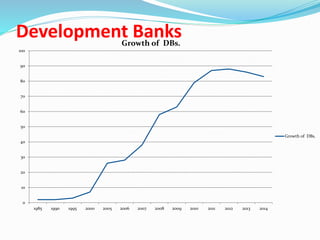
Development Banks
0
10
20
30
40
50
60
70
80
90
100
1985 1990 1995 2000 2005 2006 2007 2008 2009 2010 2011 2012 2013 2014
Growth of DBs.
Growth of DBs.
0
50
100
150
200
250
300
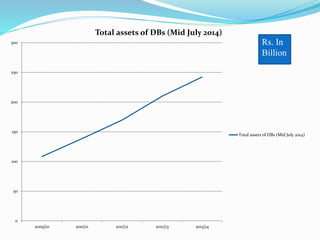
2009|10 2010|11 2011|12 2012|13 2013|14
Total assets of DBs (Mid July 2014)
Rs. In
Billion
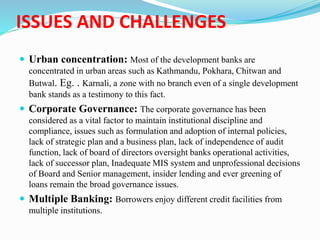
ISSUES AND CHALLENGES
 Urban concentration: Most of the development banks are
concentrated in urban areas such as Kathmandu, Pokhara, Chitwan and
Butwal. Eg. . Karnali, a zone with no branch even of a single development
bank stands as a testimony to this fact.
 Corporate Governance: The corporate governance has been
considered as a vital factor to maintain institutional discipline and
compliance, issues such as formulation and adoption of internal policies,
lack of strategic plan and a business plan, lack of independence of audit
function, lack of board of directors oversight banks operational activities,
lack of successor plan, Inadequate MIS system and unprofessional decisions
of Board and Senior management, insider lending and ever greening of
loans remain the broad governance issues.
 Multiple Banking: Borrowers enjoy different credit facilities from
multiple institutions.
Finance company

Finance company

  • 1.
  • 2.
    Introduction  Finance Companiesare licensed by Nepal Rastra Bank in ‘Class C’.  Finance companies are those intermediaries, which link the savers and users of capital. They collect small and scattered saving of the individuals and mobilize it in the productive sectors in the form of investment or loan.  Finance company engaged in making loan to individuals or businesses unlike a bank, it does not receive deposits but rather obtains its financing from banks, institutions, and other money market sources.
  • 3.
    Types of financecompany’s 1. Consumer finance companies: Consumer finance companies provide financing for customers of retail stores or wholesalers. consumer finance companies also provide personal loans directly to individuals to finance purchases of large household items. Some consumer finance companies also provide mortgage loans. 2. Business finance companies: Business finance companies offer loans to small businesses. Business finance companies also provide financing in the form of credit cards that are used by a business's employees for travel or for making purchases on behalf of the business. 3. Captive finance subsidiaries: Primary purpose is to finance sales of the parent company's products and services, provide wholesale financing to distributors of the parent company's products, and purchases receivables of parent company.
  • 4.
    Sources of funds Loan from banks Finance companies commonly borrow from commercial banks and can consistently renew the loans over time.  Commercial paper commercial paper is available only for short term financing, Only the most well-known finance companies have traditionally been able to issue commercial paper to attract funds, because unsecured commercial paper exposes investors to the risk of default.  Deposits Under certain conditions, some states allow finance companies to attract fund by offering customer deposits similar to those of the depository institutions.
  • 5.
    Cont….  Bonds Finance companiesin need of long term funds can issue bonds.  Capital Finance companies can build their capital base by retaining earnings or by issuing stock. Like other financial institutions, finance companies maintain a low level of capital as a percentage of total assets.
  • 6.
    Uses of financecompany funds 1. Consumer loans Finance companies extend consumer loans in the form of personal loans  automobile loan  finance companies offer personal loans for home improvement, mobile homes, and a variety of other personal expenses
  • 7.
    Cont…. 2.Business loans andleasing  Companies commonly obtain these loans from the time they purchase raw materials until cash is generated from sales of the finished goods.  Such loans are short term but may be renewed  finance companies provide financing is by leasing. 3. Real estate loans  Finance companies offer real estate loans in the form of mortgages on commercial estate and second mortgages on residential real estate.  These mortgages are typically secured and historically have a relatively low default rate
  • 11.
    Issues of financecompanies  The total number of finance companies decreased to 53 in Mid - July 2014 from 59 in Mid - July 2013. The decrease in significant number of finance company is observed due to the merger and up gradation.
  • 12.
    Development Banks 0 10 20 30 40 50 60 70 80 90 100 1985 19901995 2000 2005 2006 2007 2008 2009 2010 2011 2012 2013 2014 Growth of DBs. Growth of DBs.
  • 17.
    0 50 100 150 200 250 300 2009|10 2010|11 2011|122012|13 2013|14 Total assets of DBs (Mid July 2014) Total assets of DBs (Mid July 2014) Rs. In Billion
  • 18.
    ISSUES AND CHALLENGES Urban concentration: Most of the development banks are concentrated in urban areas such as Kathmandu, Pokhara, Chitwan and Butwal. Eg. . Karnali, a zone with no branch even of a single development bank stands as a testimony to this fact.  Corporate Governance: The corporate governance has been considered as a vital factor to maintain institutional discipline and compliance, issues such as formulation and adoption of internal policies, lack of strategic plan and a business plan, lack of independence of audit function, lack of board of directors oversight banks operational activities, lack of successor plan, Inadequate MIS system and unprofessional decisions of Board and Senior management, insider lending and ever greening of loans remain the broad governance issues.  Multiple Banking: Borrowers enjoy different credit facilities from multiple institutions.