Human Resource Management
Fifteenth Edition
Chapter 9
Performance
Management and
Appraisal
Copyright © 2017, 2015, 2013 Pearson Education, Inc. All Rights Reserved
Learning Objectives (1 of 2)
9-1. Describe the performance appraisal process.
9-2. Define the pros and cons of at least eight
performance appraisal methods.
Copyright © 2017, 2015, 2013 Pearson Education, Inc. All Rights Reserved
Learning Objectives (2 of 2)
9-3. Give examples of potential appraisal problems
and how to deal with them.
9-4. List steps to take in the appraisal interview.
9-5. Explain key points in how to use the appraisal
interview to boost employee engagement.
9-6. Explain how you would take a performance
management approach to appraisal.
Copyright © 2017, 2015, 2013 Pearson Education, Inc. All Rights Reserved
I.
Describe the appraisal process.
Copyright © 2017, 2015, 2013 Pearson Education, Inc. All Rights Reserved
Basics of Performance Appraisal
• The performance appraisal process steps
1. Sets work standards
2. Assesses performance
3. Provides feedback to the employee
Copyright © 2017, 2015, 2013 Pearson Education, Inc. All Rights Reserved
Why Appraise Performance?
Five reasons:
1. Used for pay, promotion, and retention decisions
2. Links performance management to company
goals
3. The manager can correct deficiencies and
reinforce strengths
4. With appraisals employee’s can review career
plans
5. Training needs are identified
Copyright © 2017, 2015, 2013 Pearson Education, Inc. All Rights Reserved
Defining the Employee’s Goals and
Performance Standards
1. Goals
2. Job dimensions or Traits
3. Behaviors or Competencies
Copyright © 2017, 2015, 2013 Pearson Education, Inc. All Rights Reserved
Improving Performance: HR as a
Profit Center
Setting Performance Goals at Ball Corporation
Let’s talk about it…
Copyright © 2017, 2015, 2013 Pearson Education, Inc. All Rights Reserved
Improving Performance: HR Tools for
Line Managers and Small Businesses
How to set Effective Goals
Let’s talk about it…
Copyright © 2017, 2015, 2013 Pearson Education, Inc. All Rights Reserved
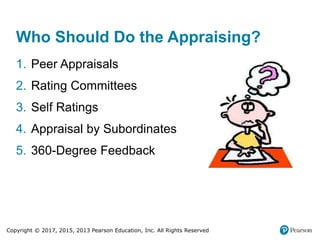
Who Should Do the Appraising?
1. Peer Appraisals
2. Rating Committees
3. Self Ratings
4. Appraisal by Subordinates
5. 360-Degree Feedback
Copyright © 2017, 2015, 2013 Pearson Education, Inc. All Rights Reserved
II.
Discuss the pros and cons of at
least eight performance
appraisal methods.
Copyright © 2017, 2015, 2013 Pearson Education, Inc. All Rights Reserved
Techniques for Appraising
Performance (1 of 2)
1. Graphic Rating Scale
2. Alternation Ranking
3. Paired Comparison
4. Forced Distribution
5. Critical Incident Method
Copyright © 2017, 2015, 2013 Pearson Education, Inc. All Rights Reserved
Techniques for Appraising
Performance (2 of 2)
6. Narrative Forms
7. Behavior Anchored Rating
Scale
8. Mixed Standards Scales
9. Management by
Objectives (MBO)
Copyright © 2017, 2015, 2013 Pearson Education, Inc. All Rights Reserved
Computerized and Web-Based
Performance Appraisal
Many employers today
make use of computerized
or online appraisals for
evaluating employee
performance.
Copyright © 2017, 2015, 2013 Pearson Education, Inc. All Rights Reserved
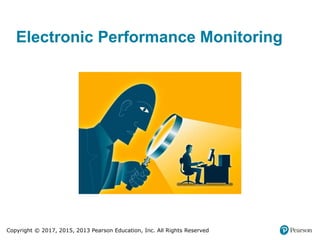
Electronic Performance Monitoring
Copyright © 2017, 2015, 2013 Pearson Education, Inc. All Rights Reserved
Additional Techniques
• Conversation Days
• Appraisal in Practice
Copyright © 2017, 2015, 2013 Pearson Education, Inc. All Rights Reserved
Trends Shaping HR: Customized
Talent Management
Appraisal Methods being Customized
Let’s take a look…
Copyright © 2017, 2015, 2013 Pearson Education, Inc. All Rights Reserved
Improving Performance: The Strategic
Context
TRW’s New Global Performance Appraisal /
Management System
Let’s take a look…
Copyright © 2017, 2015, 2013 Pearson Education, Inc. All Rights Reserved
III.
Give examples of potential
appraisal problems and how to
deal with them.
Copyright © 2017, 2015, 2013 Pearson Education, Inc. All Rights Reserved
Dealing with Rater Error Appraisal
Problems
• Potential appraisal problems
‒ Unclear standards
‒ Halo Effect
‒ Central Tendency
‒ Leniency or Strictness
‒ Recency Effects
Copyright © 2017, 2015, 2013 Pearson Education, Inc. All Rights Reserved
Diversity Counts The Problem of Bias
Copyright © 2017, 2015, 2013 Pearson Education, Inc. All Rights Reserved
The Need for Fairness (1 of 4)
Figure 9-10 Checklist of Best Practices for
Administering Fair Performance Appraisals
• Base the performance review on duties and standards
from a job analysis.
• Try to base the performance review on observable job
behaviors or objective performance data.
• Make it clear ahead of time what your performance
expectations are.
• Use a standardized performance review procedure for all
employees.
Copyright © 2017, 2015, 2013 Pearson Education, Inc. All Rights Reserved
The Need for Fairness (2 of 4)
• Make sure whoever conducts the reviews has
frequent opportunities to observe the employee’s
job performance.
• Either use multiple raters or have the rater’s
supervisor evaluate the appraisal results.
• Include an appeals mechanism.
• Document the appraisal review process and
results.
Copyright © 2017, 2015, 2013 Pearson Education, Inc. All Rights Reserved
The Need for Fairness (3 of 4)
• Discuss the appraisal results with the employee.
• Let the employees know ahead of time how you’re
going to conduct the reviews.
• Let the employee provide input regarding your
assessment of him or her.
• Indicate what the employee needs to do to
improve.
Copyright © 2017, 2015, 2013 Pearson Education, Inc. All Rights Reserved
The Need for Fairness (4 of 4)
• Train the supervisors who will be doing the
appraisals. Make sure they understand the
procedure to use, how problems (like leniency and
strictness) arise, and how to deal with them.
Copyright © 2017, 2015, 2013 Pearson Education, Inc. All Rights Reserved
Know Your Employment Law
Appraising Performance
Let’s take a look…
Copyright © 2017, 2015, 2013 Pearson Education, Inc. All Rights Reserved
IV.
List steps to take in the
appraisal interview.
Copyright © 2017, 2015, 2013 Pearson Education, Inc. All Rights Reserved
Managing the Appraisal Interview
• Appraisal Interview – an interview in which the
supervisor and subordinate review the appraisal
and make plans to remedy deficiencies and
reinforce strengths.
Copyright © 2017, 2015, 2013 Pearson Education, Inc. All Rights Reserved
How to Conduct the Appraisal
Interview
• Prepare
• Plan
• Measure Success
• Date to Complete
• Coach
Copyright © 2017, 2015, 2013 Pearson Education, Inc. All Rights Reserved
Guidelines to Conducting the
Appraisal Interview
• Objective data
• Don’t get personal
• Encouragement
• Agreement
Copyright © 2017, 2015, 2013 Pearson Education, Inc. All Rights Reserved
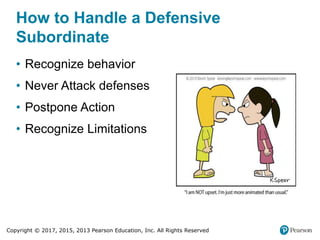
How to Handle a Defensive
Subordinate
• Recognize behavior
• Never Attack defenses
• Postpone Action
• Recognize Limitations
Copyright © 2017, 2015, 2013 Pearson Education, Inc. All Rights Reserved
How to Criticize a Subordinate
Copyright © 2017, 2015, 2013 Pearson Education, Inc. All Rights Reserved
How to Handle a Formal Written
Warning
Copyright © 2017, 2015, 2013 Pearson Education, Inc. All Rights Reserved
V.
Explain key points in how to
use the appraisal interview to
boost employee engagement.
Copyright © 2017, 2015, 2013 Pearson Education, Inc. All Rights Reserved
Employee Engagement Guide for
Managers
• Use the Appraisal Interview to Build Engagement
Copyright © 2017, 2015, 2013 Pearson Education, Inc. All Rights Reserved
VI.
Explain how you would take a
performance management
approach to appraisal.
Copyright © 2017, 2015, 2013 Pearson Education, Inc. All Rights Reserved
Performance Management
• Performance Management – is the continuous
process of identifying, measuring, and developing
the performance of individuals and teams and
aligning their performance with the organization’s
goals.
Copyright © 2017, 2015, 2013 Pearson Education, Inc. All Rights Reserved
Total Quality Management and
Performance Appraisal
• Cease Dependence
• Continuous Improvement
• Extensive Training
• Drive out Fear
• Remove Barriers
• Self Improvement
Copyright © 2017, 2015, 2013 Pearson Education, Inc. All Rights Reserved
What is Performance Management?
Copyright © 2017, 2015, 2013 Pearson Education, Inc. All Rights Reserved
Trends Shaping HR: Digital and
Social Media
Digital Technology use in Performance
Management
Let’s take a look…
Copyright © 2017, 2015, 2013 Pearson Education, Inc. All Rights Reserved
Improving Performance: HR Practices
Around the Globe
Performance Management at General Dynamic
Armament Systems (GDAS)
Let’s talk about it…
Copyright © 2017, 2015, 2013 Pearson Education, Inc. All Rights Reserved
The Managers Role in Performance
Management
Copyright © 2017, 2015, 2013 Pearson Education, Inc. All Rights Reserved
Chapter 9 Review
What you should now know….
Copyright © 2017, 2015, 2013 Pearson Education, Inc. All Rights Reserved
Copyright

Human Resource Management Chapter 9: Performance Management and Appraisal

  • 1.
    Human Resource Management FifteenthEdition Chapter 9 Performance Management and Appraisal Copyright © 2017, 2015, 2013 Pearson Education, Inc. All Rights Reserved
  • 2.
    Copyright © 2017,2015, 2013 Pearson Education, Inc. All Rights Reserved Learning Objectives (1 of 2) 9-1. Describe the performance appraisal process. 9-2. Define the pros and cons of at least eight performance appraisal methods.
  • 3.
    Copyright © 2017,2015, 2013 Pearson Education, Inc. All Rights Reserved Learning Objectives (2 of 2) 9-3. Give examples of potential appraisal problems and how to deal with them. 9-4. List steps to take in the appraisal interview. 9-5. Explain key points in how to use the appraisal interview to boost employee engagement. 9-6. Explain how you would take a performance management approach to appraisal.
  • 4.
    Copyright © 2017,2015, 2013 Pearson Education, Inc. All Rights Reserved I. Describe the appraisal process.
  • 5.
    Copyright © 2017,2015, 2013 Pearson Education, Inc. All Rights Reserved Basics of Performance Appraisal • The performance appraisal process steps 1. Sets work standards 2. Assesses performance 3. Provides feedback to the employee
  • 6.
    Copyright © 2017,2015, 2013 Pearson Education, Inc. All Rights Reserved Why Appraise Performance? Five reasons: 1. Used for pay, promotion, and retention decisions 2. Links performance management to company goals 3. The manager can correct deficiencies and reinforce strengths 4. With appraisals employee’s can review career plans 5. Training needs are identified
  • 7.
    Copyright © 2017,2015, 2013 Pearson Education, Inc. All Rights Reserved Defining the Employee’s Goals and Performance Standards 1. Goals 2. Job dimensions or Traits 3. Behaviors or Competencies
  • 8.
    Copyright © 2017,2015, 2013 Pearson Education, Inc. All Rights Reserved Improving Performance: HR as a Profit Center Setting Performance Goals at Ball Corporation Let’s talk about it…
  • 9.
    Copyright © 2017,2015, 2013 Pearson Education, Inc. All Rights Reserved Improving Performance: HR Tools for Line Managers and Small Businesses How to set Effective Goals Let’s talk about it…
  • 10.
    Copyright © 2017,2015, 2013 Pearson Education, Inc. All Rights Reserved Who Should Do the Appraising? 1. Peer Appraisals 2. Rating Committees 3. Self Ratings 4. Appraisal by Subordinates 5. 360-Degree Feedback
  • 11.
    Copyright © 2017,2015, 2013 Pearson Education, Inc. All Rights Reserved II. Discuss the pros and cons of at least eight performance appraisal methods.
  • 12.
    Copyright © 2017,2015, 2013 Pearson Education, Inc. All Rights Reserved Techniques for Appraising Performance (1 of 2) 1. Graphic Rating Scale 2. Alternation Ranking 3. Paired Comparison 4. Forced Distribution 5. Critical Incident Method
  • 13.
    Copyright © 2017,2015, 2013 Pearson Education, Inc. All Rights Reserved Techniques for Appraising Performance (2 of 2) 6. Narrative Forms 7. Behavior Anchored Rating Scale 8. Mixed Standards Scales 9. Management by Objectives (MBO)
  • 14.
    Copyright © 2017,2015, 2013 Pearson Education, Inc. All Rights Reserved Computerized and Web-Based Performance Appraisal Many employers today make use of computerized or online appraisals for evaluating employee performance.
  • 15.
    Copyright © 2017,2015, 2013 Pearson Education, Inc. All Rights Reserved Electronic Performance Monitoring
  • 16.
    Copyright © 2017,2015, 2013 Pearson Education, Inc. All Rights Reserved Additional Techniques • Conversation Days • Appraisal in Practice
  • 17.
    Copyright © 2017,2015, 2013 Pearson Education, Inc. All Rights Reserved Trends Shaping HR: Customized Talent Management Appraisal Methods being Customized Let’s take a look…
  • 18.
    Copyright © 2017,2015, 2013 Pearson Education, Inc. All Rights Reserved Improving Performance: The Strategic Context TRW’s New Global Performance Appraisal / Management System Let’s take a look…
  • 19.
    Copyright © 2017,2015, 2013 Pearson Education, Inc. All Rights Reserved III. Give examples of potential appraisal problems and how to deal with them.
  • 20.
    Copyright © 2017,2015, 2013 Pearson Education, Inc. All Rights Reserved Dealing with Rater Error Appraisal Problems • Potential appraisal problems ‒ Unclear standards ‒ Halo Effect ‒ Central Tendency ‒ Leniency or Strictness ‒ Recency Effects
  • 21.
    Copyright © 2017,2015, 2013 Pearson Education, Inc. All Rights Reserved Diversity Counts The Problem of Bias
  • 22.
    Copyright © 2017,2015, 2013 Pearson Education, Inc. All Rights Reserved The Need for Fairness (1 of 4) Figure 9-10 Checklist of Best Practices for Administering Fair Performance Appraisals • Base the performance review on duties and standards from a job analysis. • Try to base the performance review on observable job behaviors or objective performance data. • Make it clear ahead of time what your performance expectations are. • Use a standardized performance review procedure for all employees.
  • 23.
    Copyright © 2017,2015, 2013 Pearson Education, Inc. All Rights Reserved The Need for Fairness (2 of 4) • Make sure whoever conducts the reviews has frequent opportunities to observe the employee’s job performance. • Either use multiple raters or have the rater’s supervisor evaluate the appraisal results. • Include an appeals mechanism. • Document the appraisal review process and results.
  • 24.
    Copyright © 2017,2015, 2013 Pearson Education, Inc. All Rights Reserved The Need for Fairness (3 of 4) • Discuss the appraisal results with the employee. • Let the employees know ahead of time how you’re going to conduct the reviews. • Let the employee provide input regarding your assessment of him or her. • Indicate what the employee needs to do to improve.
  • 25.
    Copyright © 2017,2015, 2013 Pearson Education, Inc. All Rights Reserved The Need for Fairness (4 of 4) • Train the supervisors who will be doing the appraisals. Make sure they understand the procedure to use, how problems (like leniency and strictness) arise, and how to deal with them.
  • 26.
    Copyright © 2017,2015, 2013 Pearson Education, Inc. All Rights Reserved Know Your Employment Law Appraising Performance Let’s take a look…
  • 27.
    Copyright © 2017,2015, 2013 Pearson Education, Inc. All Rights Reserved IV. List steps to take in the appraisal interview.
  • 28.
    Copyright © 2017,2015, 2013 Pearson Education, Inc. All Rights Reserved Managing the Appraisal Interview • Appraisal Interview – an interview in which the supervisor and subordinate review the appraisal and make plans to remedy deficiencies and reinforce strengths.
  • 29.
    Copyright © 2017,2015, 2013 Pearson Education, Inc. All Rights Reserved How to Conduct the Appraisal Interview • Prepare • Plan • Measure Success • Date to Complete • Coach
  • 30.
    Copyright © 2017,2015, 2013 Pearson Education, Inc. All Rights Reserved Guidelines to Conducting the Appraisal Interview • Objective data • Don’t get personal • Encouragement • Agreement
  • 31.
    Copyright © 2017,2015, 2013 Pearson Education, Inc. All Rights Reserved How to Handle a Defensive Subordinate • Recognize behavior • Never Attack defenses • Postpone Action • Recognize Limitations
  • 32.
    Copyright © 2017,2015, 2013 Pearson Education, Inc. All Rights Reserved How to Criticize a Subordinate
  • 33.
    Copyright © 2017,2015, 2013 Pearson Education, Inc. All Rights Reserved How to Handle a Formal Written Warning
  • 34.
    Copyright © 2017,2015, 2013 Pearson Education, Inc. All Rights Reserved V. Explain key points in how to use the appraisal interview to boost employee engagement.
  • 35.
    Copyright © 2017,2015, 2013 Pearson Education, Inc. All Rights Reserved Employee Engagement Guide for Managers • Use the Appraisal Interview to Build Engagement
  • 36.
    Copyright © 2017,2015, 2013 Pearson Education, Inc. All Rights Reserved VI. Explain how you would take a performance management approach to appraisal.
  • 37.
    Copyright © 2017,2015, 2013 Pearson Education, Inc. All Rights Reserved Performance Management • Performance Management – is the continuous process of identifying, measuring, and developing the performance of individuals and teams and aligning their performance with the organization’s goals.
  • 38.
    Copyright © 2017,2015, 2013 Pearson Education, Inc. All Rights Reserved Total Quality Management and Performance Appraisal • Cease Dependence • Continuous Improvement • Extensive Training • Drive out Fear • Remove Barriers • Self Improvement
  • 39.
    Copyright © 2017,2015, 2013 Pearson Education, Inc. All Rights Reserved What is Performance Management?
  • 40.
    Copyright © 2017,2015, 2013 Pearson Education, Inc. All Rights Reserved Trends Shaping HR: Digital and Social Media Digital Technology use in Performance Management Let’s take a look…
  • 41.
    Copyright © 2017,2015, 2013 Pearson Education, Inc. All Rights Reserved Improving Performance: HR Practices Around the Globe Performance Management at General Dynamic Armament Systems (GDAS) Let’s talk about it…
  • 42.
    Copyright © 2017,2015, 2013 Pearson Education, Inc. All Rights Reserved The Managers Role in Performance Management
  • 43.
    Copyright © 2017,2015, 2013 Pearson Education, Inc. All Rights Reserved Chapter 9 Review What you should now know….
  • 44.
    Copyright © 2017,2015, 2013 Pearson Education, Inc. All Rights Reserved Copyright