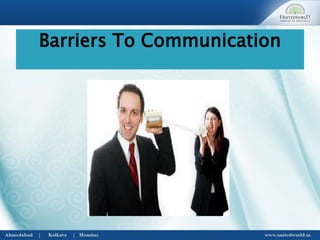
Barriers To Communication
 Introduction
 Communication process
 Some facts
 Barriers in communication
 Barriers – sender, receiver and both.
 How to overcome these barriers
 Conclusion
Index
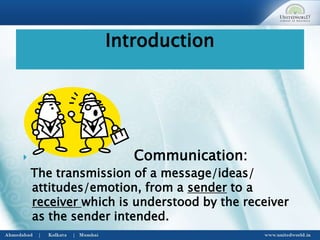
 Communication:
The transmission of a message/ideas/
attitudes/emotion, from a sender to a
receiver which is understood by the receiver
as the sender intended.
Introduction
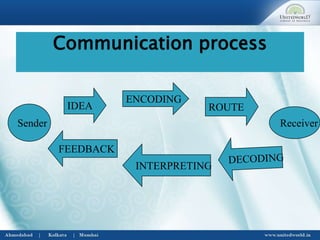
Communication process
Sender Receiver
ENCODING
ROUTEIDEA
FEEDBACK
INTERPRETING
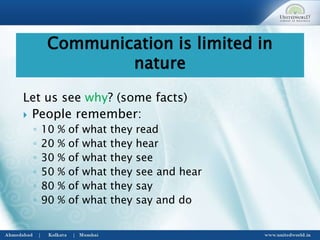
Let us see why? (some facts)
 People remember:
◦ 10 % of what they read
◦ 20 % of what they hear
◦ 30 % of what they see
◦ 50 % of what they see and hear
◦ 80 % of what they say
◦ 90 % of what they say and do
Communication is limited in
nature
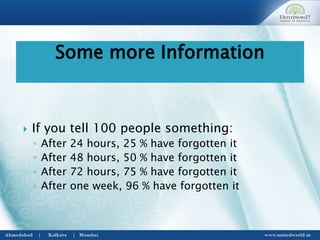
 If you tell 100 people something:
◦ After 24 hours, 25 % have forgotten it
◦ After 48 hours, 50 % have forgotten it
◦ After 72 hours, 75 % have forgotten it
◦ After one week, 96 % have forgotten it
Some more Information
 A barrier in Communication reduces the
impact of the communication during & after
the process is over.
 To be more precise, communication process
must address the barriers that exist in the
process
 So, Communication is about overcoming
barriers.
Why this happens…
An Example: a video…
 The common barriers in communication
are:
◦ Environmental barriers
◦ Personal barriers
◦ Administrative and financial barriers
◦ Time barriers
Barriers in communication
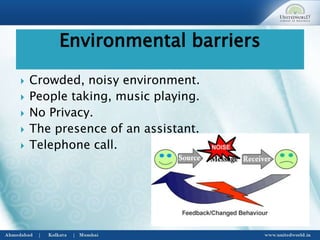
 Crowded, noisy environment.
 People taking, music playing.
 No Privacy.
 The presence of an assistant.
 Telephone call.
Environmental barriers
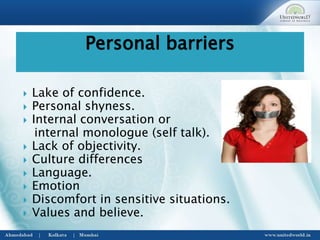
 Lake of confidence.
 Personal shyness.
 Internal conversation or
internal monologue (self talk).
 Lack of objectivity.
 Culture differences
 Language.
 Emotion
 Discomfort in sensitive situations.
 Values and believe.
Personal barriers
 Administrative decisions.
 Management strategy.
 Financial support.
 Number of staff.
 Goal conflicts
Administrative and financial
barriers
 Lack of time.
 Inappropriate time to talk.
 Inferring (conclude)
Time barriers
 Lack of planning
 “purpose” of communication
 Objectives to be achieved
 Choice of wrong language, resulting in badly
encoded message
 Unshared & unqualified assumptions
 Different perception of reality
 Wrong choice of the channel
Barriers – sender
 Poor listener
 Inattention
 Mistrust
 Lack of interest
 Premature evaluation
 Semantic Difficulties
 Bias / Lack of trust
 Different perception of reality
 Attitudinal clash with sender
 Not in a fit physical state
Barriers – Receiver
 Absence of a common frame of reference
affecting smooth interpretation of
thoughts, feelings and attitudes from the
sender to the receiver in a specific situation
Common barrier –
both sender & receiver
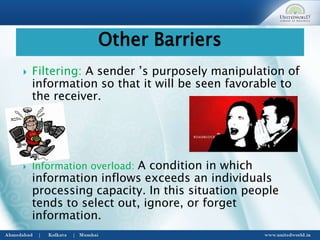
 Filtering: A sender ’s purposely manipulation of
information so that it will be seen favorable to
the receiver.
 Information overload: A condition in which
information inflows exceeds an individuals
processing capacity. In this situation people
tends to select out, ignore, or forget
information.
Other Barriers
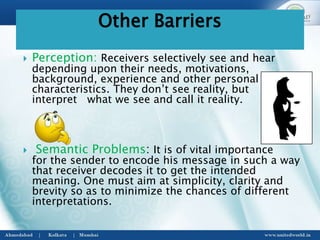
 Perception: Receivers selectively see and hear
depending upon their needs, motivations,
background, experience and other personal
characteristics. They don’t see reality, but
interpret what we see and call it reality.
 Semantic Problems: It is of vital importance
for the sender to encode his message in such a way
that receiver decodes it to get the intended
meaning. One must aim at simplicity, clarity and
brevity so as to minimize the chances of different
interpretations.
Other Barriers
 Eliminating differences in perception
 Use of Simple Language
 Reduction and elimination of noise levels
 Know what you want to convey
 Active Listening
 Emotional State
 Simple Organizational Structure
 Avoid Information Overload
 Give Constructive Feedback
 Proper Media Selection
 Flexibility in meeting the targets
How to overcome these Barriers
Communication is about overcoming the
barriers i.e.
(environmental, personal, administrative, fin
ancial and time). For communication to be
effective, one has to understand that
barriers exist and the knowledge of
minimizing these barriers is the only way by
which we will be better effective
communicators.
Conclusion
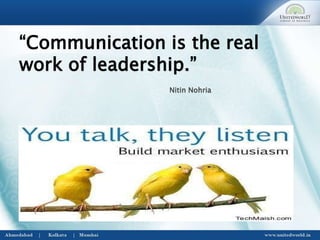
“Communication is the real
work of leadership.”
Nitin Nohria
Campus Overview
907/A Uvarshad
Gandhinagar
Highway, Ahmedabad
– 382422.
Ahmedabad Kolkata
Infinity Benchmark,
10th Floor, Plot G1,
Block EP & GP,
Sector V, Salt-Lake,
Kolkata – 700091.
Mumbai
Goldline Business
Centre Linkway Estate,
Next to Chincholi Fire
Brigade, Malad
(West), Mumbai – 400
064.
Thank you

Barriers to communication

  • 2.
  • 3.
     Introduction  Communicationprocess  Some facts  Barriers in communication  Barriers – sender, receiver and both.  How to overcome these barriers  Conclusion Index
  • 4.
     Communication: The transmissionof a message/ideas/ attitudes/emotion, from a sender to a receiver which is understood by the receiver as the sender intended. Introduction
  • 5.
  • 6.
    Let us seewhy? (some facts)  People remember: ◦ 10 % of what they read ◦ 20 % of what they hear ◦ 30 % of what they see ◦ 50 % of what they see and hear ◦ 80 % of what they say ◦ 90 % of what they say and do Communication is limited in nature
  • 7.
     If youtell 100 people something: ◦ After 24 hours, 25 % have forgotten it ◦ After 48 hours, 50 % have forgotten it ◦ After 72 hours, 75 % have forgotten it ◦ After one week, 96 % have forgotten it Some more Information
  • 8.
     A barrierin Communication reduces the impact of the communication during & after the process is over.  To be more precise, communication process must address the barriers that exist in the process  So, Communication is about overcoming barriers. Why this happens…
  • 9.
    An Example: avideo…
  • 10.
     The commonbarriers in communication are: ◦ Environmental barriers ◦ Personal barriers ◦ Administrative and financial barriers ◦ Time barriers Barriers in communication
  • 11.
     Crowded, noisyenvironment.  People taking, music playing.  No Privacy.  The presence of an assistant.  Telephone call. Environmental barriers
  • 12.
     Lake ofconfidence.  Personal shyness.  Internal conversation or internal monologue (self talk).  Lack of objectivity.  Culture differences  Language.  Emotion  Discomfort in sensitive situations.  Values and believe. Personal barriers
  • 13.
     Administrative decisions. Management strategy.  Financial support.  Number of staff.  Goal conflicts Administrative and financial barriers
  • 14.
     Lack oftime.  Inappropriate time to talk.  Inferring (conclude) Time barriers
  • 15.
     Lack ofplanning  “purpose” of communication  Objectives to be achieved  Choice of wrong language, resulting in badly encoded message  Unshared & unqualified assumptions  Different perception of reality  Wrong choice of the channel Barriers – sender
  • 16.
     Poor listener Inattention  Mistrust  Lack of interest  Premature evaluation  Semantic Difficulties  Bias / Lack of trust  Different perception of reality  Attitudinal clash with sender  Not in a fit physical state Barriers – Receiver
  • 17.
     Absence ofa common frame of reference affecting smooth interpretation of thoughts, feelings and attitudes from the sender to the receiver in a specific situation Common barrier – both sender & receiver
  • 18.
     Filtering: Asender ’s purposely manipulation of information so that it will be seen favorable to the receiver.  Information overload: A condition in which information inflows exceeds an individuals processing capacity. In this situation people tends to select out, ignore, or forget information. Other Barriers
  • 19.
     Perception: Receiversselectively see and hear depending upon their needs, motivations, background, experience and other personal characteristics. They don’t see reality, but interpret what we see and call it reality.  Semantic Problems: It is of vital importance for the sender to encode his message in such a way that receiver decodes it to get the intended meaning. One must aim at simplicity, clarity and brevity so as to minimize the chances of different interpretations. Other Barriers
  • 21.
     Eliminating differencesin perception  Use of Simple Language  Reduction and elimination of noise levels  Know what you want to convey  Active Listening  Emotional State  Simple Organizational Structure  Avoid Information Overload  Give Constructive Feedback  Proper Media Selection  Flexibility in meeting the targets How to overcome these Barriers
  • 22.
    Communication is aboutovercoming the barriers i.e. (environmental, personal, administrative, fin ancial and time). For communication to be effective, one has to understand that barriers exist and the knowledge of minimizing these barriers is the only way by which we will be better effective communicators. Conclusion
  • 23.
    “Communication is thereal work of leadership.” Nitin Nohria
  • 24.
    Campus Overview 907/A Uvarshad Gandhinagar Highway,Ahmedabad – 382422. Ahmedabad Kolkata Infinity Benchmark, 10th Floor, Plot G1, Block EP & GP, Sector V, Salt-Lake, Kolkata – 700091. Mumbai Goldline Business Centre Linkway Estate, Next to Chincholi Fire Brigade, Malad (West), Mumbai – 400 064.
  • 25.