Business Communication :Basic
Concepts and Skills
Barriers to Communication
4
1
Presented by: Kamelia Gulam
Chapter Outline
 Defining Barriers to Communication
 Types of Barriers:
1. PHYSICAL or Environmental BARRIERS
2. Physiological or biological barriers
3. SEMANTIC OR LANGUAGE BARRIERS
4. PERSONAL BARRIERS
5. EMOTIONAL BARRIERS
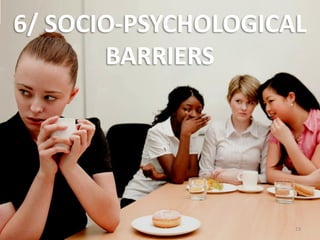
6. Socio-Psychological Barriers
7. Cross-Cultural Barriers
8. Physiological or biological barriers
 Overcoming Communication Barriers
2
Barriers
Barriers to communication can be classified as follows on the
basis of the stage of the communication process during which
the problem/s arise:
1. Sender-oriented barriers (lack of planning , clarity about the
purpose of communication, improper choice of word, wrong
choice of channel…)
2. Receiver-oriented barriers (poor listening, lack of interest, ..)
3. Channel- oriented barriers ( noise, wrong selection of
medium..)
3
Anything that hinders the process of communication at any of
these levels is a barrier to communication and is also called
miscommunication
Barriers to communication can be defined as the aspects or
conditions that interfere with effective exchange of ideas or
thoughts.
4
Types of Barriers
1. PHYSICAL or Environmental BARRIERS
2. Physiological or biological barriers
3. SEMANTIC OR LANGUAGE BARRIERS
4. PERSONAL BARRIERS
5. EMOTIONAL BARRIERS
6. Socio-Psychological Barriers
7. Cross-Cultural Barriers
8. Physiological or biological barriers
5
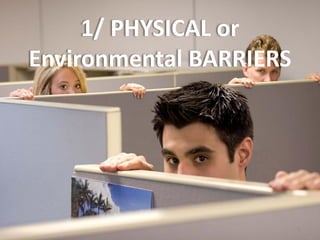
1/ PHYSICAL or
Environmental BARRIERS
6
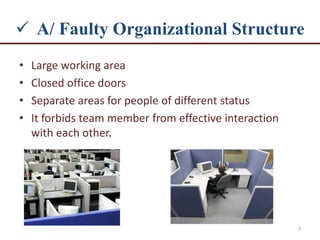
 A/ Faulty Organizational Structure
• Large working area
• Closed office doors
• Separate areas for people of different status
• It forbids team member from effective interaction
with each other.
7
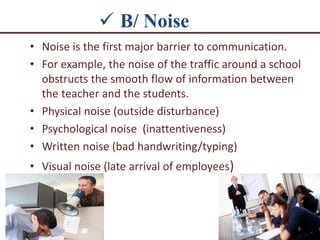
 B/ Noise
• Noise is the first major barrier to communication.
• For example, the noise of the traffic around a school
obstructs the smooth flow of information between
the teacher and the students.
• Physical noise (outside disturbance)
• Psychological noise (inattentiveness)
• Written noise (bad handwriting/typing)
• Visual noise (late arrival of employees)
8
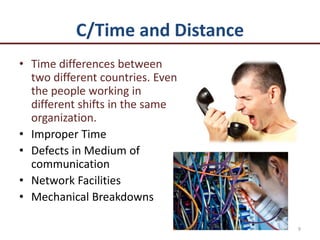
C/Time and Distance
• Time differences between
two different countries. Even
the people working in
different shifts in the same
organization.
• Improper Time
• Defects in Medium of
communication
• Network Facilities
• Mechanical Breakdowns
9
D/ Information Overload
• Piling up of tasks due to improper time
management.
• Excess number of people assigned for same
task
• Work overload
10
 F/ Surroundings
• Adverse weather conditions affect not only
the means of communication, but also have
an impact on the sender and the receiver of
the message.
• For example: When two people have to
communicate with each other under extreme
weather conditions.
11
2/ Physiological or biological barriers
• Physiological barriers are related to a person’s
health and fitness. This may arise due to disabilities
of the sender or the receiver.
• For example: poor eyesight, deafness and
uncontrolled body movement.
• Physical defects in one’s body may also disrupt
communication.
12
3/ SEMANTIC & LANGUAGE
BARRIERS
13
 3/ SEMANTIC OR LANGUAGE BARRIERS
• Semantics is the systematic study of the meaning of words. Thus, the semantic
barriers are barriers related to language. Such barriers are problems that arise
during the process of encoding and/or decoding the message into words and ideas
respectively.
• The most common semantic barriers are listed as under:
a. Misinterpretation of Words
For example, the word 'yellow‘
b. Use of Technical Language
For example, in the computer jargon, 'to burn a CD' means 'to copy the data on a CD'.
To a layman, the word 'burn' may have a very different connotation.
c. Ambiguity
• A sender often assumes that his audience would perceive the situation as he does
or have the same opinion about an issue or understand the message as he
understands it
14
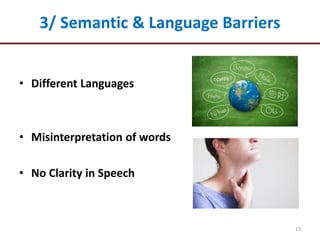
3/ Semantic & Language Barriers
• Different Languages
• Misinterpretation of words
• No Clarity in Speech
15
Language Barriers
• Use of technical language
• Not being specific
16
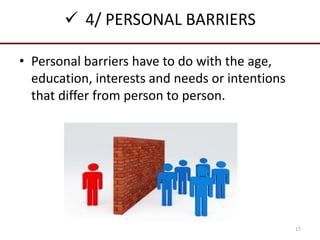
 4/ PERSONAL BARRIERS
• Personal barriers have to do with the age,
education, interests and needs or intentions
that differ from person to person.
17
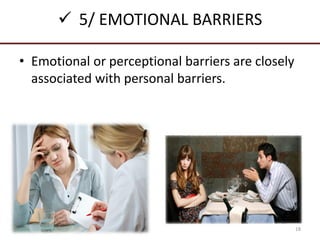
 5/ EMOTIONAL BARRIERS
• Emotional or perceptional barriers are closely
associated with personal barriers.
18
6/ SOCIO-PSYCHOLOGICAL
BARRIERS
19
 What is Pyschological barrier?
. Psychological barriers can be described
as the cause of distorted communication
because of human psychology problems.
20
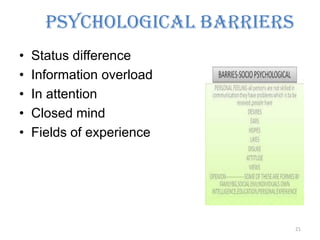
Psychological barriers
• Status difference
• Information overload
• In attention
• Closed mind
• Fields of experience
21
Others include:
• Group identification
• Self-image
• Premature evaluation
• Distrust
• Poor retention
22
7/ CROSS-CULTURAL
BARRIERS
23
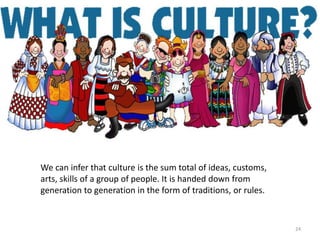
We can infer that culture is the sum total of ideas, customs,
arts, skills of a group of people. It is handed down from
generation to generation in the form of traditions, or rules.
24
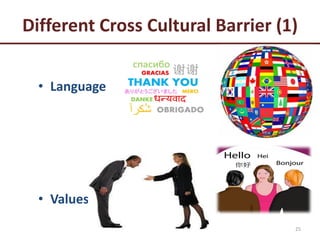
Different Cross Cultural Barrier (1)
• Language
• Values
25
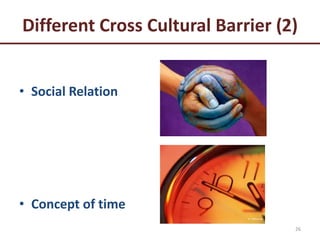
Different Cross Cultural Barrier (2)
• Social Relation
• Concept of time
26
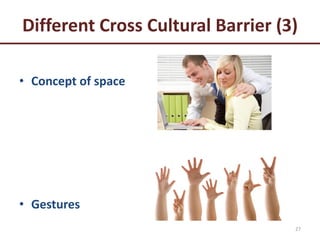
Different Cross Cultural Barrier (3)
• Concept of space
• Gestures
27
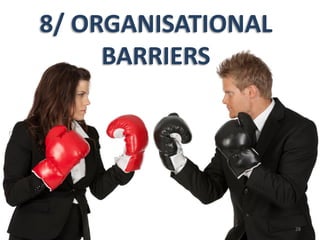
8/ ORGANISATIONAL
BARRIERS
28
8. Organizational Barriers
Loss or distortion of messages as they
pass from one level to another
Filtering of information according to
one’s understanding/interpretation
Messages not read completely or not
understood correctly
Deliberate withholding of
information from peers perceived as
rivals
29
….cont
Lack of communication policy
Authoritarian attitude of management
Poorly Defined Authority and
Responsibility
Too Many Levels in Organization
Structure
Insufficient Communication Training 30
Overcoming Communication Barriers/1
Individual Skills
Active listening (Listening for full meaning without
making premature judgments or interpretations)
Use Feedback (Many problems are attributable to
misunderstanding)
Use Simplified Language (communicate in clear,
easily understood terms)
31
Overcoming Communication Barriers
Select the appropriate channel for the message
Make a special effort to understand each other's
perspective
Managers should practice MBWA.
 (The management by wandering around (MBWA),
also management by walking around, refers to a
style of business management which involves
managers wandering around, in an unstructured
manner, through the workplace(s), at random, to
check with employees, or equipment, about the
status of ongoing work)
32
Overcoming Communication
Barriers/2
Organizational Actions
Create a climate of trust and openness
Develop and use formal information channels
in all directions
Encourage the use of multiple channels
including formal and informal communications
 The organizational structure should fit
communication needs.
33
Ways To Overcome Barriers to
Communication-
• For Physical Barriers-
 Appropriate Seating Arrangement
 Ensure Visibility & Audibility
 Environmental Comfort
 Minimise Visual/Oral Distractions
For Semantic Barriers-
 Use of Simple Language
 Symbols & Charts
 Active Listening/ Constructive feedback
Contd..
• For Socio-Psychological Barriers-
Calling Attention & Motivation
Assistance & Sympathy
For Cross Cultural Barriers-
Understanding of Traditions & Customs
Information of all Sides of Culture
Contd..
• For Organisational Barriers-
Simple Organisational Structure
Avoiding Information Overload
Flexibility in Meeting Targets
Thank you

Chapter 4 barriers to communication

  • 1.
    Business Communication :Basic Conceptsand Skills Barriers to Communication 4 1 Presented by: Kamelia Gulam
  • 2.
    Chapter Outline  DefiningBarriers to Communication  Types of Barriers: 1. PHYSICAL or Environmental BARRIERS 2. Physiological or biological barriers 3. SEMANTIC OR LANGUAGE BARRIERS 4. PERSONAL BARRIERS 5. EMOTIONAL BARRIERS 6. Socio-Psychological Barriers 7. Cross-Cultural Barriers 8. Physiological or biological barriers  Overcoming Communication Barriers 2
  • 3.
    Barriers Barriers to communicationcan be classified as follows on the basis of the stage of the communication process during which the problem/s arise: 1. Sender-oriented barriers (lack of planning , clarity about the purpose of communication, improper choice of word, wrong choice of channel…) 2. Receiver-oriented barriers (poor listening, lack of interest, ..) 3. Channel- oriented barriers ( noise, wrong selection of medium..) 3
  • 4.
    Anything that hindersthe process of communication at any of these levels is a barrier to communication and is also called miscommunication Barriers to communication can be defined as the aspects or conditions that interfere with effective exchange of ideas or thoughts. 4
  • 5.
    Types of Barriers 1.PHYSICAL or Environmental BARRIERS 2. Physiological or biological barriers 3. SEMANTIC OR LANGUAGE BARRIERS 4. PERSONAL BARRIERS 5. EMOTIONAL BARRIERS 6. Socio-Psychological Barriers 7. Cross-Cultural Barriers 8. Physiological or biological barriers 5
  • 6.
  • 7.
     A/ FaultyOrganizational Structure • Large working area • Closed office doors • Separate areas for people of different status • It forbids team member from effective interaction with each other. 7
  • 8.
     B/ Noise •Noise is the first major barrier to communication. • For example, the noise of the traffic around a school obstructs the smooth flow of information between the teacher and the students. • Physical noise (outside disturbance) • Psychological noise (inattentiveness) • Written noise (bad handwriting/typing) • Visual noise (late arrival of employees) 8
  • 9.
    C/Time and Distance •Time differences between two different countries. Even the people working in different shifts in the same organization. • Improper Time • Defects in Medium of communication • Network Facilities • Mechanical Breakdowns 9
  • 10.
    D/ Information Overload •Piling up of tasks due to improper time management. • Excess number of people assigned for same task • Work overload 10
  • 11.
     F/ Surroundings •Adverse weather conditions affect not only the means of communication, but also have an impact on the sender and the receiver of the message. • For example: When two people have to communicate with each other under extreme weather conditions. 11
  • 12.
    2/ Physiological orbiological barriers • Physiological barriers are related to a person’s health and fitness. This may arise due to disabilities of the sender or the receiver. • For example: poor eyesight, deafness and uncontrolled body movement. • Physical defects in one’s body may also disrupt communication. 12
  • 13.
    3/ SEMANTIC &LANGUAGE BARRIERS 13
  • 14.
     3/ SEMANTICOR LANGUAGE BARRIERS • Semantics is the systematic study of the meaning of words. Thus, the semantic barriers are barriers related to language. Such barriers are problems that arise during the process of encoding and/or decoding the message into words and ideas respectively. • The most common semantic barriers are listed as under: a. Misinterpretation of Words For example, the word 'yellow‘ b. Use of Technical Language For example, in the computer jargon, 'to burn a CD' means 'to copy the data on a CD'. To a layman, the word 'burn' may have a very different connotation. c. Ambiguity • A sender often assumes that his audience would perceive the situation as he does or have the same opinion about an issue or understand the message as he understands it 14

  • 15.
    3/ Semantic &Language Barriers • Different Languages • Misinterpretation of words • No Clarity in Speech 15
  • 16.
    Language Barriers • Useof technical language • Not being specific 16
  • 17.
     4/ PERSONALBARRIERS • Personal barriers have to do with the age, education, interests and needs or intentions that differ from person to person. 17
  • 18.
     5/ EMOTIONALBARRIERS • Emotional or perceptional barriers are closely associated with personal barriers. 18
  • 19.
  • 20.
     What isPyschological barrier? . Psychological barriers can be described as the cause of distorted communication because of human psychology problems. 20
  • 21.
    Psychological barriers • Statusdifference • Information overload • In attention • Closed mind • Fields of experience 21
  • 22.
    Others include: • Groupidentification • Self-image • Premature evaluation • Distrust • Poor retention 22
  • 23.
  • 24.
    We can inferthat culture is the sum total of ideas, customs, arts, skills of a group of people. It is handed down from generation to generation in the form of traditions, or rules. 24
  • 25.
    Different Cross CulturalBarrier (1) • Language • Values 25
  • 26.
    Different Cross CulturalBarrier (2) • Social Relation • Concept of time 26
  • 27.
    Different Cross CulturalBarrier (3) • Concept of space • Gestures 27
  • 28.
  • 29.
    8. Organizational Barriers Lossor distortion of messages as they pass from one level to another Filtering of information according to one’s understanding/interpretation Messages not read completely or not understood correctly Deliberate withholding of information from peers perceived as rivals 29
  • 30.
    ….cont Lack of communicationpolicy Authoritarian attitude of management Poorly Defined Authority and Responsibility Too Many Levels in Organization Structure Insufficient Communication Training 30
  • 31.
    Overcoming Communication Barriers/1 IndividualSkills Active listening (Listening for full meaning without making premature judgments or interpretations) Use Feedback (Many problems are attributable to misunderstanding) Use Simplified Language (communicate in clear, easily understood terms) 31
  • 32.
    Overcoming Communication Barriers Selectthe appropriate channel for the message Make a special effort to understand each other's perspective Managers should practice MBWA.  (The management by wandering around (MBWA), also management by walking around, refers to a style of business management which involves managers wandering around, in an unstructured manner, through the workplace(s), at random, to check with employees, or equipment, about the status of ongoing work) 32
  • 33.
    Overcoming Communication Barriers/2 Organizational Actions Createa climate of trust and openness Develop and use formal information channels in all directions Encourage the use of multiple channels including formal and informal communications  The organizational structure should fit communication needs. 33
  • 35.
    Ways To OvercomeBarriers to Communication- • For Physical Barriers-  Appropriate Seating Arrangement  Ensure Visibility & Audibility  Environmental Comfort  Minimise Visual/Oral Distractions For Semantic Barriers-  Use of Simple Language  Symbols & Charts  Active Listening/ Constructive feedback
  • 36.
    Contd.. • For Socio-PsychologicalBarriers- Calling Attention & Motivation Assistance & Sympathy For Cross Cultural Barriers- Understanding of Traditions & Customs Information of all Sides of Culture
  • 37.
    Contd.. • For OrganisationalBarriers- Simple Organisational Structure Avoiding Information Overload Flexibility in Meeting Targets
  • 38.