NATIONAL UNIVERSITY OF SCIENCE AND TECHNOLOGY
FACULTY OF ENGINEERING
DEPARTMENT OF CIVIL AND WATER ENGINEERING TCW
TCW1103 ENGINEERING COMMUNICATION SKILLS
GONDO TINASHE M
Barriers in the
Communication Process
and Possible Solutions
What Is Communication And Barrier ?
• Communication is the art of transmitting knowledge, ideas, information
and thoughts from one person to another. The transfer should be such that
the receiver understands the meaning and the intent of the message and give
proper feedback
• can be regarded as a two way process of exchanging or shaping ideas, feelings and
information.
• Barrier –an obstacle in a place that prevents us from completing certain
tasks.
What is a Barrier in Communication?
• There are three levels at which communication takes place
1. Noticing is done with the senses, and is at the physical level
2. Understanding is at the level of intelligence
3. Acceptance is at the emotional level
Anything that hinders the process of communication at any of these levels is a
barrier to communication
Barriers to communication can be defined as the aspects or conditions that interfere
with effective exchange of ideas or thoughts
Barriers Of Communication
1. Physiological Barrier
2. Psychological Barrier
3. Physical and Environmental
barriers
4. Cultural Barriers
5. Personal barriers
6. Social Barriers
7. Semantic Barrier
8. Linguistic Barriers
9. Organizational Barriers
1. Physiological Barrier
• Physiological barriers to communication are related with the
limitations of the human body and the human mind (memory,
attention, and perception).
• Physiological barriers may result from individuals’ personal
discomfort, caused by ill health, poor eye sight, or hearing
difficulties.
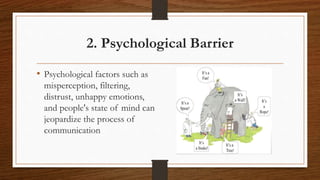
2. Psychological Barrier
• Psychological factors such as
misperception, filtering,
distrust, unhappy emotions,
and people's state of mind can
jeopardize the process of
communication
3. Physical and Environmental barriers
• Distractions such as background noise, poor lighting, uncomfortable sitting,
unhygienic room, or an environment that is too hot or cold can affect
people's morale and concentration, which in turn interfere with effective
communication
• Environmental barriers
• Crowded, noisy environment.
• People taking, music playing.
• No Privacy.
• Telephone call.
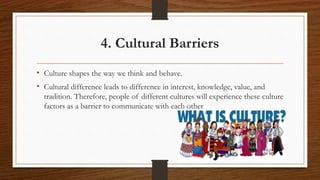
4. Cultural Barriers
• Culture shapes the way we think and behave.
• Cultural difference leads to difference in interest, knowledge, value, and
tradition. Therefore, people of different cultures will experience these culture
factors as a barrier to communicate with each other
5. Personal Barrier
• Lake of confidence.
• Personal shyness.
• Internal conversation or internal
monologue (self talk).
• Discomfort in sensitive situations
• Lack of objectivity.
• Culture differences
• Language.
• Emotion
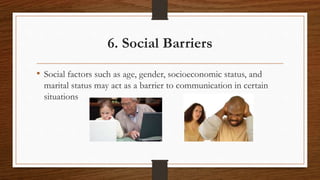
6. Social Barriers
• Social factors such as age, gender, socioeconomic status, and
marital status may act as a barrier to communication in certain
situations
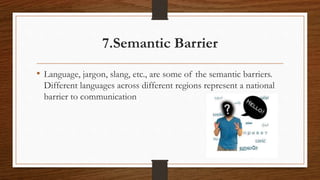
7.Semantic Barrier
• Language, jargon, slang, etc., are some of the semantic barriers.
Different languages across different regions represent a national
barrier to communication
8. Linguistic Barriers
• Individual linguistic ability may sometimes become a barrier to
communication.
• The use of difficult or inappropriate words in communication can prevent
the people from understanding the message
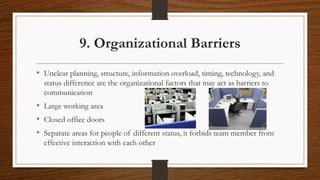
9. Organizational Barriers
• Unclear planning, structure, information overload, timing, technology, and
status difference are the organizational factors that may act as barriers to
communication
• Large working area
• Closed office doors
• Separate areas for people of different status, it forbids team member from
effective interaction with each other
Possible Solutions
How to overcome these barriers
The Six C’s
• There are 6 C's of effective communication, which are applicable to both
written and oral communication. They are as follows
• Complete- The message must be
complete in all respect and should
convey all facts required by the
receiver.
• Clear- Clarity in communication
makes understanding easier and
enhances the meaning of a
message. A clear message uses
exact, appropriate, and concrete
words and avoids ambiguous words
• Consideration- Consideration
implies “stepping into the shoes of
others.” Effective communication
must take the receiver/s into
consideration (i.e., the audience's
viewpoints, background, mindset,
education level, etc.).
• Concise- Conciseness means
eliminating wordiness and
communicating what you want to
convey in least possible words
• Correctness- Correctness in
communication implies that there
are no grammatical and spelling
errors in communication.
• Courtesy- Courtesy in message
implies that the message should
show the sender's expression as
well as respect to the receiver. The
sender of the message should be
sincerely polite, judicious, reflective,
and enthusiastic.
Do For Effective Communication
For Physical Barriers-
• Appropriate Seating Arrangement
• Ensure Visibility & Audibility
• Environmental Comfort
• Minimize Visual/Oral Distractions
Do For Effective Communication
For Semantic Barriers-
• Use of Simple Language
• Symbols & Charts
• Active Listening/ Constructive feedback
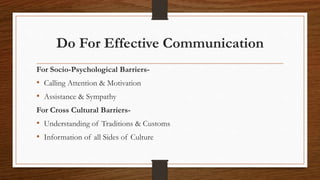
Do For Effective Communication
For Socio-Psychological Barriers-
• Calling Attention & Motivation
• Assistance & Sympathy
For Cross Cultural Barriers-
• Understanding of Traditions & Customs
• Information of all Sides of Culture
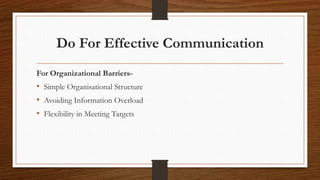
Do For Effective Communication
For Organizational Barriers-
• Simple Organisational Structure
• Avoiding Information Overload
• Flexibility in Meeting Targets
“
”
Communication is the real work
of leadership
REFERENCES
1. https://www2.slideshare.net/burhanAhmed14/communication-its-barrier
2. https://www.slidegeeks.com/business/product/barriers-effective-communication-ppt-
powerpoint-presentation-infographic-template-shapes-cpb
Thank You

Barriers in the communication process with possible solutions

  • 1.
    NATIONAL UNIVERSITY OFSCIENCE AND TECHNOLOGY FACULTY OF ENGINEERING DEPARTMENT OF CIVIL AND WATER ENGINEERING TCW TCW1103 ENGINEERING COMMUNICATION SKILLS GONDO TINASHE M
  • 2.
    Barriers in the CommunicationProcess and Possible Solutions
  • 3.
    What Is CommunicationAnd Barrier ? • Communication is the art of transmitting knowledge, ideas, information and thoughts from one person to another. The transfer should be such that the receiver understands the meaning and the intent of the message and give proper feedback • can be regarded as a two way process of exchanging or shaping ideas, feelings and information. • Barrier –an obstacle in a place that prevents us from completing certain tasks.
  • 4.
    What is aBarrier in Communication? • There are three levels at which communication takes place 1. Noticing is done with the senses, and is at the physical level 2. Understanding is at the level of intelligence 3. Acceptance is at the emotional level Anything that hinders the process of communication at any of these levels is a barrier to communication Barriers to communication can be defined as the aspects or conditions that interfere with effective exchange of ideas or thoughts
  • 5.
    Barriers Of Communication 1.Physiological Barrier 2. Psychological Barrier 3. Physical and Environmental barriers 4. Cultural Barriers 5. Personal barriers 6. Social Barriers 7. Semantic Barrier 8. Linguistic Barriers 9. Organizational Barriers
  • 6.
    1. Physiological Barrier •Physiological barriers to communication are related with the limitations of the human body and the human mind (memory, attention, and perception). • Physiological barriers may result from individuals’ personal discomfort, caused by ill health, poor eye sight, or hearing difficulties.
  • 7.
    2. Psychological Barrier •Psychological factors such as misperception, filtering, distrust, unhappy emotions, and people's state of mind can jeopardize the process of communication
  • 8.
    3. Physical andEnvironmental barriers • Distractions such as background noise, poor lighting, uncomfortable sitting, unhygienic room, or an environment that is too hot or cold can affect people's morale and concentration, which in turn interfere with effective communication • Environmental barriers • Crowded, noisy environment. • People taking, music playing. • No Privacy. • Telephone call.
  • 9.
    4. Cultural Barriers •Culture shapes the way we think and behave. • Cultural difference leads to difference in interest, knowledge, value, and tradition. Therefore, people of different cultures will experience these culture factors as a barrier to communicate with each other
  • 10.
    5. Personal Barrier •Lake of confidence. • Personal shyness. • Internal conversation or internal monologue (self talk). • Discomfort in sensitive situations • Lack of objectivity. • Culture differences • Language. • Emotion
  • 11.
    6. Social Barriers •Social factors such as age, gender, socioeconomic status, and marital status may act as a barrier to communication in certain situations
  • 12.
    7.Semantic Barrier • Language,jargon, slang, etc., are some of the semantic barriers. Different languages across different regions represent a national barrier to communication
  • 13.
    8. Linguistic Barriers •Individual linguistic ability may sometimes become a barrier to communication. • The use of difficult or inappropriate words in communication can prevent the people from understanding the message
  • 14.
    9. Organizational Barriers •Unclear planning, structure, information overload, timing, technology, and status difference are the organizational factors that may act as barriers to communication • Large working area • Closed office doors • Separate areas for people of different status, it forbids team member from effective interaction with each other
  • 15.
    Possible Solutions How toovercome these barriers
  • 16.
    The Six C’s •There are 6 C's of effective communication, which are applicable to both written and oral communication. They are as follows • Complete- The message must be complete in all respect and should convey all facts required by the receiver. • Clear- Clarity in communication makes understanding easier and enhances the meaning of a message. A clear message uses exact, appropriate, and concrete words and avoids ambiguous words
  • 17.
    • Consideration- Consideration implies“stepping into the shoes of others.” Effective communication must take the receiver/s into consideration (i.e., the audience's viewpoints, background, mindset, education level, etc.). • Concise- Conciseness means eliminating wordiness and communicating what you want to convey in least possible words • Correctness- Correctness in communication implies that there are no grammatical and spelling errors in communication. • Courtesy- Courtesy in message implies that the message should show the sender's expression as well as respect to the receiver. The sender of the message should be sincerely polite, judicious, reflective, and enthusiastic.
  • 18.
    Do For EffectiveCommunication For Physical Barriers- • Appropriate Seating Arrangement • Ensure Visibility & Audibility • Environmental Comfort • Minimize Visual/Oral Distractions
  • 19.
    Do For EffectiveCommunication For Semantic Barriers- • Use of Simple Language • Symbols & Charts • Active Listening/ Constructive feedback
  • 20.
    Do For EffectiveCommunication For Socio-Psychological Barriers- • Calling Attention & Motivation • Assistance & Sympathy For Cross Cultural Barriers- • Understanding of Traditions & Customs • Information of all Sides of Culture
  • 21.
    Do For EffectiveCommunication For Organizational Barriers- • Simple Organisational Structure • Avoiding Information Overload • Flexibility in Meeting Targets
  • 22.
    “ ” Communication is thereal work of leadership REFERENCES 1. https://www2.slideshare.net/burhanAhmed14/communication-its-barrier 2. https://www.slidegeeks.com/business/product/barriers-effective-communication-ppt- powerpoint-presentation-infographic-template-shapes-cpb
  • 23.