• means “rebirth” ; decribed as classy aimed for
perfection
• flourished in the 14th century, in Florence, Italy
• era of great creativity in literature, sculpture
and painting
• featured the use of perspective, balance, form
and proportion (classicism)
• focused on Christian religion and common
daily activities of people
• The ideal man during this period was
supposed to be a well-rounded individual and
with knowledge in various fields like
philosophy, art, science and music.
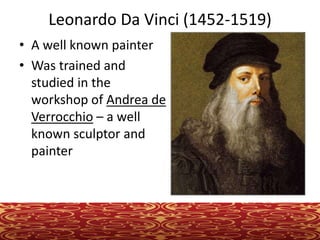
Leonardo Da Vinci (1452-1519)
• A well known painter
• Was trained and
studied in the
workshop of Andrea de
Verrocchio – a well
known sculptor and
painter
Great works
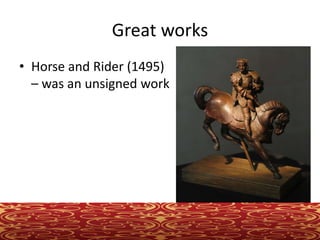
• Horse and Rider (1495)
– was an unsigned work
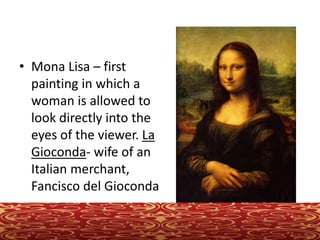
• Mona Lisa – first
painting in which a
woman is allowed to
look directly into the
eyes of the viewer. La
Gioconda- wife of an
Italian merchant,
Fancisco del Gioconda
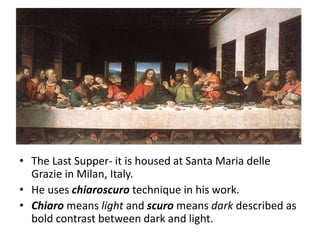
• The Last Supper- it is housed at Santa Maria delle
Grazie in Milan, Italy.
• He uses chiaroscuro technique in his work.
• Chiaro means light and scuro means dark described as
bold contrast between dark and light.
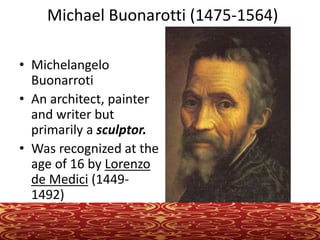
Michael Buonarotti (1475-1564)
• Michelangelo
Buonarroti
• An architect, painter
and writer but
primarily a sculptor.
• Was recognized at the
age of 16 by Lorenzo
de Medici (1449-
1492)
Great Works:
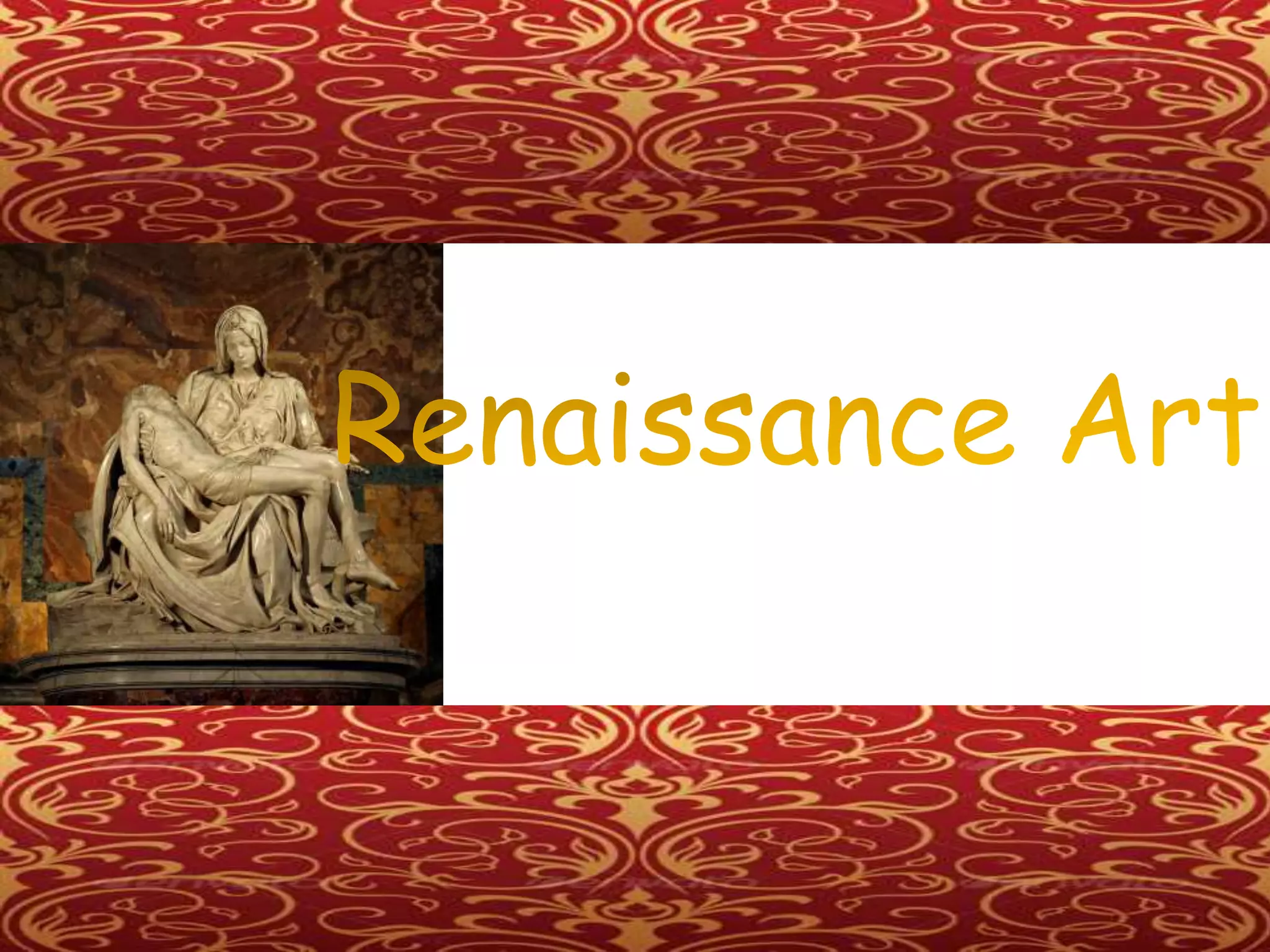
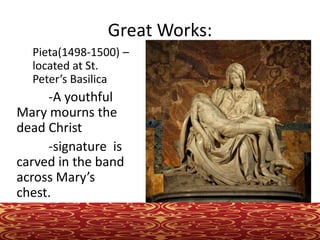
Pieta(1498-1500) –
located at St.
Peter’s Basilica
-A youthful
Mary mourns the
dead Christ
-signature is
carved in the band
across Mary’s
chest.
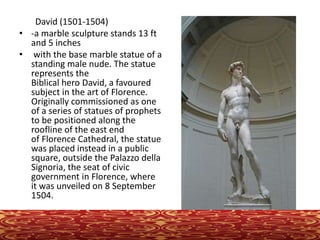
David (1501-1504)
• -a marble sculpture stands 13 ft
and 5 inches
• with the base marble statue of a
standing male nude. The statue
represents the
Biblical hero David, a favoured
subject in the art of Florence.
Originally commissioned as one
of a series of statues of prophets
to be positioned along the
roofline of the east end
of Florence Cathedral, the statue
was placed instead in a public
square, outside the Palazzo della
Signoria, the seat of civic
government in Florence, where
it was unveiled on 8 September
1504.
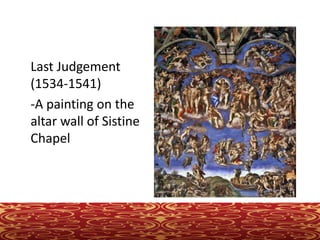
Last Judgement
(1534-1541)
-A painting on the
altar wall of Sistine
Chapel
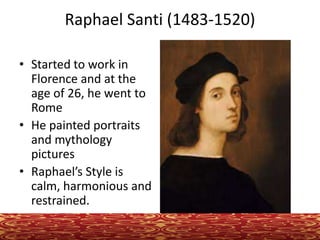
Raphael Santi (1483-1520)
• Started to work in
Florence and at the
age of 26, he went to
Rome
• He painted portraits
and mythology
pictures
• Raphael’s Style is
calm, harmonious and
restrained.
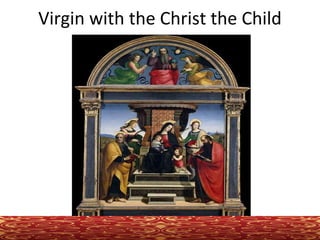
Virgin with the Christ the Child
• derived from the Portuguese barocco meaning, 'irregular
pearl or stone‘
• In art criticism the word Baroque came to be used to describe
anything irregular, bizarre, or otherwise departing from
established rules and proportions.
• Baroque art above all reflected the religious tensions of the
age - notably the desire of the Catholic Church in Rome (as
annunciated at the Council of Trent, 1545-63) to reassert itself
in the wake of the Protestant Reformation.
• The Baroque style of architecture prevailed in
Europe during the 17th and 18th centuries and
was characterized by elaborate and grotesque
forms and ornamentalations.
• In painting, this is characterized by
• Movement
• Energy
• Restleness
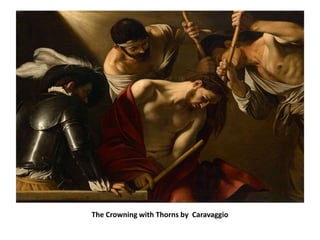
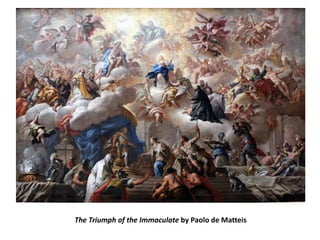
• The compositions of baroque painting
employs diagonal and zigzag lines that express
the vitality and movement quality of the
baroque art.
The Crowning with Thorns by Caravaggio
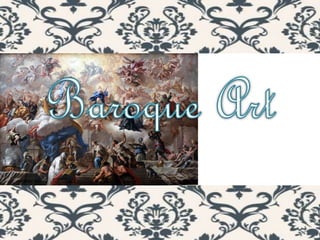
The Triumph of the Immaculate by Paolo de Matteis
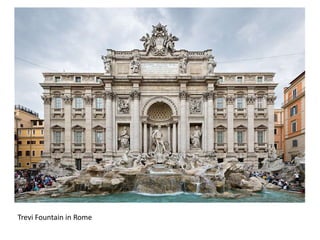
• Baroque style in architecture is marked
by heavy sculptural and extravagantly
ornamental facade. The giant twisted
columns, broken pediments, and a
variety of motifs such as scrolls, scallops,
trellises, urns, and angels.
Trevi Fountain in Rome
• emphasized massiveness and monumentality,
movement, dramatic spatial and lighting
sequences, and a rich interior decoration
using contrasting surface textures, vivid
colours, and luxurious materials to heighten
the structure’s physical immediacy and evoke
sensual delight.
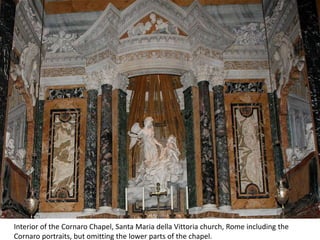
Interior of the Cornaro Chapel, Santa Maria della Vittoria church, Rome including the
Cornaro portraits, but omitting the lower parts of the chapel.
• In Baroque sculpture, groups of figures
assumed new importance and there was a
dynamic movement and energy of human
forms—they spiraled around an empty central
vortex, or reached outwards into the
surrounding space.
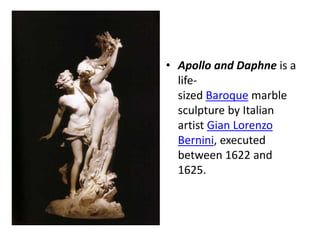
• Apollo and Daphne is a
life-
sized Baroque marble
sculpture by Italian
artist Gian Lorenzo
Bernini, executed
between 1622 and
1625.
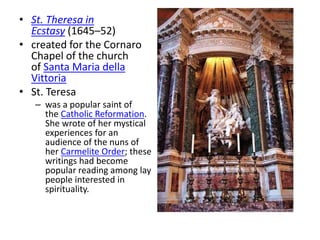
• St. Theresa in
Ecstasy (1645–52)
• created for the Cornaro
Chapel of the church
of Santa Maria della
Vittoria
• St. Teresa
– was a popular saint of
the Catholic Reformation.
She wrote of her mystical
experiences for an
audience of the nuns of
her Carmelite Order; these
writings had become
popular reading among lay
people interested in
spirituality.
• The Baroque style, as an expression of
religious emotionalism, eventually found its
way into the Spanish and Portugese colonies
in Central and South America, and in the East,
particularly the Philippines, with the
widespread
Modern Arts
• includes artistic works produced during the
period extending roughly from the 1860s to
the 1970s, and denotes the style
and philosophy of the art produced during
that era.
• The term is usually associated with art in
which the traditions of the past have been
thrown aside in a spirit of experimentation.
Modern artists experimented with new ways
of seeing and with fresh ideas about the
nature of materials and functions of art.
Effect:
A tendency away from the narrative, which was
characteristic for the traditional arts,
toward abstraction is characteristic of much
modern art.
Modern art Begins with the heritage of
painters like:
• Vincent van Gogh,
• Paul Cézanne,
• Paul Gauguin,
• Georges Seurat and
• Henri de Toulouse-Lautrec
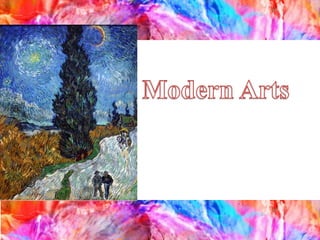
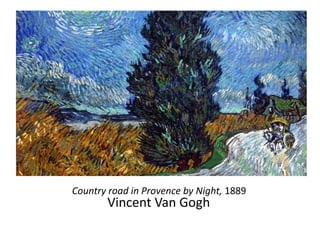
Country road in Provence by Night, 1889
Vincent Van Gogh
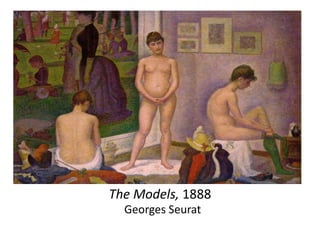
The Models, 1888
Georges Seurat
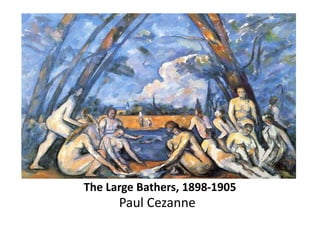
The Large Bathers, 1898-1905
Paul Cezanne
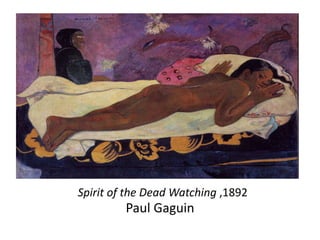
Spirit of the Dead Watching ,1892
Paul Gaguin
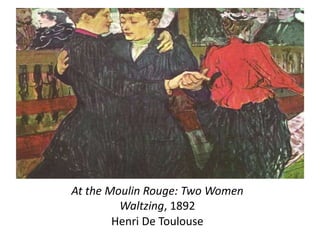
At the Moulin Rouge: Two Women
Waltzing, 1892
Henri De Toulouse
History of Modern Arts
19th Century
• 1863
- Edouard Monet show his painting
Le déjeuner sur l'herbe in the Salon des
Refusés in Paris.
• 1855
- Gustave Courbet exhibited “ The Artist’s
Studio “
• 1784
- Jacques-Louis David completed his
painting The Oath of the Horatii
 H. Harvard Arnason (Historian)
- he said that “each of these dates has
significance for the development of modern
art, but none categorically marks a completely
new beginning.”
Immanuel Kant ( Clement Greenberg )
- the first real modernist
The pioneers of modern art were:
• Romantics, Realists and Impressionists
• By the late 19th century, additional
movements which were to be influential in
modern art had begun to emerge: post-
Impressionism as well as Symbolism.
Early 20th Century
Among the movements which flowered in the
first decade of the 20th century were:
• Fauvism,
• Cubism,
• Expressionism, and
• Futurism
After World War II
• U.S. became the focal point of new artistic
movements.
• 1950’s and 1960’s saw the emergence
of Abstract Expressionism, Color field
painting, Pop art, Op art, Hard-edge
painting, Minimal art, Lyrical
Abstraction, Fluxus , Happening , Video
art, Postminimalism, Photorealism and various
other movements.
• In the late 1960s and the 1970s, Land art, Performance
art, Conceptual art, and other new art forms had attracted the
attention of curators and critics, at the expense of more traditional
media.
• By the end of the 1970s, when cultural critics began speaking of
"the end of painting" (the title of a provocative essay written in
1981 by Douglas Crimp), new media art had become a category in
itself, with a growing number of artists experimenting with
technological means such as video art. Painting assumed renewed
importance in the 1980s and 1990s, as evidenced by the rise
of neo-expressionism and the revival of figurative painting.
• Towards the end of the 20th century, a number of artists and
architects started questioning the idea of "the modern" and created
typically Postmodern works.

Renaissance, baroque and modern art

  • 2.
    • means “rebirth”; decribed as classy aimed for perfection • flourished in the 14th century, in Florence, Italy • era of great creativity in literature, sculpture and painting • featured the use of perspective, balance, form and proportion (classicism) • focused on Christian religion and common daily activities of people
  • 3.
    • The idealman during this period was supposed to be a well-rounded individual and with knowledge in various fields like philosophy, art, science and music.
  • 4.
    Leonardo Da Vinci(1452-1519) • A well known painter • Was trained and studied in the workshop of Andrea de Verrocchio – a well known sculptor and painter
  • 5.
    Great works • Horseand Rider (1495) – was an unsigned work
  • 6.
    • Mona Lisa– first painting in which a woman is allowed to look directly into the eyes of the viewer. La Gioconda- wife of an Italian merchant, Fancisco del Gioconda
  • 7.
    • The LastSupper- it is housed at Santa Maria delle Grazie in Milan, Italy. • He uses chiaroscuro technique in his work. • Chiaro means light and scuro means dark described as bold contrast between dark and light.
  • 8.
    Michael Buonarotti (1475-1564) •Michelangelo Buonarroti • An architect, painter and writer but primarily a sculptor. • Was recognized at the age of 16 by Lorenzo de Medici (1449- 1492)
  • 9.
    Great Works: Pieta(1498-1500) – locatedat St. Peter’s Basilica -A youthful Mary mourns the dead Christ -signature is carved in the band across Mary’s chest.
  • 10.
    David (1501-1504) • -amarble sculpture stands 13 ft and 5 inches • with the base marble statue of a standing male nude. The statue represents the Biblical hero David, a favoured subject in the art of Florence. Originally commissioned as one of a series of statues of prophets to be positioned along the roofline of the east end of Florence Cathedral, the statue was placed instead in a public square, outside the Palazzo della Signoria, the seat of civic government in Florence, where it was unveiled on 8 September 1504.
  • 11.
    Last Judgement (1534-1541) -A paintingon the altar wall of Sistine Chapel
  • 12.
    Raphael Santi (1483-1520) •Started to work in Florence and at the age of 26, he went to Rome • He painted portraits and mythology pictures • Raphael’s Style is calm, harmonious and restrained.
  • 13.
    Virgin with theChrist the Child
  • 15.
    • derived fromthe Portuguese barocco meaning, 'irregular pearl or stone‘ • In art criticism the word Baroque came to be used to describe anything irregular, bizarre, or otherwise departing from established rules and proportions. • Baroque art above all reflected the religious tensions of the age - notably the desire of the Catholic Church in Rome (as annunciated at the Council of Trent, 1545-63) to reassert itself in the wake of the Protestant Reformation.
  • 16.
    • The Baroquestyle of architecture prevailed in Europe during the 17th and 18th centuries and was characterized by elaborate and grotesque forms and ornamentalations. • In painting, this is characterized by • Movement • Energy • Restleness
  • 17.
    • The compositionsof baroque painting employs diagonal and zigzag lines that express the vitality and movement quality of the baroque art.
  • 18.
    The Crowning withThorns by Caravaggio
  • 19.
    The Triumph ofthe Immaculate by Paolo de Matteis
  • 20.
    • Baroque stylein architecture is marked by heavy sculptural and extravagantly ornamental facade. The giant twisted columns, broken pediments, and a variety of motifs such as scrolls, scallops, trellises, urns, and angels.
  • 21.
  • 22.
    • emphasized massivenessand monumentality, movement, dramatic spatial and lighting sequences, and a rich interior decoration using contrasting surface textures, vivid colours, and luxurious materials to heighten the structure’s physical immediacy and evoke sensual delight.
  • 23.
    Interior of theCornaro Chapel, Santa Maria della Vittoria church, Rome including the Cornaro portraits, but omitting the lower parts of the chapel.
  • 24.
    • In Baroquesculpture, groups of figures assumed new importance and there was a dynamic movement and energy of human forms—they spiraled around an empty central vortex, or reached outwards into the surrounding space.
  • 25.
    • Apollo andDaphne is a life- sized Baroque marble sculpture by Italian artist Gian Lorenzo Bernini, executed between 1622 and 1625.
  • 26.
    • St. Theresain Ecstasy (1645–52) • created for the Cornaro Chapel of the church of Santa Maria della Vittoria • St. Teresa – was a popular saint of the Catholic Reformation. She wrote of her mystical experiences for an audience of the nuns of her Carmelite Order; these writings had become popular reading among lay people interested in spirituality.
  • 27.
    • The Baroquestyle, as an expression of religious emotionalism, eventually found its way into the Spanish and Portugese colonies in Central and South America, and in the East, particularly the Philippines, with the widespread
  • 29.
    Modern Arts • includesartistic works produced during the period extending roughly from the 1860s to the 1970s, and denotes the style and philosophy of the art produced during that era. • The term is usually associated with art in which the traditions of the past have been thrown aside in a spirit of experimentation.
  • 30.
    Modern artists experimentedwith new ways of seeing and with fresh ideas about the nature of materials and functions of art. Effect: A tendency away from the narrative, which was characteristic for the traditional arts, toward abstraction is characteristic of much modern art.
  • 31.
    Modern art Beginswith the heritage of painters like: • Vincent van Gogh, • Paul Cézanne, • Paul Gauguin, • Georges Seurat and • Henri de Toulouse-Lautrec
  • 32.
    Country road inProvence by Night, 1889 Vincent Van Gogh
  • 33.
  • 34.
    The Large Bathers,1898-1905 Paul Cezanne
  • 35.
    Spirit of theDead Watching ,1892 Paul Gaguin
  • 36.
    At the MoulinRouge: Two Women Waltzing, 1892 Henri De Toulouse
  • 37.
  • 38.
    19th Century • 1863 -Edouard Monet show his painting Le déjeuner sur l'herbe in the Salon des Refusés in Paris. • 1855 - Gustave Courbet exhibited “ The Artist’s Studio “
  • 39.
    • 1784 - Jacques-LouisDavid completed his painting The Oath of the Horatii  H. Harvard Arnason (Historian) - he said that “each of these dates has significance for the development of modern art, but none categorically marks a completely new beginning.”
  • 40.
    Immanuel Kant (Clement Greenberg ) - the first real modernist The pioneers of modern art were: • Romantics, Realists and Impressionists • By the late 19th century, additional movements which were to be influential in modern art had begun to emerge: post- Impressionism as well as Symbolism.
  • 41.
    Early 20th Century Amongthe movements which flowered in the first decade of the 20th century were: • Fauvism, • Cubism, • Expressionism, and • Futurism
  • 42.
    After World WarII • U.S. became the focal point of new artistic movements. • 1950’s and 1960’s saw the emergence of Abstract Expressionism, Color field painting, Pop art, Op art, Hard-edge painting, Minimal art, Lyrical Abstraction, Fluxus , Happening , Video art, Postminimalism, Photorealism and various other movements.
  • 43.
    • In thelate 1960s and the 1970s, Land art, Performance art, Conceptual art, and other new art forms had attracted the attention of curators and critics, at the expense of more traditional media. • By the end of the 1970s, when cultural critics began speaking of "the end of painting" (the title of a provocative essay written in 1981 by Douglas Crimp), new media art had become a category in itself, with a growing number of artists experimenting with technological means such as video art. Painting assumed renewed importance in the 1980s and 1990s, as evidenced by the rise of neo-expressionism and the revival of figurative painting. • Towards the end of the 20th century, a number of artists and architects started questioning the idea of "the modern" and created typically Postmodern works.