Chef Mehernosh Dhanda
2/8/2013   BAC 101 Culinary Foundation Level 1                     1
Scope
 After this session you will be able to:
  Identify the different cooking methods
  State the relationship between textures,
   cooking time & the method of cooking
  Explain the advantages & disadvantages of
   different cooking methods
  Be aware about the safe handling rules
   associated with each cooking method
2/8/2013       BAC 101 Culinary Foundation Level 1   2
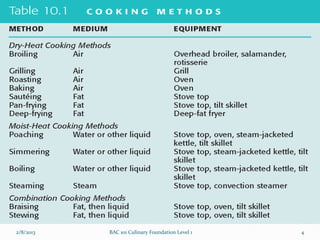
Cooking Methods
  Dry-heat cooking methods
     Air
     Fat
  Moist-heat cooking methods
     Water
     Steam
  Combination cooking methods
     Employ both dry- and moist-heat methods


2/8/2013           BAC 101 Culinary Foundation Level 1   3
2/8/2013   BAC 101 Culinary Foundation Level 1   4
Dry-Heat Cooking Methods
  Broiling
  Grilling
  Roasting and baking
  Sautéing
     Stir-frying
  Pan-frying
  Deep-frying


2/8/2013            BAC 101 Culinary Foundation Level 1   5
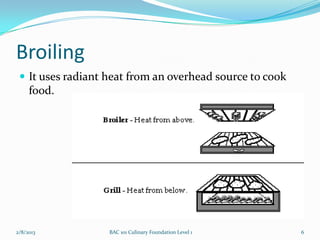
Broiling
  It uses radiant heat from an overhead source to cook
     food.


2/8/2013           BAC 101 Culinary Foundation Level 1    6
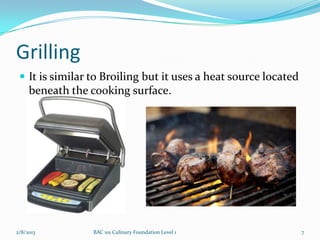
Grilling
  It is similar to Broiling but it uses a heat source located
     beneath the cooking surface.


2/8/2013         BAC 101 Culinary Foundation Level 1             7
GRILLING AND BARBECUING
 Advantages
  Grilling is a quick, easy method of cooking
  There is little loss of nutrients and less fat is used.
  Grilled food are tasty and easy to digest


 Disadvantages
  Grilled foods cannot be successfully reheated
  They need to be served straight away
  Only tender cuts of meat can be used
2/8/2013         BAC 101 Culinary Foundation Level 1         8
GRILLING AND BARBECUING
 Safety Rules
  Do not leave food unattended whilst cooking
  Keep work area clean & floors free from spilt grease
  Exercise great care when adjusting grill bars or
   salamander racks
  Assume all surfaces & items around grill areas to be
   hot.. FEEL BEFORE YOU PICK UP ANYTHING!!!


2/8/2013       BAC 101 Culinary Foundation Level 1    9
Roasting & Baking
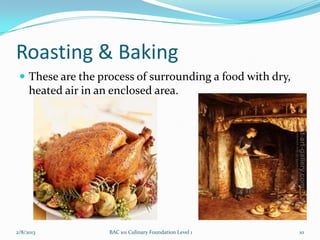
  These are the process of surrounding a food with dry,
     heated air in an enclosed area.


2/8/2013             BAC 101 Culinary Foundation Level 1   10
ROASTING
 Advantages:-
  Minimal fire risk
  Meat juices from the meat can be used for gravy which
   enhance the flavor
  Gives a variety to the menu
 Disadvantages:-
  Constant attention is required
  Losses of nutrients like amino acids


2/8/2013       BAC 101 Culinary Foundation Level 1     11
ROASTING
 Safety Rules
  The correct degree of cooking of meats must be
   accurately measured to protect from parasitic worms
   and pathogenic bacteria

  Care should be taken when handling oven trays to
     prevent spillages of hot fat

  Safe practices should be observed in                 operational
     procedure, clothing and footwear

2/8/2013          BAC 101 Culinary Foundation Level 1             12
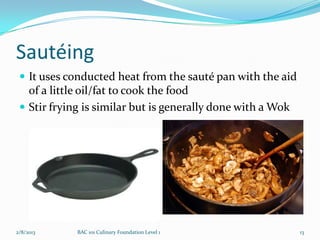
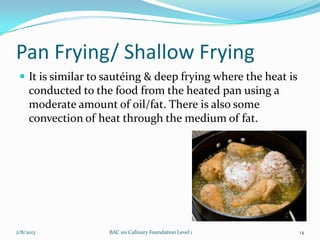
Sautéing
  It uses conducted heat from the sauté pan with the aid
   of a little oil/fat to cook the food
  Stir frying is similar but is generally done with a Wok


2/8/2013     BAC 101 Culinary Foundation Level 1             13
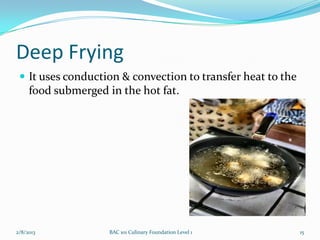
Pan Frying/ Shallow Frying
  It is similar to sautéing & deep frying where the heat is
     conducted to the food from the heated pan using a
     moderate amount of oil/fat. There is also some
     convection of heat through the medium of fat.


2/8/2013            BAC 101 Culinary Foundation Level 1        14
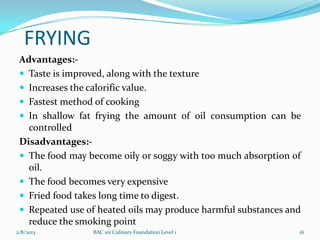
Deep Frying
  It uses conduction & convection to transfer heat to the
     food submerged in the hot fat.


2/8/2013             BAC 101 Culinary Foundation Level 1     15
FRYING
 Advantages:-
  Taste is improved, along with the texture
  Increases the calorific value.
  Fastest method of cooking
  In shallow fat frying the amount of oil consumption can be
   controlled
 Disadvantages:-
  The food may become oily or soggy with too much absorption of
   oil.
  The food becomes very expensive
  Fried food takes long time to digest.
  Repeated use of heated oils may produce harmful substances and
   reduce the smoking point
2/8/2013         BAC 101 Culinary Foundation Level 1            16
FRYING
 Safety Rules
  All personnel must be trained in correct usage of the
   equipment
  The proper level of frying medium should be used
  The fryer must not be overloaded as this may cause hot
   oil/fat overflow.
  Drain wet foods and then dry with absorbent paper.
   This prevents splatters of hot fat
  Pans must be moved carefully on the stove top to
   prevent splattering and burns

2/8/2013       BAC 101 Culinary Foundation Level 1      17
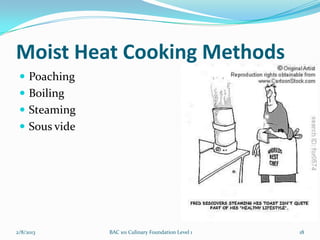
Moist Heat Cooking Methods
  Poaching
  Boiling
  Steaming
  Sous vide


2/8/2013       BAC 101 Culinary Foundation Level 1   18
Poaching
  It uses convection to transfer heat to cook foods that
   don’t need higher temperature or time.
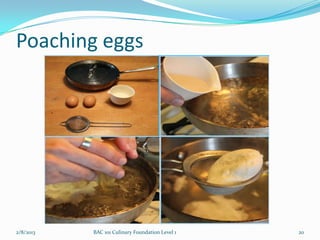
  Water temperature for poaching eggs should be
   around 160 to 180ºF (71-82ºC).
  As a rule of thumb, bring the water to a boil, then
   reduce it to a simmer before cooking.


2/8/2013           BAC 101 Culinary Foundation Level 1      19
Poaching eggs


2/8/2013   BAC 101 Culinary Foundation Level 1   20
POACHING
 Advantages:-
  Foods with delicate texture may be cooked without
   breaking up.
  Poached foods are easily digested
  No fat needs to be added to cook the food

 Disadvantages:-
  Poaching is not particularly suitable for large pieces of food
  There is some flavor and nutrient loss from the food the
   cooking liquid
  There is little development in color and flavor
2/8/2013         BAC 101 Culinary Foundation Level 1            21
POACHING
 Safety Rules
  Equipment should be matched to the quantity of food
   to prevent spillages.
  Care should be taken in handling dishes which are
   brought to temperature on the top of the stove and
   then transferred to the oven


2/8/2013      BAC 101 Culinary Foundation Level 1    22
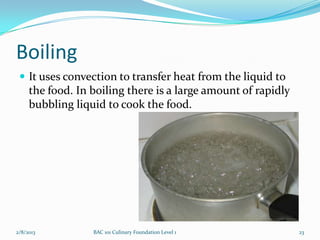
Boiling
  It uses convection to transfer heat from the liquid to
     the food. In boiling there is a large amount of rapidly
     bubbling liquid to cook the food.


2/8/2013          BAC 101 Culinary Foundation Level 1          23
BOILING
 Advantages
  Tougher, cheaper cuts of meat may be used
  Heat transfer is fairly rapid and efficient
  The food is not likely to burn
  The food remains moist


 Disadvantages
  Flavor and some color may be lost from the food into liquid
  Loss of nutrients (especially water-soluble vitamins) may
   be high
2/8/2013         BAC 101 Culinary Foundation Level 1         24
BOILING
 Safety Rules
  The boiling utensil should be matched with the
   quantity of food to be cooked
  The food handler should take care when placing foods
   into or removing items from boiling liquids
  When reducing liquids adequate ventilation should be
   available to prevent dampness


2/8/2013       BAC 101 Culinary Foundation Level 1    25
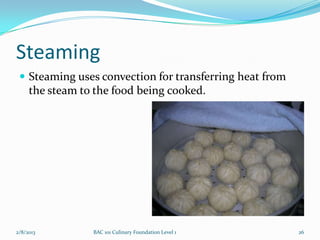
Steaming
  Steaming uses convection for transferring heat from
     the steam to the food being cooked.


2/8/2013         BAC 101 Culinary Foundation Level 1     26
Combination Cooking Methods
  Braising
  Stewing


2/8/2013      BAC 101 Culinary Foundation Level 1   27
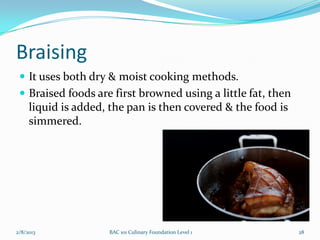
Braising
  It uses both dry & moist cooking methods.
  Braised foods are first browned using a little fat, then
     liquid is added, the pan is then covered & the food is
     simmered.


2/8/2013             BAC 101 Culinary Foundation Level 1      28
Stewing
  It is similar to braising but is generally used on smaller
     cuts of meat & the cooking time is shorter as compared
     to braising.


2/8/2013         BAC 101 Culinary Foundation Level 1            29
Assignment
 Group 1
 Prepare a PowerPoint presentation on the different
   methods of cooking used in Indian cooking with 25
   pictures & explanations of each type… Eg: Steaming:-
   Idlis, Dhokla, Khandvi, etc
 Group 2
   Prepare a PowerPoint presentation on the different
   methods of cooking used in Asian cooking with 25
   pictures & explanations of each type… Eg: Steaming:-
   Momos, etc

2/8/2013       BAC 101 Culinary Foundation Level 1        30
Thank You


2/8/2013   BAC 101 Culinary Foundation Level 1   31

07 methods of cooking

  • 1.
    Chef Mehernosh Dhanda 2/8/2013 BAC 101 Culinary Foundation Level 1 1
  • 2.
    Scope After thissession you will be able to:  Identify the different cooking methods  State the relationship between textures, cooking time & the method of cooking  Explain the advantages & disadvantages of different cooking methods  Be aware about the safe handling rules associated with each cooking method 2/8/2013 BAC 101 Culinary Foundation Level 1 2
  • 3.
    Cooking Methods Dry-heat cooking methods  Air  Fat  Moist-heat cooking methods  Water  Steam  Combination cooking methods  Employ both dry- and moist-heat methods 2/8/2013 BAC 101 Culinary Foundation Level 1 3
  • 4.
    2/8/2013 BAC 101 Culinary Foundation Level 1 4
  • 5.
    Dry-Heat Cooking Methods  Broiling  Grilling  Roasting and baking  Sautéing  Stir-frying  Pan-frying  Deep-frying 2/8/2013 BAC 101 Culinary Foundation Level 1 5
  • 6.
    Broiling  Ituses radiant heat from an overhead source to cook food. 2/8/2013 BAC 101 Culinary Foundation Level 1 6
  • 7.
    Grilling  Itis similar to Broiling but it uses a heat source located beneath the cooking surface. 2/8/2013 BAC 101 Culinary Foundation Level 1 7
  • 8.
    GRILLING AND BARBECUING Advantages  Grilling is a quick, easy method of cooking  There is little loss of nutrients and less fat is used.  Grilled food are tasty and easy to digest Disadvantages  Grilled foods cannot be successfully reheated  They need to be served straight away  Only tender cuts of meat can be used 2/8/2013 BAC 101 Culinary Foundation Level 1 8
  • 9.
    GRILLING AND BARBECUING Safety Rules  Do not leave food unattended whilst cooking  Keep work area clean & floors free from spilt grease  Exercise great care when adjusting grill bars or salamander racks  Assume all surfaces & items around grill areas to be hot.. FEEL BEFORE YOU PICK UP ANYTHING!!! 2/8/2013 BAC 101 Culinary Foundation Level 1 9
  • 10.
    Roasting & Baking  These are the process of surrounding a food with dry, heated air in an enclosed area. 2/8/2013 BAC 101 Culinary Foundation Level 1 10
  • 11.
    ROASTING Advantages:- Minimal fire risk  Meat juices from the meat can be used for gravy which enhance the flavor  Gives a variety to the menu Disadvantages:-  Constant attention is required  Losses of nutrients like amino acids 2/8/2013 BAC 101 Culinary Foundation Level 1 11
  • 12.
    ROASTING Safety Rules  The correct degree of cooking of meats must be accurately measured to protect from parasitic worms and pathogenic bacteria  Care should be taken when handling oven trays to prevent spillages of hot fat  Safe practices should be observed in operational procedure, clothing and footwear 2/8/2013 BAC 101 Culinary Foundation Level 1 12
  • 13.
    Sautéing  Ituses conducted heat from the sauté pan with the aid of a little oil/fat to cook the food  Stir frying is similar but is generally done with a Wok 2/8/2013 BAC 101 Culinary Foundation Level 1 13
  • 14.
    Pan Frying/ ShallowFrying  It is similar to sautéing & deep frying where the heat is conducted to the food from the heated pan using a moderate amount of oil/fat. There is also some convection of heat through the medium of fat. 2/8/2013 BAC 101 Culinary Foundation Level 1 14
  • 15.
    Deep Frying It uses conduction & convection to transfer heat to the food submerged in the hot fat. 2/8/2013 BAC 101 Culinary Foundation Level 1 15
  • 16.
    FRYING Advantages:- Taste is improved, along with the texture  Increases the calorific value.  Fastest method of cooking  In shallow fat frying the amount of oil consumption can be controlled Disadvantages:-  The food may become oily or soggy with too much absorption of oil.  The food becomes very expensive  Fried food takes long time to digest.  Repeated use of heated oils may produce harmful substances and reduce the smoking point 2/8/2013 BAC 101 Culinary Foundation Level 1 16
  • 17.
    FRYING Safety Rules  All personnel must be trained in correct usage of the equipment  The proper level of frying medium should be used  The fryer must not be overloaded as this may cause hot oil/fat overflow.  Drain wet foods and then dry with absorbent paper. This prevents splatters of hot fat  Pans must be moved carefully on the stove top to prevent splattering and burns 2/8/2013 BAC 101 Culinary Foundation Level 1 17
  • 18.
    Moist Heat CookingMethods  Poaching  Boiling  Steaming  Sous vide 2/8/2013 BAC 101 Culinary Foundation Level 1 18
  • 19.
    Poaching  Ituses convection to transfer heat to cook foods that don’t need higher temperature or time.  Water temperature for poaching eggs should be around 160 to 180ºF (71-82ºC).  As a rule of thumb, bring the water to a boil, then reduce it to a simmer before cooking. 2/8/2013 BAC 101 Culinary Foundation Level 1 19
  • 20.
    Poaching eggs 2/8/2013 BAC 101 Culinary Foundation Level 1 20
  • 21.
    POACHING Advantages:- Foods with delicate texture may be cooked without breaking up.  Poached foods are easily digested  No fat needs to be added to cook the food Disadvantages:-  Poaching is not particularly suitable for large pieces of food  There is some flavor and nutrient loss from the food the cooking liquid  There is little development in color and flavor 2/8/2013 BAC 101 Culinary Foundation Level 1 21
  • 22.
    POACHING Safety Rules  Equipment should be matched to the quantity of food to prevent spillages.  Care should be taken in handling dishes which are brought to temperature on the top of the stove and then transferred to the oven 2/8/2013 BAC 101 Culinary Foundation Level 1 22
  • 23.
    Boiling  Ituses convection to transfer heat from the liquid to the food. In boiling there is a large amount of rapidly bubbling liquid to cook the food. 2/8/2013 BAC 101 Culinary Foundation Level 1 23
  • 24.
    BOILING Advantages Tougher, cheaper cuts of meat may be used  Heat transfer is fairly rapid and efficient  The food is not likely to burn  The food remains moist Disadvantages  Flavor and some color may be lost from the food into liquid  Loss of nutrients (especially water-soluble vitamins) may be high 2/8/2013 BAC 101 Culinary Foundation Level 1 24
  • 25.
    BOILING Safety Rules  The boiling utensil should be matched with the quantity of food to be cooked  The food handler should take care when placing foods into or removing items from boiling liquids  When reducing liquids adequate ventilation should be available to prevent dampness 2/8/2013 BAC 101 Culinary Foundation Level 1 25
  • 26.
    Steaming  Steaminguses convection for transferring heat from the steam to the food being cooked. 2/8/2013 BAC 101 Culinary Foundation Level 1 26
  • 27.
    Combination Cooking Methods  Braising  Stewing 2/8/2013 BAC 101 Culinary Foundation Level 1 27
  • 28.
    Braising  Ituses both dry & moist cooking methods.  Braised foods are first browned using a little fat, then liquid is added, the pan is then covered & the food is simmered. 2/8/2013 BAC 101 Culinary Foundation Level 1 28
  • 29.
    Stewing  Itis similar to braising but is generally used on smaller cuts of meat & the cooking time is shorter as compared to braising. 2/8/2013 BAC 101 Culinary Foundation Level 1 29
  • 30.
    Assignment Group 1 Prepare a PowerPoint presentation on the different methods of cooking used in Indian cooking with 25 pictures & explanations of each type… Eg: Steaming:- Idlis, Dhokla, Khandvi, etc Group 2 Prepare a PowerPoint presentation on the different methods of cooking used in Asian cooking with 25 pictures & explanations of each type… Eg: Steaming:- Momos, etc 2/8/2013 BAC 101 Culinary Foundation Level 1 30
  • 31.
    Thank You 2/8/2013 BAC 101 Culinary Foundation Level 1 31