Molecular
Genetics
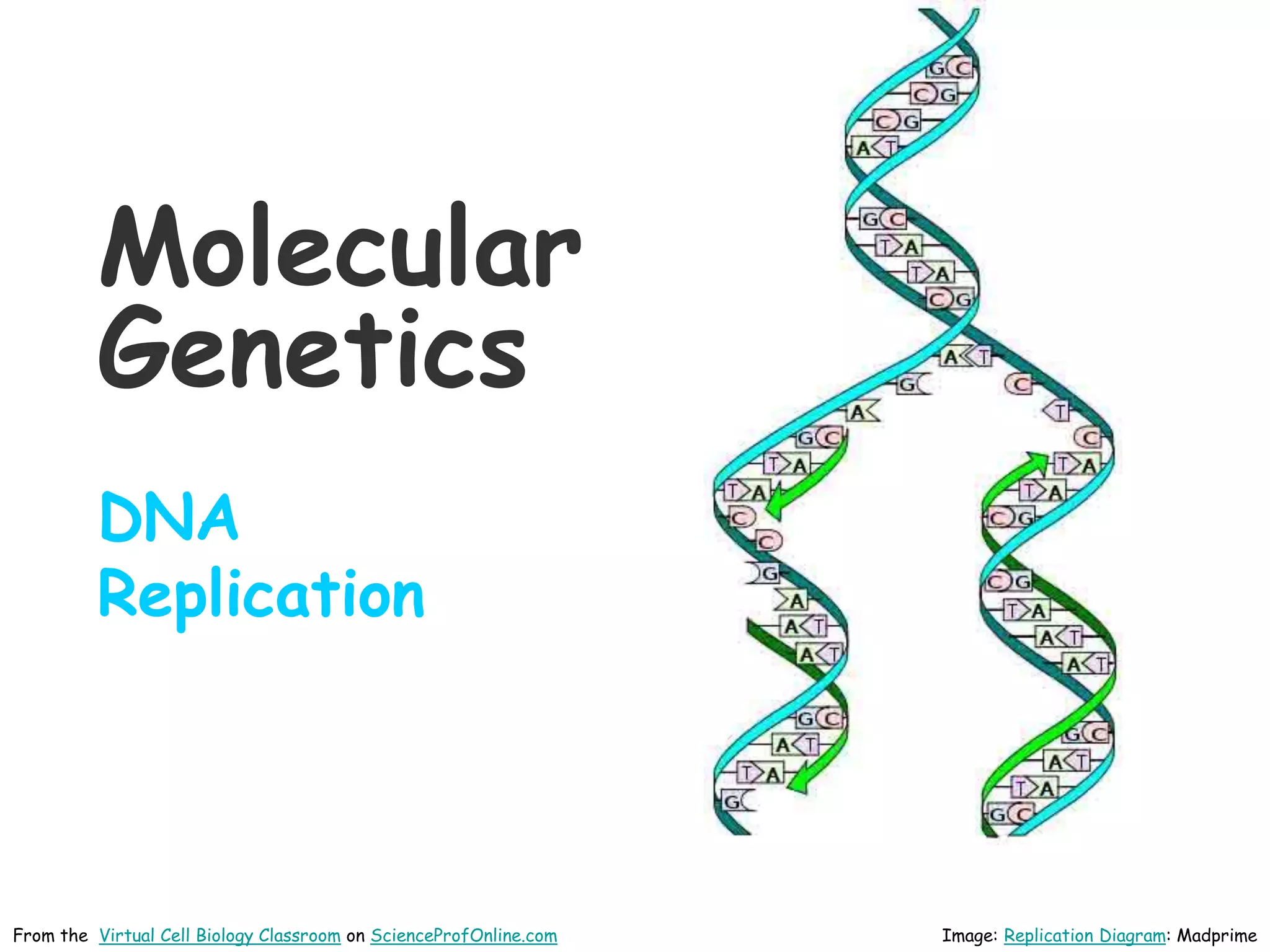
DNA
Replication
Image: Replication Diagram: Madprime
From the Virtual Cell Biology Classroom on ScienceProfOnline.com
Everyday Biology
How do bacteria
become resistant
to antibiotics?
From the Virtual Cell Biology Classroom on ScienceProfOnline.com
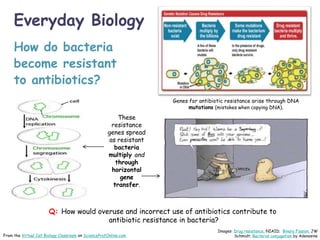
Genes for antibiotic resistance arise through DNA
mutations (mistakes when copying DNA).
Images: Drug resistance, NIAID; Binary Fission, JW
Schmidt; Bacterial conjugation by Adenosine
These
resistance
genes spread
as resistant
bacteria
multiply and
through
horizontal
gene
transfer.
Q: How would overuse and incorrect use of antibiotics contribute to
antibiotic resistance in bacteria?
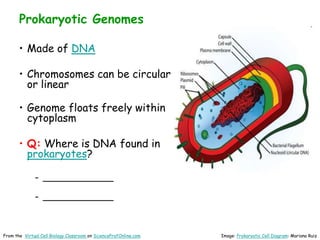
Prokaryotic Genomes
• Made of DNA
• Chromosomes can be circular
or linear
• Genome floats freely within
cytoplasm
• Q: Where is DNA found in
prokaryotes?
– ______________
– ______________
Image: Prokaryotic Cell Diagram: Mariana Ruiz
From the Virtual Cell Biology Classroom on ScienceProfOnline.com
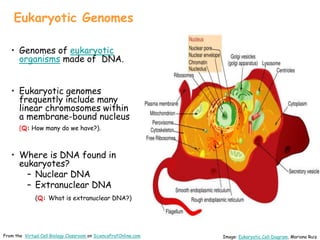
Eukaryotic Genomes
• Genomes of eukaryotic
organisms made of DNA.
• Eukaryotic genomes
frequently include many
linear chromosomes within
a membrane-bound nucleus
(Q: How many do we have?).
• Where is DNA found in
eukaryotes?
– Nuclear DNA
– Extranuclear DNA
(Q: What is extranuclear DNA?)
Image: Eukaryotic Cell Diagram, Mariana Ruiz
From the Virtual Cell Biology Classroom on ScienceProfOnline.com
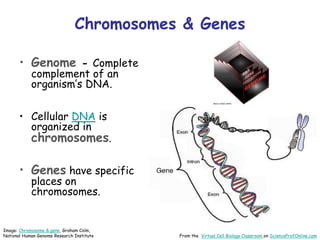
Chromosomes & Genes
• Genome - Complete
complement of an
organism’s DNA.
• Cellular DNA is
organized in
chromosomes.
• Genes have specific
places on
chromosomes.
From the Virtual Cell Biology Classroom on ScienceProfOnline.com
Image: Chromosome & gene, Graham Colm,
National Human Genome Research Institute
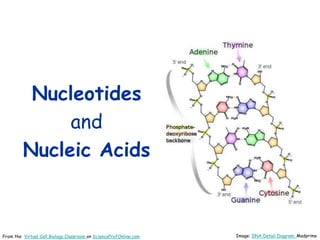
Nucleotides
and
Nucleic Acids
Image: DNA Detail Diagram: Madprime
From the Virtual Cell Biology Classroom on ScienceProfOnline.com
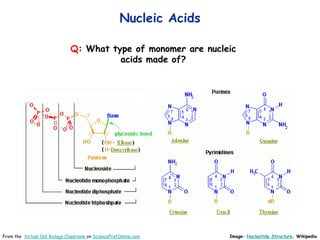
Nucleic Acids
Q: What type of monomer are nucleic
acids made of?
Image: Nucleotide Structure, Wikipedia
From the Virtual Cell Biology Classroom on ScienceProfOnline.com
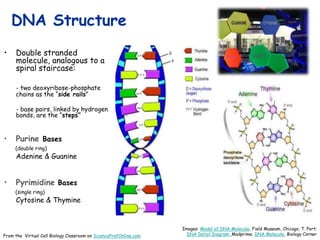
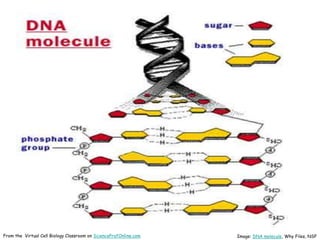
DNA Structure
• Double stranded
molecule, analogous to a
spiral staircase:
- two deoxyribose-phosphate
chains as the “side rails”
- base pairs, linked by hydrogen
bonds, are the “steps”
• Purine Bases
(double ring)
Adenine & Guanine
• Pyrimidine Bases
(single ring)
Cytosine & Thymine
Images: Model of DNA Molecule, Field Museum, Chicago, T. Port;
DNA Detail Diagram: Madprime; DNA Molecule, Biology Corner
From the Virtual Cell Biology Classroom on ScienceProfOnline.com
Image: DNA molecule, Why Files, NSF
From the Virtual Cell Biology Classroom on ScienceProfOnline.com
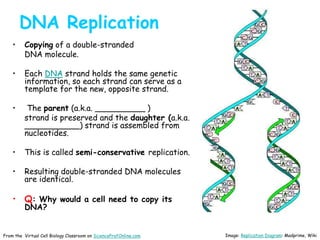
DNA Replication
• Copying of a double-stranded
DNA molecule.
• Each DNA strand holds the same genetic
information, so each strand can serve as a
template for the new, opposite strand.
• The parent (a.k.a. __________ )
strand is preserved and the daughter (a.k.a.
___________) strand is assembled from
nucleotides.
• This is called semi-conservative replication.
• Resulting double-stranded DNA molecules
are identical.
• Q: Why would a cell need to copy its
DNA?
Image: Replication Diagram: Madprime, Wiki
From the Virtual Cell Biology Classroom on ScienceProfOnline.com
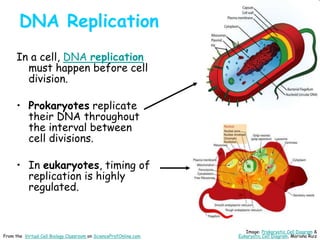
DNA Replication
In a cell, DNA replication
must happen before cell
division.
• Prokaryotes replicate
their DNA throughout
the interval between
cell divisions.
• In eukaryotes, timing of
replication is highly
regulated.
Image: Prokaryotic Cell Diagram &
Eukaryotic Cell Diagram, Mariana Ruiz
From the Virtual Cell Biology Classroom on ScienceProfOnline.com
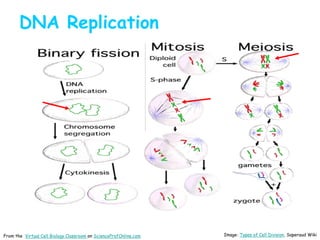
Image: Types of Cell Division, Saperaud Wiki
DNA Replication
From the Virtual Cell Biology Classroom on ScienceProfOnline.com
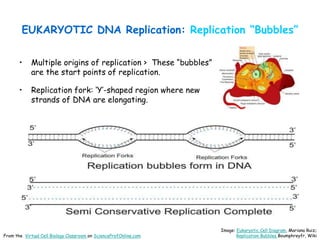
EUKARYOTIC DNA Replication: Replication “Bubbles”
• Multiple origins of replication > These “bubbles”
are the start points of replication.
• Replication fork: ‘Y’-shaped region where new
strands of DNA are elongating.
Image: Eukaryotic Cell Diagram, Mariana Ruiz;
Replication Bubbles Boumphreyfr, Wiki
From the Virtual Cell Biology Classroom on ScienceProfOnline.com
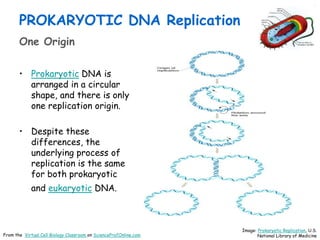
PROKARYOTIC DNA Replication
One Origin
• Prokaryotic DNA is
arranged in a circular
shape, and there is only
one replication origin.
• Despite these
differences, the
underlying process of
replication is the same
for both prokaryotic
and eukaryotic DNA.
Image: Prokaryotic Replication, U.S.
National Library of Medicine
From the Virtual Cell Biology Classroom on ScienceProfOnline.com
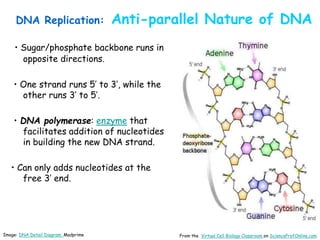
DNA Replication: Anti-parallel Nature of DNA
• Sugar/phosphate backbone runs in
opposite directions.
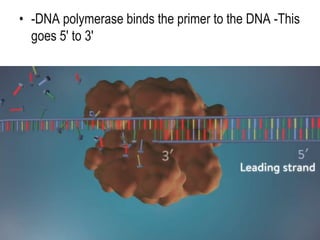
• One strand runs 5’ to 3’, while the
other runs 3’ to 5’.
• DNA polymerase: enzyme that
facilitates addition of nucleotides
in building the new DNA strand.
• Can only adds nucleotides at the
free 3’ end.
Image: DNA Detail Diagram: Madprime From the Virtual Cell Biology Classroom on ScienceProfOnline.com
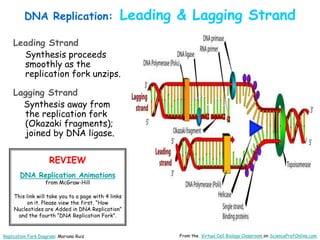
DNA Replication: Leading & Lagging Strand
Leading Strand
Synthesis proceeds
smoothly as the
replication fork unzips.
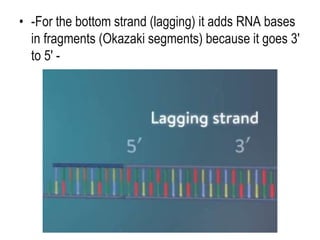
Lagging Strand
Synthesis away from
the replication fork
(Okazaki fragments);
joined by DNA ligase.
Replication Fork Diagram: Mariana Ruiz From the Virtual Cell Biology Classroom on ScienceProfOnline.com
REVIEW
DNA Replication Animations
from McGraw-Hill
This link will take you to a page with 4 links
on it. Please view the first, “How
Nucleotides are Added in DNA Replication”
and the fourth “DNA Replication Fork”.
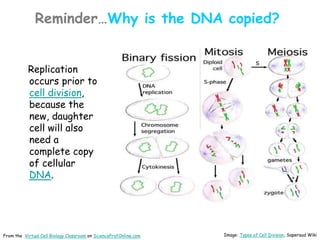
Reminder…Why is the DNA copied?
Replication
occurs prior to
cell division,
because the
new, daughter
cell will also
need a
complete copy
of cellular
DNA.
Image: Types of Cell Division, Saperaud Wiki
From the Virtual Cell Biology Classroom on ScienceProfOnline.com
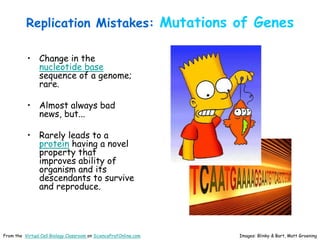
Replication Mistakes: Mutations of Genes
• Change in the
nucleotide base
sequence of a genome;
rare.
• Almost always bad
news, but...
• Rarely leads to a
protein having a novel
property that
improves ability of
organism and its
descendants to survive
and reproduce.
Images: Blinky & Bart, Matt Groening
From the Virtual Cell Biology Classroom on ScienceProfOnline.com
Are you feeling blinded by science?
Do yourself a favor. Use the…
Virtual Cell Biology
Classroom (VCBC) !
The VCBC is full of resources to help you succeed,
including:
• practice test questions
• review questions
• study guides and learning objectives
• PowerPoints on other topics
You can access the Virtual Cell Biology Classroom by going to the Science Prof Online
website www.ScienceProfOnline.com
Images: Blinded With Science album, Thomas Dolby; Endomembrane system, Mariana Ruiz, Wiki
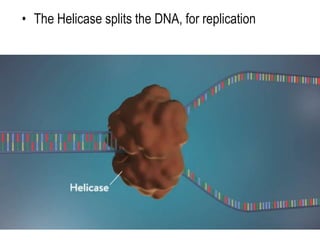
• The Helicase splits the DNA, for replication
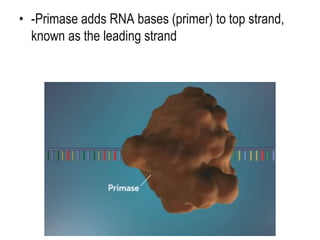
• -Primase adds RNA bases (primer) to top strand,
known as the leading strand
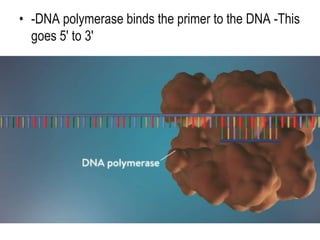
• -DNA polymerase binds the primer to the DNA -This
goes 5' to 3'
• -DNA polymerase binds the primer to the DNA -This
goes 5' to 3'
• -For the bottom strand (lagging) it adds RNA bases
in fragments (Okazaki segments) because it goes 3'
to 5' -
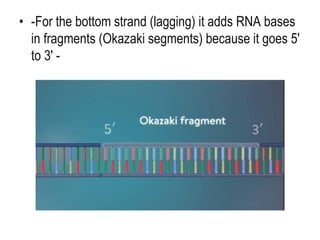
• -For the bottom strand (lagging) it adds RNA bases
in fragments (Okazaki segments) because it goes 5'
to 3' -
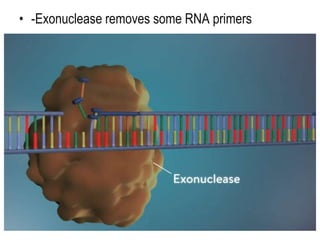
• -Exonuclease removes some RNA primers
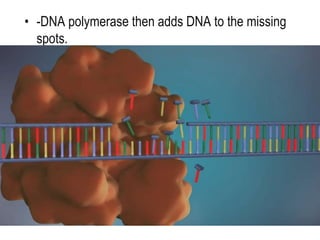
• -DNA polymerase then adds DNA to the missing
spots.
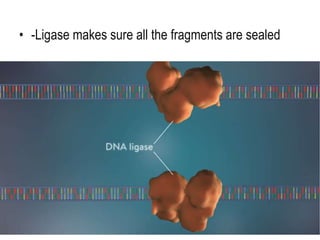
• -Ligase makes sure all the fragments are sealed
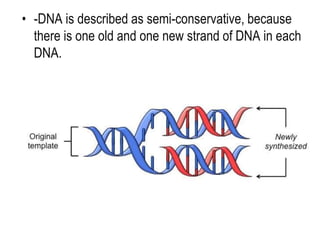
• -DNA is described as semi-conservative, because
there is one old and one new strand of DNA in each
DNA.

Genetics-DNA-Replication-Biology-Lecture-PowerPoint-VCBCct.pptx

  • 1.
    Molecular Genetics DNA Replication Image: Replication Diagram:Madprime From the Virtual Cell Biology Classroom on ScienceProfOnline.com
  • 2.
    Everyday Biology How dobacteria become resistant to antibiotics? From the Virtual Cell Biology Classroom on ScienceProfOnline.com Genes for antibiotic resistance arise through DNA mutations (mistakes when copying DNA). Images: Drug resistance, NIAID; Binary Fission, JW Schmidt; Bacterial conjugation by Adenosine These resistance genes spread as resistant bacteria multiply and through horizontal gene transfer. Q: How would overuse and incorrect use of antibiotics contribute to antibiotic resistance in bacteria?
  • 3.
    Prokaryotic Genomes • Madeof DNA • Chromosomes can be circular or linear • Genome floats freely within cytoplasm • Q: Where is DNA found in prokaryotes? – ______________ – ______________ Image: Prokaryotic Cell Diagram: Mariana Ruiz From the Virtual Cell Biology Classroom on ScienceProfOnline.com
  • 4.
    Eukaryotic Genomes • Genomesof eukaryotic organisms made of DNA. • Eukaryotic genomes frequently include many linear chromosomes within a membrane-bound nucleus (Q: How many do we have?). • Where is DNA found in eukaryotes? – Nuclear DNA – Extranuclear DNA (Q: What is extranuclear DNA?) Image: Eukaryotic Cell Diagram, Mariana Ruiz From the Virtual Cell Biology Classroom on ScienceProfOnline.com
  • 5.
    Chromosomes & Genes •Genome - Complete complement of an organism’s DNA. • Cellular DNA is organized in chromosomes. • Genes have specific places on chromosomes. From the Virtual Cell Biology Classroom on ScienceProfOnline.com Image: Chromosome & gene, Graham Colm, National Human Genome Research Institute
  • 6.
    Nucleotides and Nucleic Acids Image: DNADetail Diagram: Madprime From the Virtual Cell Biology Classroom on ScienceProfOnline.com
  • 7.
    Nucleic Acids Q: Whattype of monomer are nucleic acids made of? Image: Nucleotide Structure, Wikipedia From the Virtual Cell Biology Classroom on ScienceProfOnline.com
  • 8.
    DNA Structure • Doublestranded molecule, analogous to a spiral staircase: - two deoxyribose-phosphate chains as the “side rails” - base pairs, linked by hydrogen bonds, are the “steps” • Purine Bases (double ring) Adenine & Guanine • Pyrimidine Bases (single ring) Cytosine & Thymine Images: Model of DNA Molecule, Field Museum, Chicago, T. Port; DNA Detail Diagram: Madprime; DNA Molecule, Biology Corner From the Virtual Cell Biology Classroom on ScienceProfOnline.com
  • 9.
    Image: DNA molecule,Why Files, NSF From the Virtual Cell Biology Classroom on ScienceProfOnline.com
  • 10.
    DNA Replication • Copyingof a double-stranded DNA molecule. • Each DNA strand holds the same genetic information, so each strand can serve as a template for the new, opposite strand. • The parent (a.k.a. __________ ) strand is preserved and the daughter (a.k.a. ___________) strand is assembled from nucleotides. • This is called semi-conservative replication. • Resulting double-stranded DNA molecules are identical. • Q: Why would a cell need to copy its DNA? Image: Replication Diagram: Madprime, Wiki From the Virtual Cell Biology Classroom on ScienceProfOnline.com
  • 11.
    DNA Replication In acell, DNA replication must happen before cell division. • Prokaryotes replicate their DNA throughout the interval between cell divisions. • In eukaryotes, timing of replication is highly regulated. Image: Prokaryotic Cell Diagram & Eukaryotic Cell Diagram, Mariana Ruiz From the Virtual Cell Biology Classroom on ScienceProfOnline.com
  • 12.
    Image: Types ofCell Division, Saperaud Wiki DNA Replication From the Virtual Cell Biology Classroom on ScienceProfOnline.com
  • 13.
    EUKARYOTIC DNA Replication:Replication “Bubbles” • Multiple origins of replication > These “bubbles” are the start points of replication. • Replication fork: ‘Y’-shaped region where new strands of DNA are elongating. Image: Eukaryotic Cell Diagram, Mariana Ruiz; Replication Bubbles Boumphreyfr, Wiki From the Virtual Cell Biology Classroom on ScienceProfOnline.com
  • 14.
    PROKARYOTIC DNA Replication OneOrigin • Prokaryotic DNA is arranged in a circular shape, and there is only one replication origin. • Despite these differences, the underlying process of replication is the same for both prokaryotic and eukaryotic DNA. Image: Prokaryotic Replication, U.S. National Library of Medicine From the Virtual Cell Biology Classroom on ScienceProfOnline.com
  • 15.
    DNA Replication: Anti-parallelNature of DNA • Sugar/phosphate backbone runs in opposite directions. • One strand runs 5’ to 3’, while the other runs 3’ to 5’. • DNA polymerase: enzyme that facilitates addition of nucleotides in building the new DNA strand. • Can only adds nucleotides at the free 3’ end. Image: DNA Detail Diagram: Madprime From the Virtual Cell Biology Classroom on ScienceProfOnline.com
  • 16.
    DNA Replication: Leading& Lagging Strand Leading Strand Synthesis proceeds smoothly as the replication fork unzips. Lagging Strand Synthesis away from the replication fork (Okazaki fragments); joined by DNA ligase. Replication Fork Diagram: Mariana Ruiz From the Virtual Cell Biology Classroom on ScienceProfOnline.com REVIEW DNA Replication Animations from McGraw-Hill This link will take you to a page with 4 links on it. Please view the first, “How Nucleotides are Added in DNA Replication” and the fourth “DNA Replication Fork”.
  • 17.
    Reminder…Why is theDNA copied? Replication occurs prior to cell division, because the new, daughter cell will also need a complete copy of cellular DNA. Image: Types of Cell Division, Saperaud Wiki From the Virtual Cell Biology Classroom on ScienceProfOnline.com
  • 18.
    Replication Mistakes: Mutationsof Genes • Change in the nucleotide base sequence of a genome; rare. • Almost always bad news, but... • Rarely leads to a protein having a novel property that improves ability of organism and its descendants to survive and reproduce. Images: Blinky & Bart, Matt Groening From the Virtual Cell Biology Classroom on ScienceProfOnline.com
  • 19.
    Are you feelingblinded by science? Do yourself a favor. Use the… Virtual Cell Biology Classroom (VCBC) ! The VCBC is full of resources to help you succeed, including: • practice test questions • review questions • study guides and learning objectives • PowerPoints on other topics You can access the Virtual Cell Biology Classroom by going to the Science Prof Online website www.ScienceProfOnline.com Images: Blinded With Science album, Thomas Dolby; Endomembrane system, Mariana Ruiz, Wiki
  • 20.
    • The Helicasesplits the DNA, for replication
  • 21.
    • -Primase addsRNA bases (primer) to top strand, known as the leading strand
  • 22.
    • -DNA polymerasebinds the primer to the DNA -This goes 5' to 3'
  • 23.
    • -DNA polymerasebinds the primer to the DNA -This goes 5' to 3'
  • 24.
    • -For thebottom strand (lagging) it adds RNA bases in fragments (Okazaki segments) because it goes 3' to 5' -
  • 25.
    • -For thebottom strand (lagging) it adds RNA bases in fragments (Okazaki segments) because it goes 5' to 3' -
  • 26.
    • -Exonuclease removessome RNA primers
  • 27.
    • -DNA polymerasethen adds DNA to the missing spots.
  • 28.
    • -Ligase makessure all the fragments are sealed
  • 29.
    • -DNA isdescribed as semi-conservative, because there is one old and one new strand of DNA in each DNA.