MAIN RESEARCHING METHODS OF BACTERIA MORPHOLOGY. PREPARATION OF
THE SMEARS FROM DIFFERENT CULTURES OF MICROORGANISMS. SIMPLE METHODS OF
STAINING.
I. THEORETICAL QUESTIONS
1. Prokaryote and eukaryote:
a - common properties and differences;
b - features of bacterial cells structure.
2. Chemical composition of prokaryotes:
a - chemical composition of bacteria;
3. Morphology of bacteria:
a – classification of bacteria by the form on cocci, rods, spiral-shaped, thread-shaped;
b - morphology of cocci and division then in dependence segmentation, to give examples of pathogenic
ones;
c – rod-shaped bacteria (bacteria, bacillus, clostridia) and their locating in staining, to give examples of
pathogenic ones;
d –spiral-shaped forms of bacteria (vibrio, spirilla, spirochaetes) and give examples of pathogenic
representatives.
4. Preparation of the smear from bacterial culture.
5. The simple methods of the staining.
1. PROKARYOTIC CELL STRUCTURE
1. Structure of the envelope:
a. Cell wall (Gram-positive bacteria) or cell envelope (Gram-negative bacteria)
b. Plasma membrane
c. Capsule or slime layer (may be absent for some bacteria)
2. Cell`s interior:
a. Internal membranous structures (mesosomes)
b. Nucleoid
c. Ribosomes
d. Intracytoplasmic inclusions (may be absent)
3. Outer structures (may be absent):
a. Flagella
b. Pili and fimbriae
Differences between eukaryotic and prokaryotic cells
1. The prokaryotic cell is simpler than the eukaryotic cell at every level, with one exception: the cell wall
may be more complex.
2. The prokaryotic cell is smaller than the eukaryotic cell.
3. The cytoplasm is enclosed within a lipoprotein cell membrane, similar to the prokaryotic cell membrane.
4. The eucaryotic cell has a membrane-enclosed nucleus. Despite on eukaryotes the prokaryotes lack a
membrane-delimited nucleus. They nave a nucleoid. The bacterial nucleoid contains the DNA fibrils and is
not separated from the surrounding cytoplasm by membrane.
1
5. Prokaryotic cells lack autonomous plastids, such as mitochondria, Golgi apparatus and chloroplasts.
6. Microtubular structures distinguishing for eukaryotic cells are generally absent in prokaryotes.
Chemical composition of bacteria:
1. Water - 75-85 %;
2. Dry matter–25-15 %: proteins - 50-80 % of dry matter, nucleic acid - 10-30 % of dry matter, polysaccharides -
12-18%, Lipids - 10 % of dry matter, mineral substance - 2-14 % of dry mass
3. Morphology of Bacteria
Bacteria are, for the most part, unicellular organisms lacking chlorophyll. Their biological properties and
predominant reproduction by binary fission relates them to prokaryotes. The size of bacteria is measured in
micrometres (µm) and varies from 0.1 µm (Spiroplasma, Acholeplasma) to 16-18 µm (Spirillum volutans).
Most pathogenic bacteria measure from 0.2 to 10 µm
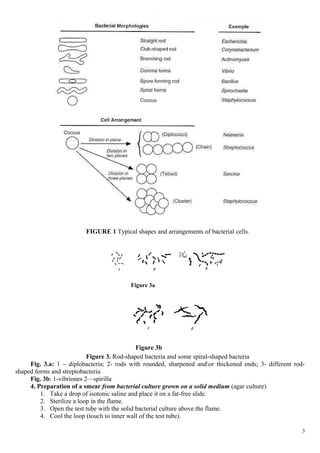
Morphologically, bacteria possess four main forms. They are either spherical (cocci), rod-shaped
(bacteria, bacilli, and clostridia), spiral-shaped (vibrio, spirilla and spirochaetes) or thread-shaped
(actynomycetes) form.
Cocci. These forms of bacteria (Fig 2) are spherical, ellipsoidal, bean-shaped, and lancelet. Cocci are
subdivided into six groups according to cell arrangement, cell division and biological properties
1. Micrococci. The cells are arranged singly. They are saprophytes, and live in water and in air (M agilis,
M.roseus, M luteus, etc )
2. Diplococci divide in one plane and remain attached in pairs. They include meningococcus, causative
agent of epidemic cerebrospinal meningitis, and gonococcus, causative agent of gonorrhoea and blennorrhoea.
3. Streptococci divide in one plane and are arranged in chains of different length. Some streptococci are
pathogenic for humans and are responsible for various diseases.
4. Tetracoccus divides in two planes at right angles to one another and forms square groups of four cells.
They very rarely produce diseases in humans.
5. Sarcina divides in three planes at right angles to one another and produces cubical packets of 8, 16
or more cells. They are frequently found in the air. Virulent species have not been encountered.
6. Staphylococci divide in random planes and generate irregular grape-like clumps. Some species of
Staphylococci cause diseases in man and animals.
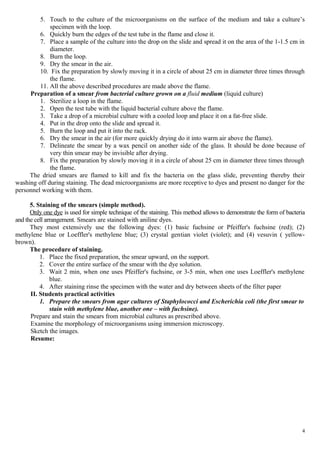
Rods. Rod-shaped or cylindrical forms (Fig. 3) are subdivided into bacteria, bacilli, and clostridia.
Bacteria include those microorganisms which, as a rule, do not produce spores (colibacillus, and
organisms responsible for enteric fever, dysentery, diphtheria, tuberculosis)
Bacilli and clostridia include organisms, which produce spores (bacilli responsible for anthrax, clostridia
are the causative agents of tetanus, anaerobic infections, etc).
Rod-shaped bacteria exhibit differences in form. Some are short (tularaemia bacillus), others are long
(anthrax bacillus). The shape of the rod’s end may be flat, rounded, sigar-shaped or bifurcated.
According to their arrangement, cylindrical forms can be subdivided into 4 groups (1) diplobacteria and
diplobacilli occurring in pairs (bacteria of pneumonia); (2) streptobacteria or streptobacilli occurring in chains
of different length (causative agents of chancroid,
anthrax), (3) bacteria and bacilli which are not arranged in a regular pattern (these comprise the majority of the
rod-shaped forms); bacteria which are arranged at angles to each other, presenting a Chinese letter pattern
(corynebacteria).
Spiral-shaped bacteria.
1. Vibrio are cells which resemble a comma in appearance. Typical representatives of this group are
Vibrio cholerae, the causative agent of cholera, and aquatic vibrio, which are widely distributed in fresh water
reservoirs.
2. Spirilla are coiled forms of bacteria exhibiting twists with one or more turns. Spirilla are rigid spiral
forms. Only one pathogenic species is known (Spirillum minus) which is responsible for a disease in humans
transmitted through the bite of rats and other rodents (rat-bite fever, sodoku).
3. Spirochaetes are flexible spiral forms. Pathogenic for human ones have turns until 3 to 25. They cause
syphilis (Treponema), relapsing fever (Borrelia) and leptospirosis (Leptospira).
Thread-shaped bacteria. This group includes actinomycetes, which produce some antibiotics and may
cause purulent diseases such as actinomycosis. Actinomycetes can branch to produce a network.
2
FIGURE 1 Typical shapes and arrangements of bacterial cells.
Figure 3b
Figure 3. Rod-shaped bacteria and some spiral-shaped bacteria
Fig. 3.a: 1 – diplobacteria; 2- rods with rounded, sharpened andor thickened ends; 3- different rod-
shaped forms and streptobacteria
Fig. 3b: 1-vibriones 2—spirilla
4. Preparation of a smear from bacterial culture grown on a solid medium (agar culture)
1. Take a drop of isotonic saline and place it on a fat-free slide.
2. Sterilize a loop in the flame.
3. Open the test tube with the solid bacterial culture above the flame.
4. Cool the loop (touch to inner wall of the test tube).
3
Figure 3a
5. Touch to the culture of the microorganisms on the surface of the medium and take a culture’s
specimen with the loop.
6. Quickly burn the edges of the test tube in the flame and close it.
7. Place a sample of the culture into the drop on the slide and spread it on the area of the 1-1.5 cm in
diameter.
8. Burn the loop.
9. Dry the smear in the air.
10. Fix the preparation by slowly moving it in a circle of about 25 cm in diameter three times through
the flame.
11. All the above described procedures are made above the flame.
Preparation of a smear from bacterial culture grown on a fluid medium (liquid culture)
1. Sterilize a loop in the flame.
2. Open the test tube with the liquid bacterial culture above the flame.
3. Take a drop of a microbial culture with a cooled loop and place it on a fat-free slide.
4. Put in the drop onto the slide and spread it.
5. Burn the loop and put it into the rack.
6. Dry the smear in the air (for more quickly drying do it into warm air above the flame).
7. Delineate the smear by a wax pencil on another side of the glass. It should be done because of
very thin smear may be invisible after drying.
8. Fix the preparation by slowly moving it in a circle of about 25 cm in diameter three times through
the flame.
The dried smears are flamed to kill and fix the bacteria on the glass slide, preventing thereby their
washing off during staining. The dead microorganisms are more receptive to dyes and present no danger for the
personnel working with them.
5. Staining of the smears (simple method).
Only one dye is used for simple technique of the staining. This method allows to demonstrate the form of bacteria
and the cell arrangement. Smears are stained with aniline dyes.
They most extensively use the following dyes: (1) basic fuchsine or Pfeiffer's fuchsine (red); (2)
methylene blue or Loeffler's methylene blue; (3) crystal gentian violet (violet); and (4) vesuvin ( yellow-
brown).
The procedure of staining.
1. Place the fixed preparation, the smear upward, on the support.
2. Cover the entire surface of the smear with the dye solution.
3. Wait 2 min, when one uses Pfeiffer's fuchsine, or 3-5 min, when one uses Loeffler's methylene
blue.
4. After staining rinse the specimen with the water and dry between sheets of the filter paper
II. Students practical activities
1. Prepare the smears from agar cultures of Staphylococci and Escherichia coli (the first smear to
stain with methylene blue, another one – with fuchsine).
Prepare and stain the smears from microbial cultures as prescribed above.
Examine the morphology of microorganisms using immersion microscopy.
Sketch the images.
Resume:
4

Main researching methods of Bacteria Morphology

  • 1.
    MAIN RESEARCHING METHODSOF BACTERIA MORPHOLOGY. PREPARATION OF THE SMEARS FROM DIFFERENT CULTURES OF MICROORGANISMS. SIMPLE METHODS OF STAINING. I. THEORETICAL QUESTIONS 1. Prokaryote and eukaryote: a - common properties and differences; b - features of bacterial cells structure. 2. Chemical composition of prokaryotes: a - chemical composition of bacteria; 3. Morphology of bacteria: a – classification of bacteria by the form on cocci, rods, spiral-shaped, thread-shaped; b - morphology of cocci and division then in dependence segmentation, to give examples of pathogenic ones; c – rod-shaped bacteria (bacteria, bacillus, clostridia) and their locating in staining, to give examples of pathogenic ones; d –spiral-shaped forms of bacteria (vibrio, spirilla, spirochaetes) and give examples of pathogenic representatives. 4. Preparation of the smear from bacterial culture. 5. The simple methods of the staining. 1. PROKARYOTIC CELL STRUCTURE 1. Structure of the envelope: a. Cell wall (Gram-positive bacteria) or cell envelope (Gram-negative bacteria) b. Plasma membrane c. Capsule or slime layer (may be absent for some bacteria) 2. Cell`s interior: a. Internal membranous structures (mesosomes) b. Nucleoid c. Ribosomes d. Intracytoplasmic inclusions (may be absent) 3. Outer structures (may be absent): a. Flagella b. Pili and fimbriae Differences between eukaryotic and prokaryotic cells 1. The prokaryotic cell is simpler than the eukaryotic cell at every level, with one exception: the cell wall may be more complex. 2. The prokaryotic cell is smaller than the eukaryotic cell. 3. The cytoplasm is enclosed within a lipoprotein cell membrane, similar to the prokaryotic cell membrane. 4. The eucaryotic cell has a membrane-enclosed nucleus. Despite on eukaryotes the prokaryotes lack a membrane-delimited nucleus. They nave a nucleoid. The bacterial nucleoid contains the DNA fibrils and is not separated from the surrounding cytoplasm by membrane. 1
  • 2.
    5. Prokaryotic cellslack autonomous plastids, such as mitochondria, Golgi apparatus and chloroplasts. 6. Microtubular structures distinguishing for eukaryotic cells are generally absent in prokaryotes. Chemical composition of bacteria: 1. Water - 75-85 %; 2. Dry matter–25-15 %: proteins - 50-80 % of dry matter, nucleic acid - 10-30 % of dry matter, polysaccharides - 12-18%, Lipids - 10 % of dry matter, mineral substance - 2-14 % of dry mass 3. Morphology of Bacteria Bacteria are, for the most part, unicellular organisms lacking chlorophyll. Their biological properties and predominant reproduction by binary fission relates them to prokaryotes. The size of bacteria is measured in micrometres (µm) and varies from 0.1 µm (Spiroplasma, Acholeplasma) to 16-18 µm (Spirillum volutans). Most pathogenic bacteria measure from 0.2 to 10 µm Morphologically, bacteria possess four main forms. They are either spherical (cocci), rod-shaped (bacteria, bacilli, and clostridia), spiral-shaped (vibrio, spirilla and spirochaetes) or thread-shaped (actynomycetes) form. Cocci. These forms of bacteria (Fig 2) are spherical, ellipsoidal, bean-shaped, and lancelet. Cocci are subdivided into six groups according to cell arrangement, cell division and biological properties 1. Micrococci. The cells are arranged singly. They are saprophytes, and live in water and in air (M agilis, M.roseus, M luteus, etc ) 2. Diplococci divide in one plane and remain attached in pairs. They include meningococcus, causative agent of epidemic cerebrospinal meningitis, and gonococcus, causative agent of gonorrhoea and blennorrhoea. 3. Streptococci divide in one plane and are arranged in chains of different length. Some streptococci are pathogenic for humans and are responsible for various diseases. 4. Tetracoccus divides in two planes at right angles to one another and forms square groups of four cells. They very rarely produce diseases in humans. 5. Sarcina divides in three planes at right angles to one another and produces cubical packets of 8, 16 or more cells. They are frequently found in the air. Virulent species have not been encountered. 6. Staphylococci divide in random planes and generate irregular grape-like clumps. Some species of Staphylococci cause diseases in man and animals. Rods. Rod-shaped or cylindrical forms (Fig. 3) are subdivided into bacteria, bacilli, and clostridia. Bacteria include those microorganisms which, as a rule, do not produce spores (colibacillus, and organisms responsible for enteric fever, dysentery, diphtheria, tuberculosis) Bacilli and clostridia include organisms, which produce spores (bacilli responsible for anthrax, clostridia are the causative agents of tetanus, anaerobic infections, etc). Rod-shaped bacteria exhibit differences in form. Some are short (tularaemia bacillus), others are long (anthrax bacillus). The shape of the rod’s end may be flat, rounded, sigar-shaped or bifurcated. According to their arrangement, cylindrical forms can be subdivided into 4 groups (1) diplobacteria and diplobacilli occurring in pairs (bacteria of pneumonia); (2) streptobacteria or streptobacilli occurring in chains of different length (causative agents of chancroid, anthrax), (3) bacteria and bacilli which are not arranged in a regular pattern (these comprise the majority of the rod-shaped forms); bacteria which are arranged at angles to each other, presenting a Chinese letter pattern (corynebacteria). Spiral-shaped bacteria. 1. Vibrio are cells which resemble a comma in appearance. Typical representatives of this group are Vibrio cholerae, the causative agent of cholera, and aquatic vibrio, which are widely distributed in fresh water reservoirs. 2. Spirilla are coiled forms of bacteria exhibiting twists with one or more turns. Spirilla are rigid spiral forms. Only one pathogenic species is known (Spirillum minus) which is responsible for a disease in humans transmitted through the bite of rats and other rodents (rat-bite fever, sodoku). 3. Spirochaetes are flexible spiral forms. Pathogenic for human ones have turns until 3 to 25. They cause syphilis (Treponema), relapsing fever (Borrelia) and leptospirosis (Leptospira). Thread-shaped bacteria. This group includes actinomycetes, which produce some antibiotics and may cause purulent diseases such as actinomycosis. Actinomycetes can branch to produce a network. 2
  • 3.
    FIGURE 1 Typicalshapes and arrangements of bacterial cells. Figure 3b Figure 3. Rod-shaped bacteria and some spiral-shaped bacteria Fig. 3.a: 1 – diplobacteria; 2- rods with rounded, sharpened andor thickened ends; 3- different rod- shaped forms and streptobacteria Fig. 3b: 1-vibriones 2—spirilla 4. Preparation of a smear from bacterial culture grown on a solid medium (agar culture) 1. Take a drop of isotonic saline and place it on a fat-free slide. 2. Sterilize a loop in the flame. 3. Open the test tube with the solid bacterial culture above the flame. 4. Cool the loop (touch to inner wall of the test tube). 3 Figure 3a
  • 4.
    5. Touch tothe culture of the microorganisms on the surface of the medium and take a culture’s specimen with the loop. 6. Quickly burn the edges of the test tube in the flame and close it. 7. Place a sample of the culture into the drop on the slide and spread it on the area of the 1-1.5 cm in diameter. 8. Burn the loop. 9. Dry the smear in the air. 10. Fix the preparation by slowly moving it in a circle of about 25 cm in diameter three times through the flame. 11. All the above described procedures are made above the flame. Preparation of a smear from bacterial culture grown on a fluid medium (liquid culture) 1. Sterilize a loop in the flame. 2. Open the test tube with the liquid bacterial culture above the flame. 3. Take a drop of a microbial culture with a cooled loop and place it on a fat-free slide. 4. Put in the drop onto the slide and spread it. 5. Burn the loop and put it into the rack. 6. Dry the smear in the air (for more quickly drying do it into warm air above the flame). 7. Delineate the smear by a wax pencil on another side of the glass. It should be done because of very thin smear may be invisible after drying. 8. Fix the preparation by slowly moving it in a circle of about 25 cm in diameter three times through the flame. The dried smears are flamed to kill and fix the bacteria on the glass slide, preventing thereby their washing off during staining. The dead microorganisms are more receptive to dyes and present no danger for the personnel working with them. 5. Staining of the smears (simple method). Only one dye is used for simple technique of the staining. This method allows to demonstrate the form of bacteria and the cell arrangement. Smears are stained with aniline dyes. They most extensively use the following dyes: (1) basic fuchsine or Pfeiffer's fuchsine (red); (2) methylene blue or Loeffler's methylene blue; (3) crystal gentian violet (violet); and (4) vesuvin ( yellow- brown). The procedure of staining. 1. Place the fixed preparation, the smear upward, on the support. 2. Cover the entire surface of the smear with the dye solution. 3. Wait 2 min, when one uses Pfeiffer's fuchsine, or 3-5 min, when one uses Loeffler's methylene blue. 4. After staining rinse the specimen with the water and dry between sheets of the filter paper II. Students practical activities 1. Prepare the smears from agar cultures of Staphylococci and Escherichia coli (the first smear to stain with methylene blue, another one – with fuchsine). Prepare and stain the smears from microbial cultures as prescribed above. Examine the morphology of microorganisms using immersion microscopy. Sketch the images. Resume: 4