• Microbial growth: It refers to the increase
in number of the cells over the period of
time.
• Increase in cellular constituents that may
result in:
– increase in cell number.
• e.g., when microorganisms reproduce binary fission
– increase in cell size.
• e.g., coenocytic microorganisms have nuclear
divisions that are not accompanied by cell divisions
• Microbiologists usually study population
growth rather than growth of individual
cells.
Bacterial Division
Binary Fission - most common method of
reproduction, asexual reproduction, splitting of
parent cell into two daughter cells
Budding - another form of bacterial division, also
asexual reproduction, it forms from outgrowths
(buds) of mature organisms, it is a form of
mitotic cell division, when the bud reaches the
size of the parent cell, it separates
• Generation Time:
“It is the time required for a cell to divide
and its population to double”
• Generation time for most of the
microorganisms are varies considerably.
For example-
E. coli divides every 20 minutes.
Most bacteria divide every 1 to 3 hours.
Some bacteria require more than 24 hours
doubling their numbers.
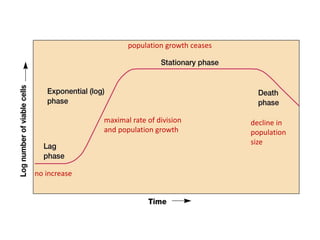
• Observed when microorganisms are
cultivated in batch culture.
– culture incubated in a closed vessel with a
single batch of medium
• Usually plotted as logarithm of cell number
versus time.
• Usually has four distinct phases.
no increase
maximal rate of division
and population growth
population growth ceases
decline in
population
size
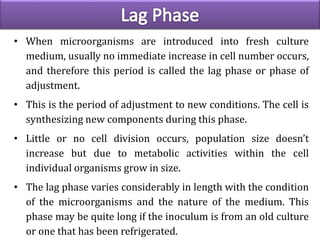
• When microorganisms are introduced into fresh culture
medium, usually no immediate increase in cell number occurs,
and therefore this period is called the lag phase or phase of
adjustment.

• This is the period of adjustment to new conditions. The cell is
synthesizing new components during this phase.
• Little or no cell division occurs, population size doesn’t
increase but due to metabolic activities within the cell
individual organisms grow in size.
• The lag phase varies considerably in length with the condition
of the microorganisms and the nature of the medium. This
phase may be quite long if the inoculum is from an old culture
or one that has been refrigerated.
• The lag phase may last from one hour to several days.
• Cell synthesizing new components
– e.g. to replenish spent materials
– e.g. to adapt to new medium or other conditions
• Varies in length
– In some cases can be very short or even absent
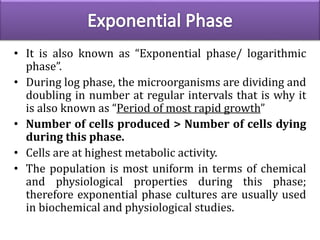
• It is also known as “Exponential phase/ logarithmic
phase”.
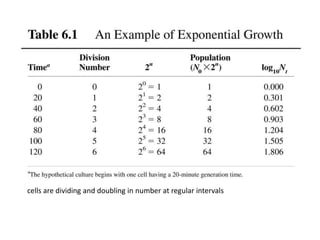
• During log phase, the microorganisms are dividing and
doubling in number at regular intervals that is why it
is also known as “Period of most rapid growth”
• Number of cells produced > Number of cells dying
during this phase.
• Cells are at highest metabolic activity.
• The population is most uniform in terms of chemical
and physiological properties during this phase;
therefore exponential phase cultures are usually used
in biochemical and physiological studies.
• Exponential growth is balanced growth. That is, all
cellular constituents are manufactured at constant
rates relative to each other.
• If nutrient levels or other environmental conditions
change, unbalanced growth results.
• Unbalanced growth also results when a bacterial
population is shifted down from a rich medium to a
poor one.
cells are dividing and doubling in number at regular intervals
• In the stationary phase the total number of viable
microorganisms remains constant
• Number of cells produced = Number of cells
dying during this phase.
• This may result from a balance between cell
division and cell death, or the population may
simply cease to divide though remaining
metabolically active.
• Population size begins to stabilize, overall cell
number does not increase and cell division begins
to slow down at increasing rate.
• Total number of viable cells remains
constant:
– may occur because metabolically active cells
stop reproducing.
– may occur because reproductive rate is
balanced by death rate.
• Factors that slow down microbial growth during
stationary phase or Possible reasons for entry
into stationary phase:
1. Accumulation of toxic waste materials.
2. Acidic pH of media.
3. Nutrient limitation.
4. Limited oxygen availability.
5. Critical population density reached.
• Death is defined to be the irreversible loss of the ability to
reproduce.
• In decline phase population size begins to decrease rapidly.
• Number of cells dying > Number of cells produced in this phase.
• Cell number decreases at a logarithmic rate and cells lose their
ability to divide.
• Only a few cells may remain alive for a long period of time.
• Detrimental environmental changes like nutrient deprivation
and the build-up of toxic wastes lead to the decline in the
number of viable cells characteristic of the death phase.
• In some cases, death rate slows due to accumulation of resistant
cells.
How to determine Microbial
numbers?
 directly – through counting
 indirectly – through measuring their
metabolic activity
DIRECT MEASUREMENT OF
MICROBIAL GROWTH
1. Plate count:
• 4 Most frequently used method of measuring bacterial
• populations.
• 4 Inoculate plate with a sample and count number of colonies.
• Assumptions:
• • Each colony originates from a single bacterial cell.
• • Original inoculum is homogeneous.
• • No cell aggregates are present.

• Advantages:
• • Measures viable cells
• Disadvantages:
• • Takes 24 hours or more for visible colonies to appear.
• • Only counts between 25 and 250 colonies are accurate.
• • Must perform serial dilutions to get appropriate numbers/plate.
Plate Counts
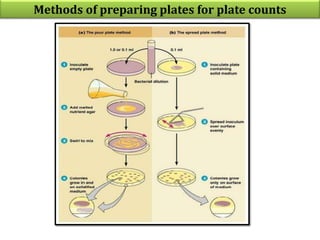
Methods of preparing plates for plate counts
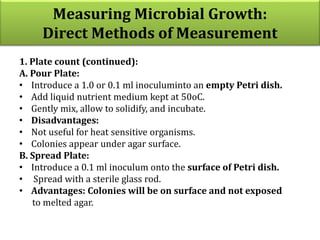
1. Plate count (continued):
A. Pour Plate:
• Introduce a 1.0 or 0.1 ml inoculuminto an empty Petri dish.
• Add liquid nutrient medium kept at 50oC.
• Gently mix, allow to solidify, and incubate.
• Disadvantages:
• Not useful for heat sensitive organisms.
• Colonies appear under agar surface.
B. Spread Plate:
• Introduce a 0.1 ml inoculum onto the surface of Petri dish.
• Spread with a sterile glass rod.
• Advantages: Colonies will be on surface and not exposed
to melted agar.
Measuring Microbial Growth:
Direct Methods of Measurement
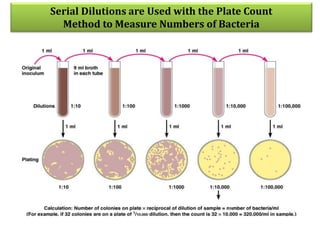
Serial Dilutions are Used with the Plate Count
Method to Measure Numbers of Bacteria
Measuring Microbial Growth:
Direct Methods of Measurement
2. Filtration:
• Used to measure small quantities of bacteria.
• Example: Fecal bacteria in a lake or in ocean
water.
• A large sample (100 ml or more) is filtered to
retain
• bacteria.
• Filter is transferred onto a Petri dish.
• Incubate and count colonies.
3. Most Probable Number (MPN):
• Used mainly to measure bacteria that will not grow
on solid medium.
• Dilute a sample repeatedly and inoculate several
broth tubes for each dilution point.

• Count the number of positive tubes in each set.
• Statistical method: Determines 95% probability
that a bacterial population falls within a certain
range.
Measuring Microbial Growth:
Direct Methods of Measurement
4. Direct Microscopic Count:
• A specific volume of a bacterial suspension (0.01 ml) is
placed on a microscope slide with a special grid.
• Stain is added to visualize bacteria.
• Cells are counted and multiplied by a factor to obtain
concentration.
• Advantages:
• No incubation time required.
• Disadvantages:
• Cannot always distinguish between live and dead bacteria.
• Motile bacteria are difficult to count.
• Requires a high concentration of bacteria (10 million/ml).
Measuring Microbial Growth:
Direct Methods of Measurement
Measuring Microbial Growth:
Indirect Methods of Measurement
1. Turbidity:
• As bacteria multiply in media, it becomes turbid.
• Use a spectrophotometer to determine %
transmission or absorbance.
• Multiply by a factor to determine concentration.
• Advantages:
• No incubation time required.
• Disadvantages:
• Cannot distinguish between live and dead bacteria.
• Requires a high concentration of bacteria (10 to 100
million cells/ml).
2. Metabolic Activity:
• As bacteria multiply in media, they produce certain
products:
• Carbon dioxide
• Acids
• Measure metabolic products.
• Expensive
3. Dry Weight:
• Bacteria or fungi in liquid media are centrifuged.
• Resulting cell pellet is weighed.
• Doesn’t distinguish live and dead cells.
Measuring Microbial Growth:
Indirect Methods of Measurement
PHYSICAL REQUIREMENTS
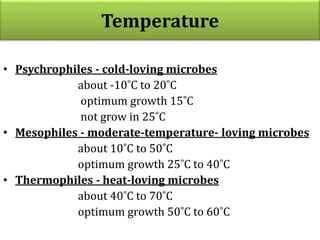
Temperature
• Psychrophiles - cold-loving microbes
about -10˚C to 20˚C
optimum growth 15˚C
not grow in 25˚C
• Mesophiles - moderate-temperature- loving microbes
about 10˚C to 50˚C
optimum growth 25˚C to 40˚C
• Thermophiles - heat-loving microbes
about 40˚C to 70˚C
optimum growth 50˚C to 60˚C
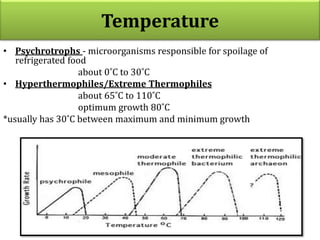
• Psychrotrophs - microorganisms responsible for spoilage of
refrigerated food
about 0˚C to 30˚C
• Hyperthermophiles/Extreme Thermophiles
about 65˚C to 110˚C
optimum growth 80˚C
*usually has 30˚C between maximum and minimum growth
Temperature
pH
• Acidity or alkalinity of a solution
• Most bacteria grow best at pH 6.5-7.5
• Very few bacteria grow below pH 4
• Acidophiles - chemoautotrophic bacteria that
are remarkably tolerant of acidity
Osmotic Pressure
• High osmotic pressures have the effect of
removing necessary water from a cell
Plasmolysis - shrinkage of cell’s plasma
membrane caused by osmotic loss of water
Factors affecting microbial
growth
Factors affecting microbial growth
1. pH
2. Moisture
3. Nutrient Content
4. Oxygen
5. Light
pH
• Most spoilage bacteria grow best near neutral
pH
• Pathogenic bacteria even more narrow in
tolerance range of near neutral
• Yeast and moulds have much greater tolerance
to acidic (lower) pH
• The optimum pH range is usually quite narrow
so that small changes in the pH can have large
effects on the growth rate of the organism
Effects of acids on organisms
• energy required to maintain cell's internal pH
• enzyme activity affected
• proteins, DNA, other molecules denatured
• longer lag, less rapid growth
Moisture
• Microbes must have a
supply of water available
• Bacteria most restricted,
then yeasts, then moulds
• Organisms tolerant of low
water levels:
– halophilic bacteria
osmophilic yeasts
– xerophilic molds
• Effects of low water levels
– longer lag, slower growth
– impaired transport
– loss of membrane fluidity
Nutrient content
• Required by all organisms: water,
carbon, nitrogen, minerals
• Organic growth factors needed to
varying degrees:
Gram + > Gram - > yeasts > moulds
• How easily are energy sources
metabolized?
sugar > alcohol > amino acids >
complex molecules
• How easily are nitrogen sources
metabolized?
– amino acids > proteins
– B vitamins required by many
bacteria
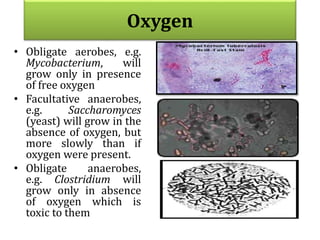
Oxygen
• Obligate aerobes, e.g.
Mycobacterium, will
grow only in presence
of free oxygen
• Facultative anaerobes,
e.g. Saccharomyces
(yeast) will grow in the
absence of oxygen, but
more slowly than if
oxygen were present.
• Obligate anaerobes,
e.g. Clostridium will
grow only in absence
of oxygen which is
toxic to them
Light
• Essential for photoautotrophs.
• As well as its intensity its wavelength
may be significant.
CHEMICAL REQUIREMENTS
Carbon
Structural backbone of living matter, it is needed for
all organic compounds to make up a living cell
Chemoheterotrophs get most of their carbon from
the source of their energy---organic materials
such as proteins, carbohydrates and lipids
Chemoautotrophs and photoautotrophs derive
their carbon from carbon dioxide
Nitrogen, Sulfur and Phosphorus
• For synthesis of cellular material
• Nitrogen and sulfur is needed for protein
synthesis
• Nitrogen and phosphorus is needed for
syntheses of DNA, RNA and ATP
• Nitrogen- 14% dry weight of a bacterial cell
• Sulfur and phosphorus- 4%
Trace Elements
• Microbes require very small amounts of other
mineral elements, such as Fe, Cu, Mo, Zn
• Essential for certain functions of certain
enzymes
• Assumed to be naturally present in tap water
and other components of media
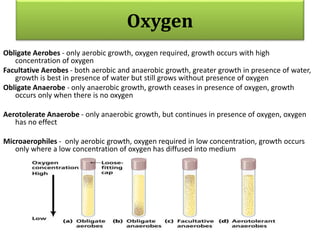
Oxygen
Obligate Aerobes - only aerobic growth, oxygen required, growth occurs with high
concentration of oxygen
Facultative Aerobes - both aerobic and anaerobic growth, greater growth in presence of water,
growth is best in presence of water but still grows without presence of oxygen
Obligate Anaerobe - only anaerobic growth, growth ceases in presence of oxygen, growth
occurs only when there is no oxygen
Aerotolerate Anaerobe - only anaerobic growth, but continues in presence of oxygen, oxygen
has no effect
Microaerophiles - only aerobic growth, oxygen required in low concentration, growth occurs
only where a low concentration of oxygen has diffused into medium
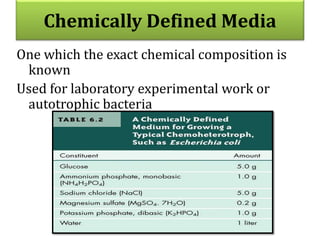
Chemically Defined Media
One which the exact chemical composition is
known
Used for laboratory experimental work or
autotrophic bacteria
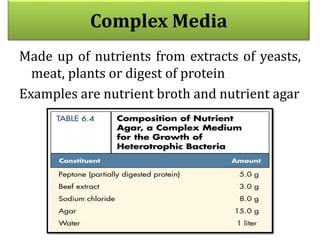
Complex Media
Made up of nutrients from extracts of yeasts,
meat, plants or digest of protein
Examples are nutrient broth and nutrient agar
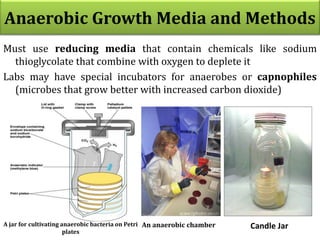
Anaerobic Growth Media and Methods
Must use reducing media that contain chemicals like sodium
thioglycolate that combine with oxygen to deplete it
Labs may have special incubators for anaerobes or capnophiles
(microbes that grow better with increased carbon dioxide)
A jar for cultivating anaerobic bacteria on Petri
plates
Candle Jar
An anaerobic chamber
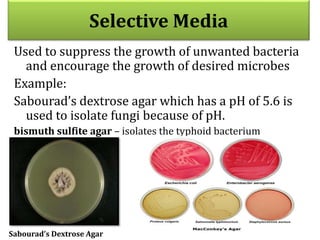
Selective Media
Used to suppress the growth of unwanted bacteria
and encourage the growth of desired microbes
Example:
Sabourad’s dextrose agar which has a pH of 5.6 is
used to isolate fungi because of pH.
bismuth sulfite agar – isolates the typhoid bacterium
Sabourad’s Dextrose Agar
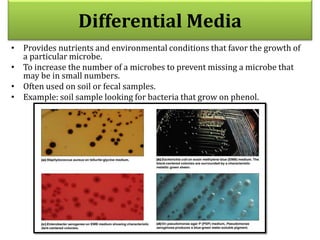
Differential Media
• Provides nutrients and environmental conditions that favor the growth of
a particular microbe.
• To increase the number of a microbes to prevent missing a microbe that
may be in small numbers.
• Often used on soil or fecal samples.
• Example: soil sample looking for bacteria that grow on phenol.

02 Microbial Growth-1.ppt

  • 2.
    • Microbial growth:It refers to the increase in number of the cells over the period of time. • Increase in cellular constituents that may result in: – increase in cell number. • e.g., when microorganisms reproduce binary fission – increase in cell size. • e.g., coenocytic microorganisms have nuclear divisions that are not accompanied by cell divisions • Microbiologists usually study population growth rather than growth of individual cells.
  • 3.
    Bacterial Division Binary Fission- most common method of reproduction, asexual reproduction, splitting of parent cell into two daughter cells Budding - another form of bacterial division, also asexual reproduction, it forms from outgrowths (buds) of mature organisms, it is a form of mitotic cell division, when the bud reaches the size of the parent cell, it separates
  • 4.
    • Generation Time: “Itis the time required for a cell to divide and its population to double” • Generation time for most of the microorganisms are varies considerably. For example- E. coli divides every 20 minutes. Most bacteria divide every 1 to 3 hours. Some bacteria require more than 24 hours doubling their numbers.
  • 5.
    • Observed whenmicroorganisms are cultivated in batch culture. – culture incubated in a closed vessel with a single batch of medium • Usually plotted as logarithm of cell number versus time. • Usually has four distinct phases.
  • 6.
    no increase maximal rateof division and population growth population growth ceases decline in population size
  • 7.
    • When microorganismsare introduced into fresh culture medium, usually no immediate increase in cell number occurs, and therefore this period is called the lag phase or phase of adjustment. • This is the period of adjustment to new conditions. The cell is synthesizing new components during this phase. • Little or no cell division occurs, population size doesn’t increase but due to metabolic activities within the cell individual organisms grow in size. • The lag phase varies considerably in length with the condition of the microorganisms and the nature of the medium. This phase may be quite long if the inoculum is from an old culture or one that has been refrigerated.
  • 8.
    • The lagphase may last from one hour to several days. • Cell synthesizing new components – e.g. to replenish spent materials – e.g. to adapt to new medium or other conditions • Varies in length – In some cases can be very short or even absent
  • 9.
    • It isalso known as “Exponential phase/ logarithmic phase”. • During log phase, the microorganisms are dividing and doubling in number at regular intervals that is why it is also known as “Period of most rapid growth” • Number of cells produced > Number of cells dying during this phase. • Cells are at highest metabolic activity. • The population is most uniform in terms of chemical and physiological properties during this phase; therefore exponential phase cultures are usually used in biochemical and physiological studies.
  • 10.
    • Exponential growthis balanced growth. That is, all cellular constituents are manufactured at constant rates relative to each other. • If nutrient levels or other environmental conditions change, unbalanced growth results. • Unbalanced growth also results when a bacterial population is shifted down from a rich medium to a poor one.
  • 11.
    cells are dividingand doubling in number at regular intervals
  • 12.
    • In thestationary phase the total number of viable microorganisms remains constant • Number of cells produced = Number of cells dying during this phase. • This may result from a balance between cell division and cell death, or the population may simply cease to divide though remaining metabolically active. • Population size begins to stabilize, overall cell number does not increase and cell division begins to slow down at increasing rate.
  • 13.
    • Total numberof viable cells remains constant: – may occur because metabolically active cells stop reproducing. – may occur because reproductive rate is balanced by death rate.
  • 14.
    • Factors thatslow down microbial growth during stationary phase or Possible reasons for entry into stationary phase: 1. Accumulation of toxic waste materials. 2. Acidic pH of media. 3. Nutrient limitation. 4. Limited oxygen availability. 5. Critical population density reached.
  • 15.
    • Death isdefined to be the irreversible loss of the ability to reproduce. • In decline phase population size begins to decrease rapidly. • Number of cells dying > Number of cells produced in this phase. • Cell number decreases at a logarithmic rate and cells lose their ability to divide. • Only a few cells may remain alive for a long period of time. • Detrimental environmental changes like nutrient deprivation and the build-up of toxic wastes lead to the decline in the number of viable cells characteristic of the death phase. • In some cases, death rate slows due to accumulation of resistant cells.
  • 16.
    How to determineMicrobial numbers?  directly – through counting  indirectly – through measuring their metabolic activity
  • 17.
  • 18.
    1. Plate count: •4 Most frequently used method of measuring bacterial • populations. • 4 Inoculate plate with a sample and count number of colonies. • Assumptions: • • Each colony originates from a single bacterial cell. • • Original inoculum is homogeneous. • • No cell aggregates are present. • Advantages: • • Measures viable cells • Disadvantages: • • Takes 24 hours or more for visible colonies to appear. • • Only counts between 25 and 250 colonies are accurate. • • Must perform serial dilutions to get appropriate numbers/plate. Plate Counts
  • 19.
    Methods of preparingplates for plate counts
  • 20.
    1. Plate count(continued): A. Pour Plate: • Introduce a 1.0 or 0.1 ml inoculuminto an empty Petri dish. • Add liquid nutrient medium kept at 50oC. • Gently mix, allow to solidify, and incubate. • Disadvantages: • Not useful for heat sensitive organisms. • Colonies appear under agar surface. B. Spread Plate: • Introduce a 0.1 ml inoculum onto the surface of Petri dish. • Spread with a sterile glass rod. • Advantages: Colonies will be on surface and not exposed to melted agar. Measuring Microbial Growth: Direct Methods of Measurement
  • 21.
    Serial Dilutions areUsed with the Plate Count Method to Measure Numbers of Bacteria
  • 22.
    Measuring Microbial Growth: DirectMethods of Measurement 2. Filtration: • Used to measure small quantities of bacteria. • Example: Fecal bacteria in a lake or in ocean water. • A large sample (100 ml or more) is filtered to retain • bacteria. • Filter is transferred onto a Petri dish. • Incubate and count colonies.
  • 23.
    3. Most ProbableNumber (MPN): • Used mainly to measure bacteria that will not grow on solid medium. • Dilute a sample repeatedly and inoculate several broth tubes for each dilution point. • Count the number of positive tubes in each set. • Statistical method: Determines 95% probability that a bacterial population falls within a certain range. Measuring Microbial Growth: Direct Methods of Measurement
  • 24.
    4. Direct MicroscopicCount: • A specific volume of a bacterial suspension (0.01 ml) is placed on a microscope slide with a special grid. • Stain is added to visualize bacteria. • Cells are counted and multiplied by a factor to obtain concentration. • Advantages: • No incubation time required. • Disadvantages: • Cannot always distinguish between live and dead bacteria. • Motile bacteria are difficult to count. • Requires a high concentration of bacteria (10 million/ml). Measuring Microbial Growth: Direct Methods of Measurement
  • 25.
    Measuring Microbial Growth: IndirectMethods of Measurement 1. Turbidity: • As bacteria multiply in media, it becomes turbid. • Use a spectrophotometer to determine % transmission or absorbance. • Multiply by a factor to determine concentration. • Advantages: • No incubation time required. • Disadvantages: • Cannot distinguish between live and dead bacteria. • Requires a high concentration of bacteria (10 to 100 million cells/ml).
  • 26.
    2. Metabolic Activity: •As bacteria multiply in media, they produce certain products: • Carbon dioxide • Acids • Measure metabolic products. • Expensive 3. Dry Weight: • Bacteria or fungi in liquid media are centrifuged. • Resulting cell pellet is weighed. • Doesn’t distinguish live and dead cells. Measuring Microbial Growth: Indirect Methods of Measurement
  • 27.
  • 28.
    Temperature • Psychrophiles -cold-loving microbes about -10˚C to 20˚C optimum growth 15˚C not grow in 25˚C • Mesophiles - moderate-temperature- loving microbes about 10˚C to 50˚C optimum growth 25˚C to 40˚C • Thermophiles - heat-loving microbes about 40˚C to 70˚C optimum growth 50˚C to 60˚C
  • 29.
    • Psychrotrophs -microorganisms responsible for spoilage of refrigerated food about 0˚C to 30˚C • Hyperthermophiles/Extreme Thermophiles about 65˚C to 110˚C optimum growth 80˚C *usually has 30˚C between maximum and minimum growth Temperature
  • 31.
    pH • Acidity oralkalinity of a solution • Most bacteria grow best at pH 6.5-7.5 • Very few bacteria grow below pH 4 • Acidophiles - chemoautotrophic bacteria that are remarkably tolerant of acidity
  • 32.
    Osmotic Pressure • Highosmotic pressures have the effect of removing necessary water from a cell Plasmolysis - shrinkage of cell’s plasma membrane caused by osmotic loss of water
  • 33.
  • 34.
    Factors affecting microbialgrowth 1. pH 2. Moisture 3. Nutrient Content 4. Oxygen 5. Light
  • 35.
    pH • Most spoilagebacteria grow best near neutral pH • Pathogenic bacteria even more narrow in tolerance range of near neutral • Yeast and moulds have much greater tolerance to acidic (lower) pH • The optimum pH range is usually quite narrow so that small changes in the pH can have large effects on the growth rate of the organism Effects of acids on organisms • energy required to maintain cell's internal pH • enzyme activity affected • proteins, DNA, other molecules denatured • longer lag, less rapid growth
  • 36.
    Moisture • Microbes musthave a supply of water available • Bacteria most restricted, then yeasts, then moulds • Organisms tolerant of low water levels: – halophilic bacteria osmophilic yeasts – xerophilic molds • Effects of low water levels – longer lag, slower growth – impaired transport – loss of membrane fluidity
  • 37.
    Nutrient content • Requiredby all organisms: water, carbon, nitrogen, minerals • Organic growth factors needed to varying degrees: Gram + > Gram - > yeasts > moulds • How easily are energy sources metabolized? sugar > alcohol > amino acids > complex molecules • How easily are nitrogen sources metabolized? – amino acids > proteins – B vitamins required by many bacteria
  • 38.
    Oxygen • Obligate aerobes,e.g. Mycobacterium, will grow only in presence of free oxygen • Facultative anaerobes, e.g. Saccharomyces (yeast) will grow in the absence of oxygen, but more slowly than if oxygen were present. • Obligate anaerobes, e.g. Clostridium will grow only in absence of oxygen which is toxic to them
  • 39.
    Light • Essential forphotoautotrophs. • As well as its intensity its wavelength may be significant.
  • 40.
  • 41.
    Carbon Structural backbone ofliving matter, it is needed for all organic compounds to make up a living cell Chemoheterotrophs get most of their carbon from the source of their energy---organic materials such as proteins, carbohydrates and lipids Chemoautotrophs and photoautotrophs derive their carbon from carbon dioxide
  • 42.
    Nitrogen, Sulfur andPhosphorus • For synthesis of cellular material • Nitrogen and sulfur is needed for protein synthesis • Nitrogen and phosphorus is needed for syntheses of DNA, RNA and ATP • Nitrogen- 14% dry weight of a bacterial cell • Sulfur and phosphorus- 4%
  • 43.
    Trace Elements • Microbesrequire very small amounts of other mineral elements, such as Fe, Cu, Mo, Zn • Essential for certain functions of certain enzymes • Assumed to be naturally present in tap water and other components of media
  • 44.
    Oxygen Obligate Aerobes -only aerobic growth, oxygen required, growth occurs with high concentration of oxygen Facultative Aerobes - both aerobic and anaerobic growth, greater growth in presence of water, growth is best in presence of water but still grows without presence of oxygen Obligate Anaerobe - only anaerobic growth, growth ceases in presence of oxygen, growth occurs only when there is no oxygen Aerotolerate Anaerobe - only anaerobic growth, but continues in presence of oxygen, oxygen has no effect Microaerophiles - only aerobic growth, oxygen required in low concentration, growth occurs only where a low concentration of oxygen has diffused into medium
  • 45.
    Chemically Defined Media Onewhich the exact chemical composition is known Used for laboratory experimental work or autotrophic bacteria
  • 46.
    Complex Media Made upof nutrients from extracts of yeasts, meat, plants or digest of protein Examples are nutrient broth and nutrient agar
  • 47.
    Anaerobic Growth Mediaand Methods Must use reducing media that contain chemicals like sodium thioglycolate that combine with oxygen to deplete it Labs may have special incubators for anaerobes or capnophiles (microbes that grow better with increased carbon dioxide) A jar for cultivating anaerobic bacteria on Petri plates Candle Jar An anaerobic chamber
  • 48.
    Selective Media Used tosuppress the growth of unwanted bacteria and encourage the growth of desired microbes Example: Sabourad’s dextrose agar which has a pH of 5.6 is used to isolate fungi because of pH. bismuth sulfite agar – isolates the typhoid bacterium Sabourad’s Dextrose Agar
  • 49.
    Differential Media • Providesnutrients and environmental conditions that favor the growth of a particular microbe. • To increase the number of a microbes to prevent missing a microbe that may be in small numbers. • Often used on soil or fecal samples. • Example: soil sample looking for bacteria that grow on phenol.

Editor's Notes