10 Quick Wins to
Transform Your IT
Service Desk from
Good to Great
stephen@itsm.tools
@stephenmann
@itsm_tools
Coverage
2
1. Background
2. Self-service success with 4 quick wins
3. Knowledge management success with 3 quick wins
4. Automation and AI success with 3 quick wins
5. Key takeaways
6. Q&A
Different
improvement
perspectives
3
• Focusing on business needs vs. employee needs
• Addressing pain points vs. realizing opportunities
• Tackling people, process, or technology issues
• Improving something vs. adding something new
• Improving a weakness vs. improving an existing strength
• Existing best practice vs. leveraging a new approach
Common IT
service desk
challenges and
opportunities
4
• Working with high IT support volumes and reducing budget
• IT service desk tool issues
• Staff recruitment and retention issues
• Struggling to quantify what “great” is for your organization
• Keeping up with changing business needs and technology
• Meeting increasing employee expectations
• Getting the basic ITSM capabilities right
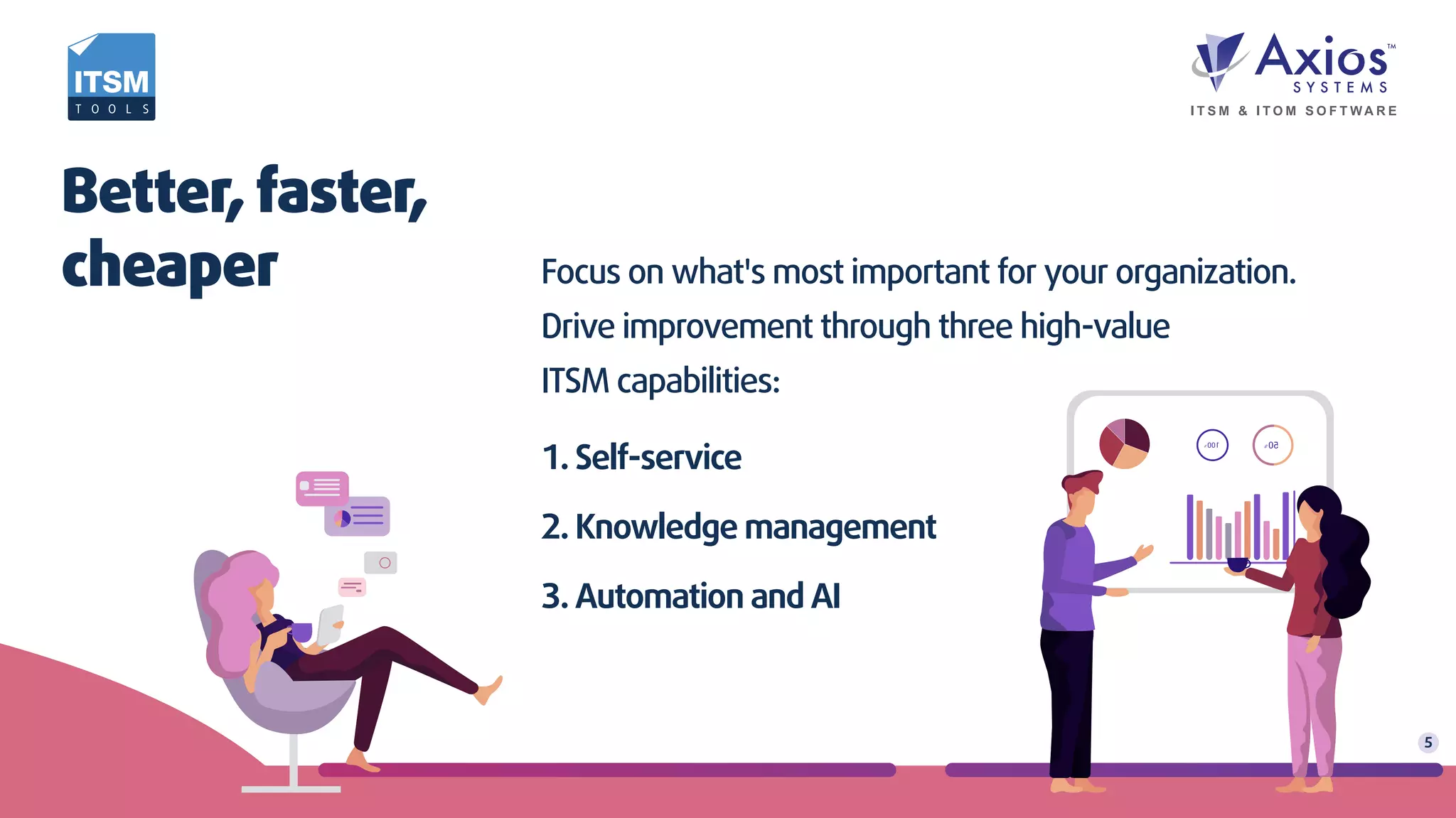
Better, faster,
cheaper
5
Focus on what's most important for your organization.
Drive improvement through three high-value
ITSM capabilities:
1. Self-service
2. Knowledge management
3. Automation and AI
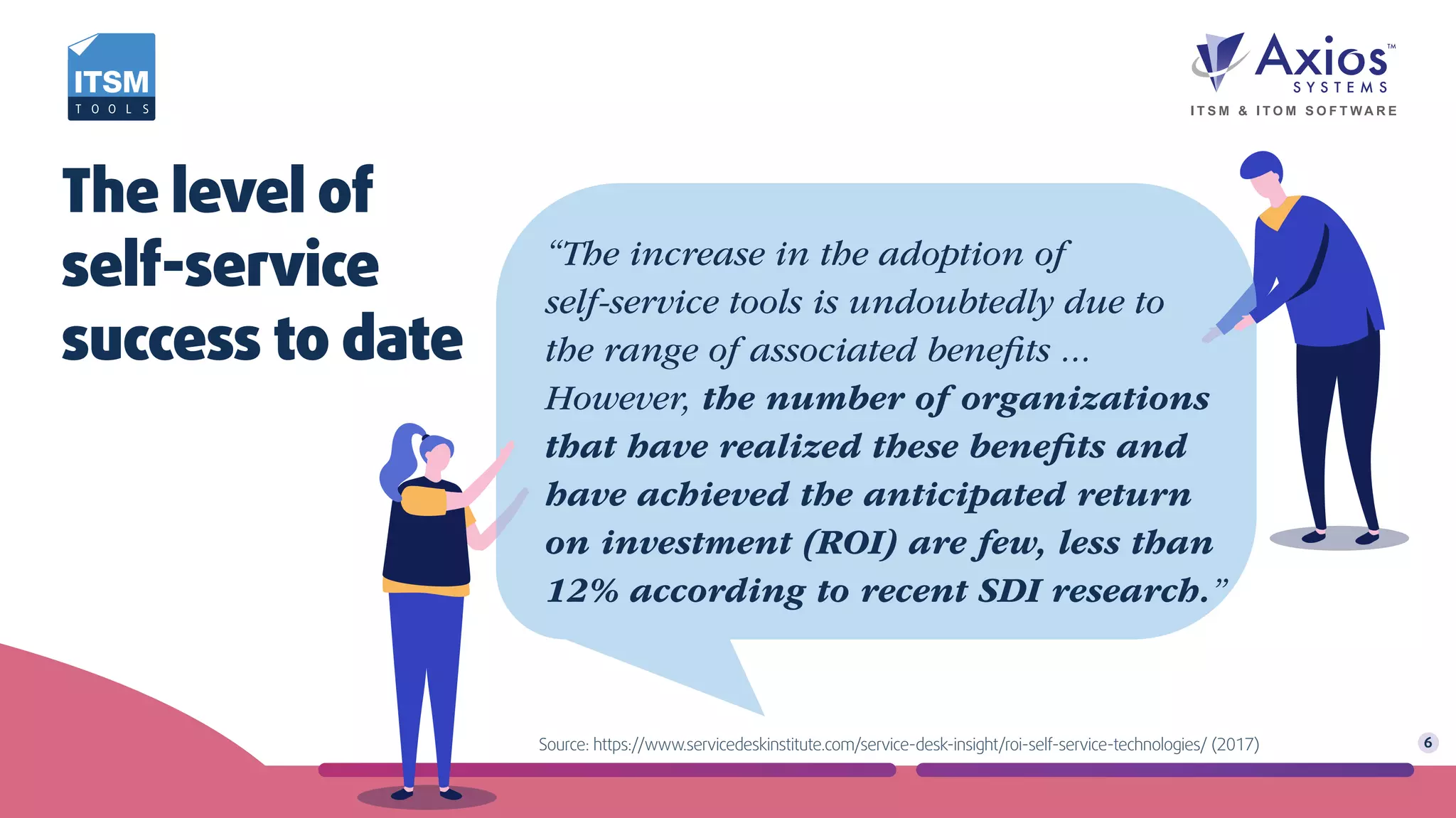
The level of
self-service
success to date
6Source: https://www.servicedeskinstitute.com/service-desk-insight/roi-self-service-technologies/ (2017)
“The increase in the adoption of
self-service tools is undoubtedly due to
the range of associated benefits ...
However, the number of organizations
that have realized these benefits and
have achieved the anticipated return
on investment (ROI) are few, less than
12% according to recent SDI research.”
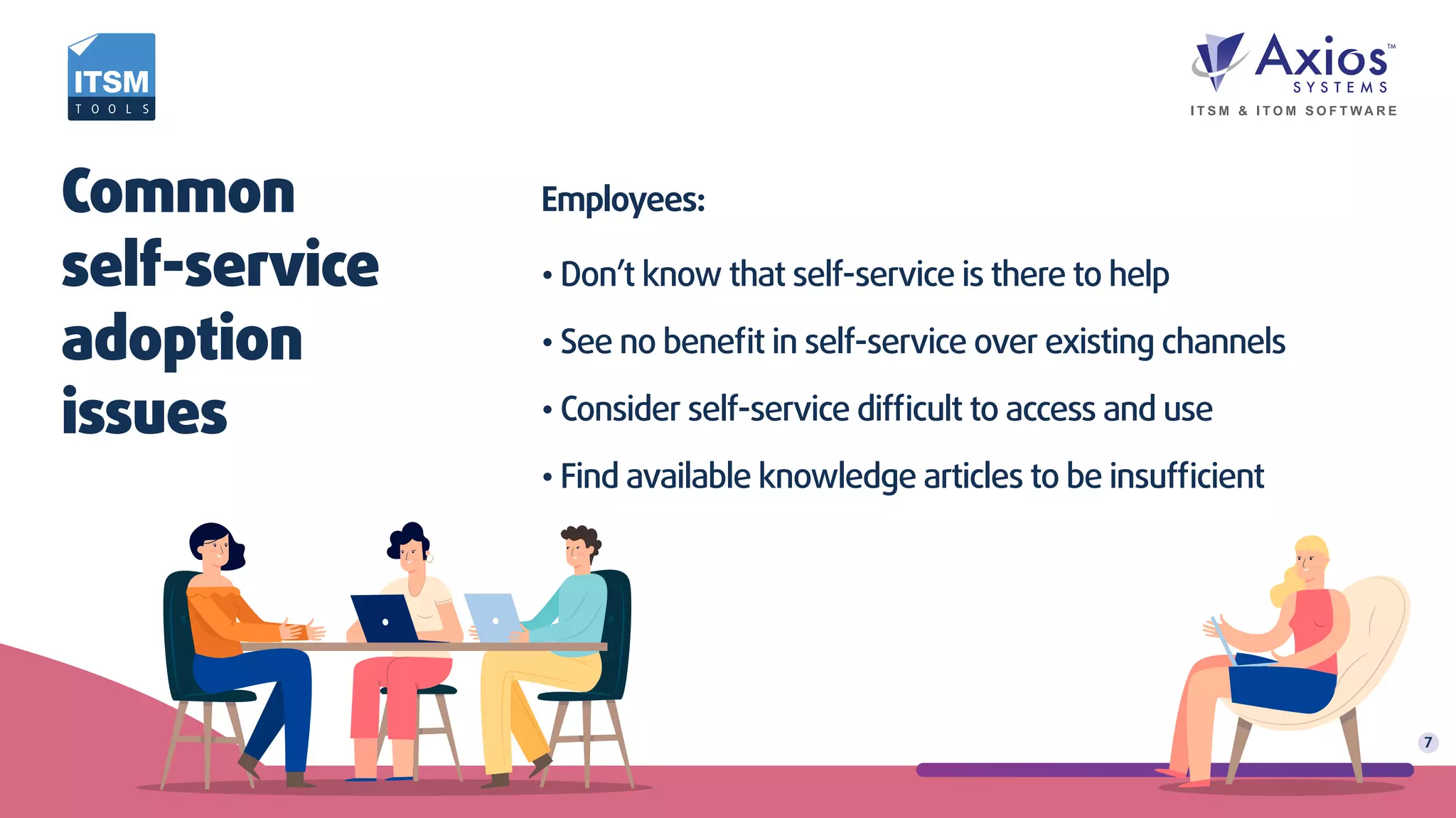
• Don’t know that self-service is there to help
• See no benefit in self-service over existing channels
• Consider self-service difficult to access and use
• Find available knowledge articles to be insufficient
Employees:Common
self-service
adoption
issues
7
Common
self-service
adoption
issues
8
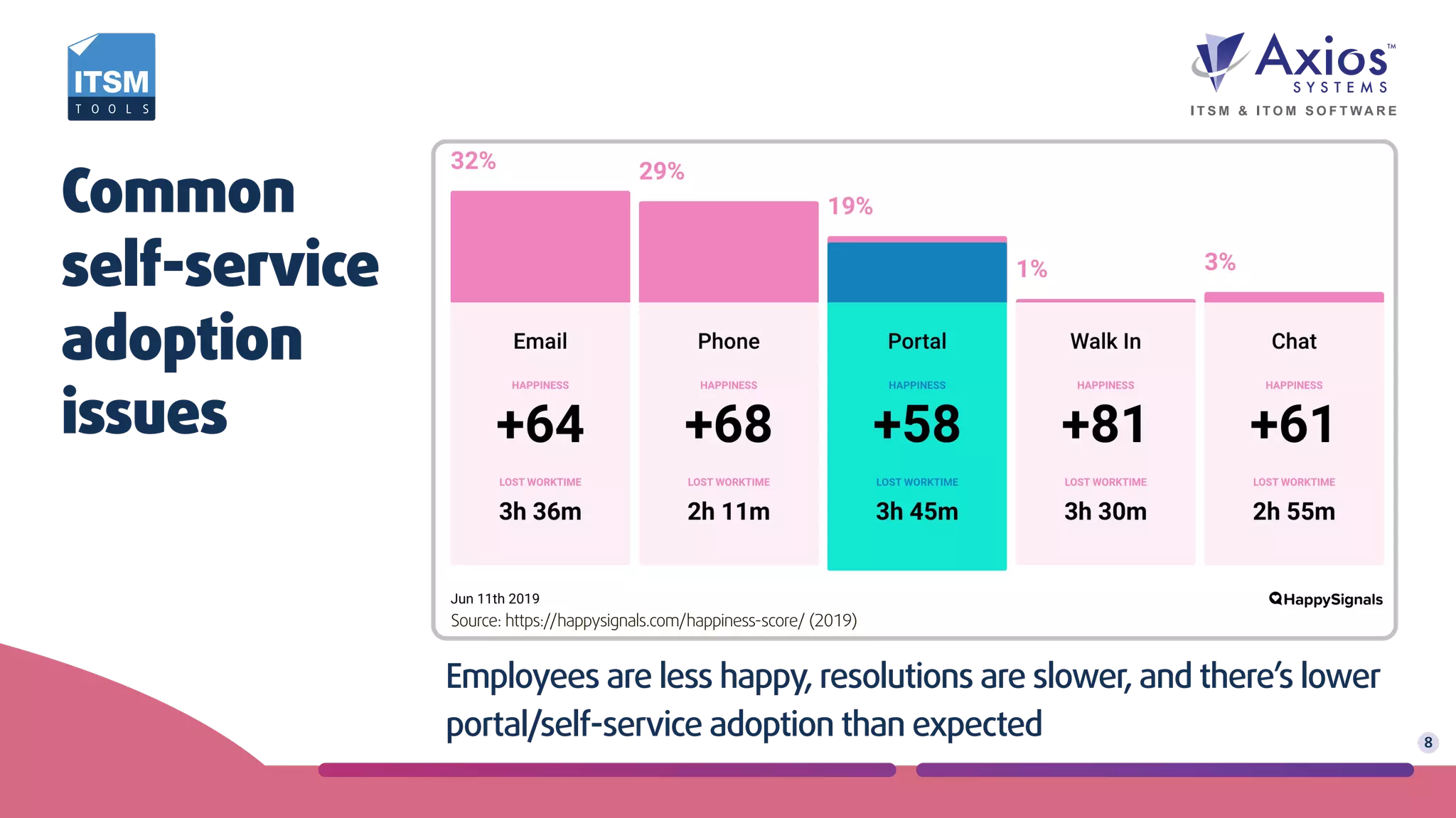
Employees are less happy, resolutions are slower, and there’s lower
portal/self-service adoption than expected
Source: https://happysignals.com/happiness-score/ (2019)
• Focusing on technology implementation not the capabilities
• Not creating the capability around employee needs
• Failing to provide sufficient knowledge articles for self-help
• Insufficient investment in organizational change management
• A lack of automation for incident resolution and service provision
• Failing to continuously improve the self-service capabilities
Understand
the root
causes
9
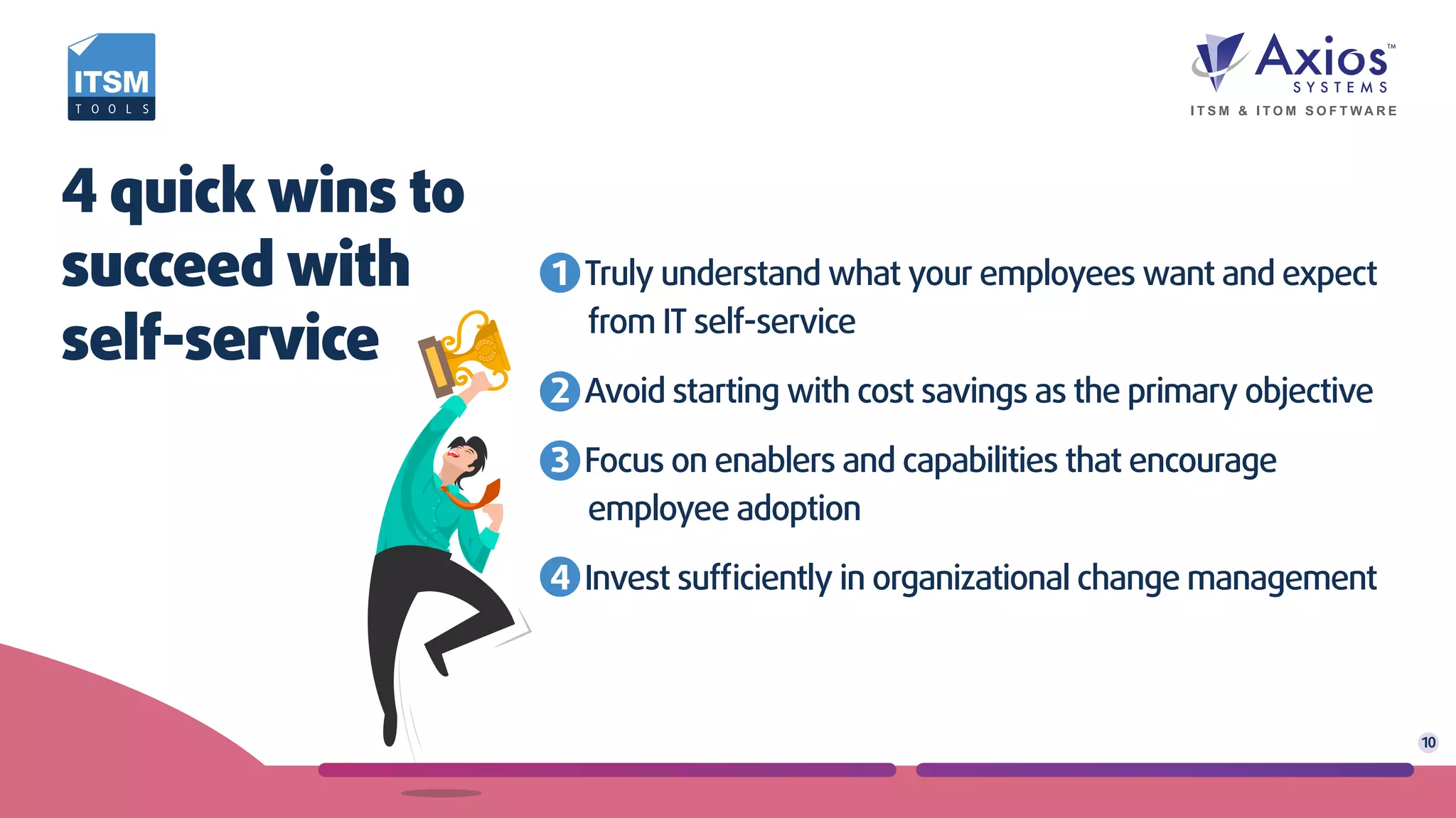
1 Truly understand what your employees want and expect
from IT self-service
2 Avoid starting with cost savings as the primary objective
3 Focus on enablers and capabilities that encourage
employee adoption
4 Invest sufficiently in organizational change management
4 quick wins to
succeed with
self-service
10
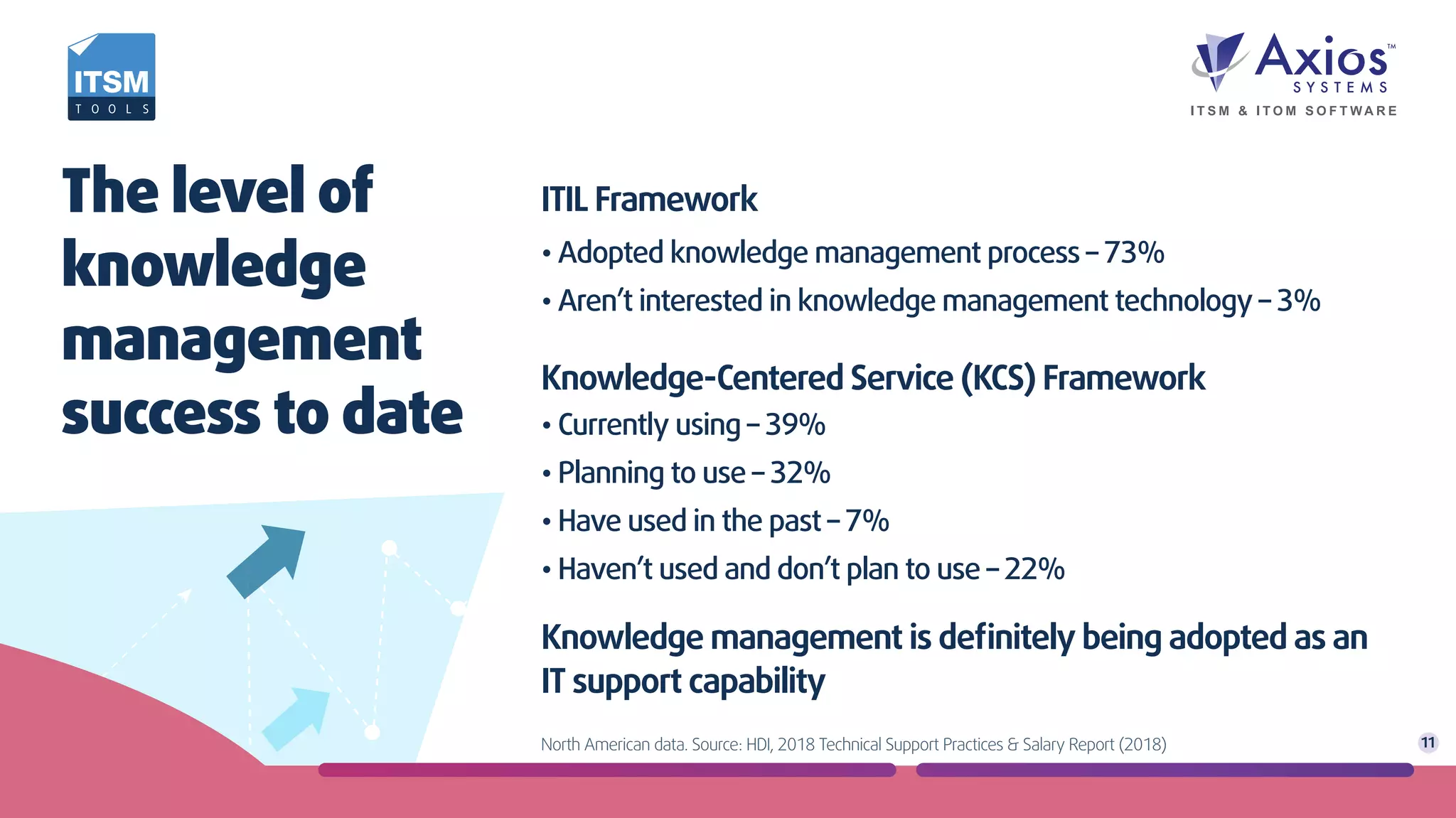
North American data. Source: HDI, 2018 Technical Support Practices & Salary Report (2018)
• Adopted knowledge management process – 73%
• Aren’t interested in knowledge management technology – 3%
ITIL Framework
Knowledge management is definitely being adopted as an
IT support capability
• Currently using – 39%
• Planning to use – 32%
• Have used in the past – 7%
• Haven’t used and don’t plan to use – 22%
Knowledge-Centered Service (KCS) Framework
The level of
knowledge
management
success to date
11
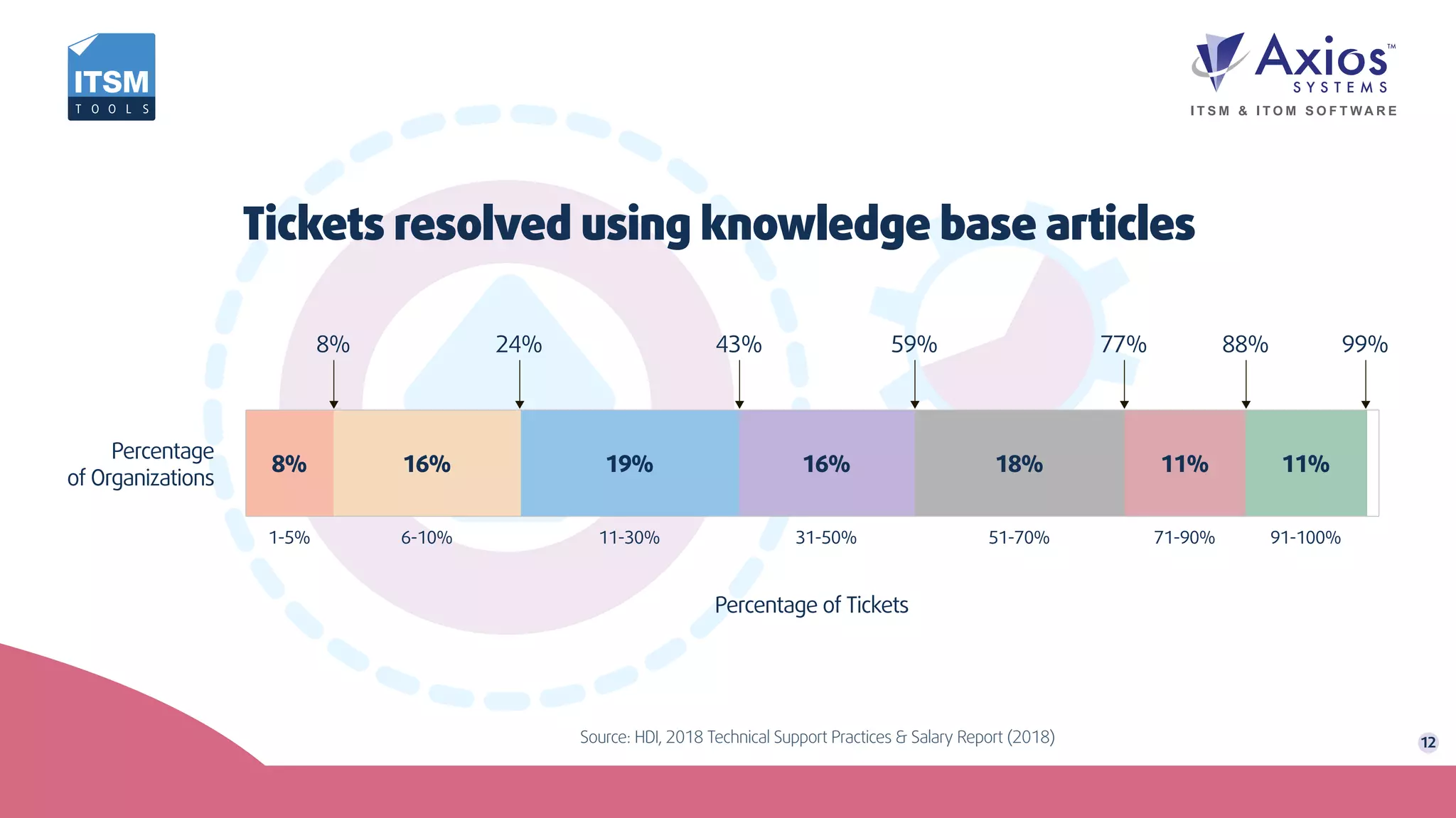
Source: HDI, 2018 Technical Support Practices & Salary Report (2018)
Tickets resolved using knowledge base articles
12
Percentage of Tickets
Percentage
of Organizations
1-5% 6-10% 11-30% 31-50% 51-70% 71-90% 91-100%
8% 24% 43% 59% 77% 88% 99%
8% 16% 16% 18% 11% 11%19%
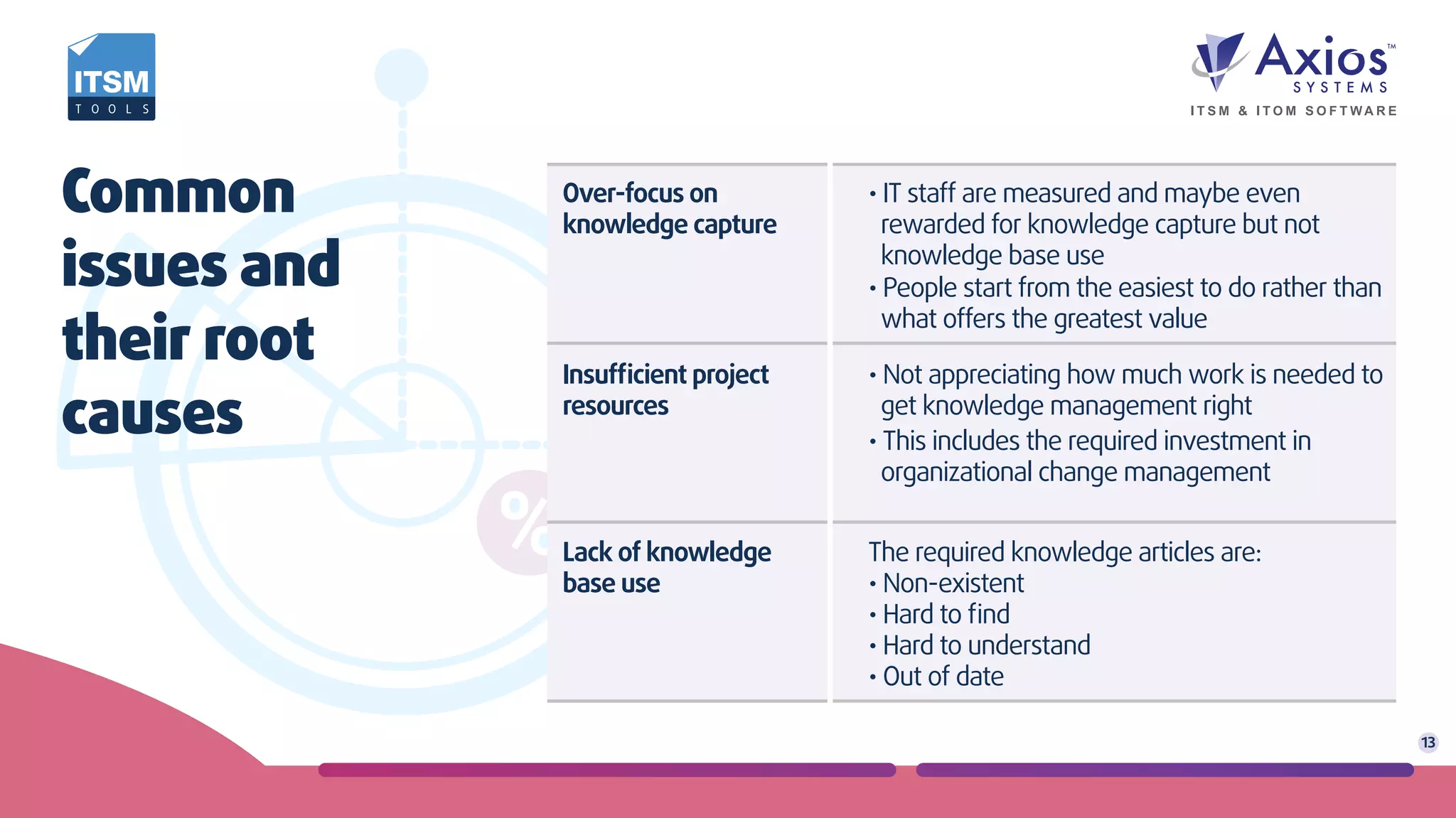
Over-focus on
knowledge capture
Insufficient project
resources
Lack of knowledge
base use
Common
issues and
their root
causes
13
• IT staff are measured and maybe even
rewarded for knowledge capture but not
knowledge base use
• Not appreciating how much work is needed to
get knowledge management right
• This includes the required investment in
organizational change management
The required knowledge articles are:
• Non-existent
• Hard to find
• Hard to understand
• Out of date
• People start from the easiest to do rather than
what offers the greatest value
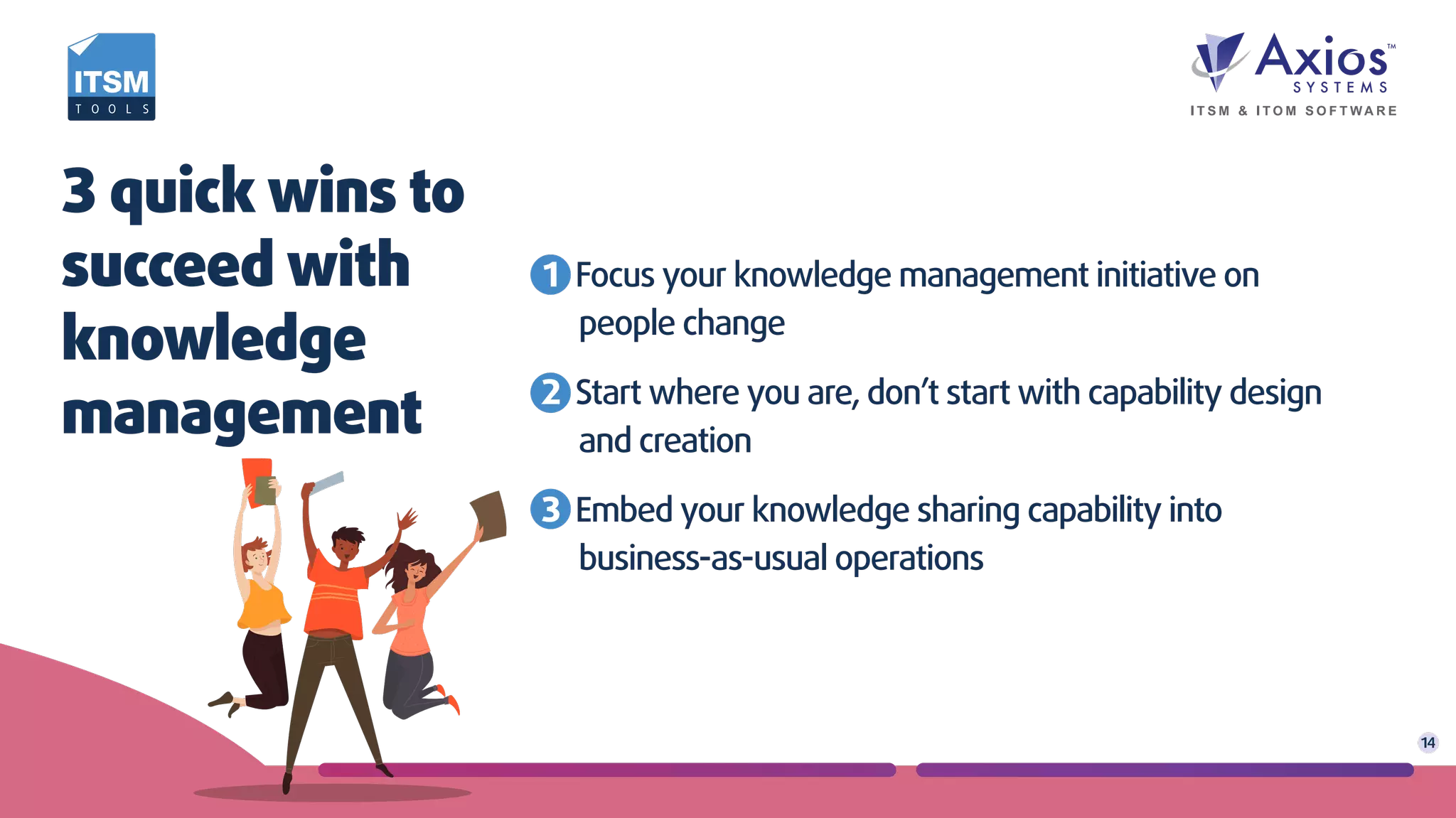
1 Focus your knowledge management initiative on
people change
2 Start where you are, don’t start with capability design
and creation
3 Embed your knowledge sharing capability into
business-as-usual operations
3 quick wins to
succeed with
knowledge
management
14
Sources: https://itsm.tools/2019/04/17/the-future-of-itsm-survey-results-2019/ (2019)
https://www.servicedeskinstitute.com/insight-resource/state-of-service-desk-strategy/ (2018)
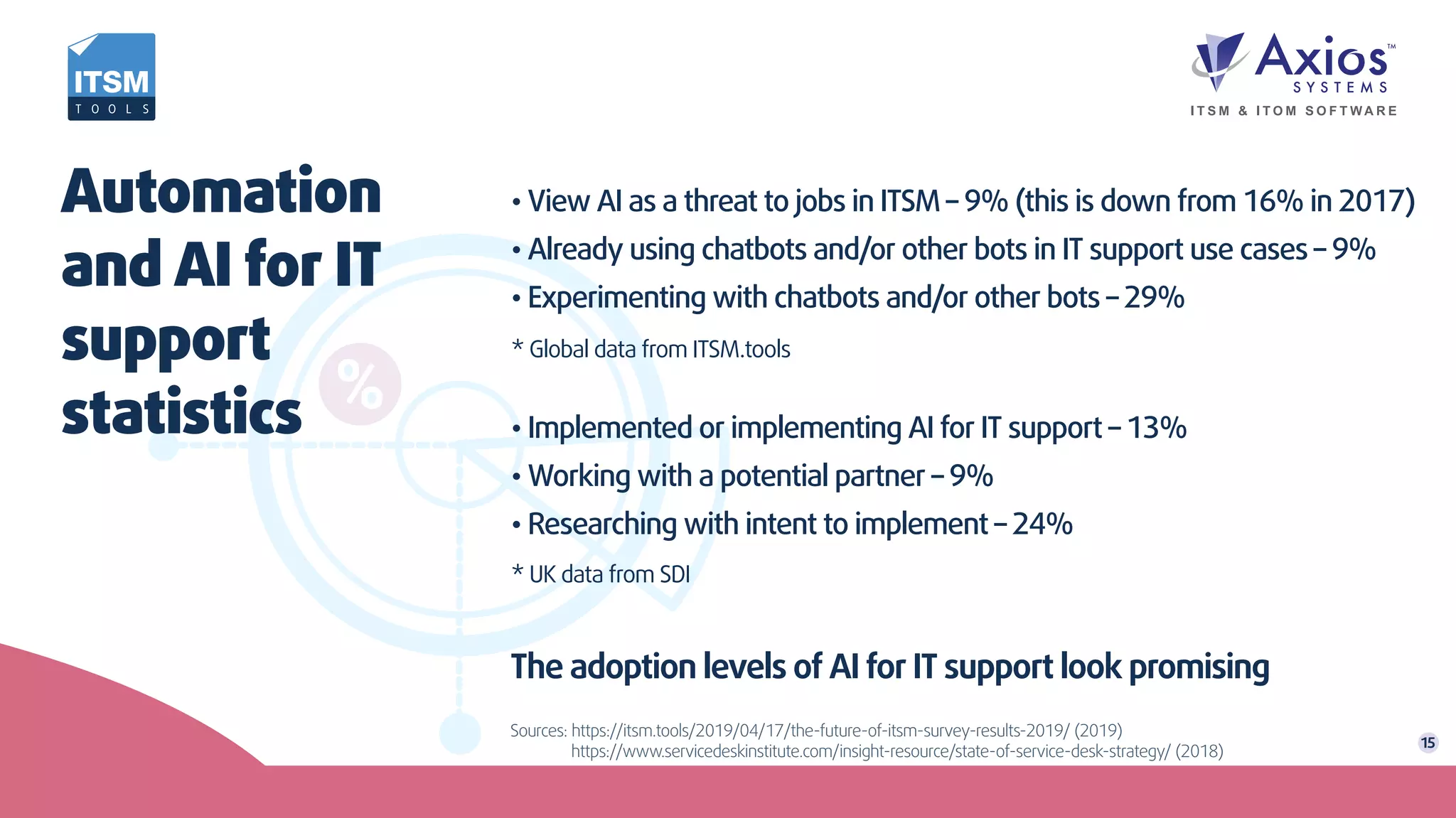
The adoption levels of AI for IT support look promising
• View AI as a threat to jobs in ITSM – 9% (this is down from 16% in 2017)
• Already using chatbots and/or other bots in IT support use cases – 9%
• Experimenting with chatbots and/or other bots – 29%
* Global data from ITSM.tools
* UK data from SDI
• Implemented or implementing AI for IT support – 13%
• Working with a potential partner – 9%
• Researching with intent to implement – 24%
Automation
and AI for IT
support
statistics
15
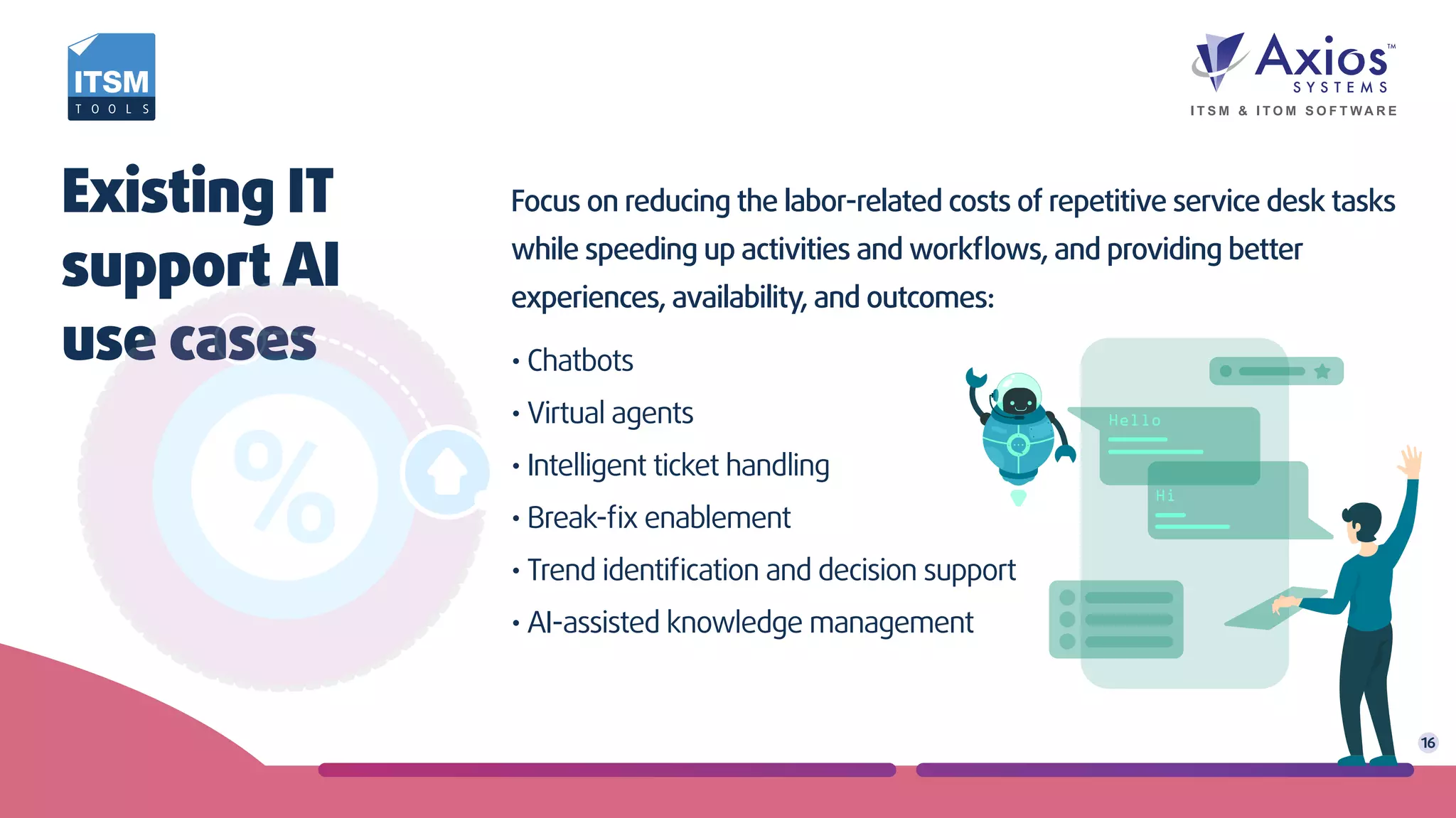
Focus on reducing the labor-related costs of repetitive service desk tasks
while speeding up activities and workflows, and providing better
experiences, availability, and outcomes:
• Chatbots
• Virtual agents
• Intelligent ticket handling
• Break-fix enablement
• Trend identification and decision support
• AI-assisted knowledge management
Existing IT
support AI
use cases
16
AI technology
complexity or “sprawl”
Unwanted capabilities
Slowed down by
building AI in-house
Potential
issues and
their root
causes
17
• The result of different teams working in
silos vs. an enterprise-wide approach to
AI adoption
• New capabilities are based on what technology
can do rather than how people want to work
• Overlooking the need for organizational change
management
• Wastes IT resource
• Not leveraging:
º Third-party, cloud-based AI services
º Software that already has AI built-in
• No agreed AI strategies and policies
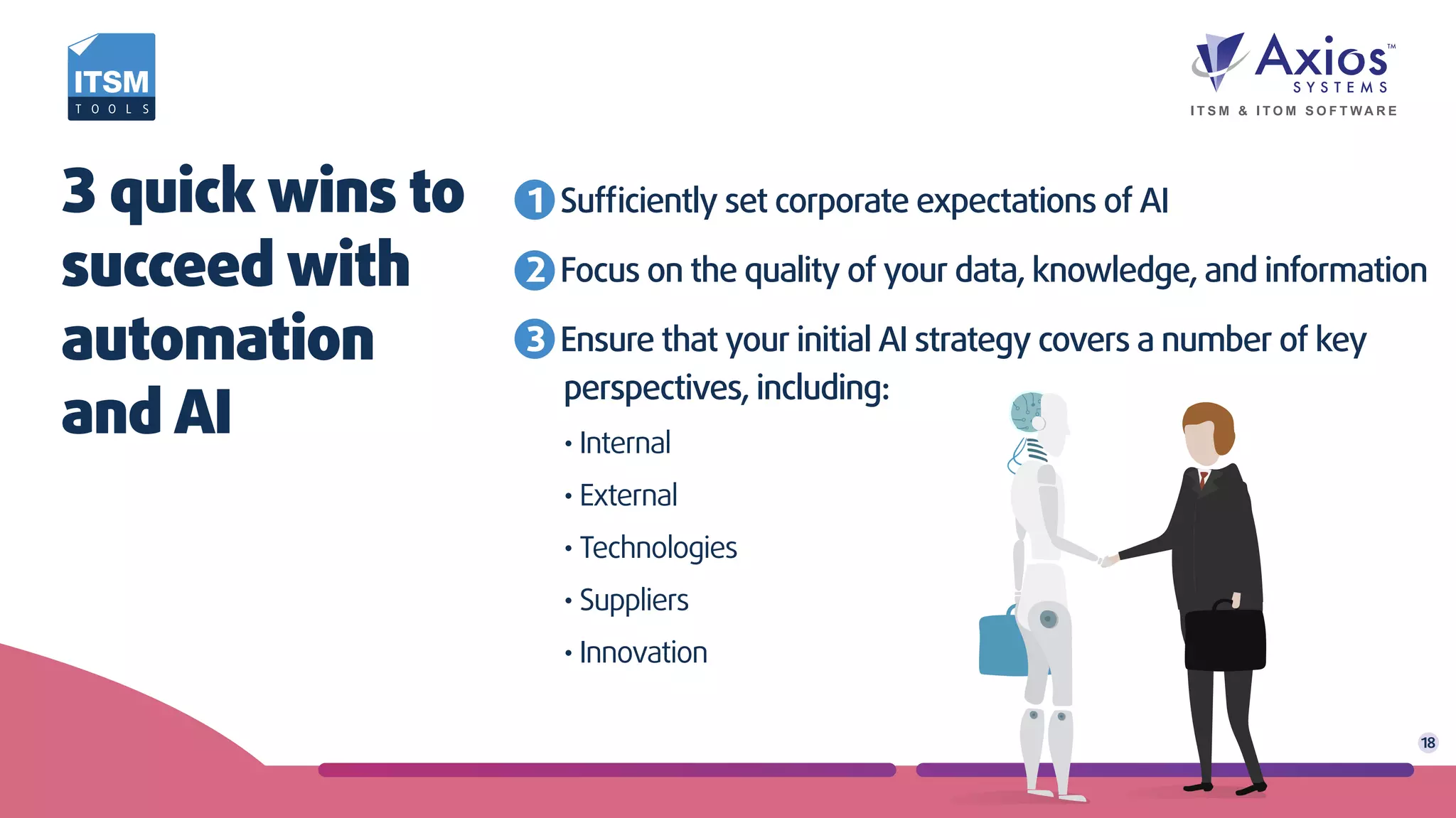
1 Sufficiently set corporate expectations of AI
2 Focus on the quality of your data, knowledge, and information
3 Ensure that your initial AI strategy covers a number of key
perspectives, including:
• Internal
• External
• Technologies
• Suppliers
• Innovation
3 quick wins to
succeed with
automation
and AI
18
Key
takeaways 1 Focus on the right improvement opportunities and what
matters most
2 Drive and deliver improvements around employee needs;
organizational change management is critical
3 Realize that successful adoption helps reduce costs
4 Embed knowledge sharing into business-as-usual operations
5 Don’t overlook the links and dependencies between multiple
improvement opportunities and the better outcomes
19
1 Whitepaper: will be available for download in July
2 On-demand webinars:
https://www.axiossystems.com/it-industry-webinars
3 Schedule a follow-up meeting: with Axios Systems
Next steps
20
assyst Intelligence (AI)
https://www.axiossystems.com/assyst-intelligence-for-itsm
assyst Marketplace
https://www.axiossystems.com/assyst-marketplace
Axios Systems LinkedIn
https://www.linkedin.com/company/axios-systems/
Axios Systems Twitter
@Axios_Systems
Axios Systems Blog
https://info.axiossystems.com/blog
Contact Axios Systems
https://www.axiossystems.com/contact-us
ITSM.tools
https://ITSM.tools
Questions &
Answers
21
@

Axios Systems Webinar: 10 quick wins to transform your IT Service Desk from good to great

  • 1.
    10 Quick Winsto Transform Your IT Service Desk from Good to Great stephen@itsm.tools @stephenmann @itsm_tools
  • 2.
    Coverage 2 1. Background 2. Self-servicesuccess with 4 quick wins 3. Knowledge management success with 3 quick wins 4. Automation and AI success with 3 quick wins 5. Key takeaways 6. Q&A
  • 3.
    Different improvement perspectives 3 • Focusing onbusiness needs vs. employee needs • Addressing pain points vs. realizing opportunities • Tackling people, process, or technology issues • Improving something vs. adding something new • Improving a weakness vs. improving an existing strength • Existing best practice vs. leveraging a new approach
  • 4.
    Common IT service desk challengesand opportunities 4 • Working with high IT support volumes and reducing budget • IT service desk tool issues • Staff recruitment and retention issues • Struggling to quantify what “great” is for your organization • Keeping up with changing business needs and technology • Meeting increasing employee expectations • Getting the basic ITSM capabilities right
  • 5.
    Better, faster, cheaper 5 Focus onwhat's most important for your organization. Drive improvement through three high-value ITSM capabilities: 1. Self-service 2. Knowledge management 3. Automation and AI
  • 6.
    The level of self-service successto date 6Source: https://www.servicedeskinstitute.com/service-desk-insight/roi-self-service-technologies/ (2017) “The increase in the adoption of self-service tools is undoubtedly due to the range of associated benefits ... However, the number of organizations that have realized these benefits and have achieved the anticipated return on investment (ROI) are few, less than 12% according to recent SDI research.”
  • 7.
    • Don’t knowthat self-service is there to help • See no benefit in self-service over existing channels • Consider self-service difficult to access and use • Find available knowledge articles to be insufficient Employees:Common self-service adoption issues 7
  • 8.
    Common self-service adoption issues 8 Employees are lesshappy, resolutions are slower, and there’s lower portal/self-service adoption than expected Source: https://happysignals.com/happiness-score/ (2019)
  • 9.
    • Focusing ontechnology implementation not the capabilities • Not creating the capability around employee needs • Failing to provide sufficient knowledge articles for self-help • Insufficient investment in organizational change management • A lack of automation for incident resolution and service provision • Failing to continuously improve the self-service capabilities Understand the root causes 9
  • 10.
    1 Truly understandwhat your employees want and expect from IT self-service 2 Avoid starting with cost savings as the primary objective 3 Focus on enablers and capabilities that encourage employee adoption 4 Invest sufficiently in organizational change management 4 quick wins to succeed with self-service 10
  • 11.
    North American data.Source: HDI, 2018 Technical Support Practices & Salary Report (2018) • Adopted knowledge management process – 73% • Aren’t interested in knowledge management technology – 3% ITIL Framework Knowledge management is definitely being adopted as an IT support capability • Currently using – 39% • Planning to use – 32% • Have used in the past – 7% • Haven’t used and don’t plan to use – 22% Knowledge-Centered Service (KCS) Framework The level of knowledge management success to date 11
  • 12.
    Source: HDI, 2018Technical Support Practices & Salary Report (2018) Tickets resolved using knowledge base articles 12 Percentage of Tickets Percentage of Organizations 1-5% 6-10% 11-30% 31-50% 51-70% 71-90% 91-100% 8% 24% 43% 59% 77% 88% 99% 8% 16% 16% 18% 11% 11%19%
  • 13.
    Over-focus on knowledge capture Insufficientproject resources Lack of knowledge base use Common issues and their root causes 13 • IT staff are measured and maybe even rewarded for knowledge capture but not knowledge base use • Not appreciating how much work is needed to get knowledge management right • This includes the required investment in organizational change management The required knowledge articles are: • Non-existent • Hard to find • Hard to understand • Out of date • People start from the easiest to do rather than what offers the greatest value
  • 14.
    1 Focus yourknowledge management initiative on people change 2 Start where you are, don’t start with capability design and creation 3 Embed your knowledge sharing capability into business-as-usual operations 3 quick wins to succeed with knowledge management 14
  • 15.
    Sources: https://itsm.tools/2019/04/17/the-future-of-itsm-survey-results-2019/ (2019) https://www.servicedeskinstitute.com/insight-resource/state-of-service-desk-strategy/(2018) The adoption levels of AI for IT support look promising • View AI as a threat to jobs in ITSM – 9% (this is down from 16% in 2017) • Already using chatbots and/or other bots in IT support use cases – 9% • Experimenting with chatbots and/or other bots – 29% * Global data from ITSM.tools * UK data from SDI • Implemented or implementing AI for IT support – 13% • Working with a potential partner – 9% • Researching with intent to implement – 24% Automation and AI for IT support statistics 15
  • 16.
    Focus on reducingthe labor-related costs of repetitive service desk tasks while speeding up activities and workflows, and providing better experiences, availability, and outcomes: • Chatbots • Virtual agents • Intelligent ticket handling • Break-fix enablement • Trend identification and decision support • AI-assisted knowledge management Existing IT support AI use cases 16
  • 17.
    AI technology complexity or“sprawl” Unwanted capabilities Slowed down by building AI in-house Potential issues and their root causes 17 • The result of different teams working in silos vs. an enterprise-wide approach to AI adoption • New capabilities are based on what technology can do rather than how people want to work • Overlooking the need for organizational change management • Wastes IT resource • Not leveraging: º Third-party, cloud-based AI services º Software that already has AI built-in • No agreed AI strategies and policies
  • 18.
    1 Sufficiently setcorporate expectations of AI 2 Focus on the quality of your data, knowledge, and information 3 Ensure that your initial AI strategy covers a number of key perspectives, including: • Internal • External • Technologies • Suppliers • Innovation 3 quick wins to succeed with automation and AI 18
  • 19.
    Key takeaways 1 Focuson the right improvement opportunities and what matters most 2 Drive and deliver improvements around employee needs; organizational change management is critical 3 Realize that successful adoption helps reduce costs 4 Embed knowledge sharing into business-as-usual operations 5 Don’t overlook the links and dependencies between multiple improvement opportunities and the better outcomes 19
  • 20.
    1 Whitepaper: willbe available for download in July 2 On-demand webinars: https://www.axiossystems.com/it-industry-webinars 3 Schedule a follow-up meeting: with Axios Systems Next steps 20
  • 21.
    assyst Intelligence (AI) https://www.axiossystems.com/assyst-intelligence-for-itsm assystMarketplace https://www.axiossystems.com/assyst-marketplace Axios Systems LinkedIn https://www.linkedin.com/company/axios-systems/ Axios Systems Twitter @Axios_Systems Axios Systems Blog https://info.axiossystems.com/blog Contact Axios Systems https://www.axiossystems.com/contact-us ITSM.tools https://ITSM.tools Questions & Answers 21 @