Is It Time to
Change Your
ITSM Tool?
How to best understand what’s
right for your organization
stephen@itsm.tools
@stephenmann
@itsm_tools
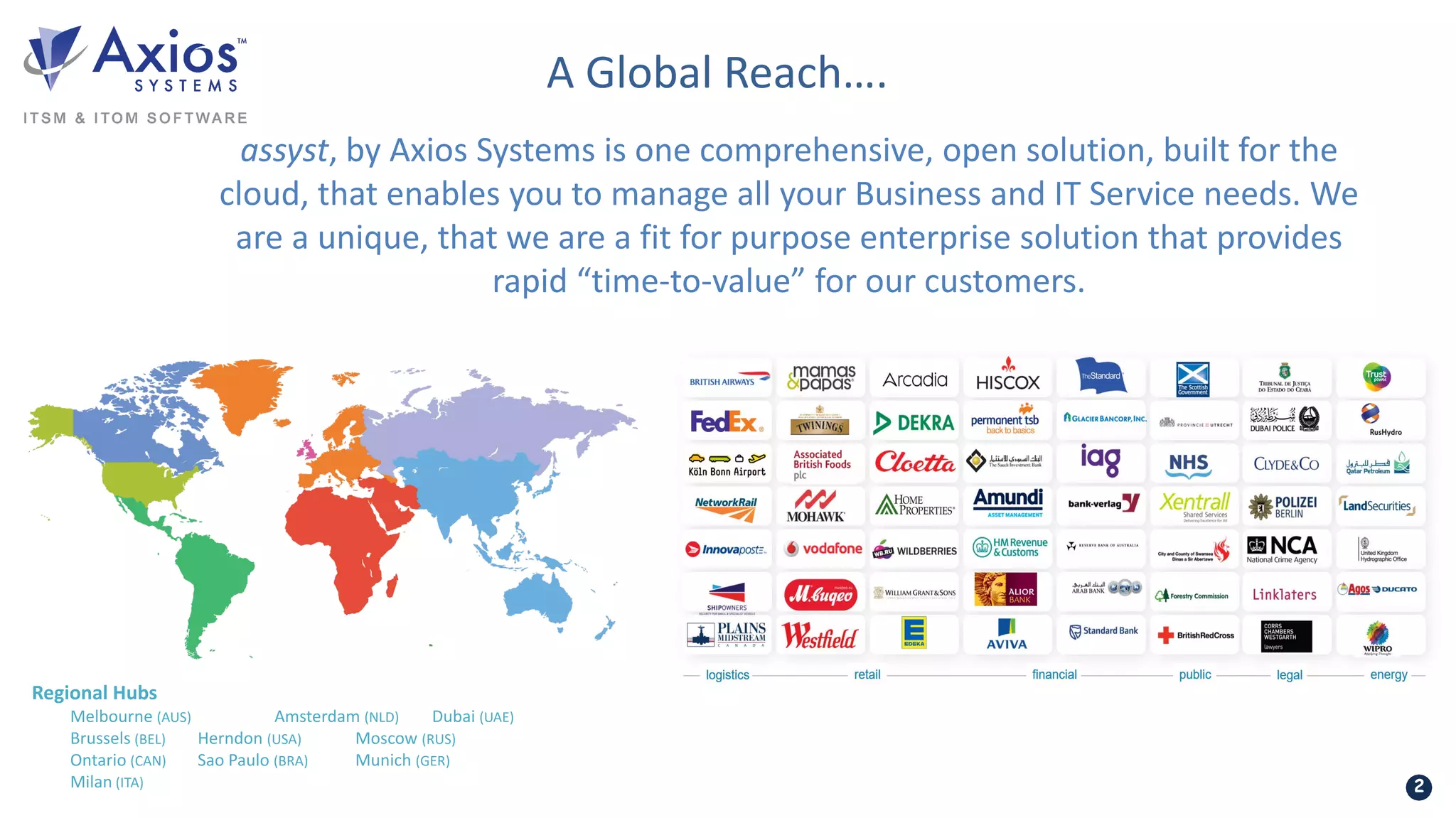
Regional Hubs
Melbourne (AUS) Amsterdam (NLD) Dubai (UAE)
Brussels (BEL) Herndon (USA) Moscow (RUS)
Ontario (CAN) Sao Paulo (BRA) Munich (GER)
Milan (ITA)
A Global Reach….
assyst, by Axios Systems is one comprehensive, open solution, built for the
cloud, that enables you to manage all your Business and IT Service needs. We
are a unique, that we are a fit for purpose enterprise solution that provides
rapid “time-to-value” for our customers.
2
Coverage
0 The key changes in the ITSM-tool marketplace
0 Why change ITSM tool?
0 Assessing your current ITSM tool
0 How to select your new ITSM tool
0 Key takeaways
stephen@itsm.tools
@stephenmann
@itsm_tools
3
stephen@itsm.tools
@stephenmann
@itsm_tools
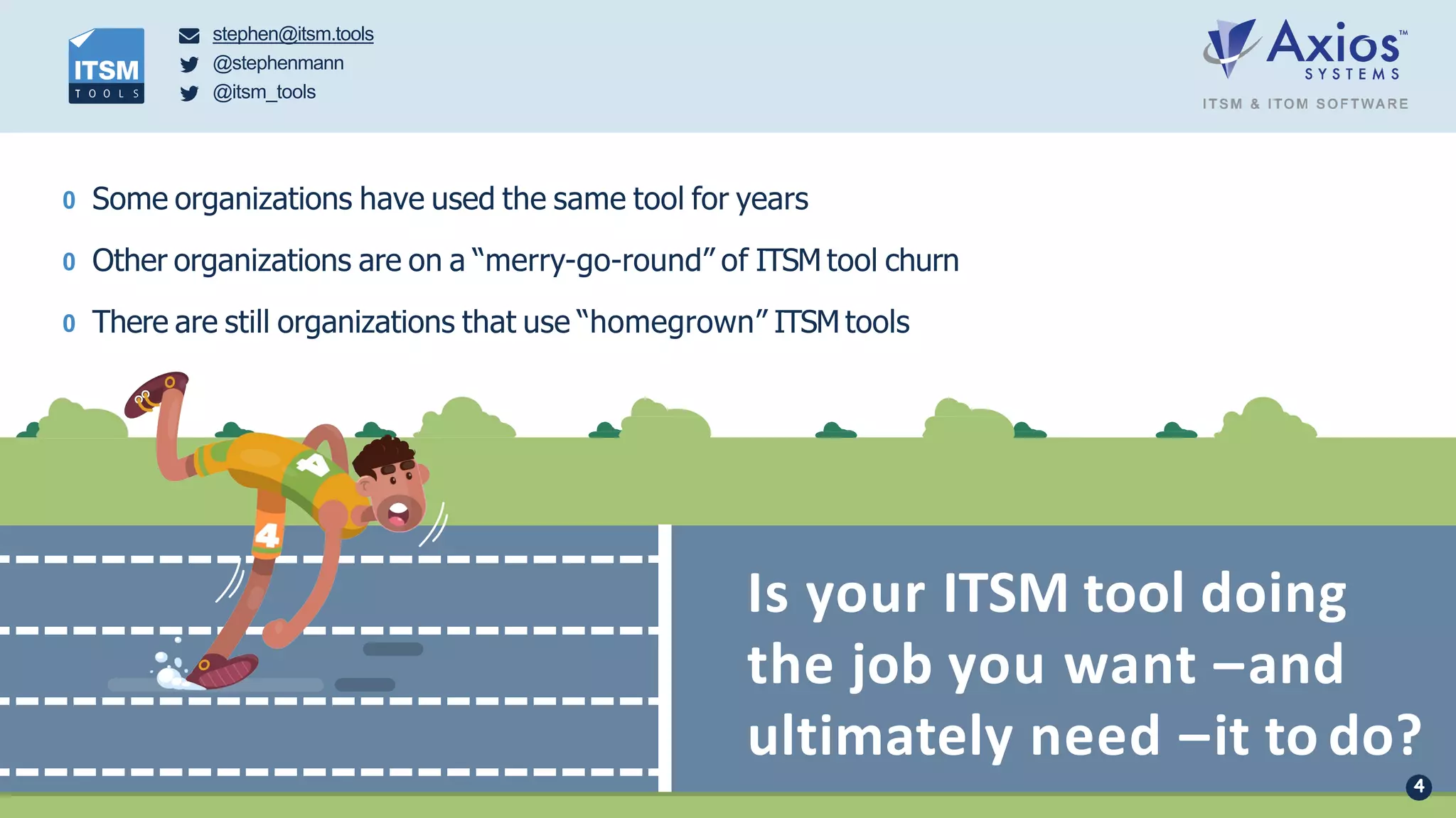
Is your ITSM tool doing
the job you want –and
ultimately need –it to do?
0 Some organizations have used the same tool for years
0 Other organizations are on a “merry-go-round” of ITSM tool churn
0 There are still organizations that use “homegrown” ITSM tools
4
stephen@itsm.tools
@stephenmann
@itsm_tools
a The level of ITSM-based capabilities
• The evolution of delivery and consumption models
a Newer, high-value capabilities
• Additional use cases –enterprise service management and SIAM
• The expected influx of AI technologies into ITSM operations
5 Key Changes in the
ITSM-Tool Marketplace
5
stephen@itsm.tools
@stephenmann
@itsm_tools
The Main Reason
Organizations Change Tool
a Tool dissatisfaction (18%)
• Failure to deliver the anticipated benefits (17%)
a End-of-life/outdated/homegrown tool no longer workable (12%)
• Because of business needs (10%)
• New ITSM-process adoption required a new tool (10%)
5Source: https://itsm.tools/2017/03/09/survey-results-change-itsm-tool/
stephen@itsm.tools
@stephenmann
@itsm_tools
Such non-tool-related causes of
dissatisfaction will not beaddressed
by merely replacing your ITSM tool
0 It’s important to separate the (root) causes from the symptoms
0 Don’t assume that the ITSM tool itself is always at fault
0 Other potential causes include:
0 The use of a misfocused set of business requirements
0 The automation of badly-designed ITSM processes
0 Insufficient IT staff to actually do what’s needed
0 Deeper cultural issues related to working practices
7
0 Why is ITSM needed?
0 Why is ITSM tool needed?
0 How will both benefit your organization?
Appreciate that ITSM, and the enabling tool, are merely the
“means to an end” rather than the “end” itself –with the “end”
actually related to better business outcomes or similar
Accessing Your
Current ITSM Tool
stephen@itsm.tools
@stephenmann
@itsm_tools
8
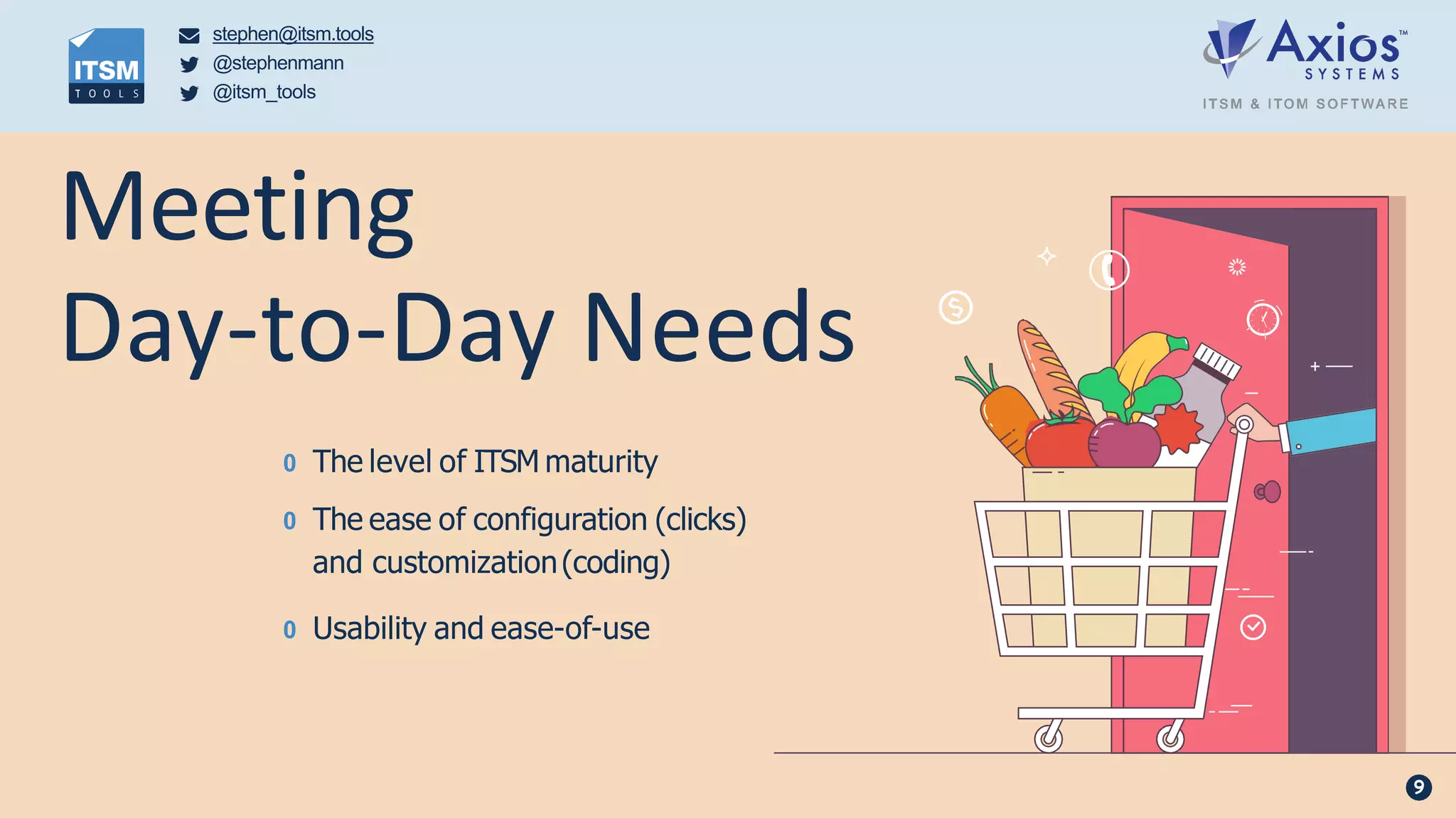
Meeting
Day-to-Day Needs
0 The level of ITSM maturity
0 The ease of configuration (clicks)
and customization(coding)
0 Usability and ease-of-use
stephen@itsm.tools
@stephenmann
@itsm_tools
9
Understanding
and Optimizing
the Tool TCO
stephen@itsm.tools
@stephenmann
@itsm_tools
1
0
Realizing the
Anticipated Benefits
0 Delivering a better service and employee/customer experience
0 Improved efficiency and effectiveness, plus reduced operational costs
0 Improved visibility into operations and service performance
0 Increased control and governance
0 Standardization and increased accountability
0 Self-service efficiencies and the associated workload reductions
0 A better understanding of what ITservices are needed 10
stephen@itsm.tools
@stephenmann
@itsm_tools
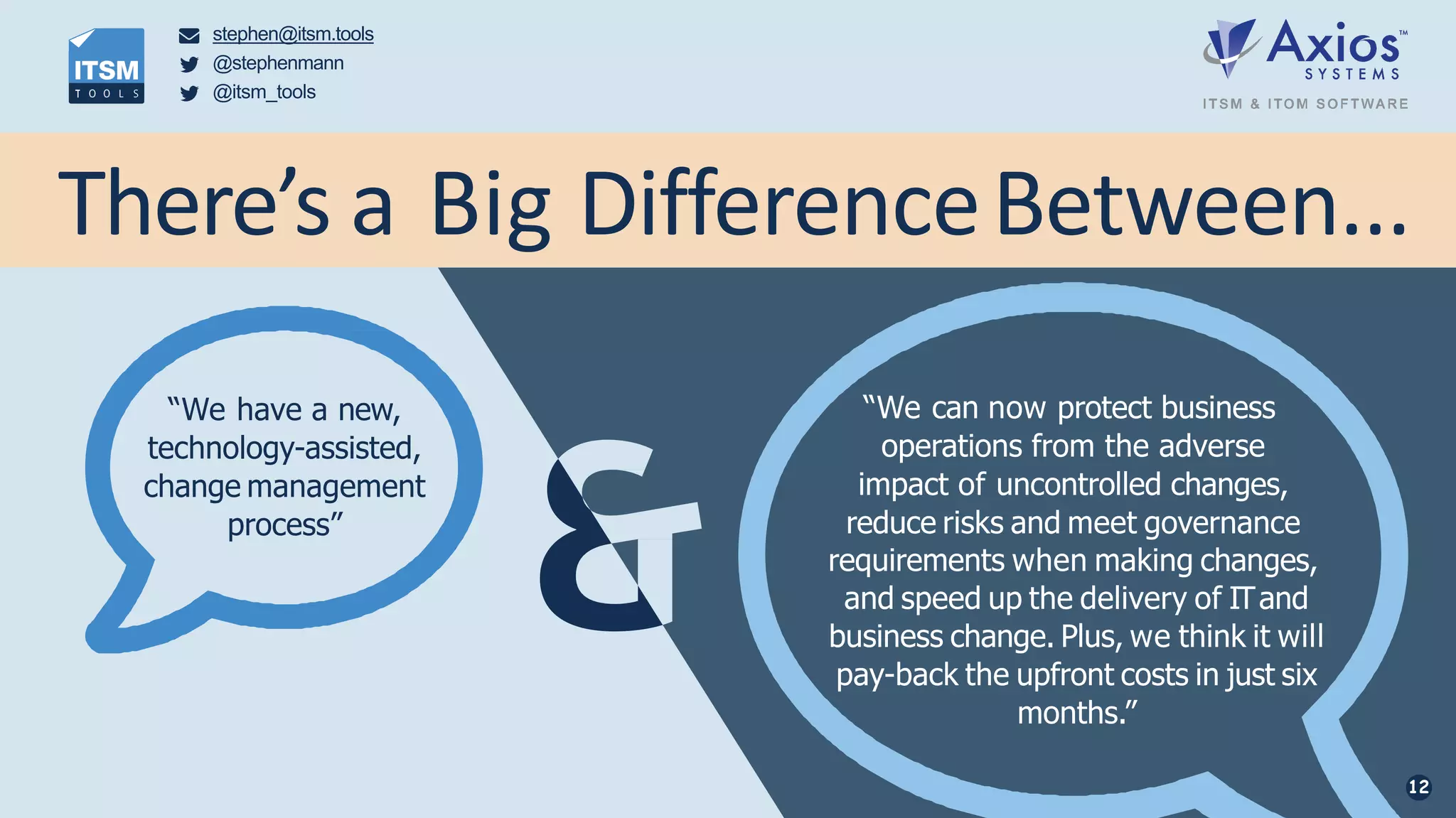
There’s a Big DifferenceBetween...
stephen@itsm.tools
@stephenmann
@itsm_tools
“We have a new,
technology-assisted,
change management
process”
“We can now protect business
operations from the adverse
impact of uncontrolled changes,
reduce risks and meet governance
requirements when making changes,
and speed up the delivery of ITand
business change. Plus, we think it will
pay-back the upfront costs in just six
months.”
12
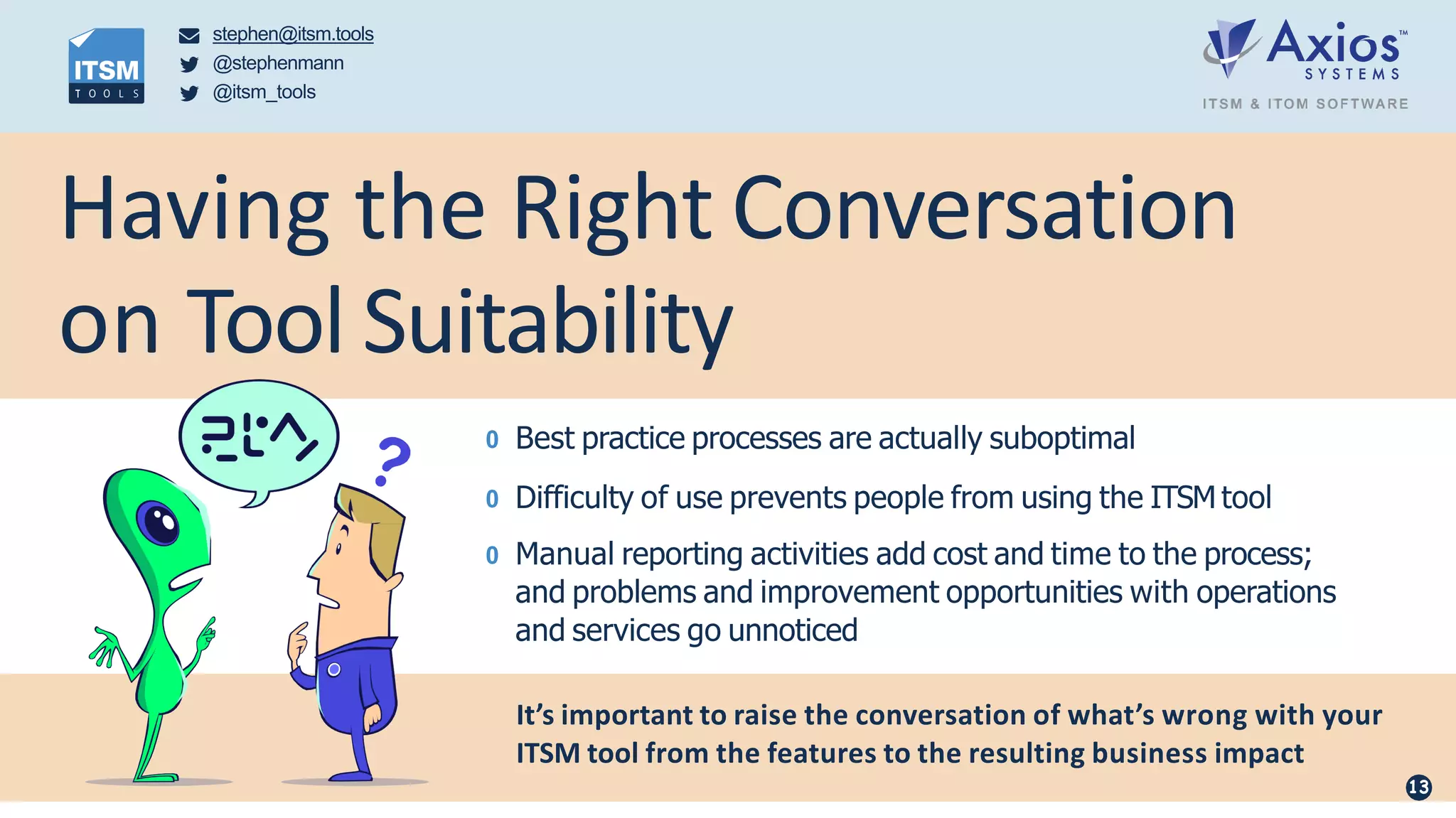
Having the Right Conversation
on Tool Suitability
0 Best practice processes are actually suboptimal
0 Difficulty of use prevents people from using the ITSM tool
0 Manual reporting activities add cost and time to the process;
and problems and improvement opportunities with operations
and services go unnoticed
It’s important to raise the conversation of what’s wrong with your
ITSM tool from the features to the resulting business impact
stephen@itsm.tools
@stephenmann
@itsm_tools
13
stephen@itsm.tools
@stephenmann
@itsm_tools
How to Select Your
New ITSMTool
in Four Steps
14
stephen@itsm.tools
@stephenmann
@itsm_tools
Step1: InternalUnderstanding
0 Understand what you need
0 Understand how the current tool fails to
deliver against these needs
15
Step 2: Understanding the ITSMToolMarket
ITSM tool and vendor differentiators include:
0 The target customer size and verticals
0 Covered geographies
0 Customer maturity
0 Tool capabilities that go beyond the commonly-adopted processes
0 The emphasis placed on aspects of ease of use
0 The tool vendor’s future “direction”
0 Pricing and available licensing models
stephen@itsm.tools
@stephenmann
@itsm_tools
16
0 The commonly-adopted ITSM processes
0 “High-value” ITSM tool capabilities
0 Business-specific needs
Step 3: Assessing ITSMTool“Table Stakes”
stephen@itsm.tools
@stephenmann
@itsm_tools
17
0 The increased speed of execution
0 Cost reductions (related to labor savings)
0 Delivering an improved employee/customer experience
0 Reduced “human error”
0 Greater flexibility for change
stephen@itsm.tools
@stephenmann
@itsm_tools
Automation
18
0 Increased operational efficiency and reduced operational costs
0 Better quality outcomes
0 Reduced duplication of effort and “wheel reinvention”
0 Optimal use of potentially scarce people skills and knowledge
0 Greater consistency of operations
0 Delivering a superior customer experience
stephen@itsm.tools
@stephenmann
@itsm_tools
Knowledge Management
19
0 Reduce costs
0 Speed up service and resolutions
0 Improve the customer/employee experience
stephen@itsm.tools
@stephenmann
@itsm_tools
Self-Service
20
stephen@itsm.tools
@stephenmann
@itsm_tools
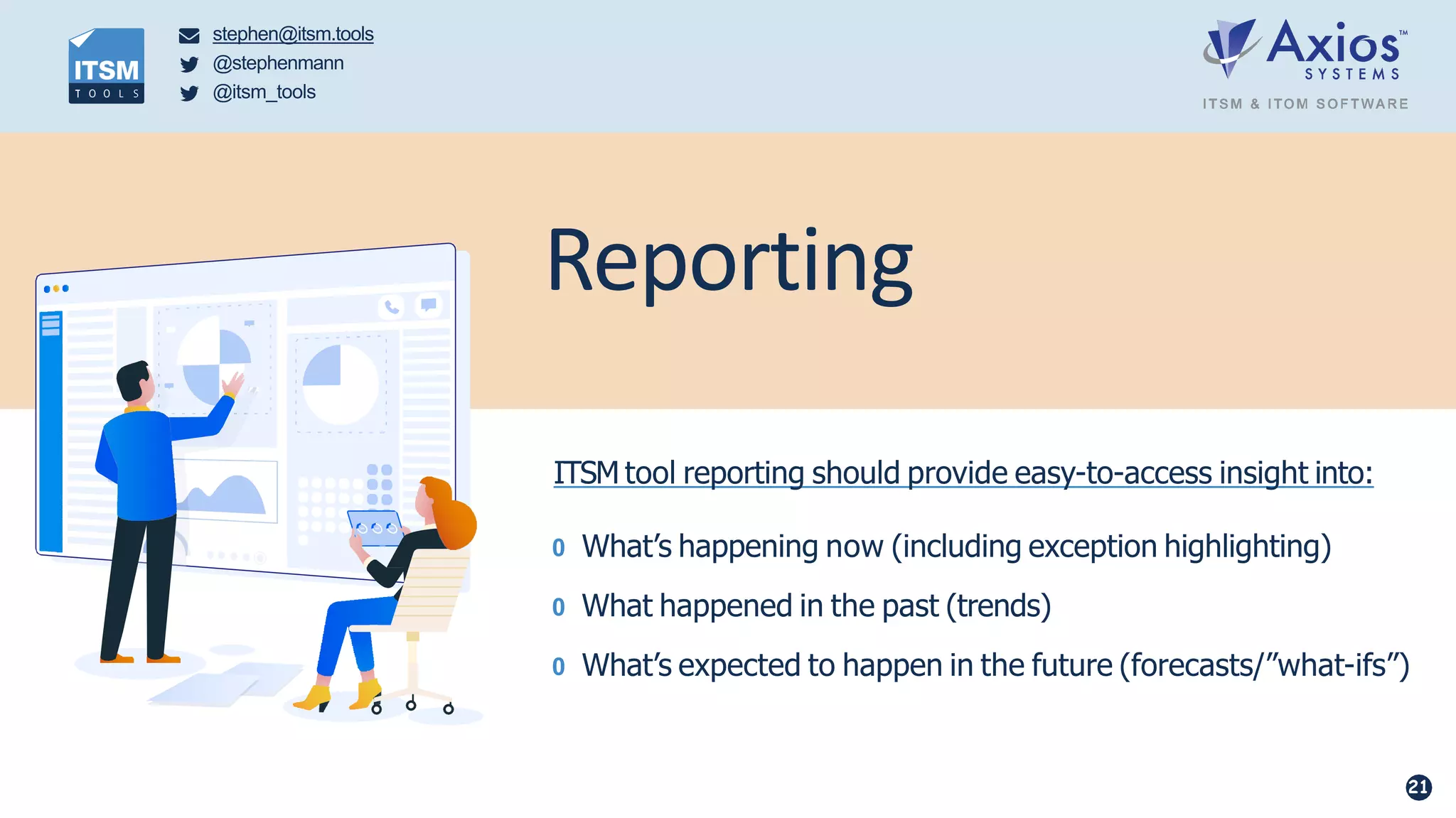
Reporting
ITSM tool reporting should provide easy-to-access insight into:
0 What’s happening now (including exception highlighting)
0 What happened in the past (trends)
0 What’s expected to happen in the future (forecasts/”what-ifs”)
21
0 Stay focused on the right things
0 Commit to specific business outcomes and ensure that
your RFP reflects this
0 Start out (and stay) impartial
0 Ensure that you comfortably balance today’s and
tomorrow’s businessrequirements
0 Question some of the vendor’s answers to your questions
Step 4: RFP Creation (andSelection Tips)
stephen@itsm.tools
@stephenmann
@itsm_tools
22
stephen@itsm.tools
@stephenmann
@itsm_tools
• How to create an RFP that delivers against organizational needs•
23
Key Takeaways
Ensure that your organization understands:
a The key changes in the ITSM-tool marketplace
• The main reasons organizations change ITSM tool (the real issues)
a What it needs to achieve from a new ITSM tool
• The ITSM marketplace and what differentiates tools and vendors
• How its needs translate into commonly-offered tool capabilities
m The relative importance of “high-value” ITSM tool capabilities
stephen@itsm.tools
@stephenmann
@itsm_tools
Contact Us
If you would like more information or have any questions on this
presentation, please contact us.
stephen@itsm.tools
@stephenmann
@itsm_tools
/axios-systems
@Axios_Systems
/axios.assyst
www
www.axiossystems.com/contact-us

Stephen Mann Webinar: Is it time to change your ITSM tool?

  • 1.
    Is It Timeto Change Your ITSM Tool? How to best understand what’s right for your organization stephen@itsm.tools @stephenmann @itsm_tools
  • 2.
    Regional Hubs Melbourne (AUS)Amsterdam (NLD) Dubai (UAE) Brussels (BEL) Herndon (USA) Moscow (RUS) Ontario (CAN) Sao Paulo (BRA) Munich (GER) Milan (ITA) A Global Reach…. assyst, by Axios Systems is one comprehensive, open solution, built for the cloud, that enables you to manage all your Business and IT Service needs. We are a unique, that we are a fit for purpose enterprise solution that provides rapid “time-to-value” for our customers. 2
  • 3.
    Coverage 0 The keychanges in the ITSM-tool marketplace 0 Why change ITSM tool? 0 Assessing your current ITSM tool 0 How to select your new ITSM tool 0 Key takeaways stephen@itsm.tools @stephenmann @itsm_tools 3
  • 4.
    stephen@itsm.tools @stephenmann @itsm_tools Is your ITSMtool doing the job you want –and ultimately need –it to do? 0 Some organizations have used the same tool for years 0 Other organizations are on a “merry-go-round” of ITSM tool churn 0 There are still organizations that use “homegrown” ITSM tools 4
  • 5.
    stephen@itsm.tools @stephenmann @itsm_tools a The levelof ITSM-based capabilities • The evolution of delivery and consumption models a Newer, high-value capabilities • Additional use cases –enterprise service management and SIAM • The expected influx of AI technologies into ITSM operations 5 Key Changes in the ITSM-Tool Marketplace 5
  • 6.
    stephen@itsm.tools @stephenmann @itsm_tools The Main Reason OrganizationsChange Tool a Tool dissatisfaction (18%) • Failure to deliver the anticipated benefits (17%) a End-of-life/outdated/homegrown tool no longer workable (12%) • Because of business needs (10%) • New ITSM-process adoption required a new tool (10%) 5Source: https://itsm.tools/2017/03/09/survey-results-change-itsm-tool/
  • 7.
    stephen@itsm.tools @stephenmann @itsm_tools Such non-tool-related causesof dissatisfaction will not beaddressed by merely replacing your ITSM tool 0 It’s important to separate the (root) causes from the symptoms 0 Don’t assume that the ITSM tool itself is always at fault 0 Other potential causes include: 0 The use of a misfocused set of business requirements 0 The automation of badly-designed ITSM processes 0 Insufficient IT staff to actually do what’s needed 0 Deeper cultural issues related to working practices 7
  • 8.
    0 Why isITSM needed? 0 Why is ITSM tool needed? 0 How will both benefit your organization? Appreciate that ITSM, and the enabling tool, are merely the “means to an end” rather than the “end” itself –with the “end” actually related to better business outcomes or similar Accessing Your Current ITSM Tool stephen@itsm.tools @stephenmann @itsm_tools 8
  • 9.
    Meeting Day-to-Day Needs 0 Thelevel of ITSM maturity 0 The ease of configuration (clicks) and customization(coding) 0 Usability and ease-of-use stephen@itsm.tools @stephenmann @itsm_tools 9
  • 10.
    Understanding and Optimizing the ToolTCO stephen@itsm.tools @stephenmann @itsm_tools 1 0
  • 11.
    Realizing the Anticipated Benefits 0Delivering a better service and employee/customer experience 0 Improved efficiency and effectiveness, plus reduced operational costs 0 Improved visibility into operations and service performance 0 Increased control and governance 0 Standardization and increased accountability 0 Self-service efficiencies and the associated workload reductions 0 A better understanding of what ITservices are needed 10 stephen@itsm.tools @stephenmann @itsm_tools
  • 12.
    There’s a BigDifferenceBetween... stephen@itsm.tools @stephenmann @itsm_tools “We have a new, technology-assisted, change management process” “We can now protect business operations from the adverse impact of uncontrolled changes, reduce risks and meet governance requirements when making changes, and speed up the delivery of ITand business change. Plus, we think it will pay-back the upfront costs in just six months.” 12
  • 13.
    Having the RightConversation on Tool Suitability 0 Best practice processes are actually suboptimal 0 Difficulty of use prevents people from using the ITSM tool 0 Manual reporting activities add cost and time to the process; and problems and improvement opportunities with operations and services go unnoticed It’s important to raise the conversation of what’s wrong with your ITSM tool from the features to the resulting business impact stephen@itsm.tools @stephenmann @itsm_tools 13
  • 14.
  • 15.
    stephen@itsm.tools @stephenmann @itsm_tools Step1: InternalUnderstanding 0 Understandwhat you need 0 Understand how the current tool fails to deliver against these needs 15
  • 16.
    Step 2: Understandingthe ITSMToolMarket ITSM tool and vendor differentiators include: 0 The target customer size and verticals 0 Covered geographies 0 Customer maturity 0 Tool capabilities that go beyond the commonly-adopted processes 0 The emphasis placed on aspects of ease of use 0 The tool vendor’s future “direction” 0 Pricing and available licensing models stephen@itsm.tools @stephenmann @itsm_tools 16
  • 17.
    0 The commonly-adoptedITSM processes 0 “High-value” ITSM tool capabilities 0 Business-specific needs Step 3: Assessing ITSMTool“Table Stakes” stephen@itsm.tools @stephenmann @itsm_tools 17
  • 18.
    0 The increasedspeed of execution 0 Cost reductions (related to labor savings) 0 Delivering an improved employee/customer experience 0 Reduced “human error” 0 Greater flexibility for change stephen@itsm.tools @stephenmann @itsm_tools Automation 18
  • 19.
    0 Increased operationalefficiency and reduced operational costs 0 Better quality outcomes 0 Reduced duplication of effort and “wheel reinvention” 0 Optimal use of potentially scarce people skills and knowledge 0 Greater consistency of operations 0 Delivering a superior customer experience stephen@itsm.tools @stephenmann @itsm_tools Knowledge Management 19
  • 20.
    0 Reduce costs 0Speed up service and resolutions 0 Improve the customer/employee experience stephen@itsm.tools @stephenmann @itsm_tools Self-Service 20
  • 21.
    stephen@itsm.tools @stephenmann @itsm_tools Reporting ITSM tool reportingshould provide easy-to-access insight into: 0 What’s happening now (including exception highlighting) 0 What happened in the past (trends) 0 What’s expected to happen in the future (forecasts/”what-ifs”) 21
  • 22.
    0 Stay focusedon the right things 0 Commit to specific business outcomes and ensure that your RFP reflects this 0 Start out (and stay) impartial 0 Ensure that you comfortably balance today’s and tomorrow’s businessrequirements 0 Question some of the vendor’s answers to your questions Step 4: RFP Creation (andSelection Tips) stephen@itsm.tools @stephenmann @itsm_tools 22
  • 23.
    stephen@itsm.tools @stephenmann @itsm_tools • How tocreate an RFP that delivers against organizational needs• 23 Key Takeaways Ensure that your organization understands: a The key changes in the ITSM-tool marketplace • The main reasons organizations change ITSM tool (the real issues) a What it needs to achieve from a new ITSM tool • The ITSM marketplace and what differentiates tools and vendors • How its needs translate into commonly-offered tool capabilities m The relative importance of “high-value” ITSM tool capabilities
  • 24.
    stephen@itsm.tools @stephenmann @itsm_tools Contact Us If youwould like more information or have any questions on this presentation, please contact us. stephen@itsm.tools @stephenmann @itsm_tools /axios-systems @Axios_Systems /axios.assyst www www.axiossystems.com/contact-us