



© 2018 FORRESTER. REPRODUCTION PROHIBITED.
Can We Manage The Future?
David Wheable, Vice President and Principal Consultant
November 2018
3© 2018 FORRESTER. REPRODUCTION PROHIBITED.
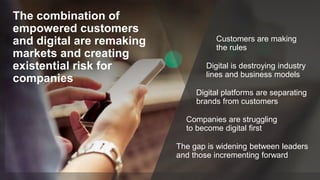
The gap is widening between leaders
and those incrementing forward
Customers are making
the rules
Digital is destroying industry
lines and business models
Digital platforms are separating
brands from customers
Companies are struggling
to become digital first
The combination of
empowered customers
and digital are remaking
markets and creating
existential risk for
companies
4© 2018 FORRESTER. REPRODUCTION PROHIBITED.
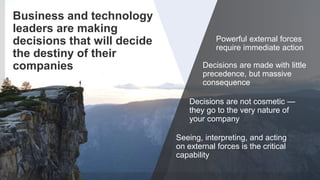
Business and technology
leaders are making
decisions that will decide
the destiny of their
companies
Seeing, interpreting, and acting
on external forces is the critical
capability
Powerful external forces
require immediate action
Decisions are made with little
precedence, but massive
consequence
Decisions are not cosmetic —
they go to the very nature of
your company
5© 2018 FORRESTER. REPRODUCTION PROHIBITED.
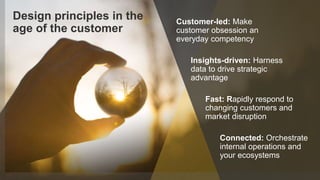
Design principles in the
age of the customer
Connected: Orchestrate
internal operations and
your ecosystems
Insights-driven: Harness
data to drive strategic
advantage
Fast: Rapidly respond to
changing customers and
market disruption
Customer-led: Make
customer obsession an
everyday competency
6© 2018 FORRESTER. REPRODUCTION PROHIBITED.
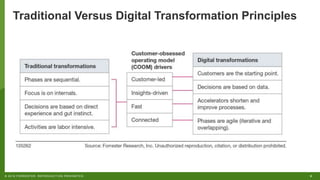
Traditional Versus Digital Transformation Principles
7© 2018 FORRESTER. REPRODUCTION PROHIBITED.
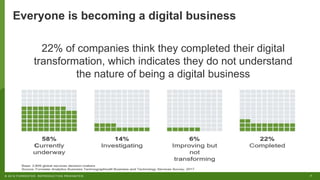
Everyone is becoming a digital business
22% of companies think they completed their digital
transformation, which indicates they do not understand
the nature of being a digital business
8© 2018 FORRESTER. REPRODUCTION PROHIBITED.
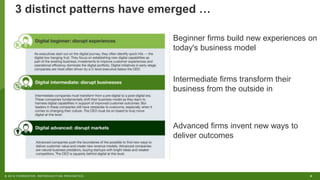
3 distinct patterns have emerged …
Beginner firms build new experiences on
today's business model
Intermediate firms transform their
business from the outside in
Advanced firms invent new ways to
deliver outcomes
9© 2018 FORRESTER. REPRODUCTION PROHIBITED.
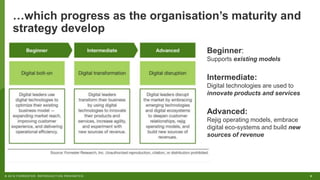
…which progress as the organisation’s maturity and
strategy develop
Beginner:
Supports existing models
Intermediate:
Digital technologies are used to
innovate products and services
Advanced:
Rejig operating models, embrace
digital eco-systems and build new
sources of revenue
© 2018 FORRESTER. REPRODUCTION PROHIBITED.
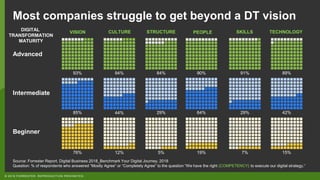
Most companies struggle to get beyond a DT vision
Source: Forrester Report, Digital Business 2018_Benchmark Your Digital Journey, 2018
Question: % of respondents who answered “Mostly Agree” or “Completely Agree” to the question “We have the right {COMPETENCY} to execute our digital strategy.“
VISION CULTURE STRUCTURE PEOPLE SKILLS TECHNOLOGY
Advanced
Intermediate
Beginner
DIGITAL
TRANSFORMATION
MATURITY
93% 94% 84% 90% 91% 89%
85% 44% 29% 64% 29% 42%
76% 12% 5% 19% 7% 15%
11© 2018 FORRESTER. REPRODUCTION PROHIBITED.
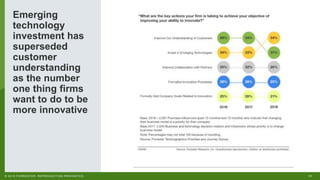
Emerging
technology
investment has
superseded
customer
understanding
as the number
one thing firms
want to do to be
more innovative
12© 2018 FORRESTER. REPRODUCTION PROHIBITED.
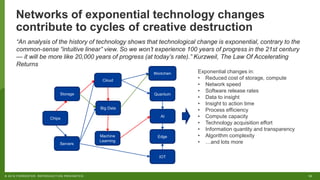
Networks of exponential technology changes
contribute to cycles of creative destruction
“An analysis of the history of technology shows that technological change is exponential, contrary to the
common-sense “intuitive linear” view. So we won’t experience 100 years of progress in the 21st century
— it will be more like 20,000 years of progress (at today’s rate).” Kurzweil, The Law Of Accelerating
Returns
Storage
Servers
Cloud
Big Data
Machine
Learning
AI
Quantum
IOT
Edge
Blockchain Exponential changes in:
• Reduced cost of storage, compute
• Network speed
• Software release rates
• Data to insight
• Insight to action time
• Process efficiency
• Compute capacity
• Technology acquisition effort
• Information quantity and transparency
• Algorithm complexity
• …and lots more
Chips
13© 2018 FORRESTER. REPRODUCTION PROHIBITED.
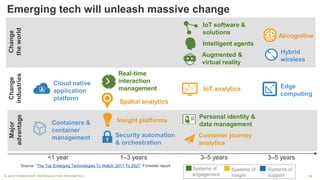
<1 year 1–3 years 3–5 years 3–5 years
Emerging tech will unleash massive changeChange
theworld
Change
industries
Major
advantage
Source: “The Top Emerging Technologies To Watch: 2017 To 2021” Forrester report
Real-time
interaction
management
Personal identity &
data management
Intelligent agents
Augmented &
virtual reality
IoT software &
solutions
Systems of
engagement
Insight platforms
Customer journey
analytics
Spatial analytics
IoT analytics
AI/cognitive
Systems of
insight
Security automation
& orchestration
Containers &
container
management
Cloud native
application
platform
Edge
computing
Hybrid
wireless
Systems of
support
14© 2018 FORRESTER. REPRODUCTION PROHIBITED.
15© 2018 FORRESTER. REPRODUCTION PROHIBITED.
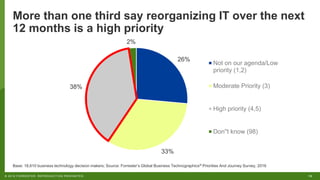
More than one third say reorganizing IT over the next
12 months is a high priority
Base: 18,610 business technology decision makers; Source: Forrester’s Global Business Technographics® Priorities And Journey Survey, 2016
26%
33%
38%
2%
Not on our agenda/Low
priority (1,2)
Moderate Priority (3)
High priority (4,5)
Don''t know (98)
16© 2018 FORRESTER. REPRODUCTION PROHIBITED.
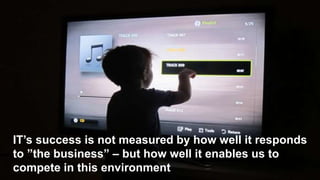
IT’s success is not measured by how well it responds
to ”the business” – but how well it enables us to
compete in this environment
17© 2018 FORRESTER. REPRODUCTION PROHIBITED.
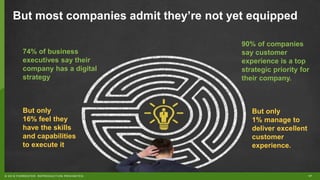
But most companies admit they’re not yet equipped
90% of companies
say customer
experience is a top
strategic priority for
their company.
But only
1% manage to
deliver excellent
customer
experience.
74% of business
executives say their
company has a digital
strategy
But only
16% feel they
have the skills
and capabilities
to execute it
18© 2018 FORRESTER. REPRODUCTION PROHIBITED.
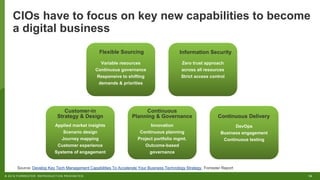
CIOs have to focus on key new capabilities to become
a digital business
Source: Develop Key Tech Management Capabilities To Accelerate Your Business Technology Strategy, Forrester Report
Applied market insights
Scenario design
Journey mapping
Customer experience
Systems of engagement
Innovation
Continuous planning
Project portfolio mgmt.
Outcome-based
governance
DevOps
Business engagement
Continuous testing
Variable resources
Continuous governance
Responsive to shifting
demands & priorities
Zero trust approach
across all resources
Strict access control
Customer-in
Strategy & Design
Continuous
Planning & Governance Continuous Delivery
Flexible Sourcing Information Security
19© 2018 FORRESTER. REPRODUCTION PROHIBITED.
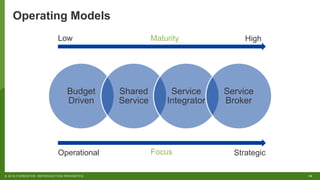
Operating Models
Budget
Driven
Shared
Service
Service
Integrator
Service
Broker
Maturity
Operational Strategic
Low High
Focus
20© 2018 FORRESTER. REPRODUCTION PROHIBITED.
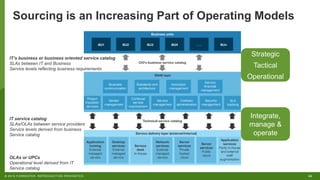
Sourcing is an Increasing Part of Operating Models
Strategic
Tactical
Operational
Integrate,
manage &
operate
IT’s business or business oriented service catalog
SLAs between IT and Business
Service levels reflecting business requirements
IT service catalog
SLAs/OLAs between service providers
Service levels derived from business
Service catalog
OLAs or UPCs
Operational level derived from IT
Service catalog
21© 2018 FORRESTER. REPRODUCTION PROHIBITED.
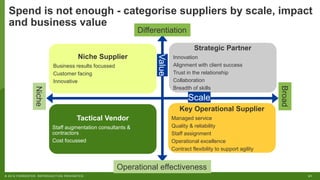
Spend is not enough - categorise suppliers by scale, impact
and business value
Niche Supplier
Business results focussed
Customer facing
Innovative
Strategic Partner
Innovation
Alignment with client success
Trust in the relationship
Collaboration
Breadth of skills
Tactical Vendor
Staff augmentation consultants &
contractors
Cost focussed
Key Operational Supplier
Managed service
Quality & reliability
Staff assignment
Operational excellence
Contract flexibility to support agility
Differentiation
Operational effectiveness
Broad
Niche
Scale
Value
22© 2018 FORRESTER. REPRODUCTION PROHIBITED.
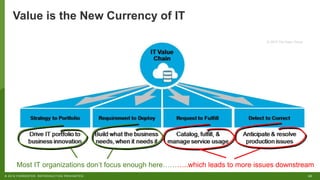
Value is the New Currency of IT
Most IT organizations don’t focus enough here………..which leads to more issues downstream
23© 2018 FORRESTER. REPRODUCTION PROHIBITED.
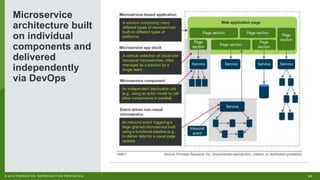
Microservice
architecture built
on individual
components and
delivered
independently
via DevOps
24© 2018 FORRESTER. REPRODUCTION PROHIBITED.
© 2017 Forrester Research, Inc. Reproduction Prohibited
25© 2018 FORRESTER. REPRODUCTION PROHIBITED.
© 2017 Forrester Research, Inc. Reproduction Prohibited
What is my
seat number?
What time do
we land?
Will there
be food on
the plane?
Is there a m
on the plan
Can I get a
mobile boarding
pass? What tim
need to le
the airp
need cash
can I use a
edit card?
room service
ll be open at
the hotel?
Is my bag
under the
weight limit?
Where is my
hotel in San
Francisco?
How will I get to
the airport?
Do I need
a visa?
What is the limit
in weight for a
carry on?
What time do I
What is the bes
way to get to
downtown?
26© 2018 FORRESTER. REPRODUCTION PROHIBITED.
© 2017 Forrester Research, Inc. Reproduction Prohibited
27© 2018 FORRESTER. REPRODUCTION PROHIBITED.
© 2017 Forrester Research, Inc. Reproduction Prohibited{this.options.log =
This.option.lo
s.options.log
l’ : ‘None’;}
</> const
params={Functio
nName:this.opt
if {invocationType
!==‘RequestRespo
nse’){this.option
{This.option.lo
is.options.log
ail’ : ‘None’;}
(this.options.data
|| {})), };
</>
invoke() {const
invocationType =
this.options.type
’) {this.options.log
= ‘None’;}
</>
if {invocationType
!==‘RequestRespo
nse’){this.option
</>
LogType:
this.options.log,
</>
if{
this.options.log,
if {invocationType
!==‘RequestRespo
nse’) </>
</>
const params
{FunctionNam
{this.optio
‘None’;}
</>
else{This.option
.log=this.option
s.log ? ‘Tail’ :
28© 2018 FORRESTER. REPRODUCTION PROHIBITED.
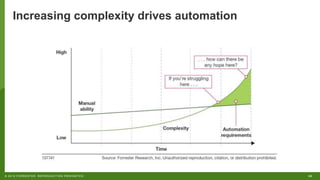
Increasing complexity drives automation
29© 2018 FORRESTER. REPRODUCTION PROHIBITED.
Digital business platforms are a
modular technology base built
around business APIs and designed
for rapid reconfiguration of business
models, processes, and ecosystems.
Forrester report “Business Platforms Power Your Digital Business”
30© 2018 FORRESTER. REPRODUCTION PROHIBITED.
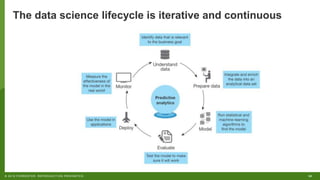
The data science lifecycle is iterative and continuous
31© 2018 FORRESTER. REPRODUCTION PROHIBITED.
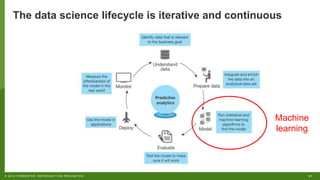
The data science lifecycle is iterative and continuous
Machine
learning
32© 2018 FORRESTER. REPRODUCTION PROHIBITED.
33© 2018 FORRESTER. REPRODUCTION PROHIBITED.
Is this ultimate
relationship
platform? …
34© 2018 FORRESTER. REPRODUCTION PROHIBITED.
or the ultimate
service integration
platform?
35© 2018 FORRESTER. REPRODUCTION PROHIBITED.
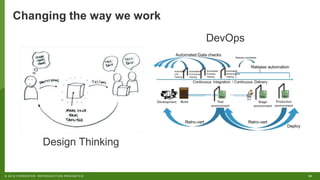
Changing the way we work
Design Thinking
DevOps
36© 2018 FORRESTER. REPRODUCTION PROHIBITED.
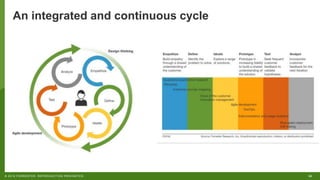
An integrated and continuous cycle
37© 2018 FORRESTER. REPRODUCTION PROHIBITED.
The Discovery of Ignorance
Sapiens A Brief History of Humankind,
Yuval Noah Harari
“The Scientific Revolution has not been a revolution of knowledge. It has
been above all a revolution of ignorance. The great discovery that
launched the Scientific Revolution was the discovery that humans do not
know the answers to their most important questions.”
FORRESTER.COM
Thank you
© 2018 FORRESTER. REPRODUCTION PROHIBITED.

Dave Wheable: Can We Manage the Future

  • 1.
    © 2018 FORRESTER.REPRODUCTION PROHIBITED.
  • 2.
    © 2018 FORRESTER.REPRODUCTION PROHIBITED. Can We Manage The Future? David Wheable, Vice President and Principal Consultant November 2018
  • 3.
    3© 2018 FORRESTER.REPRODUCTION PROHIBITED. The gap is widening between leaders and those incrementing forward Customers are making the rules Digital is destroying industry lines and business models Digital platforms are separating brands from customers Companies are struggling to become digital first The combination of empowered customers and digital are remaking markets and creating existential risk for companies
  • 4.
    4© 2018 FORRESTER.REPRODUCTION PROHIBITED. Business and technology leaders are making decisions that will decide the destiny of their companies Seeing, interpreting, and acting on external forces is the critical capability Powerful external forces require immediate action Decisions are made with little precedence, but massive consequence Decisions are not cosmetic — they go to the very nature of your company
  • 5.
    5© 2018 FORRESTER.REPRODUCTION PROHIBITED. Design principles in the age of the customer Connected: Orchestrate internal operations and your ecosystems Insights-driven: Harness data to drive strategic advantage Fast: Rapidly respond to changing customers and market disruption Customer-led: Make customer obsession an everyday competency
  • 6.
    6© 2018 FORRESTER.REPRODUCTION PROHIBITED. Traditional Versus Digital Transformation Principles
  • 7.
    7© 2018 FORRESTER.REPRODUCTION PROHIBITED. Everyone is becoming a digital business 22% of companies think they completed their digital transformation, which indicates they do not understand the nature of being a digital business
  • 8.
    8© 2018 FORRESTER.REPRODUCTION PROHIBITED. 3 distinct patterns have emerged … Beginner firms build new experiences on today's business model Intermediate firms transform their business from the outside in Advanced firms invent new ways to deliver outcomes
  • 9.
    9© 2018 FORRESTER.REPRODUCTION PROHIBITED. …which progress as the organisation’s maturity and strategy develop Beginner: Supports existing models Intermediate: Digital technologies are used to innovate products and services Advanced: Rejig operating models, embrace digital eco-systems and build new sources of revenue
  • 10.
    © 2018 FORRESTER.REPRODUCTION PROHIBITED. Most companies struggle to get beyond a DT vision Source: Forrester Report, Digital Business 2018_Benchmark Your Digital Journey, 2018 Question: % of respondents who answered “Mostly Agree” or “Completely Agree” to the question “We have the right {COMPETENCY} to execute our digital strategy.“ VISION CULTURE STRUCTURE PEOPLE SKILLS TECHNOLOGY Advanced Intermediate Beginner DIGITAL TRANSFORMATION MATURITY 93% 94% 84% 90% 91% 89% 85% 44% 29% 64% 29% 42% 76% 12% 5% 19% 7% 15%
  • 11.
    11© 2018 FORRESTER.REPRODUCTION PROHIBITED. Emerging technology investment has superseded customer understanding as the number one thing firms want to do to be more innovative
  • 12.
    12© 2018 FORRESTER.REPRODUCTION PROHIBITED. Networks of exponential technology changes contribute to cycles of creative destruction “An analysis of the history of technology shows that technological change is exponential, contrary to the common-sense “intuitive linear” view. So we won’t experience 100 years of progress in the 21st century — it will be more like 20,000 years of progress (at today’s rate).” Kurzweil, The Law Of Accelerating Returns Storage Servers Cloud Big Data Machine Learning AI Quantum IOT Edge Blockchain Exponential changes in: • Reduced cost of storage, compute • Network speed • Software release rates • Data to insight • Insight to action time • Process efficiency • Compute capacity • Technology acquisition effort • Information quantity and transparency • Algorithm complexity • …and lots more Chips
  • 13.
    13© 2018 FORRESTER.REPRODUCTION PROHIBITED. <1 year 1–3 years 3–5 years 3–5 years Emerging tech will unleash massive changeChange theworld Change industries Major advantage Source: “The Top Emerging Technologies To Watch: 2017 To 2021” Forrester report Real-time interaction management Personal identity & data management Intelligent agents Augmented & virtual reality IoT software & solutions Systems of engagement Insight platforms Customer journey analytics Spatial analytics IoT analytics AI/cognitive Systems of insight Security automation & orchestration Containers & container management Cloud native application platform Edge computing Hybrid wireless Systems of support
  • 14.
    14© 2018 FORRESTER.REPRODUCTION PROHIBITED.
  • 15.
    15© 2018 FORRESTER.REPRODUCTION PROHIBITED. More than one third say reorganizing IT over the next 12 months is a high priority Base: 18,610 business technology decision makers; Source: Forrester’s Global Business Technographics® Priorities And Journey Survey, 2016 26% 33% 38% 2% Not on our agenda/Low priority (1,2) Moderate Priority (3) High priority (4,5) Don''t know (98)
  • 16.
    16© 2018 FORRESTER.REPRODUCTION PROHIBITED. IT’s success is not measured by how well it responds to ”the business” – but how well it enables us to compete in this environment
  • 17.
    17© 2018 FORRESTER.REPRODUCTION PROHIBITED. But most companies admit they’re not yet equipped 90% of companies say customer experience is a top strategic priority for their company. But only 1% manage to deliver excellent customer experience. 74% of business executives say their company has a digital strategy But only 16% feel they have the skills and capabilities to execute it
  • 18.
    18© 2018 FORRESTER.REPRODUCTION PROHIBITED. CIOs have to focus on key new capabilities to become a digital business Source: Develop Key Tech Management Capabilities To Accelerate Your Business Technology Strategy, Forrester Report Applied market insights Scenario design Journey mapping Customer experience Systems of engagement Innovation Continuous planning Project portfolio mgmt. Outcome-based governance DevOps Business engagement Continuous testing Variable resources Continuous governance Responsive to shifting demands & priorities Zero trust approach across all resources Strict access control Customer-in Strategy & Design Continuous Planning & Governance Continuous Delivery Flexible Sourcing Information Security
  • 19.
    19© 2018 FORRESTER.REPRODUCTION PROHIBITED. Operating Models Budget Driven Shared Service Service Integrator Service Broker Maturity Operational Strategic Low High Focus
  • 20.
    20© 2018 FORRESTER.REPRODUCTION PROHIBITED. Sourcing is an Increasing Part of Operating Models Strategic Tactical Operational Integrate, manage & operate IT’s business or business oriented service catalog SLAs between IT and Business Service levels reflecting business requirements IT service catalog SLAs/OLAs between service providers Service levels derived from business Service catalog OLAs or UPCs Operational level derived from IT Service catalog
  • 21.
    21© 2018 FORRESTER.REPRODUCTION PROHIBITED. Spend is not enough - categorise suppliers by scale, impact and business value Niche Supplier Business results focussed Customer facing Innovative Strategic Partner Innovation Alignment with client success Trust in the relationship Collaboration Breadth of skills Tactical Vendor Staff augmentation consultants & contractors Cost focussed Key Operational Supplier Managed service Quality & reliability Staff assignment Operational excellence Contract flexibility to support agility Differentiation Operational effectiveness Broad Niche Scale Value
  • 22.
    22© 2018 FORRESTER.REPRODUCTION PROHIBITED. Value is the New Currency of IT Most IT organizations don’t focus enough here………..which leads to more issues downstream
  • 23.
    23© 2018 FORRESTER.REPRODUCTION PROHIBITED. Microservice architecture built on individual components and delivered independently via DevOps
  • 24.
    24© 2018 FORRESTER.REPRODUCTION PROHIBITED. © 2017 Forrester Research, Inc. Reproduction Prohibited
  • 25.
    25© 2018 FORRESTER.REPRODUCTION PROHIBITED. © 2017 Forrester Research, Inc. Reproduction Prohibited What is my seat number? What time do we land? Will there be food on the plane? Is there a m on the plan Can I get a mobile boarding pass? What tim need to le the airp need cash can I use a edit card? room service ll be open at the hotel? Is my bag under the weight limit? Where is my hotel in San Francisco? How will I get to the airport? Do I need a visa? What is the limit in weight for a carry on? What time do I What is the bes way to get to downtown?
  • 26.
    26© 2018 FORRESTER.REPRODUCTION PROHIBITED. © 2017 Forrester Research, Inc. Reproduction Prohibited
  • 27.
    27© 2018 FORRESTER.REPRODUCTION PROHIBITED. © 2017 Forrester Research, Inc. Reproduction Prohibited{this.options.log = This.option.lo s.options.log l’ : ‘None’;} </> const params={Functio nName:this.opt if {invocationType !==‘RequestRespo nse’){this.option {This.option.lo is.options.log ail’ : ‘None’;} (this.options.data || {})), }; </> invoke() {const invocationType = this.options.type ’) {this.options.log = ‘None’;} </> if {invocationType !==‘RequestRespo nse’){this.option </> LogType: this.options.log, </> if{ this.options.log, if {invocationType !==‘RequestRespo nse’) </> </> const params {FunctionNam {this.optio ‘None’;} </> else{This.option .log=this.option s.log ? ‘Tail’ :
  • 28.
    28© 2018 FORRESTER.REPRODUCTION PROHIBITED. Increasing complexity drives automation
  • 29.
    29© 2018 FORRESTER.REPRODUCTION PROHIBITED. Digital business platforms are a modular technology base built around business APIs and designed for rapid reconfiguration of business models, processes, and ecosystems. Forrester report “Business Platforms Power Your Digital Business”
  • 30.
    30© 2018 FORRESTER.REPRODUCTION PROHIBITED. The data science lifecycle is iterative and continuous
  • 31.
    31© 2018 FORRESTER.REPRODUCTION PROHIBITED. The data science lifecycle is iterative and continuous Machine learning
  • 32.
    32© 2018 FORRESTER.REPRODUCTION PROHIBITED.
  • 33.
    33© 2018 FORRESTER.REPRODUCTION PROHIBITED. Is this ultimate relationship platform? …
  • 34.
    34© 2018 FORRESTER.REPRODUCTION PROHIBITED. or the ultimate service integration platform?
  • 35.
    35© 2018 FORRESTER.REPRODUCTION PROHIBITED. Changing the way we work Design Thinking DevOps
  • 36.
    36© 2018 FORRESTER.REPRODUCTION PROHIBITED. An integrated and continuous cycle
  • 37.
    37© 2018 FORRESTER.REPRODUCTION PROHIBITED. The Discovery of Ignorance Sapiens A Brief History of Humankind, Yuval Noah Harari “The Scientific Revolution has not been a revolution of knowledge. It has been above all a revolution of ignorance. The great discovery that launched the Scientific Revolution was the discovery that humans do not know the answers to their most important questions.”
  • 38.
    FORRESTER.COM Thank you © 2018FORRESTER. REPRODUCTION PROHIBITED.

Editor's Notes

  • #2 Visit the PowerPoint resources page Backstage for quick tips and slide layout solutions for your presentations.
  • #8 Most companies have adopted digital strategies or digital technologies, to better win, serve and retain clients, to optimize processes and with that increase efficiency and lower costs. One of the driving forces behind digital transformation is the fear of disruption in the marketplace by digital native companies or companies working in other or adjacent industries that have already mastered digital business. The ambition is to become a digital business, with the ability to be a disruptive force, rather than being disrupted by someone else. And in the shorter term to increase revenues and lower costs. However, recent studies show that becoming a digital business is not just a digital transformation. It is about a complete shift of your organization to build digital into the core of the companies DNA, in other words, TO BE A DIGITAL BUSINESS. Our data shows, that when asking 2800 decision makers in a recent survey, 22% of the companies think they have finished their digital transformation and with that have achieved a mature digital state in which they can be a disruptive force. This indicates these firms might not understand the true nature of being a digital business, or simply do not have the ambition to become one.
  • #9 To better understand the entire journey, we have created a digital business maturity model to guide your journey. In the first stage of maturity, we see that companies focus on building new experiences on existing business models, products and services, and on easy to digitize processes to improve efficiency and lower costs. In the next level, which we call digital intermediate, we see that firms have started to transform their business from the outside in, looking at the ways their customers, and more importantly consumers as a whole, are consumer the products and services they offer and could offer. In the advanced stage of maturity, which companies are a mixture of digital natives such as Uber and traditional companies that have become digital businesses, such as Jon Deere, firms invent new ways to deliver outcomes for customers and consumers in their space, but also in other industries and markets. They truly are digital businesses with the operational and technological agility and the innovative power to disrupt markets. Understanding these stages of maturity provides you with the context of your own journey….. (flip to next slide)
  • #10 …..since common patterns emerge at each maturity level as companies adapt their strategy with time. To have a closer look: At the beginner level of maturity, digital most often is a bolt-on. A digital team, perhaps even with a Chief Digital Officer, identifying opportunities to optimize their existing business models, expand market reach and to deliver operational efficiencies. In the intermediate level of Digital Business maturity, digital technologies are used to innovate products and services, increase operational and technological agility, and start experimenting with new sources of revenue. A good example of companies in this stage are in the financial industry, mostly retail banks and insurance companies. In the advanced stage we see companies that have rejigged their operating models to achieve full agility, have embraced digital eco-systems and are able to build new sources of revenue, and with that have the ability to disrupt markets. IMPORTANT TO KNOW, is that when firms start working on activities in the next level of maturity before completing the typical steps needed to finish the earlier stage of maturity, they will hit problems in their transformation quite quickly and easily. A good example is a company in the finance industry (we leave the name of the company out for logical reasons) who had digitized a set of processes at the front end of their business and had restructured its IT to include flexible solutions, such as cloud based solutions, to achieve agility. When the board asked to scale up their digital initiative, the company soon found major roadblocks in their attempt to do so. In the earlier stages they had not yet build and nurtured a digital culture and thus had hit a brick wall which they could not overcome. To understand the full scope and impact to become a digital business is to understand…..(flip to next slide….)
  • #19 Our research shows that all CIOs, regardless of industry, company size, place in the value chain, or geography, will have to nail five sets of capabilities in order to deliver on their BT strategy
  • #20 The easiest way that I've found to talk about this is to think in terms of the operating model of the IT organisation: Budget Driven/Cost Centre: the simplest model where the business provides budget to fund the IT organisation. This is a very operational focus where the business is making most if not all the technology decisions. For example, server/infrastructure management. Shared Services: This is where IT develops and delivers common services that are used across business units. For example, basic email/messaging. Service Integrator: Where IT integrates both internal and external services/components to deliver services to the business. As such a single business service may comprise of elements from several suppliers. For example, integration of cloud based services such as Salesforce.com or Office 365. Service Broker: Where IT has the flexibility rapidly change service components to achieve the highest value. For example, using multiple Infrastructure-as-a-Service providers and selecting the appropriate one based on cost/service as virtual instances are created. When becoming a service broker there are often multiple similar service offerings that are presented to the business and so the business decides which services it wants to use. This distinction is important as it moves the IT/technology decision responsibility from IT to the business. Although not strictly a maturity issue you can typically view the journey from one operating model to another as an increase in maturity and capability of the IT organisation. It should also be noted that the Service Management focus moves from operational to strategic as you move up the models.
  • #22 Group discussion: Does anyone have a similar categorization model? How has it helped support or improve vendor management activities Has it helped in building relationships with lines of business? Sourcing activities? Building consensus around vendor management governance? How do your categories / tiers align to this model? How does this categorization factor into your management practices? Does it: Facilitate your internal SVM tracking and management? Determine governance and/or process rigor that gets applied to suppliers? Facilitate reporting to your stakeholders? Other?
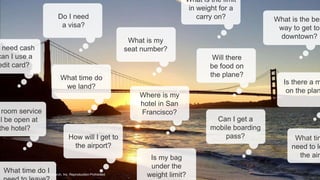
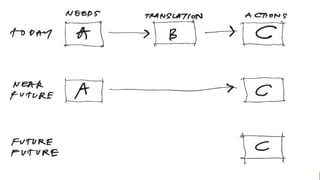
  • #25 A couple of months ago I was in Auckland and I had to get to Sydney.
  • #26 In my head, I started thinking about all the things I would need to do to get there – to make it happen.
  • #27 Then I thought about all the apps or websites I would need to use to get this stuff done.
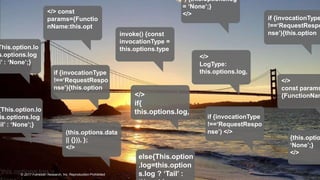
  • #28 Then I translated all of these actions into IF/THEN statements or INPUTS for Apps that I needed to slog through to get the outputs or outcomes that I wanted. That’s how I get things done today. That’s how I get to Sydney. That is the “state of digital experiences.”
  • #33 Most of you build service in this top layer today.