Actionable Steps to Elevating your
IT Service Management
Kevin J Smith
Dave Martinez
July 18, 2018
Housekeeping
• All callers on Mute. Please also mute on your side if possible
in case there are any Webex issues
• Enter Questions with the Q&A feature. Will follow up after
broadcast
• Session will be recorded and distributed later
• Follow on Twitter:
• #ivantiwebinars
• @kevinjsmith4IT
Agenda
 Overview
 Why the need for continual improvement
 How attainment makes a difference
 What are the characteristics of attainment
 Recommendations
Why we need Continual Improvement
 Competitive pressure for new features faster
 Business changes – M&A, new markets, new offerings
 Business expectations not being met by IT services
 Cost pressure to utilize cloud and outsourcing
 Growing diversity in supplier portfolio
 Increasing compliance and regulatory oversight
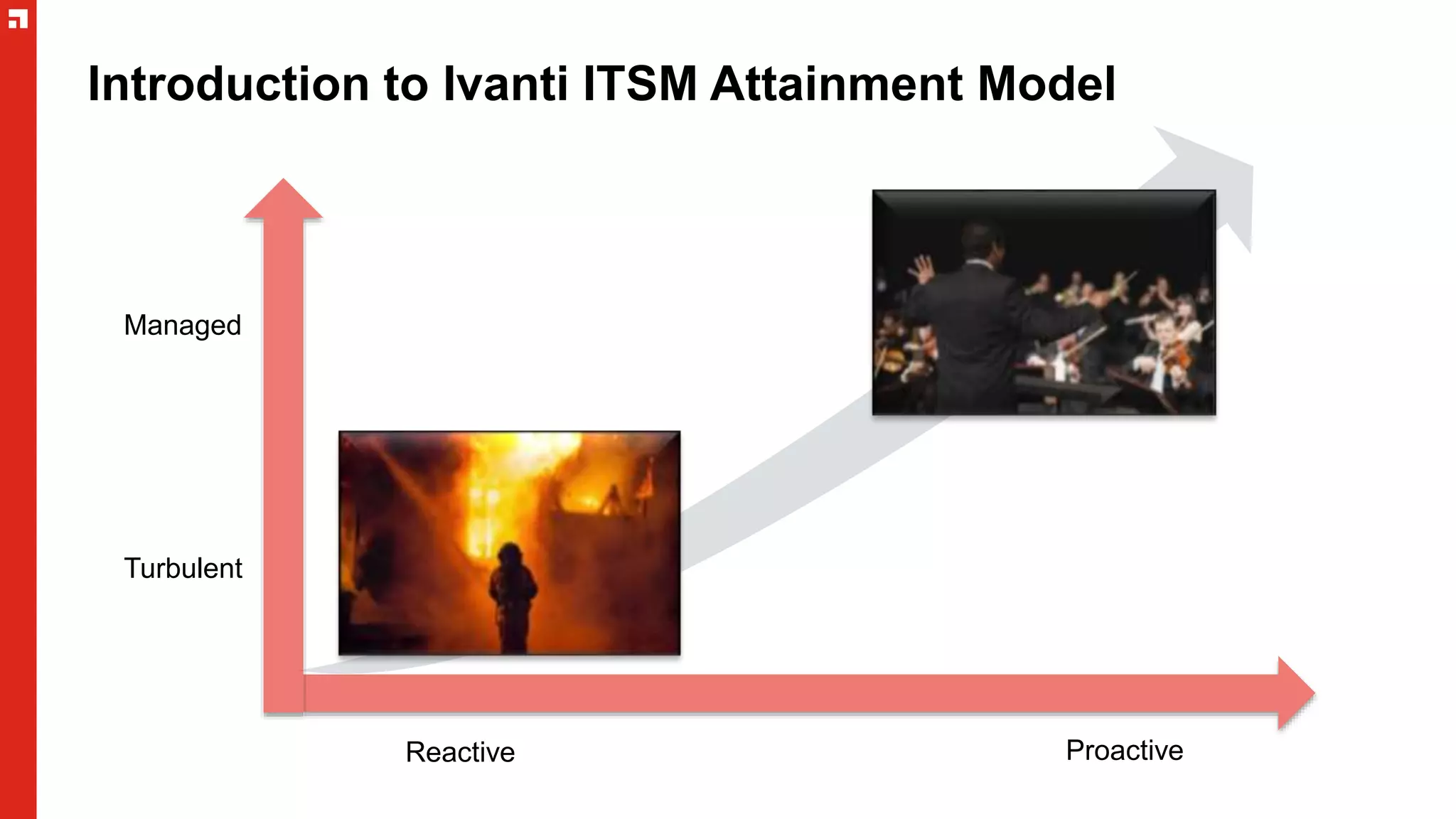
Introduction to Ivanti ITSM Attainment Model
Reactive Proactive
Turbulent
Managed
Introduction to Ivanti ITSM Attainment Model
 Digital transformation for business agility requires operational
excellence
 Provides a roadmap for next steps
 Model helps customers build the business case for
investment
 Customers should strive to mature their ITSM discipline to
achieve a level of visibility and insight that makes their
organization nimble, cost transparent and reduces risk
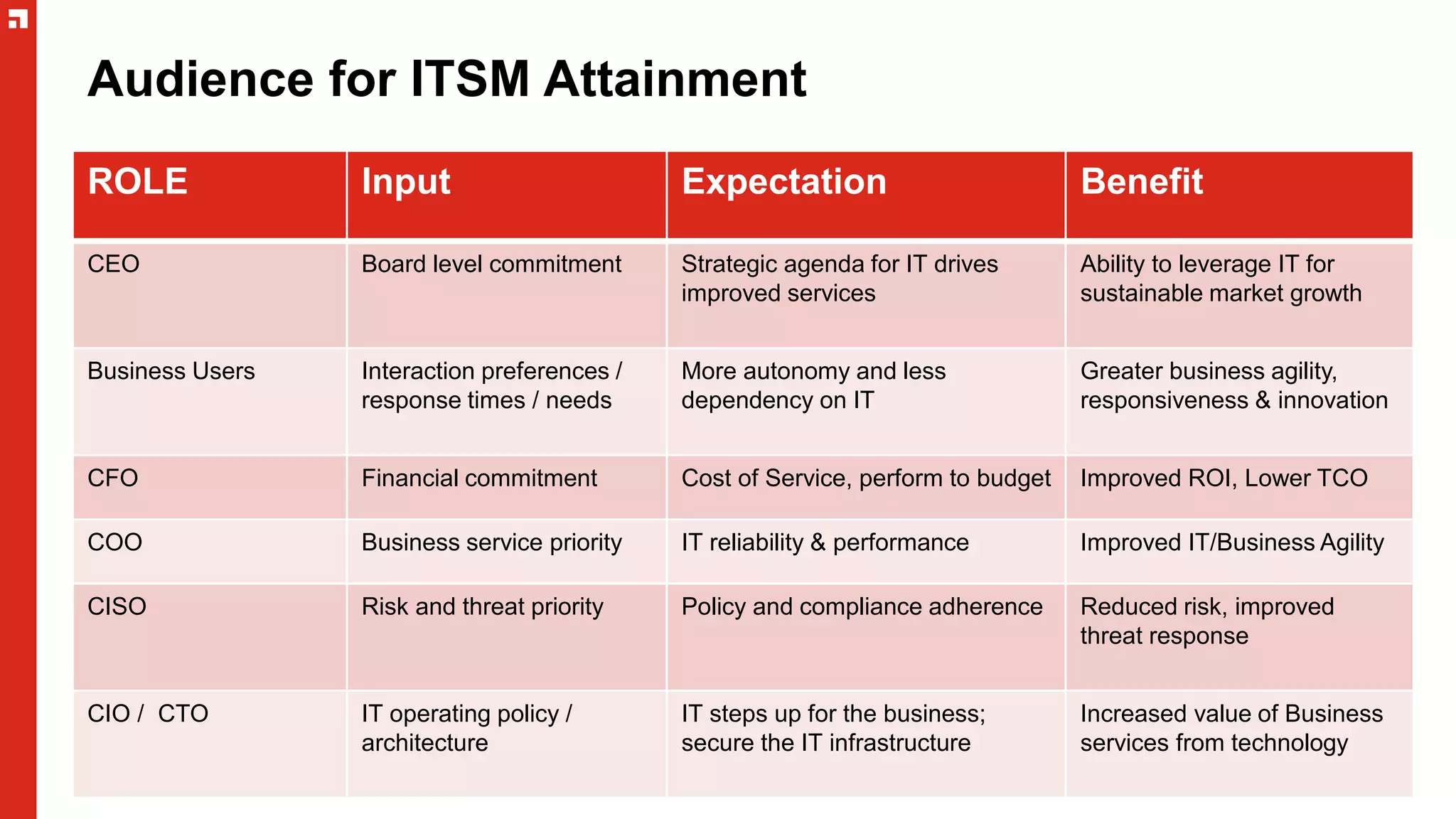
Audience for ITSM Attainment
ROLE Input Expectation Benefit
CEO Board level commitment Strategic agenda for IT drives
improved services
Ability to leverage IT for
sustainable market growth
Business Users Interaction preferences /
response times / needs
More autonomy and less
dependency on IT
Greater business agility,
responsiveness & innovation
CFO Financial commitment Cost of Service, perform to budget Improved ROI, Lower TCO
COO Business service priority IT reliability & performance Improved IT/Business Agility
CISO Risk and threat priority Policy and compliance adherence Reduced risk, improved
threat response
CIO / CTO IT operating policy /
architecture
IT steps up for the business;
secure the IT infrastructure
Increased value of Business
services from technology
Drivers for ITSM Attainment Advancement
Production Outages
Slow to resolve issues
Lack of focus on business critical issues
Too long to approve and release changes
Inability to track and govern actions for audit
Lack of planning and predictability
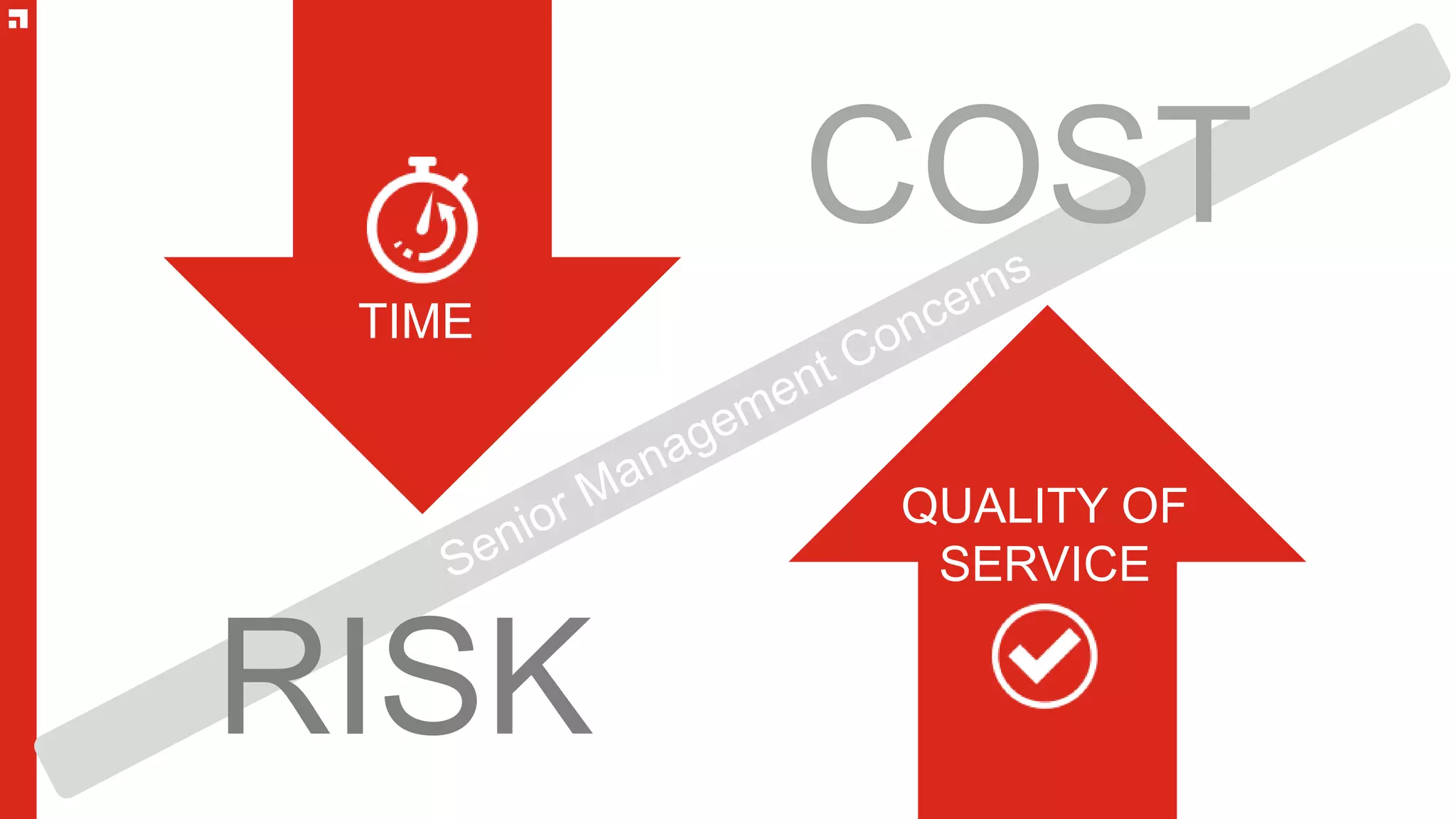
QUALITY – PERFORMANCE - COST
TIME
QUALITY OF
SERVICE
RISK
COST
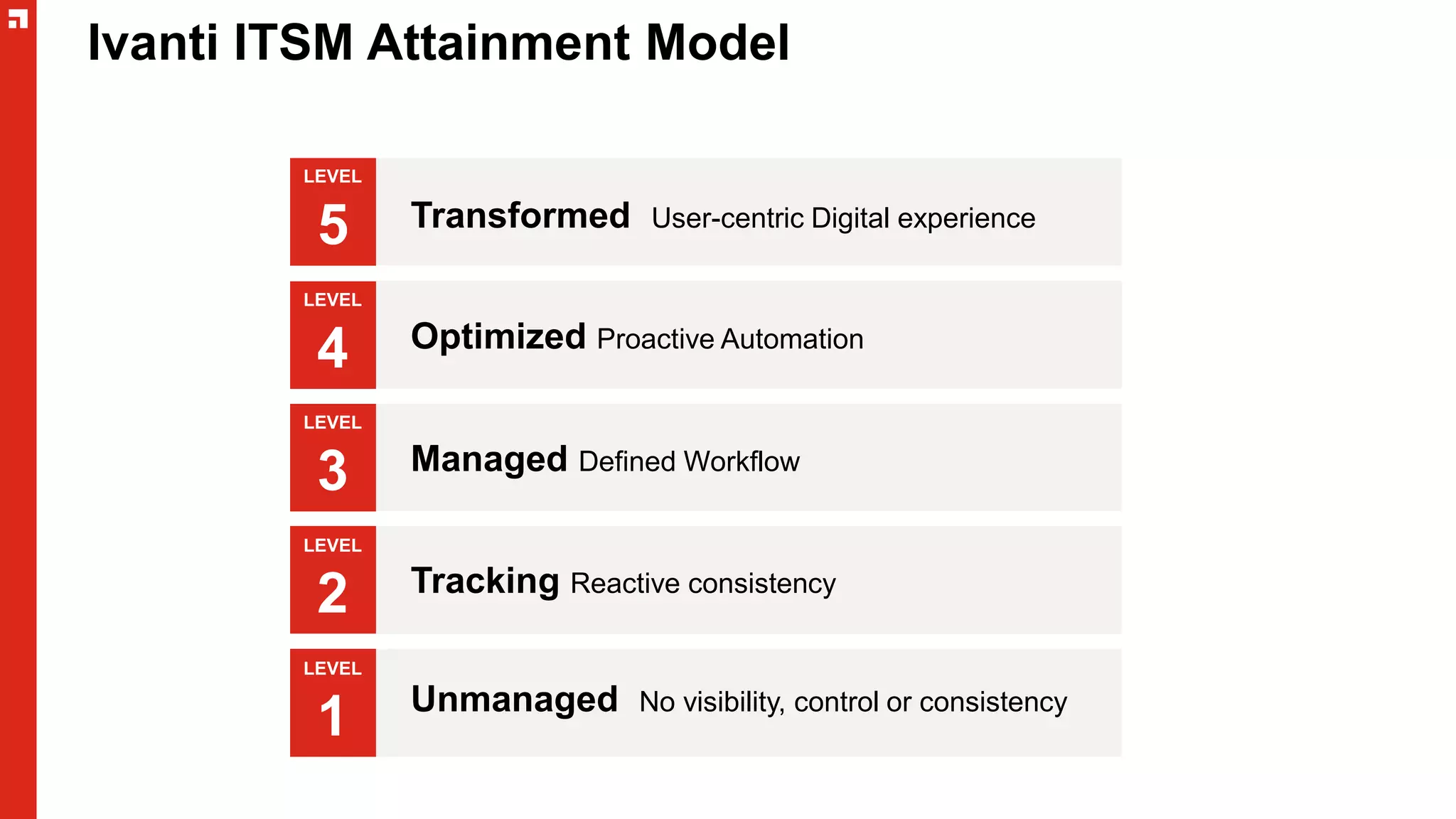
Ivanti ITSM Attainment Model
LEVEL
5
LEVEL
4
LEVEL
3
LEVEL
2
LEVEL
1 Unmanaged No visibility, control or consistency
Tracking Reactive consistency
Managed Defined Workflow
Optimized Proactive Automation
Transformed User-centric Digital experience
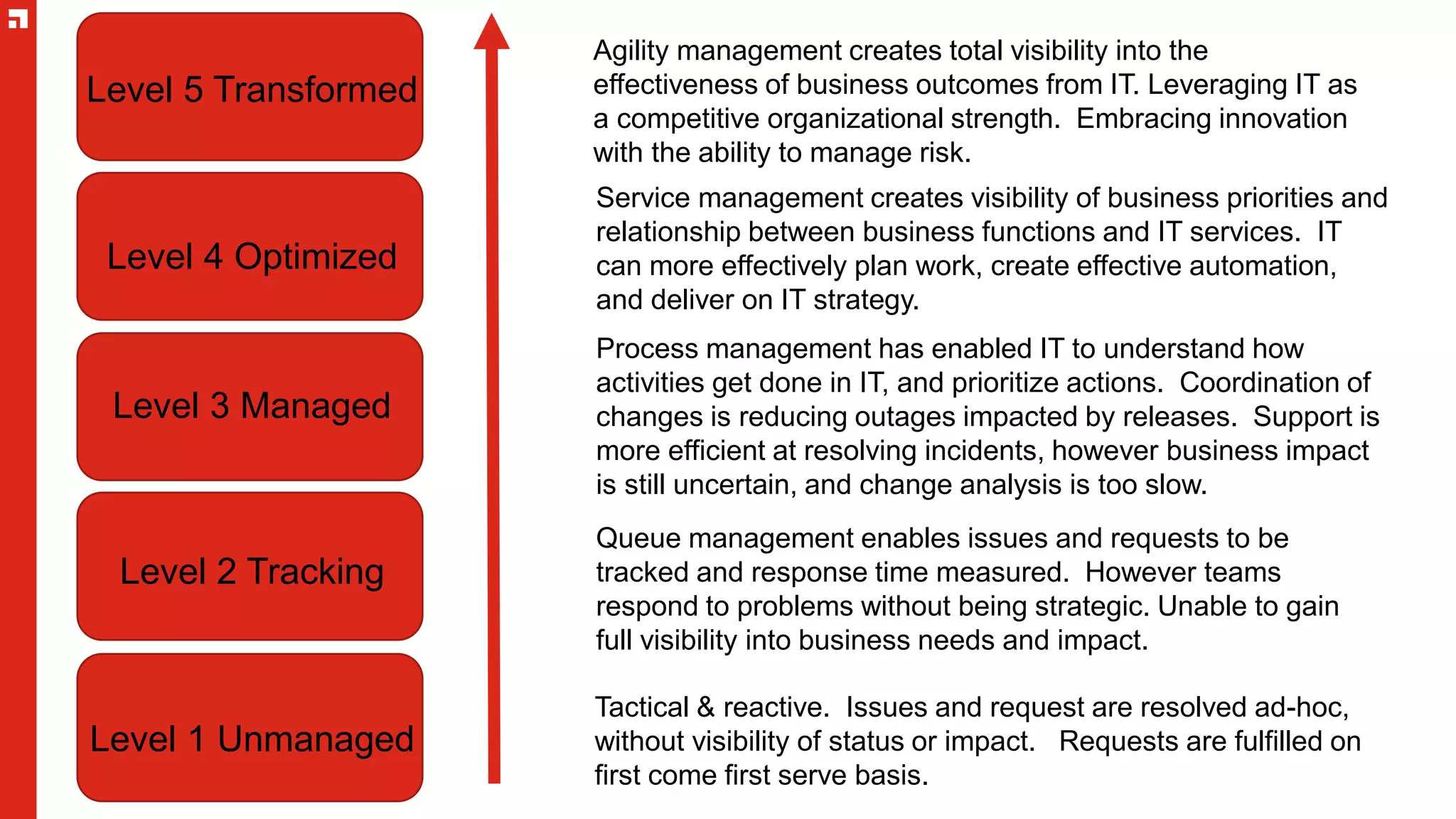
Level 1 Unmanaged
Level 2 Tracking
Level 3 Managed
Level 4 Optimized
Level 5 Transformed
Agility management creates total visibility into the
effectiveness of business outcomes from IT. Leveraging IT as
a competitive organizational strength. Embracing innovation
with the ability to manage risk.
Tactical & reactive. Issues and request are resolved ad-hoc,
without visibility of status or impact. Requests are fulfilled on
first come first serve basis.
Queue management enables issues and requests to be
tracked and response time measured. However teams
respond to problems without being strategic. Unable to gain
full visibility into business needs and impact.
Process management has enabled IT to understand how
activities get done in IT, and prioritize actions. Coordination of
changes is reducing outages impacted by releases. Support is
more efficient at resolving incidents, however business impact
is still uncertain, and change analysis is too slow.
Service management creates visibility of business priorities and
relationship between business functions and IT services. IT
can more effectively plan work, create effective automation,
and deliver on IT strategy.
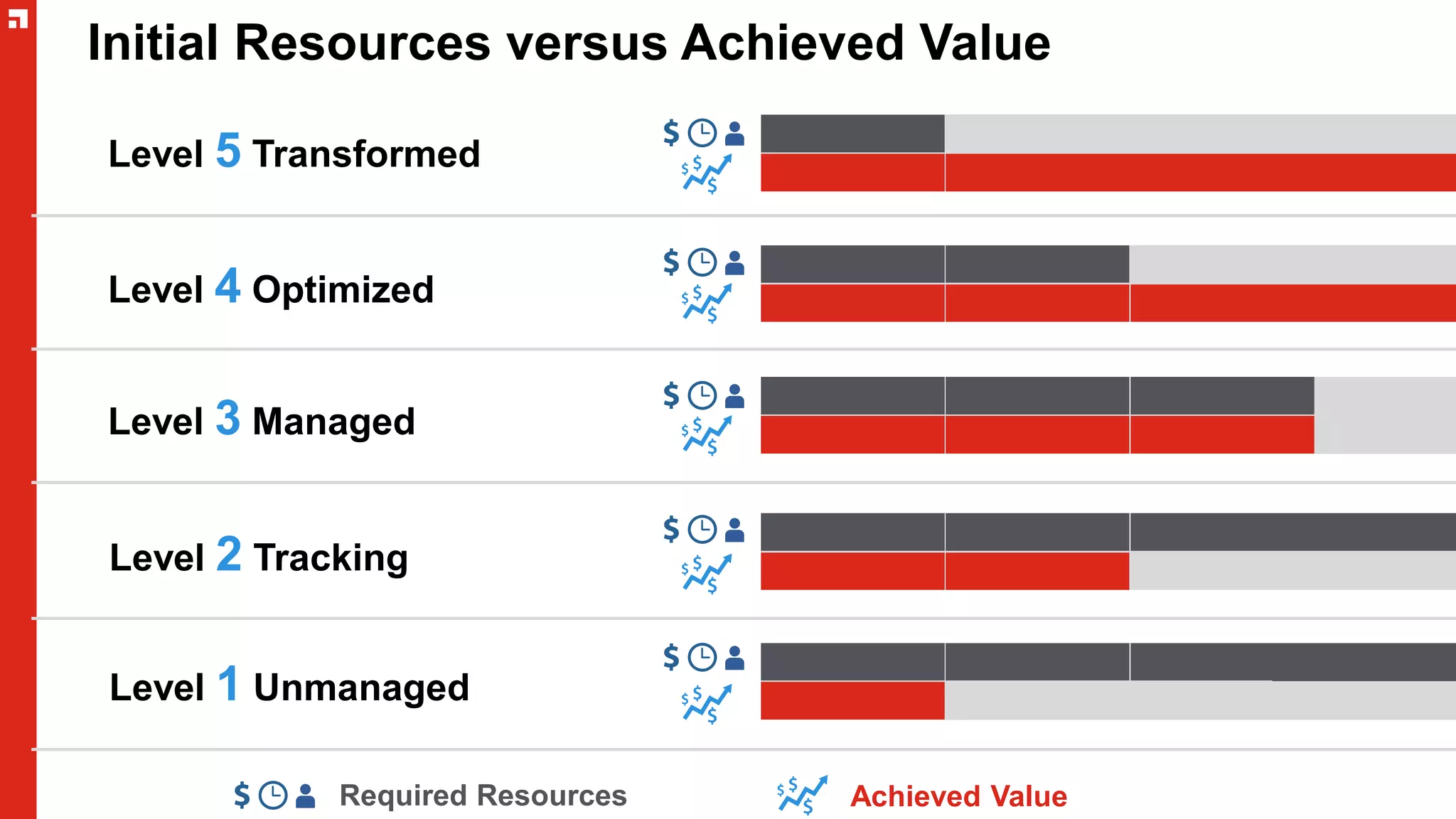
Initial Resources versus Achieved Value
Level 3 Managed
Level 4 Optimized
Level 5 Transformed
Required Resources Achieved Value
Level 2 Tracking
Level 1 Unmanaged
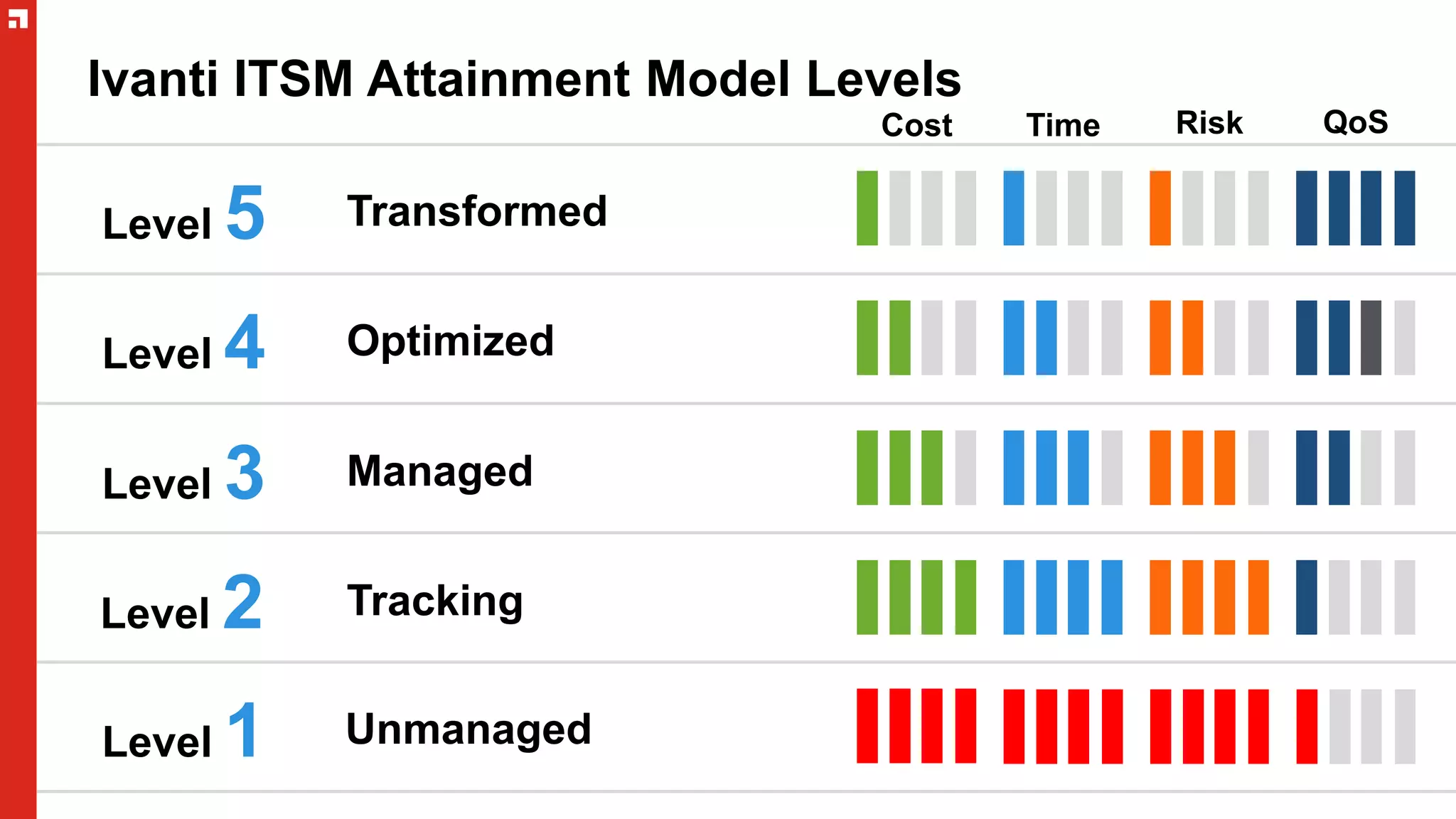
Ivanti ITSM Attainment Model Levels
Tracking
Managed
Optimized
Transformed
Level 1
Level 2
Level 3
Level 4
Level 5
Unmanaged
Cost Time Risk QoS
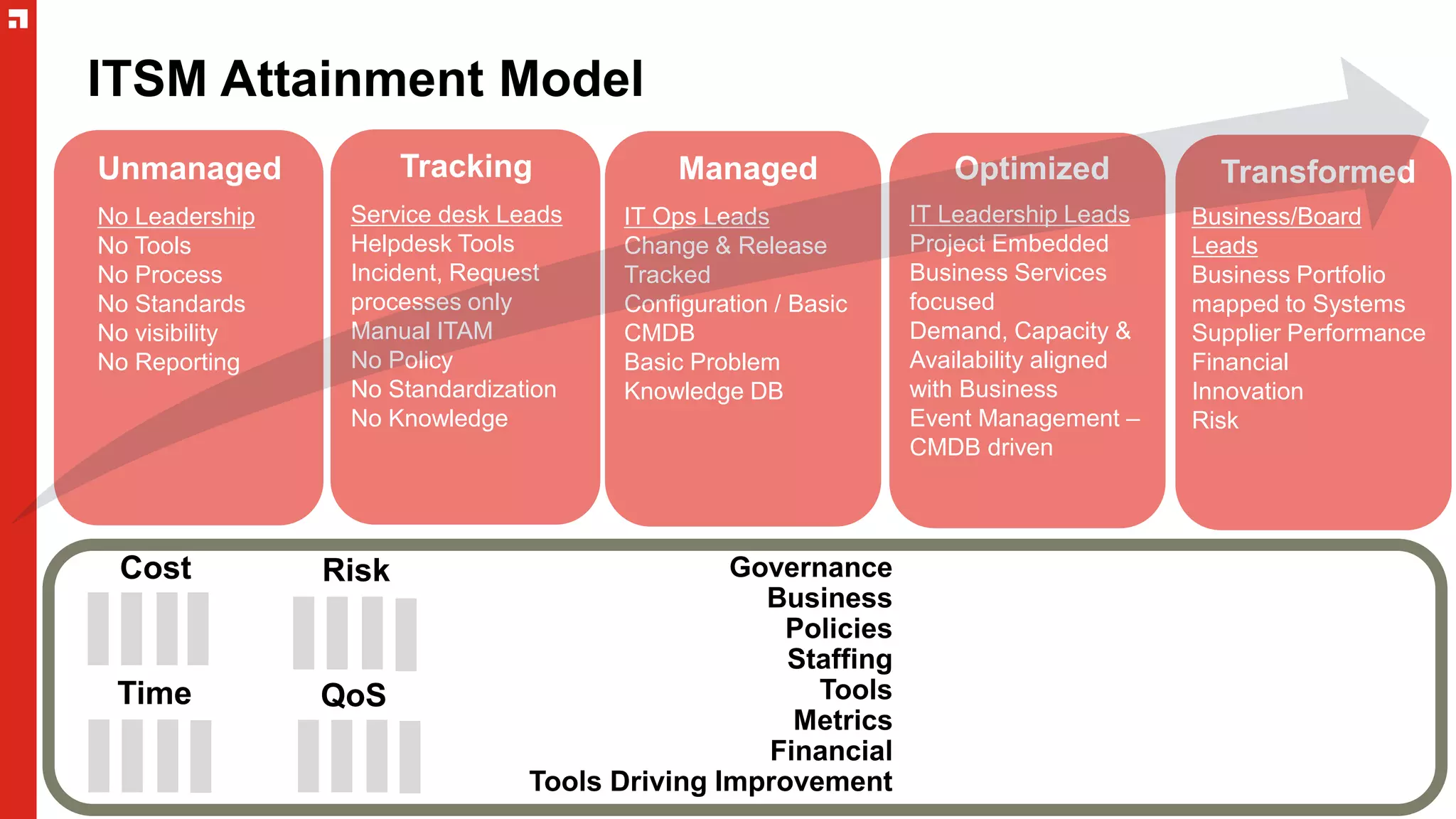
ITSM Attainment Model
Unmanaged Tracking Optimized
No Leadership
No Tools
No Process
No Standards
No visibility
No Reporting
Service desk Leads
Helpdesk Tools
Incident, Request
processes only
Manual ITAM
No Policy
No Standardization
No Knowledge
IT Leadership Leads
Project Embedded
Business Services
focused
Demand, Capacity &
Availability aligned
with Business
Event Management –
CMDB driven
Managed
IT Ops Leads
Change & Release
Tracked
Configuration / Basic
CMDB
Basic Problem
Knowledge DB
Cost
Time
Risk
QoS
Transformed
Business/Board
Leads
Business Portfolio
mapped to Systems
Supplier Performance
Financial
Innovation
Risk
Governance
Business
Policies
Staffing
Tools
Metrics
Financial
Tools Driving Improvement
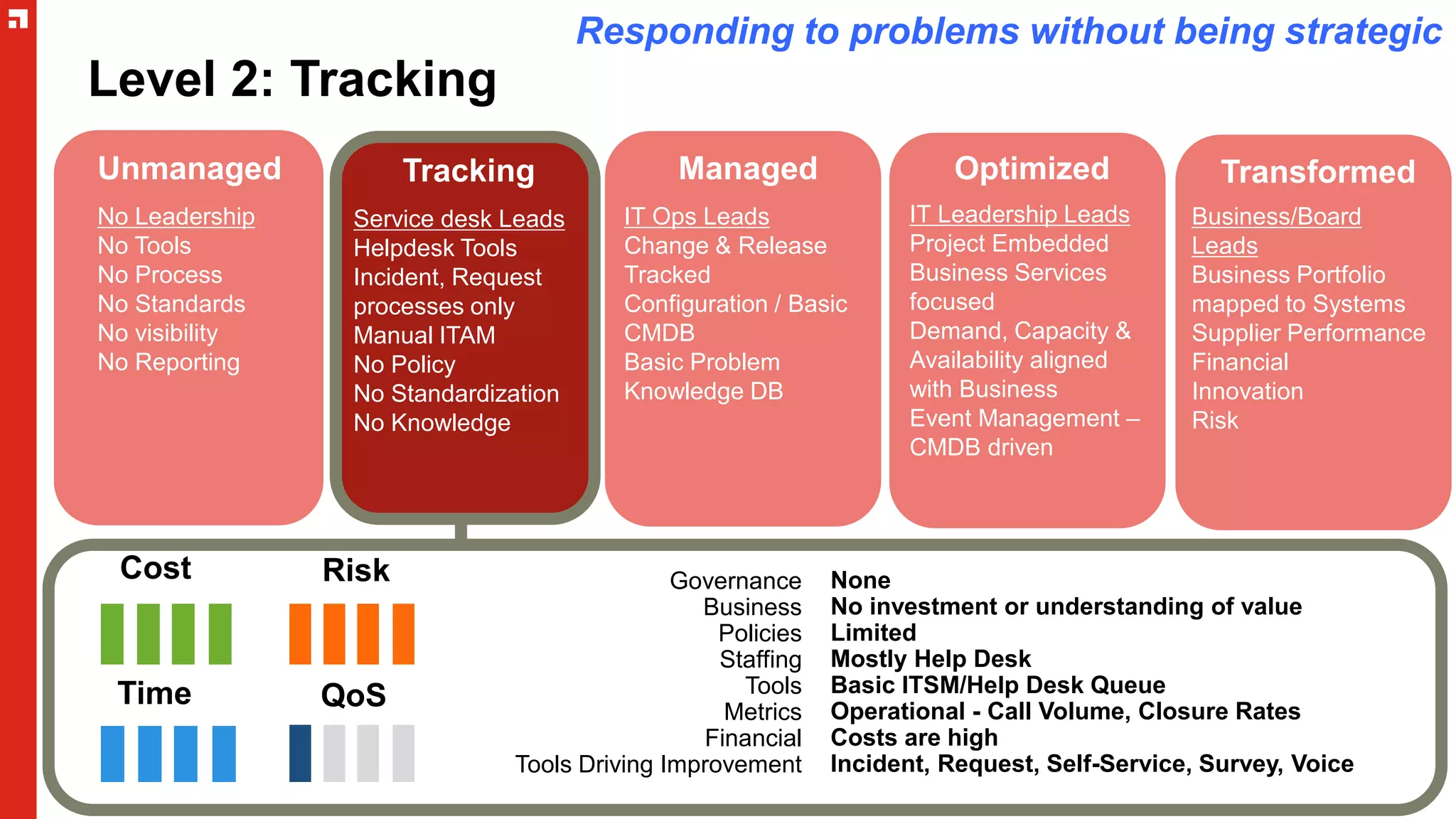
Level 2: Tracking
Unmanaged Optimized
No Leadership
No Tools
No Process
No Standards
No visibility
No Reporting
Service desk Leads
Helpdesk Tools
Incident, Request
processes only
Manual ITAM
No Policy
No Standardization
No Knowledge
IT Leadership Leads
Project Embedded
Business Services
focused
Demand, Capacity &
Availability aligned
with Business
Event Management –
CMDB driven
Managed
IT Ops Leads
Change & Release
Tracked
Configuration / Basic
CMDB
Basic Problem
Knowledge DB
Cost
Time
Risk
QoS
Transformed
Business/Board
Leads
Business Portfolio
mapped to Systems
Supplier Performance
Financial
Innovation
Risk
None
No investment or understanding of value
Limited
Mostly Help Desk
Basic ITSM/Help Desk Queue
Operational - Call Volume, Closure Rates
Costs are high
Incident, Request, Self-Service, Survey, Voice
Governance
Business
Policies
Staffing
Tools
Metrics
Financial
Tools Driving Improvement
Responding to problems without being strategic
Service desk Leads
Helpdesk Tools
Incident, Request
processes only
Manual ITAM
No Policy
No Standardization
No Knowledge
Tracking
Service desk Leads
Helpdesk Tools
Incident, Request
processes only
Manual ITAM
No Policy
No Standardization
No Knowledge
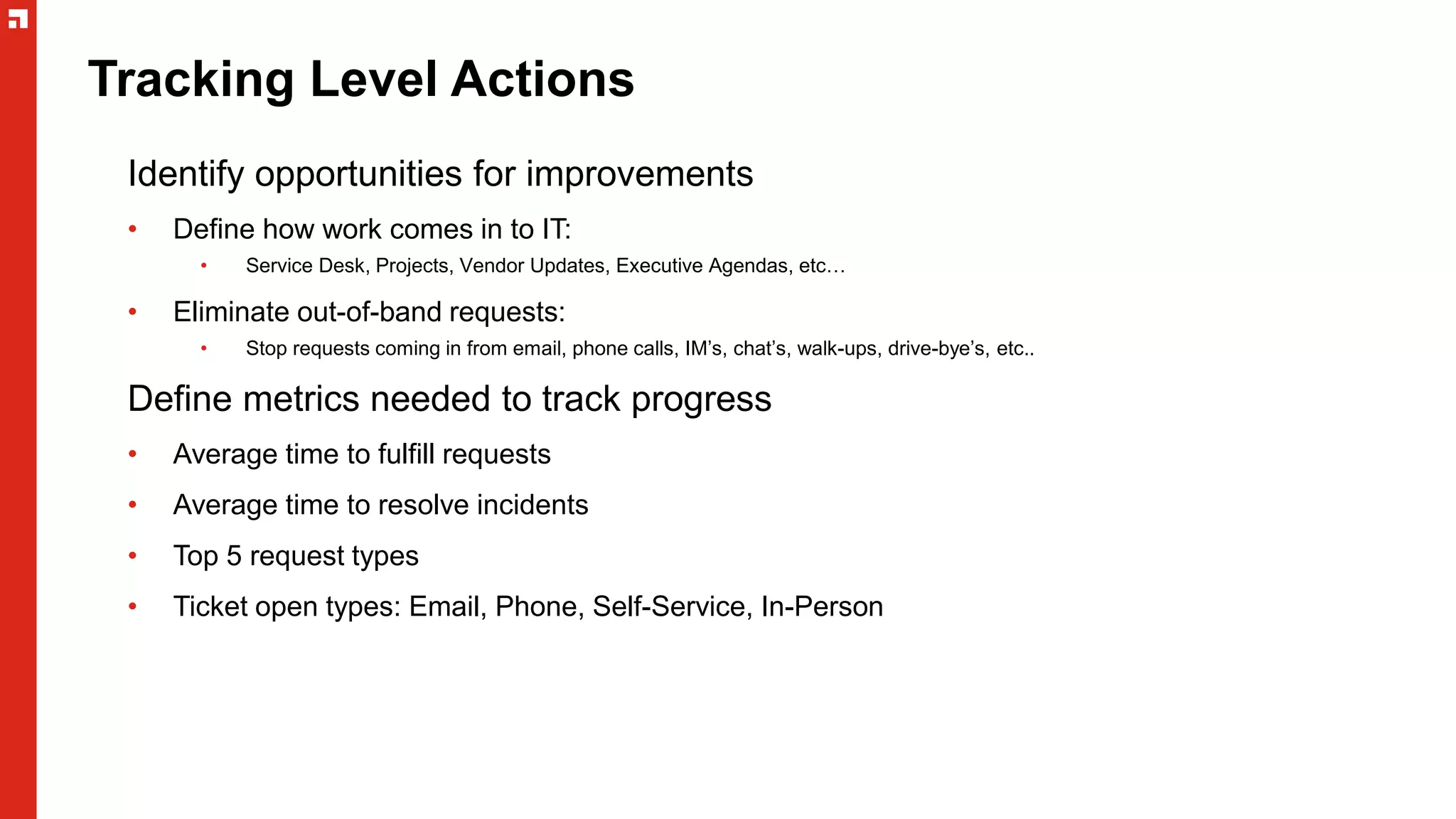
Tracking Level Actions
Identify opportunities for improvements
• Define how work comes in to IT:
• Service Desk, Projects, Vendor Updates, Executive Agendas, etc…
• Eliminate out-of-band requests:
• Stop requests coming in from email, phone calls, IM’s, chat’s, walk-ups, drive-bye’s, etc..
Define metrics needed to track progress
• Average time to fulfill requests
• Average time to resolve incidents
• Top 5 request types
• Ticket open types: Email, Phone, Self-Service, In-Person
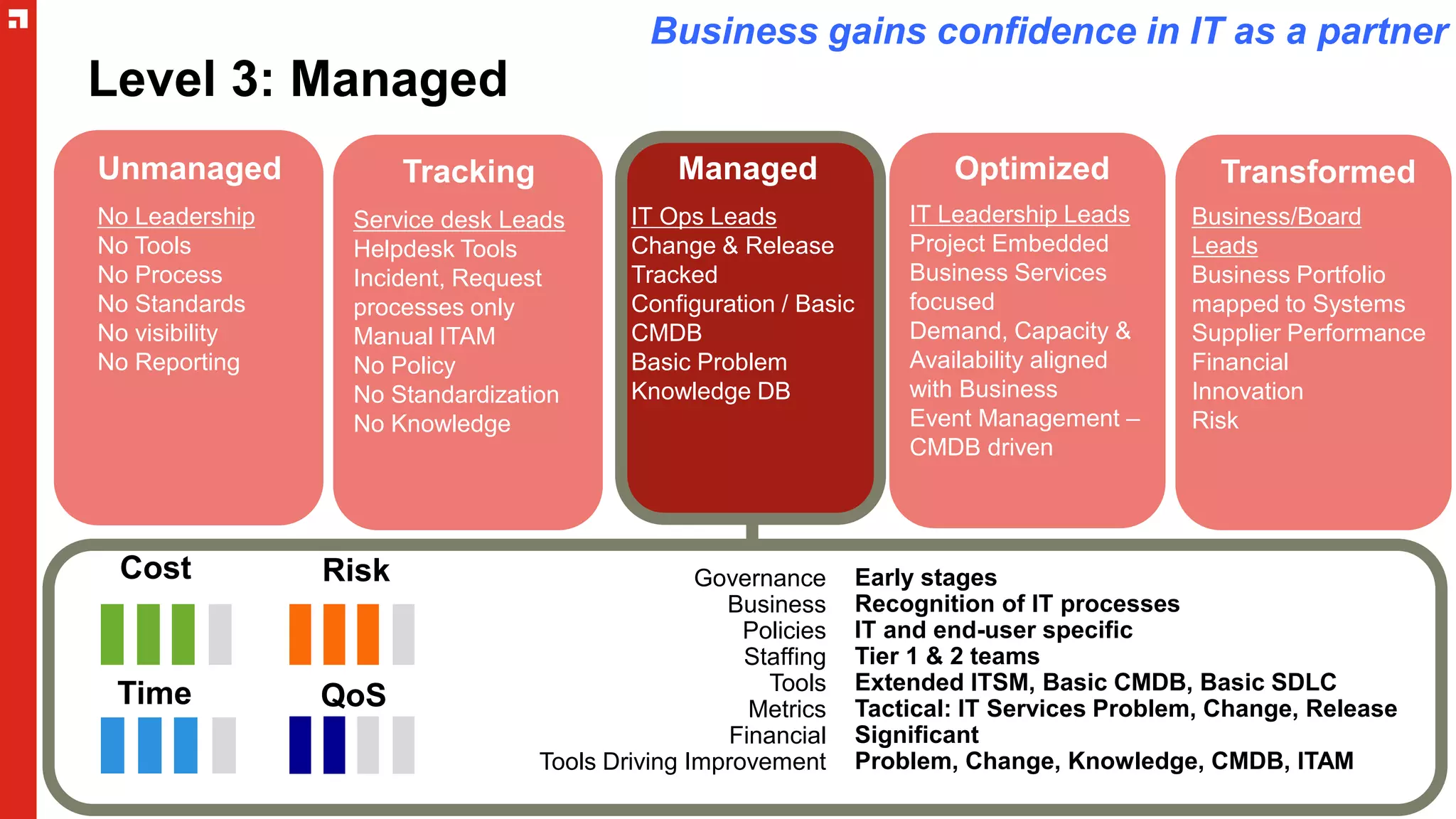
Level 3: Managed
Unmanaged Initial Optimized
No Leadership
No Tools
No Process
No Standards
No visibility
No Reporting
Service desk Leads
Helpdesk Tools
Incident, Request
processes only
Manual ITAM
No Policy
No Standardization
No Knowledge
IT Leadership Leads
Project Embedded
Business Services
focused
Demand, Capacity &
Availability aligned
with Business
Event Management –
CMDB driven
Cost
Time
Risk
QoS
Transformed
Business/Board
Leads
Business Portfolio
mapped to Systems
Supplier Performance
Financial
Innovation
Risk
Business gains confidence in IT as a partner
Managed
IT Ops Leads
Change & Release
Tracked
Configuration / Basic
CMDB
Basic Problem
Knowledge DB
Tracking
Service desk Leads
Helpdesk Tools
Incident, Request
processes only
Manual ITAM
No Policy
No Standardization
No Knowledge
Early stages
Recognition of IT processes
IT and end-user specific
Tier 1 & 2 teams
Extended ITSM, Basic CMDB, Basic SDLC
Tactical: IT Services Problem, Change, Release
Significant
Problem, Change, Knowledge, CMDB, ITAM
Governance
Business
Policies
Staffing
Tools
Metrics
Financial
Tools Driving Improvement
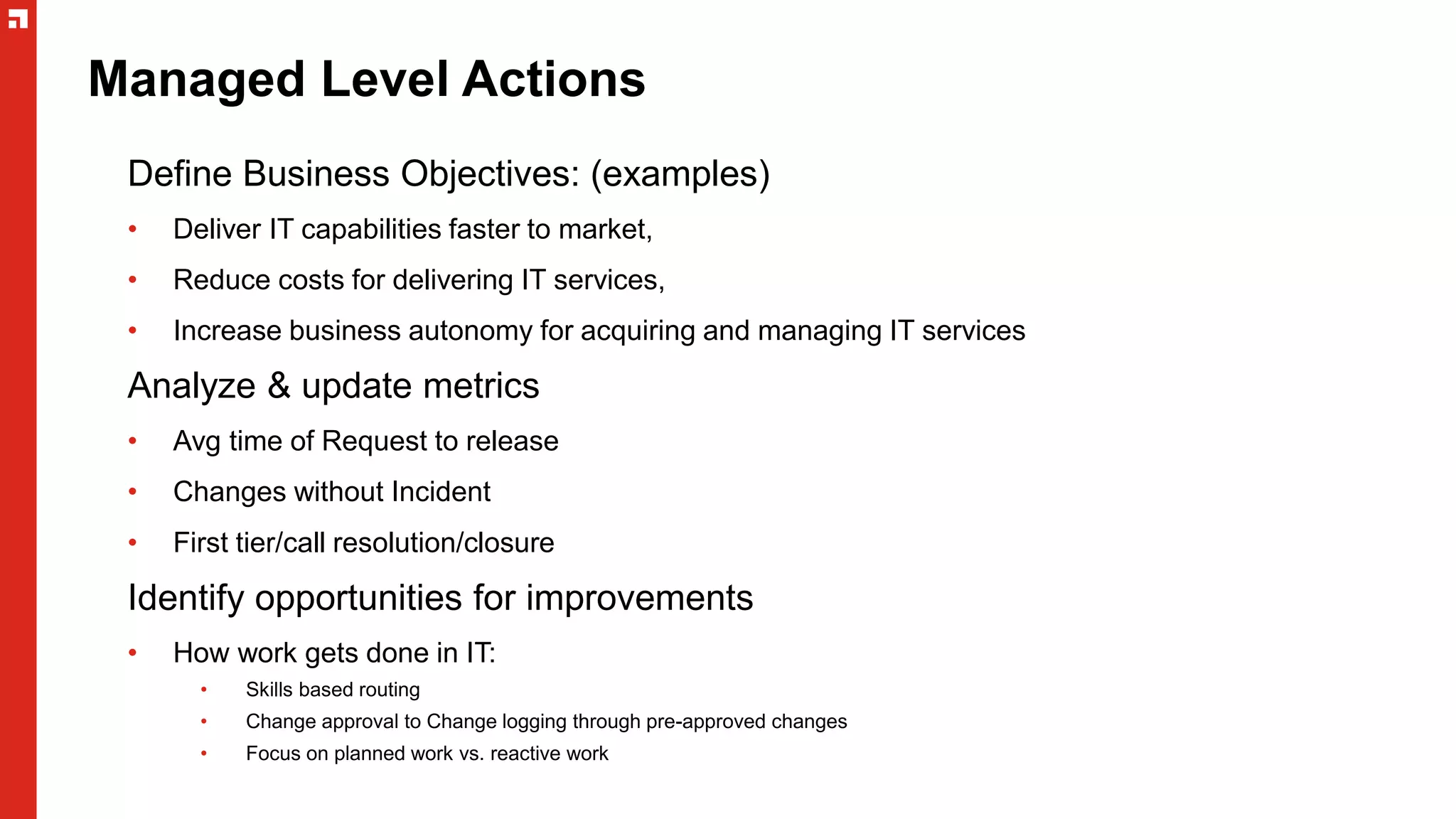
Managed Level Actions
Define Business Objectives: (examples)
• Deliver IT capabilities faster to market,
• Reduce costs for delivering IT services,
• Increase business autonomy for acquiring and managing IT services
Analyze & update metrics
• Avg time of Request to release
• Changes without Incident
• First tier/call resolution/closure
Identify opportunities for improvements
• How work gets done in IT:
• Skills based routing
• Change approval to Change logging through pre-approved changes
• Focus on planned work vs. reactive work
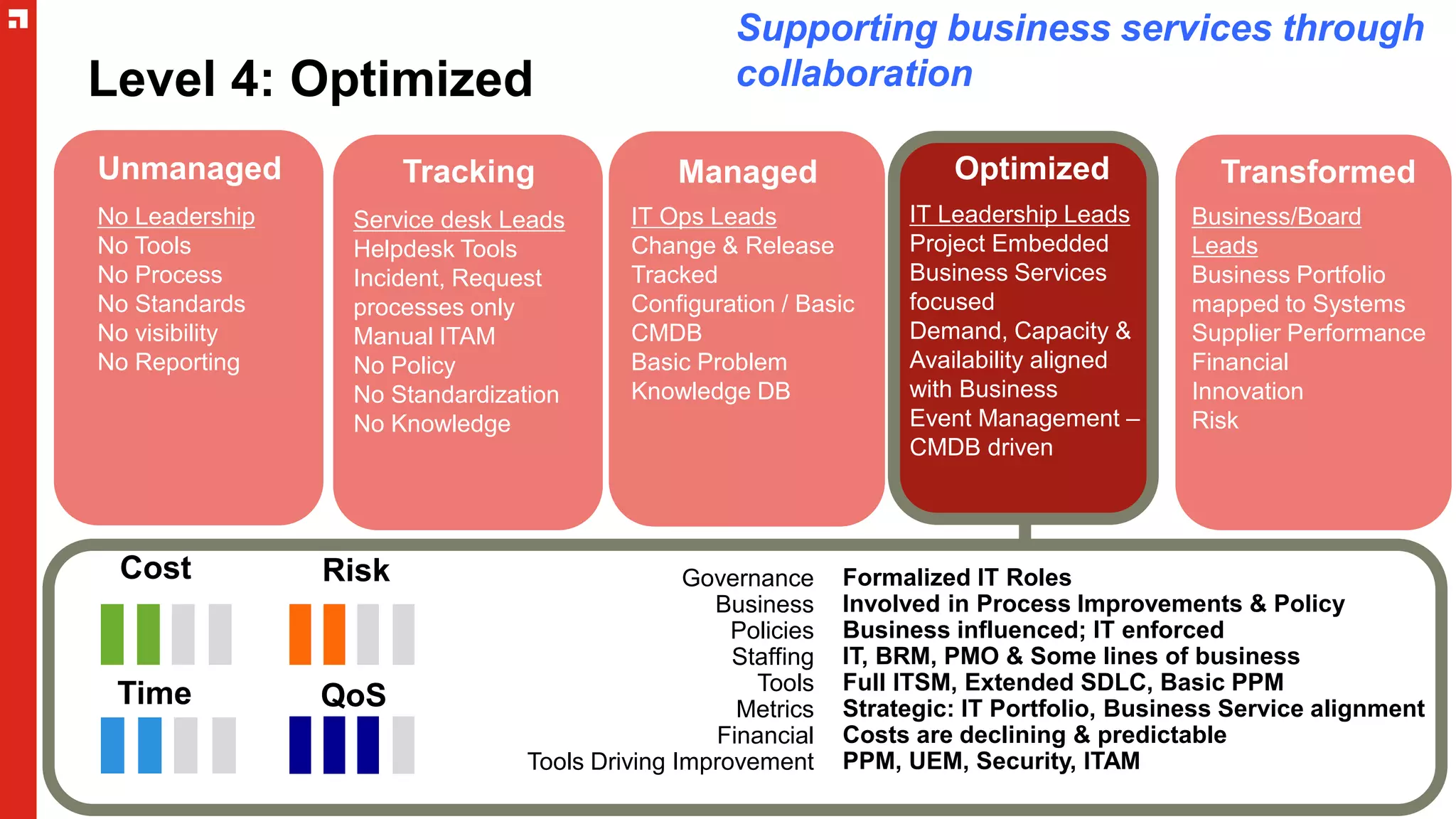
Level 4: Optimized
Unmanaged Optimized
No Leadership
No Tools
No Process
No Standards
No visibility
No Reporting
Service desk Leads
Helpdesk Tools
Incident, Request
processes only
Manual ITAM
No Policy
No Standardization
No Knowledge
Cost
Time
Risk
QoS
Transformed
Business/Board
Leads
Business Portfolio
mapped to Systems
Supplier Performance
Financial
Innovation
Risk
Supporting business services through
collaboration
Managed
IT Ops Leads
Change & Release
Tracked
Configuration / Basic
CMDB
Basic Problem
Knowledge DB
Tracking
Service desk Leads
Helpdesk Tools
Incident, Request
processes only
Manual ITAM
No Policy
No Standardization
No Knowledge
Formalized IT Roles
Involved in Process Improvements & Policy
Business influenced; IT enforced
IT, BRM, PMO & Some lines of business
Full ITSM, Extended SDLC, Basic PPM
Strategic: IT Portfolio, Business Service alignment
Costs are declining & predictable
PPM, UEM, Security, ITAM
Governance
Business
Policies
Staffing
Tools
Metrics
Financial
Tools Driving Improvement
IT Leadership Leads
Project Embedded
Business Services
focused
Demand, Capacity &
Availability aligned
with Business
Event Management –
CMDB driven
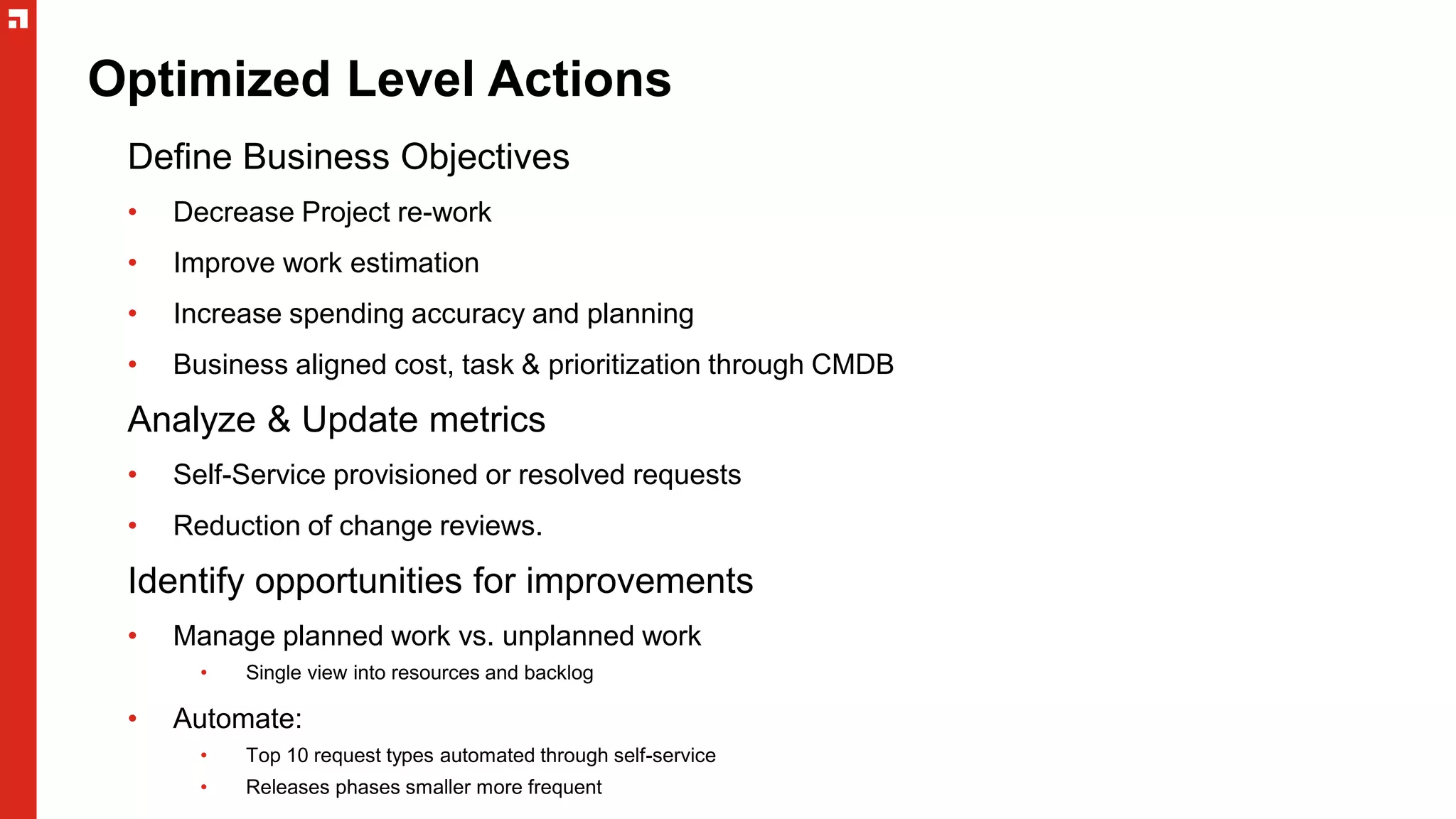
Optimized Level Actions
Define Business Objectives
• Decrease Project re-work
• Improve work estimation
• Increase spending accuracy and planning
• Business aligned cost, task & prioritization through CMDB
Analyze & Update metrics
• Self-Service provisioned or resolved requests
• Reduction of change reviews.
Identify opportunities for improvements
• Manage planned work vs. unplanned work
• Single view into resources and backlog
• Automate:
• Top 10 request types automated through self-service
• Releases phases smaller more frequent
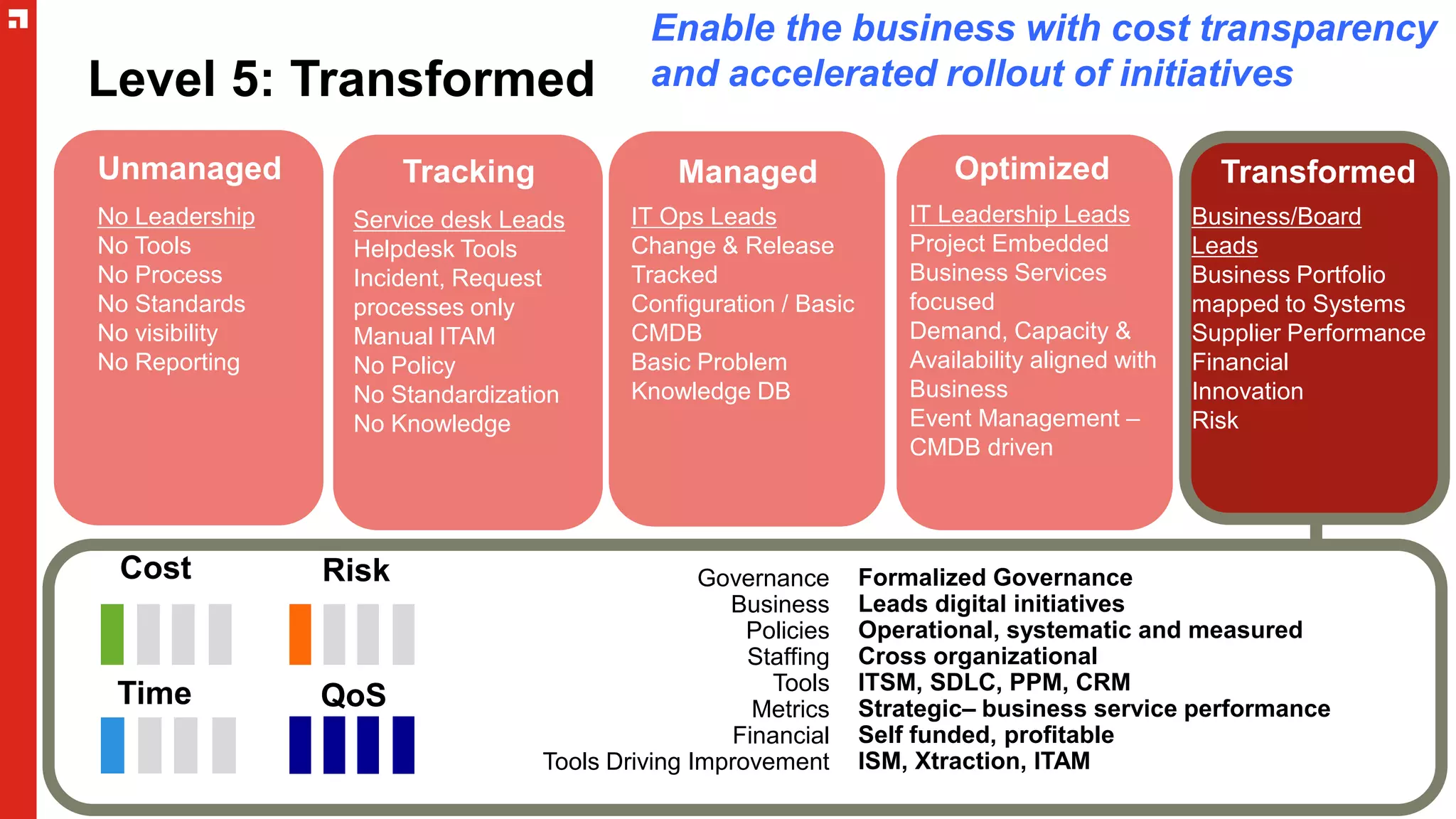
Level 5: Transformed
Unmanaged Optimized
No Leadership
No Tools
No Process
No Standards
No visibility
No Reporting
Service desk Leads
Helpdesk Tools
Incident, Request
processes only
Manual ITAM
No Policy
No Standardization
No Knowledge
IT Leadership Leads
Project Embedded
Business Services
focused
Demand, Capacity &
Availability aligned with
Business
Event Management –
CMDB driven
Cost
Time
Risk
QoS
Transformed
Business/Board
Leads
Business Portfolio
mapped to Systems
Supplier Performance
Financial
Innovation
Risk
Enable the business with cost transparency
and accelerated rollout of initiatives
Managed
IT Ops Leads
Change & Release
Tracked
Configuration / Basic
CMDB
Basic Problem
Knowledge DB
Tracking
Service desk Leads
Helpdesk Tools
Incident, Request
processes only
Manual ITAM
No Policy
No Standardization
No Knowledge
Formalized Governance
Leads digital initiatives
Operational, systematic and measured
Cross organizational
ITSM, SDLC, PPM, CRM
Strategic– business service performance
Self funded, profitable
ISM, Xtraction, ITAM
Governance
Business
Policies
Staffing
Tools
Metrics
Financial
Tools Driving Improvement
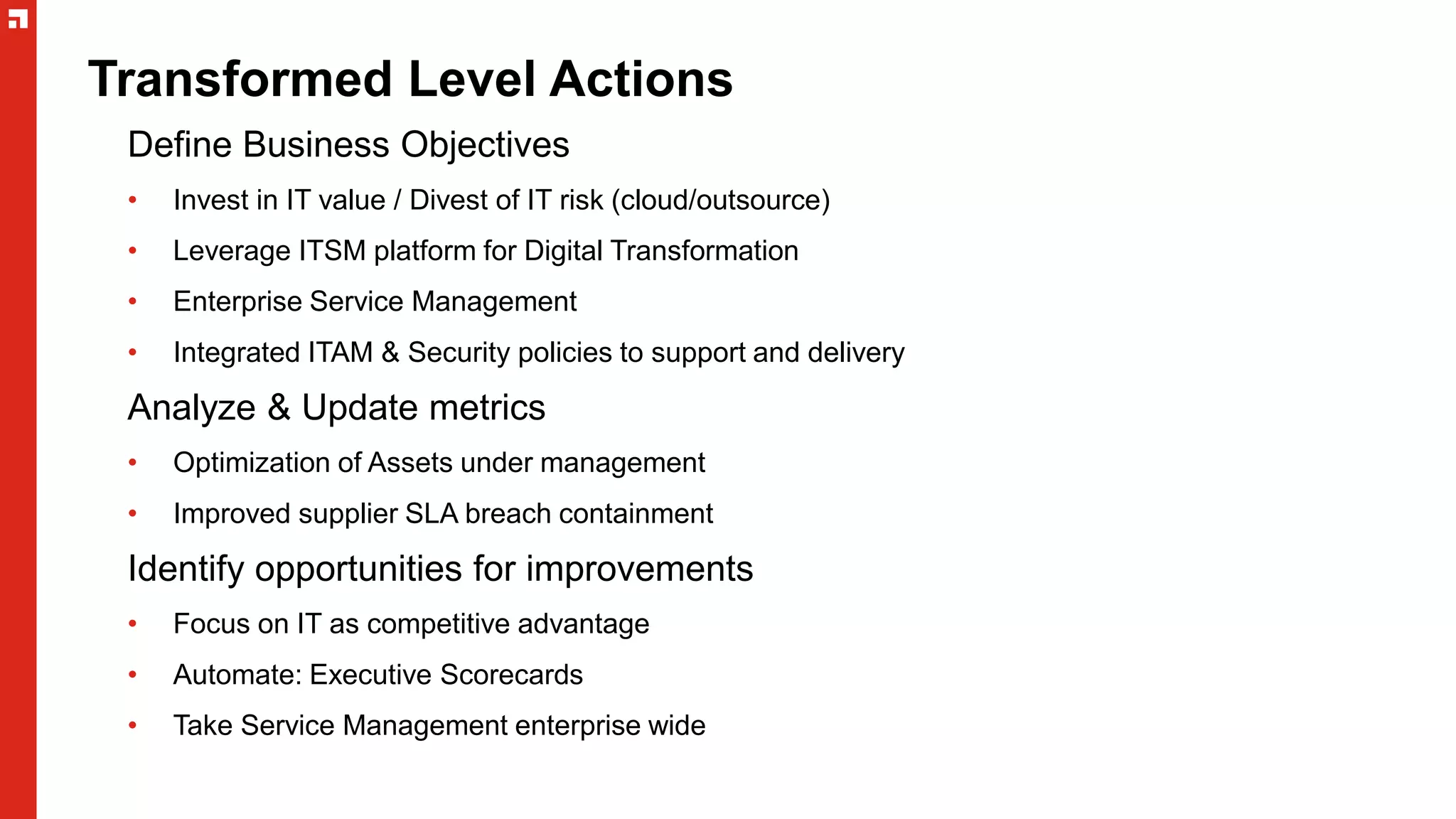
Transformed Level Actions
Define Business Objectives
• Invest in IT value / Divest of IT risk (cloud/outsource)
• Leverage ITSM platform for Digital Transformation
• Enterprise Service Management
• Integrated ITAM & Security policies to support and delivery
Analyze & Update metrics
• Optimization of Assets under management
• Improved supplier SLA breach containment
Identify opportunities for improvements
• Focus on IT as competitive advantage
• Automate: Executive Scorecards
• Take Service Management enterprise wide
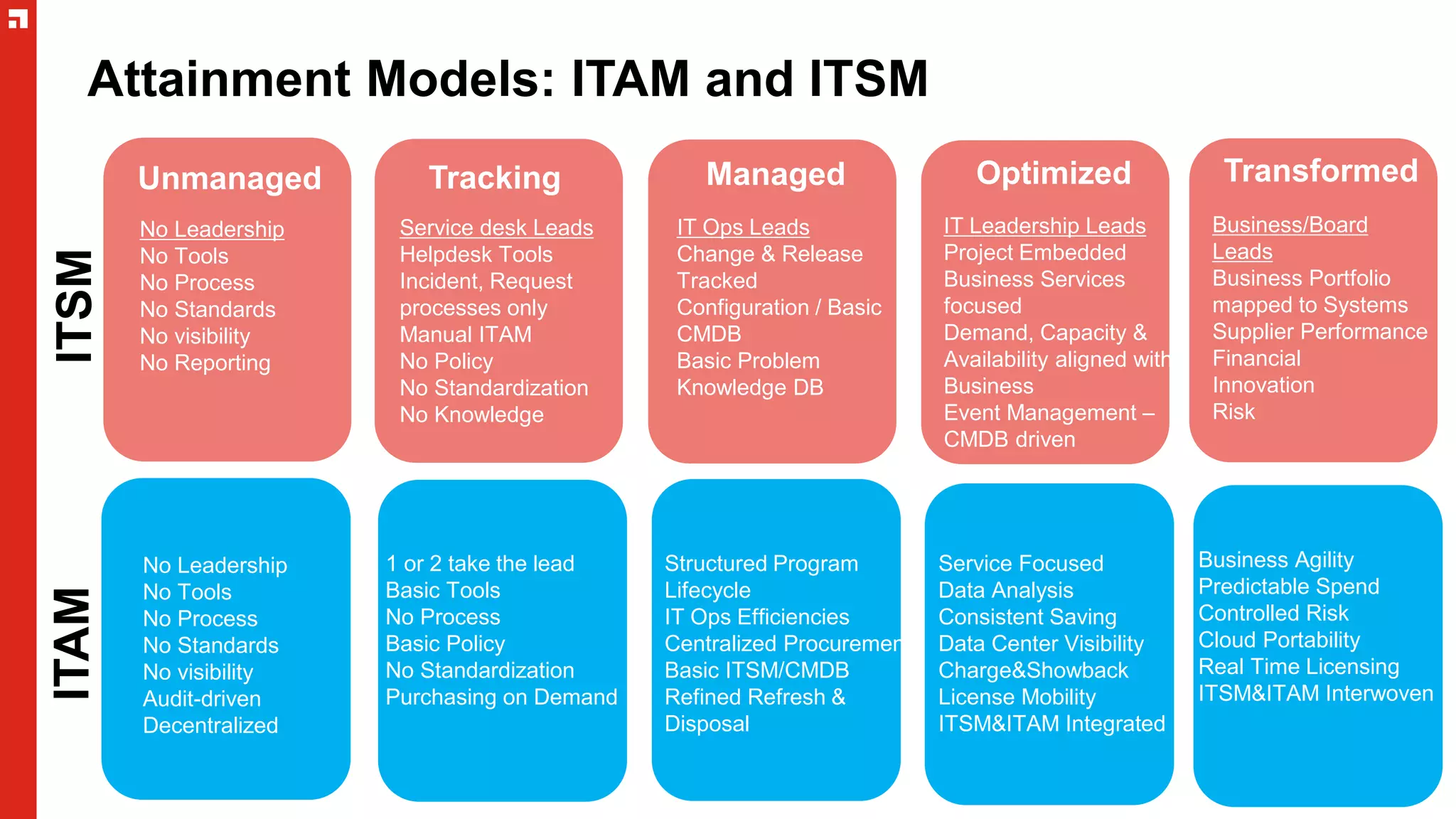
Attainment Models: ITAM and ITSM
Unmanaged
No Leadership
No Tools
No Process
No Standards
No visibility
No Reporting
TransformedOptimizedManagedTracking
Service desk Leads
Helpdesk Tools
Incident, Request
processes only
Manual ITAM
No Policy
No Standardization
No Knowledge
IT Ops Leads
Change & Release
Tracked
Configuration / Basic
CMDB
Basic Problem
Knowledge DB
IT Leadership Leads
Project Embedded
Business Services
focused
Demand, Capacity &
Availability aligned with
Business
Event Management –
CMDB driven
Business/Board
Leads
Business Portfolio
mapped to Systems
Supplier Performance
Financial
Innovation
Risk
ITSMITAM
No Leadership
No Tools
No Process
No Standards
No visibility
Audit-driven
Decentralized
Business Agility
Predictable Spend
Controlled Risk
Cloud Portability
Real Time Licensing
ITSM&ITAM Interwoven
Service Focused
Data Analysis
Consistent Saving
Data Center Visibility
Charge&Showback
License Mobility
ITSM&ITAM Integrated
Structured Program
Lifecycle
IT Ops Efficiencies
Centralized Procurement
Basic ITSM/CMDB
Refined Refresh &
Disposal
1 or 2 take the lead
Basic Tools
No Process
Basic Policy
No Standardization
Purchasing on Demand
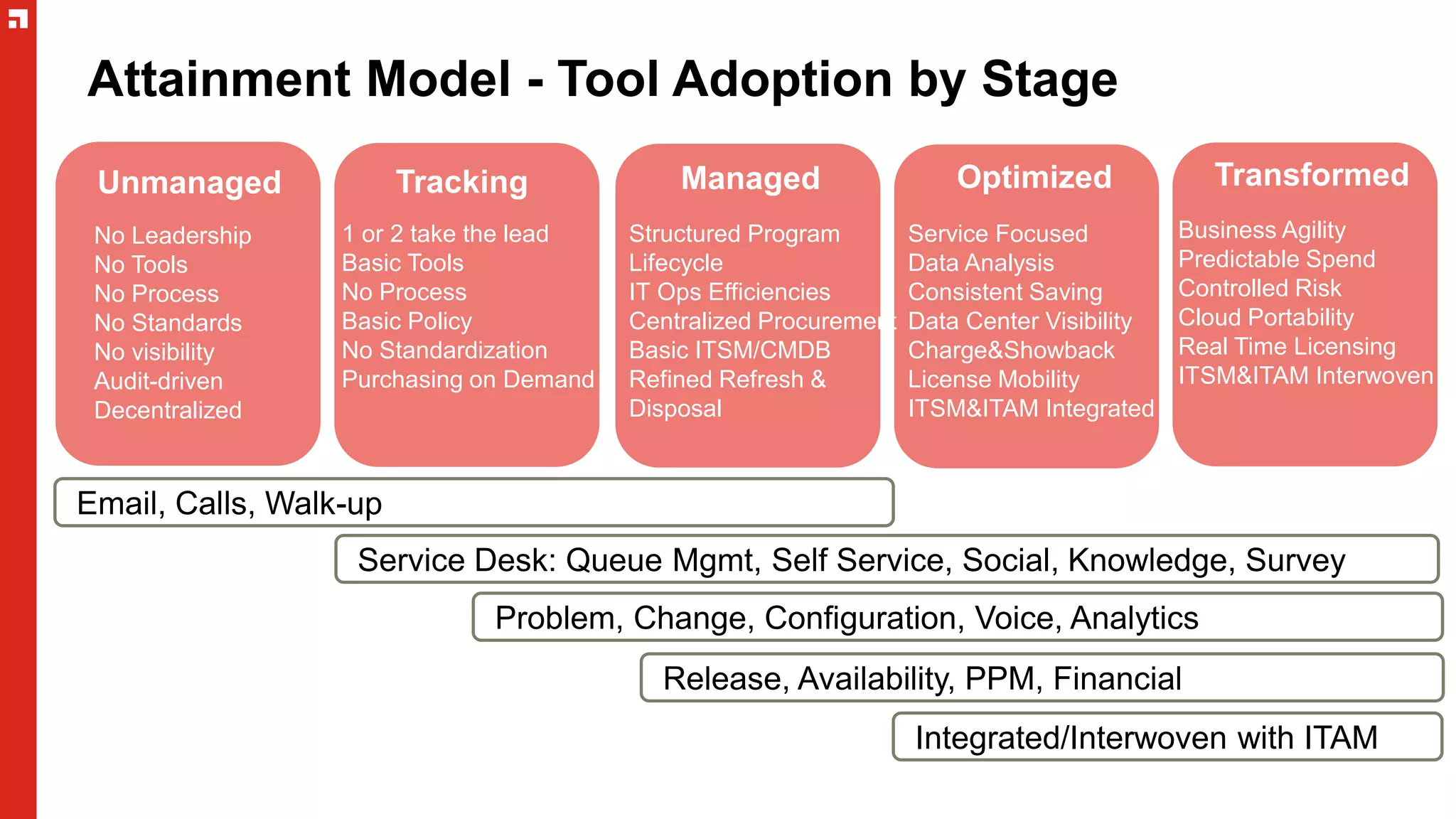
Attainment Model - Tool Adoption by Stage
Unmanaged
No Leadership
No Tools
No Process
No Standards
No visibility
Audit-driven
Decentralized
Transformed
Business Agility
Predictable Spend
Controlled Risk
Cloud Portability
Real Time Licensing
ITSM&ITAM Interwoven
Optimized
Service Focused
Data Analysis
Consistent Saving
Data Center Visibility
Charge&Showback
License Mobility
ITSM&ITAM Integrated
Managed
Structured Program
Lifecycle
IT Ops Efficiencies
Centralized Procurement
Basic ITSM/CMDB
Refined Refresh &
Disposal
Tracking
1 or 2 take the lead
Basic Tools
No Process
Basic Policy
No Standardization
Purchasing on Demand
Email, Calls, Walk-up
Service Desk: Queue Mgmt, Self Service, Social, Knowledge, Survey
Release, Availability, PPM, Financial
Problem, Change, Configuration, Voice, Analytics
Integrated/Interwoven with ITAM
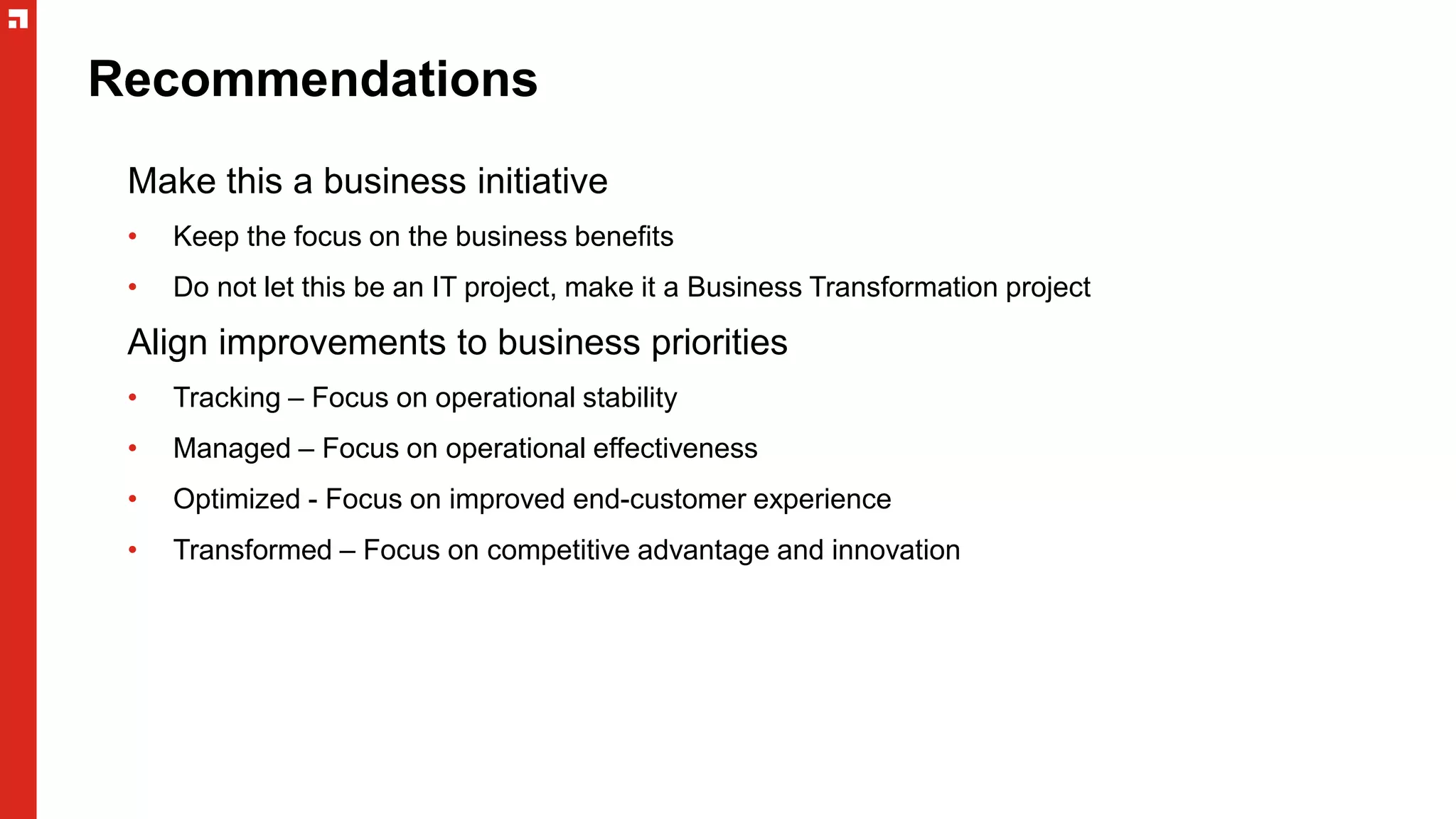
Recommendations
Make this a business initiative
• Keep the focus on the business benefits
• Do not let this be an IT project, make it a Business Transformation project
Align improvements to business priorities
• Tracking – Focus on operational stability
• Managed – Focus on operational effectiveness
• Optimized - Focus on improved end-customer experience
• Transformed – Focus on competitive advantage and innovation
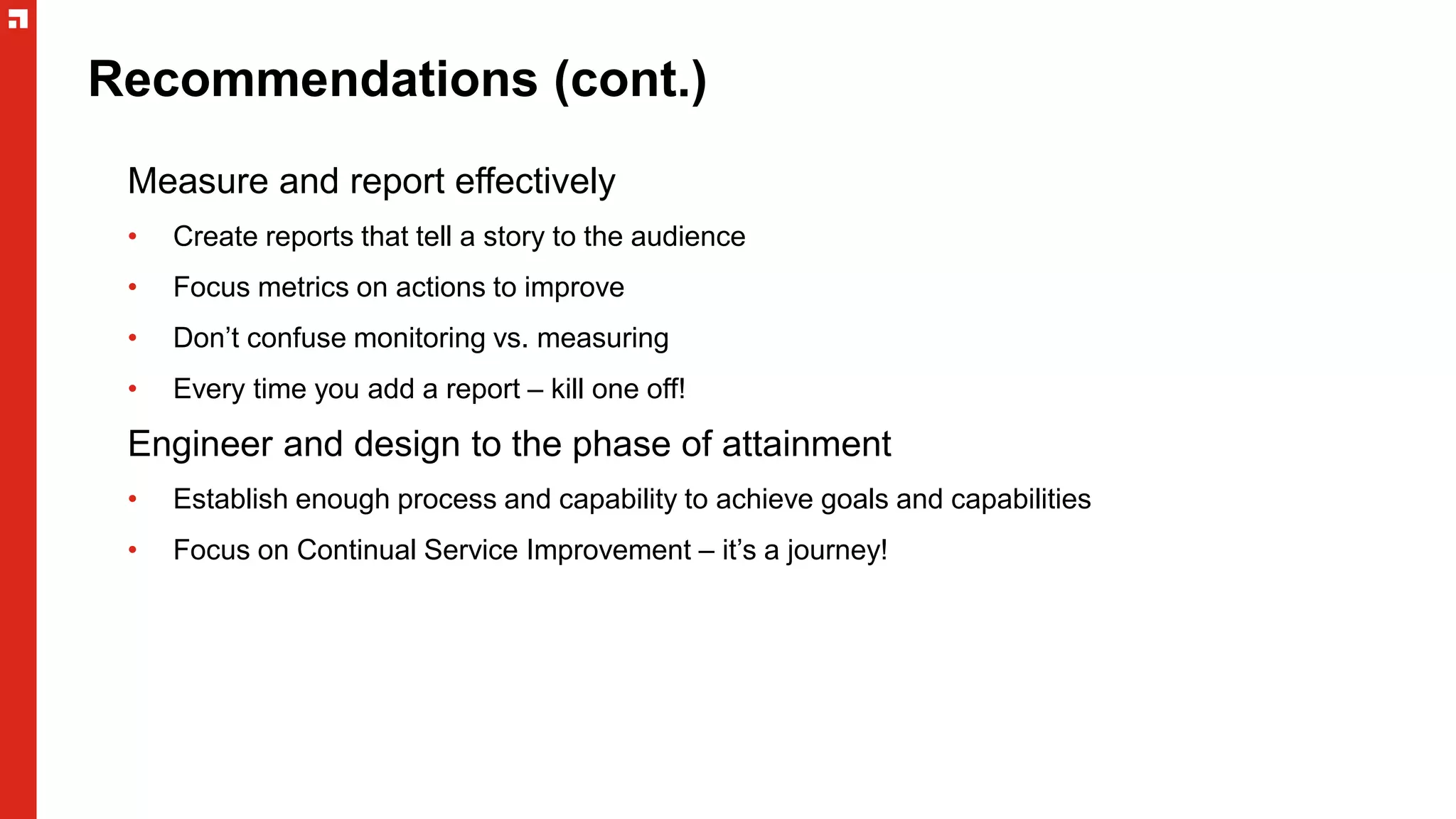
Recommendations (cont.)
Measure and report effectively
• Create reports that tell a story to the audience
• Focus metrics on actions to improve
• Don’t confuse monitoring vs. measuring
• Every time you add a report – kill one off!
Engineer and design to the phase of attainment
• Establish enough process and capability to achieve goals and capabilities
• Focus on Continual Service Improvement – it’s a journey!
Questions?
Our sincere thanks for
joining us and we hope
to see you at another
Ivanti event
Actionable Steps to Elevating your IT Service Management

Actionable Steps to Elevating your IT Service Management

  • 1.
    Actionable Steps toElevating your IT Service Management Kevin J Smith Dave Martinez July 18, 2018
  • 2.
    Housekeeping • All callerson Mute. Please also mute on your side if possible in case there are any Webex issues • Enter Questions with the Q&A feature. Will follow up after broadcast • Session will be recorded and distributed later • Follow on Twitter: • #ivantiwebinars • @kevinjsmith4IT
  • 3.
    Agenda  Overview  Whythe need for continual improvement  How attainment makes a difference  What are the characteristics of attainment  Recommendations
  • 4.
    Why we needContinual Improvement  Competitive pressure for new features faster  Business changes – M&A, new markets, new offerings  Business expectations not being met by IT services  Cost pressure to utilize cloud and outsourcing  Growing diversity in supplier portfolio  Increasing compliance and regulatory oversight
  • 5.
    Introduction to IvantiITSM Attainment Model Reactive Proactive Turbulent Managed
  • 6.
    Introduction to IvantiITSM Attainment Model  Digital transformation for business agility requires operational excellence  Provides a roadmap for next steps  Model helps customers build the business case for investment  Customers should strive to mature their ITSM discipline to achieve a level of visibility and insight that makes their organization nimble, cost transparent and reduces risk
  • 7.
    Audience for ITSMAttainment ROLE Input Expectation Benefit CEO Board level commitment Strategic agenda for IT drives improved services Ability to leverage IT for sustainable market growth Business Users Interaction preferences / response times / needs More autonomy and less dependency on IT Greater business agility, responsiveness & innovation CFO Financial commitment Cost of Service, perform to budget Improved ROI, Lower TCO COO Business service priority IT reliability & performance Improved IT/Business Agility CISO Risk and threat priority Policy and compliance adherence Reduced risk, improved threat response CIO / CTO IT operating policy / architecture IT steps up for the business; secure the IT infrastructure Increased value of Business services from technology
  • 8.
    Drivers for ITSMAttainment Advancement Production Outages Slow to resolve issues Lack of focus on business critical issues Too long to approve and release changes Inability to track and govern actions for audit Lack of planning and predictability QUALITY – PERFORMANCE - COST
  • 9.
  • 10.
    Ivanti ITSM AttainmentModel LEVEL 5 LEVEL 4 LEVEL 3 LEVEL 2 LEVEL 1 Unmanaged No visibility, control or consistency Tracking Reactive consistency Managed Defined Workflow Optimized Proactive Automation Transformed User-centric Digital experience
  • 11.
    Level 1 Unmanaged Level2 Tracking Level 3 Managed Level 4 Optimized Level 5 Transformed Agility management creates total visibility into the effectiveness of business outcomes from IT. Leveraging IT as a competitive organizational strength. Embracing innovation with the ability to manage risk. Tactical & reactive. Issues and request are resolved ad-hoc, without visibility of status or impact. Requests are fulfilled on first come first serve basis. Queue management enables issues and requests to be tracked and response time measured. However teams respond to problems without being strategic. Unable to gain full visibility into business needs and impact. Process management has enabled IT to understand how activities get done in IT, and prioritize actions. Coordination of changes is reducing outages impacted by releases. Support is more efficient at resolving incidents, however business impact is still uncertain, and change analysis is too slow. Service management creates visibility of business priorities and relationship between business functions and IT services. IT can more effectively plan work, create effective automation, and deliver on IT strategy.
  • 12.
    Initial Resources versusAchieved Value Level 3 Managed Level 4 Optimized Level 5 Transformed Required Resources Achieved Value Level 2 Tracking Level 1 Unmanaged
  • 13.
    Ivanti ITSM AttainmentModel Levels Tracking Managed Optimized Transformed Level 1 Level 2 Level 3 Level 4 Level 5 Unmanaged Cost Time Risk QoS
  • 14.
    ITSM Attainment Model UnmanagedTracking Optimized No Leadership No Tools No Process No Standards No visibility No Reporting Service desk Leads Helpdesk Tools Incident, Request processes only Manual ITAM No Policy No Standardization No Knowledge IT Leadership Leads Project Embedded Business Services focused Demand, Capacity & Availability aligned with Business Event Management – CMDB driven Managed IT Ops Leads Change & Release Tracked Configuration / Basic CMDB Basic Problem Knowledge DB Cost Time Risk QoS Transformed Business/Board Leads Business Portfolio mapped to Systems Supplier Performance Financial Innovation Risk Governance Business Policies Staffing Tools Metrics Financial Tools Driving Improvement
  • 15.
    Level 2: Tracking UnmanagedOptimized No Leadership No Tools No Process No Standards No visibility No Reporting Service desk Leads Helpdesk Tools Incident, Request processes only Manual ITAM No Policy No Standardization No Knowledge IT Leadership Leads Project Embedded Business Services focused Demand, Capacity & Availability aligned with Business Event Management – CMDB driven Managed IT Ops Leads Change & Release Tracked Configuration / Basic CMDB Basic Problem Knowledge DB Cost Time Risk QoS Transformed Business/Board Leads Business Portfolio mapped to Systems Supplier Performance Financial Innovation Risk None No investment or understanding of value Limited Mostly Help Desk Basic ITSM/Help Desk Queue Operational - Call Volume, Closure Rates Costs are high Incident, Request, Self-Service, Survey, Voice Governance Business Policies Staffing Tools Metrics Financial Tools Driving Improvement Responding to problems without being strategic Service desk Leads Helpdesk Tools Incident, Request processes only Manual ITAM No Policy No Standardization No Knowledge Tracking Service desk Leads Helpdesk Tools Incident, Request processes only Manual ITAM No Policy No Standardization No Knowledge
  • 16.
    Tracking Level Actions Identifyopportunities for improvements • Define how work comes in to IT: • Service Desk, Projects, Vendor Updates, Executive Agendas, etc… • Eliminate out-of-band requests: • Stop requests coming in from email, phone calls, IM’s, chat’s, walk-ups, drive-bye’s, etc.. Define metrics needed to track progress • Average time to fulfill requests • Average time to resolve incidents • Top 5 request types • Ticket open types: Email, Phone, Self-Service, In-Person
  • 17.
    Level 3: Managed UnmanagedInitial Optimized No Leadership No Tools No Process No Standards No visibility No Reporting Service desk Leads Helpdesk Tools Incident, Request processes only Manual ITAM No Policy No Standardization No Knowledge IT Leadership Leads Project Embedded Business Services focused Demand, Capacity & Availability aligned with Business Event Management – CMDB driven Cost Time Risk QoS Transformed Business/Board Leads Business Portfolio mapped to Systems Supplier Performance Financial Innovation Risk Business gains confidence in IT as a partner Managed IT Ops Leads Change & Release Tracked Configuration / Basic CMDB Basic Problem Knowledge DB Tracking Service desk Leads Helpdesk Tools Incident, Request processes only Manual ITAM No Policy No Standardization No Knowledge Early stages Recognition of IT processes IT and end-user specific Tier 1 & 2 teams Extended ITSM, Basic CMDB, Basic SDLC Tactical: IT Services Problem, Change, Release Significant Problem, Change, Knowledge, CMDB, ITAM Governance Business Policies Staffing Tools Metrics Financial Tools Driving Improvement
  • 18.
    Managed Level Actions DefineBusiness Objectives: (examples) • Deliver IT capabilities faster to market, • Reduce costs for delivering IT services, • Increase business autonomy for acquiring and managing IT services Analyze & update metrics • Avg time of Request to release • Changes without Incident • First tier/call resolution/closure Identify opportunities for improvements • How work gets done in IT: • Skills based routing • Change approval to Change logging through pre-approved changes • Focus on planned work vs. reactive work
  • 19.
    Level 4: Optimized UnmanagedOptimized No Leadership No Tools No Process No Standards No visibility No Reporting Service desk Leads Helpdesk Tools Incident, Request processes only Manual ITAM No Policy No Standardization No Knowledge Cost Time Risk QoS Transformed Business/Board Leads Business Portfolio mapped to Systems Supplier Performance Financial Innovation Risk Supporting business services through collaboration Managed IT Ops Leads Change & Release Tracked Configuration / Basic CMDB Basic Problem Knowledge DB Tracking Service desk Leads Helpdesk Tools Incident, Request processes only Manual ITAM No Policy No Standardization No Knowledge Formalized IT Roles Involved in Process Improvements & Policy Business influenced; IT enforced IT, BRM, PMO & Some lines of business Full ITSM, Extended SDLC, Basic PPM Strategic: IT Portfolio, Business Service alignment Costs are declining & predictable PPM, UEM, Security, ITAM Governance Business Policies Staffing Tools Metrics Financial Tools Driving Improvement IT Leadership Leads Project Embedded Business Services focused Demand, Capacity & Availability aligned with Business Event Management – CMDB driven
  • 20.
    Optimized Level Actions DefineBusiness Objectives • Decrease Project re-work • Improve work estimation • Increase spending accuracy and planning • Business aligned cost, task & prioritization through CMDB Analyze & Update metrics • Self-Service provisioned or resolved requests • Reduction of change reviews. Identify opportunities for improvements • Manage planned work vs. unplanned work • Single view into resources and backlog • Automate: • Top 10 request types automated through self-service • Releases phases smaller more frequent
  • 21.
    Level 5: Transformed UnmanagedOptimized No Leadership No Tools No Process No Standards No visibility No Reporting Service desk Leads Helpdesk Tools Incident, Request processes only Manual ITAM No Policy No Standardization No Knowledge IT Leadership Leads Project Embedded Business Services focused Demand, Capacity & Availability aligned with Business Event Management – CMDB driven Cost Time Risk QoS Transformed Business/Board Leads Business Portfolio mapped to Systems Supplier Performance Financial Innovation Risk Enable the business with cost transparency and accelerated rollout of initiatives Managed IT Ops Leads Change & Release Tracked Configuration / Basic CMDB Basic Problem Knowledge DB Tracking Service desk Leads Helpdesk Tools Incident, Request processes only Manual ITAM No Policy No Standardization No Knowledge Formalized Governance Leads digital initiatives Operational, systematic and measured Cross organizational ITSM, SDLC, PPM, CRM Strategic– business service performance Self funded, profitable ISM, Xtraction, ITAM Governance Business Policies Staffing Tools Metrics Financial Tools Driving Improvement
  • 22.
    Transformed Level Actions DefineBusiness Objectives • Invest in IT value / Divest of IT risk (cloud/outsource) • Leverage ITSM platform for Digital Transformation • Enterprise Service Management • Integrated ITAM & Security policies to support and delivery Analyze & Update metrics • Optimization of Assets under management • Improved supplier SLA breach containment Identify opportunities for improvements • Focus on IT as competitive advantage • Automate: Executive Scorecards • Take Service Management enterprise wide
  • 23.
    Attainment Models: ITAMand ITSM Unmanaged No Leadership No Tools No Process No Standards No visibility No Reporting TransformedOptimizedManagedTracking Service desk Leads Helpdesk Tools Incident, Request processes only Manual ITAM No Policy No Standardization No Knowledge IT Ops Leads Change & Release Tracked Configuration / Basic CMDB Basic Problem Knowledge DB IT Leadership Leads Project Embedded Business Services focused Demand, Capacity & Availability aligned with Business Event Management – CMDB driven Business/Board Leads Business Portfolio mapped to Systems Supplier Performance Financial Innovation Risk ITSMITAM No Leadership No Tools No Process No Standards No visibility Audit-driven Decentralized Business Agility Predictable Spend Controlled Risk Cloud Portability Real Time Licensing ITSM&ITAM Interwoven Service Focused Data Analysis Consistent Saving Data Center Visibility Charge&Showback License Mobility ITSM&ITAM Integrated Structured Program Lifecycle IT Ops Efficiencies Centralized Procurement Basic ITSM/CMDB Refined Refresh & Disposal 1 or 2 take the lead Basic Tools No Process Basic Policy No Standardization Purchasing on Demand
  • 24.
    Attainment Model -Tool Adoption by Stage Unmanaged No Leadership No Tools No Process No Standards No visibility Audit-driven Decentralized Transformed Business Agility Predictable Spend Controlled Risk Cloud Portability Real Time Licensing ITSM&ITAM Interwoven Optimized Service Focused Data Analysis Consistent Saving Data Center Visibility Charge&Showback License Mobility ITSM&ITAM Integrated Managed Structured Program Lifecycle IT Ops Efficiencies Centralized Procurement Basic ITSM/CMDB Refined Refresh & Disposal Tracking 1 or 2 take the lead Basic Tools No Process Basic Policy No Standardization Purchasing on Demand Email, Calls, Walk-up Service Desk: Queue Mgmt, Self Service, Social, Knowledge, Survey Release, Availability, PPM, Financial Problem, Change, Configuration, Voice, Analytics Integrated/Interwoven with ITAM
  • 25.
    Recommendations Make this abusiness initiative • Keep the focus on the business benefits • Do not let this be an IT project, make it a Business Transformation project Align improvements to business priorities • Tracking – Focus on operational stability • Managed – Focus on operational effectiveness • Optimized - Focus on improved end-customer experience • Transformed – Focus on competitive advantage and innovation
  • 26.
    Recommendations (cont.) Measure andreport effectively • Create reports that tell a story to the audience • Focus metrics on actions to improve • Don’t confuse monitoring vs. measuring • Every time you add a report – kill one off! Engineer and design to the phase of attainment • Establish enough process and capability to achieve goals and capabilities • Focus on Continual Service Improvement – it’s a journey!
  • 27.
  • 28.
    Our sincere thanksfor joining us and we hope to see you at another Ivanti event

Editor's Notes

  • #6 https://www.gettyimages.com/license/697612223