I N F O - T E C H R E S E A R C H G R O U P 1
The Knowledgebase at
the Center of the Universe
Info-Tech
Michel Hebert, PhD
June 4, 2018
Info-Tech Research Group, Inc. is a global leader in providing IT research and advice. Info-Tech’s products and services combine actionable insight
and relevant advice with ready-to-use tools and templates that cover the full spectrum of IT concerns. © 1997-2017 Info-Tech Research Group Inc.
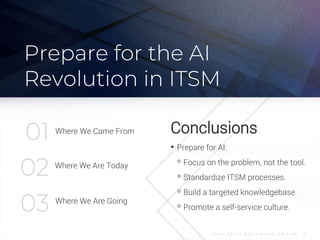
Prepare for the AI Revolution in ITSM
I N F O - T E C H R E S E A R C H G R O U P 2
Where We Are Today
Where We Are Going
Where We Came From Conclusions
• Prepare for AI:
◦ Focus on the problem, not the tool.
◦ Standardize ITSM processes.
◦ Build a targeted knowledgebase.
◦ Promote a self-service culture.
Prepare for the AI
Revolution in ITSM
01
02
03
I N F O - T E C H R E S E A R C H G R O U P 3
Where we came from
I N F O - T E C H R E S E A R C H G R O U P 4
Where We Came From
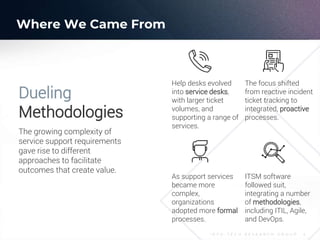
Help desks evolved
into service desks,
with larger ticket
volumes, and
supporting a range of
services.
The focus shifted
from reactive incident
ticket tracking to
integrated, proactive
processes.
As support services
became more
complex,
organizations
adopted more formal
processes.
ITSM software
followed suit,
integrating a number
of methodologies,
including ITIL, Agile,
and DevOps.
Dueling
Methodologies
The growing complexity of
service support requirements
gave rise to different
approaches to facilitate
outcomes that create value.
I N F O - T E C H R E S E A R C H G R O U P 5
Where We Came From
The Rise of
Self-Service
End users have grown more
independent even as service
support has become more
complex and begun to extend
beyond IT groups.
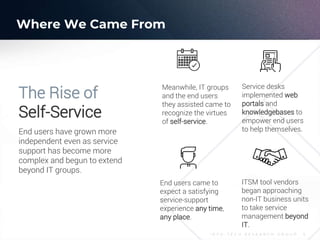
Meanwhile, IT groups
and the end users
they assisted came to
recognize the virtues
of self-service.
Service desks
implemented web
portals and
knowledgebases to
empower end users
to help themselves.
End users came to
expect a satisfying
service-support
experience any time,
any place.
ITSM tool vendors
began approaching
non-IT business units
to take service
management beyond
IT.
I N F O - T E C H R E S E A R C H G R O U P 6
Where We Are Today
I N F O - T E C H R E S E A R C H G R O U P 7
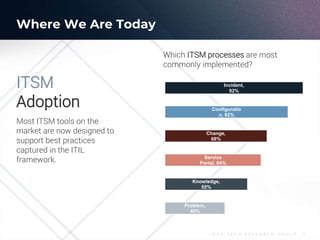
Which ITSM processes are most
commonly implemented?
Problem,
40%
Knowledge,
55%
Service
Portal, 64%
Change,
68%
Configuratio
n, 82%
Incident,
92%
ITSM
Adoption
Most ITSM tools on the
market are now designed to
support best practices
captured in the ITIL
framework.
Where We Are Today
I N F O - T E C H R E S E A R C H G R O U P 8
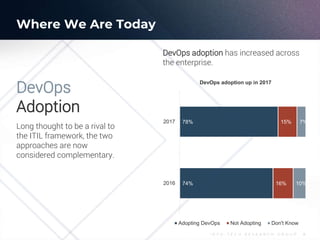
DevOps adoption has increased across
the enterprise.
74%
78%
16%
15%
10%
7%
2016
2017
DevOps adoption up in 2017
Adopting DevOps Not Adopting Don't Know
DevOps
Adoption
Long thought to be a rival to
the ITIL framework, the two
approaches are now
considered complementary.
Where We Are Today
I N F O - T E C H R E S E A R C H G R O U P 9
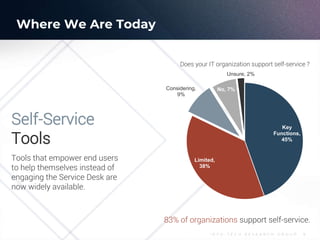
Key
Functions,
45%
Limited,
38%
Considering,
9%
No, 7%
Unsure, 2%
Does your IT organization support self-service ?
Self-Service
Tools
Tools that empower end users
to help themselves instead of
engaging the Service Desk are
now widely available.
Where We Are Today
83% of organizations support self-service.
I N F O - T E C H R E S E A R C H G R O U P 10
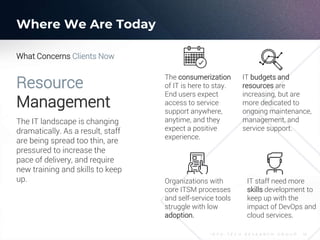
Resource
Management
The IT landscape is changing
dramatically. As a result, staff
are being spread too thin, are
pressured to increase the
pace of delivery, and require
new training and skills to keep
up.
The consumerization
of IT is here to stay.
End users expect
access to service
support anywhere,
anytime, and they
expect a positive
experience.
Organizations with
core ITSM processes
and self-service tools
struggle with low
adoption.
IT staff need more
skills development to
keep up with the
impact of DevOps and
cloud services.
IT budgets and
resources are
increasing, but are
more dedicated to
ongoing maintenance,
management, and
service support.
What Concerns Clients Now
Where We Are Today
I N F O - T E C H R E S E A R C H G R O U P 11
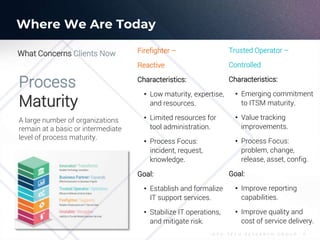
Process
Maturity
A large number of organizations
remain at a basic or intermediate
level of process maturity.
What Concerns Clients Now Firefighter –
Reactive
Characteristics:
• Low maturity, expertise,
and resources.
• Limited resources for
tool administration.
• Process Focus:
incident, request,
knowledge.
Goal:
• Establish and formalize
IT support services.
• Stabilize IT operations,
and mitigate risk.
Trusted Operator –
Controlled
Characteristics:
• Emerging commitment
to ITSM maturity.
• Value tracking
improvements.
• Process Focus:
problem, change,
release, asset, config.
Goal:
• Improve reporting
capabilities.
• Improve quality and
cost of service delivery.
Where We Are Today
I N F O - T E C H R E S E A R C H G R O U P 12
Where We Are Going
I N F O - T E C H R E S E A R C H G R O U P 13
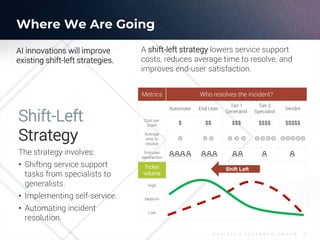
Shift-Left
Strategy
The strategy involves:
• Shifting service support
tasks from specialists to
generalists.
• Implementing self-service.
• Automating incident
resolution.
Metrics Who resolves the incident?
Automate End User
Tier 1
Generalist
Tier 2
Specialist
Vendor
Cost per
ticket $ $$ $$$ $$$$ $$$$$
Average
time to
resolve
End-user
satisfaction
Ticket
volume
High
Medium
Low
Shift Left
A shift-left strategy lowers service support
costs, reduces average time to resolve, and
improves end-user satisfaction.
Where We Are Going
AI innovations will improve
existing shift-left strategies.
I N F O - T E C H R E S E A R C H G R O U P 14
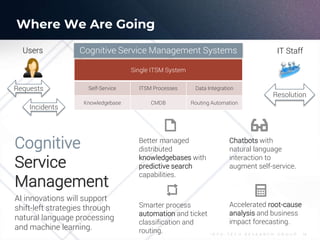
Cognitive
Service
Management
AI innovations will support
shift-left strategies through
natural language processing
and machine learning.
Users
Single ITSM System
Self-Service ITSM Processes Data Integration
Knowledgebase CMDB Routing Automation
Cognitive Service Management Systems IT Staff
Requests
Incidents
Resolution
Smarter process
automation and ticket
classification and
routing.
Better managed
distributed
knowledgebases with
predictive search
capabilities.
Accelerated root-cause
analysis and business
impact forecasting.
Chatbots with
natural language
interaction to
augment self-service.
Where We Are Going
I N F O - T E C H R E S E A R C H G R O U P 15
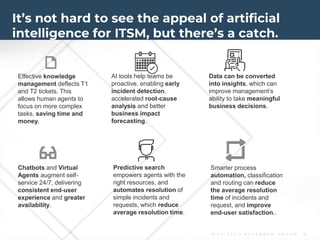
It’s not hard to see the appeal of artificial
intelligence for ITSM, but there’s a catch.
Smarter process
automation, classification
and routing can reduce
the average resolution
time of incidents and
request, and improve
end-user satisfaction..
AI tools help teams be
proactive, enabling early
incident detection,
accelerated root-cause
analysis and better
business impact
forecasting.
Effective knowledge
management deflects T1
and T2 tickets. This
allows human agents to
focus on more complex
tasks, saving time and
money.
Chatbots and Virtual
Agents augment self-
service 24/7, delivering
consistent end-user
experience and greater
availability.
Predictive search
empowers agents with the
right resources, and
automates resolution of
simple incidents and
requests, which reduce
average resolution time.
Data can be converted
into insights, which can
improve management’s
ability to take meaningful
business decisions.
I N F O - T E C H R E S E A R C H G R O U P 16
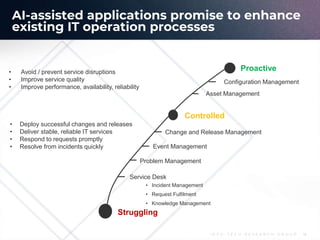
AI-assisted applications promise to enhance
existing IT operation processes
• Avoid / prevent service disruptions
• Improve service quality
• Improve performance, availability, reliability
• Deploy successful changes and releases
• Deliver stable, reliable IT services
• Respond to requests promptly
• Resolve from incidents quickly
Proactive
Struggling
Service Desk
• Incident Management
• Request Fulfilment
• Knowledge Management
Event Management
Configuration Management
Problem Management
Asset Management
Controlled
Change and Release Management
I N F O - T E C H R E S E A R C H G R O U P 17
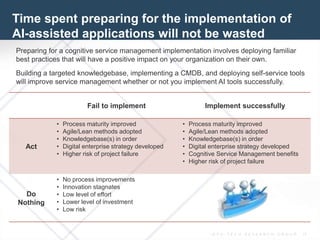
Time spent preparing for the implementation of
AI-assisted applications will not be wasted
Fail to implement Implement successfully
Act
• Process maturity improved
• Agile/Lean methods adopted
• Knowledgebase(s) in order
• Digital enterprise strategy developed
• Higher risk of project failure
• Process maturity improved
• Agile/Lean methods adopted
• Knowledgebase(s) in order
• Digital enterprise strategy developed
• Cognitive Service Management benefits
• Higher risk of project failure
Do
Nothing
• No process improvements
• Innovation stagnates
• Low level of effort
• Lower level of investment
• Low risk
Preparing for a cognitive service management implementation involves deploying familiar
best practices that will have a positive impact on your organization on their own.
Building a targeted knowledgebase, implementing a CMDB, and deploying self-service tools
will improve service management whether or not you implement AI tools successfully.
I N F O - T E C H R E S E A R C H G R O U P 18
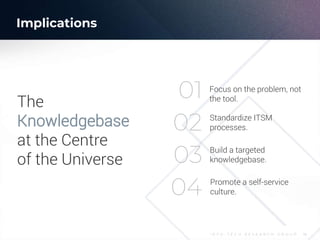
Implications
Standardize ITSM
processes.
Build a targeted
knowledgebase.
Focus on the problem, not
the tool.01
02
03
Promote a self-service
culture.04
The
Knowledgebase
at the Centre
of the Universe
I N F O - T E C H R E S E A R C H G R O U P 19
Questions?
Stay in Touch
Michel Hebert, PhD
Research Director, Executive Advisor, Infrastructure and Operations
Info-Tech Research Group
mhebert@infotech.com
1-888-670-8889 smichelhebert

Michel hebert info tech - misa presentation

  • 1.
    I N FO - T E C H R E S E A R C H G R O U P 1 The Knowledgebase at the Center of the Universe Info-Tech Michel Hebert, PhD June 4, 2018 Info-Tech Research Group, Inc. is a global leader in providing IT research and advice. Info-Tech’s products and services combine actionable insight and relevant advice with ready-to-use tools and templates that cover the full spectrum of IT concerns. © 1997-2017 Info-Tech Research Group Inc. Prepare for the AI Revolution in ITSM
  • 2.
    I N FO - T E C H R E S E A R C H G R O U P 2 Where We Are Today Where We Are Going Where We Came From Conclusions • Prepare for AI: ◦ Focus on the problem, not the tool. ◦ Standardize ITSM processes. ◦ Build a targeted knowledgebase. ◦ Promote a self-service culture. Prepare for the AI Revolution in ITSM 01 02 03
  • 3.
    I N FO - T E C H R E S E A R C H G R O U P 3 Where we came from
  • 4.
    I N FO - T E C H R E S E A R C H G R O U P 4 Where We Came From Help desks evolved into service desks, with larger ticket volumes, and supporting a range of services. The focus shifted from reactive incident ticket tracking to integrated, proactive processes. As support services became more complex, organizations adopted more formal processes. ITSM software followed suit, integrating a number of methodologies, including ITIL, Agile, and DevOps. Dueling Methodologies The growing complexity of service support requirements gave rise to different approaches to facilitate outcomes that create value.
  • 5.
    I N FO - T E C H R E S E A R C H G R O U P 5 Where We Came From The Rise of Self-Service End users have grown more independent even as service support has become more complex and begun to extend beyond IT groups. Meanwhile, IT groups and the end users they assisted came to recognize the virtues of self-service. Service desks implemented web portals and knowledgebases to empower end users to help themselves. End users came to expect a satisfying service-support experience any time, any place. ITSM tool vendors began approaching non-IT business units to take service management beyond IT.
  • 6.
    I N FO - T E C H R E S E A R C H G R O U P 6 Where We Are Today
  • 7.
    I N FO - T E C H R E S E A R C H G R O U P 7 Which ITSM processes are most commonly implemented? Problem, 40% Knowledge, 55% Service Portal, 64% Change, 68% Configuratio n, 82% Incident, 92% ITSM Adoption Most ITSM tools on the market are now designed to support best practices captured in the ITIL framework. Where We Are Today
  • 8.
    I N FO - T E C H R E S E A R C H G R O U P 8 DevOps adoption has increased across the enterprise. 74% 78% 16% 15% 10% 7% 2016 2017 DevOps adoption up in 2017 Adopting DevOps Not Adopting Don't Know DevOps Adoption Long thought to be a rival to the ITIL framework, the two approaches are now considered complementary. Where We Are Today
  • 9.
    I N FO - T E C H R E S E A R C H G R O U P 9 Key Functions, 45% Limited, 38% Considering, 9% No, 7% Unsure, 2% Does your IT organization support self-service ? Self-Service Tools Tools that empower end users to help themselves instead of engaging the Service Desk are now widely available. Where We Are Today 83% of organizations support self-service.
  • 10.
    I N FO - T E C H R E S E A R C H G R O U P 10 Resource Management The IT landscape is changing dramatically. As a result, staff are being spread too thin, are pressured to increase the pace of delivery, and require new training and skills to keep up. The consumerization of IT is here to stay. End users expect access to service support anywhere, anytime, and they expect a positive experience. Organizations with core ITSM processes and self-service tools struggle with low adoption. IT staff need more skills development to keep up with the impact of DevOps and cloud services. IT budgets and resources are increasing, but are more dedicated to ongoing maintenance, management, and service support. What Concerns Clients Now Where We Are Today
  • 11.
    I N FO - T E C H R E S E A R C H G R O U P 11 Process Maturity A large number of organizations remain at a basic or intermediate level of process maturity. What Concerns Clients Now Firefighter – Reactive Characteristics: • Low maturity, expertise, and resources. • Limited resources for tool administration. • Process Focus: incident, request, knowledge. Goal: • Establish and formalize IT support services. • Stabilize IT operations, and mitigate risk. Trusted Operator – Controlled Characteristics: • Emerging commitment to ITSM maturity. • Value tracking improvements. • Process Focus: problem, change, release, asset, config. Goal: • Improve reporting capabilities. • Improve quality and cost of service delivery. Where We Are Today
  • 12.
    I N FO - T E C H R E S E A R C H G R O U P 12 Where We Are Going
  • 13.
    I N FO - T E C H R E S E A R C H G R O U P 13 Shift-Left Strategy The strategy involves: • Shifting service support tasks from specialists to generalists. • Implementing self-service. • Automating incident resolution. Metrics Who resolves the incident? Automate End User Tier 1 Generalist Tier 2 Specialist Vendor Cost per ticket $ $$ $$$ $$$$ $$$$$ Average time to resolve End-user satisfaction Ticket volume High Medium Low Shift Left A shift-left strategy lowers service support costs, reduces average time to resolve, and improves end-user satisfaction. Where We Are Going AI innovations will improve existing shift-left strategies.
  • 14.
    I N FO - T E C H R E S E A R C H G R O U P 14 Cognitive Service Management AI innovations will support shift-left strategies through natural language processing and machine learning. Users Single ITSM System Self-Service ITSM Processes Data Integration Knowledgebase CMDB Routing Automation Cognitive Service Management Systems IT Staff Requests Incidents Resolution Smarter process automation and ticket classification and routing. Better managed distributed knowledgebases with predictive search capabilities. Accelerated root-cause analysis and business impact forecasting. Chatbots with natural language interaction to augment self-service. Where We Are Going
  • 15.
    I N FO - T E C H R E S E A R C H G R O U P 15 It’s not hard to see the appeal of artificial intelligence for ITSM, but there’s a catch. Smarter process automation, classification and routing can reduce the average resolution time of incidents and request, and improve end-user satisfaction.. AI tools help teams be proactive, enabling early incident detection, accelerated root-cause analysis and better business impact forecasting. Effective knowledge management deflects T1 and T2 tickets. This allows human agents to focus on more complex tasks, saving time and money. Chatbots and Virtual Agents augment self- service 24/7, delivering consistent end-user experience and greater availability. Predictive search empowers agents with the right resources, and automates resolution of simple incidents and requests, which reduce average resolution time. Data can be converted into insights, which can improve management’s ability to take meaningful business decisions.
  • 16.
    I N FO - T E C H R E S E A R C H G R O U P 16 AI-assisted applications promise to enhance existing IT operation processes • Avoid / prevent service disruptions • Improve service quality • Improve performance, availability, reliability • Deploy successful changes and releases • Deliver stable, reliable IT services • Respond to requests promptly • Resolve from incidents quickly Proactive Struggling Service Desk • Incident Management • Request Fulfilment • Knowledge Management Event Management Configuration Management Problem Management Asset Management Controlled Change and Release Management
  • 17.
    I N FO - T E C H R E S E A R C H G R O U P 17 Time spent preparing for the implementation of AI-assisted applications will not be wasted Fail to implement Implement successfully Act • Process maturity improved • Agile/Lean methods adopted • Knowledgebase(s) in order • Digital enterprise strategy developed • Higher risk of project failure • Process maturity improved • Agile/Lean methods adopted • Knowledgebase(s) in order • Digital enterprise strategy developed • Cognitive Service Management benefits • Higher risk of project failure Do Nothing • No process improvements • Innovation stagnates • Low level of effort • Lower level of investment • Low risk Preparing for a cognitive service management implementation involves deploying familiar best practices that will have a positive impact on your organization on their own. Building a targeted knowledgebase, implementing a CMDB, and deploying self-service tools will improve service management whether or not you implement AI tools successfully.
  • 18.
    I N FO - T E C H R E S E A R C H G R O U P 18 Implications Standardize ITSM processes. Build a targeted knowledgebase. Focus on the problem, not the tool.01 02 03 Promote a self-service culture.04 The Knowledgebase at the Centre of the Universe
  • 19.
    I N FO - T E C H R E S E A R C H G R O U P 19 Questions? Stay in Touch Michel Hebert, PhD Research Director, Executive Advisor, Infrastructure and Operations Info-Tech Research Group mhebert@infotech.com 1-888-670-8889 smichelhebert

Editor's Notes

  • #2 Introduce yourself.
  • #3 Set expectations: speak 25-35 minutes, questions for 10.
  • #5 Help desk to service desk. Rise of ITSM frameworks.
  • #6 Tell the story. Mention the adoption challenges later.
  • #8 Based on ServiceNow application usage, and reported by Stephen Mann, “Who has adopted which ITSM and ITIL processes?” (2016). ITSM becomes to lingua franca, the universal language. Even if you don’t roll it out, you need to address it.
  • #9 Based on Right-Scale’s “2017 State of the Cloud Report”
  • #10 Forbes Insight, “The State of IT Service Management, 2017”.
  • #11 Mention adoption challenges here.
  • #14 In a typical organization, analysts resolve the majority of incidents. Shift-left organizations resolve a majority of incidents automatically or through self-service.
  • #15 For the moment, the more advanced cognitive features on vendor roadmaps are largely promissory, though ITSM tools are beginning to include chatbots and predictive search features in their toolsets. Siri, Alexa, Cortona, Google Duplex
  • #16 Go through the benefits
  • #17 For the moment, the more advanced cognitive features on vendor roadmaps are largely promissory, though ITSM tools are beginning to include chatbots and predictive search features in their toolsets. Focus on the problem. Build the processes. Build the structured content. The KB. Promote self-service. Adoption. Adoption. Adoption.
  • #18 Act, but focus on the problem. Just like the adoption issue for self-service, if the organization doesn’t see the benefit, they won’t adopt the technology.