Organization Name | Group Name


Lean IT:
Separates Added Value from Waste
Evgeny Nedelko, April 2012
Lean IT: Separates Added Value from Waste

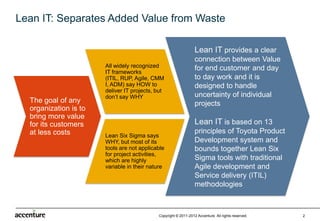
                                                                Lean IT provides a clear
                                                                connection between Value
                       All widely recognized                    for end customer  and day
                       IT frameworks
                       (ITIL, RUP, Agile, CMM                   to day work and it is
                       I, ADM) say HOW to                       designed to handle
                       deliver IT projects, but
                       don’t say WHY                            uncertainty of individual
  The goal of any                                               projects
  organization is to
  bring more value
  for its customers                                             Lean IT is based on 13
  at less costs        Lean Six Sigma says                      principles of Toyota Product
                       WHY, but most of its                     Development system and
                       tools are not applicable
                       for project                              bounds together Lean Six
                       activities, which are                    Sigma tools with traditional
                       highly variable in their
                       nature                                   Agile development and
                                                                Service delivery (ITIL)
                                                                methodologies


                                            Copyright © 2011-2012 Accenture All rights reserved.   2
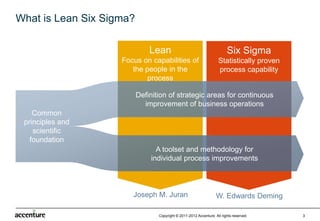
What is Lean Six Sigma?

                              Lean                                      Six Sigma
                    Focus on capabilities of                       Statistically proven
                       the people in the                           process capability
                            process

                          Definition of strategic areas for continuous
                            improvement of business operations
    Common
 principles and
    scientific
   foundation
                                A toolset and methodology for
                              individual process improvements


                       Joseph M. Juran                            W. Edwards Deming

                                 Copyright © 2011-2012 Accenture All rights reserved.     3
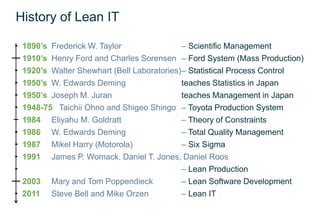
History of Lean IT

- 1890’s Frederick W. Taylor                – Scientific Management
— 1910’s Henry Ford and Charles Sorensen – Ford System (Mass Production)
- 1920’s Walter Shewhart (Bell Laboratories)– Statistical Process Control
- 1950’s W. Edwards Deming                  teaches Statistics in Japan
- 1950’s Joseph M. Juran                    teaches Management in Japan
- 1948-75 Taichii Ohno and Shigeo Shingo – Toyota Production System
– 1984 Eliyahu M. Goldratt                  – Theory of Constraints
- 1986 W. Edwards Deming                    – Total Quality Management
- 1987 Mikel Harry (Motorola)               – Six Sigma
- 1991 James P. Womack, Daniel T. Jones, Daniel Roos
-                                           – Lean Production
— 2003 Mary and Tom Poppendieck             – Lean Software Development
- 2011 Steve Bell and Mike Orzen            – Lean IT
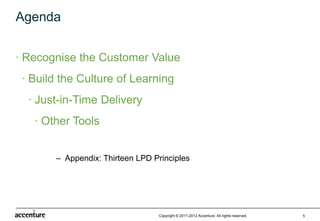
Agenda


· Recognise the Customer Value
 · Build the Culture of Learning
  · Just-in-Time Delivery
   · Other Tools


       – Appendix: Thirteen LPD Principles


                                 Copyright © 2011-2012 Accenture All rights reserved.   5
Recognise the Customer Value
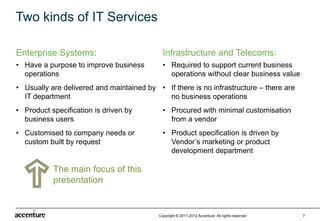
Two kinds of IT Services

Enterprise Systems:                          Infrastructure and Telecoms:
• Have a purpose to improve business         • Required to support current business
  operations                                   operations without clear business value
• Usually are delivered and maintained by • If there is no infrastructure – there are
  IT department                             no business operations
• Product specification is driven by         • Procured with minimal customisation
  business users                               from a vendor
• Customised to company needs or             • Product specification is driven by
  custom built by request                      Vendor’s marketing or product
                                               development department

           The main focus of this
           presentation


                                           Copyright © 2011-2012 Accenture All rights reserved.   7
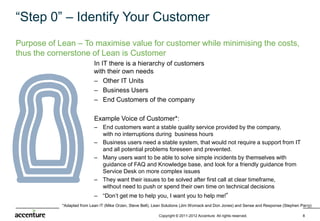
“Step 0” – Identify Your Customer
Purpose of Lean – To maximise value for customer while minimising the
costs, thus the cornerstone of Lean is Customer
                            In IT there is a hierarchy of customers
                            with their own needs
                            – Other IT Units
                            – Business Users
                            – End Customers of the company

                            Example Voice of Customer*:
                            – End customers want a stable quality service provided by the company,
                              with no interruptions during business hours
                            – Business users need a stable system, that would not require a support from IT
                              and all potential problems foreseen and prevented.
                            – Many users want to be able to solve simple incidents by themselves with
                              guidance of FAQ and Knowledge base, and look for a friendly guidance from
                              Service Desk on more complex issues
                            – They want their issues to be solved after first call at clear timeframe,
                              without need to push or spend their own time on technical decisions
                            – “Don’t get me to help you, I want you to help me!”
            *Adapted from Lean IT (Mike Orzen, Steve Bell), Lean Solutions (Jim Womack and Don Jones) and Sense and Response (Stephen Parry)

                                                             Copyright © 2011-2012 Accenture All rights reserved.                      8
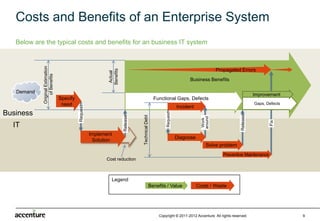
Costs and Benefits of an Enterprise System
   Below are the typical costs and benefits for an business IT system
            Original Estimation


                                                                                                                                         Propagated Errors


                                                             Benefits
                                                              Actual
                of Benefits


                                                                                                                         Business Benefits

   Demand
                                                                                                                                                               Improvement
                                  Specify                                                          Functional Gaps, Defects
                                   need                                                                                                                        Gaps, Defects
                                                                                                                   Incident
                                            Request


Business


                                                                                                         Request


                                                                                                                                                     Release
                                                                                  Technical Debt
                                                                        Release


                                                                                                                                around
                                                                                                                                 Work


                                                                                                                                                                      Fix
  IT
                                                      Implement
                                                        Implement
                                                                                                                   Diagnose
                                                       Solution
                                                         Solution
                                                                                                                                   Solve problem
                                                                                                                                            Preventive Maintenance
                                                            Cost reduction


                                                               Legend
                                                                                               Benefits / Value               Costs / Waste


                                                                                                     Copyright © 2011-2012 Accenture All rights reserved.                      9
Examples of Benefits

There are direct benefits:               and indirect benefits:
• automation of work reduces need        • appealing user interface expands
  for manual operation                     the customer loyalty
• improving quality of manufacturing     • better control of risks reduces
  process reduces scrape and use of        potential loss and reputation
  materials                              • better information management
• better control of finances reduces       improves quality of overall
  write-offs and other loss                management in organisation


                                 The result of process automation should not
                                 be staff reduction, but more time to think how
                                 to serve clients better


                                       Copyright © 2011-2012 Accenture All rights reserved.   10
Examples of Costs

In most of the cases the cost of system implementation can be reduced,
but an impact on operational (running) costs is inevitable

Technical debt is costs that are imposed by the system
These could be direct costs:          and indirect costs:
• business outage due to system       • impact on reputation
  unavailability                      • operational risks
• loss due to incorrect system        • human errors that could be
  behaviour                             prevented by software
• extra costs required for system     • training costs required for new users
  modification due to complicated
  design
• cost of regression testing


                                    Copyright © 2011-2012 Accenture All rights reserved.   11
Build the Culture of Learning
Relentless Learning and Improvement
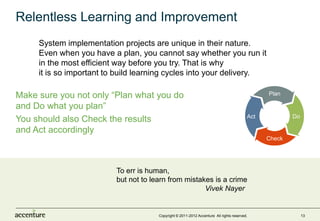
     System implementation projects are unique in their nature.
     Even when you have a plan, you cannot say whether you run it
     in the most efficient way before you try. That is why
     it is so important to build learning cycles into your delivery.

Make sure you not only “Plan what you do                                                        Plan

and Do what you plan”
                                                                                          Act           Do
You should also Check the results
and Act accordingly
                                                                                                Check


                          To err is human,
                          but not to learn from mistakes is a crime
                                                      Vivek Nayer


                                       Copyright © 2011-2012 Accenture All rights reserved.                  13
Front-load the Development Process
The main waste in any process is rework – developing system
that needs to be corrected due to error or design flaw
• To prevent this - all alternatives should be identified as soon as
  possible to allow enough time for evaluation of options and to
  identify possible constraints before completing dependent tasks

• Work on alternatives – as SOON as possible
• Make a choice – as LATE as possible


                                  Copyright © 2011-2012 Accenture All rights reserved.   14
Short Iterations
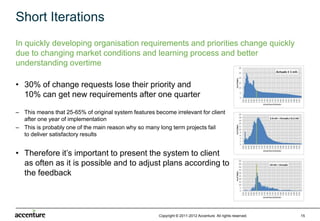
In quickly developing organisation requirements and priorities change quickly
due to changing market conditions and learning process and better
understanding overtime

• 30% of change requests lose their priority and
  10% can get new requirements after one quarter

– This means that 25-65% of original system features become irrelevant for client
  after one year of implementation
– This is probably one of the main reason why so many long term projects fail
  to deliver satisfactory results


• Therefore it’s important to present the system to client
  as often as it is possible and to adjust plans according to
  the feedback


                                                       Copyright © 2011-2012 Accenture All rights reserved.   15
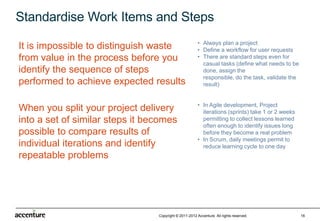
Standardise Work Items and Steps
                                                       • Always plan a project
It is impossible to distinguish waste                  • Define a workflow for user requests
from value in the process before you                   • There are standard steps even for
                                                         casual tasks (define what needs to be
identify the sequence of steps                           done, assign the
                                                         responsible, do the task, validate the
performed to achieve expected results                    result)


                                                       • In Agile development, Project
When you split your project delivery                     iterations (sprints) take 1 or 2 weeks
into a set of similar steps it becomes                   permitting to collect lessons learned
                                                         often enough to identify issues long
possible to compare results of                           before they become a real problem
                                                       • In Scrum, daily meetings permit to
individual iterations and identify                       reduce learning cycle to one day
repeatable problems


                                 Copyright © 2011-2012 Accenture All rights reserved.             16
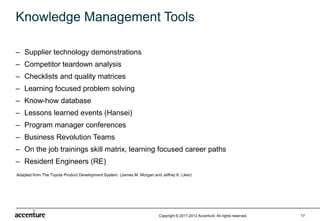
Knowledge Management Tools

– Supplier technology demonstrations
– Competitor teardown analysis
– Checklists and quality matrices
– Learning focused problem solving
– Know-how database
– Lessons learned events (Hansei)
– Program manager conferences
– Business Revolution Teams
– On the job trainings skill matrix, learning focused career paths
– Resident Engineers (RE)
Adapted from The Toyota Product Development System, (James M. Morgan and Jeffrey K. Liker)


                                                                         Copyright © 2011-2012 Accenture All rights reserved.   17
Just-in-Time Delivery
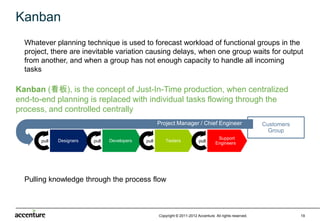
Kanban
  Whatever planning technique is used to forecast workload of functional groups in the
  project, there are inevitable variation causing delays, when one group waits for output
  from another, and when a group has not enough capacity to handle all incoming
  tasks

Kanban (看板), is the concept of Just-In-Time production, when centralized
end-to-end planning is replaced with individual tasks flowing through the
process, and controlled centrally
                                                     Project Manager / Chief Engineer                       Customers
                                                                                                              Group
                                                                                       Support
       pull   Designers   pull   Developers   pull      Testers             pull      Engineers


  Pulling knowledge through the process flow


                                                     Copyright © 2011-2012 Accenture All rights reserved.               19
Alignment through Visual Communication
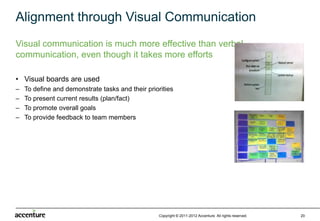
Visual communication is much more effective than verbal
communication, even though it takes more efforts

• Visual boards are used
–   To define and demonstrate tasks and their priorities
–   To present current results (plan/fact)
–   To promote overall goals
–   To provide feedback to team members


                                                   Copyright © 2011-2012 Accenture All rights reserved.   20
Leveled Process Flow


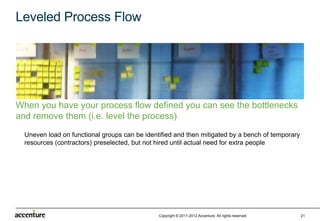
When you have your process flow defined you can see the bottlenecks
and remove them (i.e. level the process)
  Uneven load on functional groups can be identified and then mitigated by a bench of temporary
  resources (contractors) preselected, but not hired until actual need for extra people


                                               Copyright © 2011-2012 Accenture All rights reserved.   21
Integrate Suppliers into the Quality System
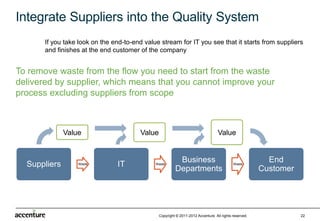
       If you take look on the end-to-end value stream for IT you see that it starts from suppliers
       and finishes at the end customer of the company


To remove waste from the flow you need to start from the waste
delivered by supplier, which means that you cannot improve your
process excluding suppliers from scope


              Value                      Value                                     Value


                                                           Business                                       End
  Suppliers       Waste         IT            Waste                                         Waste
                                                          Departments                                   Customer


                                                 Copyright © 2011-2012 Accenture All rights reserved.              22
Organisational Matrix
       Analysis Lead   Development Lead   Testing Lead               Support Lead

                                             Project Manager / Chief Engineer                       Customers
                                                                                                      Group
          Designers        Developers       Testers                 Support Engineers


                                             Project Manager / Chief Engineer                       Customers
                                                                                                      Group
          Designers        Developers       Testers                 Support Engineers


                                             Project Manager / Chief Engineer                       Customers
                                                                                                      Group
          Designers        Developers       Testers                 Support Engineers


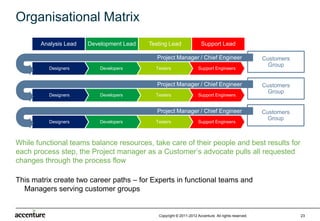
While functional teams balance resources, take care of their people and best results for
each process step, the Project manager as a Customer’s advocate pulls all requested
changes through the process flow

This matrix create two career paths – for Experts in functional teams and
  Managers serving customer groups


                                             Copyright © 2011-2012 Accenture All rights reserved.               23
Organise to Balance the Matrix
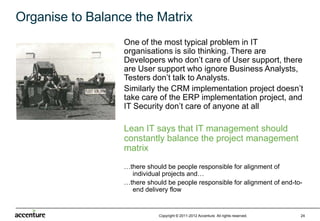
                  One of the most typical problem in IT
                  organisations is silo thinking. There are
                  Developers who don’t care of User support, there
                  are User support who ignore Business
                  Analysts, Testers don’t talk to Analysts.
                  Similarly the CRM implementation project doesn’t
                  take care of the ERP implementation project, and
                  IT Security don’t care of anyone at all

                  Lean IT says that IT management should
                  constantly balance the project management
                  matrix
                  …there should be people responsible for alignment of
                    individual projects and…
                  …there should be people responsible for alignment of end-to-
                    end delivery flow


                             Copyright © 2011-2012 Accenture All rights reserved.   24
Other Lean Tools
Other Lean Tools


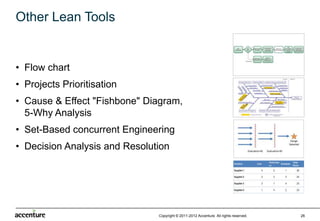
• Flow chart
• Projects Prioritisation
• Cause & Effect "Fishbone" Diagram,
  5-Why Analysis
• Set-Based concurrent Engineering
• Decision Analysis and Resolution


                               Copyright © 2011-2012 Accenture All rights reserved.   26
A3 Thinking

A3 Report is a Project Charter
  covering the following topics:              Principles of the A3 system:
                                              Objectivity
•   Problem side (left half of a page):       Distillation and visualization
–   Background                                Results and Process
–   Voice of Customer                         Alignment
–   Current State (metrics, VSM)
–   Root Cause Analysis                       A3 Reports cannot be drafted in isolation by a
                                                person working alone in their room
•   Solution side (right half of a page):
–   Project Team                              It’s essential that the A3 Report
–   Action Plan
                                              should be updated throughout the
–   Project Targets vs. Actuals
                                              project life as long as
–   Effect Confirmation / Value Delivered
                                              understanding of the facts changes


                                            Copyright © 2011-2012 Accenture All rights reserved.   27
Poka-Yoke
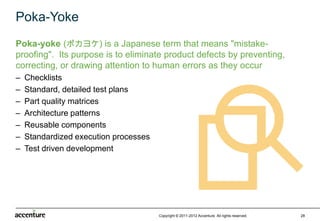
Poka-yoke (ポカヨケ) is a Japanese term that means "mistake-
proofing". Its purpose is to eliminate product defects by
preventing, correcting, or drawing attention to human errors as they
occur
–   Checklists
–   Standard, detailed test plans
–   Part quality matrices
–   Architecture patterns
–   Reusable components
–   Standardized execution processes
–   Test driven development


                                       Copyright © 2011-2012 Accenture All rights reserved.   28
Adapt Technology to the Problem, not the opposite

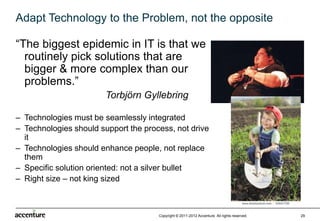
“The biggest epidemic in IT is that we
  routinely pick solutions that are
  bigger & more complex than our
  problems.”
                        Torbjörn Gyllebring

– Technologies must be seamlessly integrated
– Technologies should support the process, not drive
  it
– Technologies should enhance people, not replace
  them
– Specific solution oriented: not a silver bullet
– Right size – not king sized


                                      Copyright © 2011-2012 Accenture All rights reserved.   29
Appendix: Thirteen LPD Principles
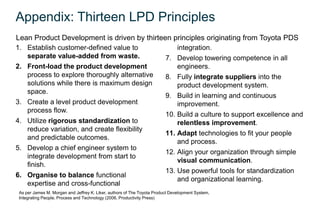
Lean Product Development is driven by thirteen principles originating from Toyota PDS
1. Establish customer-defined value to                                       integration.
   separate value-added from waste.                                      7. Develop towering competence in all
2. Front-load the product development                                        engineers.
   process to explore thoroughly alternative                             8. Fully integrate suppliers into the
   solutions while there is maximum design                                   product development system.
   space.
                                                                         9. Build in learning and continuous
3. Create a level product development                                        improvement.
   process flow.
                                                                         10. Build a culture to support excellence and
4. Utilize rigorous standardization to                                       relentless improvement.
   reduce variation, and create flexibility
                                                                         11. Adapt technologies to fit your people
   and predictable outcomes.
                                                                             and process.
5. Develop a chief engineer system to
                                                                         12. Align your organization through simple
   integrate development from start to
                                                                             visual communication.
   finish.
                                                                         13. Use powerful tools for standardization
6. Organise to balance functional
                                                                             and organizational learning.
   expertise and cross-functional
 As per James M. Morgan and Jeffrey K. Liker, authors of The Toyota Product Development System,
 Integrating People, Process and Technology (2006, Productivity Press)
Learn more

Lean Six Sigma CBT training on myLearning
• https://mylearning.accenture.com/accenture/lang-
  en/management/LMS_ActDetails.asp?ActId=546942

“Lean IT: Enabling and Sustaining Your Lean Transformation”
by Steve Bell, and Mike Orzen (available online)
• http://skillport.books24x7.com/toc.aspx?bkid=36963

“Sense and Respond: The Journey to Customer Purpose”
by Stephen Parry, Sue Barlow, and Mike Faulkner
• http://www.amazon.co.uk/dp/140394573X


                                     Copyright © 2011-2012 Accenture All rights reserved.   31
Your questions?

My view on Lean IT

  • 1.
    Organization Name |Group Name Lean IT: Separates Added Value from Waste Evgeny Nedelko, April 2012
  • 2.
    Lean IT: SeparatesAdded Value from Waste Lean IT provides a clear connection between Value All widely recognized for end customer  and day IT frameworks (ITIL, RUP, Agile, CMM to day work and it is I, ADM) say HOW to designed to handle deliver IT projects, but don’t say WHY uncertainty of individual The goal of any projects organization is to bring more value for its customers Lean IT is based on 13 at less costs Lean Six Sigma says principles of Toyota Product WHY, but most of its Development system and tools are not applicable for project bounds together Lean Six activities, which are Sigma tools with traditional highly variable in their nature Agile development and Service delivery (ITIL) methodologies Copyright © 2011-2012 Accenture All rights reserved. 2
  • 3.
    What is LeanSix Sigma? Lean Six Sigma Focus on capabilities of Statistically proven the people in the process capability process Definition of strategic areas for continuous improvement of business operations Common principles and scientific foundation A toolset and methodology for individual process improvements Joseph M. Juran W. Edwards Deming Copyright © 2011-2012 Accenture All rights reserved. 3
  • 4.
    History of LeanIT - 1890’s Frederick W. Taylor – Scientific Management — 1910’s Henry Ford and Charles Sorensen – Ford System (Mass Production) - 1920’s Walter Shewhart (Bell Laboratories)– Statistical Process Control - 1950’s W. Edwards Deming teaches Statistics in Japan - 1950’s Joseph M. Juran teaches Management in Japan - 1948-75 Taichii Ohno and Shigeo Shingo – Toyota Production System – 1984 Eliyahu M. Goldratt – Theory of Constraints - 1986 W. Edwards Deming – Total Quality Management - 1987 Mikel Harry (Motorola) – Six Sigma - 1991 James P. Womack, Daniel T. Jones, Daniel Roos - – Lean Production — 2003 Mary and Tom Poppendieck – Lean Software Development - 2011 Steve Bell and Mike Orzen – Lean IT
  • 5.
    Agenda · Recognise theCustomer Value · Build the Culture of Learning · Just-in-Time Delivery · Other Tools – Appendix: Thirteen LPD Principles Copyright © 2011-2012 Accenture All rights reserved. 5
  • 6.
  • 7.
    Two kinds ofIT Services Enterprise Systems: Infrastructure and Telecoms: • Have a purpose to improve business • Required to support current business operations operations without clear business value • Usually are delivered and maintained by • If there is no infrastructure – there are IT department no business operations • Product specification is driven by • Procured with minimal customisation business users from a vendor • Customised to company needs or • Product specification is driven by custom built by request Vendor’s marketing or product development department The main focus of this presentation Copyright © 2011-2012 Accenture All rights reserved. 7
  • 8.
    “Step 0” –Identify Your Customer Purpose of Lean – To maximise value for customer while minimising the costs, thus the cornerstone of Lean is Customer In IT there is a hierarchy of customers with their own needs – Other IT Units – Business Users – End Customers of the company Example Voice of Customer*: – End customers want a stable quality service provided by the company, with no interruptions during business hours – Business users need a stable system, that would not require a support from IT and all potential problems foreseen and prevented. – Many users want to be able to solve simple incidents by themselves with guidance of FAQ and Knowledge base, and look for a friendly guidance from Service Desk on more complex issues – They want their issues to be solved after first call at clear timeframe, without need to push or spend their own time on technical decisions – “Don’t get me to help you, I want you to help me!” *Adapted from Lean IT (Mike Orzen, Steve Bell), Lean Solutions (Jim Womack and Don Jones) and Sense and Response (Stephen Parry) Copyright © 2011-2012 Accenture All rights reserved. 8
  • 9.
    Costs and Benefitsof an Enterprise System Below are the typical costs and benefits for an business IT system Original Estimation Propagated Errors Benefits Actual of Benefits Business Benefits Demand Improvement Specify Functional Gaps, Defects need Gaps, Defects Incident Request Business Request Release Technical Debt Release around Work Fix IT Implement Implement Diagnose Solution Solution Solve problem Preventive Maintenance Cost reduction Legend Benefits / Value Costs / Waste Copyright © 2011-2012 Accenture All rights reserved. 9
  • 10.
    Examples of Benefits Thereare direct benefits: and indirect benefits: • automation of work reduces need • appealing user interface expands for manual operation the customer loyalty • improving quality of manufacturing • better control of risks reduces process reduces scrape and use of potential loss and reputation materials • better information management • better control of finances reduces improves quality of overall write-offs and other loss management in organisation The result of process automation should not be staff reduction, but more time to think how to serve clients better Copyright © 2011-2012 Accenture All rights reserved. 10
  • 11.
    Examples of Costs Inmost of the cases the cost of system implementation can be reduced, but an impact on operational (running) costs is inevitable Technical debt is costs that are imposed by the system These could be direct costs: and indirect costs: • business outage due to system • impact on reputation unavailability • operational risks • loss due to incorrect system • human errors that could be behaviour prevented by software • extra costs required for system • training costs required for new users modification due to complicated design • cost of regression testing Copyright © 2011-2012 Accenture All rights reserved. 11
  • 12.
    Build the Cultureof Learning
  • 13.
    Relentless Learning andImprovement System implementation projects are unique in their nature. Even when you have a plan, you cannot say whether you run it in the most efficient way before you try. That is why it is so important to build learning cycles into your delivery. Make sure you not only “Plan what you do Plan and Do what you plan” Act Do You should also Check the results and Act accordingly Check To err is human, but not to learn from mistakes is a crime Vivek Nayer Copyright © 2011-2012 Accenture All rights reserved. 13
  • 14.
    Front-load the DevelopmentProcess The main waste in any process is rework – developing system that needs to be corrected due to error or design flaw • To prevent this - all alternatives should be identified as soon as possible to allow enough time for evaluation of options and to identify possible constraints before completing dependent tasks • Work on alternatives – as SOON as possible • Make a choice – as LATE as possible Copyright © 2011-2012 Accenture All rights reserved. 14
  • 15.
    Short Iterations In quicklydeveloping organisation requirements and priorities change quickly due to changing market conditions and learning process and better understanding overtime • 30% of change requests lose their priority and 10% can get new requirements after one quarter – This means that 25-65% of original system features become irrelevant for client after one year of implementation – This is probably one of the main reason why so many long term projects fail to deliver satisfactory results • Therefore it’s important to present the system to client as often as it is possible and to adjust plans according to the feedback Copyright © 2011-2012 Accenture All rights reserved. 15
  • 16.
    Standardise Work Itemsand Steps • Always plan a project It is impossible to distinguish waste • Define a workflow for user requests from value in the process before you • There are standard steps even for casual tasks (define what needs to be identify the sequence of steps done, assign the responsible, do the task, validate the performed to achieve expected results result) • In Agile development, Project When you split your project delivery iterations (sprints) take 1 or 2 weeks into a set of similar steps it becomes permitting to collect lessons learned often enough to identify issues long possible to compare results of before they become a real problem • In Scrum, daily meetings permit to individual iterations and identify reduce learning cycle to one day repeatable problems Copyright © 2011-2012 Accenture All rights reserved. 16
  • 17.
    Knowledge Management Tools –Supplier technology demonstrations – Competitor teardown analysis – Checklists and quality matrices – Learning focused problem solving – Know-how database – Lessons learned events (Hansei) – Program manager conferences – Business Revolution Teams – On the job trainings skill matrix, learning focused career paths – Resident Engineers (RE) Adapted from The Toyota Product Development System, (James M. Morgan and Jeffrey K. Liker) Copyright © 2011-2012 Accenture All rights reserved. 17
  • 18.
  • 19.
    Kanban Whateverplanning technique is used to forecast workload of functional groups in the project, there are inevitable variation causing delays, when one group waits for output from another, and when a group has not enough capacity to handle all incoming tasks Kanban (看板), is the concept of Just-In-Time production, when centralized end-to-end planning is replaced with individual tasks flowing through the process, and controlled centrally Project Manager / Chief Engineer Customers Group Support pull Designers pull Developers pull Testers pull Engineers Pulling knowledge through the process flow Copyright © 2011-2012 Accenture All rights reserved. 19
  • 20.
    Alignment through VisualCommunication Visual communication is much more effective than verbal communication, even though it takes more efforts • Visual boards are used – To define and demonstrate tasks and their priorities – To present current results (plan/fact) – To promote overall goals – To provide feedback to team members Copyright © 2011-2012 Accenture All rights reserved. 20
  • 21.
    Leveled Process Flow Whenyou have your process flow defined you can see the bottlenecks and remove them (i.e. level the process) Uneven load on functional groups can be identified and then mitigated by a bench of temporary resources (contractors) preselected, but not hired until actual need for extra people Copyright © 2011-2012 Accenture All rights reserved. 21
  • 22.
    Integrate Suppliers intothe Quality System If you take look on the end-to-end value stream for IT you see that it starts from suppliers and finishes at the end customer of the company To remove waste from the flow you need to start from the waste delivered by supplier, which means that you cannot improve your process excluding suppliers from scope Value Value Value Business End Suppliers Waste IT Waste Waste Departments Customer Copyright © 2011-2012 Accenture All rights reserved. 22
  • 23.
    Organisational Matrix Analysis Lead Development Lead Testing Lead Support Lead Project Manager / Chief Engineer Customers Group Designers Developers Testers Support Engineers Project Manager / Chief Engineer Customers Group Designers Developers Testers Support Engineers Project Manager / Chief Engineer Customers Group Designers Developers Testers Support Engineers While functional teams balance resources, take care of their people and best results for each process step, the Project manager as a Customer’s advocate pulls all requested changes through the process flow This matrix create two career paths – for Experts in functional teams and Managers serving customer groups Copyright © 2011-2012 Accenture All rights reserved. 23
  • 24.
    Organise to Balancethe Matrix One of the most typical problem in IT organisations is silo thinking. There are Developers who don’t care of User support, there are User support who ignore Business Analysts, Testers don’t talk to Analysts. Similarly the CRM implementation project doesn’t take care of the ERP implementation project, and IT Security don’t care of anyone at all Lean IT says that IT management should constantly balance the project management matrix …there should be people responsible for alignment of individual projects and… …there should be people responsible for alignment of end-to- end delivery flow Copyright © 2011-2012 Accenture All rights reserved. 24
  • 25.
  • 26.
    Other Lean Tools •Flow chart • Projects Prioritisation • Cause & Effect "Fishbone" Diagram, 5-Why Analysis • Set-Based concurrent Engineering • Decision Analysis and Resolution Copyright © 2011-2012 Accenture All rights reserved. 26
  • 27.
    A3 Thinking A3 Reportis a Project Charter covering the following topics: Principles of the A3 system: Objectivity • Problem side (left half of a page): Distillation and visualization – Background Results and Process – Voice of Customer Alignment – Current State (metrics, VSM) – Root Cause Analysis A3 Reports cannot be drafted in isolation by a person working alone in their room • Solution side (right half of a page): – Project Team It’s essential that the A3 Report – Action Plan should be updated throughout the – Project Targets vs. Actuals project life as long as – Effect Confirmation / Value Delivered understanding of the facts changes Copyright © 2011-2012 Accenture All rights reserved. 27
  • 28.
    Poka-Yoke Poka-yoke (ポカヨケ) isa Japanese term that means "mistake- proofing". Its purpose is to eliminate product defects by preventing, correcting, or drawing attention to human errors as they occur – Checklists – Standard, detailed test plans – Part quality matrices – Architecture patterns – Reusable components – Standardized execution processes – Test driven development Copyright © 2011-2012 Accenture All rights reserved. 28
  • 29.
    Adapt Technology tothe Problem, not the opposite “The biggest epidemic in IT is that we routinely pick solutions that are bigger & more complex than our problems.” Torbjörn Gyllebring – Technologies must be seamlessly integrated – Technologies should support the process, not drive it – Technologies should enhance people, not replace them – Specific solution oriented: not a silver bullet – Right size – not king sized Copyright © 2011-2012 Accenture All rights reserved. 29
  • 30.
    Appendix: Thirteen LPDPrinciples Lean Product Development is driven by thirteen principles originating from Toyota PDS 1. Establish customer-defined value to integration. separate value-added from waste. 7. Develop towering competence in all 2. Front-load the product development engineers. process to explore thoroughly alternative 8. Fully integrate suppliers into the solutions while there is maximum design product development system. space. 9. Build in learning and continuous 3. Create a level product development improvement. process flow. 10. Build a culture to support excellence and 4. Utilize rigorous standardization to relentless improvement. reduce variation, and create flexibility 11. Adapt technologies to fit your people and predictable outcomes. and process. 5. Develop a chief engineer system to 12. Align your organization through simple integrate development from start to visual communication. finish. 13. Use powerful tools for standardization 6. Organise to balance functional and organizational learning. expertise and cross-functional As per James M. Morgan and Jeffrey K. Liker, authors of The Toyota Product Development System, Integrating People, Process and Technology (2006, Productivity Press)
  • 31.
    Learn more Lean SixSigma CBT training on myLearning • https://mylearning.accenture.com/accenture/lang- en/management/LMS_ActDetails.asp?ActId=546942 “Lean IT: Enabling and Sustaining Your Lean Transformation” by Steve Bell, and Mike Orzen (available online) • http://skillport.books24x7.com/toc.aspx?bkid=36963 “Sense and Respond: The Journey to Customer Purpose” by Stephen Parry, Sue Barlow, and Mike Faulkner • http://www.amazon.co.uk/dp/140394573X Copyright © 2011-2012 Accenture All rights reserved. 31
  • 32.

Editor's Notes

  • #5 Scientists distinguish three kinds of activity:Repeatable activity targeted to achieve a results of consistent characteristics and quality is called “Production”One time activity targeted to achieve a unique result is called “Project”An activity which goal is the activity itself is called“Game”IT is a mixture of “Production” and “Project” activities and value-adding activities in IT are usually in projects. They cannot be optimised usingjust Traditional Lean Six Sigma methods because they designed to handle thousands or millions of similar delivery cycles, and not few unique projects.In addition to famous Toyota Production System, they used Product Development System to run projects. This methodology is now evolved in Lean Product Development
  • #28 You cannot approve and fix content of A3