© Axios Systems PLC 2017
Slide 1
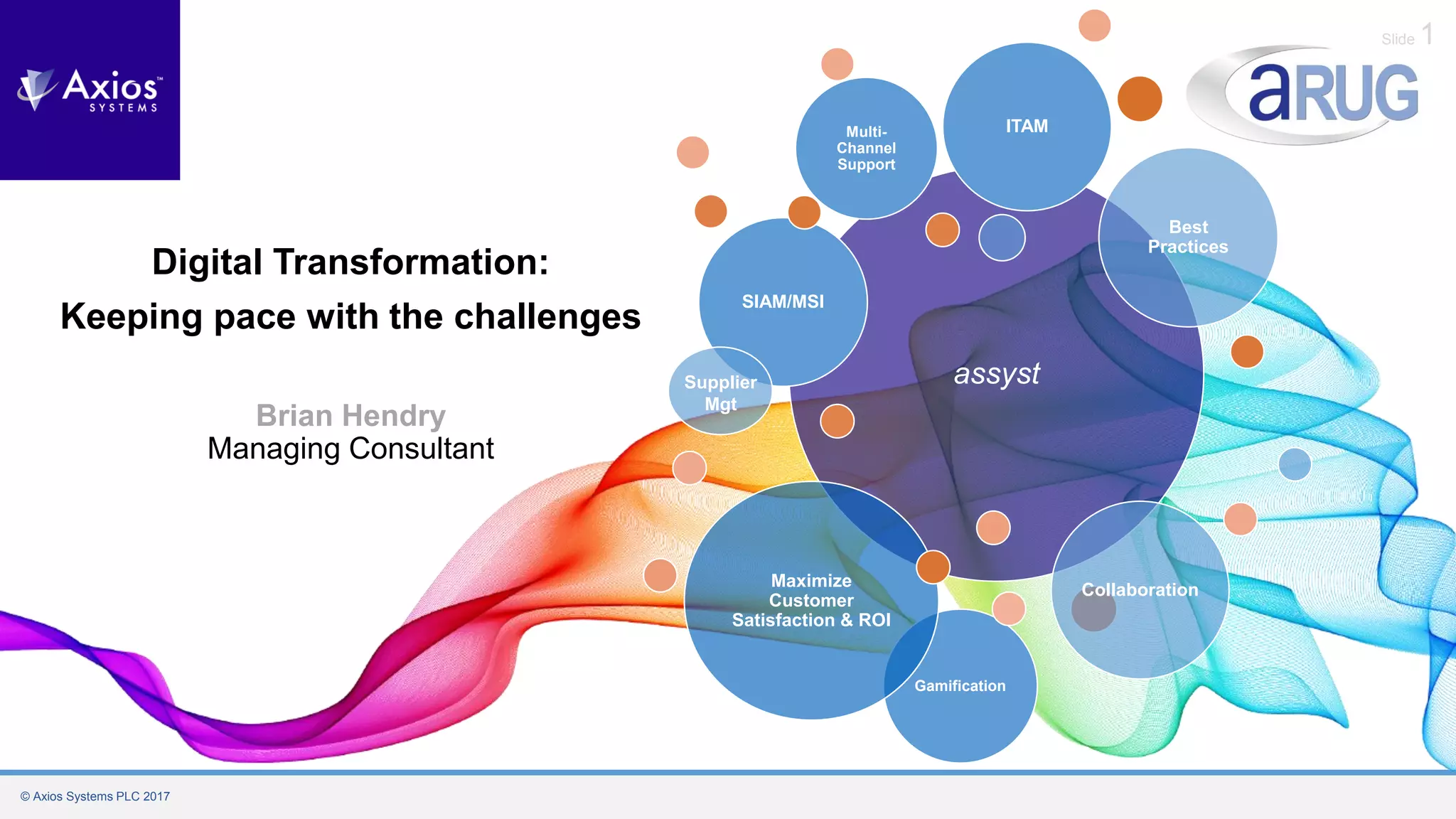
Gamification
assyst
SIAM/MSI
Best
Practices
Maximize
Customer
Satisfaction & ROI
Collaboration
Supplier
Mgt
ITAMMulti-
Channel
Support
Digital Transformation:
Keeping pace with the challenges
Brian Hendry
Managing Consultant
© Axios Systems PLC 2017
Slide 2
Agenda
• What is Digital Transformation?
• Why does Digital Transformation matter?
• What is Big Data?
• Why does Big Data matter?
• Using Big Data
• Big Data: Facts
• Breakout Session
© Axios Systems PLC 2017
Slide 3
© Axios Systems PLC 2017
Slide 4
What is Digital Transformation?
Digital transformation is the integration of digital technology into all
areas of a business, resulting in fundamental changes to how
businesses operate and how they deliver value to customers.
Beyond that, it's a cultural change that requires organisations to:
• Continually challenge the status quo
• Experiment often
• Get comfortable with failure
This sometimes means walking away from long-standing business
processes that companies were built upon in favour of relatively new
practices that are still being defined
© Axios Systems PLC 2017
Slide 5
Why does Digital Transformation matter?
There are a number of reasons that a business may undergo digital
transformation, but by far, the most likely reason is that they have to. It's a
survival issue for many.
Businesses that failed to transform include Kodak; Nokia; Xerox;
Blockbuster; etc.
Businesses don't transform by choice because it is expensive and risky.
Businesses go through transformation when they have failed to evolve.
© Axios Systems PLC 2017
Slide 6
What is big data?
Big data is a term that describes the large volume of data, both
structured and unstructured, that inundates a business on a day-to-day
basis.
But it’s not the amount of data that’s important. It’s what organisations
do with the data that matters.
Big data can be analyzed for insights that lead to better decisions and
strategic business moves.
© Axios Systems PLC 2017
Slide 7
What is big data?
Big should help organisations harness their data and use it to identify
new opportunities.
Before this can happen however, Organisations need to ask themselves
some questions:
• Are we able to take advantage of the data available to us in tangible
ways that impact our business?
• Can we get answers quickly to questions about our business?
• Is our current data environment well integrated, or a convoluted and
expensive headache?
© Axios Systems PLC 2017
Slide 8
Why does Big Data matter?
• Proactivity and anticipating customer needs
• Mitigating risk
• Delivering relevant products
• Personalisation and service
• Optimising and improving the customer experience
© Axios Systems PLC 2017
Slide 9
Using Big Data
© Axios Systems PLC 2017
Slide 10
Big Data: Facts
• More data has been created in the past two years than in the entire
previous history of the human race
• There are 205 billion emails sent and received per day and 277,000
tweets every minute
• Facebook users send on average 35 million messages and view 3
million videos every minute
• It is estimated that by 2020 the World Wide Web will contain 40
zettabytes (400 billion gigabytes)
© Axios Systems PLC 2017
Slide 11
Breakout session
Think about Big Data and consider:
• What gaps do you have in your current data?
• What extra data elements could you use?
• Where you could get them from?
• How it could improve the way your function works?
© Axios Systems PLC 2017
Slide 12
Data Sources
Incident/Problem/Change:
• Schedules
• Status and progress
• Resolution/fulfilment details
• Resolution/fulfilment timescales
• Effort
• Teams/Individuals involved
• Links between support ​life-cycle records
© Axios Systems PLC 2017
Slide 13
Data Sources
IT Systems:
• Configuration Item details and status
• User/Customer details
• System health
• IVR/CTI volumes
• Customers/Users:
• Interactions from web and mobile support portals
• Locations
• Skills
• Services used and frequency
• Survey results
© Axios Systems PLC 2017
Slide 14
Data Sources
• User Portal/Service Catalogue
• Services used
• Frequency of use
• Who is viewing/using the portal
• Pages viewed
• Which are the most common/popular pages/Services?
• Support Teams/Suppliers
• Workload
• Availability
• Skills
© Axios Systems PLC 2017
Slide 15
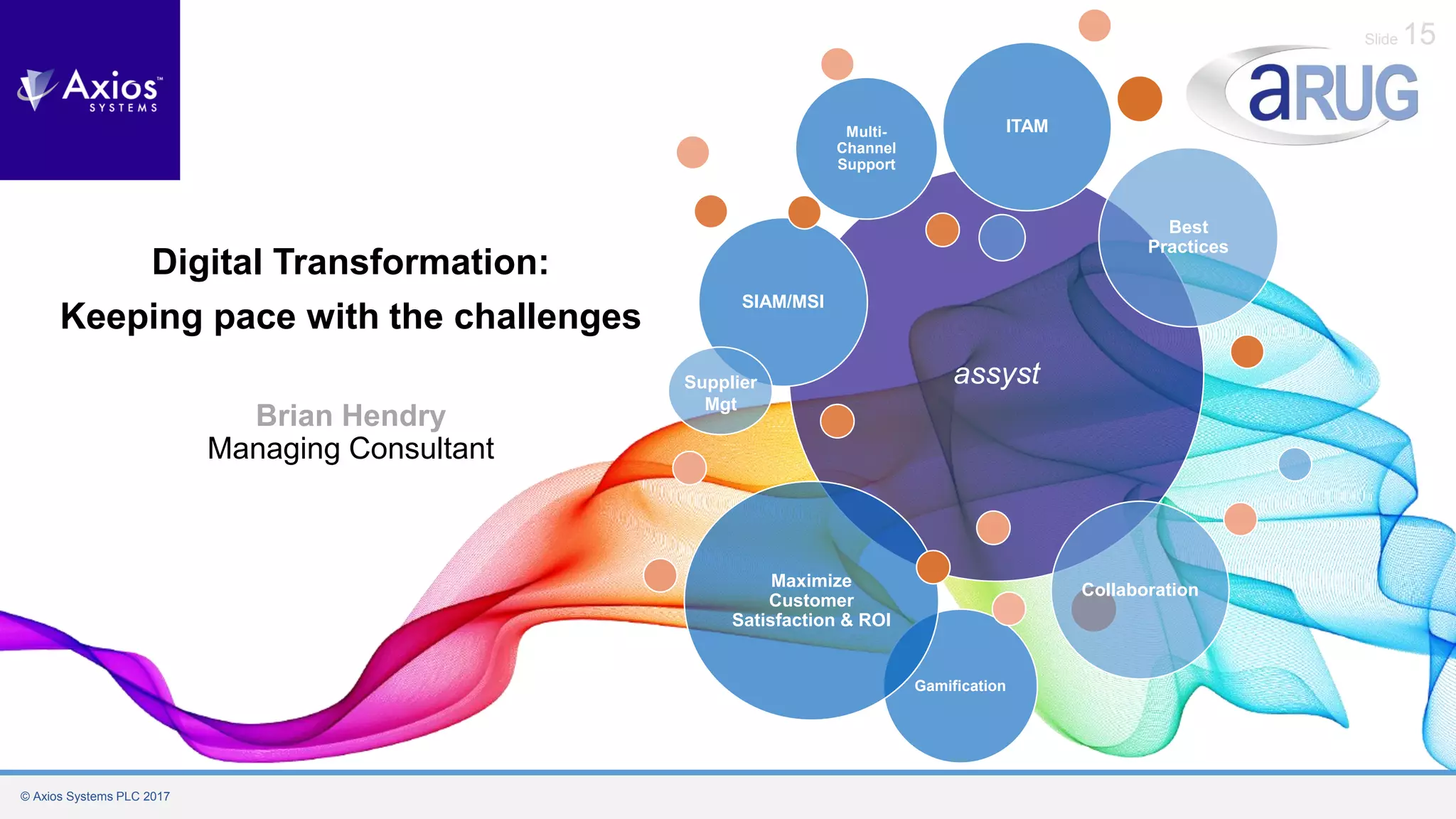
Gamification
assyst
SIAM/MSI
Best
Practices
Maximize
Customer
Satisfaction & ROI
Collaboration
Supplier
Mgt
ITAMMulti-
Channel
Support
Digital Transformation:
Keeping pace with the challenges
Brian Hendry
Managing Consultant

Axios Systems assyst RUG2017 - Digital Transformation: Keeping pace with the challenges

  • 1.
    © Axios SystemsPLC 2017 Slide 1 Gamification assyst SIAM/MSI Best Practices Maximize Customer Satisfaction & ROI Collaboration Supplier Mgt ITAMMulti- Channel Support Digital Transformation: Keeping pace with the challenges Brian Hendry Managing Consultant
  • 2.
    © Axios SystemsPLC 2017 Slide 2 Agenda • What is Digital Transformation? • Why does Digital Transformation matter? • What is Big Data? • Why does Big Data matter? • Using Big Data • Big Data: Facts • Breakout Session
  • 3.
    © Axios SystemsPLC 2017 Slide 3
  • 4.
    © Axios SystemsPLC 2017 Slide 4 What is Digital Transformation? Digital transformation is the integration of digital technology into all areas of a business, resulting in fundamental changes to how businesses operate and how they deliver value to customers. Beyond that, it's a cultural change that requires organisations to: • Continually challenge the status quo • Experiment often • Get comfortable with failure This sometimes means walking away from long-standing business processes that companies were built upon in favour of relatively new practices that are still being defined
  • 5.
    © Axios SystemsPLC 2017 Slide 5 Why does Digital Transformation matter? There are a number of reasons that a business may undergo digital transformation, but by far, the most likely reason is that they have to. It's a survival issue for many. Businesses that failed to transform include Kodak; Nokia; Xerox; Blockbuster; etc. Businesses don't transform by choice because it is expensive and risky. Businesses go through transformation when they have failed to evolve.
  • 6.
    © Axios SystemsPLC 2017 Slide 6 What is big data? Big data is a term that describes the large volume of data, both structured and unstructured, that inundates a business on a day-to-day basis. But it’s not the amount of data that’s important. It’s what organisations do with the data that matters. Big data can be analyzed for insights that lead to better decisions and strategic business moves.
  • 7.
    © Axios SystemsPLC 2017 Slide 7 What is big data? Big should help organisations harness their data and use it to identify new opportunities. Before this can happen however, Organisations need to ask themselves some questions: • Are we able to take advantage of the data available to us in tangible ways that impact our business? • Can we get answers quickly to questions about our business? • Is our current data environment well integrated, or a convoluted and expensive headache?
  • 8.
    © Axios SystemsPLC 2017 Slide 8 Why does Big Data matter? • Proactivity and anticipating customer needs • Mitigating risk • Delivering relevant products • Personalisation and service • Optimising and improving the customer experience
  • 9.
    © Axios SystemsPLC 2017 Slide 9 Using Big Data
  • 10.
    © Axios SystemsPLC 2017 Slide 10 Big Data: Facts • More data has been created in the past two years than in the entire previous history of the human race • There are 205 billion emails sent and received per day and 277,000 tweets every minute • Facebook users send on average 35 million messages and view 3 million videos every minute • It is estimated that by 2020 the World Wide Web will contain 40 zettabytes (400 billion gigabytes)
  • 11.
    © Axios SystemsPLC 2017 Slide 11 Breakout session Think about Big Data and consider: • What gaps do you have in your current data? • What extra data elements could you use? • Where you could get them from? • How it could improve the way your function works?
  • 12.
    © Axios SystemsPLC 2017 Slide 12 Data Sources Incident/Problem/Change: • Schedules • Status and progress • Resolution/fulfilment details • Resolution/fulfilment timescales • Effort • Teams/Individuals involved • Links between support ​life-cycle records
  • 13.
    © Axios SystemsPLC 2017 Slide 13 Data Sources IT Systems: • Configuration Item details and status • User/Customer details • System health • IVR/CTI volumes • Customers/Users: • Interactions from web and mobile support portals • Locations • Skills • Services used and frequency • Survey results
  • 14.
    © Axios SystemsPLC 2017 Slide 14 Data Sources • User Portal/Service Catalogue • Services used • Frequency of use • Who is viewing/using the portal • Pages viewed • Which are the most common/popular pages/Services? • Support Teams/Suppliers • Workload • Availability • Skills
  • 15.
    © Axios SystemsPLC 2017 Slide 15 Gamification assyst SIAM/MSI Best Practices Maximize Customer Satisfaction & ROI Collaboration Supplier Mgt ITAMMulti- Channel Support Digital Transformation: Keeping pace with the challenges Brian Hendry Managing Consultant