Total intravenous anesthesia (TIVA) &
Target Controlled Infusion(TCI)
台北榮總麻醉部
王審之
TIVA
• Total intravenous anesthesia
– Amnesia and analgesia
• Sedation in intensive care unit
• Day surgery
• Office based anesthesia
– Muscle relaxant
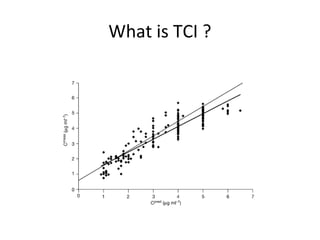
What is TCI ?
TCI
• Target controlled infusion
– Amnesia: propofol
• Infusion model: Marsh, Schnider
– Analgesia: opioid
• Fentanyl
• Alfentanil
• Remifentanil
• Sufentanil
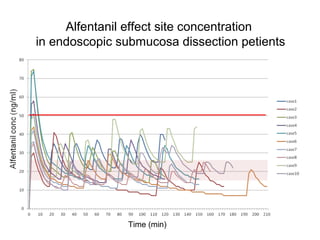
Time (min)
Alfentanil effect site concentration
in endoscopic submucosa dissection petients
TCI for adult: propofol
Infusion mode for Propofol
• Marsh
– Derived from Gept’s model (1987)
• Regional anesthesia combined propofol infusion
• Total 18 patients
• No BMI data
– Scarecely adequate in the elderly
• Anaesthesia 1998;53:Suppl. 1:61-67
• Ann Fr Anesthn Reanim 2000;19:R027
• For patients less than 70y/o
Infusion mode for Propofol
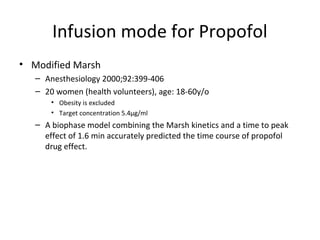
• Modified Marsh
– Anesthesiology 2000;92:399-406
– 20 women (health volunteers), age: 18-60y/o
• Obesity is excluded
• Target concentration 5.4μg/ml
– A biophase model combining the Marsh kinetics and a time to peak
effect of 1.6 min accurately predicted the time course of propofol
drug effect.
Infusion mode for Propofol
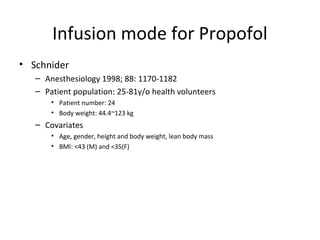
• Schnider
– Anesthesiology 1998; 88: 1170-1182
– Patient population: 25-81y/o health volunteers
• Patient number: 24
• Body weight: 44.4~123 kg
– Covariates
• Age, gender, height and body weight, lean body mass
• BMI: <43 (M) and <35(F)
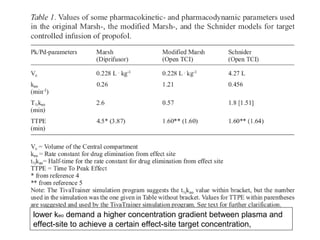
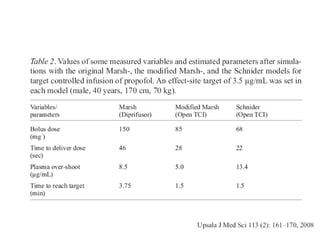
lower keo demand a higher concentration gradient between plasma and
effect-site to achieve a certain effect-site target concentration,
Which is better
• In a recent clinical trial, changes in the BIS correlated better with effect
site concentration predictions by the original Marsh model than with the
Schnider model.
– Anesthesia 2007; 62: 661-6
• Potential benefits with the Marsh II and Schnider models are reduced
hemodynamic and respiratory effects.
– Age is included as a pharmacokinetic co-factor in the Schnider model
TCI for adult: opioid
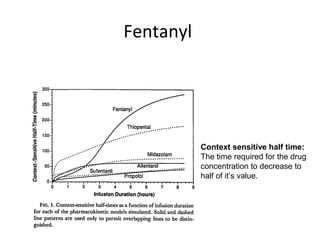
Fentanyl
Context sensitive half time:
The time required for the drug
concentration to decrease to
half of it’s value.
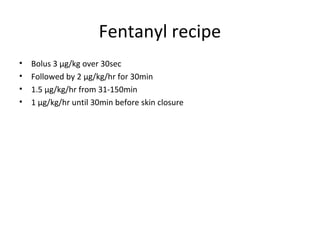
Fentanyl recipe
• Bolus 3 μg/kg over 30sec
• Followed by 2 μg/kg/hr for 30min
• 1.5 μg/kg/hr from 31-150min
• 1 μg/kg/hr until 30min before skin closure
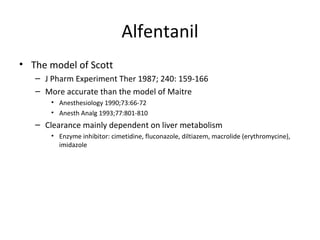
Alfentanil
• The model of Scott
– J Pharm Experiment Ther 1987; 240: 159-166
– More accurate than the model of Maitre
• Anesthesiology 1990;73:66-72
• Anesth Analg 1993;77:801-810
– Clearance mainly dependent on liver metabolism
• Enzyme inhibitor: cimetidine, fluconazole, diltiazem, macrolide (erythromycine),
imidazole
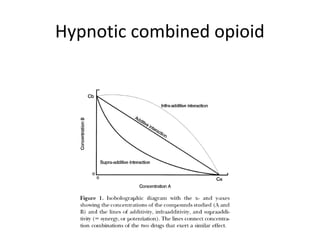
Hypnotic combined opioid
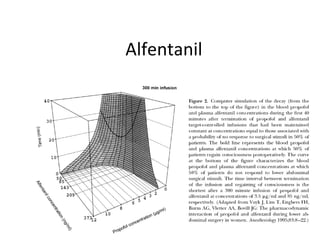
Alfentanil
TCI diy
TIVA trainer for simulation
• Download from EuroSIVA website
– 100 Euro for registration
Should we routinely monitor
anesthetic depth in TIVA?
Propofol infusion syndrome
• Defined as acute bradycardia progressing to asystole
combined with lipemic plasma, fatty liver enlargement,
metabolic acidosis with negative base excess > 10mmol/l,
rhabdomyolysis or myoglobinuria associated with propofol
infusion.
– Large dose, prolonged duration.
• A hereditary mitochondrial fatty acid metabolism impairment
resembling medium chain acyl-CoA dehydrogenase deficiency
is responsible for the susceptibility to the development of
propofol infusion syndrome.
• Minerva anestesiol 2009;75:339
TCI without monitoring
• Driving with one eye closed.
– Expert opinion
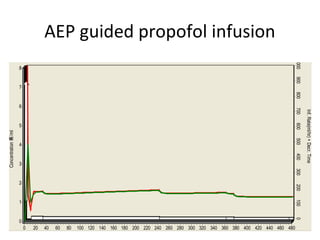
AEP guided propofol infusion
480460440420400380360340320300280260240220200180160140120100806040200
Concentration/ml痢
8
7
6
5
4
3
2
1
0
Inf.Rate(ml/hr)+Decr.Time
10009008007006005004003002001000
BIS
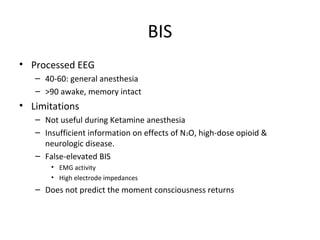
• Processed EEG
– 40-60: general anesthesia
– >90 awake, memory intact
• Limitations
– Not useful during Ketamine anesthesia
– Insufficient information on effects of N2O, high-dose opioid &
neurologic disease.
– False-elevated BIS
• EMG activity
• High electrode impedances
– Does not predict the moment consciousness returns
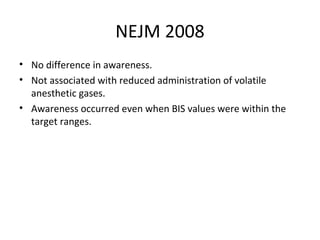
NEJM 2008
• No difference in awareness.
• Not associated with reduced administration of volatile
anesthetic gases.
• Awareness occurred even when BIS values were within the
target ranges.
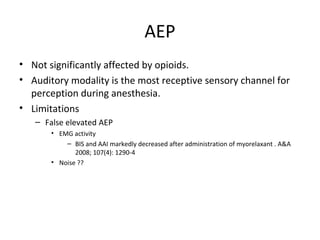
AEP
• Not significantly affected by opioids.
• Auditory modality is the most receptive sensory channel for
perception during anesthesia.
• Limitations
– False elevated AEP
• EMG activity
– BIS and AAI markedly decreased after administration of myorelaxant . A&A
2008; 107(4): 1290-4
• Noise ??
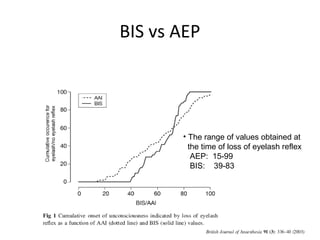
BIS vs AEP
• The range of values obtained at
the time of loss of eyelash reflex
AEP: 15-99
BIS: 39-83
BIS vs AEP
• The awake values for AAI were less and showed more variation between
subjects than BIS.
Closed loop system
• The input
– Drug delivery (etc. propofol, opioids)
• The output
– evoked potential, bispected index (BIS), blood pressure, pulse rate.
Discussion …
• Can anesthetic depth monitoring decrease unnecessary
propofol use?
– Putative early propofol infusion syndrome: typical symptoms without
cardiac involvement.
• Monitor pH, lactate, base excess and creatinine kinase is recommended.
Can we applied propofol continuous
infusion for children or even infant ?
Infusion mode for Propofol
• Kataria
– Anesthesiology 1994; 80: 104-122
– Patient population: 3-11y/o children receiving body surface surgery.
• Patient number: 53
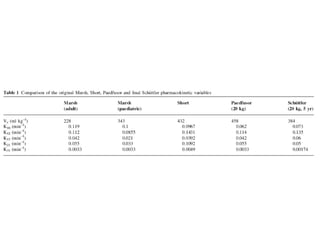
– Three-compartment pharmacokinetic model
• Weight-adjusting the volumes and clearances significantly improved the accuracy.
Infusion mode for Propofol
• Marsh (Pediatric)
– BJA 1991; 67: 41-48
• Marsh (Pediatric)
– Patient population: 1-12y/o children receiving minor surgery
• Patient number: 20
Infusion mode for Propofol
• Paedfusor
– BJA 2003; 91: 507~513
– 32 children of ASA status II±III, undergoing elective cardiac surgery or
cardiac catheterization were enrolled.
– The effect of bypass
• system was negative during bypass: -5.5%
• Large volume of distribution (ml): 270: 4600: 1340: 8200
– No outcome data
For pediatric anesthesia
• Propofol is not indicated for use in children < 3y/o.
– Pediatric Anesthesia 2004; 14: 374-379
– Still lack of FDA approval
• Propofol is not approved for sedation in pediatric ICU
patients.
• Minerva anestesiol 2009;75:339
For MEP monitoring
• J Neurosurg Pediatrics 7:000–000, 2011
– From Texas
– For 10 children age under 3 year old (mean age: 16.8 months)
receiving complex spine surgery
– Sevo induction
– Maintenance: propofol 6-15mg/kg/hr
– No mention of OP time
• Discussion: The loss or absence of MEP amplitude may be minimized
when propofol is administered in small, titrated doses (6-15mg/kg/hr) in a
child younger than 3 years of age.
In PICU in Australia and NZ
• The majority of practitioners (82%) use propofol infusion in
children in PICU
– the main indication being for short-term sedation in children requiring
procedures.
• 67% of paediatric intensivists use maximum infusion doses
that may be considered dangerously high (> or = 10 mg/kg/h)
• 19% use propofol infusion for prolonged periods (> 72 hours).
• A smaller proportion (15%) of respondents indicate that they
may use both higher doses and prolonged periods of infusion
• Anaesth Intensive Care. 2002 Dec;30(6):786-93.
For prolonged sedation
• Propofol should be used with extreme caution for prolonged
sedation in intensive care unit patients, at dose rates of below
5 mg/kg per h
• Curr Opin Anaesthesiol. 2003 Jun;16(3):285-90
• TIVA with propofol in infants younger than 1 year old requires
extensive experience with TIVA in older children and with the
handling of this special age group and should be undertaken
with maximum precautionary measures.
– Infusion rate up to 9mg/kg/hr over 2-4hours are recommended for
TIVA in children.
• Anaesthesist. 2003 Sep;52(9):763-77.
BIS for children
• The Bispectral Index correlates well with the Ramsay score in
the normal sedated child.
• Pediatric Critical Care Medicine: January 2003 ; 4(1) 60-64
Can patient outcome be determined
by anesthetic agent we used?
TIVA in cardiac surgery
• Still no conclusion
– 30-day mortality in acute procedure was significantly lower in the
propofol group.
– 30-day mortality caused by infection, pulmonary causes or renal
causes was significantly lower in the propofol group.
– J Cardiothorac Vasc Anesth 2007;21:664-71
– Volatile anesthetic in AVR: better preservation of myocardial function
and a reduced postoperative release of troponin I.
– Less ICU stay in the volatile anesthetic group.
– Anesth Analg 2006;103:289-96
Safety issues for office-based
anesthesia
2008 ASA statement
• A reliable source of oxygen and backup oxygen sources.
• An adequate and reliable source of suction.
• Reliable system for scavenging waste anesthetic gases.
– while inhalation anesthetics are administered…
• Adequate illumination of the patient, anesthesia machine and
monitoring equipment.
– Hard to define adequate illumination.
• Sufficient space to accommodate necessary equipment and
personnel.
– Most critical part in most circumstances in our hospital.
• Sufficient electrical outlets
2008 ASA statement
• Anesthetic equipment
– a self-inflating hand resuscitator bag capable of administering at least
90 percent oxygen as a means to deliver positive pressure ventilation
– adequate anesthesia drugs, supplies and equipment for the intended
anesthesia care
– adequate monitoring equipment
• An emergency cart
– a defibrillator
– emergency drugs
– equipment adequate to provide cardiopulmonary resuscitation
• adequate staff trained to support the anesthesiologist and a
reliable means of two-way communication to request
assistance.
2008 ASA statement
• Appropriate postanesthesia management should be provided.
– Our weak point.
Statement on safe use of propofol
• ASA 2009 statement
– The practitioner should be present throughout the procedure and be
completely dedicated to that task.
– manage the potential medical complications of sedation/anesthesia.
– proficient in airway management
– have advanced life support
– understand the pharmacology of the drugs used.
– Monitoring
• Ventilation: Monitoring for the presence of exhaled carbon dioxide should
be utilized because movement of the chest will not dependably identify
airway obstruction or apnea.
• oxygen saturation
• heart rate
• blood pressure.
Summary
• Safer environment
– Oxygen supply and suction should be close to the patient.
• Safer equipment
– Emergency cart: defibrillator
– Keep ABC in mind
– End-tidal CO2 monitoring
Thanks for your attention

Tiva & tci for 1118

  • 1.
    Total intravenous anesthesia(TIVA) & Target Controlled Infusion(TCI) 台北榮總麻醉部 王審之
  • 2.
    TIVA • Total intravenousanesthesia – Amnesia and analgesia • Sedation in intensive care unit • Day surgery • Office based anesthesia – Muscle relaxant
  • 3.
  • 4.
    TCI • Target controlledinfusion – Amnesia: propofol • Infusion model: Marsh, Schnider – Analgesia: opioid • Fentanyl • Alfentanil • Remifentanil • Sufentanil
  • 5.
    Time (min) Alfentanil effectsite concentration in endoscopic submucosa dissection petients
  • 6.
  • 7.
    Infusion mode forPropofol • Marsh – Derived from Gept’s model (1987) • Regional anesthesia combined propofol infusion • Total 18 patients • No BMI data – Scarecely adequate in the elderly • Anaesthesia 1998;53:Suppl. 1:61-67 • Ann Fr Anesthn Reanim 2000;19:R027 • For patients less than 70y/o
  • 8.
    Infusion mode forPropofol • Modified Marsh – Anesthesiology 2000;92:399-406 – 20 women (health volunteers), age: 18-60y/o • Obesity is excluded • Target concentration 5.4μg/ml – A biophase model combining the Marsh kinetics and a time to peak effect of 1.6 min accurately predicted the time course of propofol drug effect.
  • 9.
    Infusion mode forPropofol • Schnider – Anesthesiology 1998; 88: 1170-1182 – Patient population: 25-81y/o health volunteers • Patient number: 24 • Body weight: 44.4~123 kg – Covariates • Age, gender, height and body weight, lean body mass • BMI: <43 (M) and <35(F)
  • 10.
    lower keo demanda higher concentration gradient between plasma and effect-site to achieve a certain effect-site target concentration,
  • 12.
    Which is better •In a recent clinical trial, changes in the BIS correlated better with effect site concentration predictions by the original Marsh model than with the Schnider model. – Anesthesia 2007; 62: 661-6 • Potential benefits with the Marsh II and Schnider models are reduced hemodynamic and respiratory effects. – Age is included as a pharmacokinetic co-factor in the Schnider model
  • 13.
  • 14.
    Fentanyl Context sensitive halftime: The time required for the drug concentration to decrease to half of it’s value.
  • 15.
    Fentanyl recipe • Bolus3 μg/kg over 30sec • Followed by 2 μg/kg/hr for 30min • 1.5 μg/kg/hr from 31-150min • 1 μg/kg/hr until 30min before skin closure
  • 16.
    Alfentanil • The modelof Scott – J Pharm Experiment Ther 1987; 240: 159-166 – More accurate than the model of Maitre • Anesthesiology 1990;73:66-72 • Anesth Analg 1993;77:801-810 – Clearance mainly dependent on liver metabolism • Enzyme inhibitor: cimetidine, fluconazole, diltiazem, macrolide (erythromycine), imidazole
  • 17.
  • 18.
  • 19.
  • 20.
    TIVA trainer forsimulation • Download from EuroSIVA website – 100 Euro for registration
  • 21.
    Should we routinelymonitor anesthetic depth in TIVA?
  • 22.
    Propofol infusion syndrome •Defined as acute bradycardia progressing to asystole combined with lipemic plasma, fatty liver enlargement, metabolic acidosis with negative base excess > 10mmol/l, rhabdomyolysis or myoglobinuria associated with propofol infusion. – Large dose, prolonged duration. • A hereditary mitochondrial fatty acid metabolism impairment resembling medium chain acyl-CoA dehydrogenase deficiency is responsible for the susceptibility to the development of propofol infusion syndrome. • Minerva anestesiol 2009;75:339
  • 23.
    TCI without monitoring •Driving with one eye closed. – Expert opinion
  • 24.
    AEP guided propofolinfusion 480460440420400380360340320300280260240220200180160140120100806040200 Concentration/ml痢 8 7 6 5 4 3 2 1 0 Inf.Rate(ml/hr)+Decr.Time 10009008007006005004003002001000
  • 25.
    BIS • Processed EEG –40-60: general anesthesia – >90 awake, memory intact • Limitations – Not useful during Ketamine anesthesia – Insufficient information on effects of N2O, high-dose opioid & neurologic disease. – False-elevated BIS • EMG activity • High electrode impedances – Does not predict the moment consciousness returns
  • 26.
    NEJM 2008 • Nodifference in awareness. • Not associated with reduced administration of volatile anesthetic gases. • Awareness occurred even when BIS values were within the target ranges.
  • 27.
    AEP • Not significantlyaffected by opioids. • Auditory modality is the most receptive sensory channel for perception during anesthesia. • Limitations – False elevated AEP • EMG activity – BIS and AAI markedly decreased after administration of myorelaxant . A&A 2008; 107(4): 1290-4 • Noise ??
  • 28.
    BIS vs AEP •The range of values obtained at the time of loss of eyelash reflex AEP: 15-99 BIS: 39-83
  • 29.
    BIS vs AEP •The awake values for AAI were less and showed more variation between subjects than BIS.
  • 30.
    Closed loop system •The input – Drug delivery (etc. propofol, opioids) • The output – evoked potential, bispected index (BIS), blood pressure, pulse rate.
  • 31.
    Discussion … • Cananesthetic depth monitoring decrease unnecessary propofol use? – Putative early propofol infusion syndrome: typical symptoms without cardiac involvement. • Monitor pH, lactate, base excess and creatinine kinase is recommended.
  • 32.
    Can we appliedpropofol continuous infusion for children or even infant ?
  • 33.
    Infusion mode forPropofol • Kataria – Anesthesiology 1994; 80: 104-122 – Patient population: 3-11y/o children receiving body surface surgery. • Patient number: 53 – Three-compartment pharmacokinetic model • Weight-adjusting the volumes and clearances significantly improved the accuracy.
  • 34.
    Infusion mode forPropofol • Marsh (Pediatric) – BJA 1991; 67: 41-48 • Marsh (Pediatric) – Patient population: 1-12y/o children receiving minor surgery • Patient number: 20
  • 35.
    Infusion mode forPropofol • Paedfusor – BJA 2003; 91: 507~513 – 32 children of ASA status II±III, undergoing elective cardiac surgery or cardiac catheterization were enrolled. – The effect of bypass • system was negative during bypass: -5.5% • Large volume of distribution (ml): 270: 4600: 1340: 8200 – No outcome data
  • 37.
    For pediatric anesthesia •Propofol is not indicated for use in children < 3y/o. – Pediatric Anesthesia 2004; 14: 374-379 – Still lack of FDA approval • Propofol is not approved for sedation in pediatric ICU patients. • Minerva anestesiol 2009;75:339
  • 38.
    For MEP monitoring •J Neurosurg Pediatrics 7:000–000, 2011 – From Texas – For 10 children age under 3 year old (mean age: 16.8 months) receiving complex spine surgery – Sevo induction – Maintenance: propofol 6-15mg/kg/hr – No mention of OP time • Discussion: The loss or absence of MEP amplitude may be minimized when propofol is administered in small, titrated doses (6-15mg/kg/hr) in a child younger than 3 years of age.
  • 39.
    In PICU inAustralia and NZ • The majority of practitioners (82%) use propofol infusion in children in PICU – the main indication being for short-term sedation in children requiring procedures. • 67% of paediatric intensivists use maximum infusion doses that may be considered dangerously high (> or = 10 mg/kg/h) • 19% use propofol infusion for prolonged periods (> 72 hours). • A smaller proportion (15%) of respondents indicate that they may use both higher doses and prolonged periods of infusion • Anaesth Intensive Care. 2002 Dec;30(6):786-93.
  • 40.
    For prolonged sedation •Propofol should be used with extreme caution for prolonged sedation in intensive care unit patients, at dose rates of below 5 mg/kg per h • Curr Opin Anaesthesiol. 2003 Jun;16(3):285-90 • TIVA with propofol in infants younger than 1 year old requires extensive experience with TIVA in older children and with the handling of this special age group and should be undertaken with maximum precautionary measures. – Infusion rate up to 9mg/kg/hr over 2-4hours are recommended for TIVA in children. • Anaesthesist. 2003 Sep;52(9):763-77.
  • 41.
    BIS for children •The Bispectral Index correlates well with the Ramsay score in the normal sedated child. • Pediatric Critical Care Medicine: January 2003 ; 4(1) 60-64
  • 42.
    Can patient outcomebe determined by anesthetic agent we used?
  • 43.
    TIVA in cardiacsurgery • Still no conclusion – 30-day mortality in acute procedure was significantly lower in the propofol group. – 30-day mortality caused by infection, pulmonary causes or renal causes was significantly lower in the propofol group. – J Cardiothorac Vasc Anesth 2007;21:664-71 – Volatile anesthetic in AVR: better preservation of myocardial function and a reduced postoperative release of troponin I. – Less ICU stay in the volatile anesthetic group. – Anesth Analg 2006;103:289-96
  • 44.
    Safety issues foroffice-based anesthesia
  • 45.
    2008 ASA statement •A reliable source of oxygen and backup oxygen sources. • An adequate and reliable source of suction. • Reliable system for scavenging waste anesthetic gases. – while inhalation anesthetics are administered… • Adequate illumination of the patient, anesthesia machine and monitoring equipment. – Hard to define adequate illumination. • Sufficient space to accommodate necessary equipment and personnel. – Most critical part in most circumstances in our hospital. • Sufficient electrical outlets
  • 46.
    2008 ASA statement •Anesthetic equipment – a self-inflating hand resuscitator bag capable of administering at least 90 percent oxygen as a means to deliver positive pressure ventilation – adequate anesthesia drugs, supplies and equipment for the intended anesthesia care – adequate monitoring equipment • An emergency cart – a defibrillator – emergency drugs – equipment adequate to provide cardiopulmonary resuscitation • adequate staff trained to support the anesthesiologist and a reliable means of two-way communication to request assistance.
  • 47.
    2008 ASA statement •Appropriate postanesthesia management should be provided. – Our weak point.
  • 48.
    Statement on safeuse of propofol • ASA 2009 statement – The practitioner should be present throughout the procedure and be completely dedicated to that task. – manage the potential medical complications of sedation/anesthesia. – proficient in airway management – have advanced life support – understand the pharmacology of the drugs used. – Monitoring • Ventilation: Monitoring for the presence of exhaled carbon dioxide should be utilized because movement of the chest will not dependably identify airway obstruction or apnea. • oxygen saturation • heart rate • blood pressure.
  • 49.
    Summary • Safer environment –Oxygen supply and suction should be close to the patient. • Safer equipment – Emergency cart: defibrillator – Keep ABC in mind – End-tidal CO2 monitoring
  • 50.
    Thanks for yourattention