909,SENTHUR POLYTECHNIC
COLLEGE
DEPARTMENT OF AUTOMOBILE
ENGINEERTING
SEMINAR
Submitted by:
NITHYANANTHAN S
Autonomous Vehicles
Topics Discussed
• What is an autonomous vehicle?
• History
• How does it work?
• Advantages
• Disadvantages
• Future
What is an Autonomous Vehicle?
• An autonomous vehicle (robotic car, driverless
car) is a automobile capable of transporting
passengers without the need for human
direction or interaction.
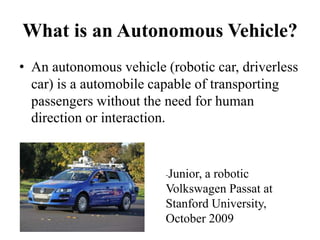
-Junior, a robotic
Volkswagen Passat at
Stanford University,
October 2009
History
• 1926 – Achen Motor displayed it remote
control vehicle, Phantom Auto, on the streets
of Milwaukee, Wisconsin. The operator
followed the Phantom Auto in another car.
• 1960’s – Ohio State University department of
Communications and Control systems
launches autonomous vehicle project. States
that roads will be ready for autonomous
vehicles in approximately 15 years.
History
• 1980’s - DARPA funds the Autonomous-Land-Vehicle
(ALV)project using technologies from Carnegie Mellon
University (CMU) and University of Michigan.
Employed laser radar and computer vision to have
driverless vehicle trail a lead car at 19 mph.
• 1995 – CMU develops “No Hands Across America”
project in which a 98.2% autonomous vehicle traversed
3,100 miles across U.S. Neural networking was used to
steer the vehicle, however, the throttle and brake were
operated by a human via remote control.
History
• 2005 – Google, Volkswagen, and Stanford
Engineers win DARPA Grand Challenge, an 132
mile off-road racing contest, with Stanley.
• SPECS:
– 7 battery powered Pentium M
computers
– Terrain read with 4 laser range
finders, radar, cameras. System
reads environment and avoids
collision in real time.
History
• As of today, Google has created a fleet of driverless
automobiles. They have logged over 300,000 miles of
autonomous vehicle transportation. There has been only one
accident recorded. The accident was said to be caused by a
human driver as the driverless function was disengaged.
• Driverless vehicles are now able to legal travel roads and
highways in Nevada, California, and Florida. Texas has
now begun discussing criteria for laws concerning robotic
cars. Most states, however, have found it extremely
difficult to approach autonomous vehicle laws, as most laws
concerning automobiles assume a human operator
How does it work?
• Hardware:
– Velodyne 64 beam laser, mounted of the roof, generates a
3-D map of the environment.
– 4 radars mounted on the front and rear bumpers to navigate
through high speed traffic.
– A camera located on the rear view mirror dedicated to
reading traffic lights.
– GPS
How Does it Work?
• Software:
– Google Chauffeur – The premium software program
dedicated to driverless vehicles. Maintains vehicle
control most of the time, however, if it encounters a
situation that it is ensure of, the system will ask for a
driver to take control.
– Still in Beta testing
– Averages one error every 300 miles.
– Performs hundreds of diagnostic tests every second.
– Goal: To be safer than the average driver, not crash
proof
Advantages
• Better quality of life.
• Higher Productivity.
– The average American spends 18.5 hours a week
in a car.
• Safer roads.
– It is estimated that 40,000 people die in auto
accidents every year.
Disadvantages
• Difficult task for lawmakers.
• Insurance and accidents. Who is to blame?
• Can we trust this technology? Can this replace
human judgment?
Future Possibilities
• Google plans to have commercially available
autonomous vehicles by 2017.
• Cars will become a mobile entertainment center.
Including dedicated Wi-Fi.
• V2V (Vehicle to Vehicle) Communication –
802.11p and Dedicated Short Range
Communications Standards (DSRCS).
– 5.9 GHz range radio frequency for collision
avoidance, managing traffic signals, and platoons
(coordinated fuel efficient groups).
Conclusion
• Autonomous vehicles have been subject to research and
development for nearly a century.
• Current vehicles employ a combination of laser mapping systems,
cameras, and sensors to read terrain, other vehicles, and traffic
lights.
• Google Chauffeur is the most advance software system to date.
• Weighing out the pros and cons.
• V2V communication is in the near future.
• Cars will no longer be thought of as simply a transportation
option, but rather a mobile entertainment center equipped with
Wi-Fi, televisions, and a entertainment dedicated onboard
computer.
• Japan has already begun to employ autonomous vehicles in the
trucking industry.
THANK YOU

AUTONOMOUS CAR.pptx

  • 1.
    909,SENTHUR POLYTECHNIC COLLEGE DEPARTMENT OFAUTOMOBILE ENGINEERTING SEMINAR Submitted by: NITHYANANTHAN S
  • 2.
  • 3.
    Topics Discussed • Whatis an autonomous vehicle? • History • How does it work? • Advantages • Disadvantages • Future
  • 4.
    What is anAutonomous Vehicle? • An autonomous vehicle (robotic car, driverless car) is a automobile capable of transporting passengers without the need for human direction or interaction. -Junior, a robotic Volkswagen Passat at Stanford University, October 2009
  • 5.
    History • 1926 –Achen Motor displayed it remote control vehicle, Phantom Auto, on the streets of Milwaukee, Wisconsin. The operator followed the Phantom Auto in another car. • 1960’s – Ohio State University department of Communications and Control systems launches autonomous vehicle project. States that roads will be ready for autonomous vehicles in approximately 15 years.
  • 6.
    History • 1980’s -DARPA funds the Autonomous-Land-Vehicle (ALV)project using technologies from Carnegie Mellon University (CMU) and University of Michigan. Employed laser radar and computer vision to have driverless vehicle trail a lead car at 19 mph. • 1995 – CMU develops “No Hands Across America” project in which a 98.2% autonomous vehicle traversed 3,100 miles across U.S. Neural networking was used to steer the vehicle, however, the throttle and brake were operated by a human via remote control.
  • 7.
    History • 2005 –Google, Volkswagen, and Stanford Engineers win DARPA Grand Challenge, an 132 mile off-road racing contest, with Stanley. • SPECS: – 7 battery powered Pentium M computers – Terrain read with 4 laser range finders, radar, cameras. System reads environment and avoids collision in real time.
  • 8.
    History • As oftoday, Google has created a fleet of driverless automobiles. They have logged over 300,000 miles of autonomous vehicle transportation. There has been only one accident recorded. The accident was said to be caused by a human driver as the driverless function was disengaged. • Driverless vehicles are now able to legal travel roads and highways in Nevada, California, and Florida. Texas has now begun discussing criteria for laws concerning robotic cars. Most states, however, have found it extremely difficult to approach autonomous vehicle laws, as most laws concerning automobiles assume a human operator
  • 9.
    How does itwork? • Hardware: – Velodyne 64 beam laser, mounted of the roof, generates a 3-D map of the environment. – 4 radars mounted on the front and rear bumpers to navigate through high speed traffic. – A camera located on the rear view mirror dedicated to reading traffic lights. – GPS
  • 10.
    How Does itWork? • Software: – Google Chauffeur – The premium software program dedicated to driverless vehicles. Maintains vehicle control most of the time, however, if it encounters a situation that it is ensure of, the system will ask for a driver to take control. – Still in Beta testing – Averages one error every 300 miles. – Performs hundreds of diagnostic tests every second. – Goal: To be safer than the average driver, not crash proof
  • 11.
    Advantages • Better qualityof life. • Higher Productivity. – The average American spends 18.5 hours a week in a car. • Safer roads. – It is estimated that 40,000 people die in auto accidents every year.
  • 12.
    Disadvantages • Difficult taskfor lawmakers. • Insurance and accidents. Who is to blame? • Can we trust this technology? Can this replace human judgment?
  • 13.
    Future Possibilities • Googleplans to have commercially available autonomous vehicles by 2017. • Cars will become a mobile entertainment center. Including dedicated Wi-Fi. • V2V (Vehicle to Vehicle) Communication – 802.11p and Dedicated Short Range Communications Standards (DSRCS). – 5.9 GHz range radio frequency for collision avoidance, managing traffic signals, and platoons (coordinated fuel efficient groups).
  • 14.
    Conclusion • Autonomous vehicleshave been subject to research and development for nearly a century. • Current vehicles employ a combination of laser mapping systems, cameras, and sensors to read terrain, other vehicles, and traffic lights. • Google Chauffeur is the most advance software system to date. • Weighing out the pros and cons. • V2V communication is in the near future. • Cars will no longer be thought of as simply a transportation option, but rather a mobile entertainment center equipped with Wi-Fi, televisions, and a entertainment dedicated onboard computer. • Japan has already begun to employ autonomous vehicles in the trucking industry.
  • 15.