Dept. of Mechanical
Engg. Presented By:
Ajay Savita
ME-A(5th SEM)
Roll no:
0928ME121007
3
🞂 Cams are used to convert rotary motion to
oscillatory motion (almost always) or
oscillatory motion to rotary motion (rarely)
🞂 For high speed applications – example,
internal combustion engines
🞂 Objectives of this chapter:
◦ Learn fundamental concepts and terminology
◦ Learn how to design a cam and follower set to
achieve a desired output motion.
🞂 In IC engines to operate the inlet and exhaust valves
Based on modes of Input / Output motion
1 Rotating cam – Translating follower
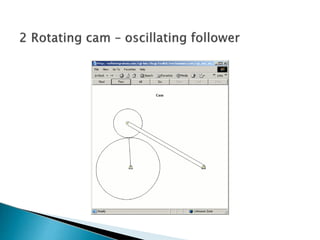
2 Rotating cam – Oscillating follower
3 Translating cam – Translating follower
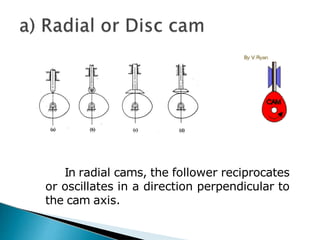
a) Radial or disc cam
b) Cylindrical cam
c) End cam
In radial cams, the follower reciprocates
or oscillates in a direction perpendicular to
the cam axis.
In cylindrical cams, the follower
reciprocates or oscillates in a direction
parallel to the cams axis.
It is also
similar to
cylindrical
cams, but
the follower
makes
contact at
periphery of
the cam as
shown in fig
🞂 Follower is the element to which the motion
of cam is provided
🞂 i.e. Reciprocating or oscillating motion
The start and stop of the follower is
Uniform Velocity
The cam follower rises and falls at a constant speed.
very abrupt and rough.
Modified Uniform Velocity
The modified uniform velocity motion smoothes out the roughness of the uniform
velocity motion by adding a radius at the high and low points of the cam motion.
This type of
Harmonic Motion
The follower motion has a smooth start and stop but the speed is not uniform.
motion is used where the cam rotates at a very fast speed.
Uniform Acceleration
The uniform acceleration is the smoothest motion of all of the cams and causes the
follower to maintain a constant speed throughout the cam travel.
1.According to the shape of follower
🞂 Knife edge follower
🞂 Roller follower
🞂 Flat faced follower
🞂 Spherical faced follower
a) Radial follower
b) Offset follower
🞂 When the motion of the follower is along an
axis passing through the centre of the cam, it
is known as radial followers. Above figures
are examples of this type.
When the motion of the follower is along an axis away
from the axis of the cam centre, it is called off-set
follower. Above figures are examples of this type.
🞂 1. Reciprocating or Translating
🞂 2.Oscillating or Rotating
🞂 Cam profile: The outer
surface of the disc cam.
🞂 Base circle : The circle
with the shortest radius
from the cam center to
any part of the cam
profile.
🞂 Trace point: It is a point
on the follower, and its
motion describes the
movement of the
follower. It is used to
generate the pitch curve.
🞂 Pitch curve : The path
generated by the
trace point as the
follower is rotated
about a stationery
cam.
 Prime circle: The
smallest circle from
the cam center
through the pitch
curve
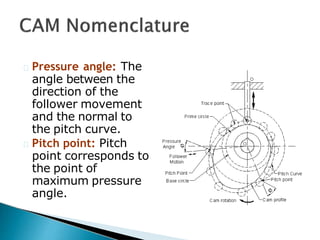
🞂 Pressure angle: The
angle between the
direction of the
follower movement
and the normal to
the pitch curve.
🞂 Pitch point: Pitch
point corresponds to
the point of
maximum pressure
angle.
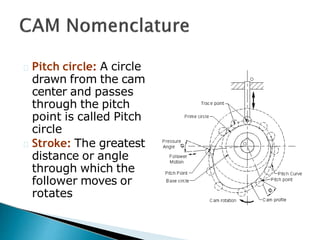
🞂 Pitch circle: A circle
drawn from the cam
center and passes
through the pitch
point is called Pitch
circle
🞂 Stroke: The greatest
distance or angle
through which the
follower moves or
rotates
Function of cam.pptx

Function of cam.pptx

  • 1.
    Dept. of Mechanical Engg.Presented By: Ajay Savita ME-A(5th SEM) Roll no: 0928ME121007
  • 3.
    3 🞂 Cams areused to convert rotary motion to oscillatory motion (almost always) or oscillatory motion to rotary motion (rarely) 🞂 For high speed applications – example, internal combustion engines 🞂 Objectives of this chapter: ◦ Learn fundamental concepts and terminology ◦ Learn how to design a cam and follower set to achieve a desired output motion.
  • 4.
    🞂 In ICengines to operate the inlet and exhaust valves
  • 5.
    Based on modesof Input / Output motion 1 Rotating cam – Translating follower 2 Rotating cam – Oscillating follower 3 Translating cam – Translating follower
  • 9.
    a) Radial ordisc cam b) Cylindrical cam c) End cam
  • 10.
    In radial cams,the follower reciprocates or oscillates in a direction perpendicular to the cam axis.
  • 11.
    In cylindrical cams,the follower reciprocates or oscillates in a direction parallel to the cams axis.
  • 12.
    It is also similarto cylindrical cams, but the follower makes contact at periphery of the cam as shown in fig
  • 13.
    🞂 Follower isthe element to which the motion of cam is provided 🞂 i.e. Reciprocating or oscillating motion
  • 14.
    The start andstop of the follower is Uniform Velocity The cam follower rises and falls at a constant speed. very abrupt and rough. Modified Uniform Velocity The modified uniform velocity motion smoothes out the roughness of the uniform velocity motion by adding a radius at the high and low points of the cam motion.
  • 15.
    This type of HarmonicMotion The follower motion has a smooth start and stop but the speed is not uniform. motion is used where the cam rotates at a very fast speed. Uniform Acceleration The uniform acceleration is the smoothest motion of all of the cams and causes the follower to maintain a constant speed throughout the cam travel.
  • 16.
    1.According to theshape of follower 🞂 Knife edge follower 🞂 Roller follower 🞂 Flat faced follower 🞂 Spherical faced follower
  • 21.
    a) Radial follower b)Offset follower
  • 22.
    🞂 When themotion of the follower is along an axis passing through the centre of the cam, it is known as radial followers. Above figures are examples of this type.
  • 23.
    When the motionof the follower is along an axis away from the axis of the cam centre, it is called off-set follower. Above figures are examples of this type.
  • 24.
    🞂 1. Reciprocatingor Translating 🞂 2.Oscillating or Rotating
  • 25.
    🞂 Cam profile:The outer surface of the disc cam. 🞂 Base circle : The circle with the shortest radius from the cam center to any part of the cam profile. 🞂 Trace point: It is a point on the follower, and its motion describes the movement of the follower. It is used to generate the pitch curve.
  • 26.
    🞂 Pitch curve: The path generated by the trace point as the follower is rotated about a stationery cam.  Prime circle: The smallest circle from the cam center through the pitch curve
  • 27.
    🞂 Pressure angle:The angle between the direction of the follower movement and the normal to the pitch curve. 🞂 Pitch point: Pitch point corresponds to the point of maximum pressure angle.
  • 28.
    🞂 Pitch circle:A circle drawn from the cam center and passes through the pitch point is called Pitch circle 🞂 Stroke: The greatest distance or angle through which the follower moves or rotates