SELF DRIVING CAR
AUTONOMOUS VEHICLE
INTRO
• “ A self driving car, also known as an autonomous vehicle , driverless
car is a vehicle that is capable of sensing its environment and moving
safely its environment and moving safely with little or no human input.
”
• They combine sensors and software to control , navigate and drive the
vehicle.
HISTORY
• The concept of making the autonomous cars starts at the 1920
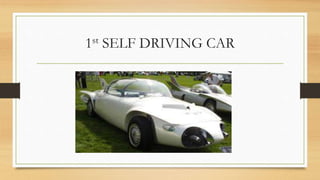
• In 1939 , Norman Bel Geddes created the first self-driving car, which was
an electric vehicle guided by radio-controlled electromagnetic fields
generated with magnetized metal spikes embedded in the roadway. By 1958,
General Motors had made this concept a reality.
1st SELF DRIVING CAR
• In the 1980s, a vision-guided Mercedes-Benz robotic van, designed
by Ernst Dickmanns and his team at the Bundeswehr University
Munich in Munich, Germany, achieved a speed of 39 miles per hour
(63 km/h) on streets without traffic.
DARPA CHALLENGES
• It was DARPA’s (Defense Advanced Research Projects Agency) self-driving
cars competition of 2004, 2005 and 2007 that really kick-started the race to
create road-worthy autonomous vehicles. DARPA’s challenge to university
students and private contractors on developing self-driving cars helped pave
the way for a safer and eco-friendly future.
• DARPA 1 (2004)
• DARPA 2 (2005)
• DARPA 3 (2007)
DARPA 1 & 2
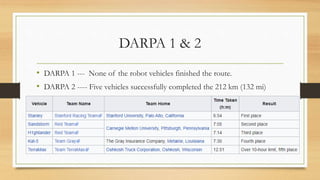
• DARPA 1 --- None of the robot vehicles finished the route.
• DARPA 2 ---- Five vehicles successfully completed the 212 km (132 mi)
course:
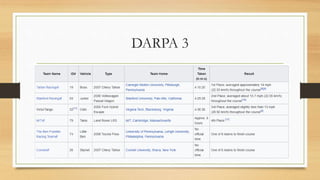
DARPA 3
WORKING
TECHNOLOGY
• SENSORS
• HYBRID NAVIGATION
• COMPUTER VISION
• VEHICULAR COMMUNICATON SYSTEM
COMPUTER VISION
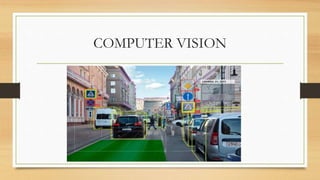
• CREATING 3D MAP --- It can create a 3D map using the camera.
• CLASSIFYING AND DETECTING OBJECTS --- It can enable self-
driving vehicles to classify and detect different objects. The vehicle can use
Lidar sensors and cameras, and the former can use pulsed laser beams to
measure distance. The data obtained can be combined with 3D maps to spot
objects like traffic lights, vehicles, and pedestrians.
COMPUTER VISION
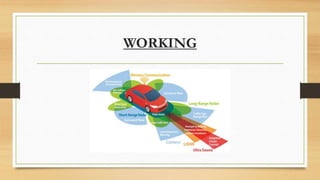
SENSORS
• LIDAR & RADAR ----RADAR(Radio Detection and Ranging) is send out a
radio waves that detect objects and their distance and speed in relation t the
vehicle in real time.
• LIDAR (Light Detection and Ranging ) is works similar to Radar system
,with the only difference that they use laser instead of radio waves. LIDAR
can be configured t create a full 360 degree map around the vehicle.
• CAMERA is the eye of the autonomous vehicle it see the object like human.
It’s capable of maintaining a 360degree view of their external environment.
HYBRID NAVIGATION
• Hybrid navigation is the simultaneous use one more then one navigation
system for location data determination , needed for navigation. By using
multiple system at once the accuracy as a whole is improved.
• Especially for self-driving cars, the exact and continuous knowledge of the
navigating object’s location is essential.
VEHICULAR COMMUNICATON SYSTEM
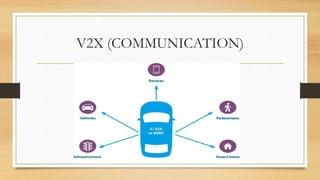
• Vehicular communication system are computer network in which vehicles
and roadside units are communicating nodes, providing each other with
information such as safety warning and traffic information.
• They can be effective in avoiding accident.
• Both types of nodes are Dedicated Short Range Communication(DSRC)
devices. It works in 5.9 GHz band with bandwidth of 75MHz and range of
300m.
V2X (COMMUNICATION)
USE OF AI IN AV
• Autonomous driving is one of the key application areas of artificial
intelligence (AI). Autonomous vehicle are equipped with multiple sensors,
such as cameras, radars and lidar , which help them better understand the
surroundings and in path planning. These sensors generate a massive amount
of data.
• The first use of AI for autonomous driving goes back to the second Defense
Advanced Research Projects Agency (DARPA) Autonomous Vehicle
Challenge in 2005, which was won by the Stanford University Racing Team's
autonomous robotic car 'Stanley'.
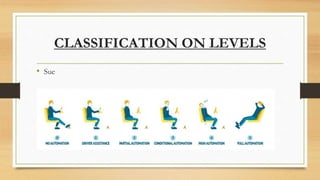
CLASSIFICATION ON LEVELS
• Sue
Levels
• LEVEL 0 ----- All major system are controlled by humans.
• LEVEL 1 ----- Certain system, such as cruise control or
automatic braking , may be controlled by the car, one at a time.
• LEVEL 2 ----- The car can control the steering and acceleration ,
but require the human.
• LEVEL 3 ---- The car can manage all safety-critical functions
under certain conditions, but the driver is expected to take over
when alerted.
• LEVEL 4 --- The car is fully-autonomous in some driving
scenarios, but driver have to take the control in some area like
rush area.
• LEVEL 5--- The car is completely capable of self-driving in every
situation.
CHALLENGES TO DRIVING THE AV
• Susceptibility of car’s sensing and navigation system to different types of
weather as snow and including signal jamming.
• Artificial Intelligence is still able to function properly in the inner-city
environment.
APPLICATIONS
• Autonomous Trucks and Vans
• Transportation System (EX. Driverless Metro )
PROS
• SAFETY: Its reduce the human errors
• ENVIRONMENT : In future approx. all car run on the electric power this
can save the diesel which make the pollution.
• TRAFFIC CONTROL– human traffic enforcers make errors and
statistically make traffic congestion even worse. Self-driving cars will
eliminate the need for them, making them available for other good services
to society.
PROS
• LESS ACCCIDENT---As there is no possibility of human error or distraction, it’s
likely there will be less accidents and reduced fatalities on the road, the biggest pro
of all.
• NO MORE DRINKING DRIVE --- Drink driving should no longer be a
concern, as you won’t have to rely on a designated driver to get you home after a
night out, your car will do the driving, safely.
• FREEDOM FOR DISABLED --- Driverless cars will allow for disabled and
those less mobile to get around easier and comfortably. Driverless cars mean more
freedom and less dependence on other people or forms of transport.
CONS
• SECURITY ISSUE --- It has some hacking potential.
• UNEMPLOYMENT --- It takes the jobs of taxi and personal drivers.
• WEATHER PROBLEM --- like snow , it make problem in the sensing of
road lines
CONS
• HACKING POTENTIAL-- Increasingly connected vehicles means they
are more vulnerable to the threat of hackers, who may be able to take over
control of the cars. Equally, there are privacy concerns in the car being
tracked and knowing your frequent destinations, i.e. your home.
•
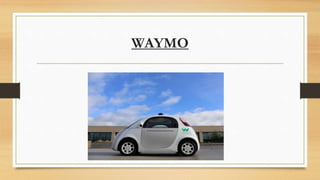
WAYMO
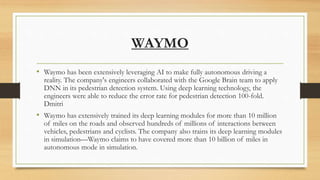
• Waymo has been extensively leveraging AI to make fully autonomous driving a
reality. The company's engineers collaborated with the Google Brain team to apply
DNN in its pedestrian detection system. Using deep learning technology, the
engineers were able to reduce the error rate for pedestrian detection 100-fold.
Dmitri
• Waymo has extensively trained its deep learning modules for more than 10 million
of miles on the roads and observed hundreds of millions of interactions between
vehicles, pedestrians and cyclists. The company also trains its deep learning modules
in simulation—Waymo claims to have covered more than 10 billion of miles in
autonomous mode in simulation.
WAYMO
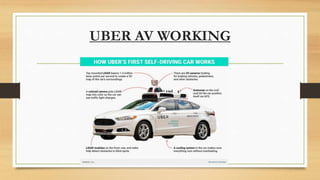
UBER AV WORKING

Self driving car

  • 1.
  • 2.
    INTRO • “ Aself driving car, also known as an autonomous vehicle , driverless car is a vehicle that is capable of sensing its environment and moving safely its environment and moving safely with little or no human input. ” • They combine sensors and software to control , navigate and drive the vehicle.
  • 3.
    HISTORY • The conceptof making the autonomous cars starts at the 1920 • In 1939 , Norman Bel Geddes created the first self-driving car, which was an electric vehicle guided by radio-controlled electromagnetic fields generated with magnetized metal spikes embedded in the roadway. By 1958, General Motors had made this concept a reality.
  • 4.
  • 5.
    • In the1980s, a vision-guided Mercedes-Benz robotic van, designed by Ernst Dickmanns and his team at the Bundeswehr University Munich in Munich, Germany, achieved a speed of 39 miles per hour (63 km/h) on streets without traffic.
  • 6.
    DARPA CHALLENGES • Itwas DARPA’s (Defense Advanced Research Projects Agency) self-driving cars competition of 2004, 2005 and 2007 that really kick-started the race to create road-worthy autonomous vehicles. DARPA’s challenge to university students and private contractors on developing self-driving cars helped pave the way for a safer and eco-friendly future. • DARPA 1 (2004) • DARPA 2 (2005) • DARPA 3 (2007)
  • 7.
    DARPA 1 &2 • DARPA 1 --- None of the robot vehicles finished the route. • DARPA 2 ---- Five vehicles successfully completed the 212 km (132 mi) course:
  • 8.
  • 9.
  • 10.
    TECHNOLOGY • SENSORS • HYBRIDNAVIGATION • COMPUTER VISION • VEHICULAR COMMUNICATON SYSTEM
  • 11.
    COMPUTER VISION • CREATING3D MAP --- It can create a 3D map using the camera. • CLASSIFYING AND DETECTING OBJECTS --- It can enable self- driving vehicles to classify and detect different objects. The vehicle can use Lidar sensors and cameras, and the former can use pulsed laser beams to measure distance. The data obtained can be combined with 3D maps to spot objects like traffic lights, vehicles, and pedestrians.
  • 12.
  • 13.
    SENSORS • LIDAR &RADAR ----RADAR(Radio Detection and Ranging) is send out a radio waves that detect objects and their distance and speed in relation t the vehicle in real time. • LIDAR (Light Detection and Ranging ) is works similar to Radar system ,with the only difference that they use laser instead of radio waves. LIDAR can be configured t create a full 360 degree map around the vehicle. • CAMERA is the eye of the autonomous vehicle it see the object like human. It’s capable of maintaining a 360degree view of their external environment.
  • 14.
    HYBRID NAVIGATION • Hybridnavigation is the simultaneous use one more then one navigation system for location data determination , needed for navigation. By using multiple system at once the accuracy as a whole is improved. • Especially for self-driving cars, the exact and continuous knowledge of the navigating object’s location is essential.
  • 15.
    VEHICULAR COMMUNICATON SYSTEM •Vehicular communication system are computer network in which vehicles and roadside units are communicating nodes, providing each other with information such as safety warning and traffic information. • They can be effective in avoiding accident. • Both types of nodes are Dedicated Short Range Communication(DSRC) devices. It works in 5.9 GHz band with bandwidth of 75MHz and range of 300m.
  • 16.
  • 17.
    USE OF AIIN AV • Autonomous driving is one of the key application areas of artificial intelligence (AI). Autonomous vehicle are equipped with multiple sensors, such as cameras, radars and lidar , which help them better understand the surroundings and in path planning. These sensors generate a massive amount of data. • The first use of AI for autonomous driving goes back to the second Defense Advanced Research Projects Agency (DARPA) Autonomous Vehicle Challenge in 2005, which was won by the Stanford University Racing Team's autonomous robotic car 'Stanley'.
  • 18.
  • 19.
    Levels • LEVEL 0----- All major system are controlled by humans. • LEVEL 1 ----- Certain system, such as cruise control or automatic braking , may be controlled by the car, one at a time.
  • 20.
    • LEVEL 2----- The car can control the steering and acceleration , but require the human. • LEVEL 3 ---- The car can manage all safety-critical functions under certain conditions, but the driver is expected to take over when alerted.
  • 21.
    • LEVEL 4--- The car is fully-autonomous in some driving scenarios, but driver have to take the control in some area like rush area. • LEVEL 5--- The car is completely capable of self-driving in every situation.
  • 22.
    CHALLENGES TO DRIVINGTHE AV • Susceptibility of car’s sensing and navigation system to different types of weather as snow and including signal jamming. • Artificial Intelligence is still able to function properly in the inner-city environment.
  • 23.
    APPLICATIONS • Autonomous Trucksand Vans • Transportation System (EX. Driverless Metro )
  • 24.
    PROS • SAFETY: Itsreduce the human errors • ENVIRONMENT : In future approx. all car run on the electric power this can save the diesel which make the pollution. • TRAFFIC CONTROL– human traffic enforcers make errors and statistically make traffic congestion even worse. Self-driving cars will eliminate the need for them, making them available for other good services to society.
  • 25.
    PROS • LESS ACCCIDENT---Asthere is no possibility of human error or distraction, it’s likely there will be less accidents and reduced fatalities on the road, the biggest pro of all. • NO MORE DRINKING DRIVE --- Drink driving should no longer be a concern, as you won’t have to rely on a designated driver to get you home after a night out, your car will do the driving, safely. • FREEDOM FOR DISABLED --- Driverless cars will allow for disabled and those less mobile to get around easier and comfortably. Driverless cars mean more freedom and less dependence on other people or forms of transport.
  • 26.
    CONS • SECURITY ISSUE--- It has some hacking potential. • UNEMPLOYMENT --- It takes the jobs of taxi and personal drivers. • WEATHER PROBLEM --- like snow , it make problem in the sensing of road lines
  • 27.
    CONS • HACKING POTENTIAL--Increasingly connected vehicles means they are more vulnerable to the threat of hackers, who may be able to take over control of the cars. Equally, there are privacy concerns in the car being tracked and knowing your frequent destinations, i.e. your home. •
  • 28.
    WAYMO • Waymo hasbeen extensively leveraging AI to make fully autonomous driving a reality. The company's engineers collaborated with the Google Brain team to apply DNN in its pedestrian detection system. Using deep learning technology, the engineers were able to reduce the error rate for pedestrian detection 100-fold. Dmitri • Waymo has extensively trained its deep learning modules for more than 10 million of miles on the roads and observed hundreds of millions of interactions between vehicles, pedestrians and cyclists. The company also trains its deep learning modules in simulation—Waymo claims to have covered more than 10 billion of miles in autonomous mode in simulation.
  • 29.
  • 30.