TRANSMISSION SYSTEMS
RAVI TANDEL – U13ME234
DEEP PATEL – U13ME235
B. BHARATH – U13ME236
TRANSMISSION SYSTEM
Function of transmission :-
It is used to transmit engine torque to the driving wheels to drive the vehicle
on the road.
Requirement of transmission system
 To provide for disconnecting the engine from the driving wheels
 When engine is running , connect the driving wheels to engine
smoothly without shock
 Leverage between engine and driving wheels to be varied
 Enable the driving wheels to rotate at different speeds.
 Provide relative movement between engine and riving wheels
 To provide high torque at the time of starting the engine, hill climbing
and accelerating.
Transmission System - Layout
Types of transmission
TRANSMISSION
SYSTEMS
MECHANICAL
CLUTCH,GEAR BOX
and LIVE AXLE.
CLUTCH,GEAR BOX
and DEAD AXLE
CLUTCH, GEAR
BOX and AXLE LESS
HYDRAULIC
HYDRO STATIC HYDRO DYNAMIC
ELECTRICAL and
ELECTROMAGNETIC
Types of transmission
They are also classified as:-
A. Manual transmission
B. Fully automatic Transmission
C. Semi-Automatic Transmission
D. Combine selective Transmission
Types of transmission
REAR WHEEL DRIVE
 The transmission is usually mounted
to the back of the engine.
 Power flow on this system is simple
and straight forward going from the
engine, through the torque
converter, then through the
transmission and drive shaft until it
reaches the final drive where it is
split and sent to the two rear wheels.
FRONT WHEEL DRIVE
 On a front wheel drive car, the transmission
is usually combined with the final drive to
form what is called a transaxle.
 Transaxle is a device set up in the
transmission gear box, clutch, final drive,
combined into a single unit.
 Today in cars, the front-engine, front-wheel
drive, with the engine in front of the front
axle, driving the front wheels is getting
popular.
 This layout is typically chosen for its compact
packaging.
Manual Transmission
Manual transmission is a type of motor vehicle transmission in which the
gear ratios can be changed manually by the driver as the vehicle moves with
vehicle moves with the help of the following components.
 Clutch
 Gearbox
 Differential
Automatic Transmission
 Automatic transmission is a
is a type of motor vehicle
transmission that can
automatically change the gear
gear ratios as the vehicle
moves, freeing the driver from
from having to shift gears
gears manually.
Manual Transmission
Advantages:-
1. Better gas Mileage.
2. Initial cost is less.
3. Maintenance cost is less.
Disadvantages:-
1. It takes longer time to learn.
2. Difficult to drive in certain terrain
3. Heavy clutch pedal feedback may
hurt your left leg in longer run.
Automatic Transmission
1. Driving an automatic is less distracting. No
worry about shifting gears.
2. Better to drive in traffic
3. To help accelerate quickly
1. Less fuel efficient.
2. Takes longer to change gear between high &
low options.
3. Initial cost is high.
4. Repair is costly.
Clutch
 Clutch is used to disengage
and engage the engine with
rest of the transmission
systems.
 To disengage while starting
engine and while changing
ratio.
 To engage after starting of the
engine and gear shift
Clutch Unit
 Flywheel also acts as a driving member
 Pressure plate is connected to clutch cover
 Clutch Cover assembly is bolted to the flywheel.
 Clutch springs placed between Pressure plate &
plate, press the Pressure plate against the clutch
 Thus Clutch plate is squeezed between Flywheel
Pressure plate.
Clutch operation
Types of clutch
Single Plate Clutch
Types of clutch
Multi-Plate Clutch
Types of clutch
Cone Clutch
Types of clutch
Electromagnetic Clutch
Types of Clutch
Centrifugal Clutch
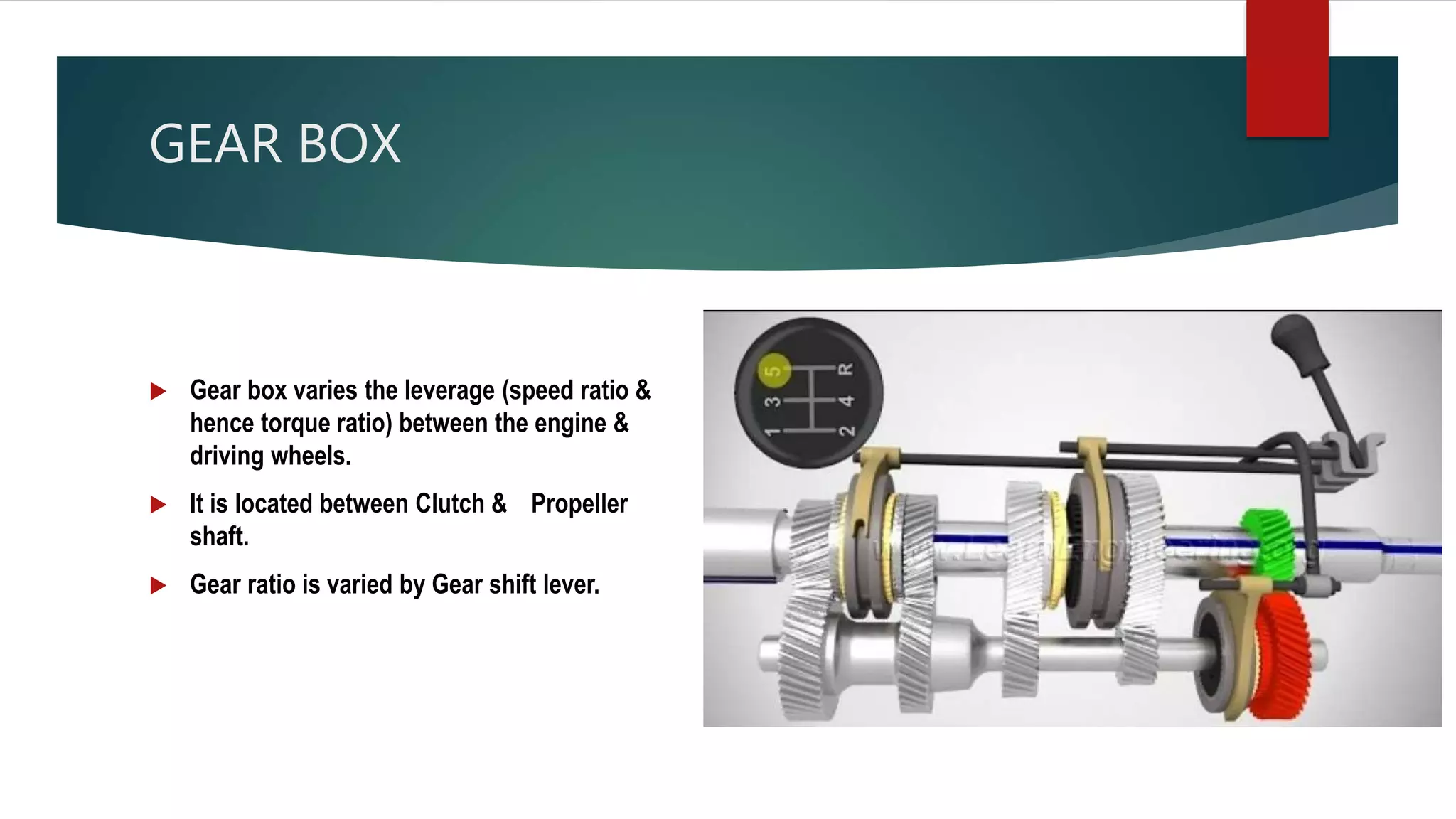
GEAR BOX
 Gear box varies the leverage (speed ratio &
hence torque ratio) between the engine &
driving wheels.
 It is located between Clutch & Propeller
shaft.
 Gear ratio is varied by Gear shift lever.
Explanation of gearing
Need for Gearbox
Synchronizer
 If the dog teeth make contact with the gear, but the
two parts are spinning at different speeds, the
teeth will fail to engage and a loud grinding sound
will be heard as they clatter together. For this
reason, a modern dog clutch in an automobile has
a synchronizer mechanism or synchromesh.
 Synchronizers serve to let shafts and gears (sleeves
and gears in most cases) engage with each other
smoothly after their speeds have been
synchronized. That is, synchronization means
eliminating differences in rpm between different
components.
Sliding Mesh Transmission
 This is the simplest type of gear box. The figure
gives a simplified view if the gear box. The power
comes from the engine to the clutch shaft and
hence to the clutch gear which is always in mesh
with a gear on the lay shaft.
 All the gears on the lay shaft are fixed to it and as
such they are all the time rotating when the engine
is running and the clutch is engaged.
 Three direct and one reverse speeds are attained
on suitably moving the gear on the main shaft by
means of selector mechanism.
Automatic Transmission
 An automatic transmission can automatically
change gear ratios as the vehicle moves,
freeing the driver from having to shift
gears manually.
 The most popular form found in automobiles is
the hydraulic automatic transmission.
 This system uses a fluid coupling in place of a
friction clutch, and accomplishes gear changes
by locking and unlocking a system of planetary
gears.
 Torque Converter : A type of fluid coupling, hydraulically connecting the
engine to the transmission. This takes the place of a friction clutch in a
clutch in a manual transmission. It transmits and decouples the engine
the engine power to the planetary gears, allowing the vehicle to come to
vehicle to come to stop with the engine still running without stalling.
Automatic Transmission
 CVT provides infinite number of gear ratios
(between a minimum & a maximum).
 Shifts automatically with an infinite number of
ratios
 Seamless power delivery
 no torque interruption & power loss
Continuously Variable Transmission
Universal joints
 A universal joint, is a joint or coupling in a
rigid rod that allows the rod to 'bend' in any
direction, and is commonly used in shafts
that transmit rotary motion. It consists of a
pair of hinges located close together,
oriented at 90° to each other, connected by
a cross shaft. The universal joint is not
a constant-velocity joint.
Propeller shaft
 A drive shaft is a mechanical
component for transmitting torque
and rotation, usually used to
connect other components of a
drive train that cannot be connected
directly because of distance or the
need to allow for relative movement
between them.
Differential
 A vehicle with two drive wheels has the problem that
when it turns a corner the drive wheels must rotate at
different speeds to maintain traction. The automotive
differential is designed to drive a pair of wheels while
allowing them to rotate at different speeds.
 When cornering the inner wheel travels a shorter
distance than the outer wheel, so without a differential
either the inner wheel rotates too fast or the outer wheel
drags, which results in difficult and unpredictable
handling, damage to tires and roads, and strain on (or
possible failure of) the entire drivetrain.
Differential explanation, 1937
THANK YOU

Automatic Transmission System

  • 1.
    TRANSMISSION SYSTEMS RAVI TANDEL– U13ME234 DEEP PATEL – U13ME235 B. BHARATH – U13ME236
  • 2.
    TRANSMISSION SYSTEM Function oftransmission :- It is used to transmit engine torque to the driving wheels to drive the vehicle on the road.
  • 3.
    Requirement of transmissionsystem  To provide for disconnecting the engine from the driving wheels  When engine is running , connect the driving wheels to engine smoothly without shock  Leverage between engine and driving wheels to be varied  Enable the driving wheels to rotate at different speeds.  Provide relative movement between engine and riving wheels  To provide high torque at the time of starting the engine, hill climbing and accelerating.
  • 4.
  • 5.
    Types of transmission TRANSMISSION SYSTEMS MECHANICAL CLUTCH,GEARBOX and LIVE AXLE. CLUTCH,GEAR BOX and DEAD AXLE CLUTCH, GEAR BOX and AXLE LESS HYDRAULIC HYDRO STATIC HYDRO DYNAMIC ELECTRICAL and ELECTROMAGNETIC
  • 6.
  • 7.
    They are alsoclassified as:- A. Manual transmission B. Fully automatic Transmission C. Semi-Automatic Transmission D. Combine selective Transmission Types of transmission
  • 8.
    REAR WHEEL DRIVE The transmission is usually mounted to the back of the engine.  Power flow on this system is simple and straight forward going from the engine, through the torque converter, then through the transmission and drive shaft until it reaches the final drive where it is split and sent to the two rear wheels.
  • 9.
    FRONT WHEEL DRIVE On a front wheel drive car, the transmission is usually combined with the final drive to form what is called a transaxle.  Transaxle is a device set up in the transmission gear box, clutch, final drive, combined into a single unit.  Today in cars, the front-engine, front-wheel drive, with the engine in front of the front axle, driving the front wheels is getting popular.  This layout is typically chosen for its compact packaging.
  • 10.
    Manual Transmission Manual transmissionis a type of motor vehicle transmission in which the gear ratios can be changed manually by the driver as the vehicle moves with vehicle moves with the help of the following components.  Clutch  Gearbox  Differential
  • 11.
    Automatic Transmission  Automatictransmission is a is a type of motor vehicle transmission that can automatically change the gear gear ratios as the vehicle moves, freeing the driver from from having to shift gears gears manually.
  • 12.
    Manual Transmission Advantages:- 1. Bettergas Mileage. 2. Initial cost is less. 3. Maintenance cost is less. Disadvantages:- 1. It takes longer time to learn. 2. Difficult to drive in certain terrain 3. Heavy clutch pedal feedback may hurt your left leg in longer run. Automatic Transmission 1. Driving an automatic is less distracting. No worry about shifting gears. 2. Better to drive in traffic 3. To help accelerate quickly 1. Less fuel efficient. 2. Takes longer to change gear between high & low options. 3. Initial cost is high. 4. Repair is costly.
  • 13.
    Clutch  Clutch isused to disengage and engage the engine with rest of the transmission systems.  To disengage while starting engine and while changing ratio.  To engage after starting of the engine and gear shift
  • 14.
    Clutch Unit  Flywheelalso acts as a driving member  Pressure plate is connected to clutch cover  Clutch Cover assembly is bolted to the flywheel.  Clutch springs placed between Pressure plate & plate, press the Pressure plate against the clutch  Thus Clutch plate is squeezed between Flywheel Pressure plate.
  • 15.
  • 16.
  • 17.
  • 18.
  • 19.
  • 20.
  • 21.
    GEAR BOX  Gearbox varies the leverage (speed ratio & hence torque ratio) between the engine & driving wheels.  It is located between Clutch & Propeller shaft.  Gear ratio is varied by Gear shift lever.
  • 22.
  • 24.
  • 25.
    Synchronizer  If thedog teeth make contact with the gear, but the two parts are spinning at different speeds, the teeth will fail to engage and a loud grinding sound will be heard as they clatter together. For this reason, a modern dog clutch in an automobile has a synchronizer mechanism or synchromesh.  Synchronizers serve to let shafts and gears (sleeves and gears in most cases) engage with each other smoothly after their speeds have been synchronized. That is, synchronization means eliminating differences in rpm between different components.
  • 26.
    Sliding Mesh Transmission This is the simplest type of gear box. The figure gives a simplified view if the gear box. The power comes from the engine to the clutch shaft and hence to the clutch gear which is always in mesh with a gear on the lay shaft.  All the gears on the lay shaft are fixed to it and as such they are all the time rotating when the engine is running and the clutch is engaged.  Three direct and one reverse speeds are attained on suitably moving the gear on the main shaft by means of selector mechanism.
  • 27.
    Automatic Transmission  Anautomatic transmission can automatically change gear ratios as the vehicle moves, freeing the driver from having to shift gears manually.  The most popular form found in automobiles is the hydraulic automatic transmission.  This system uses a fluid coupling in place of a friction clutch, and accomplishes gear changes by locking and unlocking a system of planetary gears.
  • 28.
     Torque Converter: A type of fluid coupling, hydraulically connecting the engine to the transmission. This takes the place of a friction clutch in a clutch in a manual transmission. It transmits and decouples the engine the engine power to the planetary gears, allowing the vehicle to come to vehicle to come to stop with the engine still running without stalling. Automatic Transmission
  • 29.
     CVT providesinfinite number of gear ratios (between a minimum & a maximum).  Shifts automatically with an infinite number of ratios  Seamless power delivery  no torque interruption & power loss Continuously Variable Transmission
  • 30.
    Universal joints  Auniversal joint, is a joint or coupling in a rigid rod that allows the rod to 'bend' in any direction, and is commonly used in shafts that transmit rotary motion. It consists of a pair of hinges located close together, oriented at 90° to each other, connected by a cross shaft. The universal joint is not a constant-velocity joint.
  • 31.
    Propeller shaft  Adrive shaft is a mechanical component for transmitting torque and rotation, usually used to connect other components of a drive train that cannot be connected directly because of distance or the need to allow for relative movement between them.
  • 32.
    Differential  A vehiclewith two drive wheels has the problem that when it turns a corner the drive wheels must rotate at different speeds to maintain traction. The automotive differential is designed to drive a pair of wheels while allowing them to rotate at different speeds.  When cornering the inner wheel travels a shorter distance than the outer wheel, so without a differential either the inner wheel rotates too fast or the outer wheel drags, which results in difficult and unpredictable handling, damage to tires and roads, and strain on (or possible failure of) the entire drivetrain.
  • 33.
  • 34.