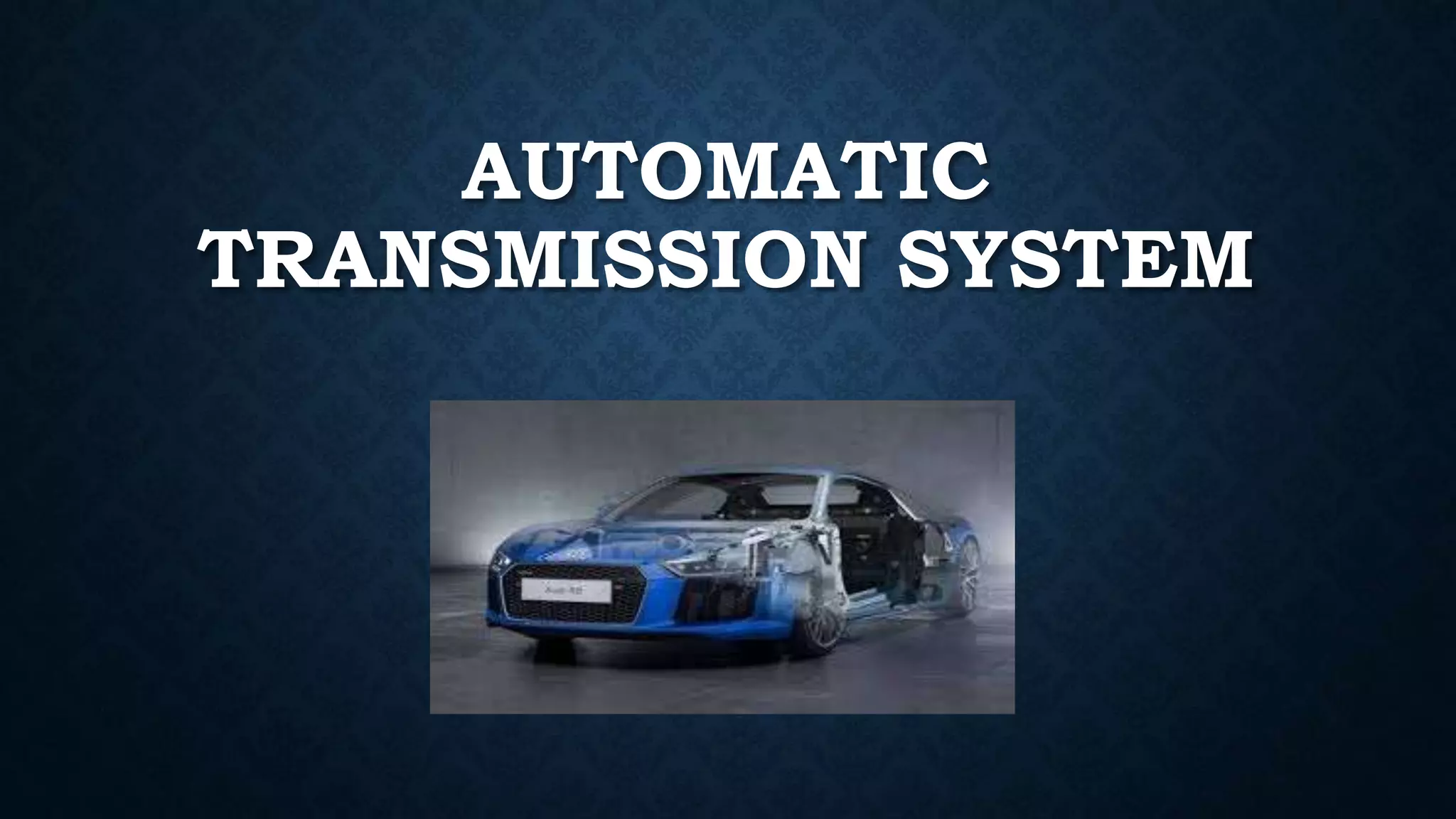
AUTOMATIC
TRANSMISSION SYSTEM
Presented By:- Gurpreet Singh Hunjan
Roll no. - 170620112
CONTENTS
INTRODUCTION
WHAT IS TRANSMISSION ?
TYPES OF AUTOMATIC TRANSMISSION
CLUTCH PACKS
BANDS
TORQUE CONVERTER
HYDRAULIC SYSTEM
COMPUTER CONTROLS
AUTOMATIC TRANSMISSION CARS IN INDIA
CONCLUSION
INTRODUCTION
The modern automatic transmission is by far, the most
complicated mechanical component in today’s world.
Automatic transmission contains Mechanical system,
Hydraulic system, Electrical system and Computer
controls, all working together in perfect harmony which goes
virtually unnoticed until there is a problem.
WHAT IS TRANSMISSION ?
 The transmission is a device that is connected to the back
of the engine and sends the power to the drive wheels.
 Purpose of the transmission is to provide high torque at
the time of starting the engine, hill climbing, accelerating
and pulling the vehicle on a road.
TYPES OF AUTOMATIC TRANSMISSION
1. Rear Wheel Drive
2. Front Wheel Drive
1. REAR WHEEL DRIVE
o The transmission is usually mounted to the back of the engine.
o Power flow on this system is simple and straight forward going from
the engine, through the torque converter, then through the
transmission and drive shaft until it reaches the final drive where it
is split and sent to the two rear wheels.
o Example of rear wheel drive is Alpha Romeo Alfetta in early 70’s.
1. REAR WHEEL DRIVE
2. FRONT WHEEL DRIVE
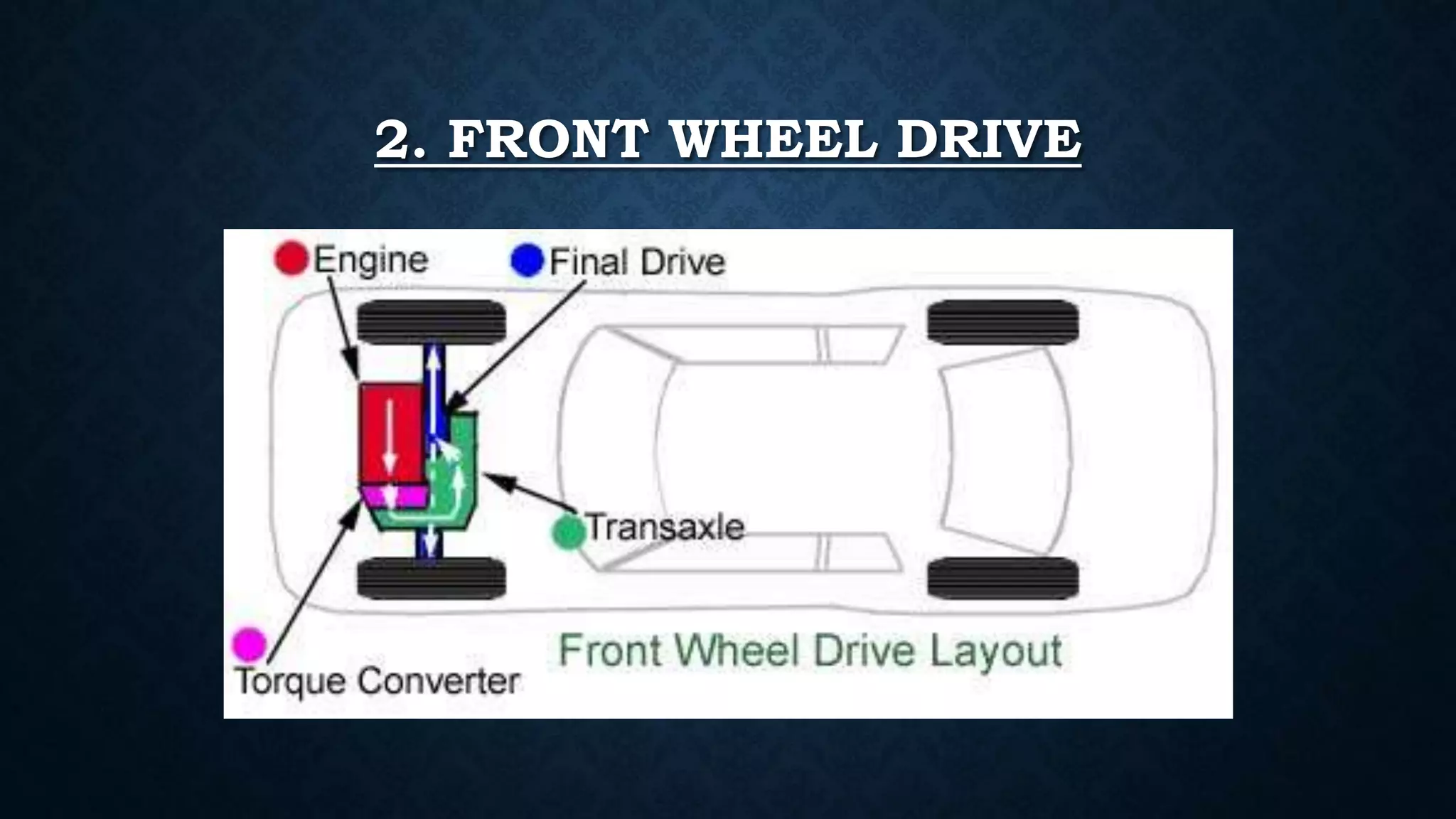
o On a front wheel drive car, the transmission is usually combined with the
final drive to form what is called a transaxle.
o Front wheel drive layouts are those in which the front wheels of the vehicle
are driven. The most popular layout used in cars today is the front wheel
drive, in which the engine is in front of the front axle, driving the front
wheels.
o This layout is typically chosen for its compact packaging.
2. FRONT WHEEL DRIVE
P = Park
R = Reverse
N = Neutral
D = Drive
2= 2nd Gear
L = Low Gear
TRANSMISSION COMPONENTS
o Planetary Gear Sets
o Hydraulic System
• Oil Pump
• Valve Body
• Clutches
• Band
o Seals and Gaskets
o Torque Converter
o Governor
o Computer Controls
PLANETARY GEAR SETS
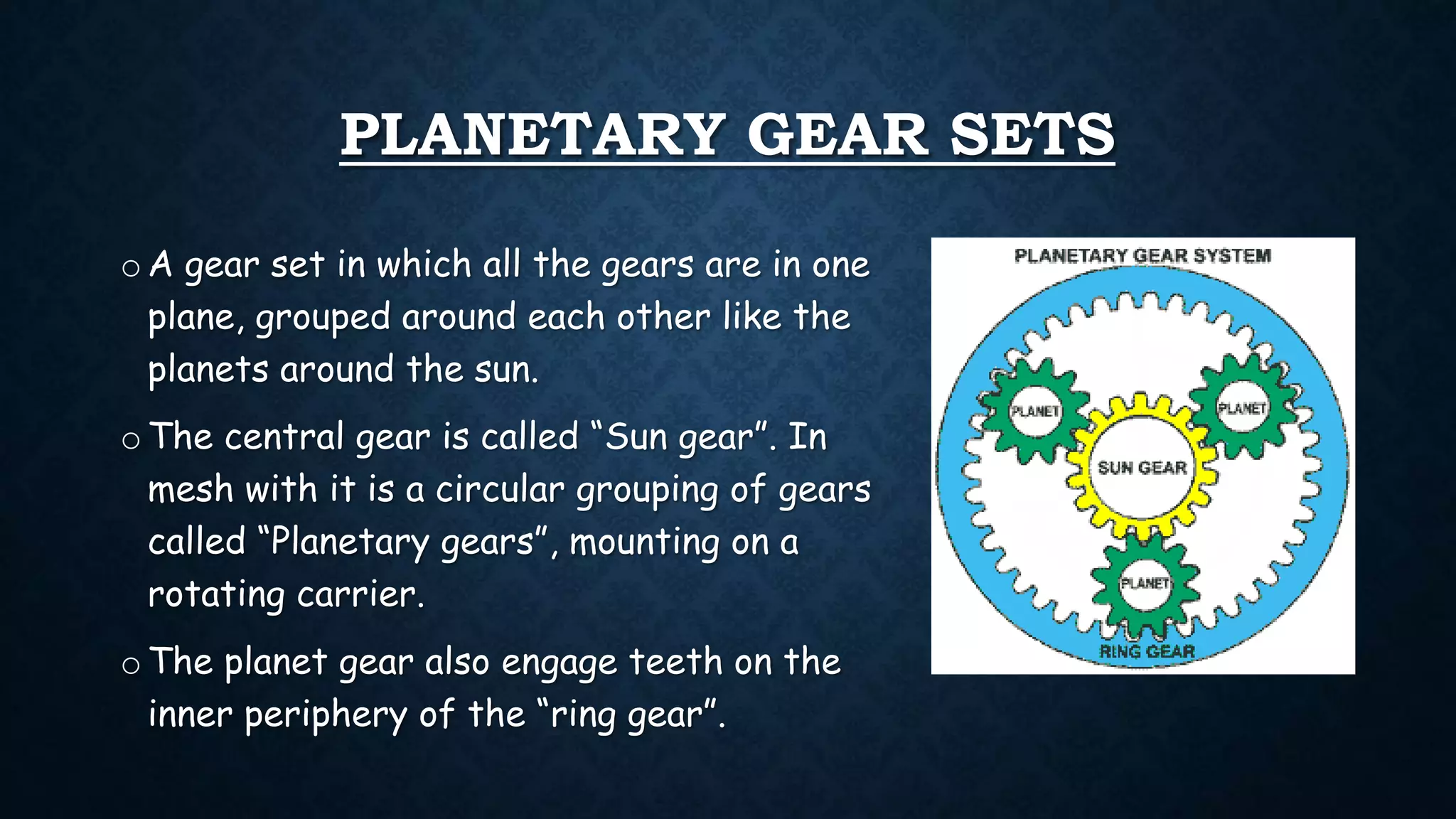
o A gear set in which all the gears are in one
plane, grouped around each other like the
planets around the sun.
o The central gear is called “Sun gear”. In
mesh with it is a circular grouping of gears
called “Planetary gears”, mounting on a
rotating carrier.
o The planet gear also engage teeth on the
inner periphery of the “ring gear”.
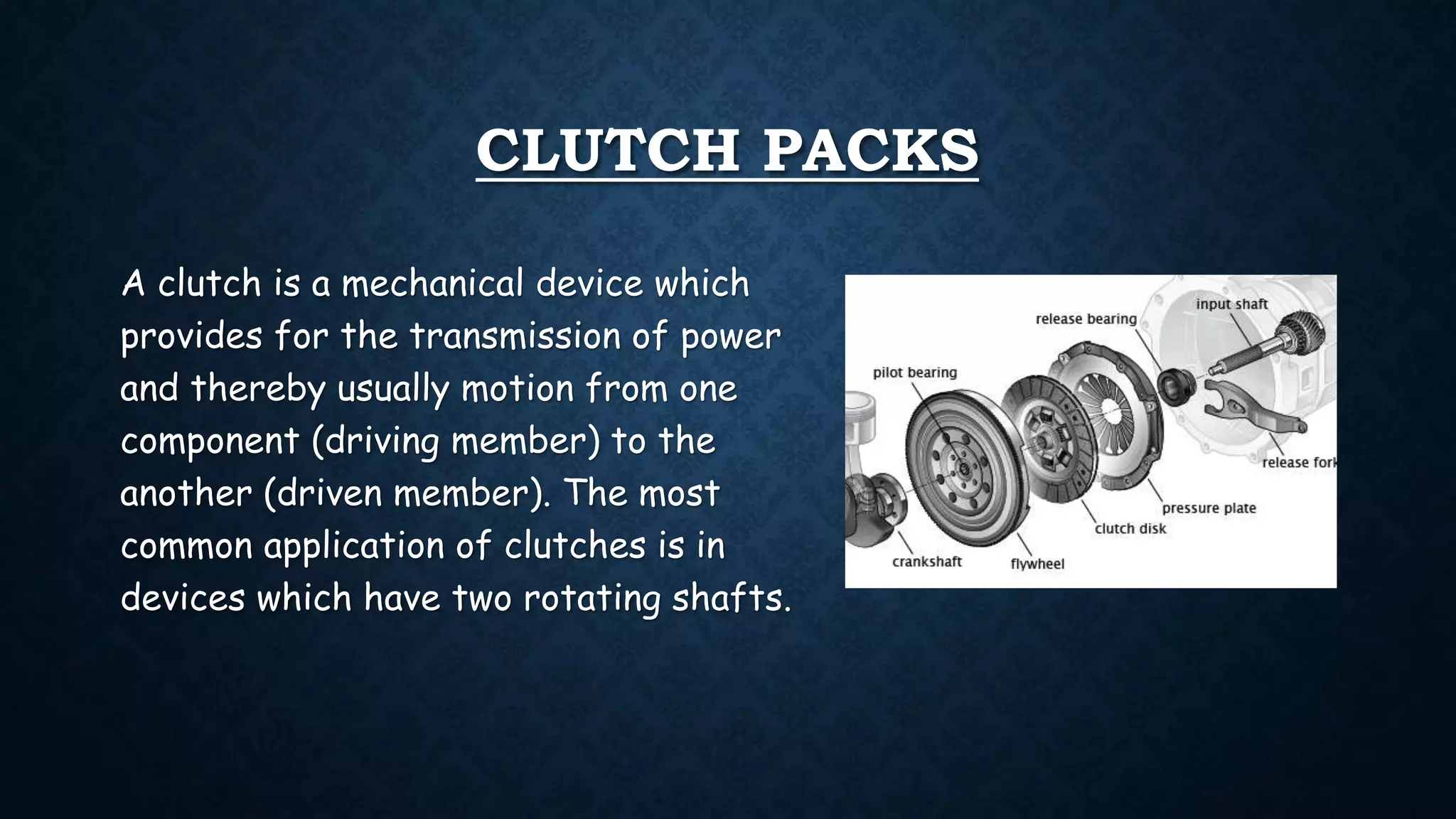
CLUTCH PACKS
A clutch is a mechanical device which
provides for the transmission of power
and thereby usually motion from one
component (driving member) to the
another (driven member). The most
common application of clutches is in
devices which have two rotating shafts.
TORQUE CONVERTER
• Torque converter is a form of
fluid coupling.
• It uses a fluid and vaned
rotors to transmit power
between shafts. The torque
converter is filled with ATF.
• It is used to transfer rotating
power from prime mover to a
rotating driven load.
HYDRAULIC SYSTEM
• The Hydraulic System is a complex maze of passages and tubes that
sends transmission fluid under pressure to all parts of the
transmission and torque converter.
• It works with some components :-
 Oil Pump
 Valve body
OIL PUMP
• It produces all the oil pressure that
is required in transmission.
• The Oil is sent under pressure to
the pressure regulator, the valve
body and the rest of the
components as required.
VALVE BODY
• It is the brain of the automatic
transmission.
• It contains a maze of the channels
and passages that direct fluid to the
numerous valves.
• These valves activate the appropriate
clutch pack or band servo to smoothly
shift to the appropriate gear for each
driving situation.
COMPUTER CONTROLS
• The computer uses sensors on the engine and transmission to detect
such as throttle position, vehicle speed, engine speed, engine load,
brake pedal position, etc. to control exact shift points as well as how
soft or firm the shift should be. Once the computer receives this
information, it then send signals to a solenoid pack inside the
transmission.
CONCLUSION
• Thus Automatic transmission is widely spreading technology in most
of the automobile manufacturing industries by eliminating the tedious
task of constant shifting of gears. But due to the addition of fuel
pump, valves, etc. extra power is required to operate this systems
which is taken from the engine which makes this system less
efficient than the manual transmission.
ANY QUERY ?
THANK YOU !!

Automatic transmission system

  • 1.
  • 2.
    Presented By:- GurpreetSingh Hunjan Roll no. - 170620112
  • 3.
    CONTENTS INTRODUCTION WHAT IS TRANSMISSION? TYPES OF AUTOMATIC TRANSMISSION CLUTCH PACKS BANDS TORQUE CONVERTER HYDRAULIC SYSTEM COMPUTER CONTROLS AUTOMATIC TRANSMISSION CARS IN INDIA CONCLUSION
  • 4.
    INTRODUCTION The modern automatictransmission is by far, the most complicated mechanical component in today’s world. Automatic transmission contains Mechanical system, Hydraulic system, Electrical system and Computer controls, all working together in perfect harmony which goes virtually unnoticed until there is a problem.
  • 5.
    WHAT IS TRANSMISSION?  The transmission is a device that is connected to the back of the engine and sends the power to the drive wheels.  Purpose of the transmission is to provide high torque at the time of starting the engine, hill climbing, accelerating and pulling the vehicle on a road.
  • 6.
    TYPES OF AUTOMATICTRANSMISSION 1. Rear Wheel Drive 2. Front Wheel Drive
  • 7.
    1. REAR WHEELDRIVE o The transmission is usually mounted to the back of the engine. o Power flow on this system is simple and straight forward going from the engine, through the torque converter, then through the transmission and drive shaft until it reaches the final drive where it is split and sent to the two rear wheels. o Example of rear wheel drive is Alpha Romeo Alfetta in early 70’s.
  • 8.
  • 9.
    2. FRONT WHEELDRIVE o On a front wheel drive car, the transmission is usually combined with the final drive to form what is called a transaxle. o Front wheel drive layouts are those in which the front wheels of the vehicle are driven. The most popular layout used in cars today is the front wheel drive, in which the engine is in front of the front axle, driving the front wheels. o This layout is typically chosen for its compact packaging.
  • 10.
  • 11.
    P = Park R= Reverse N = Neutral D = Drive 2= 2nd Gear L = Low Gear
  • 12.
    TRANSMISSION COMPONENTS o PlanetaryGear Sets o Hydraulic System • Oil Pump • Valve Body • Clutches • Band o Seals and Gaskets o Torque Converter o Governor o Computer Controls
  • 13.
    PLANETARY GEAR SETS oA gear set in which all the gears are in one plane, grouped around each other like the planets around the sun. o The central gear is called “Sun gear”. In mesh with it is a circular grouping of gears called “Planetary gears”, mounting on a rotating carrier. o The planet gear also engage teeth on the inner periphery of the “ring gear”.
  • 14.
    CLUTCH PACKS A clutchis a mechanical device which provides for the transmission of power and thereby usually motion from one component (driving member) to the another (driven member). The most common application of clutches is in devices which have two rotating shafts.
  • 15.
    TORQUE CONVERTER • Torqueconverter is a form of fluid coupling. • It uses a fluid and vaned rotors to transmit power between shafts. The torque converter is filled with ATF. • It is used to transfer rotating power from prime mover to a rotating driven load.
  • 16.
    HYDRAULIC SYSTEM • TheHydraulic System is a complex maze of passages and tubes that sends transmission fluid under pressure to all parts of the transmission and torque converter. • It works with some components :-  Oil Pump  Valve body
  • 17.
    OIL PUMP • Itproduces all the oil pressure that is required in transmission. • The Oil is sent under pressure to the pressure regulator, the valve body and the rest of the components as required.
  • 18.
    VALVE BODY • Itis the brain of the automatic transmission. • It contains a maze of the channels and passages that direct fluid to the numerous valves. • These valves activate the appropriate clutch pack or band servo to smoothly shift to the appropriate gear for each driving situation.
  • 19.
    COMPUTER CONTROLS • Thecomputer uses sensors on the engine and transmission to detect such as throttle position, vehicle speed, engine speed, engine load, brake pedal position, etc. to control exact shift points as well as how soft or firm the shift should be. Once the computer receives this information, it then send signals to a solenoid pack inside the transmission.
  • 20.
    CONCLUSION • Thus Automatictransmission is widely spreading technology in most of the automobile manufacturing industries by eliminating the tedious task of constant shifting of gears. But due to the addition of fuel pump, valves, etc. extra power is required to operate this systems which is taken from the engine which makes this system less efficient than the manual transmission.
  • 21.
  • 22.