Seminar on:
Automatic Irrigation System
With Remote Monitoring and
Control System
Submitted by:
Chiranjeev sinha
Roll no. 1113321030
EN 3rd year
Session 2013 -2014
Introduction
 The continuous increasing in population of the world demands massive amount
of food which is a major cause of concern in coming future.
 To meet the need of huge food production there is an urgent need of rapid
improvement in food production technology, a system that makes the
agricultural process easier and burden free from the farmer’s prospective.
 In a country like India, where the economy is mainly based on agriculture and
the climatic conditions are isotropic, still we are not able to make full use of
agricultural resources, so we introduce the MBIS.
 MBIS is a manually controlled micro controller based irrigation system by
which farmers can irrigate their fields very easily from anywhere in the world.
Problems in Irrigation
 Water wastage
 Crop destroyed
 Money wastage
 Time wastage
 Land fertility decrease
 Huge labor needed
Drip Irrigation System
 In manual irrigation sometimes
the quantity of water irrigated is in
excess or sometimes there is
scarcity of water due to which the
crops get destroyed.
 Drip irrigation saves water by
allowing water to drip slowly
directly to the roots of plants,
through a network
of valves, pipes, tubing,
and emitters.
 It will improve crop performance
by ensuring adequate water and
nutrients when needed.
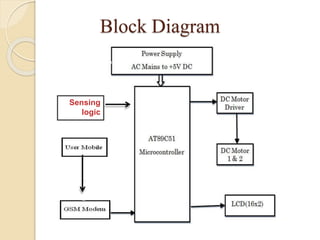
Block Diagram
Sensing
logic
Sensing logic
 The logic consists of two wires one with the 5V supply and the other one was the
ground attached to the adjacent sprinklers of Drip irrigation system
 When there is water in the field conduction will take place between the wires
• voltage at the microcontroller will go low
• The interrupt generated will trigger the GSM module to call the
authentic user which indicates there is need of turning OFF the
motor.
 If there is no water in the field, there is no conduction between the wires
• voltage at the microcontroller will go high
• The interrupt generated will trigger the GSM module to call the
authentic user which indicates there is need of turning ON the
motor
Working
 Once call has come from the GSM module setup in the circuit.
 If the farmer wants to switch ON the motor he just needs to give a ring to the
particular modem number (GSM number) which is implemented in this
circuit.
 Microcontroller checks weather the call is coming from authenticated person
if it matches with the number which is given in the program then it will start
the motor.
 If the number doesn’t match means some other person is calling then no
action will be taken.
Advantages
 Decreased Labor Costs.
 Improved and better crop
production.
 No water deficiency in crops.
 User friendly setup.
 Easy to control
 Saves time.
 Saves water.
 Low cost and easy to implement.
 Cover whole area of the field.
 Reliable system.
Disadvantages
 Difficult in case of failure of GSM modem.
 Kit is to be protected from reaching water.
Conclusion
 This system is user friendly and having a lots of advantages
 Farmer can use it from any where in the world according to their needs.
 It is very cheap and reliable system having less disadvantages.
 The ability to conserve the natural resources as well as giving a splendid
boost to the production of the crops is one of the main aims of
implementing such technology into the agricultural domain of the country
 To achieve the nation’s goal of having three times meal for everyone.
References
 Mahir Dursun and Semih Ozden (2011). “A wireless application of drip irrigation
automation supported by soil moisture sensors”, Scientific Research and Essays
Vol. 6(7), pp. 1573-1582, 4 April, 2011.
 Indu Gautam, S.R.N. Reddy, “Innovative GSM Bluetooth Based Remote
Controlled Embedded System for Irrigation”, on IJCA, June 2012.
 Mahesh M. Galgalikar, “Real-Time Atomization of Agricultural Environment for
Social Modernization of Indian Agricultural System”, on IEEE Proceedings, 2010.
 Vasif Ahmed, Siddharth A. Ladhake, “Design of Ultra Low Cost Cell Phone
Based Embedded System for Irrigation”, on International Conference on Machine
Vision and Human Machine Interface,2010
Queries ?

Automatic drip irrigation system

  • 1.
    Seminar on: Automatic IrrigationSystem With Remote Monitoring and Control System Submitted by: Chiranjeev sinha Roll no. 1113321030 EN 3rd year Session 2013 -2014
  • 2.
    Introduction  The continuousincreasing in population of the world demands massive amount of food which is a major cause of concern in coming future.  To meet the need of huge food production there is an urgent need of rapid improvement in food production technology, a system that makes the agricultural process easier and burden free from the farmer’s prospective.  In a country like India, where the economy is mainly based on agriculture and the climatic conditions are isotropic, still we are not able to make full use of agricultural resources, so we introduce the MBIS.  MBIS is a manually controlled micro controller based irrigation system by which farmers can irrigate their fields very easily from anywhere in the world.
  • 3.
    Problems in Irrigation Water wastage  Crop destroyed  Money wastage  Time wastage  Land fertility decrease  Huge labor needed
  • 4.
    Drip Irrigation System In manual irrigation sometimes the quantity of water irrigated is in excess or sometimes there is scarcity of water due to which the crops get destroyed.  Drip irrigation saves water by allowing water to drip slowly directly to the roots of plants, through a network of valves, pipes, tubing, and emitters.  It will improve crop performance by ensuring adequate water and nutrients when needed.
  • 5.
  • 6.
    Sensing logic  Thelogic consists of two wires one with the 5V supply and the other one was the ground attached to the adjacent sprinklers of Drip irrigation system  When there is water in the field conduction will take place between the wires • voltage at the microcontroller will go low • The interrupt generated will trigger the GSM module to call the authentic user which indicates there is need of turning OFF the motor.  If there is no water in the field, there is no conduction between the wires • voltage at the microcontroller will go high • The interrupt generated will trigger the GSM module to call the authentic user which indicates there is need of turning ON the motor
  • 7.
    Working  Once callhas come from the GSM module setup in the circuit.  If the farmer wants to switch ON the motor he just needs to give a ring to the particular modem number (GSM number) which is implemented in this circuit.  Microcontroller checks weather the call is coming from authenticated person if it matches with the number which is given in the program then it will start the motor.  If the number doesn’t match means some other person is calling then no action will be taken.
  • 8.
    Advantages  Decreased LaborCosts.  Improved and better crop production.  No water deficiency in crops.  User friendly setup.  Easy to control  Saves time.  Saves water.  Low cost and easy to implement.  Cover whole area of the field.  Reliable system.
  • 9.
    Disadvantages  Difficult incase of failure of GSM modem.  Kit is to be protected from reaching water.
  • 10.
    Conclusion  This systemis user friendly and having a lots of advantages  Farmer can use it from any where in the world according to their needs.  It is very cheap and reliable system having less disadvantages.  The ability to conserve the natural resources as well as giving a splendid boost to the production of the crops is one of the main aims of implementing such technology into the agricultural domain of the country  To achieve the nation’s goal of having three times meal for everyone.
  • 11.
    References  Mahir Dursunand Semih Ozden (2011). “A wireless application of drip irrigation automation supported by soil moisture sensors”, Scientific Research and Essays Vol. 6(7), pp. 1573-1582, 4 April, 2011.  Indu Gautam, S.R.N. Reddy, “Innovative GSM Bluetooth Based Remote Controlled Embedded System for Irrigation”, on IJCA, June 2012.  Mahesh M. Galgalikar, “Real-Time Atomization of Agricultural Environment for Social Modernization of Indian Agricultural System”, on IEEE Proceedings, 2010.  Vasif Ahmed, Siddharth A. Ladhake, “Design of Ultra Low Cost Cell Phone Based Embedded System for Irrigation”, on International Conference on Machine Vision and Human Machine Interface,2010
  • 12.