The International Journal Of Engineering And Science (IJES)
|| Volume || 4 || Issue || 3 || Pages || PP.37-42 || 2015 ||
ISSN (e): 2319 – 1813 ISSN (p): 2319 – 1805
www.theijes.com The IJES Page 37
Prototype for automatically navigated water irrigation system
Pratik A.Patil1
, Sangram V.Bhosale2
, Kunal R. Joshi2
, Digvijay T.Bhakare2
,
Akash J.Gurav2
,
1
Assistant Professor, Sanjeevan Engineering and Technology Institute, Panhala, Kolhapur, India
2
UG Student, Sanjeevan Engineering and Technology Institute, Panhala, Kolhapur, India
-----------------------------------------------------------ABSTRACT----------------------------------------------------------
In this paper we present a prototype for automatic controlling of irrigation water along with the water
navigation. Prototype includes controller node, actuation node, sensor node and mobile phone. In controller
node SIM300 GSM module is integrated with Intel MCS-51 microcontroller using RS232 parallel
communication IC device. In actuation node three driver circuits along with three DC motor operated valves
are integrated with the microcontroller. In sensor node three water sensors that placed in the respective
irrigation piping are integrated with the microcontroller. A registered mobile phone (SIM) is used to send the
information about the required field to be irrigated in the form of SMS. On receiving a SMS, controller node
will decide which valve to be kept on or off and even in how much percentage through the DC motor actuation.
The sensor node can be mounted in the irrigation pipes for sensing the presence of water and the sensed data is
sent back to the controller node from where the water navigation path will be sent on the registered mobile
phone (SIM) in the form of a SMS. Mobile phone can also be used for sending request to switch on/off the
irrigation motor.
KEYWORDS: Global system for mobile communication (GSM), Irrigation, Microcontroller, Short message
service (SMS), Water sensor.
---------------------------------------------------------------------------------------------------------------------------------------
Date of Submission: 07-March-2015 Date of Accepted: 30.March.2015
---------------------------------------------------------------------------------------------------------------------------------------
I. INTRODUCTION
Agriculture is major source of food production to the growing demand of human population. In
agriculture, irrigation is an essential process that influences crop production. Generally farmers visit their
agriculture fields periodically and remain present during the irrigation to manually navigate water to the
respective fields. This irrigation method takes lot of time and effort particularly when a farmer need to irrigate
multiple agriculture fields distributed in different geographical areas. Nowadays, farmers need to manage their
agriculture activity along with other occupations.
Automation in irrigation system makes farmer’s work much easier. Sensor based automated irrigation
system provides promising solution to farmers where presence of farmer in field is not mandatory to perform
irrigation process. Automated irrigation systems are developed to operate the water pump remotely [2], [3]. The
advancement has even taken place to switch on or off the water pumping motor automatically depending upon
the soil moisture level in the respective agricultural fields [1], [6], [11]. The need of electromechanically
programmed system, for controlling mechanical devices like water pumping motor, water pipe valves, etc
remotely based on the feedback of sensor node placed in irrigation field has arrived. Many existing systems use
computers along with data base technologies for monitoring and controlling irrigation activity [4], [5], [7], [9],
[10], [13], [15]. But in real time, farmers need cheap and simple feedback assisted user interface for controlling
automated irrigation system. Nowadays, mobile phone is the most common device used by famers. Therefore
mobile phone is used in sensor based automated irrigation system [5], [7], [8], [10], [12], [13], [14], [15]. This
helps farmers to control irrigation process remotely.
In this paper, we present a prototype for automatic controlling of irrigation water along with the water
navigation. Prototype includes sensor node, controller node and mobile phone. In sensor node, water sensor is
integrated with Intel MCS-51 microcontroller using SIM300 GSM module. In controller node, GSM module
and three DC motor driven valves are integrated with Intel MCS-51 microcontroller. For experimentation, we
have used three pots as three different irrigation fields. Each field is provided with a separate piping for the
water supply from a single water source. A command signal to irrigate particular field or fields will be sent from
a registered mobile number in the form of SMS. On receiving SMS, controller node will decide which valve to
Prototype for automatically navigated water irrigation system
www.theijes.com The IJES Page 38
open &/or close and in how much percentage. Depending on the decision taken by controller, an action signal
will be sent to the DC motors to operate the respective valve. Water sensors are placed in the irrigation piping
which are integrated with the Intel MCS-51 microcontroller. On receiving signals from water sensors, controller
node will form a water navigation path in the programmed form and sends it on a registered mobile number as a
message. Results show the proposed prototype is effective in automatic controlling of irrigation water along
with the water navigation based on the feedback of water sensors and corrective commands from mobile phone.
Rest of this paper is organized as follows: Section 2 presents a literature study on sensor based irrigation
systems, section 3 is proposed system, section 4 is system components, section 5 is experimentation, and section
6 is conclusion.
II. LITERATURE SURVEY
In this section we present a detailed study on Micro Controller based automated irrigation system.
Mandip Singh et al [1] implemented microcontroller based clockwise/anticlockwise stepper motor control. He
used ATmels (AT89c51) 8-bit microcontroller with unipolar stepper motor. Crystal oscillator of frequency
11.0592 MHz is used to produce pulses with the help of clock frequency and driver ULN2003 used to energize
the stator. AT89c51 is programmed in assembly language which is burnt by using Keil software and then
compiled to HEX. Similarly, Abhinav Rajpal et al [2] presented a paper on Microcontroller based automatic
irrigation system with moisture sensor. The prime concern of this paper is to automatically control the water
irrigation using moisture sensors. Depending upon number of fields to be irrigated, number of moisture sensors
can be chosen and are immersed in the field soil to detect the moisture content. These moisture sensors along
with water pumping motor are interfaced with the microcontroller 80C51. This microcontroller is so
programmed as to automatically operate the motor either ON or OFF depending upon the soil moisture level.
Kamral Hassan et al [3] implemented GSM based motor control and protection system. The main
objective of this paper is to control motor by using receiver and transmitter stations. The receiver is always kept
in auto receiving mode. Microcontroller is used to operate relay which is interfaced with GSM module. DTMF
(Dial Tone Multi Frequency) decoder circuit detects dialed pattern from telephone line and decodes that signal
to generate 4 digit binary codes. This signal code from DTMF is sent to microcontroller which there after
decides to turn the motor either ON or OFF. Also, R. Suresh et al [4] implemented GSM based automated
irrigation control using Rraingun irrigation system, in which the humidity and temperature of plants are
precisely controlled. In this system, based on variable atmospheric conditions water is sprinkled at the roots of
plants by using solenoid valve. This solenoid valve is integrated with microcontroller. GSM module is used to
exchange the data between cellular network and microcontroller. Microcontroller is also integrated with the
moisture sensor to receive the feedback signal about humidity and temperature. After the action, Microcontroller
signalizes the mobile trough GSM module.
In more advance, Manish Giri et al [5] implemented automated wireless drip irrigation using linear
programming. It is microcontroller based PC driven integrated irrigation system. The sensors senses the physical
parameters (viz. light, temperature, pH, humidity) and coverts it to the electrical signal. Signal array take input
from sensor and fed it for suitable signal conditioning. The signal conditioning involves an amplifier to amplify
the signal, ADC to convert analog signal into digital form and sends it to the microcontroller as an input.
Sensors are integrated with microcontroller through ADC. Microcontroller is programmed to control the
actuators which in turn control the observed parameters.
III. PROPOSED SYSTEM
In this section, we propose a prototype for automatic controlling of irrigation water and its navigation
remotely. The proposed system use mobile phone for controlling the DC motor operated valves based on the
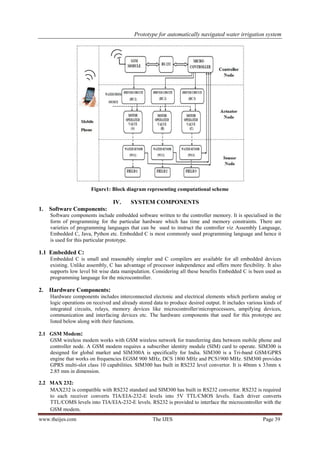
SMS. In most of the existing systems mobile phone is used to switch on/off the water pumping motor. Figure 1
illustrates overview of the proposed system. The prototype includes: controller node, actuator node, sensor node
and mobile phone. In controller node SIM300 GSM module is integrated with Intel MCS-51 microcontroller
using RS232 IC device. In actuation node three driver circuits along with three DC motor operated valves are
integrated with the Intel MCS-51 microcontroller. In sensor node three water sensors that placed in the
respective irrigation piping are integrated with the Intel MCS-51 microcontroller. A registered mobile phone is
used to send the information about the required field to be irrigated in the form of SMS. On receiving a SMS,
controller node will decide which valve to be kept on or off and even in how much percentage through the DC
motor actuation.
The sensor node (water sensors) can be mounted in irrigation pipes for sensing the presence of water
and the sensed data is sent back to the controller node. In the controller node depending on the signal from water
sensors and the programming, a water navigation path will be prepared in the form of a map. This controller
node there after sends the navigation path on the registered mobile phone in the form of SMS.
Prototype for automatically navigated water irrigation system
www.theijes.com The IJES Page 39
Figure1: Block diagram representing computational scheme
IV. SYSTEM COMPONENTS
1. Software Components:
Software components include embedded software written to the controller memory. It is specialised in the
form of programming for the particular hardware which has time and memory constraints. There are
varieties of programming languages that can be used to instruct the controller viz Assembly Language,
Embedded C, Java, Python etc. Embedded C is most commonly used programming language and hence it
is used for this particular prototype.
1.1 Embedded C:
Embedded C is small and reasonably simpler and C compilers are available for all embedded devices
existing. Unlike assembly, C has advantage of processor independence and offers more flexibility. It also
supports low level bit wise data manipulation. Considering all these benefits Embedded C is been used as
programming language for the microcontroller.
2. Hardware Components:
Hardware components includes interconnected electonic and electrical elements which perform analog or
logic operations on received and already stored data to produce desired output. It includes various kinds of
integrated circuits, relays, memory devices like microcontroller/microprocessors, ampifying devices,
communication and interfacing devices etc. The hardware components that used for this prototype are
listed below along with their functions.
2.1 GSM Modem:
GSM wireless modem works with GSM wireless network for transferring data between mobile phone and
controller node. A GSM modem requires a subscriber identity module (SIM) card to operate. SIM300 is
designed for global market and SIM300A is specifically for India. SIM300 is a Tri-band GSM/GPRS
engine that works on frequencies EGSM 900 MHz, DCS 1800 MHz and PCS1900 MHz. SIM300 provides
GPRS multi-slot class 10 capabilities. SIM300 has built in RS232 level convertor. It is 40mm x 33mm x
2.85 mm in dimension.
2.2 MAX 232:
MAX232 is compatible with RS232 standard and SIM300 has built in RS232 convertor. RS232 is required
to each receiver converts TIA/EIA-232-E levels into 5V TTL/CMOS levels. Each driver converts
TTL/COMS levels into TIA/EIA-232-E levels. RS232 is provided to interface the microcontroller with the
GSM modem.
Prototype for automatically navigated water irrigation system
www.theijes.com The IJES Page 40
2.3 Microcontroller 8051:
Microcontroller 8051 is an 8-bit microcontroller which incorporates 4KB on chip memory and includes
12MHz Crystal with 1 Microsecond instruction cycle, 16 bit timers usually two, 3 internal and 2 external
interrupts, 16 bit program counter and data pointer with on chip RAM of 128 bytes. Serial interface is
programmable for three duplex UART modes for serial I/O. It has four I/O ports out of which first port is
used to integrate with GSM module to receive and send the information; second port is integrated with DC
motor operated valve to send the actuation signal while third port is integrated with water sensor to receive
the monitored signal.
2.4 DC Motor Operated Valve:
Installed DC motor operated valve serves the purpose of operating the Actuator Node. Incorporated DC
motor is compatible with 12V DC supply. The speed of the DC motor is 30 RPM which actuates the valves
through gears with gear ratio of 1:1.5. DC motor operated valves are interfaced with the controller node to
control the flow of water.
2.5 Water Sensor:
YL 69 water sensor along with bridge device YL 38 is used to detect the presence of water in the irrigation
pipes. The bridge device YL 38 can also be called as middle man circuit. This sensor has two plastic
probes which has metal strips attached on it. This sensor is fitted in the pipes such that when water flows
through the pipe, probes of the sensor will get inserted into water. When both the probes come in direct
contact with water at a time, current passes through them which trigger the output to middle bridge YL 38.
The bridge device there after gives output to microcontroller in the required form.
2.6 Other Components:
16 X 2 LCD is used to display message received by GSM module. Each character is displayed using 5 X 7
or 5 X 10 pixel matrix. Motor driver circuit is simply a switch for motor and 12V batteries are used for
power supply along with transformers for suitable voltage transformation.
V. EXPERIMENTATION
We have abstracted three pots as irrigation fields. Each field is provided with separate piping from a
water source. Three water sensors (viz. WS1, WS2 and WS3) are mounted in the piping just near the individual
fields to detect the presence of water at that particular field. All three DC motor operated valves (viz. MOV1,
MOV2 and MOV3) are placed at an equal distance from the water source so that same pressure will be received
at all the valves.
Depending upon the field/fields to be irrigated, a particular set of instructions is sent from a registered
mobile number to the GSM module in the form of SMS. GSM module there after decodes the set of instructions
and sends the signal to a microcontroller through RS232 communicating device. Microcontroller is programmed
with Embedded C to operate the DC motor operated valves as per the instruction set. Using this prototype, three
fields can be irrigated in fifteen different ways. A DC motor controlled valve has five different positions viz.
completely closed or 0%open, 25% open, half open or 50% open, 75%open and fully open or 100% open. As
mentioned we have chosen three irrigation fields and five valve states, so there are fifteen different ways by
selected field/fields can be irrigated. These fifteen ways are explained in following four cases.
The below tables includes the states/percentage opening of all three valves. MOV stands for DC motor
operated valve followed by number. MOV1 is considered as ‘valve A’, MOV2 as ‘valve B’ while MOV3 as
‘valve C’. The last column of every table shows instruction set. Instruction set represents the SMS text that can
be typed using mobile phone and has to be sent from a registered mobile number.
Case1: Any one valve is 100% open and other two are closed
MOV1
(A)
MOV2
(B)
MOV3
(C)
Instruction set
100% 0 0 A100 B0 C0
0 100% 0 A0 B100 C0
0 0 100% A0 B0 C100
Prototype for automatically navigated water irrigation system
www.theijes.com The IJES Page 41
Case2: Any two valves are 50% open and other valve remains closed
MOV1
(A)
MOV2
(B)
MOV3
(C)
Instruction set
50% 50% 0 A50 B50 C0
50% 0 50% A50 B0 C50
0 50% 50% A0 B50 C50
Case3: Any one valve is 50% open and remaining two valves are each 25% open
MOV1
(A)
MOV2
(B)
MOV3
(C)
Instruction set
50% 25% 25% A50 B25 C25
25% 50% 25% A25 B50 C25
25% 25% 50% A25 B25 C50
Case4: Any one valve is 75% open and any other one valve (out of two) is 25% open
MOV1
(A)
MOV2
(B)
MOV3
(C)
Instruction set
75% 25% 0 A75 B25 C0
75% 0 25% A75 B0 C25
25% 75% 0 A25 B75 C0
25% 0 75% A25 B0 C75
0 75% 25% A0 B75 C25
0 25% 75% A0 B25 C75
VI. CONCLUSION
In this paper we present a prototype for automatic controlling of irrigation water along with water
navigation. Prototype includes sensor node, controller node, actuator node and mobile phone. The sensor node is
deployed in the piping system for sensing the presence of water and the sensed data is sent to controller node.
On receiving sensor signal the controller node which is interfaced with GSM module will send a message to
registered mobile number which confirms the presence of water in the irrigated field. Commands can also be
sent in the form of SMS to switch on/off the irrigation motor. Prototype is experimented by taking three pots as
irrigation fields. The experimental results show that the prototype is capable for automaticaly controlling and
remote accessing of irrigation motor based on the feedback of water sensor. The prototype can facilitate farmer
in monitoring and controlling irrigation activity remotely.
VII. ACKNOWLEDGEMENT
We take this opportunity to express our deepest gratitude to our project team of Sanjeevan Engineering
and Technology Institute (SETI) for helping each other and keeping the team spirit high in developing this
prototype. We also appreciate all those who have helped us directly or indirectly towards the successful
completion of this paper.
REFERENCES
[1] Abhinav Rajpal, Sumit Jain, Nistha Khare and Anil Kumar Shukla “Microcontroller- Based Automatic Irrigation System with
Moisture Sensors”, Proceedings of the International Conference on Science and Engineering (ICSE), ISBN: 978-981-08-7931-0,
2011.
[2] Kamrul Hassan, Raziul Islam Siddiqui, Md. Takdirul Islam, Nahid Alam Siddiqui, and Syed Mohammad Enam Uddin, “GSM
Based Automatic Motor Control and Protection System”, International Journal of Advancements in Research & Technology, Vol.
2, Issue 2, February-2013.
[3] Mandeep Singh, Rekha and Balwinder Singh “Microcontroller Based Clockwise/Anticlockwise Stepper Motor Controller Using PC
Keyboard Via Com Port”, International Journal of Computer Science & Communication, Vol. 1, No.1, pp 189-191 January-June
2010.
[4] Manish Giri and Dnyaneshwar Natha Wavhal, “Automated Intelligent Wireless Drip Irrigation Using Linear Programming”,
Proceedings of the Special Interest Group on Management of Data Record, International Journal of Advanced Research in
Computer Engineering & Technology, Vol. 2, Issue 1, 2013.
[5] R. Suresh, S. Gopinath, K. Govindraju, T. Devika, and N. Suthanthira Vanitha, “ GSM Based Automated Irrigation Control using
Raingun Irrigation System” ,International Journal of Advanced Research in Computer & Communication Engineering, Vol. 3, Issue
2, February 2014.
[6] Sanyam Agarwal, Arvind Gautam, Pankaj Singh, and Rohit Sharma, “A BJT Based Soil Moisture Sensor for Irrigation
Monitoring”, Journal of Pure & Applied Science & Technology, Vol. 2(1), pp. 116-123, 2012.
Prototype for automatically navigated water irrigation system
www.theijes.com The IJES Page 42
[7] Sikhjit Singh and Neha Sharma, “Research Paper on Drip Irrigation Management using Wireless Sensors”, International Journal of
Computer Networks & Wireless Communications, Vol. 2, No. 4, pp. 461-464, 2012.
[8] Sumeetha S. and Sharmila D. “Embeded Based Remote Control Application using Mobile Phone in Irrigation”, International
Journal of Power Control Signal and Computation, Vol. 3, No. 1, pp. 76-79, 2012.
[9] Tahar Boutra, Abdellah Akhkha, Abdulkhaliq Alshuaibi and Ragheid Atta, “Evaluation of an Automated Irrigation system using
Wheat Crops”, Agriculture and Biology Journal of North America, Vol. 2, pp. 80-88, 2011.
[10] Rashid Hussain, JL Sahgal, Anshulgangwar, Md.Riyaj,” Control of Irrigation Automatically By Using Wireless Sensor Network”,
International Journal of soft Computing and Engineering (IJSCE) ISSN: 2231-2307, Vol. 3, Issue 1, March 2013.
[11] V. H. Atodaria, A. M. Tailor, Z. N. Shah, “SMS Controlled Irrigation System with Moisture Sensors”, Indian Journal of Applied
Research, Vol. 3, Issue 5, May 2013.
[12] Pavithra D. S. and M. S .Srinath, ”GSM based Automatic Irrigation Control System for Efficient Use of Resources and Crop
Planning by Using an Android Mobile”,IOSR Journal of Mechanical and Civil Engineering (IOSR-JMCE), Vol. 11, Issue 4, July-
August 2014.
[13] Deepti Bansal and S.R.N Reddy, “WSN Based Closed Loop Automatic Irrigation System”, International Journal of Engineering
Science and Innovative Technology (IJESIT), Volume 2, Issue 3, May 2013.
[14] Chandrika Chanda, Surbhi Agarwa and Er. B. Persis Urbana Ivy, “A Survey of Automated GSM Based Irrigation Systems”,
International Journal of Emerging Technology and Advanced Engineering, Vol. 2, Issue 10, October 2012.
[15] Laxmi Shabadi, Nandini Patil, Nikita. M, Shruti. J, Smitha. P and Swati C, “Irrigation Control System Using Android and GSM for
Efficient Use of Water and Power”, International Journal of Advanced Research in Computer Science and Software Engineering,
Vol. 4, Issue 7, July 2014.
BIOGRAPHY
Sr.No. Name
1 Pratik A. Patil
2 Sangram V. Bhosale
3 Kunal R.Joshi
4 Digvijay T. Bhakare
5 Akash J. Gurav
6 Nitin B. Marge

Prototype for automatically navigated water irrigation system

  • 1.
    The International JournalOf Engineering And Science (IJES) || Volume || 4 || Issue || 3 || Pages || PP.37-42 || 2015 || ISSN (e): 2319 – 1813 ISSN (p): 2319 – 1805 www.theijes.com The IJES Page 37 Prototype for automatically navigated water irrigation system Pratik A.Patil1 , Sangram V.Bhosale2 , Kunal R. Joshi2 , Digvijay T.Bhakare2 , Akash J.Gurav2 , 1 Assistant Professor, Sanjeevan Engineering and Technology Institute, Panhala, Kolhapur, India 2 UG Student, Sanjeevan Engineering and Technology Institute, Panhala, Kolhapur, India -----------------------------------------------------------ABSTRACT---------------------------------------------------------- In this paper we present a prototype for automatic controlling of irrigation water along with the water navigation. Prototype includes controller node, actuation node, sensor node and mobile phone. In controller node SIM300 GSM module is integrated with Intel MCS-51 microcontroller using RS232 parallel communication IC device. In actuation node three driver circuits along with three DC motor operated valves are integrated with the microcontroller. In sensor node three water sensors that placed in the respective irrigation piping are integrated with the microcontroller. A registered mobile phone (SIM) is used to send the information about the required field to be irrigated in the form of SMS. On receiving a SMS, controller node will decide which valve to be kept on or off and even in how much percentage through the DC motor actuation. The sensor node can be mounted in the irrigation pipes for sensing the presence of water and the sensed data is sent back to the controller node from where the water navigation path will be sent on the registered mobile phone (SIM) in the form of a SMS. Mobile phone can also be used for sending request to switch on/off the irrigation motor. KEYWORDS: Global system for mobile communication (GSM), Irrigation, Microcontroller, Short message service (SMS), Water sensor. --------------------------------------------------------------------------------------------------------------------------------------- Date of Submission: 07-March-2015 Date of Accepted: 30.March.2015 --------------------------------------------------------------------------------------------------------------------------------------- I. INTRODUCTION Agriculture is major source of food production to the growing demand of human population. In agriculture, irrigation is an essential process that influences crop production. Generally farmers visit their agriculture fields periodically and remain present during the irrigation to manually navigate water to the respective fields. This irrigation method takes lot of time and effort particularly when a farmer need to irrigate multiple agriculture fields distributed in different geographical areas. Nowadays, farmers need to manage their agriculture activity along with other occupations. Automation in irrigation system makes farmer’s work much easier. Sensor based automated irrigation system provides promising solution to farmers where presence of farmer in field is not mandatory to perform irrigation process. Automated irrigation systems are developed to operate the water pump remotely [2], [3]. The advancement has even taken place to switch on or off the water pumping motor automatically depending upon the soil moisture level in the respective agricultural fields [1], [6], [11]. The need of electromechanically programmed system, for controlling mechanical devices like water pumping motor, water pipe valves, etc remotely based on the feedback of sensor node placed in irrigation field has arrived. Many existing systems use computers along with data base technologies for monitoring and controlling irrigation activity [4], [5], [7], [9], [10], [13], [15]. But in real time, farmers need cheap and simple feedback assisted user interface for controlling automated irrigation system. Nowadays, mobile phone is the most common device used by famers. Therefore mobile phone is used in sensor based automated irrigation system [5], [7], [8], [10], [12], [13], [14], [15]. This helps farmers to control irrigation process remotely. In this paper, we present a prototype for automatic controlling of irrigation water along with the water navigation. Prototype includes sensor node, controller node and mobile phone. In sensor node, water sensor is integrated with Intel MCS-51 microcontroller using SIM300 GSM module. In controller node, GSM module and three DC motor driven valves are integrated with Intel MCS-51 microcontroller. For experimentation, we have used three pots as three different irrigation fields. Each field is provided with a separate piping for the water supply from a single water source. A command signal to irrigate particular field or fields will be sent from a registered mobile number in the form of SMS. On receiving SMS, controller node will decide which valve to
  • 2.
    Prototype for automaticallynavigated water irrigation system www.theijes.com The IJES Page 38 open &/or close and in how much percentage. Depending on the decision taken by controller, an action signal will be sent to the DC motors to operate the respective valve. Water sensors are placed in the irrigation piping which are integrated with the Intel MCS-51 microcontroller. On receiving signals from water sensors, controller node will form a water navigation path in the programmed form and sends it on a registered mobile number as a message. Results show the proposed prototype is effective in automatic controlling of irrigation water along with the water navigation based on the feedback of water sensors and corrective commands from mobile phone. Rest of this paper is organized as follows: Section 2 presents a literature study on sensor based irrigation systems, section 3 is proposed system, section 4 is system components, section 5 is experimentation, and section 6 is conclusion. II. LITERATURE SURVEY In this section we present a detailed study on Micro Controller based automated irrigation system. Mandip Singh et al [1] implemented microcontroller based clockwise/anticlockwise stepper motor control. He used ATmels (AT89c51) 8-bit microcontroller with unipolar stepper motor. Crystal oscillator of frequency 11.0592 MHz is used to produce pulses with the help of clock frequency and driver ULN2003 used to energize the stator. AT89c51 is programmed in assembly language which is burnt by using Keil software and then compiled to HEX. Similarly, Abhinav Rajpal et al [2] presented a paper on Microcontroller based automatic irrigation system with moisture sensor. The prime concern of this paper is to automatically control the water irrigation using moisture sensors. Depending upon number of fields to be irrigated, number of moisture sensors can be chosen and are immersed in the field soil to detect the moisture content. These moisture sensors along with water pumping motor are interfaced with the microcontroller 80C51. This microcontroller is so programmed as to automatically operate the motor either ON or OFF depending upon the soil moisture level. Kamral Hassan et al [3] implemented GSM based motor control and protection system. The main objective of this paper is to control motor by using receiver and transmitter stations. The receiver is always kept in auto receiving mode. Microcontroller is used to operate relay which is interfaced with GSM module. DTMF (Dial Tone Multi Frequency) decoder circuit detects dialed pattern from telephone line and decodes that signal to generate 4 digit binary codes. This signal code from DTMF is sent to microcontroller which there after decides to turn the motor either ON or OFF. Also, R. Suresh et al [4] implemented GSM based automated irrigation control using Rraingun irrigation system, in which the humidity and temperature of plants are precisely controlled. In this system, based on variable atmospheric conditions water is sprinkled at the roots of plants by using solenoid valve. This solenoid valve is integrated with microcontroller. GSM module is used to exchange the data between cellular network and microcontroller. Microcontroller is also integrated with the moisture sensor to receive the feedback signal about humidity and temperature. After the action, Microcontroller signalizes the mobile trough GSM module. In more advance, Manish Giri et al [5] implemented automated wireless drip irrigation using linear programming. It is microcontroller based PC driven integrated irrigation system. The sensors senses the physical parameters (viz. light, temperature, pH, humidity) and coverts it to the electrical signal. Signal array take input from sensor and fed it for suitable signal conditioning. The signal conditioning involves an amplifier to amplify the signal, ADC to convert analog signal into digital form and sends it to the microcontroller as an input. Sensors are integrated with microcontroller through ADC. Microcontroller is programmed to control the actuators which in turn control the observed parameters. III. PROPOSED SYSTEM In this section, we propose a prototype for automatic controlling of irrigation water and its navigation remotely. The proposed system use mobile phone for controlling the DC motor operated valves based on the SMS. In most of the existing systems mobile phone is used to switch on/off the water pumping motor. Figure 1 illustrates overview of the proposed system. The prototype includes: controller node, actuator node, sensor node and mobile phone. In controller node SIM300 GSM module is integrated with Intel MCS-51 microcontroller using RS232 IC device. In actuation node three driver circuits along with three DC motor operated valves are integrated with the Intel MCS-51 microcontroller. In sensor node three water sensors that placed in the respective irrigation piping are integrated with the Intel MCS-51 microcontroller. A registered mobile phone is used to send the information about the required field to be irrigated in the form of SMS. On receiving a SMS, controller node will decide which valve to be kept on or off and even in how much percentage through the DC motor actuation. The sensor node (water sensors) can be mounted in irrigation pipes for sensing the presence of water and the sensed data is sent back to the controller node. In the controller node depending on the signal from water sensors and the programming, a water navigation path will be prepared in the form of a map. This controller node there after sends the navigation path on the registered mobile phone in the form of SMS.
  • 3.
    Prototype for automaticallynavigated water irrigation system www.theijes.com The IJES Page 39 Figure1: Block diagram representing computational scheme IV. SYSTEM COMPONENTS 1. Software Components: Software components include embedded software written to the controller memory. It is specialised in the form of programming for the particular hardware which has time and memory constraints. There are varieties of programming languages that can be used to instruct the controller viz Assembly Language, Embedded C, Java, Python etc. Embedded C is most commonly used programming language and hence it is used for this particular prototype. 1.1 Embedded C: Embedded C is small and reasonably simpler and C compilers are available for all embedded devices existing. Unlike assembly, C has advantage of processor independence and offers more flexibility. It also supports low level bit wise data manipulation. Considering all these benefits Embedded C is been used as programming language for the microcontroller. 2. Hardware Components: Hardware components includes interconnected electonic and electrical elements which perform analog or logic operations on received and already stored data to produce desired output. It includes various kinds of integrated circuits, relays, memory devices like microcontroller/microprocessors, ampifying devices, communication and interfacing devices etc. The hardware components that used for this prototype are listed below along with their functions. 2.1 GSM Modem: GSM wireless modem works with GSM wireless network for transferring data between mobile phone and controller node. A GSM modem requires a subscriber identity module (SIM) card to operate. SIM300 is designed for global market and SIM300A is specifically for India. SIM300 is a Tri-band GSM/GPRS engine that works on frequencies EGSM 900 MHz, DCS 1800 MHz and PCS1900 MHz. SIM300 provides GPRS multi-slot class 10 capabilities. SIM300 has built in RS232 level convertor. It is 40mm x 33mm x 2.85 mm in dimension. 2.2 MAX 232: MAX232 is compatible with RS232 standard and SIM300 has built in RS232 convertor. RS232 is required to each receiver converts TIA/EIA-232-E levels into 5V TTL/CMOS levels. Each driver converts TTL/COMS levels into TIA/EIA-232-E levels. RS232 is provided to interface the microcontroller with the GSM modem.
  • 4.
    Prototype for automaticallynavigated water irrigation system www.theijes.com The IJES Page 40 2.3 Microcontroller 8051: Microcontroller 8051 is an 8-bit microcontroller which incorporates 4KB on chip memory and includes 12MHz Crystal with 1 Microsecond instruction cycle, 16 bit timers usually two, 3 internal and 2 external interrupts, 16 bit program counter and data pointer with on chip RAM of 128 bytes. Serial interface is programmable for three duplex UART modes for serial I/O. It has four I/O ports out of which first port is used to integrate with GSM module to receive and send the information; second port is integrated with DC motor operated valve to send the actuation signal while third port is integrated with water sensor to receive the monitored signal. 2.4 DC Motor Operated Valve: Installed DC motor operated valve serves the purpose of operating the Actuator Node. Incorporated DC motor is compatible with 12V DC supply. The speed of the DC motor is 30 RPM which actuates the valves through gears with gear ratio of 1:1.5. DC motor operated valves are interfaced with the controller node to control the flow of water. 2.5 Water Sensor: YL 69 water sensor along with bridge device YL 38 is used to detect the presence of water in the irrigation pipes. The bridge device YL 38 can also be called as middle man circuit. This sensor has two plastic probes which has metal strips attached on it. This sensor is fitted in the pipes such that when water flows through the pipe, probes of the sensor will get inserted into water. When both the probes come in direct contact with water at a time, current passes through them which trigger the output to middle bridge YL 38. The bridge device there after gives output to microcontroller in the required form. 2.6 Other Components: 16 X 2 LCD is used to display message received by GSM module. Each character is displayed using 5 X 7 or 5 X 10 pixel matrix. Motor driver circuit is simply a switch for motor and 12V batteries are used for power supply along with transformers for suitable voltage transformation. V. EXPERIMENTATION We have abstracted three pots as irrigation fields. Each field is provided with separate piping from a water source. Three water sensors (viz. WS1, WS2 and WS3) are mounted in the piping just near the individual fields to detect the presence of water at that particular field. All three DC motor operated valves (viz. MOV1, MOV2 and MOV3) are placed at an equal distance from the water source so that same pressure will be received at all the valves. Depending upon the field/fields to be irrigated, a particular set of instructions is sent from a registered mobile number to the GSM module in the form of SMS. GSM module there after decodes the set of instructions and sends the signal to a microcontroller through RS232 communicating device. Microcontroller is programmed with Embedded C to operate the DC motor operated valves as per the instruction set. Using this prototype, three fields can be irrigated in fifteen different ways. A DC motor controlled valve has five different positions viz. completely closed or 0%open, 25% open, half open or 50% open, 75%open and fully open or 100% open. As mentioned we have chosen three irrigation fields and five valve states, so there are fifteen different ways by selected field/fields can be irrigated. These fifteen ways are explained in following four cases. The below tables includes the states/percentage opening of all three valves. MOV stands for DC motor operated valve followed by number. MOV1 is considered as ‘valve A’, MOV2 as ‘valve B’ while MOV3 as ‘valve C’. The last column of every table shows instruction set. Instruction set represents the SMS text that can be typed using mobile phone and has to be sent from a registered mobile number. Case1: Any one valve is 100% open and other two are closed MOV1 (A) MOV2 (B) MOV3 (C) Instruction set 100% 0 0 A100 B0 C0 0 100% 0 A0 B100 C0 0 0 100% A0 B0 C100
  • 5.
    Prototype for automaticallynavigated water irrigation system www.theijes.com The IJES Page 41 Case2: Any two valves are 50% open and other valve remains closed MOV1 (A) MOV2 (B) MOV3 (C) Instruction set 50% 50% 0 A50 B50 C0 50% 0 50% A50 B0 C50 0 50% 50% A0 B50 C50 Case3: Any one valve is 50% open and remaining two valves are each 25% open MOV1 (A) MOV2 (B) MOV3 (C) Instruction set 50% 25% 25% A50 B25 C25 25% 50% 25% A25 B50 C25 25% 25% 50% A25 B25 C50 Case4: Any one valve is 75% open and any other one valve (out of two) is 25% open MOV1 (A) MOV2 (B) MOV3 (C) Instruction set 75% 25% 0 A75 B25 C0 75% 0 25% A75 B0 C25 25% 75% 0 A25 B75 C0 25% 0 75% A25 B0 C75 0 75% 25% A0 B75 C25 0 25% 75% A0 B25 C75 VI. CONCLUSION In this paper we present a prototype for automatic controlling of irrigation water along with water navigation. Prototype includes sensor node, controller node, actuator node and mobile phone. The sensor node is deployed in the piping system for sensing the presence of water and the sensed data is sent to controller node. On receiving sensor signal the controller node which is interfaced with GSM module will send a message to registered mobile number which confirms the presence of water in the irrigated field. Commands can also be sent in the form of SMS to switch on/off the irrigation motor. Prototype is experimented by taking three pots as irrigation fields. The experimental results show that the prototype is capable for automaticaly controlling and remote accessing of irrigation motor based on the feedback of water sensor. The prototype can facilitate farmer in monitoring and controlling irrigation activity remotely. VII. ACKNOWLEDGEMENT We take this opportunity to express our deepest gratitude to our project team of Sanjeevan Engineering and Technology Institute (SETI) for helping each other and keeping the team spirit high in developing this prototype. We also appreciate all those who have helped us directly or indirectly towards the successful completion of this paper. REFERENCES [1] Abhinav Rajpal, Sumit Jain, Nistha Khare and Anil Kumar Shukla “Microcontroller- Based Automatic Irrigation System with Moisture Sensors”, Proceedings of the International Conference on Science and Engineering (ICSE), ISBN: 978-981-08-7931-0, 2011. [2] Kamrul Hassan, Raziul Islam Siddiqui, Md. Takdirul Islam, Nahid Alam Siddiqui, and Syed Mohammad Enam Uddin, “GSM Based Automatic Motor Control and Protection System”, International Journal of Advancements in Research & Technology, Vol. 2, Issue 2, February-2013. [3] Mandeep Singh, Rekha and Balwinder Singh “Microcontroller Based Clockwise/Anticlockwise Stepper Motor Controller Using PC Keyboard Via Com Port”, International Journal of Computer Science & Communication, Vol. 1, No.1, pp 189-191 January-June 2010. [4] Manish Giri and Dnyaneshwar Natha Wavhal, “Automated Intelligent Wireless Drip Irrigation Using Linear Programming”, Proceedings of the Special Interest Group on Management of Data Record, International Journal of Advanced Research in Computer Engineering & Technology, Vol. 2, Issue 1, 2013. [5] R. Suresh, S. Gopinath, K. Govindraju, T. Devika, and N. Suthanthira Vanitha, “ GSM Based Automated Irrigation Control using Raingun Irrigation System” ,International Journal of Advanced Research in Computer & Communication Engineering, Vol. 3, Issue 2, February 2014. [6] Sanyam Agarwal, Arvind Gautam, Pankaj Singh, and Rohit Sharma, “A BJT Based Soil Moisture Sensor for Irrigation Monitoring”, Journal of Pure & Applied Science & Technology, Vol. 2(1), pp. 116-123, 2012.
  • 6.
    Prototype for automaticallynavigated water irrigation system www.theijes.com The IJES Page 42 [7] Sikhjit Singh and Neha Sharma, “Research Paper on Drip Irrigation Management using Wireless Sensors”, International Journal of Computer Networks & Wireless Communications, Vol. 2, No. 4, pp. 461-464, 2012. [8] Sumeetha S. and Sharmila D. “Embeded Based Remote Control Application using Mobile Phone in Irrigation”, International Journal of Power Control Signal and Computation, Vol. 3, No. 1, pp. 76-79, 2012. [9] Tahar Boutra, Abdellah Akhkha, Abdulkhaliq Alshuaibi and Ragheid Atta, “Evaluation of an Automated Irrigation system using Wheat Crops”, Agriculture and Biology Journal of North America, Vol. 2, pp. 80-88, 2011. [10] Rashid Hussain, JL Sahgal, Anshulgangwar, Md.Riyaj,” Control of Irrigation Automatically By Using Wireless Sensor Network”, International Journal of soft Computing and Engineering (IJSCE) ISSN: 2231-2307, Vol. 3, Issue 1, March 2013. [11] V. H. Atodaria, A. M. Tailor, Z. N. Shah, “SMS Controlled Irrigation System with Moisture Sensors”, Indian Journal of Applied Research, Vol. 3, Issue 5, May 2013. [12] Pavithra D. S. and M. S .Srinath, ”GSM based Automatic Irrigation Control System for Efficient Use of Resources and Crop Planning by Using an Android Mobile”,IOSR Journal of Mechanical and Civil Engineering (IOSR-JMCE), Vol. 11, Issue 4, July- August 2014. [13] Deepti Bansal and S.R.N Reddy, “WSN Based Closed Loop Automatic Irrigation System”, International Journal of Engineering Science and Innovative Technology (IJESIT), Volume 2, Issue 3, May 2013. [14] Chandrika Chanda, Surbhi Agarwa and Er. B. Persis Urbana Ivy, “A Survey of Automated GSM Based Irrigation Systems”, International Journal of Emerging Technology and Advanced Engineering, Vol. 2, Issue 10, October 2012. [15] Laxmi Shabadi, Nandini Patil, Nikita. M, Shruti. J, Smitha. P and Swati C, “Irrigation Control System Using Android and GSM for Efficient Use of Water and Power”, International Journal of Advanced Research in Computer Science and Software Engineering, Vol. 4, Issue 7, July 2014. BIOGRAPHY Sr.No. Name 1 Pratik A. Patil 2 Sangram V. Bhosale 3 Kunal R.Joshi 4 Digvijay T. Bhakare 5 Akash J. Gurav 6 Nitin B. Marge