
SEMINAR ON
“ PIC BASED DRIP IRRIGATION SYSTEM ”
Presented by
Mr. UJJWAL G. CHAURPAGAR
(Final year EXTC – A57)
Guided by
Prof. U.U. WAGHMARE
Project & Seminar Guide
Department of Electronics &
Telecommunication Engineering
Babasaheb Naik College of Engineering,
CONTENTSCONTENTS
Introduction
Block diagram
Working
Merits
Application
Future Scope
Conclusion
Reference
INTRODUCTIONINTRODUCTION
 In the world of advance electronics, life of
human beings should be simpler hence to
make life more simpler and convenient,
we have made “AUTOMATIC PLANT
IRRIGATION SYSTEM”.
A model of controlling irrigation facilities to
help millions of people. This model uses
sensor technology with microcontroller to
make a smart switching device .
The model shows the basic switching
mechanism of Water motor using sensors
from any part of field by sensing the
BLOCK DIAGRAMBLOCK DIAGRAM
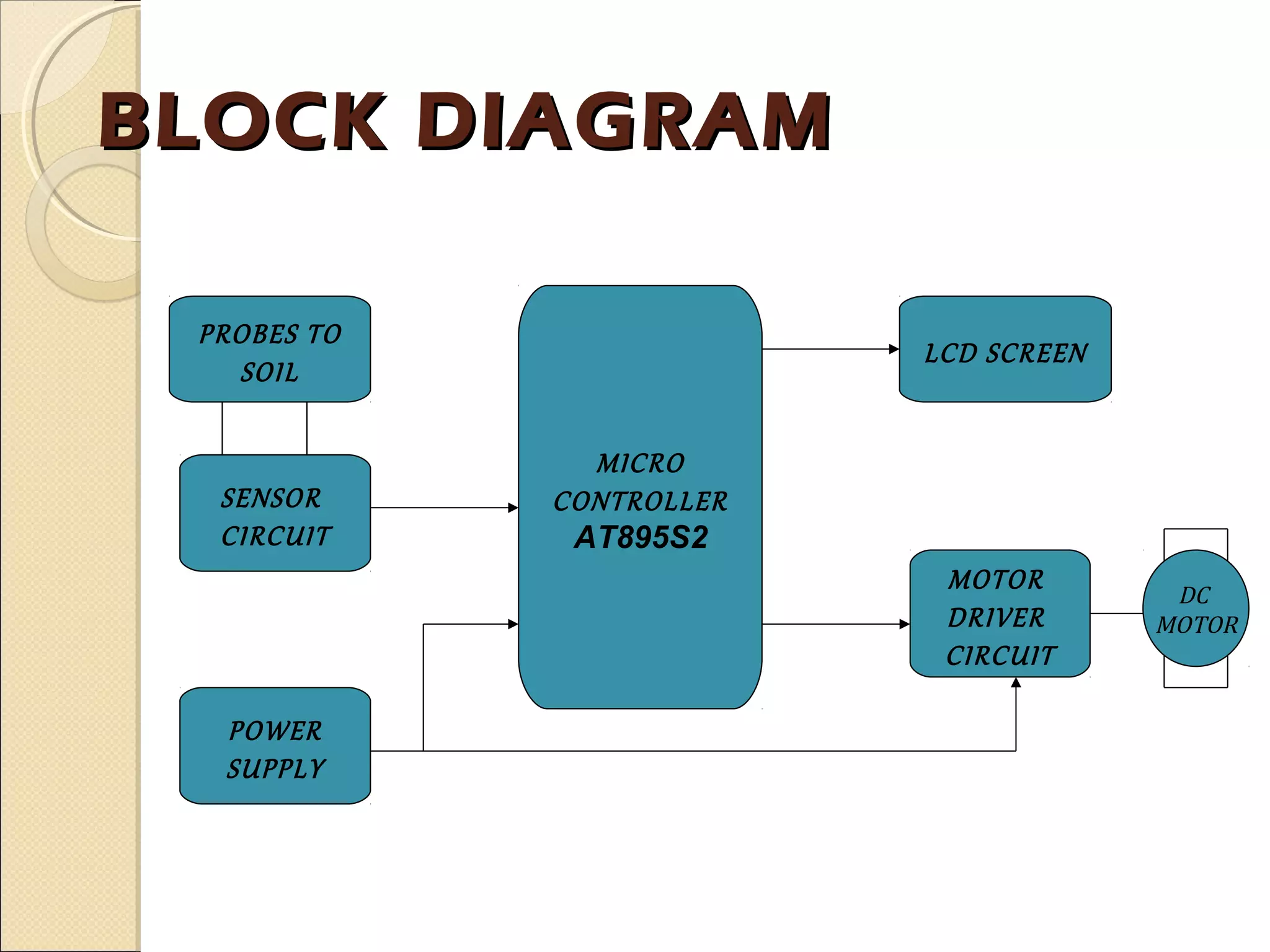
MICRO
CONTROLLER
AT895S2
SENSOR
CIRCUIT
POWER
SUPPLY
LCD SCREEN
MOTOR
DRIVER
CIRCUIT
PROBES TO
SOIL
DC
MOTOR
WORKINGWORKING
 This project consist of three stages
namely sensor circuit, microcontroller
circuit and motor driver circuit.
Sensor circuit senses the condition of soil
and compares the voltage with the
reference voltage i.e.,5v this is done by
the IC timer 555.
If the condition of soil is less than the
reference voltage i.e.,dry then the IC timer
send the high signal (logic ‘1’ ) to
Microcontroller PORT 39, this will turn
‘ON’ the motor driver circuit (1293d) which
When the soil becomes wet i.e, greater
than reference voltage(5v) the timer send
logic ‘0’ signal to microcontroller which will
turn ‘off’ the motor driver circuit and stop
pumping water to the field.
The condition of motor and soil are
displayed in the LCD screen.
In this way the process is repeated,
whenever there is need of water to the
field.
MERITSMERITS
 Saves water - Studies show that drip irrigation systems
use 30 - 50% less water than conventional watering
methods, such as sprinklers.
 Improves growth - Smaller amounts of water applied
over a longer amount of time provide ideal growing
conditions. Drip irrigation extends watering times for
plants, and prevents soil erosion and nutrient runoff.
Also, because the flow is continuous, water penetrates
deeply into the soil to get well down into the root zone.
 Discourages weeds - Water is only delivered where it's
needed.
 Saves time - Setting and moving sprinklers is not
required. A timer delay as per environment can be
added to the system for automatic watering.
DEMERITSDEMERITS
 This is applicable for only large
farms.
 Have limited life after installation due
to the detoriation of the plastic
component in a hot, arid climate
when exposed to ultraviolet light.
APPLICATIONSAPPLICATIONS
Irrigation In Fields.
Irrigation In Gardens, Parks.
 Very Efficient For Paddy, Rice Fields.
FUTURE EXTENSIONFUTURE EXTENSION
Water resources can be utilized
efficiently and effectively based on
various other parameters so that
agricultural sector becomes more
productive. Automatic drip irrigation at
different seasons is another future
scope. Water is allowed to the field of
crops depending upon the particular
season. Some more parameters such
as plant growth at different stages,
whether condition are to be taken into
CONCLUSIONCONCLUSION
In present days especially farmers are
facing major problems in watering their
agriculture fields, it’s because they have
no proper idea about when the power is
available so that they can pump water.
Even after then they need to wait until the
field is properly watered, which makes
them to stop doing other activities. Here is
an idea which helps not only farmers even
for watering the gardens also, which
senses the soil moisture and switches the
REFERANCESREFERANCES
Muhammad Ali Mazidi, Janice
Gillispie Mazidi, Rolin D. McKinlay,
“The 8051 Microcontroller and
Embedded Systems using Assembly
and C,”, Pearson Edition, Second
Edition
Ashok & K.Ashok; “Microcontroller
based drip irrigation system”,
published in technical paper in www.
Engineers.com on April 30th, 2010.
THTHANK YOU!!!ANK YOU!!!

PIC BASED DRIP IRRIGATION SYSTEM

  • 1.
    SEMINAR ON “ PICBASED DRIP IRRIGATION SYSTEM ” Presented by Mr. UJJWAL G. CHAURPAGAR (Final year EXTC – A57) Guided by Prof. U.U. WAGHMARE Project & Seminar Guide Department of Electronics & Telecommunication Engineering Babasaheb Naik College of Engineering,
  • 2.
  • 3.
    INTRODUCTIONINTRODUCTION  In theworld of advance electronics, life of human beings should be simpler hence to make life more simpler and convenient, we have made “AUTOMATIC PLANT IRRIGATION SYSTEM”. A model of controlling irrigation facilities to help millions of people. This model uses sensor technology with microcontroller to make a smart switching device . The model shows the basic switching mechanism of Water motor using sensors from any part of field by sensing the
  • 4.
  • 5.
    WORKINGWORKING  This projectconsist of three stages namely sensor circuit, microcontroller circuit and motor driver circuit. Sensor circuit senses the condition of soil and compares the voltage with the reference voltage i.e.,5v this is done by the IC timer 555. If the condition of soil is less than the reference voltage i.e.,dry then the IC timer send the high signal (logic ‘1’ ) to Microcontroller PORT 39, this will turn ‘ON’ the motor driver circuit (1293d) which
  • 6.
    When the soilbecomes wet i.e, greater than reference voltage(5v) the timer send logic ‘0’ signal to microcontroller which will turn ‘off’ the motor driver circuit and stop pumping water to the field. The condition of motor and soil are displayed in the LCD screen. In this way the process is repeated, whenever there is need of water to the field.
  • 7.
    MERITSMERITS  Saves water- Studies show that drip irrigation systems use 30 - 50% less water than conventional watering methods, such as sprinklers.  Improves growth - Smaller amounts of water applied over a longer amount of time provide ideal growing conditions. Drip irrigation extends watering times for plants, and prevents soil erosion and nutrient runoff. Also, because the flow is continuous, water penetrates deeply into the soil to get well down into the root zone.  Discourages weeds - Water is only delivered where it's needed.  Saves time - Setting and moving sprinklers is not required. A timer delay as per environment can be added to the system for automatic watering.
  • 8.
    DEMERITSDEMERITS  This isapplicable for only large farms.  Have limited life after installation due to the detoriation of the plastic component in a hot, arid climate when exposed to ultraviolet light.
  • 9.
    APPLICATIONSAPPLICATIONS Irrigation In Fields. IrrigationIn Gardens, Parks.  Very Efficient For Paddy, Rice Fields.
  • 10.
    FUTURE EXTENSIONFUTURE EXTENSION Waterresources can be utilized efficiently and effectively based on various other parameters so that agricultural sector becomes more productive. Automatic drip irrigation at different seasons is another future scope. Water is allowed to the field of crops depending upon the particular season. Some more parameters such as plant growth at different stages, whether condition are to be taken into
  • 11.
    CONCLUSIONCONCLUSION In present daysespecially farmers are facing major problems in watering their agriculture fields, it’s because they have no proper idea about when the power is available so that they can pump water. Even after then they need to wait until the field is properly watered, which makes them to stop doing other activities. Here is an idea which helps not only farmers even for watering the gardens also, which senses the soil moisture and switches the
  • 12.
    REFERANCESREFERANCES Muhammad Ali Mazidi,Janice Gillispie Mazidi, Rolin D. McKinlay, “The 8051 Microcontroller and Embedded Systems using Assembly and C,”, Pearson Edition, Second Edition Ashok & K.Ashok; “Microcontroller based drip irrigation system”, published in technical paper in www. Engineers.com on April 30th, 2010.
  • 13.