SMART AUTOMATED
IRRIGATION SYSTEM
BY USING ARDUINO
By
PRASHANT D. AUTI
2
Under Guided by
PROF. MS. POOJA PATIL
CONTENTS
1. ABSTRACT
2. INTRODUCTION
3. PROBLEM STATEMENT
4. LITERATURE SURVEY
5. PROPOSED SYSTEM
6. FLOW DIAGRAM
7. FUTURE SCOPE
8. CONCLUSION
9. REFERENCES
SMART AUTOMATED IRRIGATION SYSTEM BY USING ARDUINO 3
ABSTRACT
Current global technology plays an important role in the field of agriculture.
Automation is the technology with which a procedure or process is executed without
human assistance. The main objective of this work is to determine how a person can
use the automatic irrigation system of his own moderately economical facilities in a
few hours to connect some electronic components and other materials. An automatic
irrigation system based on sensor-based systems has been designed and implemented
as one of the most widely used and advantageous automatic systems. This will help
people in their daily activities, thus saving them time and hard work. This system uses
sensor technology with the microcontroller, relay, DC motor and battery.
MOBILE CONTROLLED IRRIGATION, SMART
IRRIGATION, SENSER CONTROLLED
KEYWORD-
SMART AUTOMATED IRRIGATION SYSTEM BY USING ARDUINO 4
SMART AUTOMATED IRRIGATION SYSTEM BY USING ARDUINO 5
INTRODUCTION
• The Project 'Smart Irrigation System' is used for the optimization use of
water in agricultural field without the intervention of farmer by using soil
moisture.
• Sensor that senses the moisture content of the Soil using Microcontroller
that turn ON/OFF the pump automatically according to the need of water for
irrigation.
SMART AUTOMATED IRRIGATION SYSTEM BY USING ARDUINO 6
1. The absence of automatic controlling of the system result in improper
water control system.
2. The major reason for these limitations is the growth of population which
is increasing at a faster rate.
3. At present there is emerging global water crisis where managing scarcity
of water has become a serious job.
.
PROBLEM STATEMENT
SMART AUTOMATED IRRIGATION SYSTEM BY
USING ARDUINO 7
LITERATURE SURVEY
On the basis of the literature review, we have proposed
a GSM based automatic irrigation system having promising scope.
Proposed work attempts to save the natural resources available for
human kind by continuously monitoring the status of the soil, the flow of
water can be controlled and thereby reduce the wastage.
SMART AUTOMATED IRRIGATION SYSTEM BY USING ARDUINO 8
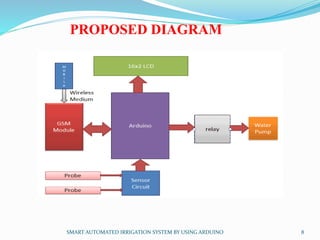
PROPOSED DIAGRAM
SMART AUTOMATED IRRIGATION SYSTEM BY USING ARDUINO 9
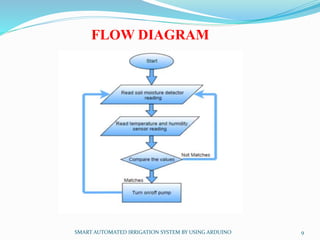
FLOW DIAGRAM
SMART AUTOMATED IRRIGATION SYSTEM BY USING
ARDUINO 10
FUTURE SCOPE
This smart irrigation system extends watering time for plants,
and provides ideal growth condition. It saves time and timer delay as per
the environmental condition can be added for automatic watering. This
smart irrigation system can be adjusted and modified according to the
changing environment.
SMART AUTOMATED IRRIGATION SYSTEM BY USING ARDUINO 11
CONCLUSION
Thus the “Automated Irrigation system based on soil moisture
using Arduino” has been designed and tested successfully. It has been
developed by integrated features of all the hardware components used.
SMART AUTOMATED IRRIGATION SYSTEM BY USING ARDUINO 12
REFERENCES
Ali, M. A., Islam, M. S., Sarker, M. N. I., & Bari, M. A. (2015). Study on Biology of Red
Pumpkin Beetle in Sweet Gourd Plants. International Journal of Applied Research Journal,
2(1), 1–4.
Baraka, K., Ghobril, M., Malek, S., Kanj, R., & Kayssi, A. (2013). Low cost
Arduino/Android based Energy-Efficient Home Automation System with Smart Task
Scheduling. In Fifth International Conference on Computational Developing a Smart Irrigation
System Using Arduino 38 International Journal of Research Studies in Science, Engineering
and Technology V6 ● I1 ● 2018 Intelligence, Communication Systems and Networks (pp.
296–301). https://doi.org/10.1109/CICSYN.2013.47
Caetano, F., Pitarma, R., & Reis, P. (2015). Advanced System for Garden Irrigation
Management. In New Contributions in Information Systems and Technologies (pp. 565– 574).
https://doi.org/10.1007/978-3-319-16486- 1_55

Smart automated irrigation system ppt

  • 2.
    SMART AUTOMATED IRRIGATION SYSTEM BYUSING ARDUINO By PRASHANT D. AUTI 2 Under Guided by PROF. MS. POOJA PATIL
  • 3.
    CONTENTS 1. ABSTRACT 2. INTRODUCTION 3.PROBLEM STATEMENT 4. LITERATURE SURVEY 5. PROPOSED SYSTEM 6. FLOW DIAGRAM 7. FUTURE SCOPE 8. CONCLUSION 9. REFERENCES SMART AUTOMATED IRRIGATION SYSTEM BY USING ARDUINO 3
  • 4.
    ABSTRACT Current global technologyplays an important role in the field of agriculture. Automation is the technology with which a procedure or process is executed without human assistance. The main objective of this work is to determine how a person can use the automatic irrigation system of his own moderately economical facilities in a few hours to connect some electronic components and other materials. An automatic irrigation system based on sensor-based systems has been designed and implemented as one of the most widely used and advantageous automatic systems. This will help people in their daily activities, thus saving them time and hard work. This system uses sensor technology with the microcontroller, relay, DC motor and battery. MOBILE CONTROLLED IRRIGATION, SMART IRRIGATION, SENSER CONTROLLED KEYWORD- SMART AUTOMATED IRRIGATION SYSTEM BY USING ARDUINO 4
  • 5.
    SMART AUTOMATED IRRIGATIONSYSTEM BY USING ARDUINO 5 INTRODUCTION • The Project 'Smart Irrigation System' is used for the optimization use of water in agricultural field without the intervention of farmer by using soil moisture. • Sensor that senses the moisture content of the Soil using Microcontroller that turn ON/OFF the pump automatically according to the need of water for irrigation.
  • 6.
    SMART AUTOMATED IRRIGATIONSYSTEM BY USING ARDUINO 6 1. The absence of automatic controlling of the system result in improper water control system. 2. The major reason for these limitations is the growth of population which is increasing at a faster rate. 3. At present there is emerging global water crisis where managing scarcity of water has become a serious job. . PROBLEM STATEMENT
  • 7.
    SMART AUTOMATED IRRIGATIONSYSTEM BY USING ARDUINO 7 LITERATURE SURVEY On the basis of the literature review, we have proposed a GSM based automatic irrigation system having promising scope. Proposed work attempts to save the natural resources available for human kind by continuously monitoring the status of the soil, the flow of water can be controlled and thereby reduce the wastage.
  • 8.
    SMART AUTOMATED IRRIGATIONSYSTEM BY USING ARDUINO 8 PROPOSED DIAGRAM
  • 9.
    SMART AUTOMATED IRRIGATIONSYSTEM BY USING ARDUINO 9 FLOW DIAGRAM
  • 10.
    SMART AUTOMATED IRRIGATIONSYSTEM BY USING ARDUINO 10 FUTURE SCOPE This smart irrigation system extends watering time for plants, and provides ideal growth condition. It saves time and timer delay as per the environmental condition can be added for automatic watering. This smart irrigation system can be adjusted and modified according to the changing environment.
  • 11.
    SMART AUTOMATED IRRIGATIONSYSTEM BY USING ARDUINO 11 CONCLUSION Thus the “Automated Irrigation system based on soil moisture using Arduino” has been designed and tested successfully. It has been developed by integrated features of all the hardware components used.
  • 12.
    SMART AUTOMATED IRRIGATIONSYSTEM BY USING ARDUINO 12 REFERENCES Ali, M. A., Islam, M. S., Sarker, M. N. I., & Bari, M. A. (2015). Study on Biology of Red Pumpkin Beetle in Sweet Gourd Plants. International Journal of Applied Research Journal, 2(1), 1–4. Baraka, K., Ghobril, M., Malek, S., Kanj, R., & Kayssi, A. (2013). Low cost Arduino/Android based Energy-Efficient Home Automation System with Smart Task Scheduling. In Fifth International Conference on Computational Developing a Smart Irrigation System Using Arduino 38 International Journal of Research Studies in Science, Engineering and Technology V6 ● I1 ● 2018 Intelligence, Communication Systems and Networks (pp. 296–301). https://doi.org/10.1109/CICSYN.2013.47 Caetano, F., Pitarma, R., & Reis, P. (2015). Advanced System for Garden Irrigation Management. In New Contributions in Information Systems and Technologies (pp. 565– 574). https://doi.org/10.1007/978-3-319-16486- 1_55