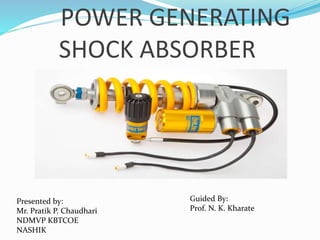
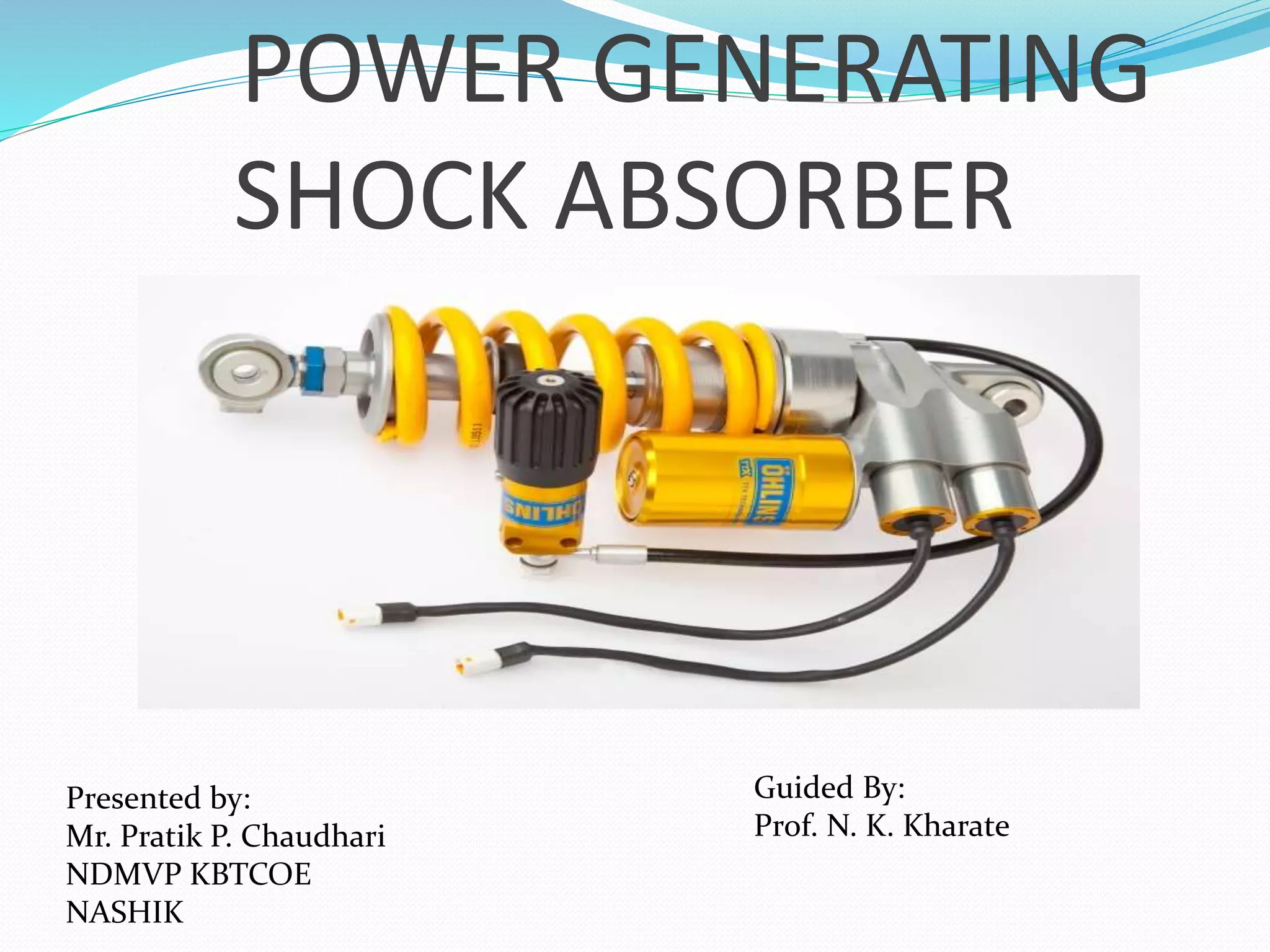
POWER GENERATING
SHOCK ABSORBER
Presented by:
Mr. Pratik P. Chaudhari
NDMVP KBTCOE
NASHIK
Guided By:
Prof. N. K. Kharate
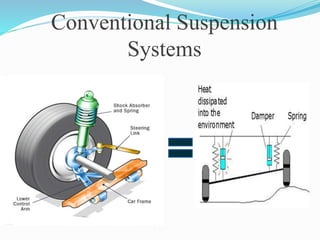
Conventional Suspension
Systems
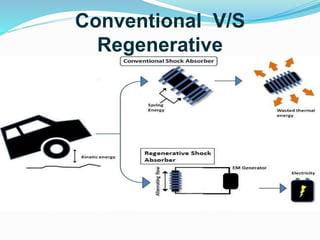
Conventional V/S
Regenerative
Different types:-
Linear-type Shock
Absorbers
Rotary-type Shock
Absorbers
Based on the type of construction
and the way of energy generation
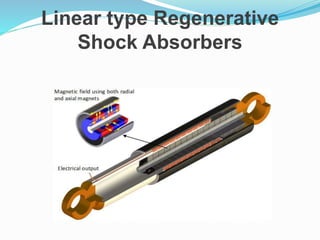
Linear type Regenerative
Shock Absorbers
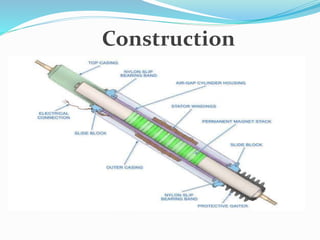
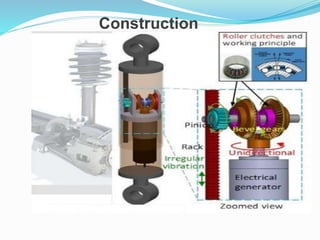
Construction
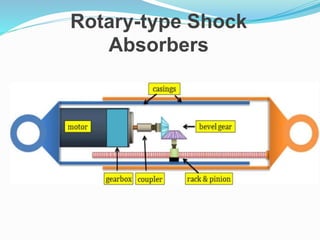
Rotary-type Shock
Absorbers
Construction
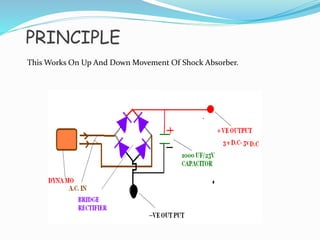
PRINCIPLE
This Works On Up And Down Movement Of Shock Absorber.
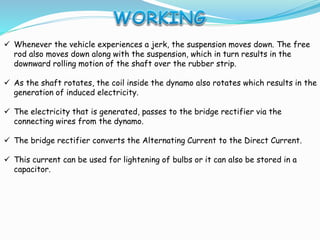
 Whenever the vehicle experiences a jerk, the suspension moves down. The free
rod also moves down along with the suspension, which in turn results in the
downward rolling motion of the shaft over the rubber strip.
 As the shaft rotates, the coil inside the dynamo also rotates which results in the
generation of induced electricity.
 The electricity that is generated, passes to the bridge rectifier via the
connecting wires from the dynamo.
 The bridge rectifier converts the Alternating Current to the Direct Current.
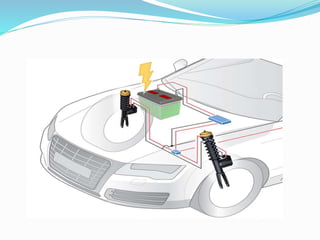
 This current can be used for lightening of bulbs or it can also be stored in a
capacitor.
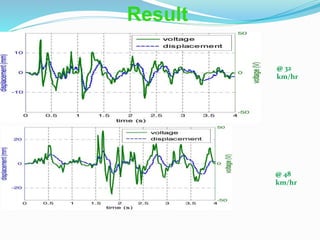
Road Tests
• Vehicle used:
Chevrolet
Suburban SUV
(2002 model).
• Test speed:
32kmph & 48 kmph
Result
@ 32
km/hr
@ 48
km/hr
 Since the weight of the system is very less, it does hampers
with the momentum of the vehicle. Therefore, more power is
produced from a comparatively lesser energy.
 Since it is a case of rolling motion, and we know that the
coefficient of rolling friction is less, hence there is no
significant loss in the energy.
 In this, the diameter of the dynamo is about 3 cm. if this
diameter is further reduced, then more amount of energy can
be produced due to greater number of rotations.
 Energy is produced near the speed breakers as well as near
ditches on even slightly uneven roads.
DISADVANTAGES
 System is the costly
 If system breakdowns it’s very difficult and costly
affair to repair it
 The system is very complex
 Requires high precision machinery and skilled
workers to manufacture
Further modifications
The number of dynamos used can be increased.
The capacity of dynamo can be increased.
The diameter of dynamo can be decreased.
Gear system can be introduced so that efficiency can be increased.
CONCLUSION
A larger magnetic field will be necessary if more power needs to be generated.
Conversion of energy produced by a vehicle shock absorbers movements into electrical
energy, allows a significant fuel saving.
It is possible to obtain a fuel saving between 1.5 and 6%, depending on the vehicle
and on the driving conditions. Moreover, the researchers say that this system can
improve the stability of the vehicle.
“Regenerative braking harvests large amount of power in a very short time, in an
intermittent manner”, Lie Zuo said. “However, the regenerative shock absorbers can
harvest the power in a continuous way. On the smooth highway road, the electric
shock absorbers can improve the fuel efficiency by 2%, and on bumpy roads up to 10%
increase can be expected.”
More researchers are going on to extend the tests involving other types of vehicles
such as trucks, buses and other automotive vehicles
REFERENCES
1. Lei Zuo, Brian Scully, Jurgen Shestani and Yu Zhou, ‘Design and
characterization of an electromagnetic energy harvester for vehicle
suspensions’, Journal of Smart Materials and Structures, Volume 19,
Number 4.
2. Gupta A, Jendrzejczyk J A, Mulcahy T M and Hull J R , ‘Design of
electromagnetic shock absorbers’, International Journal of Mechanics &
Material Design, Volume 3, Number 3.
3. Goldner R B, Zerigian P and Hull J R, ‘A preliminary study of energy
recovery in vehicles by using regenerative magnetic shock absorbers’,
SAE Paper #2001-01-2071.
4. Pei-Sheng Zhang and Lei Zuo, ’Energy harvesting, ride comfort, and
road handling of regenerative vehicle suspensions’, ASME Journal
of Vibration and Acoustics, 2012.
5. Zhen Longxin and Wei Xiaogang , ‘Structure and Performance Analysis
of Regenerative Electromagnetic Shock Absorber’, Journal of networks,
vol. 5, no. 12, December 2010
Power Generating Shock Absorber

Power Generating Shock Absorber

  • 1.
    POWER GENERATING SHOCK ABSORBER Presentedby: Mr. Pratik P. Chaudhari NDMVP KBTCOE NASHIK Guided By: Prof. N. K. Kharate
  • 2.
  • 3.
  • 4.
    Different types:- Linear-type Shock Absorbers Rotary-typeShock Absorbers Based on the type of construction and the way of energy generation
  • 5.
  • 6.
  • 7.
  • 8.
  • 9.
    PRINCIPLE This Works OnUp And Down Movement Of Shock Absorber.
  • 10.
     Whenever thevehicle experiences a jerk, the suspension moves down. The free rod also moves down along with the suspension, which in turn results in the downward rolling motion of the shaft over the rubber strip.  As the shaft rotates, the coil inside the dynamo also rotates which results in the generation of induced electricity.  The electricity that is generated, passes to the bridge rectifier via the connecting wires from the dynamo.  The bridge rectifier converts the Alternating Current to the Direct Current.  This current can be used for lightening of bulbs or it can also be stored in a capacitor.
  • 12.
    Road Tests • Vehicleused: Chevrolet Suburban SUV (2002 model). • Test speed: 32kmph & 48 kmph
  • 13.
  • 14.
     Since theweight of the system is very less, it does hampers with the momentum of the vehicle. Therefore, more power is produced from a comparatively lesser energy.  Since it is a case of rolling motion, and we know that the coefficient of rolling friction is less, hence there is no significant loss in the energy.  In this, the diameter of the dynamo is about 3 cm. if this diameter is further reduced, then more amount of energy can be produced due to greater number of rotations.  Energy is produced near the speed breakers as well as near ditches on even slightly uneven roads.
  • 15.
    DISADVANTAGES  System isthe costly  If system breakdowns it’s very difficult and costly affair to repair it  The system is very complex  Requires high precision machinery and skilled workers to manufacture
  • 16.
    Further modifications The numberof dynamos used can be increased. The capacity of dynamo can be increased. The diameter of dynamo can be decreased. Gear system can be introduced so that efficiency can be increased.
  • 17.
    CONCLUSION A larger magneticfield will be necessary if more power needs to be generated. Conversion of energy produced by a vehicle shock absorbers movements into electrical energy, allows a significant fuel saving. It is possible to obtain a fuel saving between 1.5 and 6%, depending on the vehicle and on the driving conditions. Moreover, the researchers say that this system can improve the stability of the vehicle. “Regenerative braking harvests large amount of power in a very short time, in an intermittent manner”, Lie Zuo said. “However, the regenerative shock absorbers can harvest the power in a continuous way. On the smooth highway road, the electric shock absorbers can improve the fuel efficiency by 2%, and on bumpy roads up to 10% increase can be expected.” More researchers are going on to extend the tests involving other types of vehicles such as trucks, buses and other automotive vehicles
  • 18.
    REFERENCES 1. Lei Zuo,Brian Scully, Jurgen Shestani and Yu Zhou, ‘Design and characterization of an electromagnetic energy harvester for vehicle suspensions’, Journal of Smart Materials and Structures, Volume 19, Number 4. 2. Gupta A, Jendrzejczyk J A, Mulcahy T M and Hull J R , ‘Design of electromagnetic shock absorbers’, International Journal of Mechanics & Material Design, Volume 3, Number 3. 3. Goldner R B, Zerigian P and Hull J R, ‘A preliminary study of energy recovery in vehicles by using regenerative magnetic shock absorbers’, SAE Paper #2001-01-2071. 4. Pei-Sheng Zhang and Lei Zuo, ’Energy harvesting, ride comfort, and road handling of regenerative vehicle suspensions’, ASME Journal of Vibration and Acoustics, 2012. 5. Zhen Longxin and Wei Xiaogang , ‘Structure and Performance Analysis of Regenerative Electromagnetic Shock Absorber’, Journal of networks, vol. 5, no. 12, December 2010