AUTOMATED GUIDED
VEHICLE
PRESENTED BY : NURSAZWANI MOHD SHAM
DEPARTMENT : INDUSTRIAL MECHATRONIC
LECTURE : MR. FAUZI BIN ANUAR
“Introduction to
Automatic Guided Vehicles”
An automated guided vehicle or automatic guided vehicle (AGV)
is a mobile robot that follows markers or wires in the floor, or uses
vision, magnets, or lasers for navigation. They are most often used in
industrial applications to move materials around a manufacturing
facility or warehouse
The AGV can tow objects behind them in trailers to which they can
autonomously attach. The trailers can be used to move raw materials
or finished product. The AGV can also store objects on a bed. The
objects can be placed on a set of motorized rollers (conveyor) and
then pushed off by reversing them. AGVs are employed in nearly
every industry, including, pulp, paper, metals, newspaper, and general
manufacturing. Transporting materials such as food, linen or medicine
in hospitals is also done.
An AGV can also be called a laser guided vehicle
(LGV). In Germany the technology is also
called Fahrerlose Transport system (FTS) and in
Sweden forarlosa trucker.
AGVs are available in a variety of models and can be
used to move products on an assembly line, transport
goods throughout a plant or warehouse, and deliver
loads.
Continued…..
History of AGV’S
The first AGV was brought to market in the 1950s, by
Barrett Electronics of Northbrook, Illinois, and at the
time it was simply a tow truck that followed a wire in the
floor instead of a rail. Over the years the technology
has become more sophisticated and today automated
vehicles are mainly Laser navigated e.g. LGV (Laser
Guided Vehicle).
In an automated process, LGVs are programmed to
communicate with other robots to ensure product is
moved smoothly through the warehouse, whether it is
being stored for future use or sent directly to shipping
areas. Today, the AGV plays an important role in the
design of new factories and warehouses,
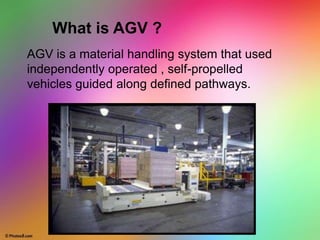
What is AGV ?
AGV is a material handling system that used
independently operated , self-propelled
vehicles guided along defined pathways.
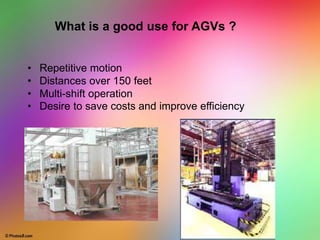
• Repetitive motion
• Distances over 150 feet
• Multi-shift operation
• Desire to save costs and improve efficiency
What is a good use for AGVs ?
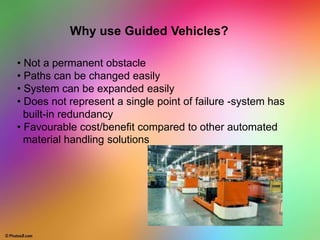
• Not a permanent obstacle
• Paths can be changed easily
• System can be expanded easily
• Does not represent a single point of failure -system has
built-in redundancy
• Favourable cost/benefit compared to other automated
material handling solutions
Why use Guided Vehicles?
System Features
High dynamic operation
Innovative steering method
Robust design
Speed control separately for each wheel
Angular position control separately for each axle
System Concepts
• 4 drive units – 4 steering axles
• 2 motors for each unit
• 1 controlled for each motor
• Host computer gets speed-position
information and determine the drive path
Battery charging with generative braking
4-quardrant mode for motor-generator driving.
Circuit integrated to obtain braking energy from
the drives.
Special capacitor for storing voltage ang charging
the battery.
Its optimised by “self charging programe” at
specific charging place after periodic time.
Some manufacturers are providing “battery swap
options”.
Type of AGV’S
Driverless trains
o It consists of a towing vehicle that pulls one or more trailers
to from a train
o This type is applicable in moving heavy pay loads over
large distance in warehouse or factories with or without
intermediate pickup and drop off point along the route
o It contains of 5-10 trailers and is an efficient transport
system
o The towing capacity is up to 60,000 pounds (27,000 kilos)
 AGVS Pallet Trucks
o Pallet trucks are used to move palletized load along
predetermined routed
o The capacity of an AGV pallet truck ranges up to
several thousand kilograms and some are capable
of handling two pallets
o It is achieved for vertical movement to reach loads
on racks and shelves
 AGVS Unit load Carriers
o These are used to move unit load from one station
to another
o It is also used for automatic loading and unloading
of pallets by means of rollers
o Load capacity ranges up to 250 kg or less
o Especially these vehicles are designed to move
small loads
Why consider AGVs
• Reduces the labor cost
• Flexible
• Intelligent
• Less time consuming
• Can significantly reduce production & warehouse cost
• Transforming the materials handling industry
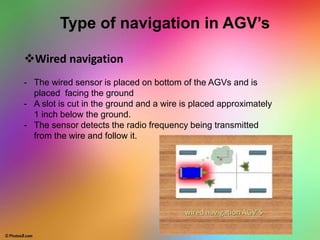
Type of navigation in AGV’s
Wired navigation
- The wired sensor is placed on bottom of the AGVs and is
placed facing the ground
- A slot is cut in the ground and a wire is placed approximately
1 inch below the ground.
- The sensor detects the radio frequency being transmitted
from the wire and follow it.
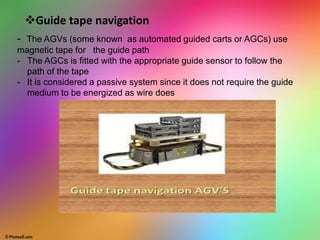
Guide tape navigation
- The AGVs (some known as automated guided carts or AGCs) use
magnetic tape for the guide path
- The AGCs is fitted with the appropriate guide sensor to follow the
path of the tape
- It is considered a passive system since it does not require the guide
medium to be energized as wire does
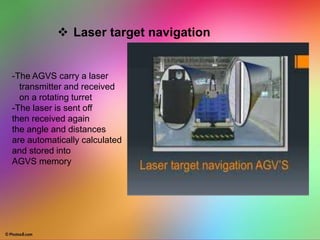
 Laser target navigation
-The AGVS carry a laser
transmitter and received
on a rotating turret
-The laser is sent off
then received again
the angle and distances
are automatically calculated
and stored into
AGVS memory
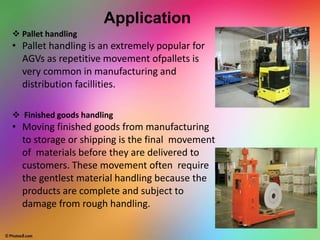
Application
 Pallet handling
• Pallet handling is an extremely popular for
AGVs as repetitive movement ofpallets is
very common in manufacturing and
distribution facillities.
 Finished goods handling
• Moving finished goods from manufacturing
to storage or shipping is the final movement
of materials before they are delivered to
customers. These movement often require
the gentlest material handling because the
products are complete and subject to
damage from rough handling.
 Unobstructed movement
 Flexibility
I. Locations, path, P/D points can be reprogrammed
II. Easy to change guide path system
III. Number of vehicles can be altered depending on
requirement
 Greater reliability
I. Less environmental problems
II. AGV can be replaced by another, in case of failure.
Lower investment
Higher operating savings on long run
I. Minimal labor cost
II. Easy maintenance
 Easy to interface with other systems
Advantages of AGV’s
Conclusion
From this task I can now able to know about automated
guided vehicle or automatic guided vehicle (AGV) is a
mobile robot that follows markers or wires in the floor,
or used vision, magnets, or lasers for navigation. They
are most often used in industrial applications to move
materials around a manufacturing facility or warehouse.
Application of the automatic guided vehicle has
broadened during the late 20th century.
THANK
YOU

Automated guided vehicle

  • 1.
    AUTOMATED GUIDED VEHICLE PRESENTED BY: NURSAZWANI MOHD SHAM DEPARTMENT : INDUSTRIAL MECHATRONIC LECTURE : MR. FAUZI BIN ANUAR
  • 2.
    “Introduction to Automatic GuidedVehicles” An automated guided vehicle or automatic guided vehicle (AGV) is a mobile robot that follows markers or wires in the floor, or uses vision, magnets, or lasers for navigation. They are most often used in industrial applications to move materials around a manufacturing facility or warehouse The AGV can tow objects behind them in trailers to which they can autonomously attach. The trailers can be used to move raw materials or finished product. The AGV can also store objects on a bed. The objects can be placed on a set of motorized rollers (conveyor) and then pushed off by reversing them. AGVs are employed in nearly every industry, including, pulp, paper, metals, newspaper, and general manufacturing. Transporting materials such as food, linen or medicine in hospitals is also done.
  • 3.
    An AGV canalso be called a laser guided vehicle (LGV). In Germany the technology is also called Fahrerlose Transport system (FTS) and in Sweden forarlosa trucker. AGVs are available in a variety of models and can be used to move products on an assembly line, transport goods throughout a plant or warehouse, and deliver loads. Continued…..
  • 4.
    History of AGV’S Thefirst AGV was brought to market in the 1950s, by Barrett Electronics of Northbrook, Illinois, and at the time it was simply a tow truck that followed a wire in the floor instead of a rail. Over the years the technology has become more sophisticated and today automated vehicles are mainly Laser navigated e.g. LGV (Laser Guided Vehicle). In an automated process, LGVs are programmed to communicate with other robots to ensure product is moved smoothly through the warehouse, whether it is being stored for future use or sent directly to shipping areas. Today, the AGV plays an important role in the design of new factories and warehouses,
  • 5.
    What is AGV? AGV is a material handling system that used independently operated , self-propelled vehicles guided along defined pathways.
  • 6.
    • Repetitive motion •Distances over 150 feet • Multi-shift operation • Desire to save costs and improve efficiency What is a good use for AGVs ?
  • 7.
    • Not apermanent obstacle • Paths can be changed easily • System can be expanded easily • Does not represent a single point of failure -system has built-in redundancy • Favourable cost/benefit compared to other automated material handling solutions Why use Guided Vehicles?
  • 8.
    System Features High dynamicoperation Innovative steering method Robust design Speed control separately for each wheel Angular position control separately for each axle
  • 9.
    System Concepts • 4drive units – 4 steering axles • 2 motors for each unit • 1 controlled for each motor • Host computer gets speed-position information and determine the drive path
  • 10.
    Battery charging withgenerative braking 4-quardrant mode for motor-generator driving. Circuit integrated to obtain braking energy from the drives. Special capacitor for storing voltage ang charging the battery. Its optimised by “self charging programe” at specific charging place after periodic time. Some manufacturers are providing “battery swap options”.
  • 11.
    Type of AGV’S Driverlesstrains o It consists of a towing vehicle that pulls one or more trailers to from a train o This type is applicable in moving heavy pay loads over large distance in warehouse or factories with or without intermediate pickup and drop off point along the route o It contains of 5-10 trailers and is an efficient transport system o The towing capacity is up to 60,000 pounds (27,000 kilos)
  • 12.
     AGVS PalletTrucks o Pallet trucks are used to move palletized load along predetermined routed o The capacity of an AGV pallet truck ranges up to several thousand kilograms and some are capable of handling two pallets o It is achieved for vertical movement to reach loads on racks and shelves
  • 13.
     AGVS Unitload Carriers o These are used to move unit load from one station to another o It is also used for automatic loading and unloading of pallets by means of rollers o Load capacity ranges up to 250 kg or less o Especially these vehicles are designed to move small loads
  • 14.
    Why consider AGVs •Reduces the labor cost • Flexible • Intelligent • Less time consuming • Can significantly reduce production & warehouse cost • Transforming the materials handling industry
  • 15.
    Type of navigationin AGV’s Wired navigation - The wired sensor is placed on bottom of the AGVs and is placed facing the ground - A slot is cut in the ground and a wire is placed approximately 1 inch below the ground. - The sensor detects the radio frequency being transmitted from the wire and follow it.
  • 16.
    Guide tape navigation -The AGVs (some known as automated guided carts or AGCs) use magnetic tape for the guide path - The AGCs is fitted with the appropriate guide sensor to follow the path of the tape - It is considered a passive system since it does not require the guide medium to be energized as wire does
  • 17.
     Laser targetnavigation -The AGVS carry a laser transmitter and received on a rotating turret -The laser is sent off then received again the angle and distances are automatically calculated and stored into AGVS memory
  • 18.
    Application  Pallet handling •Pallet handling is an extremely popular for AGVs as repetitive movement ofpallets is very common in manufacturing and distribution facillities.  Finished goods handling • Moving finished goods from manufacturing to storage or shipping is the final movement of materials before they are delivered to customers. These movement often require the gentlest material handling because the products are complete and subject to damage from rough handling.
  • 19.
     Unobstructed movement Flexibility I. Locations, path, P/D points can be reprogrammed II. Easy to change guide path system III. Number of vehicles can be altered depending on requirement  Greater reliability I. Less environmental problems II. AGV can be replaced by another, in case of failure. Lower investment Higher operating savings on long run I. Minimal labor cost II. Easy maintenance  Easy to interface with other systems Advantages of AGV’s
  • 21.
    Conclusion From this taskI can now able to know about automated guided vehicle or automatic guided vehicle (AGV) is a mobile robot that follows markers or wires in the floor, or used vision, magnets, or lasers for navigation. They are most often used in industrial applications to move materials around a manufacturing facility or warehouse. Application of the automatic guided vehicle has broadened during the late 20th century.
  • 22.