MATERIAL
HANDLING
MATERIAL HANDLING
Material handling is the
 function of moving the right
 material to the right place in
 the right time, in the right
 amount, in sequence, and in
 the right condition to
 minimize production cost.
MATERIAL HANDLING
A  material-handling system can be
 simply defined as an integrated system
 involving such activities as handling,
 storing, and controlling of materials.
 Theword material has very broad
 meaning, covering all kinds of raw
 materials, work in process,
 subassemblies, and finished assemblies.
MATERIAL HANDLING
 The  primary objective of
  using a material handling
  system is to ensure that the
  material in the right amount is
  safely delivered to the desired
  destination at the right time
  and at minimum cost.
MATERIAL HANDLING
The material handling system is
 properly designed not only to
 ensure the minimum cost and
 compatibility with other
 manufacturing equipment but also
 to meet safety concerns.
 The cost of MH estimates 20-25
  of total manufacturing labor cost
  in the United States
GOALS OF MATERIAL HANDLING
   The  primary goal is to reduce unit
    costs of production
   Maintain   or improve product
    quality, reduce damage of
    materials
   Promote  safety and improve
    working conditions
GOALS OF MATERIAL HANDLING
  Promote       increased use of
   facilities
  Reduce       tare weight (dead
   weight)
  Control      inventory
GOALS OF MATERIAL HANDLING
   Promote    productivity
    material should flow in a straight
     line
    use gravity! It is free power
    move more material at one time
    mechanize material handling
    automate material handling
GOALS OF MATERIAL HANDLING
    Material   handling equipment includes:
     Transport Equipment: industrial
      trucks, Automated Guided vehicles
      (AGVs), monorails, conveyors, cranes
      and hoists.
     Storage Systems: bulk storage, rack
      systems, shelving and bins, drawer
      storage, automated storage systems.
     Unitizing Equipment: palletizers
     Identification and Tracking systems
CONSIDERATIONS IN MATERIAL
 HANDLING SYSTEM DESIGN
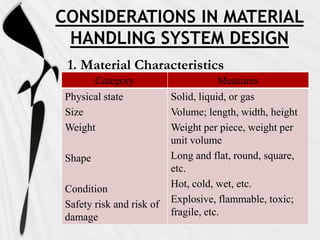
 1. Material Characteristics
      Category                         Measures
Physical state            Solid, liquid, or gas
Size                      Volume; length, width, height
Weight                    Weight per piece, weight per
                          unit volume
Shape                     Long and flat, round, square,
                          etc.
Condition                 Hot, cold, wet, etc.
Safety risk and risk of   Explosive, flammable, toxic;
damage                    fragile, etc.
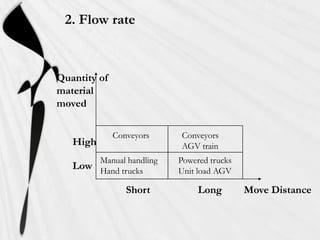
2. Flow rate


Quantity of
material
moved

              Conveyors   Conveyors
   High                   AGV train
       Manual handling    Powered trucks
   Low Hand trucks        Unit load AGV

                 Short         Long        Move Distance
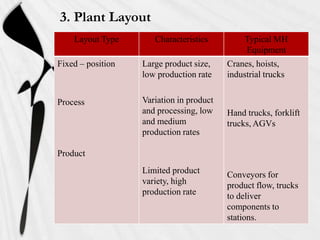
3. Plant Layout
    Layout Type       Characteristics          Typical MH
                                               Equipment
Fixed – position   Large product size,    Cranes, hoists,
                   low production rate    industrial trucks


Process            Variation in product
                   and processing, low    Hand trucks, forklift
                   and medium             trucks, AGVs
                   production rates

Product
                   Limited product        Conveyors for
                   variety, high          product flow, trucks
                   production rate        to deliver
                                          components to
                                          stations.
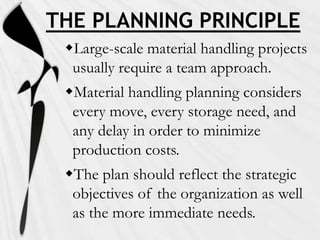
THE PLANNING PRINCIPLE
 Large-scale material handling projects
  usually require a team approach.
 Material handling planning considers
  every move, every storage need, and
  any delay in order to minimize
  production costs.
 The plan should reflect the strategic
  objectives of the organization as well
  as the more immediate needs.
THE SYSTEMS PRINCIPLE
 MH and storage activities should be fully
  integrated to form a coordinated,
  operational system that spans receiving,
  inspection, storage, production, assembly,
  …, shipping, and the handling of returns.
   Information flow and physical material flow
    should be integrated and treated as
    concurrent activities.
   Methods should be provided for easily
    identifying materials and products, for
    determining their location and status within
    facilities and within the supply chain.
SIMPLIFICATION PRINCIPLE
 simplify handling by reducing, eliminating, or
  combining unnecessary movement and/or
  equipment.
 Four questions to ask to simplify any job:
  Can this job be eliminated?
  If we can’t eliminate, can we combine
   movements to reduce cost? (unit load concept)
  If we can’t eliminate or combine, can we
   rearrange the operations to reduce the travel
   distance?
  If we can’t do any of the above, can we simplify?
GRAVITY PRINCIPLE
Utilize gravity to move material whenever
 practical.

SPACE UTILIZATION
    PRINCIPLE
The better we use our building cube, the less
 space we need to buy or rent.
Racks, mezzanines, and overhead conveyors are a
 few examples that promote this goal.
UNIT LOAD PRINCIPLE
Unit loads should be appropriately
 sized and configured at each stage of
 the supply chain.
The most common unit load is the
 pallet
 cardboard pallets
 plastic pallets
 wooden pallets
 steel skids
AUTOMATION PRINCIPLE
  MH operations should be
   mechanized and/or automated
   where feasible to improve
   operational efficiency, increase
   responsiveness, improve
   consistency and predictability,
   decrease operating costs.
THE STANDARDIZATION
      PRINCIPLE
standardize handling methods as well as
 types and sizes of handling equipment
too many sizes and brands of
 equipment results in higher operational
 cost.
A fewer sizes of carton will simplify
 the storage.
EQUIPMENT SELECTION
          PRINCIPLE
Why? What? Where? When? How? Who?
If we answer these questions about each move, the
 solution will become evident.

   THE MAINTENANCE
       PRINCIPLE
 Plan for preventive maintenance and scheduled
  repairs of all handling equipment.
 Pallets and storage facilities need repair too.
THE DEAD WEIGHT
         PRINCIPLE
  Try to reduce the ratio of equipment weight
   to product weight. Don’t buy equipment
   that is bigger than necessary.
  Reduce tare weight and save money.

THE CAPACITY PRINCIPLE
  use handling equipment to help achieve
   desired production capacity
  i.e. material handling equipment can help to
   maximize production equipment utilization.
MATERIAL HANDLING EQUIPMENT
    Industrial trucks include hand trucks such as
     two-wheeled, four-wheeled, hand lift, and
     forklift and powered trucks such as forklift,
     tractor-trailer trains, industrial crane trucks,
     and side loaders.
    Conveyors    such as belt, chute, roller, wheel,
     slat, chain, bucket, trolley, tow, screw,
     vibrating, and pneumatic.
    Monorails, hoists, and cranes such as bridge,
     gantry, tower, and stacker.
MATERIAL HANDLING EQUIPMENT
   Automated     guided vehicle systems
     such as unit load carriers, towing,
     pallet trucks, fork trucks, and
     assembly line.
   Automated     storage and retrieval
     systems (AS/RS) such as unit load,
     mini-load, person-on-board, deep
     lane, and storage carousel systems.
Mtrl handling

Mtrl handling

  • 1.
  • 2.
    MATERIAL HANDLING Material handlingis the function of moving the right material to the right place in the right time, in the right amount, in sequence, and in the right condition to minimize production cost.
  • 3.
    MATERIAL HANDLING A material-handling system can be simply defined as an integrated system involving such activities as handling, storing, and controlling of materials.  Theword material has very broad meaning, covering all kinds of raw materials, work in process, subassemblies, and finished assemblies.
  • 4.
    MATERIAL HANDLING The primary objective of using a material handling system is to ensure that the material in the right amount is safely delivered to the desired destination at the right time and at minimum cost.
  • 5.
    MATERIAL HANDLING The materialhandling system is properly designed not only to ensure the minimum cost and compatibility with other manufacturing equipment but also to meet safety concerns. The cost of MH estimates 20-25 of total manufacturing labor cost in the United States
  • 6.
    GOALS OF MATERIALHANDLING The primary goal is to reduce unit costs of production Maintain or improve product quality, reduce damage of materials Promote safety and improve working conditions
  • 7.
    GOALS OF MATERIALHANDLING Promote increased use of facilities Reduce tare weight (dead weight) Control inventory
  • 8.
    GOALS OF MATERIALHANDLING Promote productivity material should flow in a straight line use gravity! It is free power move more material at one time mechanize material handling automate material handling
  • 9.
    GOALS OF MATERIALHANDLING  Material handling equipment includes: Transport Equipment: industrial trucks, Automated Guided vehicles (AGVs), monorails, conveyors, cranes and hoists. Storage Systems: bulk storage, rack systems, shelving and bins, drawer storage, automated storage systems. Unitizing Equipment: palletizers Identification and Tracking systems
  • 10.
    CONSIDERATIONS IN MATERIAL HANDLING SYSTEM DESIGN 1. Material Characteristics Category Measures Physical state Solid, liquid, or gas Size Volume; length, width, height Weight Weight per piece, weight per unit volume Shape Long and flat, round, square, etc. Condition Hot, cold, wet, etc. Safety risk and risk of Explosive, flammable, toxic; damage fragile, etc.
  • 11.
    2. Flow rate Quantityof material moved Conveyors Conveyors High AGV train Manual handling Powered trucks Low Hand trucks Unit load AGV Short Long Move Distance
  • 12.
    3. Plant Layout Layout Type Characteristics Typical MH Equipment Fixed – position Large product size, Cranes, hoists, low production rate industrial trucks Process Variation in product and processing, low Hand trucks, forklift and medium trucks, AGVs production rates Product Limited product Conveyors for variety, high product flow, trucks production rate to deliver components to stations.
  • 13.
    THE PLANNING PRINCIPLE Large-scale material handling projects usually require a team approach. Material handling planning considers every move, every storage need, and any delay in order to minimize production costs. The plan should reflect the strategic objectives of the organization as well as the more immediate needs.
  • 14.
    THE SYSTEMS PRINCIPLE MH and storage activities should be fully integrated to form a coordinated, operational system that spans receiving, inspection, storage, production, assembly, …, shipping, and the handling of returns. Information flow and physical material flow should be integrated and treated as concurrent activities. Methods should be provided for easily identifying materials and products, for determining their location and status within facilities and within the supply chain.
  • 15.
    SIMPLIFICATION PRINCIPLE simplifyhandling by reducing, eliminating, or combining unnecessary movement and/or equipment. Four questions to ask to simplify any job: Can this job be eliminated? If we can’t eliminate, can we combine movements to reduce cost? (unit load concept) If we can’t eliminate or combine, can we rearrange the operations to reduce the travel distance? If we can’t do any of the above, can we simplify?
  • 16.
    GRAVITY PRINCIPLE Utilize gravityto move material whenever practical. SPACE UTILIZATION PRINCIPLE The better we use our building cube, the less space we need to buy or rent. Racks, mezzanines, and overhead conveyors are a few examples that promote this goal.
  • 17.
    UNIT LOAD PRINCIPLE Unitloads should be appropriately sized and configured at each stage of the supply chain. The most common unit load is the pallet cardboard pallets plastic pallets wooden pallets steel skids
  • 18.
    AUTOMATION PRINCIPLE MH operations should be mechanized and/or automated where feasible to improve operational efficiency, increase responsiveness, improve consistency and predictability, decrease operating costs.
  • 19.
    THE STANDARDIZATION PRINCIPLE standardize handling methods as well as types and sizes of handling equipment too many sizes and brands of equipment results in higher operational cost. A fewer sizes of carton will simplify the storage.
  • 20.
    EQUIPMENT SELECTION PRINCIPLE Why? What? Where? When? How? Who? If we answer these questions about each move, the solution will become evident. THE MAINTENANCE PRINCIPLE  Plan for preventive maintenance and scheduled repairs of all handling equipment.  Pallets and storage facilities need repair too.
  • 21.
    THE DEAD WEIGHT PRINCIPLE  Try to reduce the ratio of equipment weight to product weight. Don’t buy equipment that is bigger than necessary.  Reduce tare weight and save money. THE CAPACITY PRINCIPLE  use handling equipment to help achieve desired production capacity  i.e. material handling equipment can help to maximize production equipment utilization.
  • 22.
    MATERIAL HANDLING EQUIPMENT  Industrial trucks include hand trucks such as two-wheeled, four-wheeled, hand lift, and forklift and powered trucks such as forklift, tractor-trailer trains, industrial crane trucks, and side loaders.  Conveyors such as belt, chute, roller, wheel, slat, chain, bucket, trolley, tow, screw, vibrating, and pneumatic.  Monorails, hoists, and cranes such as bridge, gantry, tower, and stacker.
  • 23.
    MATERIAL HANDLING EQUIPMENT Automated guided vehicle systems such as unit load carriers, towing, pallet trucks, fork trucks, and assembly line. Automated storage and retrieval systems (AS/RS) such as unit load, mini-load, person-on-board, deep lane, and storage carousel systems.