MALAVIYA NATIONAL INSTITUTE OF TECHNOLOGY
AUTOCOLLIMATOR
INTRODUCTION OF AUTOCOLLIMATOR :-
 A general discussion of autocollimators is found in the
book Engineering Optics by K. J. Habell and Arthur Cox,
published by Pitman (London), 1948 .
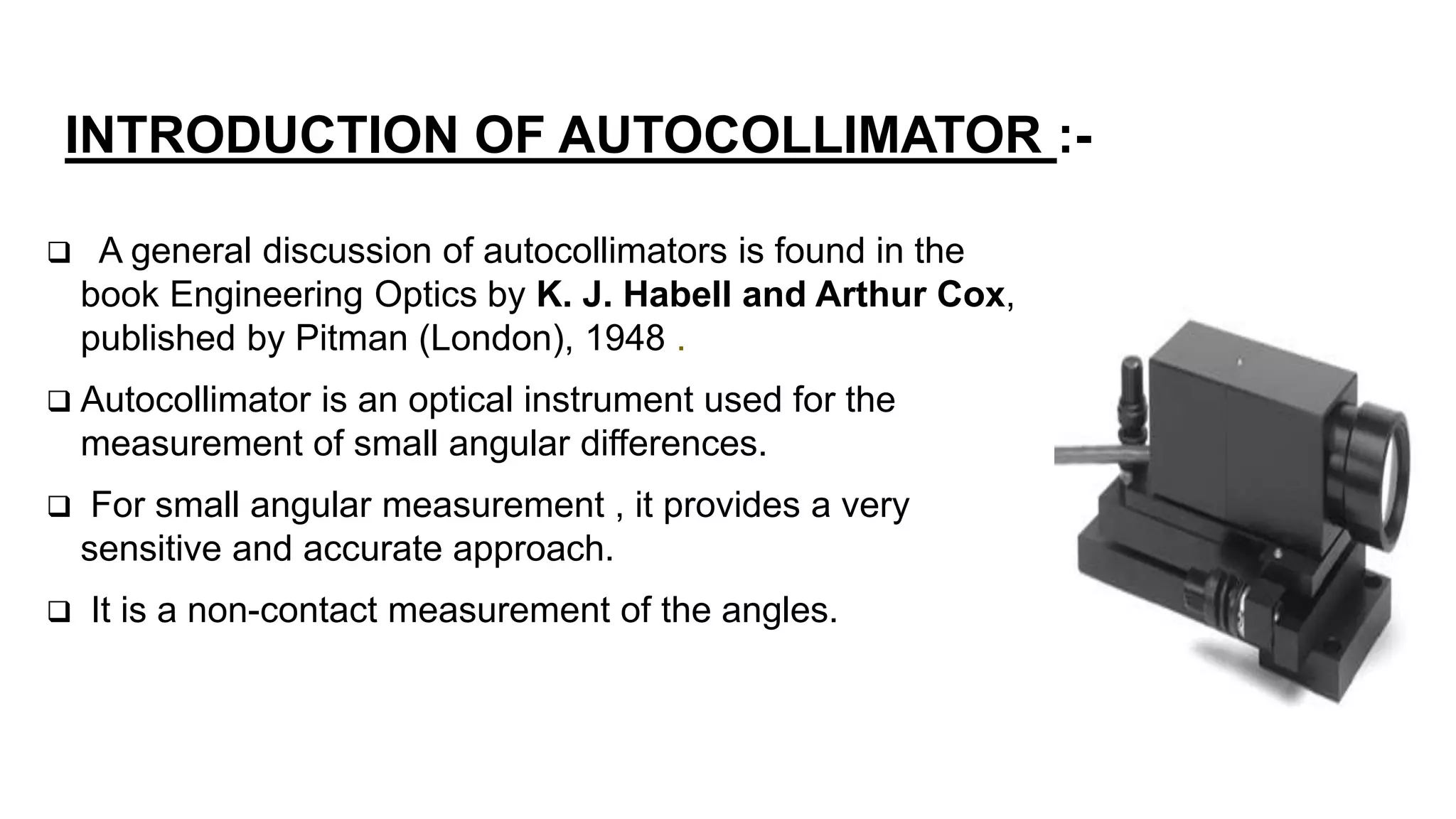
 Autocollimator is an optical instrument used for the
measurement of small angular differences.
 For small angular measurement , it provides a very
sensitive and accurate approach.
 It is a non-contact measurement of the angles.
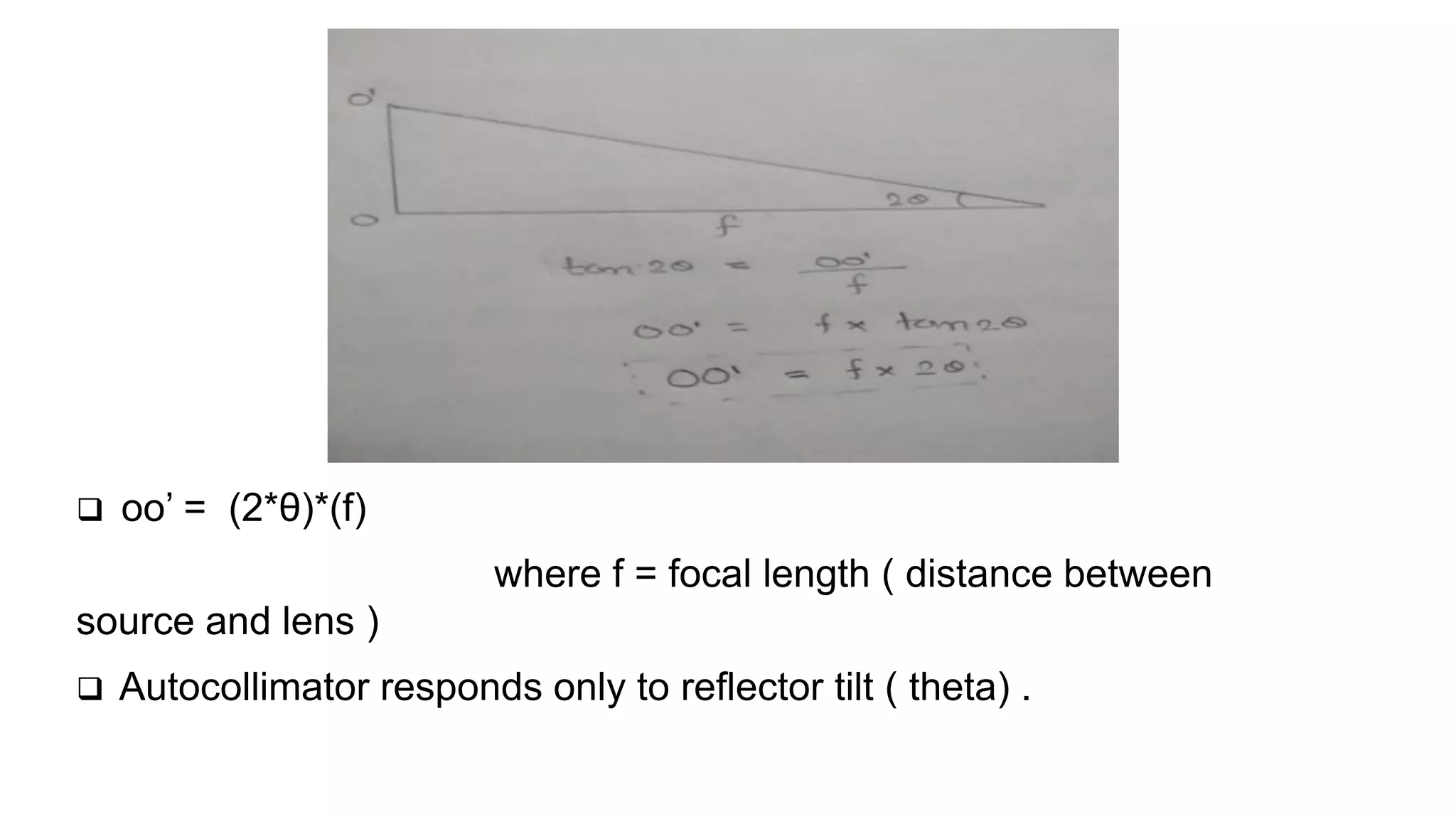
 oo’ = (2*θ)*(f)
where f = focal length ( distance between
source and lens )
 Autocollimator responds only to reflector tilt ( theta) .
 TYPES OF AUTOCOLLIMATOR :-
• Visual Autocollimators
• Digital Autocollimators
1) VISUAL AUTOCOLLIMATOR :-
• Visual autocollimators measure the
angle of optically flat (1/4 wave or
better), reflective surfaces in arc
seconds by viewing a graduated
reticle through an eyepiece.
• The longer the focal length of the
visual autocollimator, the greater
the angular resolution and the
smaller the field of view.
2) DIGITAL AUTOCOLLIMATOR :-
• Autocollimators are PC-based instruments which are
designed to operate in the lab as well as in a
machine shop environment.
• use an electronic photodetector to detect the
reflected beam.
• No external controller is required.
• Advantages:
1) High precision.
2) Real-Time measurements.
3) User – friendly interface.
4) Creating data reports and transferring in
other programes.
APPLICATONS :-
 Measurement of straightness and flatness .
 Precise angular indexing in conjuction with polygons .
 Comparative measurement using master angles .
 Assessment of squareness and parallelism of
components .
 Measurement of small linear dimensions .
ADVANTAGES :-
Measure the Straightness and Flatness .
Used for higher accuracy measurement .
To check squareness and parallelism.
Easy to setup and operate.
Used to align components.
Measuring small angles.
DISADVANTAGES :-
 regular maintenance is required.
Difficulty in positioning and identification.
Time consuming.
Requires sample cutting and processing for tracing
by the detector.
OTHER MEASURING DEVICES :-
 Protractor
 Clinometer
 Sine Bar
 Angle Guages

Autocollimator

  • 1.
    MALAVIYA NATIONAL INSTITUTEOF TECHNOLOGY AUTOCOLLIMATOR
  • 2.
    INTRODUCTION OF AUTOCOLLIMATOR:-  A general discussion of autocollimators is found in the book Engineering Optics by K. J. Habell and Arthur Cox, published by Pitman (London), 1948 .  Autocollimator is an optical instrument used for the measurement of small angular differences.  For small angular measurement , it provides a very sensitive and accurate approach.  It is a non-contact measurement of the angles.
  • 4.
     oo’ =(2*θ)*(f) where f = focal length ( distance between source and lens )  Autocollimator responds only to reflector tilt ( theta) .
  • 5.
     TYPES OFAUTOCOLLIMATOR :- • Visual Autocollimators • Digital Autocollimators
  • 6.
    1) VISUAL AUTOCOLLIMATOR:- • Visual autocollimators measure the angle of optically flat (1/4 wave or better), reflective surfaces in arc seconds by viewing a graduated reticle through an eyepiece. • The longer the focal length of the visual autocollimator, the greater the angular resolution and the smaller the field of view.
  • 7.
    2) DIGITAL AUTOCOLLIMATOR:- • Autocollimators are PC-based instruments which are designed to operate in the lab as well as in a machine shop environment. • use an electronic photodetector to detect the reflected beam. • No external controller is required. • Advantages: 1) High precision. 2) Real-Time measurements. 3) User – friendly interface. 4) Creating data reports and transferring in other programes.
  • 8.
    APPLICATONS :-  Measurementof straightness and flatness .  Precise angular indexing in conjuction with polygons .  Comparative measurement using master angles .  Assessment of squareness and parallelism of components .  Measurement of small linear dimensions .
  • 10.
    ADVANTAGES :- Measure theStraightness and Flatness . Used for higher accuracy measurement . To check squareness and parallelism. Easy to setup and operate. Used to align components. Measuring small angles.
  • 11.
    DISADVANTAGES :-  regularmaintenance is required. Difficulty in positioning and identification. Time consuming. Requires sample cutting and processing for tracing by the detector.
  • 12.
    OTHER MEASURING DEVICES:-  Protractor  Clinometer  Sine Bar  Angle Guages