Overview
What is Autism?
Is there more than one type of Autism?
What causes Autism?
How is Autism diagnosed?
What are the characteristics of Autism?
What are the most effective approaches to treating

Autism? Is there a cure?
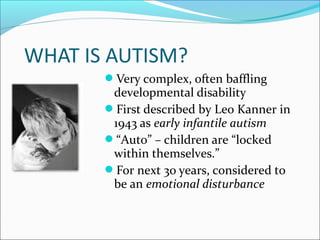
WHAT IS AUTISM?
Very complex, often baffling

developmental disability
First described by Leo Kanner in
1943 as early infantile autism
“Auto” – children are “locked
within themselves.”
For next 30 years, considered to
be an emotional disturbance
WHAT IS AUTISM?
3 categories for autism in IDEA?
Today, autism is a severe form of a broader group

of disorders
These are referred to as pervasive developmental
disorders (later)
Typically appears during the first 3 years of life
WHAT IS AUTISM?
Very likely neurological in origin – not

emotional, not the refrigerator mom
Prevalence figures vary widely (textbook says
5/10,000, but recent data say as high as 1/1000 or
even 1/500.
4 times more prevalent in boys
No known racial, ethnic, or social boundaries
No relation to family income, lifestyle
WHAT IS AUTISM?
Autism impacts normal development of the brain in

areas of social interaction and communication
skills.
Difficult to communicate with others and relate to
the outside world.
Occasionally, aggressive and/or self-injurious
behavior may be present.
WHAT ARE THE TYPES?
Actually, the “umbrella” heading is Pervasive

Developmental Disorder (PDD).
Autism is one of the 5 PDDs.
All have commonalities in communication and social
deficits
Differ in terms of severity
1. Autistic Disorder
Impairments in social interaction,

communication, and imaginative play.
Apparent before age 3.
Also includes stereotyped behaviors, interests, and
activities
2. Asperger’s Disorder
Impairments in social interactions, and presence of

restricted interests and activities
No clinically significant general delay in language
Average to above average intelligence
3. Pervasive Developmental Disorder – Not
Otherwise Specified (PDD-NOS)
Often referred to as atypical autism
Used when a child does not meet the criteria for a

specific diagnosis, but there is severe and pervasive
impairment in specified behaviors
4. Rett’s Disorder
Progressive disorder which, to date, has only

occurred in girls.
Period of normal development and then the loss of
previously acquired skills
Also loss of purposeful use of hands, which is
replaced by repetitive hand movements
Beginning at age of 1-4 years
5. Childhood Disintegrative
Disorder
Normal development for at least the first 2 years
Then significant loss of previously acquired skills
Conclusions on Types
Autism is a spectrum disorder
This means that symptoms and characteristics

can present themselves in wide variety of
combinations, from mild to severe
Autistic individuals can be very different from
each other
“Autism” is still commonly used to refer to any of
the 5 PDDs
What causes (and doesn’t cause)
autism?
Good agreement in general that autism is caused by

abnormalities in brain development, neurochemistry,
and genetic factors
Bettleheim’s theory of psychogenesis?
How is Autism Diagnosed?
No definitive medical test
Team uses interviews, observation, and specific

checklists developed for this purpose.
Team might include neurologist, psychologist,
developmental pediatrician, speech/language
therapist, learning consultant, etc.
Must rule out MR, hearing impairment, behavior
disorders, or eccentric habits
CHARACTERISTICS
1. Communication/Language
2. Social Interaction
3. Behaviors
4. Sensory and movement disorders
5. Resistance to change (predictability)
6. Intellectual functioning
1. Communication/language
Broad range of abilities, from no verbal

communication to quite complex skills
Two common impairments:
A. Delayed language
B. Echolalia
A. Delayed language
50% of autistic individuals will eventually have

useful speech (?)
Pronoun reversal: “You want white icing on
chocolate cake.”
Difficulty in conversing easily with others
Difficulty in shifting topics
Look away; poor eye contact
Facilitated communication??????
Elements of Facilitated
Communication
1. Physical Support
2. Initial training/introduction
3. Maintaining focus
4. Avoiding competence testing
5. Generalization
6. Fading
B. Echolalia
Common in very young children (Age 3)
Immediate or delayed (even years)
Is there communicative intent with echolalia?
2. Social Interaction
One of hallmarks of autism is lack of social

interaction
1. Impaired use of nonverbal behavior
2. Lack of peer relationships
3. Failure to spontaneously share enjoyment,
interests, etc. with others
4. Lack of reciprocity
Theory of mind?
3. Behaviors
Repetitive behaviors, including obsessions, tics, and

perseveration
Impeding behaviors (impede their learning or the
learning of others)
Will need positive behavior supports
A. Self-injurious behavior
B. Aggression
4. Sensory and movement
disorders
Very common
Over- or under-sensitive to sensory stimuli
Abnormal posture and movements of the face,

head, trunk, and limbs
Abnormal eye movements
Repeated gestures and mannerisms
Movement disorders can be detected very early –
perhaps at birth
5. Predictability
Change in routine is very stressful
May insist on particular furniture arrangement, food

at meals, TV shows
Symmetry is often important
Interventions need to focus on preparing students for
change if possible
6. Intellectual functioning
Autism occurs in children of all levels of intelligence,

from those who are gifted to those who have mental
retardation
In general, majority of individuals with autism are
also identified as having mental retardation – 75%
below 70
Verbal and reasoning skills are difficult
Savant syndrome
Interventions
1. Individualization and early intervention are the

keys
2. Include life skills, functional academics, and
vocational preparation
3. Positive behavior support
4. Social stories (music therapy?)
5. Lovaas model
Thank you
Contact Us :
http://cerebrabraintech.com/
info@cerebrabraintech.com
https://www.facebook.com/cerebraturbobrain

What is autism ?

  • 1.
    Overview What is Autism? Isthere more than one type of Autism? What causes Autism? How is Autism diagnosed? What are the characteristics of Autism? What are the most effective approaches to treating Autism? Is there a cure?
  • 2.
    WHAT IS AUTISM? Verycomplex, often baffling developmental disability First described by Leo Kanner in 1943 as early infantile autism “Auto” – children are “locked within themselves.” For next 30 years, considered to be an emotional disturbance
  • 3.
    WHAT IS AUTISM? 3categories for autism in IDEA? Today, autism is a severe form of a broader group of disorders These are referred to as pervasive developmental disorders (later) Typically appears during the first 3 years of life
  • 4.
    WHAT IS AUTISM? Verylikely neurological in origin – not emotional, not the refrigerator mom Prevalence figures vary widely (textbook says 5/10,000, but recent data say as high as 1/1000 or even 1/500. 4 times more prevalent in boys No known racial, ethnic, or social boundaries No relation to family income, lifestyle
  • 5.
    WHAT IS AUTISM? Autismimpacts normal development of the brain in areas of social interaction and communication skills. Difficult to communicate with others and relate to the outside world. Occasionally, aggressive and/or self-injurious behavior may be present.
  • 6.
    WHAT ARE THETYPES? Actually, the “umbrella” heading is Pervasive Developmental Disorder (PDD). Autism is one of the 5 PDDs. All have commonalities in communication and social deficits Differ in terms of severity
  • 7.
    1. Autistic Disorder Impairmentsin social interaction, communication, and imaginative play. Apparent before age 3. Also includes stereotyped behaviors, interests, and activities
  • 8.
    2. Asperger’s Disorder Impairmentsin social interactions, and presence of restricted interests and activities No clinically significant general delay in language Average to above average intelligence
  • 9.
    3. Pervasive DevelopmentalDisorder – Not Otherwise Specified (PDD-NOS) Often referred to as atypical autism Used when a child does not meet the criteria for a specific diagnosis, but there is severe and pervasive impairment in specified behaviors
  • 10.
    4. Rett’s Disorder Progressivedisorder which, to date, has only occurred in girls. Period of normal development and then the loss of previously acquired skills Also loss of purposeful use of hands, which is replaced by repetitive hand movements Beginning at age of 1-4 years
  • 11.
    5. Childhood Disintegrative Disorder Normaldevelopment for at least the first 2 years Then significant loss of previously acquired skills
  • 12.
    Conclusions on Types Autismis a spectrum disorder This means that symptoms and characteristics can present themselves in wide variety of combinations, from mild to severe Autistic individuals can be very different from each other “Autism” is still commonly used to refer to any of the 5 PDDs
  • 13.
    What causes (anddoesn’t cause) autism? Good agreement in general that autism is caused by abnormalities in brain development, neurochemistry, and genetic factors Bettleheim’s theory of psychogenesis?
  • 14.
    How is AutismDiagnosed? No definitive medical test Team uses interviews, observation, and specific checklists developed for this purpose. Team might include neurologist, psychologist, developmental pediatrician, speech/language therapist, learning consultant, etc. Must rule out MR, hearing impairment, behavior disorders, or eccentric habits
  • 15.
    CHARACTERISTICS 1. Communication/Language 2. SocialInteraction 3. Behaviors 4. Sensory and movement disorders 5. Resistance to change (predictability) 6. Intellectual functioning
  • 16.
    1. Communication/language Broad rangeof abilities, from no verbal communication to quite complex skills Two common impairments: A. Delayed language B. Echolalia
  • 17.
    A. Delayed language 50%of autistic individuals will eventually have useful speech (?) Pronoun reversal: “You want white icing on chocolate cake.” Difficulty in conversing easily with others Difficulty in shifting topics Look away; poor eye contact Facilitated communication??????
  • 18.
    Elements of Facilitated Communication 1.Physical Support 2. Initial training/introduction 3. Maintaining focus 4. Avoiding competence testing 5. Generalization 6. Fading
  • 19.
    B. Echolalia Common invery young children (Age 3) Immediate or delayed (even years) Is there communicative intent with echolalia?
  • 20.
    2. Social Interaction Oneof hallmarks of autism is lack of social interaction 1. Impaired use of nonverbal behavior 2. Lack of peer relationships 3. Failure to spontaneously share enjoyment, interests, etc. with others 4. Lack of reciprocity Theory of mind?
  • 21.
    3. Behaviors Repetitive behaviors,including obsessions, tics, and perseveration Impeding behaviors (impede their learning or the learning of others) Will need positive behavior supports A. Self-injurious behavior B. Aggression
  • 22.
    4. Sensory andmovement disorders Very common Over- or under-sensitive to sensory stimuli Abnormal posture and movements of the face, head, trunk, and limbs Abnormal eye movements Repeated gestures and mannerisms Movement disorders can be detected very early – perhaps at birth
  • 23.
    5. Predictability Change inroutine is very stressful May insist on particular furniture arrangement, food at meals, TV shows Symmetry is often important Interventions need to focus on preparing students for change if possible
  • 24.
    6. Intellectual functioning Autismoccurs in children of all levels of intelligence, from those who are gifted to those who have mental retardation In general, majority of individuals with autism are also identified as having mental retardation – 75% below 70 Verbal and reasoning skills are difficult Savant syndrome
  • 25.
    Interventions 1. Individualization andearly intervention are the keys 2. Include life skills, functional academics, and vocational preparation 3. Positive behavior support 4. Social stories (music therapy?) 5. Lovaas model
  • 26.
    Thank you Contact Us: http://cerebrabraintech.com/ info@cerebrabraintech.com https://www.facebook.com/cerebraturbobrain