Stateless token-based 
authentication for pure front-end 
applications 
MADRID · NOV 21-22 · 2014 
Álvaro Sánchez-Mariscal 
Web Architect 
Daniel Ortega Segura 
Senior Grails Developer
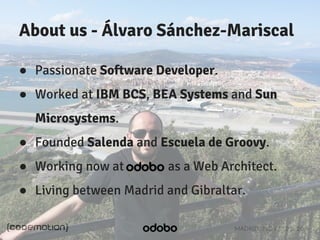
About us - Álvaro Sánchez-Mariscal 
● Passionate Software Developer. 
● Worked at IBM BCS, BEA Systems and Sun 
Microsystems. 
● Founded Salenda and Escuela de Groovy. 
● Working now at as a Web Architect. 
● Living between Madrid and Gibraltar. 
MADRID · NOV 21-22 · 2014
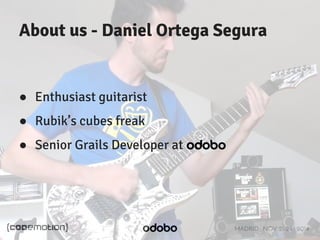
About us - Daniel Ortega Segura 
MADRID · NOV 21-22 · 2014 
● Enthusiast guitarist 
● Rubik’s cubes freak 
● Senior Grails Developer at
MADRID · NOV 21-22 · 2014 
About us - 
● HTML5 games platform. 
● We provide game developers a Javascript SDK. 
● Server side logic and maths are handled by our 
industry certified game engines. 
● Seamless integration with several casinos. 
● Check out play.odobo.com and play for free!
MADRID · NOV 21-22 · 2014 
Agenda 
1. Authentication in monolithic applications vs 
microservices. 
2. Introduction to OAuth 2.0. 
3. Achieving statelessness with JWT. 
4. Demo. 
5. Q&A.
MADRID · NOV 21-22 · 2014 
Agenda 
1. Authentication in monolithic applications vs 
microservices. 
2. Introduction to OAuth 2.0. 
3. Achieving statelessness with JWT. 
4. Demo. 
5. Q&A.
MADRID · NOV 21-22 · 2014 
Agenda 
1. Authentication in monolithic applications vs 
microservices. 
2. Introduction to OAuth 2.0. 
3. Achieving statelessness with JWT. 
4. Demo. 
5. Q&A.
MADRID · NOV 21-22 · 2014 
Agenda 
1. Authentication in monolithic applications vs 
microservices. 
2. Introduction to OAuth 2.0. 
3. Achieving statelessness with JWT. 
4. Demo. 
5. Q&A.
MADRID · NOV 21-22 · 2014 
Agenda 
1. Authentication in monolithic applications vs 
microservices. 
2. Introduction to OAuth 2.0. 
3. Achieving statelessness with JWT. 
4. Demo. 
5. Q&A.
Authentication in monolithic apps 
● Historically, authentication has always been a 
stateful service. 
● When moving to Single-Page Applications, 
and/or having mobile clients, it becomes an 
issue. 
● If you are build a REST and stateless API, your 
authentication should be that way too. 
MADRID · NOV 21-22 · 2014
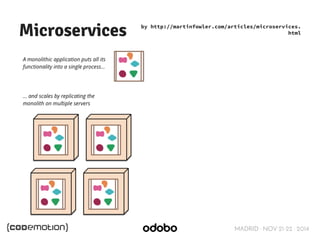
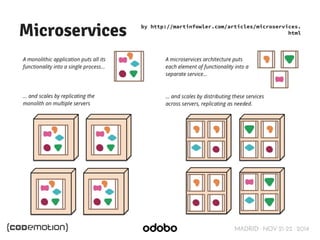
Microservices by http://martinfowler.com/articles/microservices. 
html 
MADRID · NOV 21-22 · 2014
Microservices by http://martinfowler.com/articles/microservices. 
html 
MADRID · NOV 21-22 · 2014
Authentication and microservices 
● Authentication: to verify the identity of the 
user given the credentials received. 
● Authorization: to determine if the user should 
be granted access to a particular resource. 
● In a microservices context: 
○ Authentication can be a microservice itself. 
○ Authorization is a common functionality in all of them. 
MADRID · NOV 21-22 · 2014
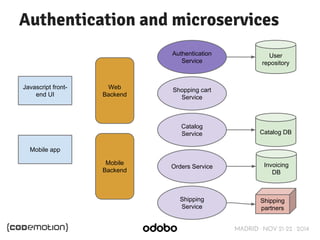
Authentication and microservices 
Catalog DB 
Invoicing 
DB 
MADRID · NOV 21-22 · 2014 
Javascript front-end 
UI 
Mobile app 
Authentication 
Service 
Shopping cart 
Service 
Catalog 
Service 
Orders Service 
Shipping 
Service 
User 
repository 
Shipping 
partners 
Web 
Backend 
Mobile 
Backend
MADRID · NOV 21-22 · 2014 
Agenda 
1. Authentication in monolithic applications vs 
microservices. 
2. Introduction to OAuth 2.0. 
3. Achieving statelessness with JWT. 
4. Demo. 
5. Q&A.
MADRID · NOV 21-22 · 2014 
Introducing OAuth 2.0 
An open protocol to allow secure authorization 
in a simple and standard method from web, 
mobile and desktop applications.
MADRID · NOV 21-22 · 2014 
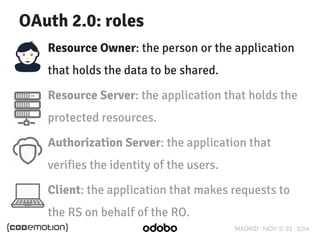
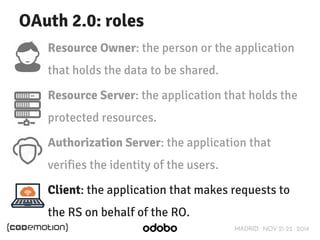
OAuth 2.0: roles 
Resource Owner: the person or the application 
that holds the data to be shared. 
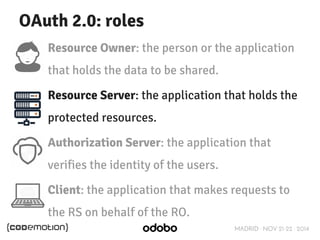
Resource Server: the application that holds the 
protected resources. 
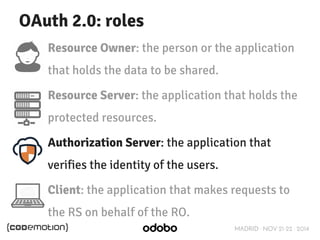
Authorization Server: the application that 
verifies the identity of the users. 
Client: the application that makes requests to 
the RS on behalf of the RO.
MADRID · NOV 21-22 · 2014 
OAuth 2.0: roles 
Resource Owner: the person or the application 
that holds the data to be shared. 
Resource Server: the application that holds the 
protected resources. 
Authorization Server: the application that 
verifies the identity of the users. 
Client: the application that makes requests to 
the RS on behalf of the RO.
MADRID · NOV 21-22 · 2014 
OAuth 2.0: roles 
Resource Owner: the person or the application 
that holds the data to be shared. 
Resource Server: the application that holds the 
protected resources. 
Authorization Server: the application that 
verifies the identity of the users. 
Client: the application that makes requests to 
the RS on behalf of the RO.
MADRID · NOV 21-22 · 2014 
OAuth 2.0: roles 
Resource Owner: the person or the application 
that holds the data to be shared. 
Resource Server: the application that holds the 
protected resources. 
Authorization Server: the application that 
verifies the identity of the users. 
Client: the application that makes requests to 
the RS on behalf of the RO.
MADRID · NOV 21-22 · 2014 
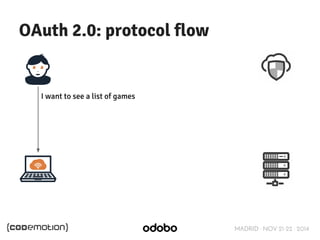
OAuth 2.0: protocol flow 
I want to see a list of games
MADRID · NOV 21-22 · 2014 
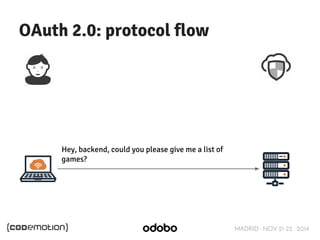
OAuth 2.0: protocol flow 
Hey, backend, could you please give me a list of 
games?
MADRID · NOV 21-22 · 2014 
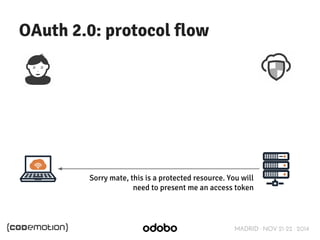
OAuth 2.0: protocol flow 
Sorry mate, this is a protected resource. You will 
need to present me an access token
MADRID · NOV 21-22 · 2014 
OAuth 2.0: protocol flow 
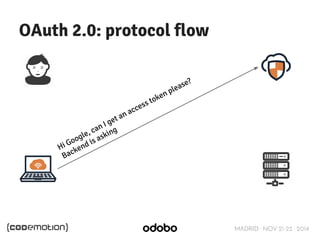
Hi Google, can I get an access token please? 
Backend is asking
MADRID · NOV 21-22 · 2014 
OAuth 2.0: protocol flow 
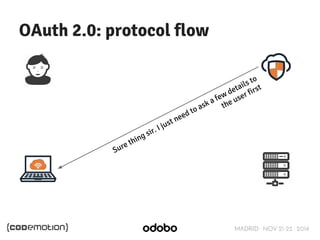
Sure thing sir. I just need to ask a few details to 
the user first
MADRID · NOV 21-22 · 2014 
OAuth 2.0: protocol flow 
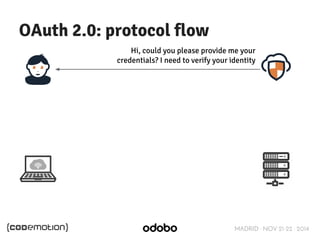
Hi, could you please provide me your 
credentials? I need to verify your identity
MADRID · NOV 21-22 · 2014 
OAuth 2.0: protocol flow 
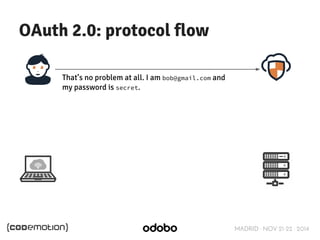
That’s no problem at all. I am bob@gmail.com and 
my password is secret.
MADRID · NOV 21-22 · 2014 
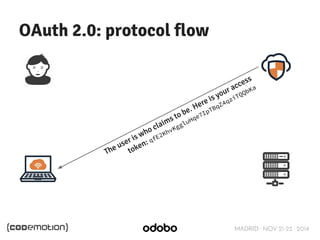
OAuth 2.0: protocol flow 
The user is who claims to be. Here is your access 
token: qfE2KhvKggluHqe7IpTBqZ4qziTQQbKa
MADRID · NOV 21-22 · 2014 
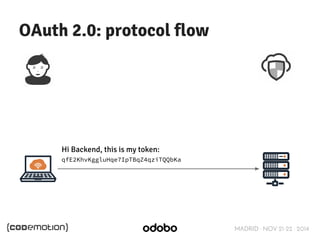
OAuth 2.0: protocol flow 
Hi Backend, this is my token: 
qfE2KhvKggluHqe7IpTBqZ4qziTQQbKa
MADRID · NOV 21-22 · 2014 
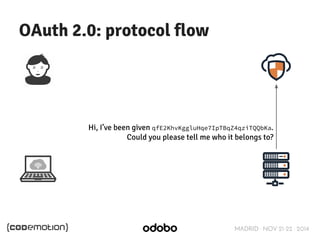
OAuth 2.0: protocol flow 
Hi, I’ve been given qfE2KhvKggluHqe7IpTBqZ4qziTQQbKa. 
Could you please tell me who it belongs to?
MADRID · NOV 21-22 · 2014 
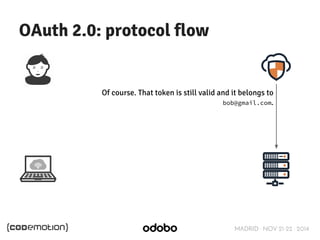
OAuth 2.0: protocol flow 
Of course. That token is still valid and it belongs to 
bob@gmail.com.
MADRID · NOV 21-22 · 2014 
OAuth 2.0: protocol flow 
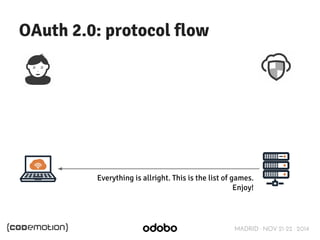
Everything is allright. This is the list of games. 
Enjoy!
MADRID · NOV 21-22 · 2014 
OAuth 2.0: protocol flow 
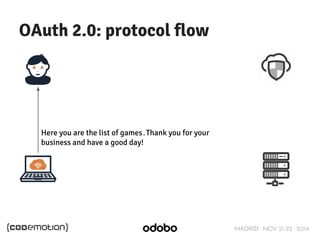
Here you are the list of games.Thank you for your 
business and have a good day!
MADRID · NOV 21-22 · 2014 
OAuth 2.0: protocol flow 
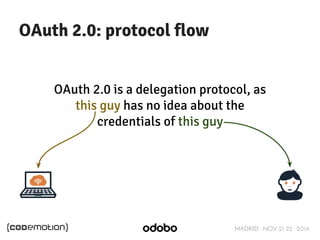
OAuth 2.0 is a delegation protocol, as 
this guy has no idea about the 
credentials of this guy
MADRID · NOV 21-22 · 2014 
OAuth 2.0: grant types 
● Authorization code: for web server 
applications. 
● Implicit: for JS front-ends and mobile apps. 
● Resource Owner Password Credentials: for 
trusted clients. 
● Client credentials: for service authentication.
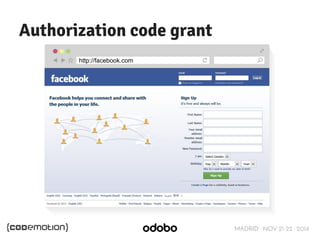
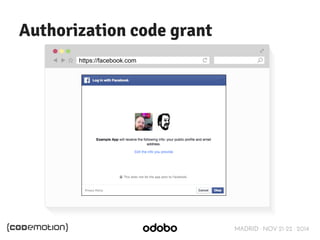
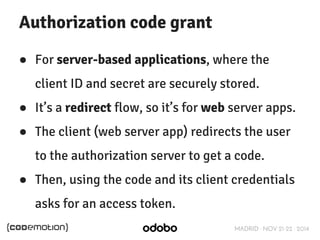
Authorization code grant 
● For server-based applications, where the 
client ID and secret are securely stored. 
● It’s a redirect flow, so it’s for web server apps. 
● The client (web server app) redirects the user 
to the authorization server to get a code. 
● Then, using the code and its client credentials 
MADRID · NOV 21-22 · 2014 
asks for an access token.
MADRID · NOV 21-22 · 2014 
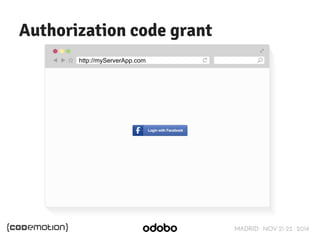
Authorization code grant 
http://myServerApp.com
MADRID · NOV 21-22 · 2014 
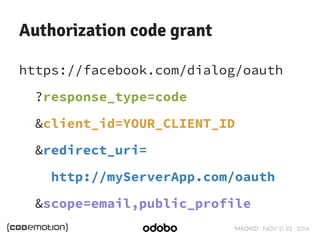
Authorization code grant 
https://facebook.com/dialog/oauth 
?response_type=code 
&client_id=YOUR_CLIENT_ID 
&redirect_uri= 
http://myServerApp.com/oauth 
&scope=email,public_profile
MADRID · NOV 21-22 · 2014 
Authorization code grant 
hhttttpp::////fmacyeSbeorvoekr.Acopmp.com
MADRID · NOV 21-22 · 2014 
Authorization code grant 
hhttttpp:s/://m/faycSeebrvoeorkA.cpopm.com
MADRID · NOV 21-22 · 2014 
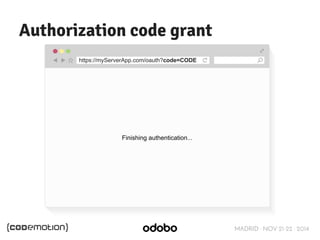
Authorization code grant 
https://myServerApp.com/oauth?code=CODE 
Finishing authentication...
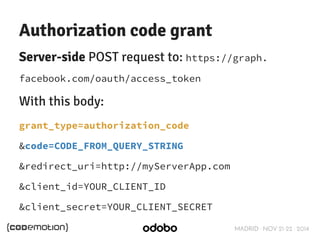
Authorization code grant 
Server-side POST request to: https://graph. 
facebook.com/oauth/access_token 
With this body: 
grant_type=authorization_code 
&code=CODE_FROM_QUERY_STRING 
&redirect_uri=http://myServerApp.com 
&client_id=YOUR_CLIENT_ID 
&client_secret=YOUR_CLIENT_SECRET 
MADRID · NOV 21-22 · 2014
MADRID · NOV 21-22 · 2014 
Authorization code grant 
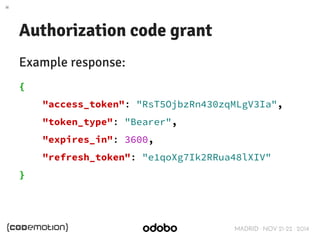
Example response: 
{ 
"access_token": "RsT5OjbzRn430zqMLgV3Ia", 
"token_type": "Bearer", 
"expires_in": 3600, 
"refresh_token": "e1qoXg7Ik2RRua48lXIV" 
}
MADRID · NOV 21-22 · 2014 
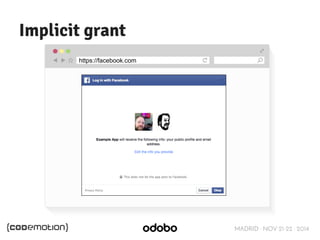
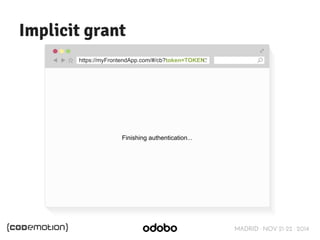
Implicit grant 
● For web applications running on the browser 
(eg: AngularJS, etc) or mobile apps. 
● Client credentials confidentiality cannot be 
guaranteed. 
● Similar to the code grant, but in this case, the 
client gets an access token directly.
MADRID · NOV 21-22 · 2014 
Implicit grant 
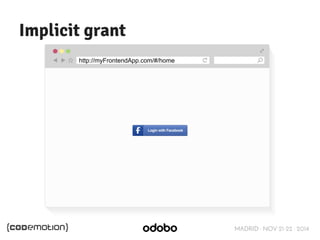
http://myFrontendApp.com/#/home
MADRID · NOV 21-22 · 2014 
Implicit grant 
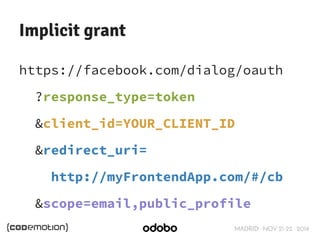
https://facebook.com/dialog/oauth 
?response_type=token 
&client_id=YOUR_CLIENT_ID 
&redirect_uri= 
http://myFrontendApp.com/#/cb 
&scope=email,public_profile
MADRID · NOV 21-22 · 2014 
Implicit grant 
hhttttpp:s/://m/faycSeebrvoeorkA.cpopm.com
MADRID · NOV 21-22 · 2014 
Implicit grant 
https://myFrontendApp.com/#/cb?token=TOKEN 
Finishing authentication...
MADRID · NOV 21-22 · 2014 
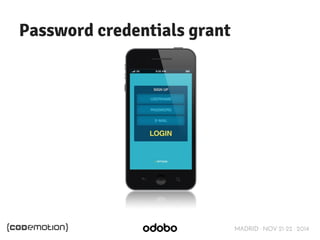
Password credentials grant 
● In this case, client collects username and 
password to get an access token directly. 
● Viable solution only for trusted clients: 
○ The official website consumer of your API. 
○ The official mobile app consuming your API. 
○ Etc.
MADRID · NOV 21-22 · 2014 
Password credentials grant
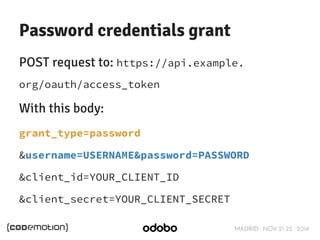
Password credentials grant 
POST request to: https://api.example. 
org/oauth/access_token 
With this body: 
grant_type=password 
&username=USERNAME&password=PASSWORD 
&client_id=YOUR_CLIENT_ID 
&client_secret=YOUR_CLIENT_SECRET 
MADRID · NOV 21-22 · 2014
MADRID · NOV 21-22 · 2014 
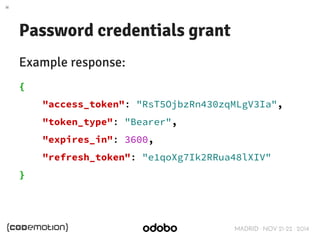
Password credentials grant 
Example response: 
{ 
"access_token": "RsT5OjbzRn430zqMLgV3Ia", 
"token_type": "Bearer", 
"expires_in": 3600, 
"refresh_token": "e1qoXg7Ik2RRua48lXIV" 
}
MADRID · NOV 21-22 · 2014 
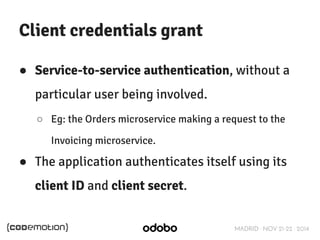
Client credentials grant 
● Service-to-service authentication, without a 
particular user being involved. 
○ Eg: the Orders microservice making a request to the 
Invoicing microservice. 
● The application authenticates itself using its 
client ID and client secret.
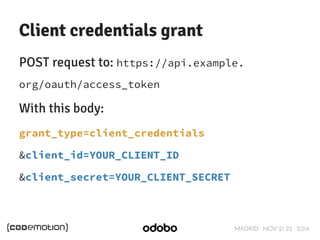
Client credentials grant 
POST request to: https://api.example. 
org/oauth/access_token 
With this body: 
grant_type=client_credentials 
&client_id=YOUR_CLIENT_ID 
&client_secret=YOUR_CLIENT_SECRET 
MADRID · NOV 21-22 · 2014
MADRID · NOV 21-22 · 2014 
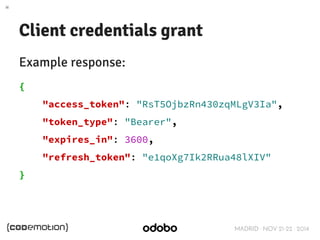
Client credentials grant 
Example response: 
{ 
"access_token": "RsT5OjbzRn430zqMLgV3Ia", 
"token_type": "Bearer", 
"expires_in": 3600, 
"refresh_token": "e1qoXg7Ik2RRua48lXIV" 
}
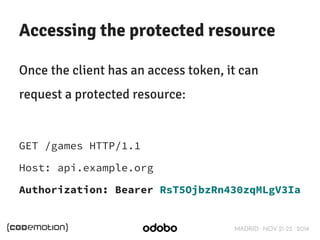
Accessing the protected resource 
Once the client has an access token, it can 
request a protected resource: 
GET /games HTTP/1.1 
Host: api.example.org 
Authorization: Bearer RsT5OjbzRn430zqMLgV3Ia 
MADRID · NOV 21-22 · 2014
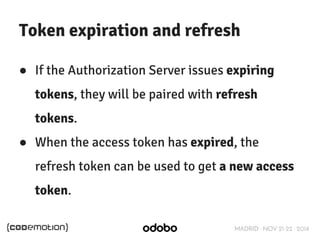
Token expiration and refresh 
● If the Authorization Server issues expiring 
tokens, they will be paired with refresh 
tokens. 
● When the access token has expired, the 
refresh token can be used to get a new access 
token. 
MADRID · NOV 21-22 · 2014
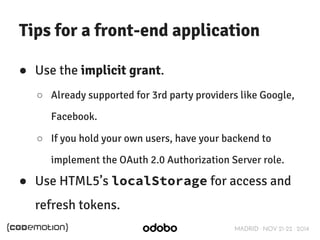
Tips for a front-end application 
MADRID · NOV 21-22 · 2014 
● Use the implicit grant. 
○ Already supported for 3rd party providers like Google, 
Facebook. 
○ If you hold your own users, have your backend to 
implement the OAuth 2.0 Authorization Server role. 
● Use HTML5’s localStorage for access and 
refresh tokens.
MADRID · NOV 21-22 · 2014 
Agenda 
1. Authentication in monolithic applications vs 
microservices. 
2. Introduction to OAuth 2.0. 
3. Achieving statelessness with JWT. 
4. Demo. 
5. Q&A.
MADRID · NOV 21-22 · 2014 
Stateful vs. Stateless 
● Authorization Servers are often stateful 
services. 
○ They store issued access tokens in databases for future 
checking. 
● How can we achieve statelessness? 
○ Issuing JWT tokens as access tokens.
MADRID · NOV 21-22 · 2014 
Introducing JWT 
JSON Web Token is a compact URL-safe means of 
representing claims to be transferred between 
two parties. The claims are encoded as a JSON 
object that is digitally signed by hashing it using 
a shared secret between the parties.
Introducing JWT... in Plain English 
A secure way to encapsulate arbitrary data that 
can be sent over unsecure URL’s. 
MADRID · NOV 21-22 · 2014
MADRID · NOV 21-22 · 2014 
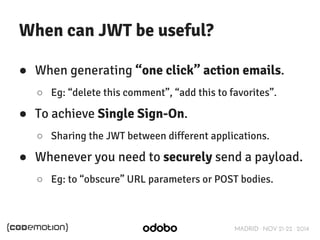
When can JWT be useful? 
● When generating “one click” action emails. 
○ Eg: “delete this comment”, “add this to favorites”. 
● To achieve Single Sign-On. 
○ Sharing the JWT between different applications. 
● Whenever you need to securely send a payload. 
○ Eg: to “obscure” URL parameters or POST bodies.
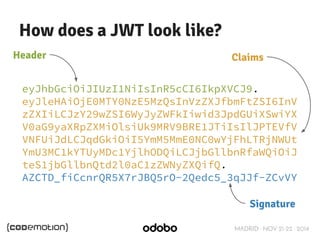
Header Claims 
MADRID · NOV 21-22 · 2014 
How does a JWT look like? 
eyJhbGciOiJIUzI1NiIsInR5cCI6IkpXVCJ9. 
eyJleHAiOjE0MTY0NzE5MzQsInVzZXJfbmFtZSI6InV 
zZXIiLCJzY29wZSI6WyJyZWFkIiwid3JpdGUiXSwiYX 
V0aG9yaXRpZXMiOlsiUk9MRV9BRE1JTiIsIlJPTEVfV 
VNFUiJdLCJqdGkiOiI5YmM5MmE0NC0wYjFhLTRjNWUt 
YmU3MC1kYTUyMDc1YjlhODQiLCJjbGllbnRfaWQiOiJ 
teS1jbGllbnQtd2l0aC1zZWNyZXQifQ. 
AZCTD_fiCcnrQR5X7rJBQ5rO-2Qedc5_3qJJf-ZCvVY 
Signature
MADRID · NOV 21-22 · 2014 
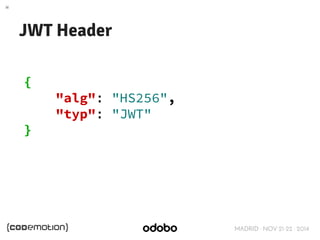
JWT Header 
{ 
"alg": "HS256", 
"typ": "JWT" 
}
MADRID · NOV 21-22 · 2014 
JWT Claims 
{ 
"exp": 1416471934, 
"user_name": "user", 
"scope": [ 
"read", 
"write" 
], 
"authorities": [ 
"ROLE_ADMIN", 
"ROLE_USER" 
], 
"jti": "9bc92a44-0b1a-4c5e-be70-da52075b9a84", 
"client_id": "my-client-with-secret" 
}
MADRID · NOV 21-22 · 2014 
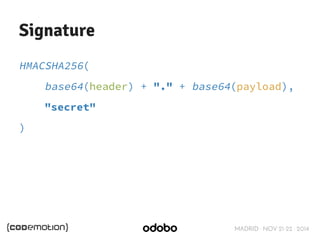
Signature 
HMACSHA256( 
base64(header) + "." + base64(payload), 
"secret" 
)
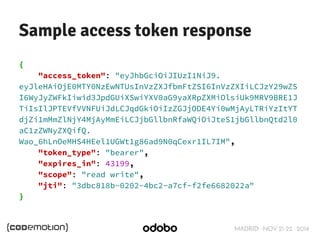
Sample access token response 
MADRID · NOV 21-22 · 2014 
{ 
"access_token": "eyJhbGciOiJIUzI1NiJ9. 
eyJleHAiOjE0MTY0NzEwNTUsInVzZXJfbmFtZSI6InVzZXIiLCJzY29wZS 
I6WyJyZWFkIiwid3JpdGUiXSwiYXV0aG9yaXRpZXMiOlsiUk9MRV9BRE1J 
TiIsIlJPTEVfVVNFUiJdLCJqdGkiOiIzZGJjODE4Yi0wMjAyLTRiYzItYT 
djZi1mMmZlNjY4MjAyMmEiLCJjbGllbnRfaWQiOiJteS1jbGllbnQtd2l0 
aC1zZWNyZXQifQ. 
Wao_6hLnOeMHS4HEel1UGWt1g86ad9N0qCexr1IL7IM", 
"token_type": "bearer", 
"expires_in": 43199, 
"scope": "read write", 
"jti": "3dbc818b-0202-4bc2-a7cf-f2fe6682022a" 
}
MADRID · NOV 21-22 · 2014 
Achieving statelessness 
● Instead of storing the access token / principal 
relationship in a stateful way, do it on a JWT. 
● Access tokens with the JWT-encoded 
principal can be securely stored on the client’s 
browser. 
● That way you are achieving one of the basic 
principles of REST: State Transfer.
MADRID · NOV 21-22 · 2014 
Tips for using JWT 
● JWT claims are just signed by default (JWS - 
JSON Web Signature). 
○ It prevents the content to be tampered. 
● Use encryption to make it bomb proof. 
○ Use any algorithm supported by JWE - JSON Web 
Encryption.
MADRID · NOV 21-22 · 2014 
Agenda 
1. Authentication in monolithic applications vs 
microservices. 
2. Introduction to OAuth 2.0. 
3. Achieving statelessness with JWT. 
4. Demo. 
5. Q&A.
MADRID · NOV 21-22 · 2014 
Agenda 
1. Authentication in monolithic applications vs 
microservices. 
2. Introduction to OAuth 2.0. 
3. Achieving statelessness with JWT. 
4. Demo. 
5. Q&A.
MADRID · NOV 21-22 · 2014 
Thanks! 
Álvaro Sánchez-Mariscal 
Web Architect 
Daniel Ortega Segura 
Senior Grails Developer

Stateless token-based authentication for pure front-end applications

  • 1.
    Stateless token-based authenticationfor pure front-end applications MADRID · NOV 21-22 · 2014 Álvaro Sánchez-Mariscal Web Architect Daniel Ortega Segura Senior Grails Developer
  • 2.
    About us -Álvaro Sánchez-Mariscal ● Passionate Software Developer. ● Worked at IBM BCS, BEA Systems and Sun Microsystems. ● Founded Salenda and Escuela de Groovy. ● Working now at as a Web Architect. ● Living between Madrid and Gibraltar. MADRID · NOV 21-22 · 2014
  • 3.
    About us -Daniel Ortega Segura MADRID · NOV 21-22 · 2014 ● Enthusiast guitarist ● Rubik’s cubes freak ● Senior Grails Developer at
  • 4.
    MADRID · NOV21-22 · 2014 About us - ● HTML5 games platform. ● We provide game developers a Javascript SDK. ● Server side logic and maths are handled by our industry certified game engines. ● Seamless integration with several casinos. ● Check out play.odobo.com and play for free!
  • 5.
    MADRID · NOV21-22 · 2014 Agenda 1. Authentication in monolithic applications vs microservices. 2. Introduction to OAuth 2.0. 3. Achieving statelessness with JWT. 4. Demo. 5. Q&A.
  • 6.
    MADRID · NOV21-22 · 2014 Agenda 1. Authentication in monolithic applications vs microservices. 2. Introduction to OAuth 2.0. 3. Achieving statelessness with JWT. 4. Demo. 5. Q&A.
  • 7.
    MADRID · NOV21-22 · 2014 Agenda 1. Authentication in monolithic applications vs microservices. 2. Introduction to OAuth 2.0. 3. Achieving statelessness with JWT. 4. Demo. 5. Q&A.
  • 8.
    MADRID · NOV21-22 · 2014 Agenda 1. Authentication in monolithic applications vs microservices. 2. Introduction to OAuth 2.0. 3. Achieving statelessness with JWT. 4. Demo. 5. Q&A.
  • 9.
    MADRID · NOV21-22 · 2014 Agenda 1. Authentication in monolithic applications vs microservices. 2. Introduction to OAuth 2.0. 3. Achieving statelessness with JWT. 4. Demo. 5. Q&A.
  • 10.
    Authentication in monolithicapps ● Historically, authentication has always been a stateful service. ● When moving to Single-Page Applications, and/or having mobile clients, it becomes an issue. ● If you are build a REST and stateless API, your authentication should be that way too. MADRID · NOV 21-22 · 2014
  • 11.
  • 12.
  • 13.
    Authentication and microservices ● Authentication: to verify the identity of the user given the credentials received. ● Authorization: to determine if the user should be granted access to a particular resource. ● In a microservices context: ○ Authentication can be a microservice itself. ○ Authorization is a common functionality in all of them. MADRID · NOV 21-22 · 2014
  • 14.
    Authentication and microservices Catalog DB Invoicing DB MADRID · NOV 21-22 · 2014 Javascript front-end UI Mobile app Authentication Service Shopping cart Service Catalog Service Orders Service Shipping Service User repository Shipping partners Web Backend Mobile Backend
  • 15.
    MADRID · NOV21-22 · 2014 Agenda 1. Authentication in monolithic applications vs microservices. 2. Introduction to OAuth 2.0. 3. Achieving statelessness with JWT. 4. Demo. 5. Q&A.
  • 16.
    MADRID · NOV21-22 · 2014 Introducing OAuth 2.0 An open protocol to allow secure authorization in a simple and standard method from web, mobile and desktop applications.
  • 17.
    MADRID · NOV21-22 · 2014 OAuth 2.0: roles Resource Owner: the person or the application that holds the data to be shared. Resource Server: the application that holds the protected resources. Authorization Server: the application that verifies the identity of the users. Client: the application that makes requests to the RS on behalf of the RO.
  • 18.
    MADRID · NOV21-22 · 2014 OAuth 2.0: roles Resource Owner: the person or the application that holds the data to be shared. Resource Server: the application that holds the protected resources. Authorization Server: the application that verifies the identity of the users. Client: the application that makes requests to the RS on behalf of the RO.
  • 19.
    MADRID · NOV21-22 · 2014 OAuth 2.0: roles Resource Owner: the person or the application that holds the data to be shared. Resource Server: the application that holds the protected resources. Authorization Server: the application that verifies the identity of the users. Client: the application that makes requests to the RS on behalf of the RO.
  • 20.
    MADRID · NOV21-22 · 2014 OAuth 2.0: roles Resource Owner: the person or the application that holds the data to be shared. Resource Server: the application that holds the protected resources. Authorization Server: the application that verifies the identity of the users. Client: the application that makes requests to the RS on behalf of the RO.
  • 21.
    MADRID · NOV21-22 · 2014 OAuth 2.0: protocol flow I want to see a list of games
  • 22.
    MADRID · NOV21-22 · 2014 OAuth 2.0: protocol flow Hey, backend, could you please give me a list of games?
  • 23.
    MADRID · NOV21-22 · 2014 OAuth 2.0: protocol flow Sorry mate, this is a protected resource. You will need to present me an access token
  • 24.
    MADRID · NOV21-22 · 2014 OAuth 2.0: protocol flow Hi Google, can I get an access token please? Backend is asking
  • 25.
    MADRID · NOV21-22 · 2014 OAuth 2.0: protocol flow Sure thing sir. I just need to ask a few details to the user first
  • 26.
    MADRID · NOV21-22 · 2014 OAuth 2.0: protocol flow Hi, could you please provide me your credentials? I need to verify your identity
  • 27.
    MADRID · NOV21-22 · 2014 OAuth 2.0: protocol flow That’s no problem at all. I am bob@gmail.com and my password is secret.
  • 28.
    MADRID · NOV21-22 · 2014 OAuth 2.0: protocol flow The user is who claims to be. Here is your access token: qfE2KhvKggluHqe7IpTBqZ4qziTQQbKa
  • 29.
    MADRID · NOV21-22 · 2014 OAuth 2.0: protocol flow Hi Backend, this is my token: qfE2KhvKggluHqe7IpTBqZ4qziTQQbKa
  • 30.
    MADRID · NOV21-22 · 2014 OAuth 2.0: protocol flow Hi, I’ve been given qfE2KhvKggluHqe7IpTBqZ4qziTQQbKa. Could you please tell me who it belongs to?
  • 31.
    MADRID · NOV21-22 · 2014 OAuth 2.0: protocol flow Of course. That token is still valid and it belongs to bob@gmail.com.
  • 32.
    MADRID · NOV21-22 · 2014 OAuth 2.0: protocol flow Everything is allright. This is the list of games. Enjoy!
  • 33.
    MADRID · NOV21-22 · 2014 OAuth 2.0: protocol flow Here you are the list of games.Thank you for your business and have a good day!
  • 34.
    MADRID · NOV21-22 · 2014 OAuth 2.0: protocol flow OAuth 2.0 is a delegation protocol, as this guy has no idea about the credentials of this guy
  • 35.
    MADRID · NOV21-22 · 2014 OAuth 2.0: grant types ● Authorization code: for web server applications. ● Implicit: for JS front-ends and mobile apps. ● Resource Owner Password Credentials: for trusted clients. ● Client credentials: for service authentication.
  • 36.
    Authorization code grant ● For server-based applications, where the client ID and secret are securely stored. ● It’s a redirect flow, so it’s for web server apps. ● The client (web server app) redirects the user to the authorization server to get a code. ● Then, using the code and its client credentials MADRID · NOV 21-22 · 2014 asks for an access token.
  • 37.
    MADRID · NOV21-22 · 2014 Authorization code grant http://myServerApp.com
  • 38.
    MADRID · NOV21-22 · 2014 Authorization code grant https://facebook.com/dialog/oauth ?response_type=code &client_id=YOUR_CLIENT_ID &redirect_uri= http://myServerApp.com/oauth &scope=email,public_profile
  • 39.
    MADRID · NOV21-22 · 2014 Authorization code grant hhttttpp::////fmacyeSbeorvoekr.Acopmp.com
  • 40.
    MADRID · NOV21-22 · 2014 Authorization code grant hhttttpp:s/://m/faycSeebrvoeorkA.cpopm.com
  • 41.
    MADRID · NOV21-22 · 2014 Authorization code grant https://myServerApp.com/oauth?code=CODE Finishing authentication...
  • 42.
    Authorization code grant Server-side POST request to: https://graph. facebook.com/oauth/access_token With this body: grant_type=authorization_code &code=CODE_FROM_QUERY_STRING &redirect_uri=http://myServerApp.com &client_id=YOUR_CLIENT_ID &client_secret=YOUR_CLIENT_SECRET MADRID · NOV 21-22 · 2014
  • 43.
    MADRID · NOV21-22 · 2014 Authorization code grant Example response: { "access_token": "RsT5OjbzRn430zqMLgV3Ia", "token_type": "Bearer", "expires_in": 3600, "refresh_token": "e1qoXg7Ik2RRua48lXIV" }
  • 44.
    MADRID · NOV21-22 · 2014 Implicit grant ● For web applications running on the browser (eg: AngularJS, etc) or mobile apps. ● Client credentials confidentiality cannot be guaranteed. ● Similar to the code grant, but in this case, the client gets an access token directly.
  • 45.
    MADRID · NOV21-22 · 2014 Implicit grant http://myFrontendApp.com/#/home
  • 46.
    MADRID · NOV21-22 · 2014 Implicit grant https://facebook.com/dialog/oauth ?response_type=token &client_id=YOUR_CLIENT_ID &redirect_uri= http://myFrontendApp.com/#/cb &scope=email,public_profile
  • 47.
    MADRID · NOV21-22 · 2014 Implicit grant hhttttpp:s/://m/faycSeebrvoeorkA.cpopm.com
  • 48.
    MADRID · NOV21-22 · 2014 Implicit grant https://myFrontendApp.com/#/cb?token=TOKEN Finishing authentication...
  • 49.
    MADRID · NOV21-22 · 2014 Password credentials grant ● In this case, client collects username and password to get an access token directly. ● Viable solution only for trusted clients: ○ The official website consumer of your API. ○ The official mobile app consuming your API. ○ Etc.
  • 50.
    MADRID · NOV21-22 · 2014 Password credentials grant
  • 51.
    Password credentials grant POST request to: https://api.example. org/oauth/access_token With this body: grant_type=password &username=USERNAME&password=PASSWORD &client_id=YOUR_CLIENT_ID &client_secret=YOUR_CLIENT_SECRET MADRID · NOV 21-22 · 2014
  • 52.
    MADRID · NOV21-22 · 2014 Password credentials grant Example response: { "access_token": "RsT5OjbzRn430zqMLgV3Ia", "token_type": "Bearer", "expires_in": 3600, "refresh_token": "e1qoXg7Ik2RRua48lXIV" }
  • 53.
    MADRID · NOV21-22 · 2014 Client credentials grant ● Service-to-service authentication, without a particular user being involved. ○ Eg: the Orders microservice making a request to the Invoicing microservice. ● The application authenticates itself using its client ID and client secret.
  • 54.
    Client credentials grant POST request to: https://api.example. org/oauth/access_token With this body: grant_type=client_credentials &client_id=YOUR_CLIENT_ID &client_secret=YOUR_CLIENT_SECRET MADRID · NOV 21-22 · 2014
  • 55.
    MADRID · NOV21-22 · 2014 Client credentials grant Example response: { "access_token": "RsT5OjbzRn430zqMLgV3Ia", "token_type": "Bearer", "expires_in": 3600, "refresh_token": "e1qoXg7Ik2RRua48lXIV" }
  • 56.
    Accessing the protectedresource Once the client has an access token, it can request a protected resource: GET /games HTTP/1.1 Host: api.example.org Authorization: Bearer RsT5OjbzRn430zqMLgV3Ia MADRID · NOV 21-22 · 2014
  • 57.
    Token expiration andrefresh ● If the Authorization Server issues expiring tokens, they will be paired with refresh tokens. ● When the access token has expired, the refresh token can be used to get a new access token. MADRID · NOV 21-22 · 2014
  • 58.
    Tips for afront-end application MADRID · NOV 21-22 · 2014 ● Use the implicit grant. ○ Already supported for 3rd party providers like Google, Facebook. ○ If you hold your own users, have your backend to implement the OAuth 2.0 Authorization Server role. ● Use HTML5’s localStorage for access and refresh tokens.
  • 59.
    MADRID · NOV21-22 · 2014 Agenda 1. Authentication in monolithic applications vs microservices. 2. Introduction to OAuth 2.0. 3. Achieving statelessness with JWT. 4. Demo. 5. Q&A.
  • 60.
    MADRID · NOV21-22 · 2014 Stateful vs. Stateless ● Authorization Servers are often stateful services. ○ They store issued access tokens in databases for future checking. ● How can we achieve statelessness? ○ Issuing JWT tokens as access tokens.
  • 61.
    MADRID · NOV21-22 · 2014 Introducing JWT JSON Web Token is a compact URL-safe means of representing claims to be transferred between two parties. The claims are encoded as a JSON object that is digitally signed by hashing it using a shared secret between the parties.
  • 62.
    Introducing JWT... inPlain English A secure way to encapsulate arbitrary data that can be sent over unsecure URL’s. MADRID · NOV 21-22 · 2014
  • 63.
    MADRID · NOV21-22 · 2014 When can JWT be useful? ● When generating “one click” action emails. ○ Eg: “delete this comment”, “add this to favorites”. ● To achieve Single Sign-On. ○ Sharing the JWT between different applications. ● Whenever you need to securely send a payload. ○ Eg: to “obscure” URL parameters or POST bodies.
  • 64.
    Header Claims MADRID· NOV 21-22 · 2014 How does a JWT look like? eyJhbGciOiJIUzI1NiIsInR5cCI6IkpXVCJ9. eyJleHAiOjE0MTY0NzE5MzQsInVzZXJfbmFtZSI6InV zZXIiLCJzY29wZSI6WyJyZWFkIiwid3JpdGUiXSwiYX V0aG9yaXRpZXMiOlsiUk9MRV9BRE1JTiIsIlJPTEVfV VNFUiJdLCJqdGkiOiI5YmM5MmE0NC0wYjFhLTRjNWUt YmU3MC1kYTUyMDc1YjlhODQiLCJjbGllbnRfaWQiOiJ teS1jbGllbnQtd2l0aC1zZWNyZXQifQ. AZCTD_fiCcnrQR5X7rJBQ5rO-2Qedc5_3qJJf-ZCvVY Signature
  • 65.
    MADRID · NOV21-22 · 2014 JWT Header { "alg": "HS256", "typ": "JWT" }
  • 66.
    MADRID · NOV21-22 · 2014 JWT Claims { "exp": 1416471934, "user_name": "user", "scope": [ "read", "write" ], "authorities": [ "ROLE_ADMIN", "ROLE_USER" ], "jti": "9bc92a44-0b1a-4c5e-be70-da52075b9a84", "client_id": "my-client-with-secret" }
  • 67.
    MADRID · NOV21-22 · 2014 Signature HMACSHA256( base64(header) + "." + base64(payload), "secret" )
  • 68.
    Sample access tokenresponse MADRID · NOV 21-22 · 2014 { "access_token": "eyJhbGciOiJIUzI1NiJ9. eyJleHAiOjE0MTY0NzEwNTUsInVzZXJfbmFtZSI6InVzZXIiLCJzY29wZS I6WyJyZWFkIiwid3JpdGUiXSwiYXV0aG9yaXRpZXMiOlsiUk9MRV9BRE1J TiIsIlJPTEVfVVNFUiJdLCJqdGkiOiIzZGJjODE4Yi0wMjAyLTRiYzItYT djZi1mMmZlNjY4MjAyMmEiLCJjbGllbnRfaWQiOiJteS1jbGllbnQtd2l0 aC1zZWNyZXQifQ. Wao_6hLnOeMHS4HEel1UGWt1g86ad9N0qCexr1IL7IM", "token_type": "bearer", "expires_in": 43199, "scope": "read write", "jti": "3dbc818b-0202-4bc2-a7cf-f2fe6682022a" }
  • 69.
    MADRID · NOV21-22 · 2014 Achieving statelessness ● Instead of storing the access token / principal relationship in a stateful way, do it on a JWT. ● Access tokens with the JWT-encoded principal can be securely stored on the client’s browser. ● That way you are achieving one of the basic principles of REST: State Transfer.
  • 70.
    MADRID · NOV21-22 · 2014 Tips for using JWT ● JWT claims are just signed by default (JWS - JSON Web Signature). ○ It prevents the content to be tampered. ● Use encryption to make it bomb proof. ○ Use any algorithm supported by JWE - JSON Web Encryption.
  • 71.
    MADRID · NOV21-22 · 2014 Agenda 1. Authentication in monolithic applications vs microservices. 2. Introduction to OAuth 2.0. 3. Achieving statelessness with JWT. 4. Demo. 5. Q&A.
  • 72.
    MADRID · NOV21-22 · 2014 Agenda 1. Authentication in monolithic applications vs microservices. 2. Introduction to OAuth 2.0. 3. Achieving statelessness with JWT. 4. Demo. 5. Q&A.
  • 73.
    MADRID · NOV21-22 · 2014 Thanks! Álvaro Sánchez-Mariscal Web Architect Daniel Ortega Segura Senior Grails Developer