Efficient HTTP
applications on the JVM
with Ratpack
Álvaro Sánchez-Mariscal
Application Architect - 4finance IT
@alvaro_sanchez
About me
● Passionate Software Developer.
○ Living in Madrid, Spain.
● Working professionally in Java since 2001.
○ BEA Systems, Sun Microsystems.
○ Groovy fanboy since 2007.
● Open source contributor: Grails, Ratpack, ..
● Speaker at JavaZone, GeeCON, JavaLand,
Codemotion...
@alvaro_sanchez
About
● We build:
● Consumer loan systems.
● Lending platform.
● Payment systems.
● Personal budgeting.
● Anti-fraud and risk system.
● We use:
● Spring Boot.
● Gradle.
● Java 8.
● Groovy.
● Jenkins, Ansible, ...
● We hire the best talent:
● In Warsaw, Prague, Riga, Vilnius and London.
● At http://www.4financeit.com.
@alvaro_sanchez
Agenda
● Introduction.
● The handlers chain.
● The context.
● Ratpack modules.
● Asynchronous & Non Blocking model.
● Q&A.
@alvaro_sanchez
Agenda
● Introduction.
● The handlers chain.
● The context.
● Ratpack modules.
● Asynchronous & Non Blocking model.
● Q&A.
@alvaro_sanchez
Agenda
● Introduction.
● The handlers chain.
● The context.
● Ratpack modules.
● Asynchronous & Non Blocking model.
● Q&A.
@alvaro_sanchez
Agenda
● Introduction.
● The handlers chain.
● The context.
● Ratpack modules.
● Asynchronous & Non Blocking model.
● Q&A.
@alvaro_sanchez
Agenda
● Introduction.
● The handlers chain.
● The context.
● Ratpack modules.
● Asynchronous & Non Blocking model.
● Q&A.
@alvaro_sanchez
Agenda
● Introduction.
● The handlers chain.
● The context.
● Ratpack modules.
● Asynchronous & Non Blocking model.
● Q&A.
@alvaro_sanchez
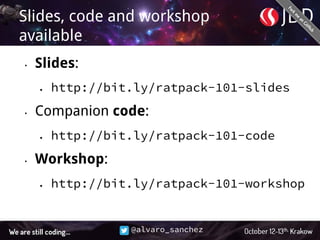
Slides, code and workshop
available
• Slides:
• http://bit.ly/ratpack-101-slides
• Companion code:
• http://bit.ly/ratpack-101-code
• Workshop:
• http://bit.ly/ratpack-101-workshop
@alvaro_sanchez
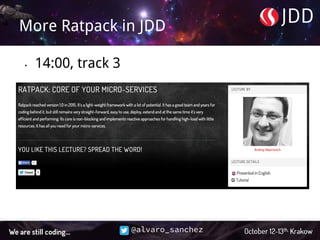
More Ratpack in JDD
• 14:00, track 3
@alvaro_sanchez
Before we start
● Raise your hand if you know:
○ Java.
○ Groovy.
○ Spock.
○ Ratpack?
@alvaro_sanchez
Introduction
● Ratpack is:
○ A set of Java 8 libraries…
■ … lightweight, un-opinionated, Netty-based...
■ … for writing non-blocking HTTP applications…
■ … focused on performance and efficiency…
■ … with an emphasis on testability..
■ … embracing Java 8 or Groovy as programming
languages.
@alvaro_sanchez
When to use Ratpack?
● For microservices.
● For high performance applications.
● For lightweight services (no container,
batteries included).
If you are writing
microservices, why
do you use
macroframeworks?
@alvaro_sanchez
Ratpack is developer friendly
• Starts up in milliseconds.
• Development-time reloading (in ms)
with Gradle.
• First-class support for functional
testing.
@alvaro_sanchez
Demo
1. Groovy script.
2. Gradle build with Lazybones.
@alvaro_sanchez
Agenda
● Introduction.
● The handlers chain.
● The context.
● Ratpack modules.
● Asynchronous & Non Blocking model.
● Q&A.
@alvaro_sanchez
Handlers
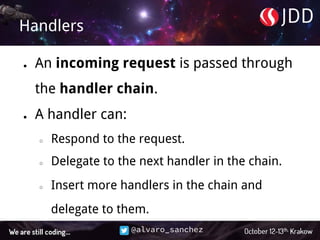
● An incoming request is passed through
the handler chain.
● A handler can:
○ Respond to the request.
○ Delegate to the next handler in the chain.
○ Insert more handlers in the chain and
delegate to them.
@alvaro_sanchez
Handlers
● Each handler is given a Context instance.
○ To interact with the request / response
objects.
○ To access the registry.
○ Etc.
● Note that Ratpack is not based on the
Servlet API.
@alvaro_sanchez
Demo
3. Handlers.
@alvaro_sanchez
Agenda
● Introduction.
● The handlers chain.
● The context.
● Ratpack modules.
● Asynchronous & Non Blocking model.
● Q&A.
@alvaro_sanchez
The Context
● The Context provides:
○ Access to the HTTP Request and Response
objects.
○ Interaction with other handlers through
next() and insert() methods.
○ Access to objects in the registry.
@alvaro_sanchez
The registry
● The context is also a Registry of
objects.
● Handlers can store objects into the
context for use by downstream handlers.
@alvaro_sanchez
Demo
4. Working with the context.
@alvaro_sanchez
Agenda
● Introduction.
● The handlers chain.
● The context.
● Ratpack modules.
● Asynchronous & Non Blocking model.
● Q&A.
@alvaro_sanchez
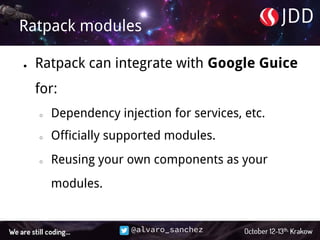
Ratpack modules
● Ratpack can integrate with Google Guice
for:
○ Dependency injection for services, etc.
○ Officially supported modules.
○ Reusing your own components as your
modules.
@alvaro_sanchez
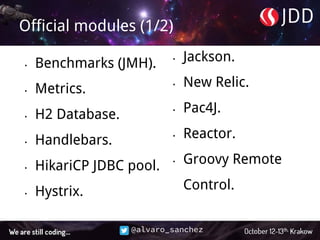
Official modules (1/2)
• Benchmarks (JMH).
• Metrics.
• H2 Database.
• Handlebars.
• HikariCP JDBC pool.
• Hystrix.
• Jackson.
• New Relic.
• Pac4J.
• Reactor.
• Groovy Remote
Control.
@alvaro_sanchez
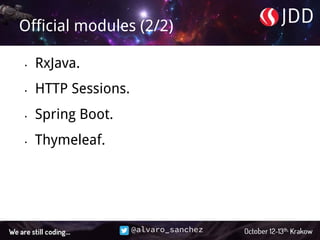
Official modules (2/2)
• RxJava.
• HTTP Sessions.
• Spring Boot.
• Thymeleaf.
@alvaro_sanchez
Demo
5. Using Guice and the Jackson module.
@alvaro_sanchez
Agenda
● Introduction.
● The handlers chain.
● The context.
● Ratpack modules.
● Asynchronous & Non Blocking model.
● Q&A.
@alvaro_sanchez
The classic approach
● A thread-per-request.
○ There is a relatively large thread pool.
○ Each request is assigned a thread from the pool.
○ If the request handling code performs blocking I/O,
the thread sleeps until the result is received.
● Overhead: thread management,
memory consumption.
@alvaro_sanchez
Ratpack’s value proposition
• HTTP IO is event-driven (non blocking).
• Powered by Netty.
• Handler chain is organised as a pipeline of
asynchronous functions.
• Small compute thread pool.
• Blocking operations are executed in a separate pool.
• Integration with existing libraries like RxJava.
@alvaro_sanchez
Async model
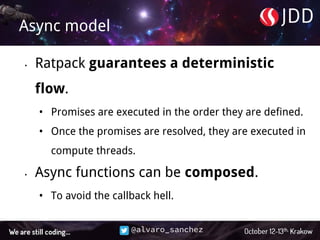
• Ratpack guarantees a deterministic
flow.
• Promises are executed in the order they are defined.
• Once the promises are resolved, they are executed in
compute threads.
• Async functions can be composed.
• To avoid the callback hell.
@alvaro_sanchez
Demo
6. Asynchronous model.
Dzięki!Álvaro Sánchez-Mariscal
Application Architect - 4finance IT
Images courtesy of

Efficient HTTP applications on the JVM with Ratpack - JDD 2015