Objectives
Augmented
Reality
Explain augmented reality
 Explain the features of augmented reality
Distinguish AR, VR, and MR
Architecture of AR systems
Application areas of augmented reality
Chapter 5
Augmented
Reality(AR)
Augmented Reality(AR): it is a view of the
physical real-world environment with
superimposed computer-generated images;
thus, changing the perception of reality.
It can be a live direct or indirect view of a
physical, real-world environment whose
elements are augmented by computer-generated
sensory input such as sound, video, graphics or
GPS data.
AR integrates digital information with the
user's environment in real-time.
Its convincing effect is achieved by ensuring
that the virtual content is aligned and registered
with the real objects.
Unlike virtual reality, which creates a totally
artificial environment, augmented reality uses
the existing environment and overlays new
information on top of it.
Augmented
Reality(AR)
You can simply experience AR using smartphones by
downloading AR apps or may be with the help of special
AR headsets, such as Google Glass, where digital content
is displayed on a tiny screen in front of a user’s eye.
Examples of augmented reality experiences include
Snapchat lenses and the game Pokemon Go
Direct and Indirect Augmentation of Objects
Augmented
Reality(AR)
VR is fully immersive, which tricks your senses into
thinking you’re in a different environment or world apart
from the real world
Using a head-mounted display (HMD) or headset, you’ll
experience a computer-generated world of imagery and
sounds in which you can manipulate objects and move
around using haptic controllers while tethered to a console
or PC.
VR simulates a computer-generated realistic experience.
Typically VR blocks out the real world (“Reality”)and
replaces it with a “Virtual” world.
Advanced VR environment will engage all five senses
(taste, sight, smell, touch, sound)
Virtual
Reality(VR)
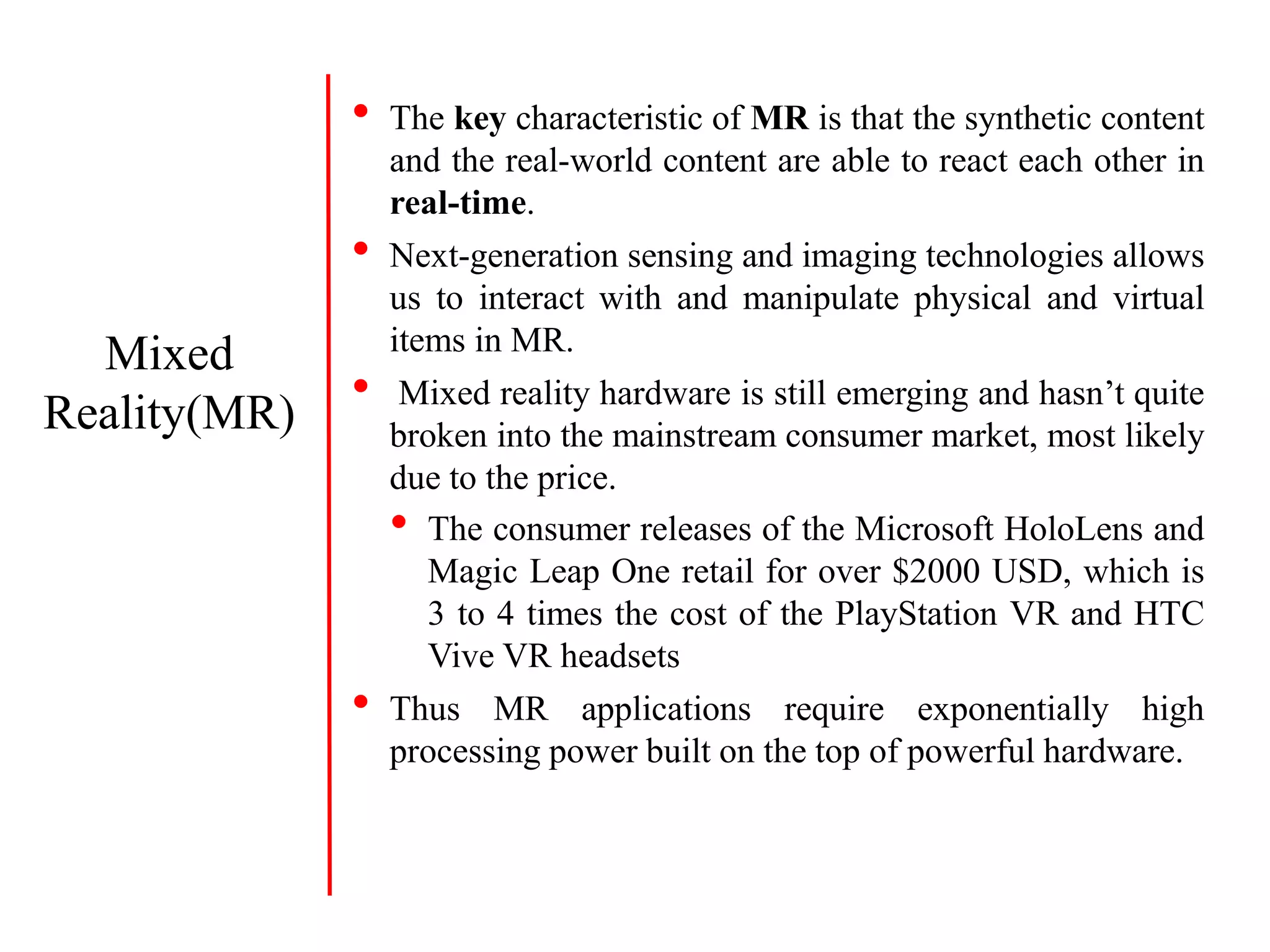
Some of popular VR devices such as HTC Vive, Ocul us
Rift or Google Cardboard and special hand controllers
can be used to enhance it’s experiences.
Most VR headsets are connected to a computer (Oculus
Rift) or a gaming console (PlayStation VR)
 There are also standalone devices (Google Cardboard is
among the most popular).
Virtual
Reality(VR)
Mixed Reality (MR) sometimes referred to as hybrid
reality.
It is the merging of real and virtual worlds to
produce new environments and visualizations; where
physical and digital objects co-exist and interact in
real-time.
It means placing new imagery within a real space in
such a way that the new imagery is able to interact, to
an extent, with what is real in the physical world we
know.
For example, with MR, you can play a virtual video
game, grab your real-world water bottle, and smack an
imaginary character from the game with the bottle.
Mixed
Reality(MR)
• The key characteristic of MR is that the synthetic content
and the real-world content are able to react each other in
real-time.
• Next-generation sensing and imaging technologies allows
us to interact with and manipulate physical and virtual
items in MR.
• Mixed reality hardware is still emerging and hasn’t quite
broken into the mainstream consumer market, most likely
due to the price.
• The consumer releases of the Microsoft HoloLens and
Magic Leap One retail for over $2000 USD, which is
3 to 4 times the cost of the PlayStation VR and HTC
Vive VR headsets
• Thus MR applications require exponentially high
processing power built on the top of powerful hardware.
Mixed
Reality(MR)
• Microsoft HoloLens tool is comprise the
following components;
• Built-in microphone array
• Binaural sound capabilities
• A built-in camera for recording
• A depth sensor
• Head-tracking cameras and
• An inertial measurement unit which helps
track your head movement.
Mixed
Reality(MR)
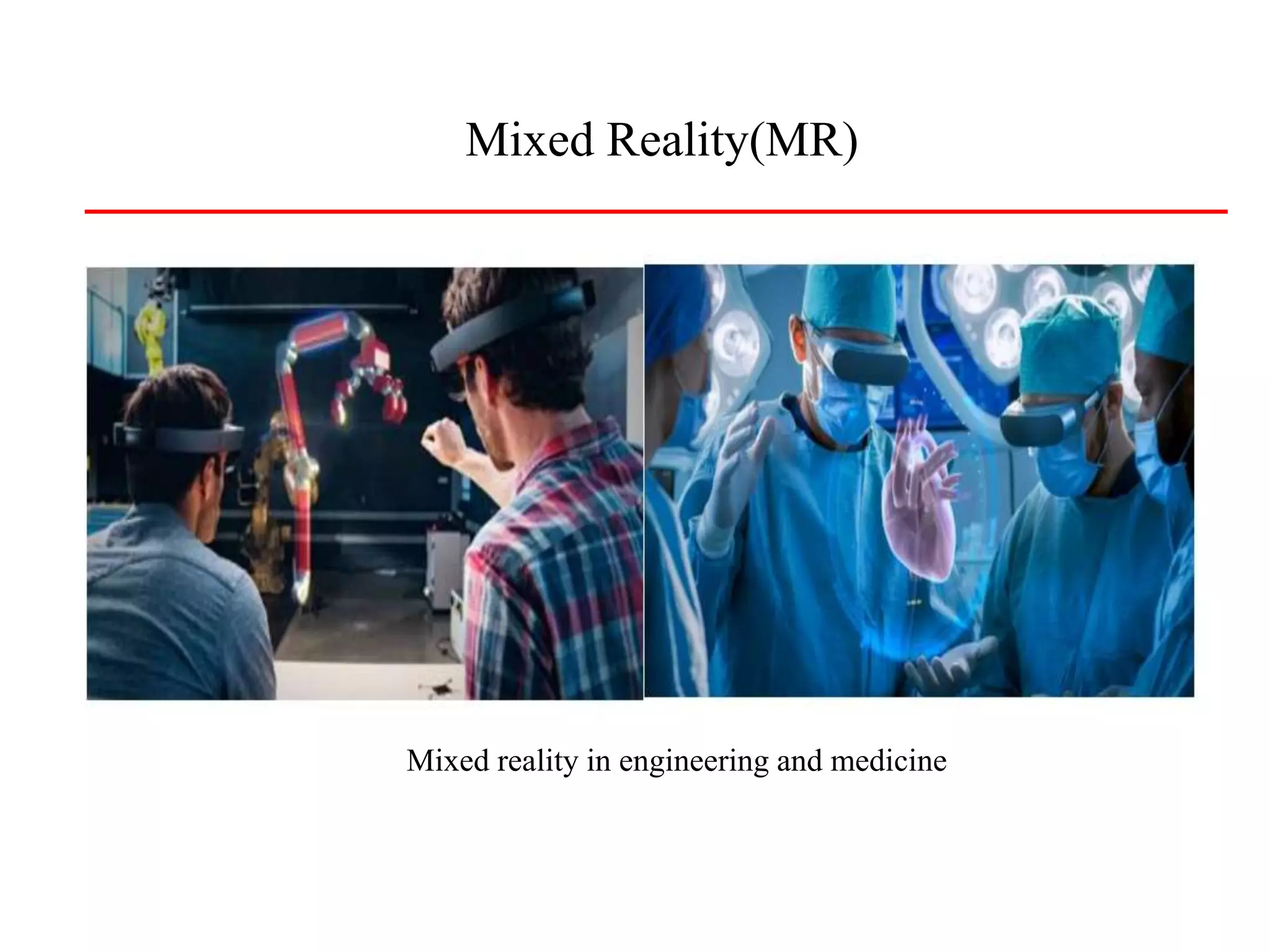
Mixed reality in engineering and medicine
Mixed Reality(MR)
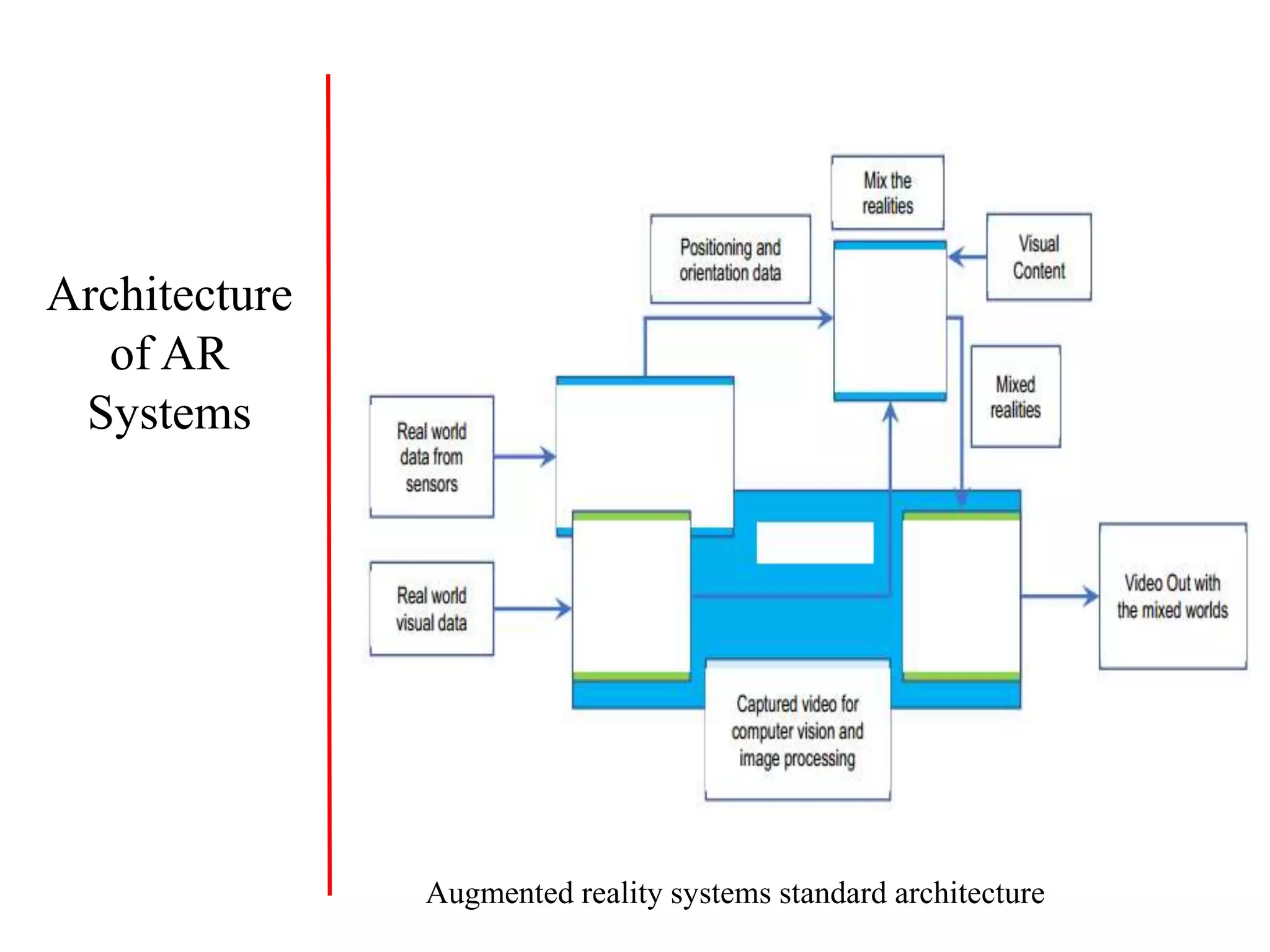
 The first Augmented Reality Systems (ARS) were
usually designed with a basis on three main blocks
 Infrastructure Tracker Unit
 Responsible for collecting data from the real
world, sending them to the Processing Unit
 Processing Unit
 Mix the virtual content with the real content
and sent the result to the Video Out module
of the Visual Unit
Architecture
of AR
Systems
 Visual Unit
 The Visual Unit can be classified into two
types of system based on the visualization
technology:
 Video see-through: It uses a Head-Mounted
Display (HMD) that employs a video-mixing and
displays the merged images on a closed-view
HMD.
 Optical see-through: It uses an HMD that
employs optical combiners to merge the images
within an open-view HMD.
Architecture
of AR
Systems
Augmented reality systems standard architecture
Architecture
of AR
Systems
 Computer vision and the exponential advancement of
computer processing power (VR, AR, and MR) technology
is becoming more and more prominent.
 There is some overlap in the applications and functions of
these emerging technologies.
 One of the most obvious differences among them is the
hardware requirements.
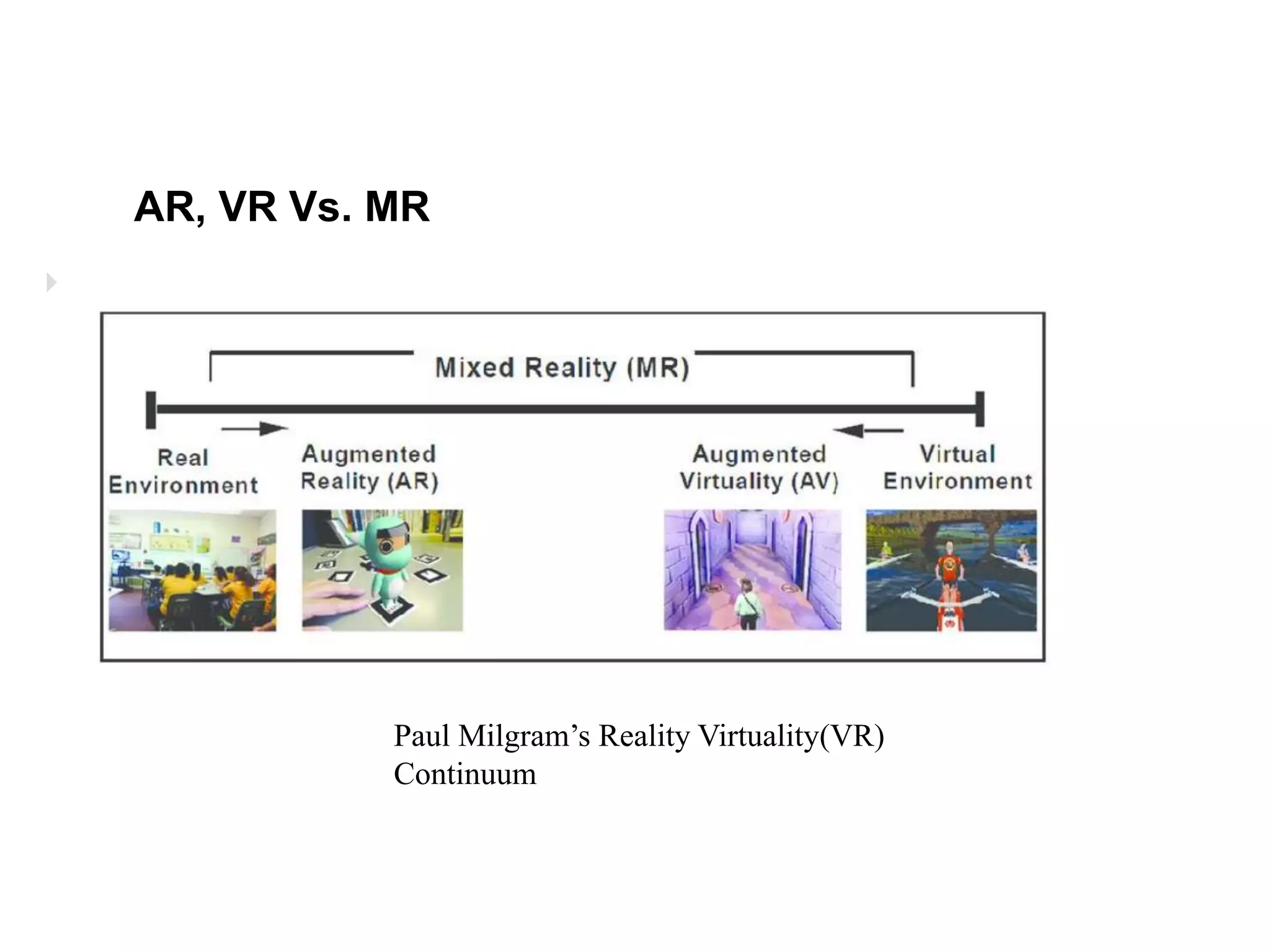
 Moreover, the following are basic differences;
• VR is content which is 100% digital and can be enjoyed
in a fully immersive environment,
• AR overlays digital content on top of the real-world and
• MR is a digital overlay that allows interactive virtual
elements to integrate and interact with the real-world
environment.
AR, VR Vs.
MR
AR, VR Vs. MR

Paul Milgram’s Reality Virtuality(VR)
Continuum
 Recently a fast developing technologies is
augmented reality (AR), which can be applied
to many different disciplines such as ;
 AR in Education
 AR In Medicine
 AR In Entertainment and
 Military
Application of
AR Systems
 AR in Education
 Flexibility and attractive to education.
 Variety of mediums- desktops, Laptops, & smartphones.
 Affordable learning materials –
 Avoids investments in physical materials like posters,
digital illustrations, physical models, prototypes.
 Interactive lessons –
 Higher engagement
 Higher retention
 Boost intellectual curiosity
Application of
AR Systems
 AR in medicine
 AR technology enhances medicine and healthcare
towards more safety and efficiency.
 For example, augmented reality has already made
significant changes in the following medical areas:
 Surgery (minimally invasive surgery);
 Education of future doctors;
 Diagnostics
 AR tools may also aid to detect the signs of
depression and other mental illnesses by reading from
facial expressions, voice tones, and physical gestures.
Application of
AR Systems
 AR in Entertainment
 Augmented reality can be used in various
“entertainment” industries
– music, movies, live shows, games.
 AR in games
 AR in music
 AR on TV
 AR in eSports
Application of
AR Systems
• Mediated (x, y )
• Multimediated Reality
Reading
Assignments
References
• Tesfahunegn M., Makonen W., Yonassa T. and Girma D. (2019).
“Introduction to Emerging Technologies Course Module”; MOSHE
• Steve M., Tom F., Yu Y., Jay I., and Zixin W.. (2018). “All Reality: Virtual,
Augmented, Mixed(X), Mediated(X,Y),and Multimediated Reality”,
Multimediated Reality; arXiv:1804.08386v1
• Paolo Fogliaroni. (2012).“Mixed Reality for Archeology and Cultural
Heritage ”; https://orcid.org/0000-0002-0578-8904

Chapter -5- Augumented Reality (AR).pptx

  • 1.
    Objectives Augmented Reality Explain augmented reality Explain the features of augmented reality Distinguish AR, VR, and MR Architecture of AR systems Application areas of augmented reality Chapter 5
  • 2.
    Augmented Reality(AR) Augmented Reality(AR): itis a view of the physical real-world environment with superimposed computer-generated images; thus, changing the perception of reality. It can be a live direct or indirect view of a physical, real-world environment whose elements are augmented by computer-generated sensory input such as sound, video, graphics or GPS data.
  • 3.
    AR integrates digitalinformation with the user's environment in real-time. Its convincing effect is achieved by ensuring that the virtual content is aligned and registered with the real objects. Unlike virtual reality, which creates a totally artificial environment, augmented reality uses the existing environment and overlays new information on top of it. Augmented Reality(AR)
  • 4.
    You can simplyexperience AR using smartphones by downloading AR apps or may be with the help of special AR headsets, such as Google Glass, where digital content is displayed on a tiny screen in front of a user’s eye. Examples of augmented reality experiences include Snapchat lenses and the game Pokemon Go Direct and Indirect Augmentation of Objects Augmented Reality(AR)
  • 5.
    VR is fullyimmersive, which tricks your senses into thinking you’re in a different environment or world apart from the real world Using a head-mounted display (HMD) or headset, you’ll experience a computer-generated world of imagery and sounds in which you can manipulate objects and move around using haptic controllers while tethered to a console or PC. VR simulates a computer-generated realistic experience. Typically VR blocks out the real world (“Reality”)and replaces it with a “Virtual” world. Advanced VR environment will engage all five senses (taste, sight, smell, touch, sound) Virtual Reality(VR)
  • 6.
    Some of popularVR devices such as HTC Vive, Ocul us Rift or Google Cardboard and special hand controllers can be used to enhance it’s experiences. Most VR headsets are connected to a computer (Oculus Rift) or a gaming console (PlayStation VR)  There are also standalone devices (Google Cardboard is among the most popular). Virtual Reality(VR)
  • 7.
    Mixed Reality (MR)sometimes referred to as hybrid reality. It is the merging of real and virtual worlds to produce new environments and visualizations; where physical and digital objects co-exist and interact in real-time. It means placing new imagery within a real space in such a way that the new imagery is able to interact, to an extent, with what is real in the physical world we know. For example, with MR, you can play a virtual video game, grab your real-world water bottle, and smack an imaginary character from the game with the bottle. Mixed Reality(MR)
  • 8.
    • The keycharacteristic of MR is that the synthetic content and the real-world content are able to react each other in real-time. • Next-generation sensing and imaging technologies allows us to interact with and manipulate physical and virtual items in MR. • Mixed reality hardware is still emerging and hasn’t quite broken into the mainstream consumer market, most likely due to the price. • The consumer releases of the Microsoft HoloLens and Magic Leap One retail for over $2000 USD, which is 3 to 4 times the cost of the PlayStation VR and HTC Vive VR headsets • Thus MR applications require exponentially high processing power built on the top of powerful hardware. Mixed Reality(MR)
  • 9.
    • Microsoft HoloLenstool is comprise the following components; • Built-in microphone array • Binaural sound capabilities • A built-in camera for recording • A depth sensor • Head-tracking cameras and • An inertial measurement unit which helps track your head movement. Mixed Reality(MR)
  • 10.
    Mixed reality inengineering and medicine Mixed Reality(MR)
  • 11.
     The firstAugmented Reality Systems (ARS) were usually designed with a basis on three main blocks  Infrastructure Tracker Unit  Responsible for collecting data from the real world, sending them to the Processing Unit  Processing Unit  Mix the virtual content with the real content and sent the result to the Video Out module of the Visual Unit Architecture of AR Systems
  • 12.
     Visual Unit The Visual Unit can be classified into two types of system based on the visualization technology:  Video see-through: It uses a Head-Mounted Display (HMD) that employs a video-mixing and displays the merged images on a closed-view HMD.  Optical see-through: It uses an HMD that employs optical combiners to merge the images within an open-view HMD. Architecture of AR Systems
  • 13.
    Augmented reality systemsstandard architecture Architecture of AR Systems
  • 14.
     Computer visionand the exponential advancement of computer processing power (VR, AR, and MR) technology is becoming more and more prominent.  There is some overlap in the applications and functions of these emerging technologies.  One of the most obvious differences among them is the hardware requirements.  Moreover, the following are basic differences; • VR is content which is 100% digital and can be enjoyed in a fully immersive environment, • AR overlays digital content on top of the real-world and • MR is a digital overlay that allows interactive virtual elements to integrate and interact with the real-world environment. AR, VR Vs. MR
  • 15.
    AR, VR Vs.MR  Paul Milgram’s Reality Virtuality(VR) Continuum
  • 16.
     Recently afast developing technologies is augmented reality (AR), which can be applied to many different disciplines such as ;  AR in Education  AR In Medicine  AR In Entertainment and  Military Application of AR Systems
  • 17.
     AR inEducation  Flexibility and attractive to education.  Variety of mediums- desktops, Laptops, & smartphones.  Affordable learning materials –  Avoids investments in physical materials like posters, digital illustrations, physical models, prototypes.  Interactive lessons –  Higher engagement  Higher retention  Boost intellectual curiosity Application of AR Systems
  • 18.
     AR inmedicine  AR technology enhances medicine and healthcare towards more safety and efficiency.  For example, augmented reality has already made significant changes in the following medical areas:  Surgery (minimally invasive surgery);  Education of future doctors;  Diagnostics  AR tools may also aid to detect the signs of depression and other mental illnesses by reading from facial expressions, voice tones, and physical gestures. Application of AR Systems
  • 19.
     AR inEntertainment  Augmented reality can be used in various “entertainment” industries – music, movies, live shows, games.  AR in games  AR in music  AR on TV  AR in eSports Application of AR Systems
  • 20.
    • Mediated (x,y ) • Multimediated Reality Reading Assignments
  • 21.
    References • Tesfahunegn M.,Makonen W., Yonassa T. and Girma D. (2019). “Introduction to Emerging Technologies Course Module”; MOSHE • Steve M., Tom F., Yu Y., Jay I., and Zixin W.. (2018). “All Reality: Virtual, Augmented, Mixed(X), Mediated(X,Y),and Multimediated Reality”, Multimediated Reality; arXiv:1804.08386v1 • Paolo Fogliaroni. (2012).“Mixed Reality for Archeology and Cultural Heritage ”; https://orcid.org/0000-0002-0578-8904

Editor's Notes

  • #5 Direct and Indirect Augmentation of Objects