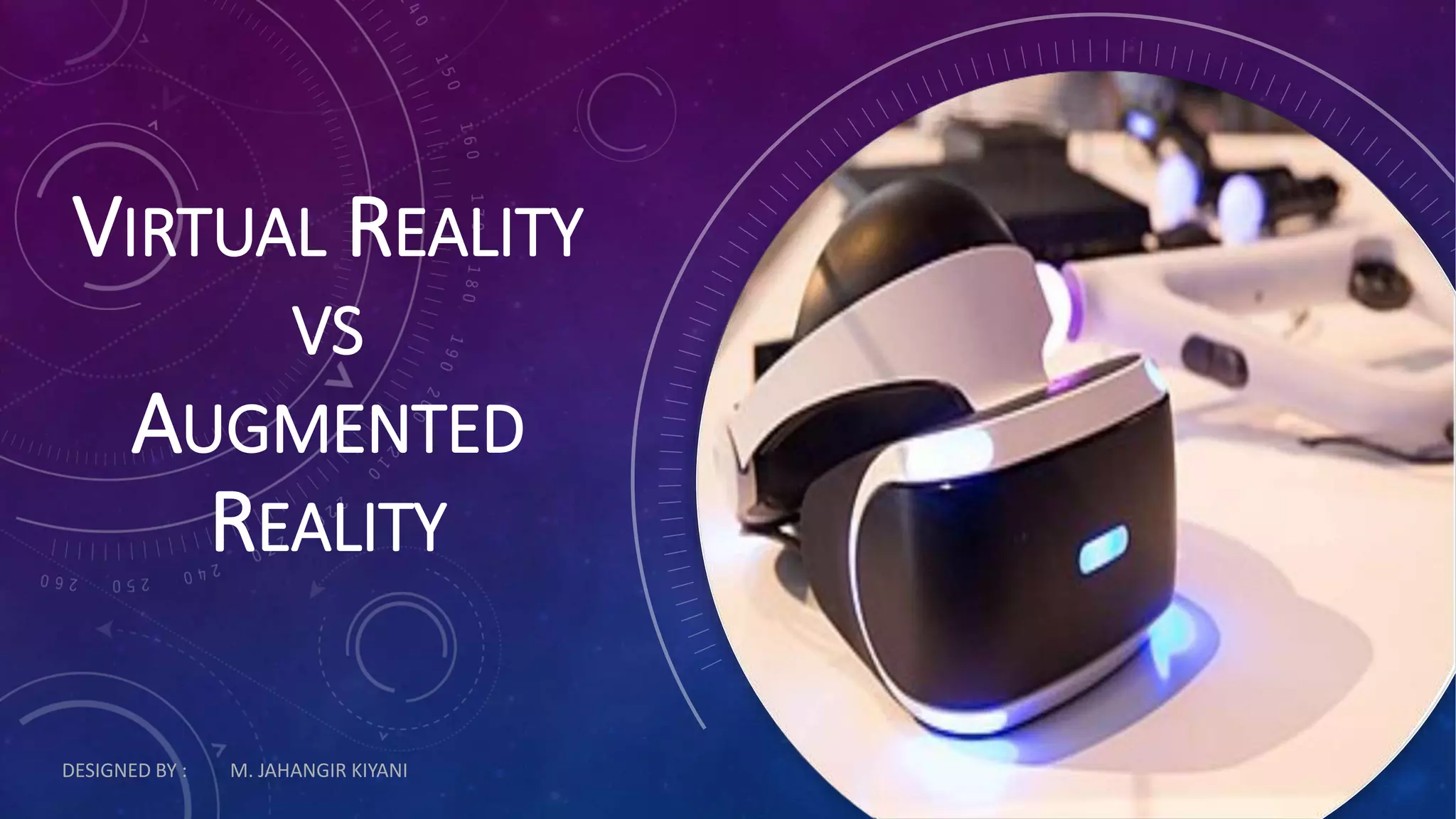


VIRTUAL REALITY
VS
AUGMENTED
REALITY
DESIGNED BY : M. JAHANGIR KIYANI
WHAT IS VIRTUAL REALITY
• “The computer-generated simulation of a three-dimensional
image or environment that can be interacted with in a seemingly
real or physical way by a person using special electronic
equipment, such as a helmet with a screen inside or gloves fitted
with sensors”
WHO INVENTED VIRTUAL REALITY?
• More than one person has been involved in the development of this
technology but if we are talking about the realm of virtual experience then
the answer is Morton Heilig.
• He produced the first interactive film experience in which viewers were
invited to watch a film which would use all of their senses. This multi-sensory
experience was the first ‘3D film’ which was designed for a single viewing only
and enabled the viewer to become part of the film. For example: he used an
oscillating fan so that the viewer could feel wind blowing on their face.
• Virtual reality is considered to have begun in the 1950’s but early elements of
it can be traced back to the 1860’s and long before the development of digital
technology
• The Virtual Reality Modelling Language (VRML), first introduced in 1994, was
intended for the development of "virtual worlds" without dependency on
headsets.
WHY WE NEED VR
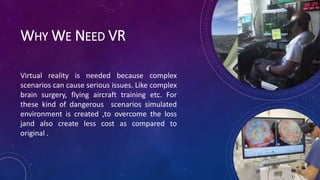
Virtual reality is needed because complex
scenarios can cause serious issues. Like complex
brain surgery, flying aircraft training etc. For
these kind of dangerous scenarios simulated
environment is created ,to overcome the loss
jand also create less cost as compared to
original .
WORKING ELEMENTS FOR VR DEVICES:
Opinions differ on what exactly constitutes a true VR experience, but in general
it should include:
• Three-dimensional images that appear to be life-sized from the perspective of
the user
• The ability to track a user's motions, particularly his head
and eye movements, and correspondingly adjust the images on the user's
display to reflect the change in perspective
TYPES
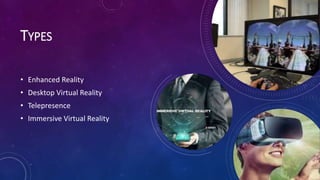
• Enhanced Reality
• Desktop Virtual Reality
• Telepresence
• Immersive Virtual Reality
AFFECTS OF VR ON USERS LIFE
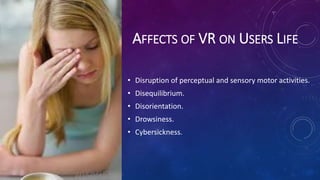
• Disruption of perceptual and sensory motor activities.
• Disequilibrium.
• Disorientation.
• Drowsiness.
• Cybersickness.
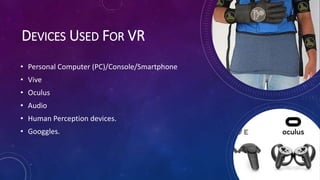
DEVICES USED FOR VR
• Personal Computer (PC)/Console/Smartphone
• Vive
• Oculus
• Audio
• Human Perception devices.
• Googgles.
APPLICATIONS OF VR
Virtual reality applications can be divided into:
• The simulation of real environments such as the interior of a
building or a spaceship often with the purpose of training or
education
• The development of an imagined environment, typically for a
game or educational adventure
APPLICATIONS OF VR
Areas in which Virtual Reality applications are commonly used :
• Design Evaluation (Virtual Prototyping).
• Planning and Maintenance.
• Concept and Data Visualization.
• Operations in hazardous or remote environments.
• Training and simulation.
• Entertainment and Leisure.
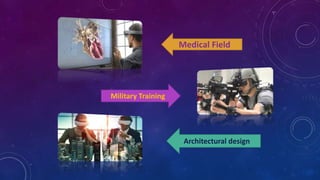
Medical Field
Military Training
Architectural design
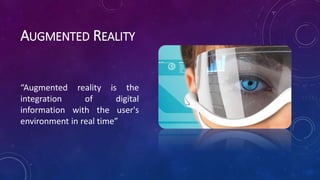
AUGMENTED REALITY
“Augmented reality is the
integration of digital
information with the user's
environment in real time”
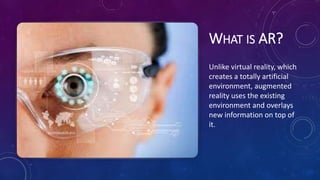
WHAT IS AR?
Unlike virtual reality, which
creates a totally artificial
environment, augmented
reality uses the existing
environment and overlays
new information on top of
it.
HISTORY
• Boeing researcher Thomas Caudell coined the term augmented reality in
1990, to describe how the head-mounted displays that electricians used when
assembling complicated wiring harnesses worked. One of the first commercial
applications of AR technology was the yellow "first down" line that began
appearing in televised football games sometime in 1998.
• Today, Google glass and heads-up displays in car windshields are perhaps the
most well-known consumer AR products, but the technology is used in many
industries including healthcare, public safety, gas and oil, tourism and
marketing.
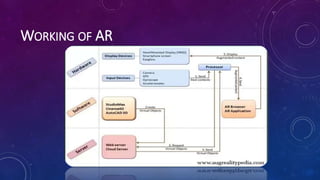
WORKING OF AR
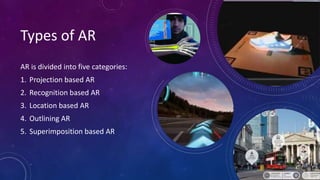
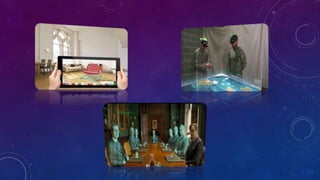
AR is divided into five categories:
1. Projection based AR
2. Recognition based AR
3. Location based AR
4. Outlining AR
5. Superimposition based AR
Types of AR
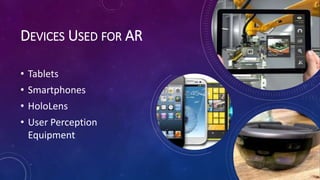
DEVICES USED FOR AR
• Tablets
• Smartphones
• HoloLens
• User Perception
Equipment
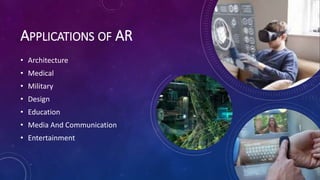
APPLICATIONS OF AR
• Architecture
• Medical
• Military
• Design
• Education
• Media And Communication
• Entertainment
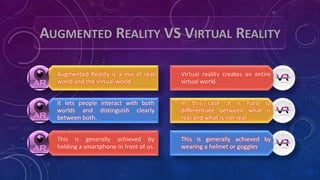
Augmented Reality is a mix of real
world and the virtual world.
It lets people interact with both
worlds and distinguish clearly
between both.
This is generally achieved by
holding a smartphone in front of us.
Virtual reality creates an entire
virtual world
In this case ,it is hard to
differentiate between what is
real and what is not real
This is generally achieved by
wearing a helmet or goggles
AUGMENTED REALITY VS VIRTUAL REALITY
CONCLUSION
AR is far behind then Virtual reality in maturity .Accuracy is
required for success of AR ,which is quite difficult .However
still AR has great future as it promises better interaction
with real and virtual world.
QUESTIONS ?
THANK YOU

Virtual reality VS Augmented Reality

  • 1.
  • 2.
    WHAT IS VIRTUALREALITY • “The computer-generated simulation of a three-dimensional image or environment that can be interacted with in a seemingly real or physical way by a person using special electronic equipment, such as a helmet with a screen inside or gloves fitted with sensors”
  • 3.
    WHO INVENTED VIRTUALREALITY? • More than one person has been involved in the development of this technology but if we are talking about the realm of virtual experience then the answer is Morton Heilig. • He produced the first interactive film experience in which viewers were invited to watch a film which would use all of their senses. This multi-sensory experience was the first ‘3D film’ which was designed for a single viewing only and enabled the viewer to become part of the film. For example: he used an oscillating fan so that the viewer could feel wind blowing on their face. • Virtual reality is considered to have begun in the 1950’s but early elements of it can be traced back to the 1860’s and long before the development of digital technology • The Virtual Reality Modelling Language (VRML), first introduced in 1994, was intended for the development of "virtual worlds" without dependency on headsets.
  • 4.
    WHY WE NEEDVR Virtual reality is needed because complex scenarios can cause serious issues. Like complex brain surgery, flying aircraft training etc. For these kind of dangerous scenarios simulated environment is created ,to overcome the loss jand also create less cost as compared to original .
  • 5.
    WORKING ELEMENTS FORVR DEVICES: Opinions differ on what exactly constitutes a true VR experience, but in general it should include: • Three-dimensional images that appear to be life-sized from the perspective of the user • The ability to track a user's motions, particularly his head and eye movements, and correspondingly adjust the images on the user's display to reflect the change in perspective
  • 6.
    TYPES • Enhanced Reality •Desktop Virtual Reality • Telepresence • Immersive Virtual Reality
  • 7.
    AFFECTS OF VRON USERS LIFE • Disruption of perceptual and sensory motor activities. • Disequilibrium. • Disorientation. • Drowsiness. • Cybersickness.
  • 8.
    DEVICES USED FORVR • Personal Computer (PC)/Console/Smartphone • Vive • Oculus • Audio • Human Perception devices. • Googgles.
  • 9.
    APPLICATIONS OF VR Virtualreality applications can be divided into: • The simulation of real environments such as the interior of a building or a spaceship often with the purpose of training or education • The development of an imagined environment, typically for a game or educational adventure
  • 10.
    APPLICATIONS OF VR Areasin which Virtual Reality applications are commonly used : • Design Evaluation (Virtual Prototyping). • Planning and Maintenance. • Concept and Data Visualization. • Operations in hazardous or remote environments. • Training and simulation. • Entertainment and Leisure.
  • 11.
  • 12.
    AUGMENTED REALITY “Augmented realityis the integration of digital information with the user's environment in real time”
  • 13.
    WHAT IS AR? Unlikevirtual reality, which creates a totally artificial environment, augmented reality uses the existing environment and overlays new information on top of it.
  • 14.
    HISTORY • Boeing researcherThomas Caudell coined the term augmented reality in 1990, to describe how the head-mounted displays that electricians used when assembling complicated wiring harnesses worked. One of the first commercial applications of AR technology was the yellow "first down" line that began appearing in televised football games sometime in 1998. • Today, Google glass and heads-up displays in car windshields are perhaps the most well-known consumer AR products, but the technology is used in many industries including healthcare, public safety, gas and oil, tourism and marketing.
  • 15.
  • 16.
    AR is dividedinto five categories: 1. Projection based AR 2. Recognition based AR 3. Location based AR 4. Outlining AR 5. Superimposition based AR Types of AR
  • 17.
    DEVICES USED FORAR • Tablets • Smartphones • HoloLens • User Perception Equipment
  • 18.
    APPLICATIONS OF AR •Architecture • Medical • Military • Design • Education • Media And Communication • Entertainment
  • 20.
    Augmented Reality isa mix of real world and the virtual world. It lets people interact with both worlds and distinguish clearly between both. This is generally achieved by holding a smartphone in front of us. Virtual reality creates an entire virtual world In this case ,it is hard to differentiate between what is real and what is not real This is generally achieved by wearing a helmet or goggles AUGMENTED REALITY VS VIRTUAL REALITY
  • 21.
    CONCLUSION AR is farbehind then Virtual reality in maturity .Accuracy is required for success of AR ,which is quite difficult .However still AR has great future as it promises better interaction with real and virtual world.
  • 22.
  • 23.