Virtual Reality
Introduction & Market Overview
by Brian Radmin ©BDMI,	Nov	2015	 1
Virtual Reality
(VR)
Experience that simulates
immersive physical presence
in a real or imagined
environment.
What is Virtual Reality?
Augmented Reality
(AR)
Experience that supplements
the view of a live, physical
environment with
digital assets.
©BDMI,	Nov	2015	 2
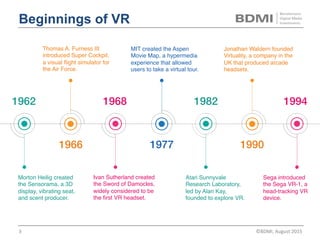
Beginnings of VR
1962!
1966!
1968!
1977!
1982!
1990!
1994!
Morton Heilig created
the Sensorama, a 3D
display, vibrating seat,
and scent producer.
Ivan Sutherland created
the Sword of Damocles,
widely considered to be
the first VR headset.
Atari Sunnyvale
Research Laboratory,
led by Alan Kay,
founded to explore VR.
Sega introduced
the Sega VR-1, a
head-tracking VR
device.
Thomas A. Furness III
introduced Super Cockpit,
a visual flight simulator for
the Air Force.
Jonathan Waldern founded
Virtuality, a company in the
UK that produced arcade
headsets.
MIT created the Aspen
Movie Map, a hypermedia
experience that allowed
users to take a virtual tour.
©BDMI,	Nov	2015	 3
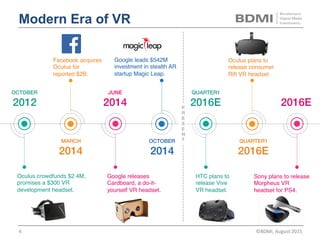
Modern Era of VR
QUARTER1!
2011!
OCTOBER!
2012!
JUNE!
2014!
MARCH!
2014!
QUARTER1!
2016E!
QUARTER1!
2016E!
!
2016E!
Valve launches VR effort
to create headset with
truly immersive presence.
Oculus crowdfunds
$2.4M, promises a $300
VR development headset.
Facebook
acquires Oculus
for reported $2B.
Google releases
Cardboard, a do-it-
yourself VR headset.
Valve and HTC
plan to release
Vive VR headset.
Oculus plans to
release consumer
Rift VR headset.
Sony plans to release
PlayStation VR
headset for PS4.
P
R
E
S
E
N
T
©BDMI,	Nov	2015	 4
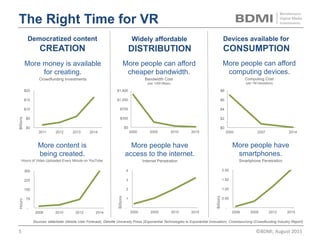
The Right Time for VR
$0
$5
$10
$15
$20
2011 2012 2013 2014
Billions	
-
75
150
225
300
2008 2010 2012 2014
More content is
being created.
Hours of Video Uploaded Every Minute on YouTube
Democratized content
CREATION
Widely affordable
DISTRIBUTION
Devices available for
CONSUMPTION
$0
$350
$700
$1,050
$1,400
2000 2005 2010 2015
-
1
2
3
4
2000 2005 2010 2015
Billions	
-
0.50
1.00
1.50
2.00
2006 2009 2012 2015
Billions	
$0
$2
$4
$6
$8
2000 2007 2014
More money is available
for creating.
Crowdfunding Investments
More people can afford
cheaper bandwidth.
Bandwidth Cost
(per 1000 Mbps)
More people have
access to the internet.
Internet Penetration
More people can afford
computing devices.
Computing Cost
(per 1M transistors)
More people have
smartphones.
Smartphone Penetration
Hours	
Sources: eMarketer (Mobile User Forecast), Deloitte University Press (Exponential Technologies to Exponential Innovation), Crowdsourcing (Crowdfunding Industry Report)
©BDMI,	Nov	2015	 5
The Right Time for VR
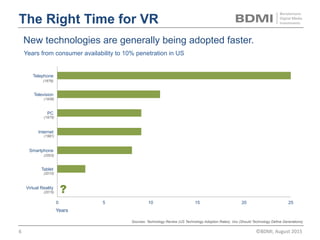
New technologies are generally being adopted faster.
0 5 10 15 20 25
Virtual Reality
Tablet
Smartphone
Internet
PC
Television
Telephone
?
(1876)
(1938)
(1990)
(2005)
(2010)
(1975)
(2015)
Years
Years from consumer availability to 10% penetration in US
Sources: Technology Review (US Technology Adoption Rates), The World Bank (Internet Users), Asympco (Smartphone Penetration)
©BDMI,	Nov	2015	 6
GAMES
ADVERTISING
FILM
	
“Working	on	game	
development,	we	always	try	
to	create	a	new	kind	of	
experience,	and	having	VR	
technology	is	almost	unfair.”		
	
Shuhei	Yoshia	
President	of	Sony	PS	Studios	
	
“We’re	right	on	the	cusp	of	a	
major	upheaval	of	the	
entertainment	world	once	[VR]	
technology	really	kicks	in.”		
	
	
Peter	Jackson	
Director	of	Lord	of	the	Rings	Trilogy	
“[VR]	is	a	percepCon	changer	
for	any	adverCser	that	wants	
to	associate	with	a	new	
fronCer	in	media.”		
Mitch	Gelman	
VP	of	Product	for	Gannet	Digital	
SOCIAL
	
“[VR]	has	the	potenCal	to	
be	the	most	social	plaEorm	
ever.	Immersive,	virtual	and	
augmented	reality	will	be	
part	of	people’s	daily	lives.”	
	
Mark	Zuckerberg	
CEO	of	Facebook	
Disruptive Potential of VR
EDUCATION
“[VR]	is	going	to	be	really	
important	for	educaCon.	
Because	kids	don’t	learn	best	
from	reading	a	book	or	looking	
at	a	chalk	board.”		
	
Palmer	Luckey	
Creator	of	the	Oculus	RiO	
MUSIC
	
“I	can	only	do	so	many	
concerts.	So	to	be	able	to	have	
more	people	experience		
them	through	VR…		
that	would	be	epic.”		
	
Miley	Cyrus	
Singer	/	Songwriter	
©BDMI,	Nov	2015	 7
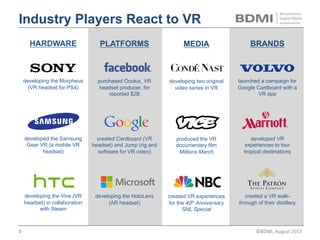
Industry Players React to VR
PLATFORMS
	
	
purchased Oculus, VR
headset producer, for
reported $2B
created Cardboard (VR
headset) and Jump (rig and
software for VR video)
developing the HoloLens
(AR headset)
HARDWARE
	
	
developing the PlayStation
VR (VR headset for PS4)
developed the Samsung
Gear VR (a mobile VR
headset)
developing the Vive (VR
headset) in collaboration
with Steam
MEDIA
	
developing two original
video series in VR
produced the VR
documentary film
Millions March
created VR experiences
for the 40th Anniversary
SNL Special
BRANDS
	
launched a campaign for
Google Cardboard with a
VR app
developed VR
experiences to tour
tropical destinations
created a VR walk-
through of their distillery
©BDMI,	Nov	2015	 8
Games
Hardware
Film
Theme Park
Other
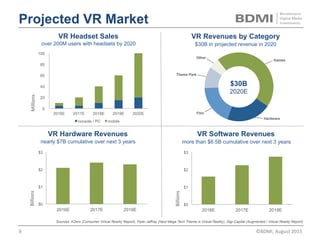
Projected VR Market
0
20
40
60
80
100
2016E 2017E 2018E 2019E 2020E
Millions	
console / PC mobile
VR Headset Sales
VR Hardware Revenues VR Software Revenues
VR Revenues by Category
$30B
2020E
nearly $7B cumulative over next 3 years more than $6.5B cumulative over next 3 years
over 200M users with headsets by 2020 $30B in projected revenue in 2020
$0
$1
$2
$3
2016E 2017E 2018E
Billions	
$0
$1
$2
$3
2016E 2017E 2018E
Billions	
Sources: KZero (Consumer Virtual Reality Report), Piper Jaffray (Next Mega Tech Theme is Virtual Reality), Digi-Capital (Augmented / Virtual Reality Report)
©BDMI,	Nov	2015	 9
Games
Hardware
Film
Theme Park
Other
Projected VR Market
0
20
40
60
80
100
2016E 2017E 2018E 2019E 2020E
Millions	
console / PC mobile
VR Headset Sales
VR Hardware Revenues VR Software Revenues
VR Revenues by Category
$30B
2020E
more than $8B cumulative over 4 years more than $7.5B cumulative over 4 years
over 200M users with headsets by 2020 $30B in projected revenue in 2020
Sources: KZero (Consumer Virtual Reality Report), Piper Jaffray (Next Mega Tech Theme is Virtual Reality), Digi-Capital (Augmented / Virtual Reality Report)
$0
$1
$2
$3
2015E 2016E 2017E 2018E
Billions	
$0
$1
$2
$3
2015E 2016E 2017E 2018E
Billions	
©BDMI,	Nov	2015	 10
Landscape of VR
©BDMI,	Nov	2015	 11
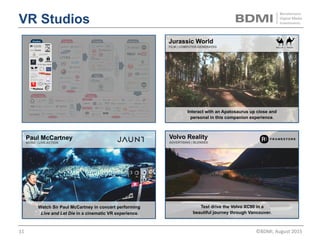
VR Studios
Jurassic World
FILM | COMPUTER-GENERATED
Interact with an Apatosaurus up close and
personal in this companion experience.
Watch Sir Paul McCartney in concert performing
Live and Let Die in a cinematic VR experience.
Paul McCartney
MUSIC | LIVE-ACTION
Volvo Reality
ADVERTISING | BLENDED
Test drive the Volvo XC90 in a
beautiful journey through Vancouver.
©BDMI,	Nov	2015	 12
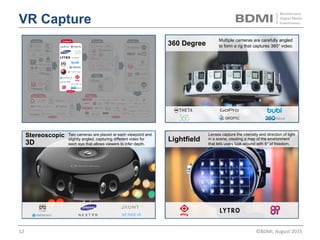
VR Capture
360 Degree
Stereoscopic
3D Lightfield
Multiple cameras are carefully angled
to form a rig that captures 360° video.
Two cameras are placed at each viewpoint and
slightly angled, capturing different video for
each eye that allows viewers to infer depth.
Lenses capture the intensity and direction of light
in a scene, creating a map of the environment
that lets users look around with 6° of freedom.
©BDMI,	Nov	2015	 13
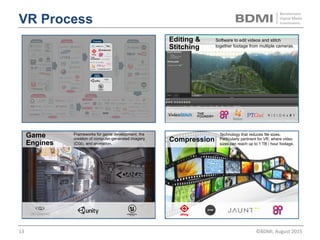
VR Process & Engines
Editing &
Stitching
CompressionEngines
Software to edit videos and stitch
together footage from multiple cameras.
Frameworks for the creation of
computer-generated imagery (CGI),
game development, and animation.
Technology that reduces file sizes.
Particularly pertinent for VR, where video
sizes can reach up to 1 TB / hour footage.
©BDMI,	Nov	2015	 14
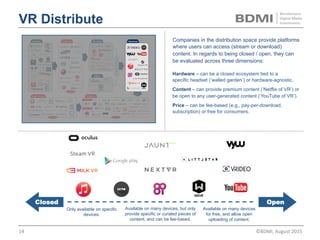
VR Distribute
Closed Open
Companies in the distribution space provide platforms
where users can access (stream or download)
content. In regards to being closed / open, they can
be evaluated across three dimensions:
Only available on specific
devices.
Available on many devices, but only
provide specific or curated pieces of
content, and can be fee-based.
Available on many devices
for free, and allow open
uploading of content.
Hardware – can be a closed ecosystem tied to a
specific headset (‘walled garden’) or hardware-agnostic.
Content – can provide premium content (‘Netflix of VR’) or
be open to any user-generated content (‘YouTube of VR’).
Price – can be fee-based (e.g., pay-per-download,
subscription) or free for consumers.
©BDMI,	Nov	2015	 15
VR Display
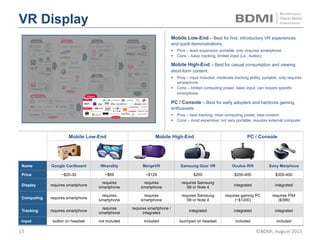
Mobile Low-End – Best for first, introductory VR experiences
and quick demonstrations.
§  Pros – least expensive, portable, only requires smartphone
§  Cons – basic tracking, limited input (i.e., button)
Mobile High-End – Best for casual consumption and viewing
short-form content.
§  Pros – input included, moderate tracking ability, portable, only requires
smartphone
§  Cons – limited computing power, basic input, can require specific
smartphone
PC / Console – Best for early adopters and hardcore gaming
enthusiasts.
§  Pros – best tracking, most computing power, best content
§  Cons – most expensive, not very portable, requires external computer
Mobile Low-End Mobile High-End PC / Console
Name Google Cardboard Wearality MergeVR Samsung Gear VR Oculus Rift PlayStation VR
Price ~$20-30 ~$69 ~$129 $200 $350-450 $300-400
Display requires smartphone
requires
smartphone
requires
smartphone
requires Samsung
S6 or Note 4
integrated integrated
Computing requires smartphone
requires
smartphone
requires
smartphone
requires Samsung
S6 or Note 4
requires gaming PC
(~$1000)
requires PS4
($399)
Tracking requires smartphone
requires
smartphone
requires smartphone /
integrated
integrated integrated integrated
Input button on headset not included included touchpad on headset included included
©BDMI,	Nov	2015	 16
VR Input / Output
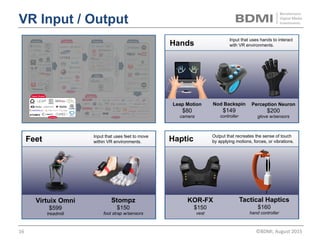
Hands
HapticFeet
Input that uses hands to interact
with VR environments.
Leap Motion
$80
camera
Nod Backspin
$149
controller
Virtuix Omni
$599
treadmill
KOR-FX
$150
vest
Tactical Haptics
$160
hand controller
Perception Neuron
$200
glove w/sensors
Input that uses feet to move
within VR environments.
Stompz
$150
foot strap w/sensors
Output that recreates the sense of touch
by applying motions, forces, or vibrations.
©BDMI,	Nov	2015	 17
VR Business Models
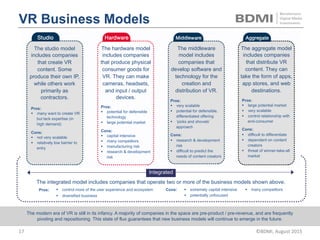
Integrated
The modern era of VR is still in its infancy. A majority of companies in the space are pre-product / pre-revenue, and are frequently
pivoting and repositioning. This state of flux guarantees that new business models will continue to emerge in the future.
The studio model
includes companies
that create VR
content. Some
produce their own IP,
while others work
primarily as
contractors.
The hardware model
includes companies
that produce physical
consumer goods for
VR. They can make
cameras, headsets,
and input / output
devices.
The middleware
model includes
companies that
develop software and
technology for the
creation and
distribution of VR.
The aggregate model
includes companies
that distribute VR
content. They can
take the form of apps,
app stores, and web
destinations.
The integrated model includes companies that operate two or more of the business models shown above.
Pros:
§  many want to create VR
but lack expertise (in
high demand)
Cons:
§  not very scalable
§  relatively low barrier to
entry
Pros:
§  potential for defensible
technology
§  large potential market
Cons:
§  capital intensive
§  many competitors
§  manufacturing risk
§  research & development
risk
Pros:
§  very scalable
§  potential for defensible,
differentiated offering
§  ‘picks and shovels’
approach
Cons:
§  research & development
risk
§  difficult to predict the
needs of content creators
Pros:
§  large potential market
§  very scalable
§  control relationship with
end-consumer
Cons:
§  difficult to differentiate
§  dependent on content
creators
§  threat of winner-take-all
market
Pros: Cons:
§  diversified business
§  many competitors
§  potentially unfocused
§  control more of the user experience and ecosystem §  extremely capital intensive
©BDMI,	Nov	2015	 18
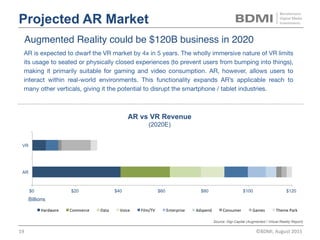
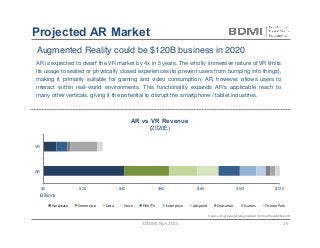
Augmented Reality could be $120B business in 2020
$0 $20 $40 $60 $80 $100 $120
AR
VR
Billions
Hardware	 Commerce	 Data	 Voice	 Film/TV	 Enterprise	 Adspend	 Consumer	 Games	 Theme	Park	
Projected AR Market
AR vs VR Revenue
(2020E)
AR is expected to dwarf the VR market by 4x in 5 years. The wholly immersive nature of VR limits
its usage to seated or physically closed experiences (to prevent users from bumping into things),
making it primarily suitable for gaming and video consumption. AR, however, allows users to
interact within real-world environments. This functionality expands AR’s applicable reach to
many other verticals, giving it the potential to disrupt the smartphone / tablet industries. 
Source: Digi-Capital (Augmented / Virtual Reality Report)
©BDMI,	Nov	2015	 19

The Emerging Virtual Reality Landscape: a Primer

  • 1.
    Virtual Reality Introduction &Market Overview by Brian Radmin ©BDMI, Nov 2015 1
  • 2.
    Virtual Reality (VR) Experience thatsimulates immersive physical presence in a real or imagined environment. What is Virtual Reality? Augmented Reality (AR) Experience that supplements the view of a live, physical environment with digital assets. ©BDMI, Nov 2015 2
  • 3.
    Beginnings of VR 1962! 1966! 1968! 1977! 1982! 1990! 1994! MortonHeilig created the Sensorama, a 3D display, vibrating seat, and scent producer. Ivan Sutherland created the Sword of Damocles, widely considered to be the first VR headset. Atari Sunnyvale Research Laboratory, led by Alan Kay, founded to explore VR. Sega introduced the Sega VR-1, a head-tracking VR device. Thomas A. Furness III introduced Super Cockpit, a visual flight simulator for the Air Force. Jonathan Waldern founded Virtuality, a company in the UK that produced arcade headsets. MIT created the Aspen Movie Map, a hypermedia experience that allowed users to take a virtual tour. ©BDMI, Nov 2015 3
  • 4.
    Modern Era ofVR QUARTER1! 2011! OCTOBER! 2012! JUNE! 2014! MARCH! 2014! QUARTER1! 2016E! QUARTER1! 2016E! ! 2016E! Valve launches VR effort to create headset with truly immersive presence. Oculus crowdfunds $2.4M, promises a $300 VR development headset. Facebook acquires Oculus for reported $2B. Google releases Cardboard, a do-it- yourself VR headset. Valve and HTC plan to release Vive VR headset. Oculus plans to release consumer Rift VR headset. Sony plans to release PlayStation VR headset for PS4. P R E S E N T ©BDMI, Nov 2015 4
  • 5.
    The Right Timefor VR $0 $5 $10 $15 $20 2011 2012 2013 2014 Billions - 75 150 225 300 2008 2010 2012 2014 More content is being created. Hours of Video Uploaded Every Minute on YouTube Democratized content CREATION Widely affordable DISTRIBUTION Devices available for CONSUMPTION $0 $350 $700 $1,050 $1,400 2000 2005 2010 2015 - 1 2 3 4 2000 2005 2010 2015 Billions - 0.50 1.00 1.50 2.00 2006 2009 2012 2015 Billions $0 $2 $4 $6 $8 2000 2007 2014 More money is available for creating. Crowdfunding Investments More people can afford cheaper bandwidth. Bandwidth Cost (per 1000 Mbps) More people have access to the internet. Internet Penetration More people can afford computing devices. Computing Cost (per 1M transistors) More people have smartphones. Smartphone Penetration Hours Sources: eMarketer (Mobile User Forecast), Deloitte University Press (Exponential Technologies to Exponential Innovation), Crowdsourcing (Crowdfunding Industry Report) ©BDMI, Nov 2015 5
  • 6.
    The Right Timefor VR New technologies are generally being adopted faster. 0 5 10 15 20 25 Virtual Reality Tablet Smartphone Internet PC Television Telephone ? (1876) (1938) (1990) (2005) (2010) (1975) (2015) Years Years from consumer availability to 10% penetration in US Sources: Technology Review (US Technology Adoption Rates), The World Bank (Internet Users), Asympco (Smartphone Penetration) ©BDMI, Nov 2015 6
  • 7.
    GAMES ADVERTISING FILM “Working on game development, we always try to create a new kind of experience, and having VR technology is almost unfair.” Shuhei Yoshia President of Sony PS Studios “We’re right on the cusp of a major upheaval of the entertainment world once [VR] technology really kicks in.” Peter Jackson Director of Lord of the Rings Trilogy “[VR] is a percepCon changer for any adverCser that wants to associate with a new fronCer in media.” Mitch Gelman VP of Product for Gannet Digital SOCIAL “[VR] has the potenCal to be the most social plaEorm ever. Immersive, virtual and augmented reality will be part of people’s daily lives.” Mark Zuckerberg CEO of Facebook Disruptive Potential ofVR EDUCATION “[VR] is going to be really important for educaCon. Because kids don’t learn best from reading a book or looking at a chalk board.” Palmer Luckey Creator of the Oculus RiO MUSIC “I can only do so many concerts. So to be able to have more people experience them through VR… that would be epic.” Miley Cyrus Singer / Songwriter ©BDMI, Nov 2015 7
  • 8.
    Industry Players Reactto VR PLATFORMS purchased Oculus, VR headset producer, for reported $2B created Cardboard (VR headset) and Jump (rig and software for VR video) developing the HoloLens (AR headset) HARDWARE developing the PlayStation VR (VR headset for PS4) developed the Samsung Gear VR (a mobile VR headset) developing the Vive (VR headset) in collaboration with Steam MEDIA developing two original video series in VR produced the VR documentary film Millions March created VR experiences for the 40th Anniversary SNL Special BRANDS launched a campaign for Google Cardboard with a VR app developed VR experiences to tour tropical destinations created a VR walk- through of their distillery ©BDMI, Nov 2015 8
  • 9.
    Games Hardware Film Theme Park Other Projected VRMarket 0 20 40 60 80 100 2016E 2017E 2018E 2019E 2020E Millions console / PC mobile VR Headset Sales VR Hardware Revenues VR Software Revenues VR Revenues by Category $30B 2020E nearly $7B cumulative over next 3 years more than $6.5B cumulative over next 3 years over 200M users with headsets by 2020 $30B in projected revenue in 2020 $0 $1 $2 $3 2016E 2017E 2018E Billions $0 $1 $2 $3 2016E 2017E 2018E Billions Sources: KZero (Consumer Virtual Reality Report), Piper Jaffray (Next Mega Tech Theme is Virtual Reality), Digi-Capital (Augmented / Virtual Reality Report) ©BDMI, Nov 2015 9
  • 10.
    Games Hardware Film Theme Park Other Projected VRMarket 0 20 40 60 80 100 2016E 2017E 2018E 2019E 2020E Millions console / PC mobile VR Headset Sales VR Hardware Revenues VR Software Revenues VR Revenues by Category $30B 2020E more than $8B cumulative over 4 years more than $7.5B cumulative over 4 years over 200M users with headsets by 2020 $30B in projected revenue in 2020 Sources: KZero (Consumer Virtual Reality Report), Piper Jaffray (Next Mega Tech Theme is Virtual Reality), Digi-Capital (Augmented / Virtual Reality Report) $0 $1 $2 $3 2015E 2016E 2017E 2018E Billions $0 $1 $2 $3 2015E 2016E 2017E 2018E Billions ©BDMI, Nov 2015 10
  • 11.
  • 12.
    VR Studios Jurassic World FILM| COMPUTER-GENERATED Interact with an Apatosaurus up close and personal in this companion experience. Watch Sir Paul McCartney in concert performing Live and Let Die in a cinematic VR experience. Paul McCartney MUSIC | LIVE-ACTION Volvo Reality ADVERTISING | BLENDED Test drive the Volvo XC90 in a beautiful journey through Vancouver. ©BDMI, Nov 2015 12
  • 13.
    VR Capture 360 Degree Stereoscopic 3DLightfield Multiple cameras are carefully angled to form a rig that captures 360° video. Two cameras are placed at each viewpoint and slightly angled, capturing different video for each eye that allows viewers to infer depth. Lenses capture the intensity and direction of light in a scene, creating a map of the environment that lets users look around with 6° of freedom. ©BDMI, Nov 2015 13
  • 14.
    VR Process &Engines Editing & Stitching CompressionEngines Software to edit videos and stitch together footage from multiple cameras. Frameworks for the creation of computer-generated imagery (CGI), game development, and animation. Technology that reduces file sizes. Particularly pertinent for VR, where video sizes can reach up to 1 TB / hour footage. ©BDMI, Nov 2015 14
  • 15.
    VR Distribute Closed Open Companiesin the distribution space provide platforms where users can access (stream or download) content. In regards to being closed / open, they can be evaluated across three dimensions: Only available on specific devices. Available on many devices, but only provide specific or curated pieces of content, and can be fee-based. Available on many devices for free, and allow open uploading of content. Hardware – can be a closed ecosystem tied to a specific headset (‘walled garden’) or hardware-agnostic. Content – can provide premium content (‘Netflix of VR’) or be open to any user-generated content (‘YouTube of VR’). Price – can be fee-based (e.g., pay-per-download, subscription) or free for consumers. ©BDMI, Nov 2015 15
  • 16.
    VR Display Mobile Low-End– Best for first, introductory VR experiences and quick demonstrations. §  Pros – least expensive, portable, only requires smartphone §  Cons – basic tracking, limited input (i.e., button) Mobile High-End – Best for casual consumption and viewing short-form content. §  Pros – input included, moderate tracking ability, portable, only requires smartphone §  Cons – limited computing power, basic input, can require specific smartphone PC / Console – Best for early adopters and hardcore gaming enthusiasts. §  Pros – best tracking, most computing power, best content §  Cons – most expensive, not very portable, requires external computer Mobile Low-End Mobile High-End PC / Console Name Google Cardboard Wearality MergeVR Samsung Gear VR Oculus Rift PlayStation VR Price ~$20-30 ~$69 ~$129 $200 $350-450 $300-400 Display requires smartphone requires smartphone requires smartphone requires Samsung S6 or Note 4 integrated integrated Computing requires smartphone requires smartphone requires smartphone requires Samsung S6 or Note 4 requires gaming PC (~$1000) requires PS4 ($399) Tracking requires smartphone requires smartphone requires smartphone / integrated integrated integrated integrated Input button on headset not included included touchpad on headset included included ©BDMI, Nov 2015 16
  • 17.
    VR Input /Output Hands HapticFeet Input that uses hands to interact with VR environments. Leap Motion $80 camera Nod Backspin $149 controller Virtuix Omni $599 treadmill KOR-FX $150 vest Tactical Haptics $160 hand controller Perception Neuron $200 glove w/sensors Input that uses feet to move within VR environments. Stompz $150 foot strap w/sensors Output that recreates the sense of touch by applying motions, forces, or vibrations. ©BDMI, Nov 2015 17
  • 18.
    VR Business Models Integrated Themodern era of VR is still in its infancy. A majority of companies in the space are pre-product / pre-revenue, and are frequently pivoting and repositioning. This state of flux guarantees that new business models will continue to emerge in the future. The studio model includes companies that create VR content. Some produce their own IP, while others work primarily as contractors. The hardware model includes companies that produce physical consumer goods for VR. They can make cameras, headsets, and input / output devices. The middleware model includes companies that develop software and technology for the creation and distribution of VR. The aggregate model includes companies that distribute VR content. They can take the form of apps, app stores, and web destinations. The integrated model includes companies that operate two or more of the business models shown above. Pros: §  many want to create VR but lack expertise (in high demand) Cons: §  not very scalable §  relatively low barrier to entry Pros: §  potential for defensible technology §  large potential market Cons: §  capital intensive §  many competitors §  manufacturing risk §  research & development risk Pros: §  very scalable §  potential for defensible, differentiated offering §  ‘picks and shovels’ approach Cons: §  research & development risk §  difficult to predict the needs of content creators Pros: §  large potential market §  very scalable §  control relationship with end-consumer Cons: §  difficult to differentiate §  dependent on content creators §  threat of winner-take-all market Pros: Cons: §  diversified business §  many competitors §  potentially unfocused §  control more of the user experience and ecosystem §  extremely capital intensive ©BDMI, Nov 2015 18
  • 19.
    Augmented Reality couldbe $120B business in 2020 $0 $20 $40 $60 $80 $100 $120 AR VR Billions Hardware Commerce Data Voice Film/TV Enterprise Adspend Consumer Games Theme Park Projected AR Market AR vs VR Revenue (2020E) AR is expected to dwarf the VR market by 4x in 5 years. The wholly immersive nature of VR limits its usage to seated or physically closed experiences (to prevent users from bumping into things), making it primarily suitable for gaming and video consumption. AR, however, allows users to interact within real-world environments. This functionality expands AR’s applicable reach to many other verticals, giving it the potential to disrupt the smartphone / tablet industries. Source: Digi-Capital (Augmented / Virtual Reality Report) ©BDMI, Nov 2015 19