


Welcome to augmented world  Augmented reality Anugya shukla
outline Introduction Understanding AR. Motivation Working Application Problem in AR Sensational technology Conclusion
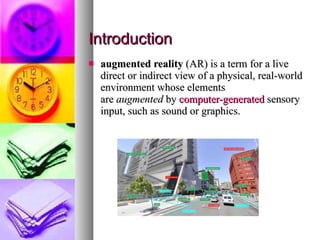
Introduction augmented reality  (AR) is a term for a live direct or indirect view of a physical, real-world environment whose elements are  augmented  by  computer-generated  sensory input, such as sound or graphics.
Understanding A.R AR is the variation of VR. VR technology completely immerse a user inside a synthetic environment while immersed user can not see the real world around him. In contrast the user allow the user to see the real world with virtual object superimposed upon or composite with real world.
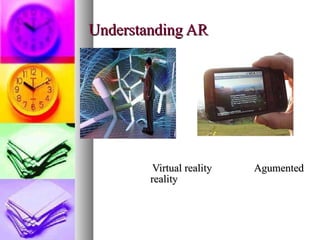
Understanding AR Virtual reality  Agumented reality
Understanding AR AR supplements reality, rather than completely replacing it. It creates the illusion the virtual and real object co exist in the same place. AR can be though of as middle ground between VR(completely synthetic) and telepresence (completely  real).
Motivation AR enhances user perception interaction with real environment. The virtual objects display information that user can not detect directly with his own sense. The information conveyed by the  virtual helps user to perform real task.
Working AR system tracks the position and orientation of users head so that overlaid material can be aligned. There are three main components need to AR work *Head mounted display (HMD) * tracking system. *mobile computing power.
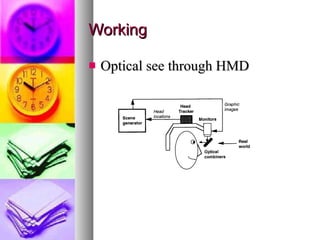
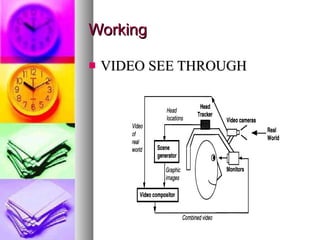
Working HMD   (HEAD MOUNTED DESIGN) Monitor allows us to see text and graphics generated by computer Head mounted system enable us to view graphics and text related by agumented system. The two basic types of HMD 1:Optical see 2:Video see
Working Optical see through HMD
Working VIDEO SEE THROUGH
Working Tracking orientation Tracking system in agumented reality is to know user location in reference to his surrounding. tracking is basically of two types  1:indoor tracking 2:outdoor tracking
Working Indoor tracking Tracking is easier in small spaces than in large spaces. Trackers typically have two parts:  One worn by the tracked person or object and other built into the surrounding environment, usually within the same room.  In optical trackers, the tracked users can wear the sensors, and targets can be fixed to the ceiling. By calculating the distance to reach visible target, the sensors can determine the user's position and orientation.
Working OUTDOOR TRACKING 1: Head orientation is determined with hybrid tracker that combines gyroscopes and accelerometers with magnetometers that measure the earth's magnetic field. 2:For position tracking we use GPS system. 3:A GPS receiver can determine its position by monitoring radio signals from navigation satellites. GPS receivers have an accuracy of about 10 to 3meters. 4:User can get better result with a technique known as differential GPS. In this we have GPS receiver and transmitter.
Working Mobile computing For a wearable augmented realty system, ther is still not enough computing power to create stereo 3-D graphics. So researchers are still researching on it .
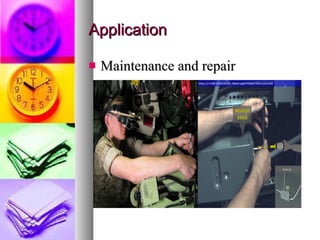
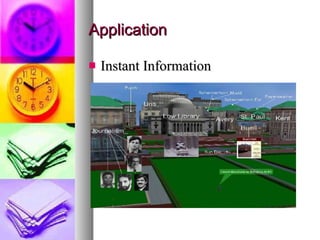
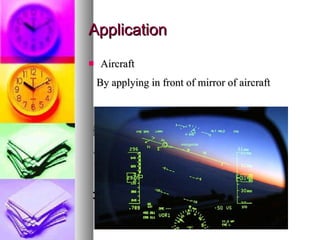
Application Medical manufacturing and repair Instant Information aircraft
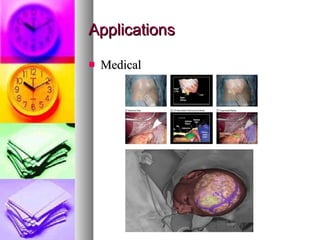
Applications Medical
Application Maintenance and repair
Application Instant Information
Application Aircraft  By applying in front of mirror of aircraft
Problem in AR Registration *  One of the most basic problem in AR. *  Object in the real and virtual world have to properly aligned with each other. *  Registration error may also cause motion sickness. * AR requires much more accurate registration system * These errors are difficult to control .
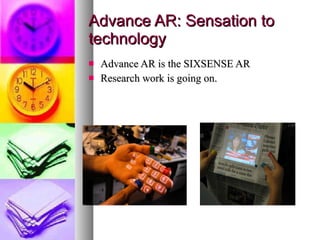
Advance AR: Sensation to technology Advance AR is the SIXSENSE AR Research work is going on.
CONCLUSION AR is new field since(1993) and it is far behind VR in maturity. First developed HMD based AR SYSTEM probably be in the application of aircraft manufacturing. A break through is required in real time HMD tracking in the outdoor at the accuracy required for AR for this technology to move ahead rapidly. AR has great future as it promises better navigation and interaction with real and virtual world.
Any Questions

Augmented reality

  • 1.
    Welcome to augmentedworld Augmented reality Anugya shukla
  • 2.
    outline Introduction UnderstandingAR. Motivation Working Application Problem in AR Sensational technology Conclusion
  • 3.
    Introduction augmented reality (AR) is a term for a live direct or indirect view of a physical, real-world environment whose elements are  augmented  by  computer-generated  sensory input, such as sound or graphics.
  • 4.
    Understanding A.R ARis the variation of VR. VR technology completely immerse a user inside a synthetic environment while immersed user can not see the real world around him. In contrast the user allow the user to see the real world with virtual object superimposed upon or composite with real world.
  • 5.
    Understanding AR Virtualreality Agumented reality
  • 6.
    Understanding AR ARsupplements reality, rather than completely replacing it. It creates the illusion the virtual and real object co exist in the same place. AR can be though of as middle ground between VR(completely synthetic) and telepresence (completely real).
  • 7.
    Motivation AR enhancesuser perception interaction with real environment. The virtual objects display information that user can not detect directly with his own sense. The information conveyed by the virtual helps user to perform real task.
  • 8.
    Working AR systemtracks the position and orientation of users head so that overlaid material can be aligned. There are three main components need to AR work *Head mounted display (HMD) * tracking system. *mobile computing power.
  • 9.
    Working HMD (HEAD MOUNTED DESIGN) Monitor allows us to see text and graphics generated by computer Head mounted system enable us to view graphics and text related by agumented system. The two basic types of HMD 1:Optical see 2:Video see
  • 10.
  • 11.
  • 12.
    Working Tracking orientationTracking system in agumented reality is to know user location in reference to his surrounding. tracking is basically of two types 1:indoor tracking 2:outdoor tracking
  • 13.
    Working Indoor trackingTracking is easier in small spaces than in large spaces. Trackers typically have two parts: One worn by the tracked person or object and other built into the surrounding environment, usually within the same room. In optical trackers, the tracked users can wear the sensors, and targets can be fixed to the ceiling. By calculating the distance to reach visible target, the sensors can determine the user's position and orientation.
  • 14.
    Working OUTDOOR TRACKING1: Head orientation is determined with hybrid tracker that combines gyroscopes and accelerometers with magnetometers that measure the earth's magnetic field. 2:For position tracking we use GPS system. 3:A GPS receiver can determine its position by monitoring radio signals from navigation satellites. GPS receivers have an accuracy of about 10 to 3meters. 4:User can get better result with a technique known as differential GPS. In this we have GPS receiver and transmitter.
  • 15.
    Working Mobile computingFor a wearable augmented realty system, ther is still not enough computing power to create stereo 3-D graphics. So researchers are still researching on it .
  • 16.
    Application Medical manufacturingand repair Instant Information aircraft
  • 17.
  • 18.
  • 19.
  • 20.
  • 21.
    Application Aircraft By applying in front of mirror of aircraft
  • 22.
    Problem in ARRegistration * One of the most basic problem in AR. * Object in the real and virtual world have to properly aligned with each other. * Registration error may also cause motion sickness. * AR requires much more accurate registration system * These errors are difficult to control .
  • 23.
    Advance AR: Sensationto technology Advance AR is the SIXSENSE AR Research work is going on.
  • 24.
    CONCLUSION AR isnew field since(1993) and it is far behind VR in maturity. First developed HMD based AR SYSTEM probably be in the application of aircraft manufacturing. A break through is required in real time HMD tracking in the outdoor at the accuracy required for AR for this technology to move ahead rapidly. AR has great future as it promises better navigation and interaction with real and virtual world.
  • 25.