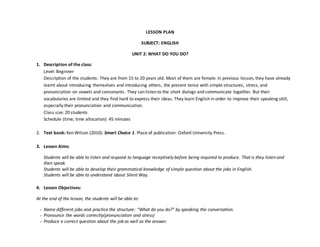
LESSON PLAN
SUBJECT: ENGLISH
UNIT 2: WHAT DO YOU DO?
1. Description of the class:
Level: Beginner
Description of the students: They are from 15 to 20 years old. Most of them are female. In previous lesson, they have already
learnt about introducing themselves and introducing others, the present tense with simple structures, stress, and
pronunciation on vowels and consonants. They can listen to the short dialogs and communicate together. But their
vocabularies are limited and they find hard to express their ideas. They learn English in order to improve their speaking skill,
especially their pronunciation and communication.
Class size: 20 students
Schedule (time, time allocation): 45 minutes
2. Text book: Ken Wilson (2010). Smart Choice 1. Place of publication: Oxford University Press.
3. Lesson Aims:
Students will be able to listen and respond to language receptively before being required to produce. That is they listen and
then speak.
Students will be able to develop their grammatical knowledge of simple question about the jobs in English.
Students will be able to understand about Silent Way.
4. Lesson Objectives:
At the end of the lesson, the students will be able to:
- Name different jobs and practice the structure: “What do you do?” by speaking the conversation.
- Pronounce the words correctly(pronunciation and stress)
- Produce a correct question about the job as well as the answer.
5. Methodology:
- Warm up, Pre – speaking, while – speaking: Silent Way.
- While – speaking, Post – listening: Silent Way + Audio-Lingualism
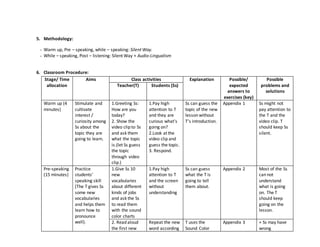
6. Classroom Procedure:
Stage/ Time
allocation
Aims Class activities Explanation Possible/
expected
answers to
exercises (key)
Possible
problems and
solutions
Teacher(T) Students (Ss)
Warm up (4
minutes)
Stimulate and
cultivate
interest /
curiosity among
Ss about the
topic they are
going to learn.
1.Greeting Ss:
How are you
today?
2. Show the
video clip to Ss
and ask them
what the topic
is.(let Ss guess
the topic
through video
clip.)
1.Pay high
attention to T
and they are
curious what's
going on?
2.Look at the
video clip and
guess the topic.
3. Respond.
Ss can guess the
topic of the new
lesson without
T’s introduction.
Appendix 1 Ss might not
pay attention to
the T and the
video clip. T
should keep Ss
silent.
Pre-speaking
(15 minutes)
Practice
students’
speaking skill
(The T gives Ss
some new
vocabularies
and helps them
learn how to
pronounce
well).
1.Give Ss 10
new
vocabularies
about different
kinds of jobs
and ask the Ss
to read them
with the sound
color charts
1.Pay high
attention to T
and the screen
without
understanding
Ss can guess
what the T is
going to tell
them about.
Appendix 2 Most of the Ss
can not
understand
what is going
on. The T
should keep
going on the
lesson.
2. Read aloud
the first new
Repeat the new
word according
T uses the
Sound Color
Appendix 3 + Ss may have
wrong
vocabulary one
time with the
sound color
charts and guide
Ss repeat.
to T’s
instruction.
charts to help Ss
learn new words
by themselves.
pronunciation
=> The T
corrects their
mistakes & asks
them to repeat
at least 3 times
3. Read aloud
the first new
vocabulary one
time with the
word color
charts and guide
Ss repeat.
Observe the
color of the
charts and the
T’s instruction,
and then try to
pronounce the
words with
correct stress.
T designs this
chart to help Ss
remember the
spelling and
stress of new
words
Appendix 4+5 Some Ss
pronounce
incorrectly =>
ask them to
repeat.
While-
speaking (15
minutes)
To help Ss
remember the
new
vocabularies
they have just
learnt through
the listening
test.
1.Let Ss listen to
a conversation
and ask them to
use the words in
the box to
complete the
conversation
Listen and fill in
the blanks.
T uses
completing the
dialogue drill to
recall Ss to the
new words they
have to learn.
Appendix 6 If some Ss can’t
listen to the
conversation
clearly, they will
raise their
hands => let
them listen
again.
To check the Ss’
pronunciation
2. Divide the
class into 10
groups, each
group includes 2
Ss and number
groups from 1
to 10. Ask them
to practice the
conversation.
Use fingers to
point out which
group will play
Work in pair
and prepare to
have the role-
play.
T can test the Ss’
pronunciation
through role-
play activity.
The chosen
group makes
errors with
their
pronunciation
=> ask another
group to model.
roles in front of
the class and
evaluate them
To help Ss find
out a new
grammar point
that is the
common Wh-
questions by
themselves.
3. Divide the
class into 2
groups. Give
each group
some pieces of
paper with a
word inside. Ask
Ss to arrange
them to the
right order and
stick them on
the board.
Stick some
pieces of paper
on the board
quickly.
T’s silence
technique will
help Ss discover
the new
grammar rule by
themselves.
A group
arranges some
pieces of paper
incorrectly =>
let them see
the right
answer of
another group.
4. Require Ss to
look at the
board and read
the different
colored
sentences
according to T’s
gestures.
Read the
different
colored
sentences
T uses self-
correction
gesture to
indicate that
each of his
fingers
represent a
word in a
sentence and
uses this to
correct Ss.
Appendix 7 Some Ss read
the sentences
wrongly => ask
another S to
read again.
To help Ss apply
the grammar
point flexibly.
5. Change one
or two word in
each sentence
and ask Ss to say
the new
sentences.
Answer the T’s
questions
quickly.
T wants Ss to
use different
words to create
the new
sentences based
on the structure
they have just
learnt.
Some Ss speak
incorrectly =>
ask another S to
model.
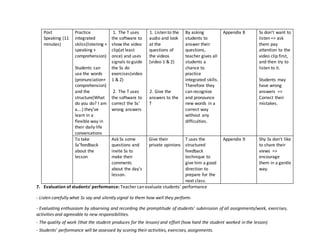
Post
Speaking (11
minutes)
Practice
integrated
skilss(listening +
speaking +
comprehension)
Students can
use the words
(pronunciation+
comprehension)
and the
structure(What
do you do? I am
a….) they’ve
learn in a
flexible way in
their daily life
conversations
1. The T uses
the software to
show the video
clip(at least
once) and uses
signals to guide
the Ss do
exercises(video
1 & 2)
2. The T uses
the software to
correct the Ss’
wrong answers
1. Listen to the
audio and look
at the
questions of
the videos
(video 1 & 2)
2. Give the
answers to the
T
By asking
students to
answer their
questions,
teacher gives all
students a
chance to
practice
integrated skills.
Therefore they
can recognize
and pronounce
new words in a
correct way
without any
difficulties.
Appendix 8 Ss don’t want to
listen => ask
them pay
attention to the
video clip first,
and then try to
listen to it.
Students may
have wrong
answers =>
Correct their
mistakes.
To take
Ss’feedback
about the
lesson
Ask Ss some
questions and
invite Ss to
make their
comments
about the day’s
lesson.
Give their
private opinions
T uses the
structured
feedback
technique to
give him a good
direction to
prepare for the
next class.
Appendix 9 Shy Ss don’t like
to share their
views =>
encourage
them in a gentle
way.
7. Evaluation of students’ performance: Teacher can evaluate students’ performance
- Listen carefully what Ss say and silently signal to them how well they perform.
- Evaluating enthusiasm by observing and recording the promptitude of students’ submission of all assignments/work, exercises,
activities and agreeable to new responsibilities.
- The quality of work (that the student produces for the lesson) and effort (how hard the student worked in the lesson)
- Students’ performance will be assessed by scoring their activities, exercises, assignments.
8. Homework/ assignments
- Classwork: Student Book – Unit 2(page 10,11,12,13)
- Homework: Work Book – Unit 2 (page 6,7,8,9)
9. References
a) Diane Larsen-Freeman and Marti Anderson.2011.Techniques and principles in Language Teaching. Oxford University Press
b) Richards, J.C and Rogers, T.S. 1986. Approaches and Methods in Language Teaching. Cambridge University Press
c) Useful websites: Searching on the site – www.google.com, http://donaldcherry.com/, http://www.glenys-
hanson.info/pedagogical-articles-pronunciation-spelling/silent-way-lesson-syllable-stress/#comment-21
d) Ken Wilson (2010). Smart Choice 1. USA: Oxford University Press.
10. Appendices
a) Classroomequipment / classroom technology: A board (flip chart), Chalks(markers), an eraser, pointer, data projector +
screen, speakers, Computer + Internet and Audio files, micro, pictures(Sound Color Charts+Word Charts) slides and Multi CD
Rom(Smart Choice 1).
b) Further practice: Work Book (Page 6,7,8,9).
c) Details of supporting things:
Appendix 1:
Appendix 2:
Appendix 3:
c
Appendix 4:
Appendix 5:
Vocabulary
Architect Singer Doctor Taxi Driver Model
/ˈɑːrkɪtekt/ /ˈsɪŋər/ /ˈdɑːktər/ /ˈtæksi ˈdraɪvər/ /ˈmɑːdl/
Pilot Actor Teacher Soccer Player Police Officer
/ˈpaɪlət/ /ˈæktər/ /ˈtiːtʃər/ /ˈsɑːkər ˈpleɪər / /pəˈliːs ˈɔːfɪsər /
Appendix 6:
Listening: Track 13 CD1
Complete the conversation
Answer:
1c 2a 3b
Appendix 7:
Common wh-questions
1)What do you do? I’m an architect.
2)Where do you live? I’m live in California.
Appendix 8:
Appendix 9:
1) What do you learn today?
2) How do you feel about the lesson?
3) Do you have any suggestion to make the lesson better?

Lesson plan

  • 1.
    LESSON PLAN SUBJECT: ENGLISH UNIT2: WHAT DO YOU DO? 1. Description of the class: Level: Beginner Description of the students: They are from 15 to 20 years old. Most of them are female. In previous lesson, they have already learnt about introducing themselves and introducing others, the present tense with simple structures, stress, and pronunciation on vowels and consonants. They can listen to the short dialogs and communicate together. But their vocabularies are limited and they find hard to express their ideas. They learn English in order to improve their speaking skill, especially their pronunciation and communication. Class size: 20 students Schedule (time, time allocation): 45 minutes 2. Text book: Ken Wilson (2010). Smart Choice 1. Place of publication: Oxford University Press. 3. Lesson Aims: Students will be able to listen and respond to language receptively before being required to produce. That is they listen and then speak. Students will be able to develop their grammatical knowledge of simple question about the jobs in English. Students will be able to understand about Silent Way. 4. Lesson Objectives: At the end of the lesson, the students will be able to: - Name different jobs and practice the structure: “What do you do?” by speaking the conversation. - Pronounce the words correctly(pronunciation and stress) - Produce a correct question about the job as well as the answer.
  • 2.
    5. Methodology: - Warmup, Pre – speaking, while – speaking: Silent Way. - While – speaking, Post – listening: Silent Way + Audio-Lingualism 6. Classroom Procedure: Stage/ Time allocation Aims Class activities Explanation Possible/ expected answers to exercises (key) Possible problems and solutions Teacher(T) Students (Ss) Warm up (4 minutes) Stimulate and cultivate interest / curiosity among Ss about the topic they are going to learn. 1.Greeting Ss: How are you today? 2. Show the video clip to Ss and ask them what the topic is.(let Ss guess the topic through video clip.) 1.Pay high attention to T and they are curious what's going on? 2.Look at the video clip and guess the topic. 3. Respond. Ss can guess the topic of the new lesson without T’s introduction. Appendix 1 Ss might not pay attention to the T and the video clip. T should keep Ss silent. Pre-speaking (15 minutes) Practice students’ speaking skill (The T gives Ss some new vocabularies and helps them learn how to pronounce well). 1.Give Ss 10 new vocabularies about different kinds of jobs and ask the Ss to read them with the sound color charts 1.Pay high attention to T and the screen without understanding Ss can guess what the T is going to tell them about. Appendix 2 Most of the Ss can not understand what is going on. The T should keep going on the lesson. 2. Read aloud the first new Repeat the new word according T uses the Sound Color Appendix 3 + Ss may have wrong
  • 3.
    vocabulary one time withthe sound color charts and guide Ss repeat. to T’s instruction. charts to help Ss learn new words by themselves. pronunciation => The T corrects their mistakes & asks them to repeat at least 3 times 3. Read aloud the first new vocabulary one time with the word color charts and guide Ss repeat. Observe the color of the charts and the T’s instruction, and then try to pronounce the words with correct stress. T designs this chart to help Ss remember the spelling and stress of new words Appendix 4+5 Some Ss pronounce incorrectly => ask them to repeat. While- speaking (15 minutes) To help Ss remember the new vocabularies they have just learnt through the listening test. 1.Let Ss listen to a conversation and ask them to use the words in the box to complete the conversation Listen and fill in the blanks. T uses completing the dialogue drill to recall Ss to the new words they have to learn. Appendix 6 If some Ss can’t listen to the conversation clearly, they will raise their hands => let them listen again. To check the Ss’ pronunciation 2. Divide the class into 10 groups, each group includes 2 Ss and number groups from 1 to 10. Ask them to practice the conversation. Use fingers to point out which group will play Work in pair and prepare to have the role- play. T can test the Ss’ pronunciation through role- play activity. The chosen group makes errors with their pronunciation => ask another group to model.
  • 4.
    roles in frontof the class and evaluate them To help Ss find out a new grammar point that is the common Wh- questions by themselves. 3. Divide the class into 2 groups. Give each group some pieces of paper with a word inside. Ask Ss to arrange them to the right order and stick them on the board. Stick some pieces of paper on the board quickly. T’s silence technique will help Ss discover the new grammar rule by themselves. A group arranges some pieces of paper incorrectly => let them see the right answer of another group. 4. Require Ss to look at the board and read the different colored sentences according to T’s gestures. Read the different colored sentences T uses self- correction gesture to indicate that each of his fingers represent a word in a sentence and uses this to correct Ss. Appendix 7 Some Ss read the sentences wrongly => ask another S to read again. To help Ss apply the grammar point flexibly. 5. Change one or two word in each sentence and ask Ss to say the new sentences. Answer the T’s questions quickly. T wants Ss to use different words to create the new sentences based on the structure they have just learnt. Some Ss speak incorrectly => ask another S to model.
  • 5.
    Post Speaking (11 minutes) Practice integrated skilss(listening + speaking+ comprehension) Students can use the words (pronunciation+ comprehension) and the structure(What do you do? I am a….) they’ve learn in a flexible way in their daily life conversations 1. The T uses the software to show the video clip(at least once) and uses signals to guide the Ss do exercises(video 1 & 2) 2. The T uses the software to correct the Ss’ wrong answers 1. Listen to the audio and look at the questions of the videos (video 1 & 2) 2. Give the answers to the T By asking students to answer their questions, teacher gives all students a chance to practice integrated skills. Therefore they can recognize and pronounce new words in a correct way without any difficulties. Appendix 8 Ss don’t want to listen => ask them pay attention to the video clip first, and then try to listen to it. Students may have wrong answers => Correct their mistakes. To take Ss’feedback about the lesson Ask Ss some questions and invite Ss to make their comments about the day’s lesson. Give their private opinions T uses the structured feedback technique to give him a good direction to prepare for the next class. Appendix 9 Shy Ss don’t like to share their views => encourage them in a gentle way. 7. Evaluation of students’ performance: Teacher can evaluate students’ performance - Listen carefully what Ss say and silently signal to them how well they perform. - Evaluating enthusiasm by observing and recording the promptitude of students’ submission of all assignments/work, exercises, activities and agreeable to new responsibilities. - The quality of work (that the student produces for the lesson) and effort (how hard the student worked in the lesson) - Students’ performance will be assessed by scoring their activities, exercises, assignments.
  • 6.
    8. Homework/ assignments -Classwork: Student Book – Unit 2(page 10,11,12,13) - Homework: Work Book – Unit 2 (page 6,7,8,9) 9. References a) Diane Larsen-Freeman and Marti Anderson.2011.Techniques and principles in Language Teaching. Oxford University Press b) Richards, J.C and Rogers, T.S. 1986. Approaches and Methods in Language Teaching. Cambridge University Press c) Useful websites: Searching on the site – www.google.com, http://donaldcherry.com/, http://www.glenys- hanson.info/pedagogical-articles-pronunciation-spelling/silent-way-lesson-syllable-stress/#comment-21 d) Ken Wilson (2010). Smart Choice 1. USA: Oxford University Press. 10. Appendices a) Classroomequipment / classroom technology: A board (flip chart), Chalks(markers), an eraser, pointer, data projector + screen, speakers, Computer + Internet and Audio files, micro, pictures(Sound Color Charts+Word Charts) slides and Multi CD Rom(Smart Choice 1). b) Further practice: Work Book (Page 6,7,8,9). c) Details of supporting things:
  • 7.
  • 8.
  • 9.
  • 10.
    Appendix 5: Vocabulary Architect SingerDoctor Taxi Driver Model /ˈɑːrkɪtekt/ /ˈsɪŋər/ /ˈdɑːktər/ /ˈtæksi ˈdraɪvər/ /ˈmɑːdl/ Pilot Actor Teacher Soccer Player Police Officer /ˈpaɪlət/ /ˈæktər/ /ˈtiːtʃər/ /ˈsɑːkər ˈpleɪər / /pəˈliːs ˈɔːfɪsər / Appendix 6: Listening: Track 13 CD1
  • 11.
    Complete the conversation Answer: 1c2a 3b Appendix 7: Common wh-questions 1)What do you do? I’m an architect. 2)Where do you live? I’m live in California. Appendix 8:
  • 12.
    Appendix 9: 1) Whatdo you learn today? 2) How do you feel about the lesson? 3) Do you have any suggestion to make the lesson better?