Bruna Luiza
Bruna Fontoura
  Giovana Perini
  Marina Garcia
   Oral-based approach;

   Visual exploration;

   Teacher gives model;

   Many repetitions;
   Role play;

   Drill: Repeat main line
    ◦ Change main line with new vocabulary
    ◦ Create and answer Yes/No questions based on
      main line;

   No grammar rule;
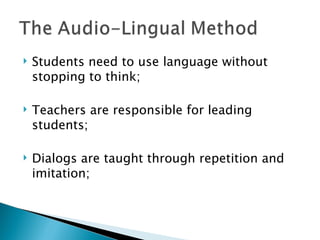
   Students need to use language without
    stopping to think;

   Teachers are responsible for leading
    students;

   Dialogs are taught through repetition and
    imitation;
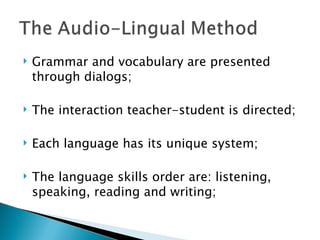
   Grammar and vocabulary are presented
    through dialogs;

   The interaction teacher-student is directed;

   Each language has its unique system;

   The language skills order are: listening,
    speaking, reading and writing;
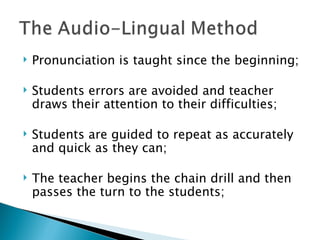
   Pronunciation is taught since the beginning;

   Students errors are avoided and teacher
    draws their attention to their difficulties;

   Students are guided to repeat as accurately
    and quick as they can;

   The teacher begins the chain drill and then
    passes the turn to the students;
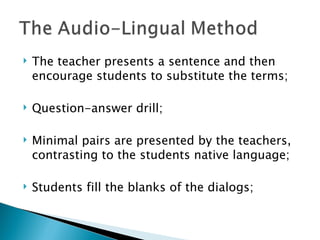
   The teacher presents a sentence and then
    encourage students to substitute the terms;

   Question-answer drill;

   Minimal pairs are presented by the teachers,
    contrasting to the students native language;

   Students fill the blanks of the dialogs;
   Caleb Gattegno

   Shares certain principles with the Cognitive
    Aproach:
   “Teaching should besubordinated to learning”

   Gattegno: learning- initiate by ourselves,
    mobilizing our inner resources;
   Goals of the teachers:

•   self-expression (thought , perceptions,
    fellings)
•   develop independence
•   onw inner criteria for correctness
   Roles
   Teacher: technician or engineer

   “Only the learner can do the learning”

   Respect the student’s autonomy
   Role of the Students

•   Use of what they know

•   Free themselves of any obstacles

•   Actively engage – personal responsibility
   As Gattegno says:
“The teacher works with the students; the
    students work on the language.”
   Teaching / Learning Process

   Starts through what the students already
    know

   Situations to focus the attention on the
    structures of the language
   Minimal spoken cues

   Students receive a great deal of practice

   Students gain autonomy by exploring the
    language and by making choices

   Students describe their reactions
   Teacher-Student Interactions

•   Teacher is silent – give cues

•   Non-verbal gestures, tools he has available

•   Student-Student interaction is desirable
   Techniques and Materials

   Sound-color chart
   Teacher’s Silent
   Peer Correction
   Rods
   Self-Correction Gestures
   Word Chart
   Structured Feedback
   References

   LARZEN-FREEMAN, D. The Audio-Lingual
    Method. The Silent Way.In: Techniques and
    principles in language teaching. 2nded.
    Oxford. 2008.

The Audio-lingual method and The Silent Way

  • 1.
    Bruna Luiza Bruna Fontoura Giovana Perini Marina Garcia
  • 2.
    Oral-based approach;  Visual exploration;  Teacher gives model;  Many repetitions;
  • 3.
    Role play;  Drill: Repeat main line ◦ Change main line with new vocabulary ◦ Create and answer Yes/No questions based on main line;  No grammar rule;
  • 4.
    Students need to use language without stopping to think;  Teachers are responsible for leading students;  Dialogs are taught through repetition and imitation;
  • 5.
    Grammar and vocabulary are presented through dialogs;  The interaction teacher-student is directed;  Each language has its unique system;  The language skills order are: listening, speaking, reading and writing;
  • 6.
    Pronunciation is taught since the beginning;  Students errors are avoided and teacher draws their attention to their difficulties;  Students are guided to repeat as accurately and quick as they can;  The teacher begins the chain drill and then passes the turn to the students;
  • 7.
    The teacher presents a sentence and then encourage students to substitute the terms;  Question-answer drill;  Minimal pairs are presented by the teachers, contrasting to the students native language;  Students fill the blanks of the dialogs;
  • 8.
    Caleb Gattegno  Shares certain principles with the Cognitive Aproach:  “Teaching should besubordinated to learning”  Gattegno: learning- initiate by ourselves, mobilizing our inner resources;
  • 9.
    Goals of the teachers: • self-expression (thought , perceptions, fellings) • develop independence • onw inner criteria for correctness
  • 10.
    Roles  Teacher: technician or engineer  “Only the learner can do the learning”  Respect the student’s autonomy
  • 11.
    Role of the Students • Use of what they know • Free themselves of any obstacles • Actively engage – personal responsibility
  • 12.
    As Gattegno says: “The teacher works with the students; the students work on the language.”
  • 13.
    Teaching / Learning Process  Starts through what the students already know  Situations to focus the attention on the structures of the language
  • 14.
    Minimal spoken cues  Students receive a great deal of practice  Students gain autonomy by exploring the language and by making choices  Students describe their reactions
  • 15.
    Teacher-Student Interactions • Teacher is silent – give cues • Non-verbal gestures, tools he has available • Student-Student interaction is desirable
  • 16.
    Techniques and Materials  Sound-color chart  Teacher’s Silent  Peer Correction  Rods  Self-Correction Gestures  Word Chart  Structured Feedback
  • 17.
    References  LARZEN-FREEMAN, D. The Audio-Lingual Method. The Silent Way.In: Techniques and principles in language teaching. 2nded. Oxford. 2008.