DESI SUSANTI
141200889
PBI
SEMESTER VI/UNIT 1
THE SILENT WAY
The Silent Way is a language-teaching
method created by Caleb Gattegno that makes
extensive use of silence as a teaching technique.
It is not usually considered a mainstream method
in language education.
A. DEFINITION OF THE SILENT WAY
 Teaching and learning activities in a silent way has
the function to encourage student responses orally
without direct instruction from the teacher.
 Teachers simply pointing to a chart that contains
the vocal consonant.
 The teacher pointed out several times with silence.
 teacher gives examples of pronunciation, and
appoint students to memorize up correctly.
 Cards and other objects can be used to elicit
student responses. The teacher gave a response in
the form of orders, inquiries, visual cues which are
the basis of classroom activities.
B. ACTIVITY
1. The role of the student
 Students can develop a personality, autonomy
and responsibility.
 Students should be aware that the skills
acquired them dependent on themselves, and
should be aware that the use of language is
useful to learn a new language.
 Students should have better reasoning, which
will help them to think way more active and
creative, so that students can reapply teaching
material that is given teacher.
2. Role of Teachers
Stevick defining a silent teacher's
task in the following way:
To teach
To test
To get your way out.
The following are some principle of the Silent
Way regarding to foreign language learning.
 The work requires language learners to relate the
linguistic signs to truth that they perceive with their
sense
 Language is not learned by repeating after a model
Language learners need to develop their own “ inner
criteria” for correctness
 Meaning is made clear by focusing learners’
perceptions, not through translation.
 Reading is worked on from the beginning but follows
from what language learners already know.
PRICIPLES OF SILENT WAY
The procedures of teaching speaking skill through
Silent Way:
Teacher prepares some symbols, rods, pictures
or others.
Teacher models the appropriate sound after
pointing to a symbol, rod, picture etc on the
chart or on the board.
Teacher silently points to the individual symbols,
rods, pictures or others and combinations of
them, and monitor students’ utterances.
C. THE IMPLEMENTATION OF SILENT WAY
METHOD
 Teacher says a word and has a student to guess what
sequence (of symbols, pictures, rods etc) comprised the
words.
 The students repeat the words.
 If there are some students saying the words incorrectly,
the teacher points another student that can pronounce
the word correctly, and points another student who
cannot pronounce the word correctly.
 If there are some students saying the word incorrectly,
this activity can be done like step 6.
 Sound-color chart
 teacher's silence
 peer correction
 rods
 self-correction gestures
 word charts,
structured feedback.
D. TECHNIQUES
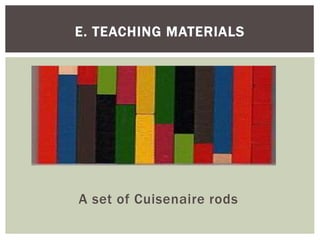
A set of Cuisenaire rods
E. TEACHING MATERIALS
The rods are used in a wide variety of
situations in the classroom. At the
beginning stages they can be used to
practice colors and numbers, and later they
can be used in more complex grammar. For
example, to teach prepositions the teacher
could use the statement "The blue rod is
between the green one and the yellow one".
They can also be used more abstractly,
perhaps to represent a clock or the floor
plan of a house.
 STUDENT INTERACT NOT ONLY WITH TEACHERS BUT
ALSO WITH EACH OTHERS
 STUDENT CORRECT THE ERRORS THEMSELVES AND
TEACHERS VIEW THESE ERROR AS THE RESPONSES
TO THE RESPONSES TO THE TEACHING AND GIVE
STUDENTS SOME HINTS AND HELP
 BECAUSE SILENT WAY TEACHERS SPEAK SO LITTLE,
THEY ARE FREE TO OBSERVE THEIR STUDENT
CAREFULLY AND BE AVAILABLE TO THEM.
F.ADVANTAGES
 Teacher must know their teaching objectives clearly
and make use of the teaching aids effectively.
 Student may be confused with the symbolsof the
colored wooden rods.
 Student waste too much time struggling with a
concept that would be easily clarified by the
teacher’s direct guide.
 It is difficult for teacher’s to evaluate student’s
progress in their learning process.
G.DISADVANTAGES
THANK YOU

The silent way

  • 1.
  • 2.
    The Silent Wayis a language-teaching method created by Caleb Gattegno that makes extensive use of silence as a teaching technique. It is not usually considered a mainstream method in language education. A. DEFINITION OF THE SILENT WAY
  • 3.
     Teaching andlearning activities in a silent way has the function to encourage student responses orally without direct instruction from the teacher.  Teachers simply pointing to a chart that contains the vocal consonant.  The teacher pointed out several times with silence.  teacher gives examples of pronunciation, and appoint students to memorize up correctly.  Cards and other objects can be used to elicit student responses. The teacher gave a response in the form of orders, inquiries, visual cues which are the basis of classroom activities. B. ACTIVITY
  • 4.
    1. The roleof the student  Students can develop a personality, autonomy and responsibility.  Students should be aware that the skills acquired them dependent on themselves, and should be aware that the use of language is useful to learn a new language.  Students should have better reasoning, which will help them to think way more active and creative, so that students can reapply teaching material that is given teacher.
  • 5.
    2. Role ofTeachers Stevick defining a silent teacher's task in the following way: To teach To test To get your way out.
  • 6.
    The following aresome principle of the Silent Way regarding to foreign language learning.  The work requires language learners to relate the linguistic signs to truth that they perceive with their sense  Language is not learned by repeating after a model Language learners need to develop their own “ inner criteria” for correctness  Meaning is made clear by focusing learners’ perceptions, not through translation.  Reading is worked on from the beginning but follows from what language learners already know. PRICIPLES OF SILENT WAY
  • 7.
    The procedures ofteaching speaking skill through Silent Way: Teacher prepares some symbols, rods, pictures or others. Teacher models the appropriate sound after pointing to a symbol, rod, picture etc on the chart or on the board. Teacher silently points to the individual symbols, rods, pictures or others and combinations of them, and monitor students’ utterances. C. THE IMPLEMENTATION OF SILENT WAY METHOD
  • 8.
     Teacher saysa word and has a student to guess what sequence (of symbols, pictures, rods etc) comprised the words.  The students repeat the words.  If there are some students saying the words incorrectly, the teacher points another student that can pronounce the word correctly, and points another student who cannot pronounce the word correctly.  If there are some students saying the word incorrectly, this activity can be done like step 6.
  • 9.
     Sound-color chart teacher's silence  peer correction  rods  self-correction gestures  word charts, structured feedback. D. TECHNIQUES
  • 10.
    A set ofCuisenaire rods E. TEACHING MATERIALS
  • 11.
    The rods areused in a wide variety of situations in the classroom. At the beginning stages they can be used to practice colors and numbers, and later they can be used in more complex grammar. For example, to teach prepositions the teacher could use the statement "The blue rod is between the green one and the yellow one". They can also be used more abstractly, perhaps to represent a clock or the floor plan of a house.
  • 12.
     STUDENT INTERACTNOT ONLY WITH TEACHERS BUT ALSO WITH EACH OTHERS  STUDENT CORRECT THE ERRORS THEMSELVES AND TEACHERS VIEW THESE ERROR AS THE RESPONSES TO THE RESPONSES TO THE TEACHING AND GIVE STUDENTS SOME HINTS AND HELP  BECAUSE SILENT WAY TEACHERS SPEAK SO LITTLE, THEY ARE FREE TO OBSERVE THEIR STUDENT CAREFULLY AND BE AVAILABLE TO THEM. F.ADVANTAGES
  • 13.
     Teacher mustknow their teaching objectives clearly and make use of the teaching aids effectively.  Student may be confused with the symbolsof the colored wooden rods.  Student waste too much time struggling with a concept that would be easily clarified by the teacher’s direct guide.  It is difficult for teacher’s to evaluate student’s progress in their learning process. G.DISADVANTAGES
  • 14.