

A2 Physical Education Long Term Psychological Preparation
Learning Outcomes Appreciate the value of long-term psychological planning and interventions Develop applied knowledge and understanding of how to use goal setting over time Experience an applied methodology in performance profiling Understand the concept of motivation and how to explain sports performance through attribution theory Learn how to develop a performance psychologically through modern psychological trends Develop an appreciation of the importance of the group in a successful performance, and how to build cohesion.
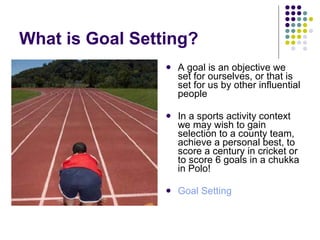
What is Goal Setting? A goal is an objective we set for ourselves, or that is set for us by other influential people In a sports activity context we may wish to gain selection to a county team, achieve a personal best, to score a century in cricket or to score 6 goals in a chukka in Polo! Goal Setting
Why is Goal Setting important? Motivates the performer Enables the performer become more organised and efficient Allows the performer to plan training and performance programmes Provides performers with a structured pathway of development by focusing attention on key elements of performance Helps reduce anxiety and control arousal Builds self-confidence and increases effectiveness
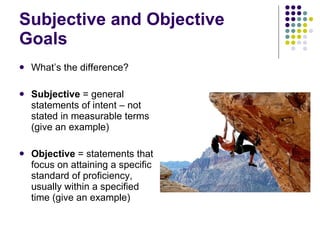
Subjective and Objective Goals What’s the difference? Subjective  = general statements of intent – not stated in measurable terms (give an example) Objective  = statements that focus on attaining a specific standard of proficiency, usually within a specified time (give an example)
Types of Goal Using the book (p104) make notes on the following: Outcome goals Performance goals Process goals Short-term goals Long-term goals (Adapted from Atherton 2003)
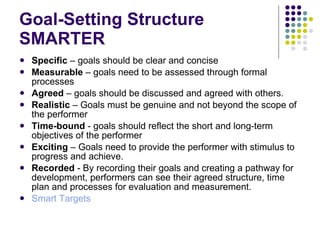
Goal-Setting Structure  SMARTER Specific  – goals should be clear and concise Measurable  – goals need to be assessed through formal processes Agreed  – goals should be discussed and agreed with others. Realistic  – Goals must be genuine and not beyond the scope of the performer Time-bound  - goals should reflect the short and long-term objectives of the performer Exciting  – Goals need to provide the performer with stimulus to progress and achieve. Recorded  - By recording their goals and creating a pathway for development, performers can see their agreed structure, time plan and processes for evaluation and measurement.  Smart Targets
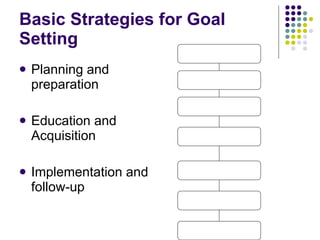
Basic Strategies for Goal Setting Planning and preparation  Education and Acquisition Implementation and follow-up Plan and set your goals (short and long-term) Never be afraid to amend your short term goals Never lose sight of the long term goal Put into place strategies you know are realistic Evaluate regularly and reward success Seek help of a tutor/coach and agree on goals Have a PLAN B at hand should things not go according to plan
Factors Affecting Successful Goal Setting Unrealistic Goals Too many goals – conflict Goals are beyond your control Inappropriate time frame No flexibility Inadequate review process Outcome goals overtake performance goals
Performance Profiling To identify areas that require psychological interventions Identify your  psychological skills training  (the systematic and consistent practice of mental and psychological skills) To aid your motivation and adherence to the programme To allow you to compare with and copy successful/elite performers
Underdogs Underdogs2 Why do underdogs succeed?? Many people have ‘bad games’ or ‘lose concentration’ or ‘freeze’ in a competitive situation – Why? Yet many don’t seek psychological solutions Mental Imagery, channel anxiety, positive arousal, motivation, self-belief, mental rehearsal, self talk, goal setting, muscle relaxation etc can all be trained to help performance Bend it like Beckham!!
Complete the motivation tasks.
Motivation Define the term Motivation. Using the text book summarise the following terms: Intrinsic Motivation Extrinsic Motivation Achievement Motivation (Murray and Gill) Nach Naf
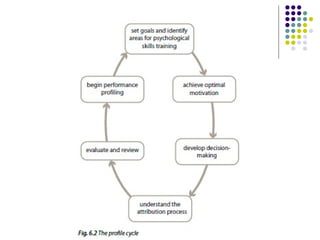
A Psychological Skills Training Programme Stage 1 – Introduction – learn the importance of the programme and conduct an honest appraisal Stage 2 – Construction- Construct a performance profile and undertake a series of strategies to enhance your desired goals profile goals Stage 3 – Implementation – make the psychological skills training programme a daily routine Stage 4 – Assessment – review and reconstruct your profile On winning the 2003 Rugby World Cup, Clive Woodward undertook an immediate performance analysis including psychological aspects – Why?
 
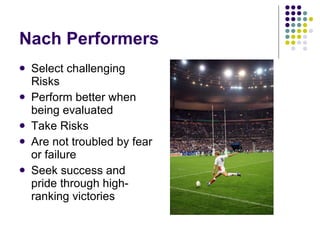
Nach Performers Select challenging Risks Perform better when being evaluated Take Risks Are not troubled by fear or failure Seek success and pride through high-ranking victories
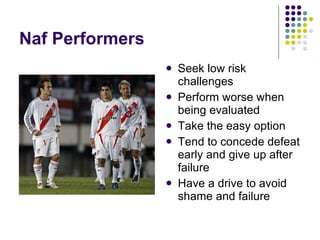
Naf Performers Seek low risk challenges Perform worse when being evaluated Take the easy option Tend to concede defeat early and give up after failure Have a drive to avoid shame and failure
Legend Legendary – look at his face!
Situational Factors Probability of success (Ps) versus the probability of failure Incentive value of success (Is) versus incentive of failure (If) By beating a higher-ranked opponent in tennis you have matched the probability of success to incentive value of winning – by accepting the challenge and being successful, you will have achieved a more valued victory.
Explain how achievement motivation, sport psychology and coaching are important aspects of successful sport.
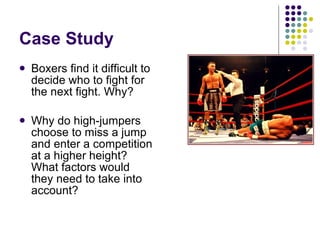
Case Study Boxers find it difficult to decide who to fight for the next fight. Why? Why do high-jumpers choose to miss a jump and enter a competition at a higher height? What factors would they need to take into account?
Attribution Theory Look at the following scenarios and write down what reasons you would give after the event as to why you won or lost: You have been training all winter for the opening athletics meeting of the season. The previous year you had been the regional champion and you were confident that you were going to be champion again this season, even though you had gone up an age group. On this occasion you came third. Your team has won every game in the league and is now in the cup final against your closest rival. You are playing the match at the rival’s home ground, but you win. http://www.youtube.com/watch?v=TVUZCpDlaWQ&feature=related http://www.youtube.com/watch?v=-UmuHna-mNs
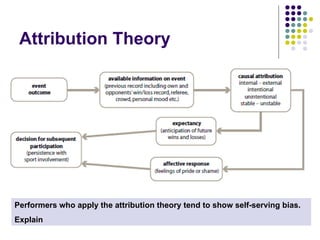
Attribution Theory An approach that attempts to categorise the reasons we give for winning and losing – attribution refers to the perceived causes of events and behaviour What questions could we ask as to why a performance occurred the way it did?
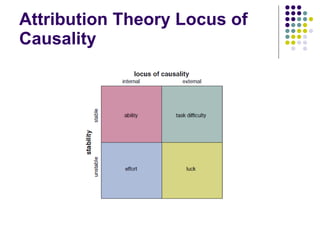
Remember The four attributions, or reasons why we may or may not have been successful in a performance are: Ability – my level of skill, ability and technique Effort – how hard I work Luck – circumstances and incidents beyond prediction Task Difficulty – a measure of the task ahead
Attribution Theory Locus of Causality
Attribution Theory Performers who apply the attribution theory tend to show self-serving bias. Explain
Learned Helplessness Is when an athlete perceives defeat is inevitable and as a result of stable, internal and uncontrollable events. Based on past experiences Need attribution retraining Low confidence levels Poor self-esteem Naf
Alternatively performers high in achievement, Nach, display mastery orientation Confident In control of their own destiny Expect success Overcome failure
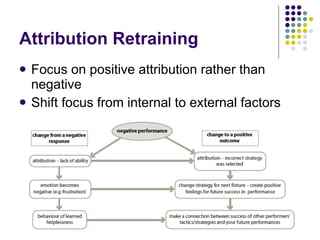
Attribution Retraining Focus on positive attribution rather than negative Shift focus from internal to external factors
How can you/your coach positively effect the locus of causality? Change tactics Blame equipment Use a positive approach to failure Focus on the perfect model and copy Avoid citing lack of ability as cause of failure Make reasons for losing less personal

Long Term Psychological Preparation

  • 1.
    A2 Physical EducationLong Term Psychological Preparation
  • 2.
    Learning Outcomes Appreciatethe value of long-term psychological planning and interventions Develop applied knowledge and understanding of how to use goal setting over time Experience an applied methodology in performance profiling Understand the concept of motivation and how to explain sports performance through attribution theory Learn how to develop a performance psychologically through modern psychological trends Develop an appreciation of the importance of the group in a successful performance, and how to build cohesion.
  • 3.
    What is GoalSetting? A goal is an objective we set for ourselves, or that is set for us by other influential people In a sports activity context we may wish to gain selection to a county team, achieve a personal best, to score a century in cricket or to score 6 goals in a chukka in Polo! Goal Setting
  • 4.
    Why is GoalSetting important? Motivates the performer Enables the performer become more organised and efficient Allows the performer to plan training and performance programmes Provides performers with a structured pathway of development by focusing attention on key elements of performance Helps reduce anxiety and control arousal Builds self-confidence and increases effectiveness
  • 5.
    Subjective and ObjectiveGoals What’s the difference? Subjective = general statements of intent – not stated in measurable terms (give an example) Objective = statements that focus on attaining a specific standard of proficiency, usually within a specified time (give an example)
  • 6.
    Types of GoalUsing the book (p104) make notes on the following: Outcome goals Performance goals Process goals Short-term goals Long-term goals (Adapted from Atherton 2003)
  • 7.
    Goal-Setting Structure SMARTER Specific – goals should be clear and concise Measurable – goals need to be assessed through formal processes Agreed – goals should be discussed and agreed with others. Realistic – Goals must be genuine and not beyond the scope of the performer Time-bound - goals should reflect the short and long-term objectives of the performer Exciting – Goals need to provide the performer with stimulus to progress and achieve. Recorded - By recording their goals and creating a pathway for development, performers can see their agreed structure, time plan and processes for evaluation and measurement. Smart Targets
  • 8.
    Basic Strategies forGoal Setting Planning and preparation Education and Acquisition Implementation and follow-up Plan and set your goals (short and long-term) Never be afraid to amend your short term goals Never lose sight of the long term goal Put into place strategies you know are realistic Evaluate regularly and reward success Seek help of a tutor/coach and agree on goals Have a PLAN B at hand should things not go according to plan
  • 9.
    Factors Affecting SuccessfulGoal Setting Unrealistic Goals Too many goals – conflict Goals are beyond your control Inappropriate time frame No flexibility Inadequate review process Outcome goals overtake performance goals
  • 10.
    Performance Profiling Toidentify areas that require psychological interventions Identify your psychological skills training (the systematic and consistent practice of mental and psychological skills) To aid your motivation and adherence to the programme To allow you to compare with and copy successful/elite performers
  • 11.
    Underdogs Underdogs2 Whydo underdogs succeed?? Many people have ‘bad games’ or ‘lose concentration’ or ‘freeze’ in a competitive situation – Why? Yet many don’t seek psychological solutions Mental Imagery, channel anxiety, positive arousal, motivation, self-belief, mental rehearsal, self talk, goal setting, muscle relaxation etc can all be trained to help performance Bend it like Beckham!!
  • 12.
  • 13.
    Motivation Define theterm Motivation. Using the text book summarise the following terms: Intrinsic Motivation Extrinsic Motivation Achievement Motivation (Murray and Gill) Nach Naf
  • 14.
    A Psychological SkillsTraining Programme Stage 1 – Introduction – learn the importance of the programme and conduct an honest appraisal Stage 2 – Construction- Construct a performance profile and undertake a series of strategies to enhance your desired goals profile goals Stage 3 – Implementation – make the psychological skills training programme a daily routine Stage 4 – Assessment – review and reconstruct your profile On winning the 2003 Rugby World Cup, Clive Woodward undertook an immediate performance analysis including psychological aspects – Why?
  • 15.
  • 16.
    Nach Performers Selectchallenging Risks Perform better when being evaluated Take Risks Are not troubled by fear or failure Seek success and pride through high-ranking victories
  • 17.
    Naf Performers Seeklow risk challenges Perform worse when being evaluated Take the easy option Tend to concede defeat early and give up after failure Have a drive to avoid shame and failure
  • 18.
    Legend Legendary –look at his face!
  • 19.
    Situational Factors Probabilityof success (Ps) versus the probability of failure Incentive value of success (Is) versus incentive of failure (If) By beating a higher-ranked opponent in tennis you have matched the probability of success to incentive value of winning – by accepting the challenge and being successful, you will have achieved a more valued victory.
  • 20.
    Explain how achievementmotivation, sport psychology and coaching are important aspects of successful sport.
  • 21.
    Case Study Boxersfind it difficult to decide who to fight for the next fight. Why? Why do high-jumpers choose to miss a jump and enter a competition at a higher height? What factors would they need to take into account?
  • 22.
    Attribution Theory Lookat the following scenarios and write down what reasons you would give after the event as to why you won or lost: You have been training all winter for the opening athletics meeting of the season. The previous year you had been the regional champion and you were confident that you were going to be champion again this season, even though you had gone up an age group. On this occasion you came third. Your team has won every game in the league and is now in the cup final against your closest rival. You are playing the match at the rival’s home ground, but you win. http://www.youtube.com/watch?v=TVUZCpDlaWQ&feature=related http://www.youtube.com/watch?v=-UmuHna-mNs
  • 23.
    Attribution Theory Anapproach that attempts to categorise the reasons we give for winning and losing – attribution refers to the perceived causes of events and behaviour What questions could we ask as to why a performance occurred the way it did?
  • 24.
    Remember The fourattributions, or reasons why we may or may not have been successful in a performance are: Ability – my level of skill, ability and technique Effort – how hard I work Luck – circumstances and incidents beyond prediction Task Difficulty – a measure of the task ahead
  • 25.
  • 26.
    Attribution Theory Performerswho apply the attribution theory tend to show self-serving bias. Explain
  • 27.
    Learned Helplessness Iswhen an athlete perceives defeat is inevitable and as a result of stable, internal and uncontrollable events. Based on past experiences Need attribution retraining Low confidence levels Poor self-esteem Naf
  • 28.
    Alternatively performers highin achievement, Nach, display mastery orientation Confident In control of their own destiny Expect success Overcome failure
  • 29.
    Attribution Retraining Focuson positive attribution rather than negative Shift focus from internal to external factors
  • 30.
    How can you/yourcoach positively effect the locus of causality? Change tactics Blame equipment Use a positive approach to failure Focus on the perfect model and copy Avoid citing lack of ability as cause of failure Make reasons for losing less personal